
The Number That Changed the Story
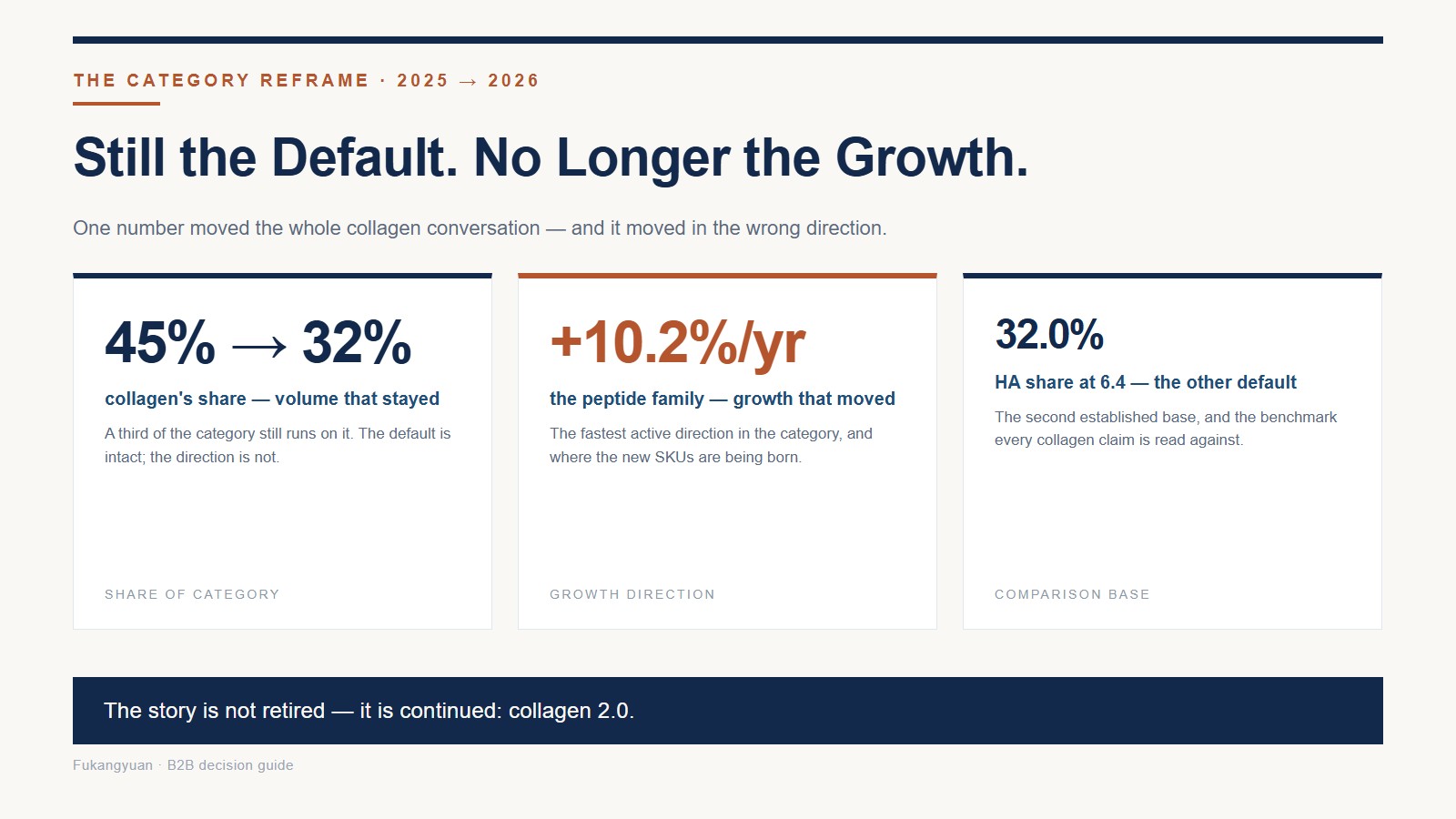
The collagen conversation in skincare changed direction this year — and the change is in one number: collagen is still the category's default, and it is no longer the category's growth. For a brand that built its range on collagen, the question is not whether the story is over. It is how the story continues.
The read comes from commercial category research, captured in full text and graded as secondary compilation — the structure read, not a share verdict. Five data points, one direction:
| Data point | Value | Source |
|---|---|---|
| The category's default | Collagen 32.0 percent share of the category, still first | Dataintelo Hyaluronic Acid & Collagen in Cosmetics, 2026-10-01 full text |
| The growth leader | Peptide family 10.2 percent per year — the fastest active direction; hyaluronic acid 32.0 percent share at 6.4 percent | same |
| Collagen's pace | Collagen 14.4 percent share of the active mix at 3.9 percent per year — below the 7.4 percent average | Grand View Research collagen market summary, 2026-10-08 |
| The trajectory | Collagen fell from 45 percent to 32 percent share — growth ran ahead of it; the peptide family gained while collagen lost | Dataintelo, same capture |
| The market signal | In the US, the 4 collagen skincare categories outgrew the 2 other collagen product families — the collagen story is being told in skincare, and it is growing there | Dataintelo, same capture |
Source: Dataintelo hyaluronic-acid & collagen in cosmetics research (updated 2026-10-01) and Grand View Research collagen market summary, both captured in full text; figures as published, secondary commercial compilation. Where the two publishers define the category differently, the scope travels with the citation.
What the Market Is Actually Doing
The category is not leaving collagen — it is adding a second sentence to the story. Three readings from the same data:
Volume stays, growth moves
A third of the category still runs on collagen — the base formula, the proven story, the reason the line exists. The growth is in the family around it: the peptide direction at 10.2 percent per year is where the new SKUs are being born.
The market re-frames, it does not retire
The sharpest signal is a German B2B sourcing thread in which a buyer asks for collagen "backed by studies" in the new formulation language — the collagen story is not being cut, it is being continued. The industry's own name for the continuation: collagen 2.0.
The pairing is the product
The formulas selling the continuation are pairs: collagen as the proven base, a peptide as the growth sentence — a copper peptide, a tripeptide, a salmon-DNA active. The pair is the SKU; either half alone is the old story or an orphan.
The Three-Tier Build: Base, Pair, Derived
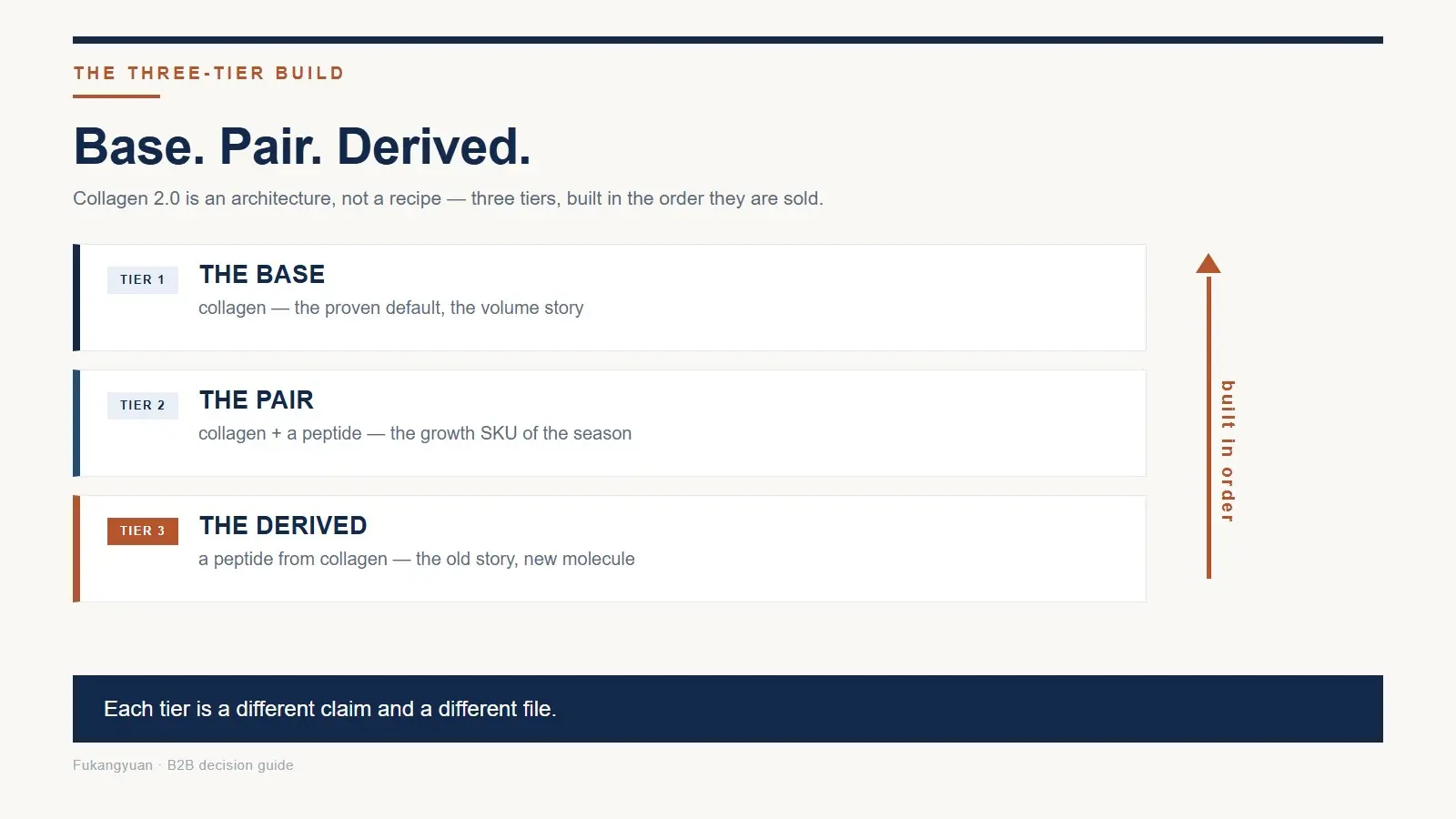
Collagen 2.0 is not a formula — it is an architecture. Three tiers, in the order they should be built, each one a different claim and a different file.
Tier 1 — the collagen base
The proven formula, the volume story. Collagen carries the category's default — 32.0 percent of it — and the base tier exists to protect that default while the growth tiers are built. The claim stays what it has always been: the proven one, with the file that matches.
Tier 2 — the peptide pair
Collagen base plus the growth sentence: a copper peptide, a tripeptide, the active the market is rewarding. The pair is where the new SKU lives — the growth direction is the peptide, the trust is the collagen, and the claim file names both halves. Where the active is PDRN rather than a peptide, the formula file carries its own weight: see how PDRN works in OEM formulas.
Tier 3 — the collagen-derived peptide
The upgrade path the data points at: a peptide derived from collagen — the collagen story in peptide form. This is the tier where the old story and the new one become the same molecule, and it is the one buyers will ask about next season.
The Claim File: Keeping the Collagen Story Defensible
The collagen category runs on claims, and the claims run on files. The guardrails, as they apply to a collagen 2.0 line:
The words that need the file
The vocabulary the category is tempted by — collagen synthesis, wrinkle treatment — is the vocabulary that must be backed or avoided, per market. The US-bound line carries the appearance language and the evidence, not the drug-suggestion words: the claim boundary built before the label is printed is the same discipline the eye-patch line runs.
Substantiation is a deliverable, not an ad-lib
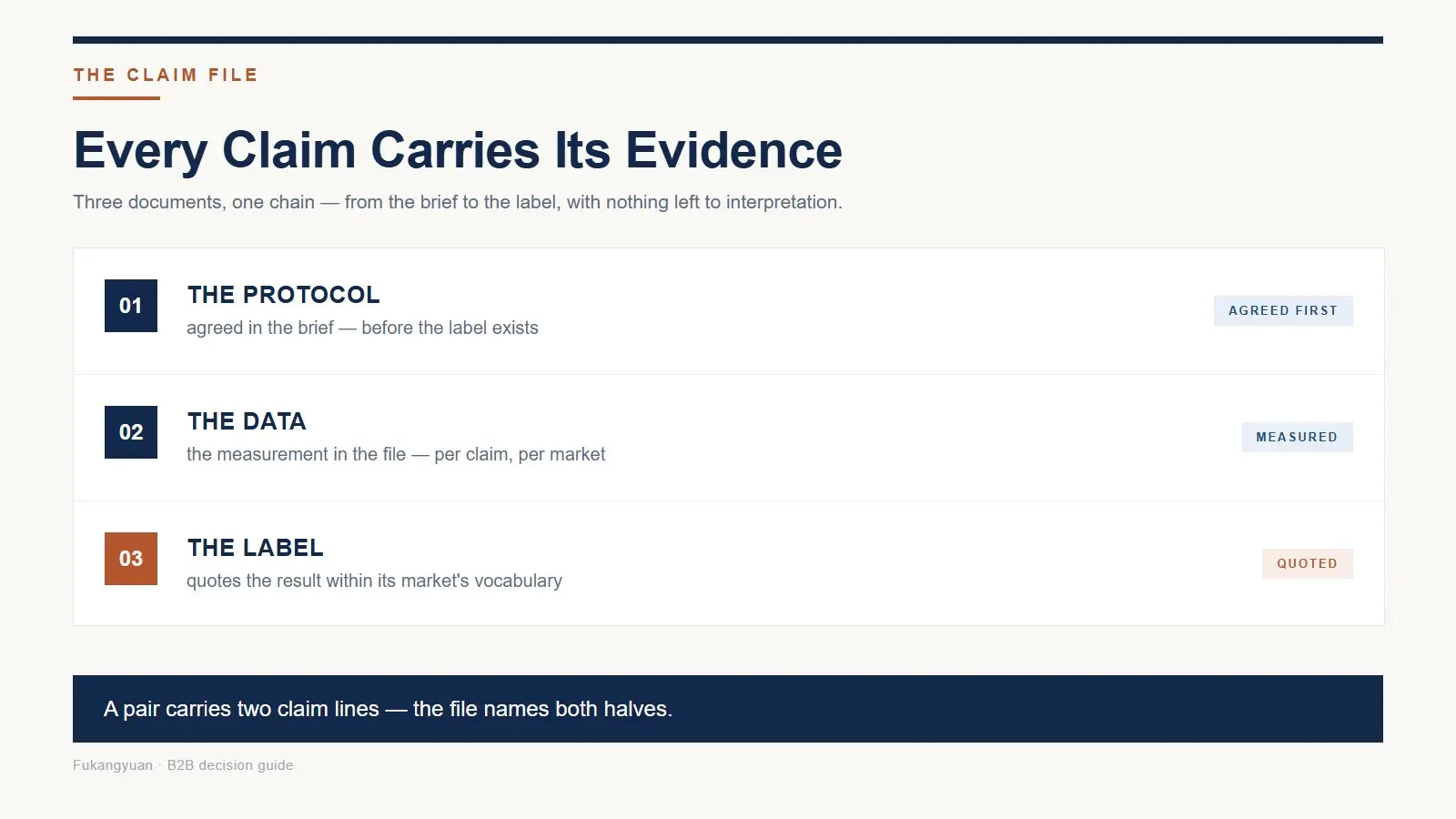
Every collagen claim in the label has a measurement behind it — the protocol agreed in the brief, the data in the file, the label quoting the result. The file is built per market: the EU runs its own rulebook — the compliance file for a market-bound order.
The pair names both halves
A peptide-pair formula carries two claim lines — the collagen's and the peptide's. The file names each half, each measurement, each market's vocabulary for it. One file, two stories, no gaps between them.
B2B Sourcing & Procurement Parameters
Specific values finalized during official quotation.
Where to Point the First Collagen 2.0 SKU
The architecture is built in order — the tiers are a sequence, not a menu. Three targeting calls: the anatomy of an OEM quote and its seven levers
Protect the base first
The collagen base is the line's existing volume — the Tier 1 file is refreshed, not rebuilt, before any growth SKU ships. The default that carries a third of the category is the asset the growth tiers are paid for.
Pick the pair the market is already asking for
The copper-peptide and tripeptide pairs are the growth language of the current season — the hero SKU is the pair, not the base, and the base is the trust underneath it. A tripeptide specification sheet is the working document for that brief.
Watch the derived tier
The collagen-derived peptide is the direction the data points at for next season — named in the roadmap, quoted as its own line when the brief arrives, without the capacity promise that the evaluation has not finished.
Frequently Asked Questions
Is collagen still worth building a line on?
Yes — with the growth tier on top of it. Collagen carries 32.0 percent of the category's active mix: the volume is the default the line is built on. What changed is the growth — the peptide direction at 10.2 percent per year is where the new SKUs are born, and the collagen 2.0 build puts the two in the same family.
What exactly is a "collagen 2.0" formula?
An architecture, not a recipe: the collagen base that carries the proven story, a peptide pair that carries the growth sentence, and — the upgrade path — the collagen-derived peptide where the old story and the new one become the same molecule. The tiers are built in order, each with its own claim file.
What is GHK-Cu and why does it lead the peptide direction?
A copper peptide — the fastest-growing named active in the peptide family. It is the first pair the collagen base meets, because the market's growth language is already written around it. Its claim runs on the same discipline as the rest of the line: the substantiation in the file, the vocabulary per market.
What does the claim file need for a collagen line?
Each claim, per market, with its measurement: the protocol agreed in the brief, the data in the file, the label quoting the result within its market's vocabulary. A peptide-pair formula carries two claim lines — the collagen's and the peptide's — and the file names both halves.
Are collagen-derived peptides an upgrade path?
They are the tier the data points at: a peptide derived from collagen — the collagen story in peptide form. Capacity for the derived tier is an evaluation decision per brief — the quote states what the line runs today and what it is being built for.
Which tier should a first collagen 2.0 SKU start at?
At the pair. The base is the line's existing default — refreshed, not rebuilt; the pair is the SKU the market is already asking for; the derived tier is the next-season direction. The sequence is the strategy, and the small-batch tier structure is how the first run is priced.(接内链③)
Send Your Collagen Brief — Get the 2.0 Build Plan & Claim File
Submit your technical formulation specifications or product requirements. A dedicated product manager on every RFQ — reply within 24 hours.