What "Halal" Actually Means for a Skincare Formula
In skincare, "halal" is used as a label, a marketing angle and a market-access document — sometimes all three at once. For a buyer, the question is not whether the word appears on the packaging but what it obliges: which inputs are excluded, which process rules apply, and which paper has to exist behind the claim. Define that first, and every later conversation — formula, documentation, certificate — becomes legible.
The ingredient test
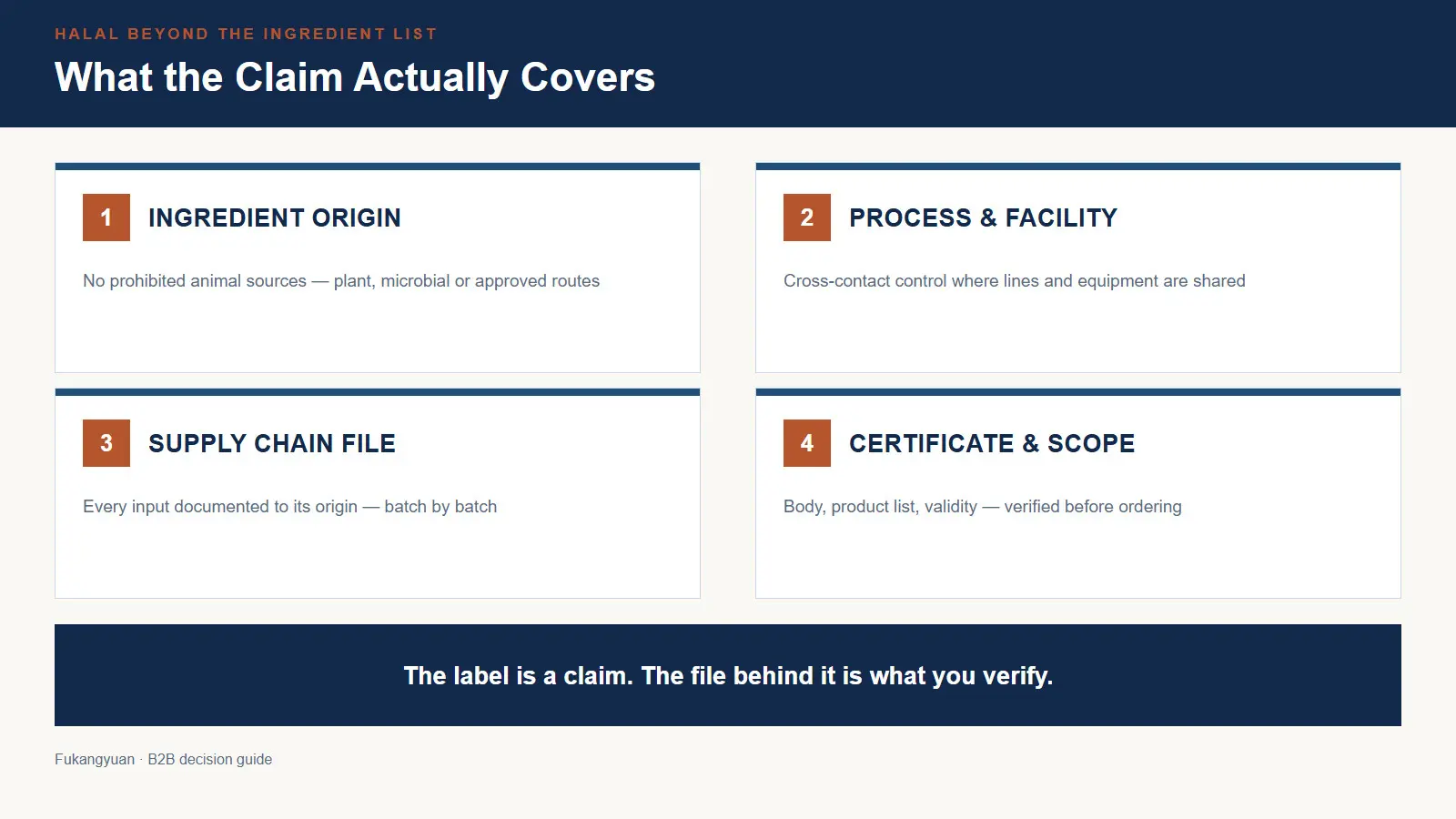
No prohibited animal-derived inputs. Glycerin, fatty acids, gellants and emollients must come from plant, microbial or otherwise acceptable routes — the formula is checked input by input, not by category.
The process test
Where a facility runs both compliant and non-compliant products, cross-contact control matters: equipment, lines, water and cleaning protocols. A compliant formula in a non-compliant process is a claim the file cannot support.
The paper trail
The distinction buyers miss most: "halal-compliant" is a formulation decision — the factory can build it from day one. "Halal-certified" is an audit outcome — an authorized body has issued a scope-limited certificate. Same word family, different deliverables, different timelines.
Which Markets Set the Bar
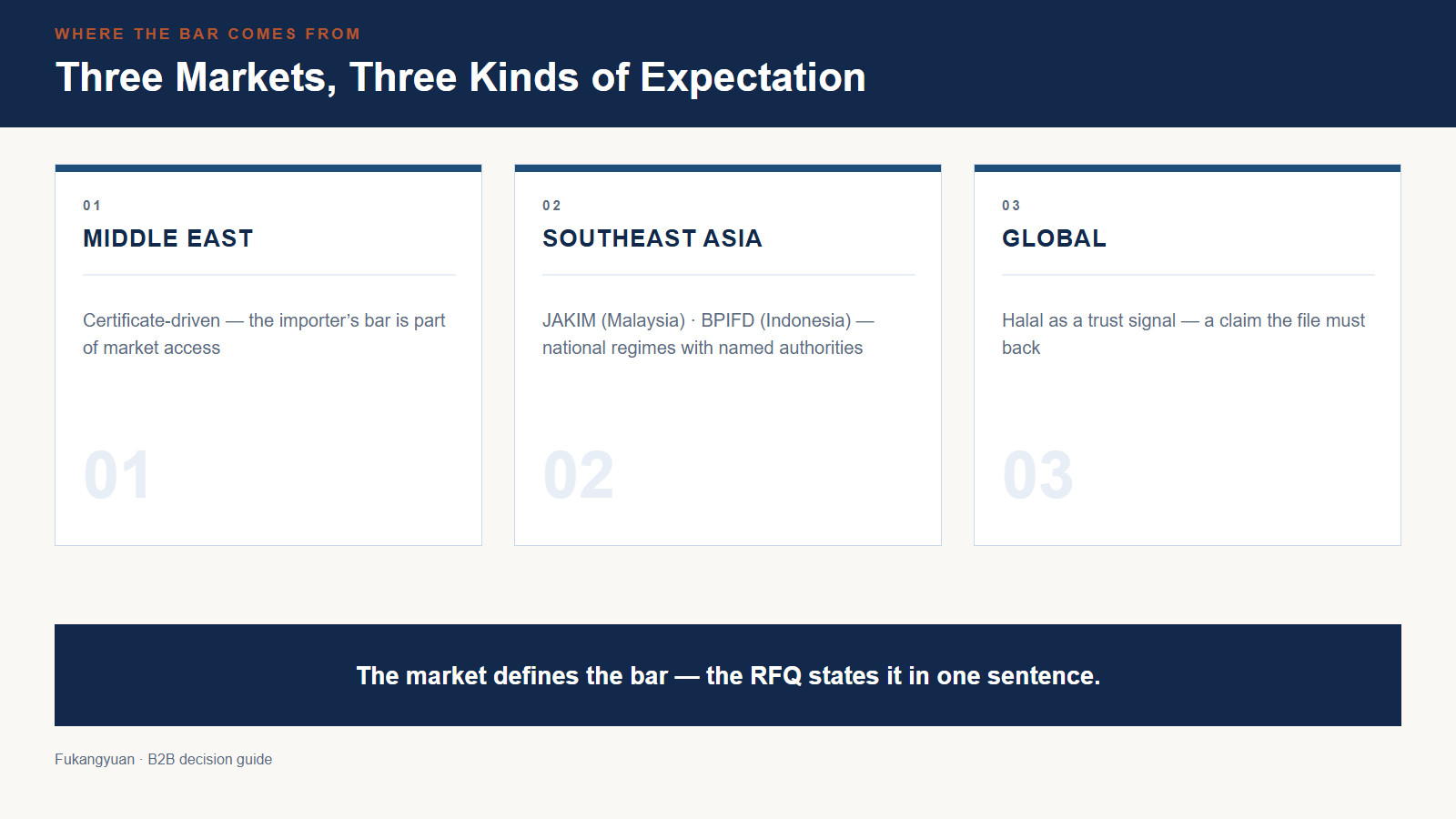
The bar is not global. It is set by the destination: the national authority, the retailer and the importer of the market you are selling into. The table below is the short version — the RFQ states the market, and the documentation plan is built to that market's bar.
| Market | Who sets the bar | What to confirm in the RFQ |
|---|---|---|
| Saudi Arabia | National regulator + importer & retailer requirements | The documentation file the importer expects at clearance |
| Gulf states (UAE, Qatar, Kuwait) | Regional standards + retailer-level requirements | Whether the retailer asks for a certificate at listing |
| Malaysia | JAKIM — the national halal authority | Certification scope: product-level or facility-level |
| Indonesia | BPIFD with MUI | Certification scope: product-level or facility-level |
| Non-Muslim markets | The brand's own positioning | A compliant formula as a claim the file must back |
Requirements move — regulators update and retailers tighten. The factory's job is to state which file it can build; the buyer's job is to confirm the current bar with the importer or the authority before the first batch.
What Changes in the Formula
Most of the change is substitution, not reinvention — for the functions in question, the compliant route usually already exists. The table is the mechanism: which input classes move, and in which direction.
| Input class | Conventional option | Compliant direction |
|---|---|---|
| Emollients | Lanolin and waxes from wool | Vegetable-ester emollients |
| Gelling & films | Gelatin-based films and gellants | Cellulose and plant-gum systems |
| Glycerin & fatty acids | Animal-tallow routes | Plant- or microbially-derived routes |
| Enzymes | Animal-organ enzymes | Microbial or plant enzymes |
| Alcohol | Ethanol-based steps | The target body's rules decide — confirm before locking the formula |
One class deserves a separate line: actives with marine origins. PDRN, derived from salmon DNA, is judged case by case against the target body's treatment of marine-derived ingredients — see how PDRN works in OEM formulas before the formula is locked.
Writing the RFQ: Four Points for a Halal Order
Four points decide whether the documentation plan is built into the quote — or negotiated after it.
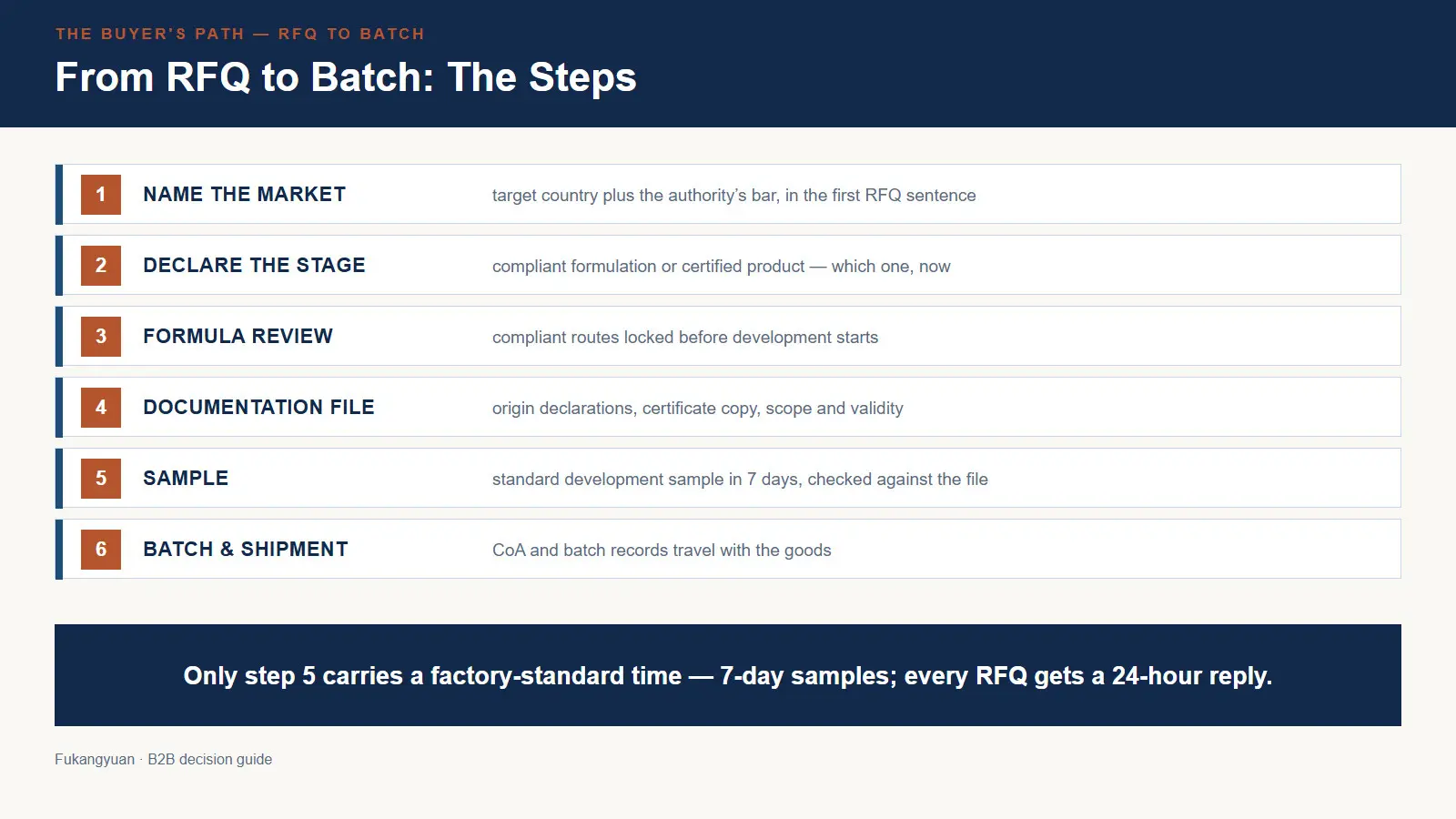
State the target market and its authority
Saudi clearance, a JAKIM-scope certificate and a private-label trust claim are three different documentation plans. One sentence in the RFQ — market plus authority — selects which one the factory builds.
Declare the stage: compliant or certified
If you need a compliant formulation now, say so; if you need a certificate at a defined stage, say which one and against which body's scope. An undeclared stage is how a quote covers the wrong file.
List the documents the goods must carry
Ingredient origin declarations, a certificate copy with scope and validity, and a CoA per batch — stated in the RFQ, so the file is built into the order instead of negotiated after it.
Keep the commercial terms standard
MOQ, incoterms and sampling follow the usual quote structure — the compliance work adds a documentation line, not a separate pricing system. Read the anatomy of an OEM quote and its seven levers.
B2B Sourcing & Procurement Parameters
Standard terms of engagement. The facility parameters do not change with the market — these do.
MOQ Policy
from 1,000 pcs — flexible by formulation & packaging
Sample Policy
7 days — R&D lab prototyping for quality, stability & sensory
Shipping & Incoterms
FOB · CIF · EXW — Shanghai & Guangzhou
Production Lead Time
fast-track with pre-approved stock packaging
Specific values finalized during official quotation.
How to Verify a Halal Claim Before You Order
Verification is where claims become decisions. A certificate is one page of the file; the discipline is checking that the page is real, in scope and current — and that the batch-level documents travel with the goods. The facility credentials underneath: FDA Registered Facility · GMPC Certified · ISO 22716 · Class 100,000 Cleanroom (20,000+ m² factory · 15+ years biotech R&D). Start with the factory landscape for choosing who to shortlist.
Copy, scope, body, validity
Request the certificate in full: which products it lists, which body issued it, and when it lapses. A scope that does not name your SKU is not a certificate for your SKU.
Confirm with the issuing body
Authorized bodies keep registries or answer verification inquiries — the buyer-side check that takes an afternoon, not a quarter.
Check the facility, not just the file
Where compliant and non-compliant lines share a roof, the audit question is cross-contact control — the 12-point checklist for verifying whichever factory you quote.
Make the batch documents travel with the goods
A CoA plus batch records on every shipment — the per-batch proof that the shelf product is the formula on the certificate.
Frequently Asked Questions
Direct answers on scope, markets, verification and sequence — the six questions a halal RFQ gets asked.
Is "halal-compliant" the same as "halal-certified"?
No. Compliant means the formula avoids prohibited inputs — a formulation decision the factory makes from day one. Certified means an authorized body has audited and issued a scope-limited certificate — a paperwork and audit process. State which one your market needs in the RFQ.
Do Middle East markets require halal certification for cosmetics?
Expectations differ by country, by retailer and by category — in some markets the certificate behaves like a market-access document, in others like a trust signal. The RFQ names the target market so the documentation plan is built to that bar, not a generic one.
Can one formula serve halal and non-halal markets?
Often yes — when the compliant version is the master formula and the market-specific file is paper, not chemistry. Where a non-compliant input is load-bearing, the factory plans a parallel line or a dedicated batch.
How do I verify the certificate a factory shows me?
Certificate copy with scope, body and validity — then confirm it with the issuing body, and check that the product list covers your SKUs. The certificate is one page of the file; the batch-level documents — CoA, ingredient origin — are what travel with the goods.
Does halal compliance change the MOQ or the quote structure?
The commercial structure — MOQ, incoterms, sampling — follows the standard quote: the anatomy of an OEM quote and its seven levers. What compliance adds is a documentation line: origin declarations, certificates and batch records.
Can I start compliant and add certification later?
Yes — that is the common sequence: compliant formulation first, certificate second, timed to when the target market or a retailer actually asks for it. The same file logic applies to regulated imports generally — see how a complete import documentation file is built.
Tell Us Your Target Market — Get a Compliant Sample Plan
Submit your technical formulation specifications or product requirements. A dedicated product manager on every RFQ — reply within 24 hours.