Why Factory Verification Is the Cheapest Risk You Can Remove
The quality problems buyers fear — failed stability, label rejections, missed lead times — almost never originate in the container. They originate in attributes the factory had, or didn't have, before the first sample. A twelve-point audit is how you check those attributes for the price of a document request.
The certificate is not the factory
Certificates get copied, scopes get misread, and facilities get left out of scope. Verifying the certificate, the scope and the surveillance report behind it is a different exercise — and the only one that predicts quality.
The questions that predict failures
Every recurring complaint in mask and skincare sourcing traces back to a checkable factory attribute: cleanroom grade, batch documentation, MOQ structure, stability capability. The audit list below is built around those attributes, not around brochure items.
Remote-first, on-site-second
Most of the checklist closes with documents and a live video walk-through before any travel. An on-site or third-party audit earns its cost when the order size does.
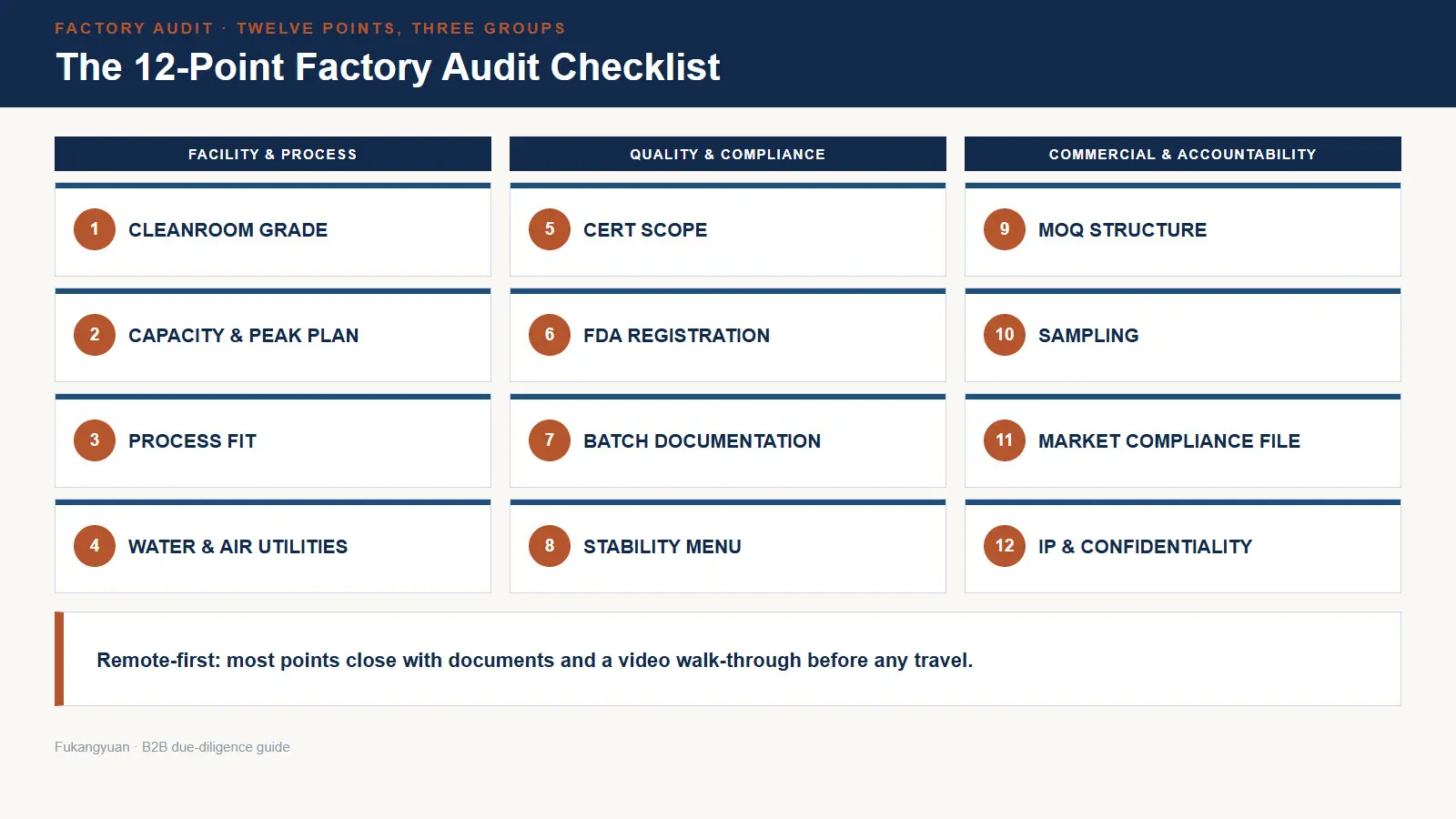
The 12-Point Factory Audit Checklist
Twelve points in three groups. For each: what to ask, and what a strong answer looks like.
Facility & process (points 1–4)
1. Cleanroom grade
Class 100,000 is the working standard for filling. Ask for the grade in writing, how it is monitored, and which lines run inside it.
2. Capacity & peak plan
Lines, shift pattern and the peak-season plan. A factory that can't tell you its capacity curve can't guarantee your lead time.
3. Process fit for your format
Masks, serums and creams run different lines. Ask which process your format uses — vacuum homogenization for a serum is not an interchangeable detail.
4. Water & air utilities
Ultra-pure water and, where the formula needs it, inert-atmosphere filling. Ask what the utility specification is, not just that it exists.
Quality & compliance (points 5–8)
5. Certification scope
GMPC and ISO 22716: which products and sites are in scope, and when the latest surveillance audit ran. A certificate without a scope and a date is a photo, not evidence.
6. FDA registration
What it is and, just as important, what it is not. (what “FDA-registered” actually covers on the import side)
7. Batch documentation
A sample batch certificate of analysis, retention samples and traceability from raw material to carton. If they can't show one, don't take their word for the next ten.
8. Stability & testing menu
Which instrumental tests are in-house and which are outsourced — hydration, TEWL, elasticity. The menu is the factory's real R&D depth.
Commercial & accountability (points 9–12)
9. MOQ structure
Bulk and filling minimums stated separately. (the anatomy of an OEM quote and its seven levers)
10. Sampling discipline
Charge, scope and the standard time — development samples in 7 days, for quality, stability and sensory, before you commit.
11. Market compliance file
Which target markets the export file covers and what each adds. (the supplier-selection side of MoCRA compliance)
12. IP & confidentiality
Formula ownership, permitted-use terms for test data, confidentiality. One of the seven specification fields that belong in any RFQ — (the seven specification fields any RFQ must carry)
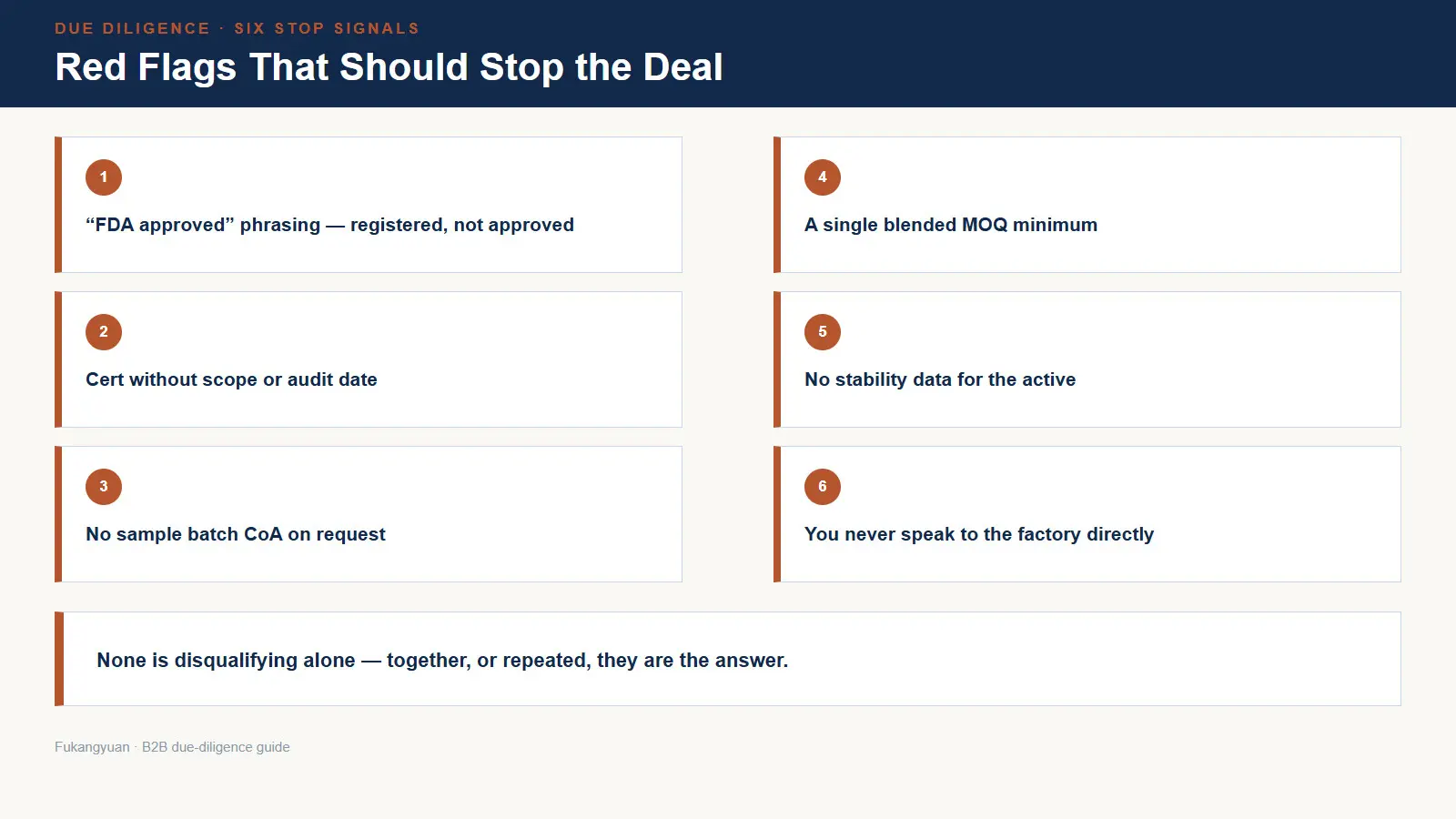
Red Flags That Should Stop the Deal
None of these is disqualifying in isolation. Together, or repeated, they are the answer.
1. “FDA approved” phrasing
Facilities are registered, products are not approved — a factory that markets it otherwise has already mis-told you one compliance fact.
2. A certificate without scope or audit date
You cannot verify what you cannot see the boundary of.
3. No sample batch CoA on request
Documentation discipline is a production attribute, not a favor.
4. A single blended MOQ minimum
The split between bulk and filling minimums is where the real floor lives.
5. No stability data for the active you're buying
If the retention at end of shelf life is unknown, the claim is unknown too.
6. You never speak to the factory directly
A quote that only arrives through a middleman is an audit you will never be able to run.
B2B Sourcing & Procurement Parameters
Engineered for high-efficacy beauty brands seeking certified compliance, reliable lead times, and flexible batch production.
MOQ Policy
from 1,000 pcs — flexible by formulation & packaging
Sample Policy
7 days — R&D lab prototyping for quality, stability & sensory
Shipping & Incoterms
FOB · CIF · EXW — Shanghai & Guangzhou
Production Lead Time
fast-track with pre-approved stock packaging
Specific values finalized during official quotation.
REPLY WITHIN 24 HOURS — a dedicated product manager on every RFQ
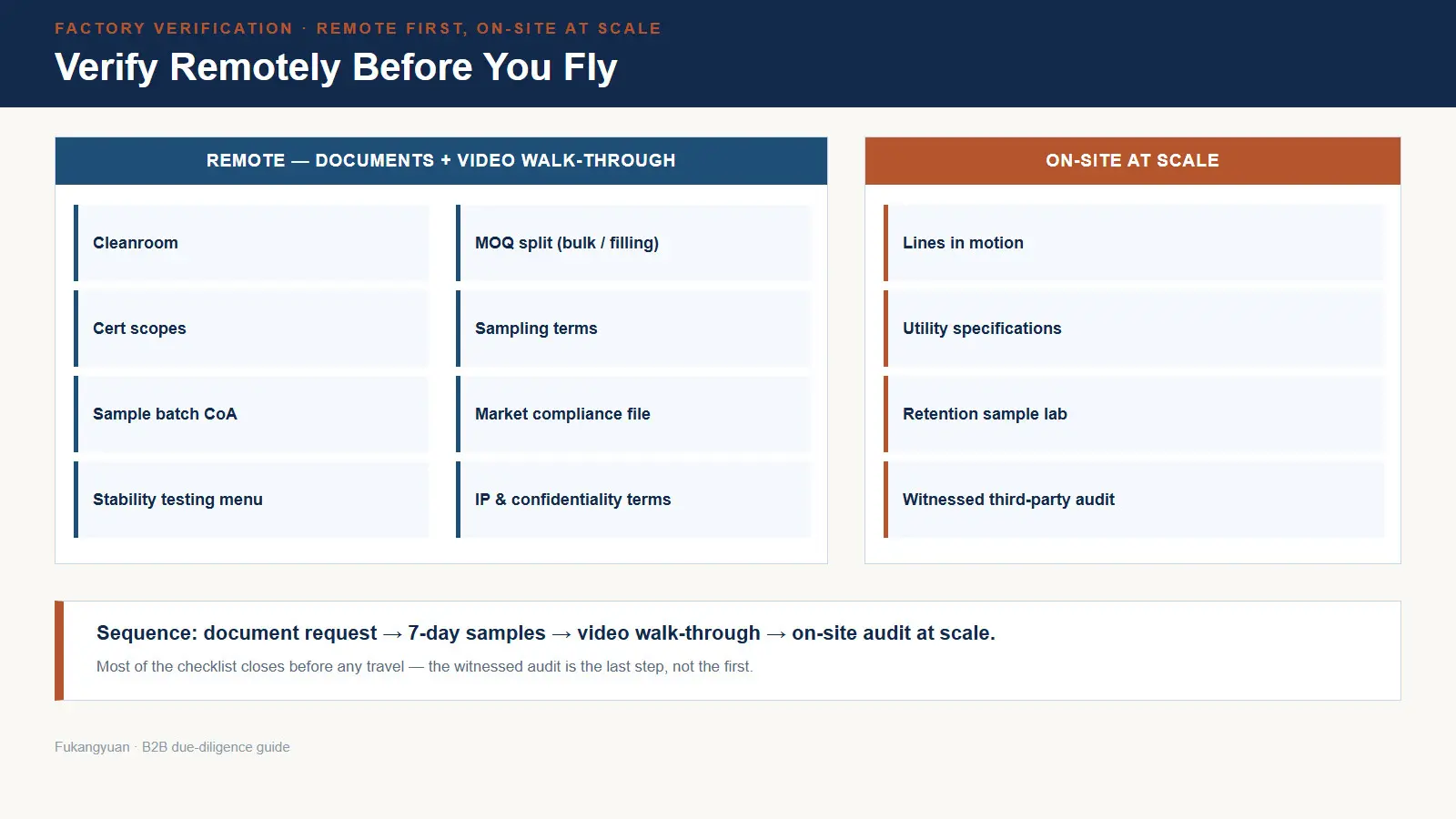
How to Run the Audit Without a Factory Visit
A structured sequence you can run before any travel is booked.
1. Document request
Scopes, surveillance report, a sample batch CoA, the export file sample — the first document that won't come is your answer.
2. Live video walk-through
Cleanroom, lines, retention lab and utility room, on the call. What you can see live is what you can later hold the factory to.
3. Sample evaluation
Development samples in 7 days close the formulation points before any commercial commitment.
4. On-site or third-party audit at scale
When the annual volume justifies it, a witnessed audit — yours or an independent body's — converts the paper trail into a verified one. (the factory landscape guide for choosing who to shortlist)
Engineered for Safety, Certified for Export
FDA Registered Facility
GMPC Certified
ISO 22716
Class 100,000 Cleanroom
20,000+ m² factory · 15+ years biotech R&D
Frequently Asked Questions
Authoritative answers to common procurement, compliance, and auditing inquiries from international brand buyers.
Q1. Do we have to visit the factory before ordering?
No. Most brands verify remotely: document request, a live video walk-through, then development samples in 7 days. An on-site or third-party audit earns its cost once the order size justifies the risk.
Q2. What does “FDA-registered” actually prove?
That the facility is registered with the FDA — not that any product is approved. Read what it covers before treating it as a quality signal.
Q3. Which documents should a serious factory share before we sign?
Certification scopes and the latest surveillance report, a sample batch certificate of analysis, stability data for the active, and an export file sample. A factory that can't produce these hasn't exported at your scale.
Q4. What is the MOQ and how should it be structured?
From 1,000 pcs, with bulk and filling minimums stated separately — for active-loaded formulas the active's own purchase minimum is often the real floor.
Q5. How long do samples take?
Development samples in 7 days from the R&D lab, for quality, stability and sensory evaluation, before you commit to a campaign.
Q6. Who owns the formula we develop together?
State it in writing before development: formula ownership, permitted-use terms for test data and confidentiality — one of the seven specification fields that belong in any RFQ.
Competitor Reference & Manufacturing Differentiation Matrix
Review verified industry benchmarks and differentiation matrices. For public references, figures reflect objective directory overviews subject to procurement verification without unsubstantiated volume assumptions.
1. Industry Benchmark Landscape
| Enterprise | Industry Perception & Operational Profile | Verification Status |
|---|---|---|
| COSMAX (科丝美诗) | Founded in 1992 (South Korea); established Shanghai plant in 2004. Global cosmetic ODM/OBM powerhouse known for full-service turnkey solutions tailored predominantly to large enterprise brand conglomerates. | Verified Official Data |
| NOX BELLCOW (诺斯贝尔) | Guangdong, China. Recognized major player in facial sheet mask and skincare contract manufacturing with extensive industrial capacity. | Review Before Citation |
| KOLMAR (科玛) | South Korea origin. Global cosmetic ODM manufacturing leader with multinational research and production footprints. | Review Before Citation |
| INTERCOS (莹特丽) | Italy origin. Renowned multinational cosmetics contract manufacturer specializing in high-end formulations and global brand lines. | Review Before Citation |
2. Fukangyuan (FKY) Strategic Positioning & Differentiation
| Dimension | FKY (Official Specifications) | Mega Conglomerate ODMs (e.g., Cosmax) | Strategic Sourcing Recommendation |
|---|---|---|---|
| R&D Experience | 15+ Years specialized biotechnology and skincare formulation R&D. | Founded in 1992 (South Korea). | FKY delivers focused skincare formulation agility and targeted bio-active customization. |
| Compliance & Certs | FDA-Registered Facility, ISO 22716, GMPC certified. | Varies by regional facility. | FKY maintains triple-accreditation compliance ready for international customs. |
| Manufacturing Scale | 20,000+ m² facility with certified Class 100,000 cleanrooms. | Large centralized mega-campuses. | Class 100,000 cleanroom environments support sterile integrity for clinical skincare. |
| Category Specialization | Facial Masks (sheet/hydrogel/clay), Serums, Professional Skincare & Body Care. | Comprehensive multi-category cosmetics & makeup ODM/OBM. | Focused domain expertise in advanced functional skincare and intensive barrier repair. |
| Service Flexibility | Private label customization, custom efficacy development, agile OEM/ODM. | Full-scale turnkey OBM designed for high-volume enterprise contracts. | Mega ODMs target enterprise mega-runs; FKY provides agility for growing & premium brands. |
| Procurement Terms | MOQ, Lead Times, and Samples confirmed per official commercial quotation. | Strict enterprise MOQ thresholds. | Clear, transparent pricing and project-specific parameters confirmed via official quotes. |
Request a Factory Verification Dossier & Sample Kit
Submit your product parameters to receive official GMP compliance dossiers, COA templates, and rapid prototype formulations within 24 hours.