
Why a Mask Factory Should Talk About Hair
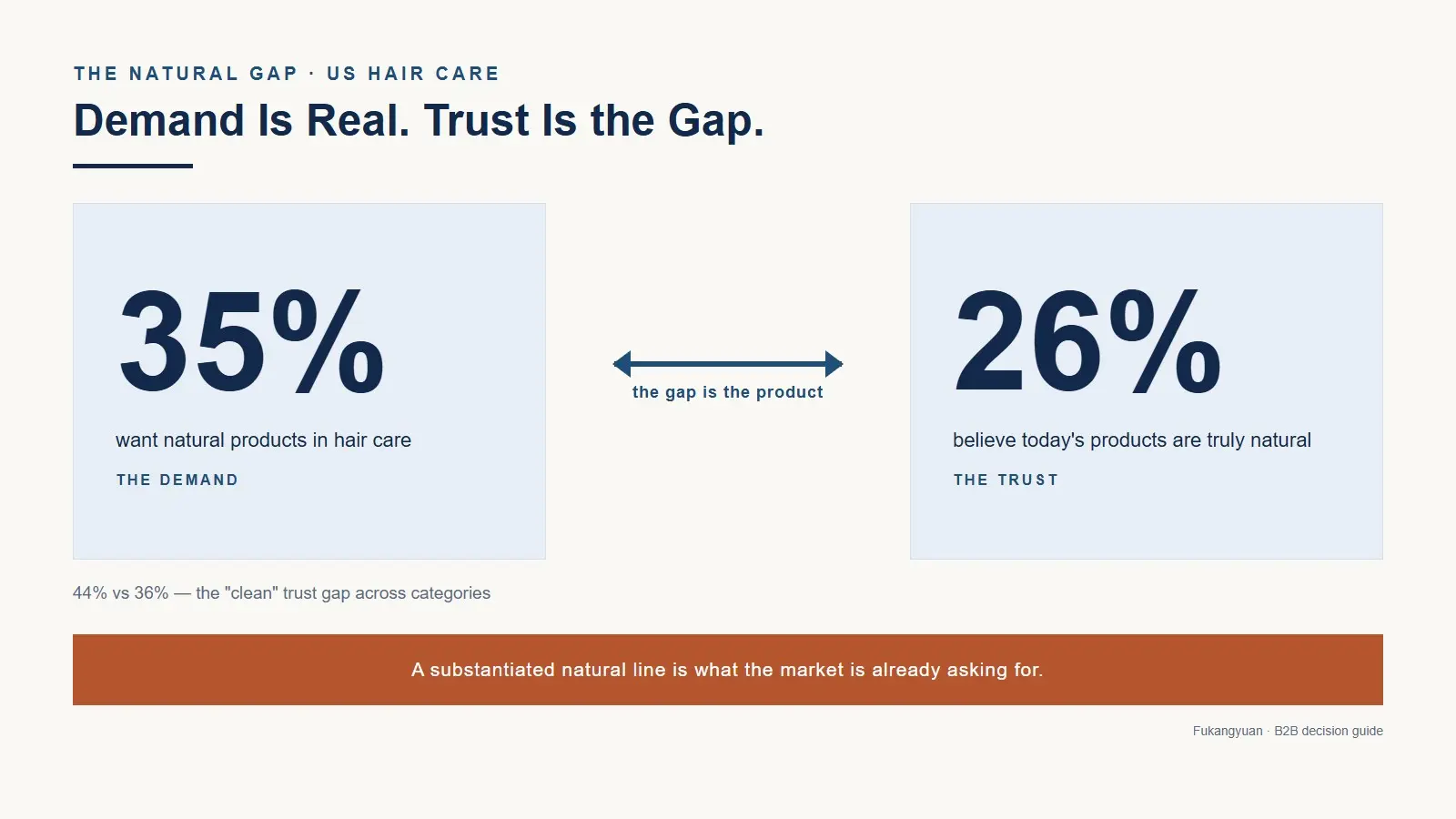
Hair care is the category next to the one you already run. Not a new factory, not a new discipline — a new formula class on the same filling infrastructure, the same GMP file, the same batch documentation. The reason to talk about it now is a number in the US market: the distance between what consumers want and what they believe.
| Signal | Data | What it means |
|---|---|---|
| The demand | 35 percent of US consumers want natural products in hair care | The natural line is the one the market is already asking for |
| The trust | Only 26 percent believe today's products are truly natural | The gap between the two numbers is the product opportunity |
| The framing | 44 vs 36 percent — the "clean" trust gap across categories | The frame moves with the file, not the adjective |
Source: Circana US hair-care consumer research, as captured in full text and graded secondary commercial research; figures as published. The demand and trust numbers are the two halves of one gap — the product opportunity is the distance between them.
The Same Line, a Different Category
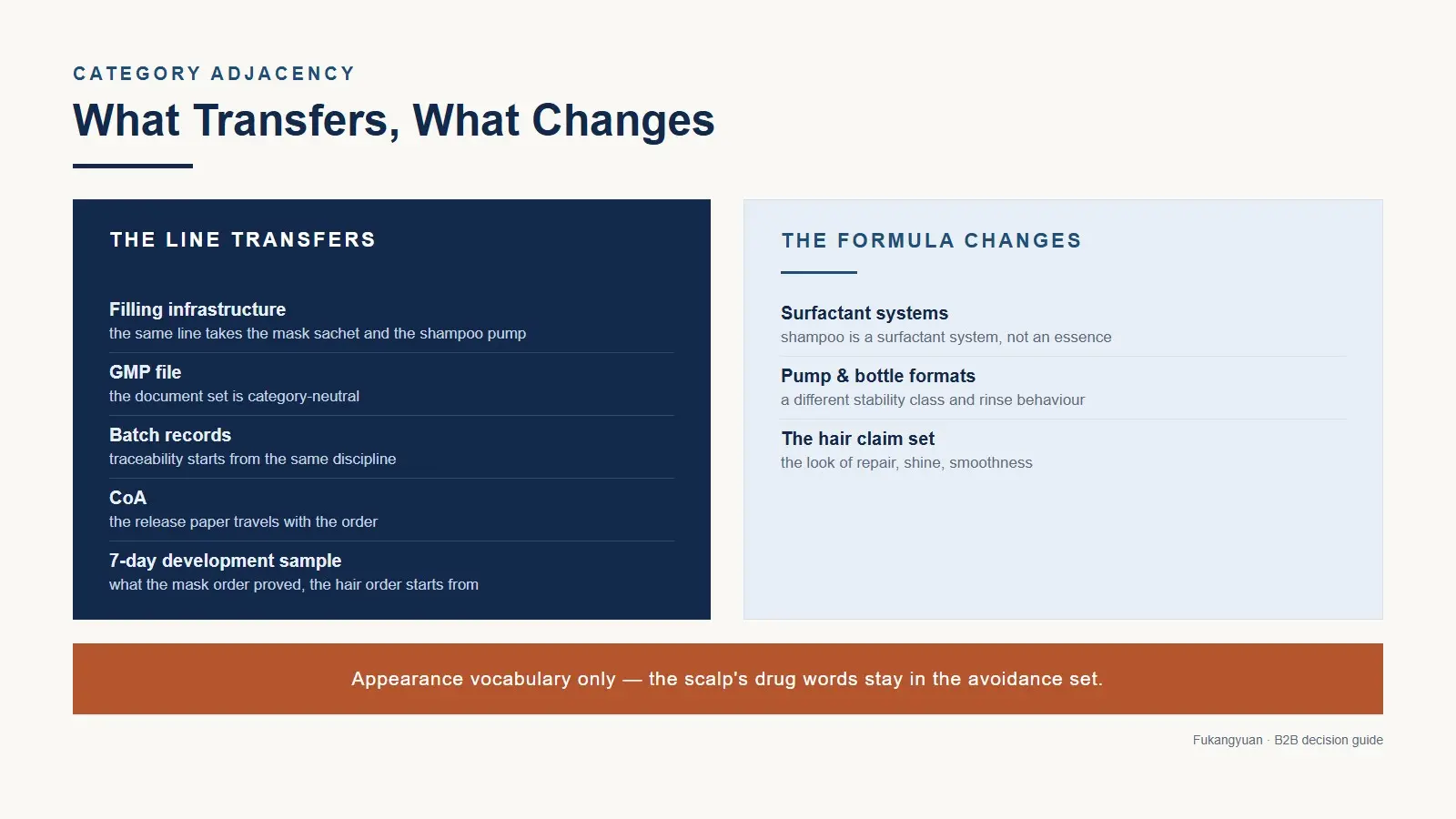
Category adjacency is a production fact before it is a strategy. Two columns: what the line already gives you, and what the formula class changes.
The line transfers — Filling infrastructure runs the format, not the category — the same line takes the mask sachet and the shampoo pump. The GMP file, the batch records, the CoA discipline and the 7-day development sample are category-neutral. What your mask order already proved, the hair order starts from.
The formula changes — Shampoo is a surfactant system, not an essence — the chemistry class, the stability work and the rinse behaviour are the new engineering. The claim set changes with it: appearance vocabulary for the hair — the look of repair, shine, smoothness — while the scalp's drug-suggestion words — growth, cure, heal — stay in the avoidance set, per market.
The Claim Matrix: One Formula, Multiple Files
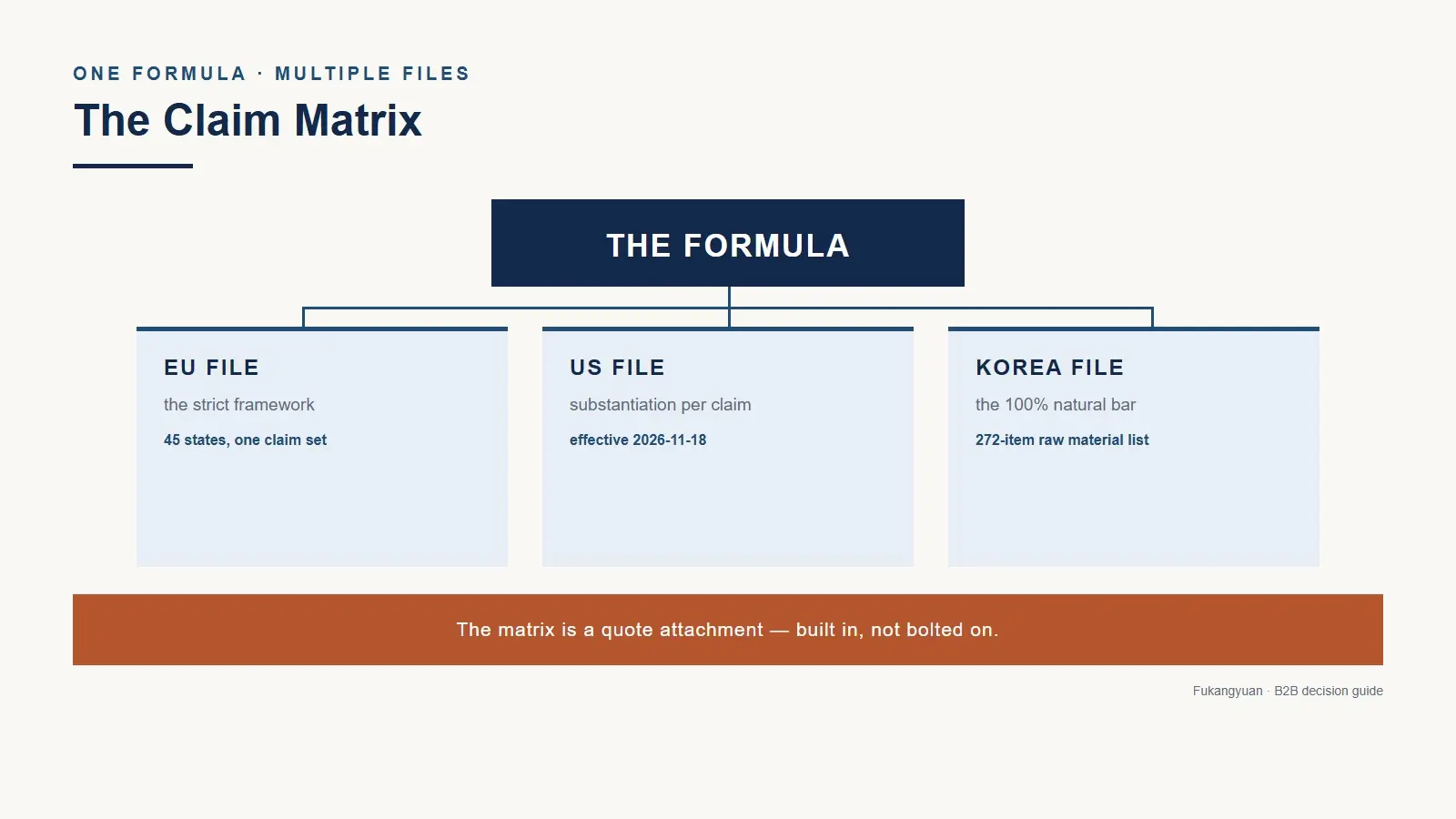
"Natural" is not one global standard — it is a set of jurisdiction-specific files, and the factory's differentiator is building them into the quote. Three regimes, three bars — the EU runs the strict framework across its 45 member states; the compliance file for a market-bound order; the US revision takes effect 2026-11-18, where "natural" and "derived from nature" claims run on a substantiation file and every free-from claim carries its own testing evidence; Korea sets the 100% natural bar — third-party certification against a 272-item raw material list; Japan runs the ingredient-level list at 79 natural items. The delivery that ties the three together: the claim matrix — one formula, a claim file per target market, attached to the quote.
The matrix is the same discipline the collagen line runs — the claim-file discipline the collagen line runs — the claim file built before the label is printed — and the same boundary the eye-patch line teaches: the growth vocabulary of the category is exactly the vocabulary the rules push back on. the claim boundary the category's growth vocabulary runs into The file is built to each market's bar; the certification it references belongs to the authority, not the factory — the quote states which bar each file meets.
The Formats: Shampoo, Hair Serum, Hair Mask
Three formats, in the order of distance from the mask line — the closer the format, the shorter the switch, and the quote states the distance as a line, not a mystery:
Hair mask & conditioner — the nearest format — The closest chemistry to the mask essence, the same filling discipline, the shortest switch. The first hair SKU for a mask brand is usually here — the line that already runs the sachet runs the jar.
Hair serum — the active format — The active-concentrated format of the category — the drop, the pump, the finish. Where the claim language does the work, and where the claim matrix carries the most weight.
Shampoo — the surfactant format — The volume format of the category and the furthest chemistry from the mask line — a different stability class, a different rinse behaviour. Quoted as its own line, because it is one.
The commercial structure is the standard one across all three — the anatomy of an OEM quote and its seven levers — and the pilot of any of them prices on the small-batch tier structure for a pilot order.
B2B Sourcing & Procurement Parameters
MOQ Policy
from 1,000 pcs — flexible by formulation & packaging
Sample Policy
7 days — R&D lab prototyping for quality, stability & sensory
Shipping & Incoterms
FOB · CIF · EXW — Shanghai & Guangzhou
Production Lead Time
fast-track with pre-approved stock packaging
Specific values finalized during official quotation.
Where to Point the First Hair SKU
Three targeting calls, in the order they compound:
Sell the gap, substantiated — The 35-versus-26 distance is the product story: a natural line whose claims carry the file that closes the trust gap. The substantiation is the differentiator, not the adjective.
Start the format close to the line — The first SKU is the one the mask infrastructure already speaks — the hair mask and the conditioner before the surfactant system. The quote states each format's distance, so the sequence is a plan, not a gamble.
Build the matrix before the label — The claim file per target market is attached to the first quote — the EU bar, the US substantiation, the Korea 100-percent bar — so the label prints once, in every market it ships to.
Frequently Asked Questions
Can a mask factory really make hair care?
Yes — on the parts that matter: the filling infrastructure, the GMP file and the documentation discipline are category-neutral, and the quote states which infrastructure each format runs on. What changes is the formula class — a surfactant system is not an essence — and the switch is quoted as a line, not hidden in the price.
What is the "natural claim gap"?
The distance between what consumers want and what they believe: 35 percent of US consumers want natural hair-care products, 26 percent believe today's are truly natural. A line whose claims carry the substantiation file is the product that gap is waiting for.
What changes for natural claims after the FTC revision?
From 2026-11-18 the revised green guide is effective in the US: "natural" and "derived from nature" run on a substantiation file, and each free-from claim — the no-plastic-microbeads, no-animal-testing, no-PFAS family — carries its own testing evidence. The file is built into the quote, not bolted on after the label.
Do different markets need different claim files?
Yes — "natural" is not one global standard. The EU runs the strict framework across 45 member states, the US runs the substantiation bar, Korea sets the 100-percent natural bar against a 272-item raw material list, and Japan runs the ingredient-level list at 79 items. The claim matrix is one formula, a file per target market.
Does hair care change the MOQ or the quote structure?
No — the commercial structure is the standard quote: the anatomy of an OEM quote and its seven levers. The format selects the line and the packaging; the pricing system is the same one.
Which hair format should a first order start with?
The one closest to the line: the hair mask and the conditioner share the most with the mask infrastructure, the serum carries the active story, and the shampoo is the furthest switch. The quote states the distance for each — the sequence is the plan. the small-batch tier structure for a pilot order
Send Your Hair Care Brief — Get a Format Quote & Claim Matrix
Submit your technical formulation specifications or product requirements. A dedicated product manager on every RFQ — reply within 24 hours.