What "EU-Ready" Actually Means for an OEM Order
One formula, one market rulebook. The EU consolidates cosmetics law into a single regulation — EC 1223/2009 — so "EU-ready" is a defined state with a named file, a named role and a named notification. If you already ship to the US, the closest cousin of this file is how an FDA-registered import file is built.
The regulation
EC 1223/2009 covers the product before it is placed on the EU market: composition limits, GMP, labeling, safety assessment and notification. There is no pre-market "approval" for cosmetics — there is a file that must exist and a notification that must be filed.
The roles
The manufacturer (the factory) makes the product. The Responsible Person — established in the EU — holds the Product Information File and is the named contact. The importer ships the goods; the RP owns the paper. Conflating these three is the most common structural error in a first EU order.
The file
Before the first unit is placed on the market: the PIF must exist, the safety report must be signed, and the CPNP notification must be filed. Sequence is part of compliance — a product that ships before its file is complete is a product with a blocked port.
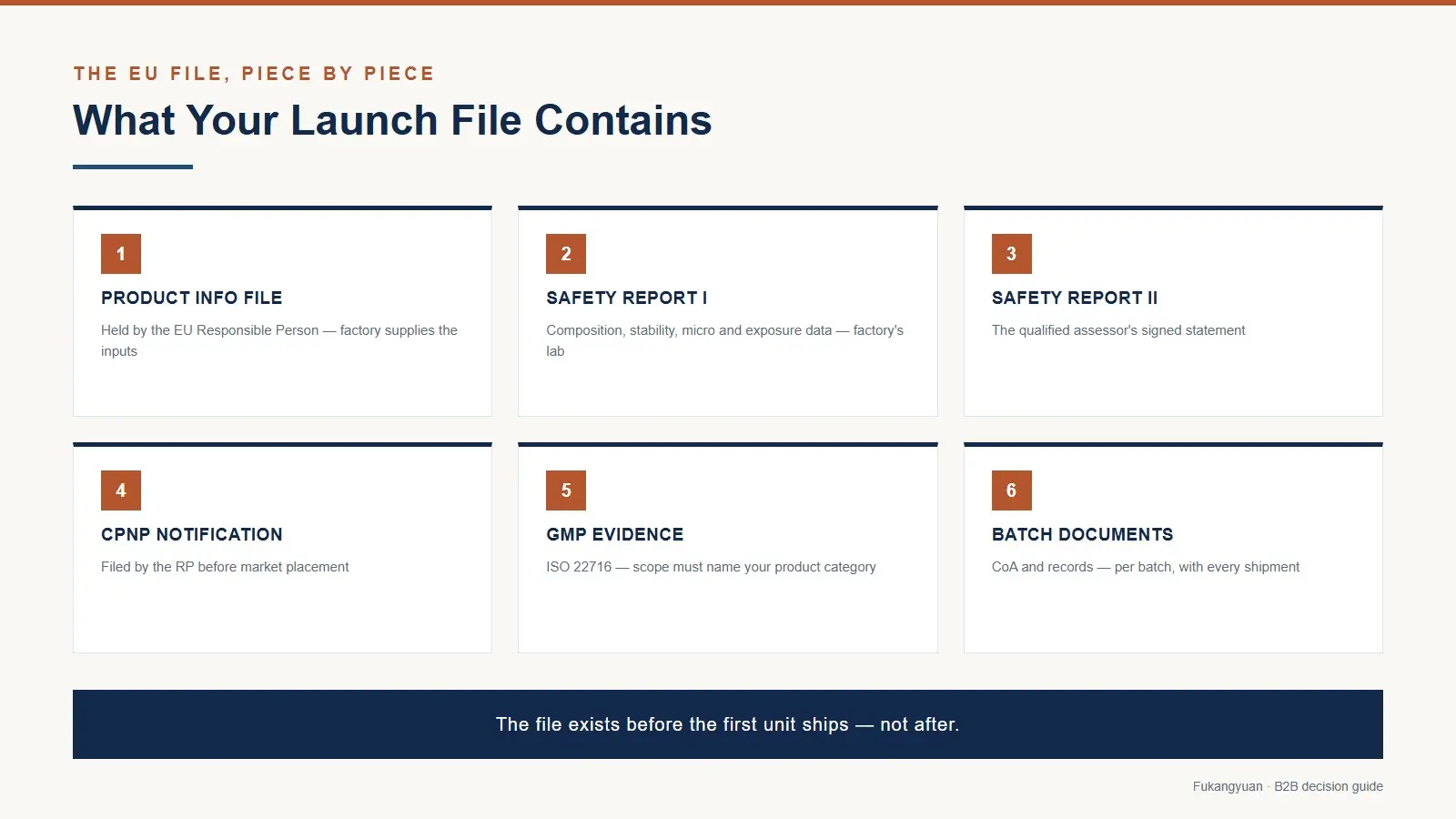
The Compliance File, Piece by Piece
The file is not one document — it is a stack, and every layer has a named owner. The table below is the buyer's view: what each piece is, who prepares it, and what you confirm.
| File component | Who prepares it | What the buyer confirms |
|---|---|---|
| Product Information File (PIF) | Responsible Person holds it — factory supplies the inputs | The factory's data package matches the PIF sections |
| Safety Report, Part I | Factory data + qualified safety assessor | Stability, micro and exposure data are in the package |
| Safety Report, Part II | The safety assessor | An assessor with the standing to sign it |
| CPNP notification | Responsible Person — before market placement | The product is in scope before the first shipment |
| GMP evidence | Factory — ISO 22716 in scope | The certificate scope covers the product category |
| Batch documents | Factory — per batch | CoA, raw material specs and INCI travel with the goods |
The regulation is amended and its annexes move — the factory's job is to state which checks it runs against the current lists; the RP's job is to confirm the live state at filing time.
High-actives carry the heaviest safety-report inputs — PDRN, derived from salmon DNA, needs its own stability and source documentation: see how PDRN works in OEM formulas.
What the Factory Can and Cannot Do
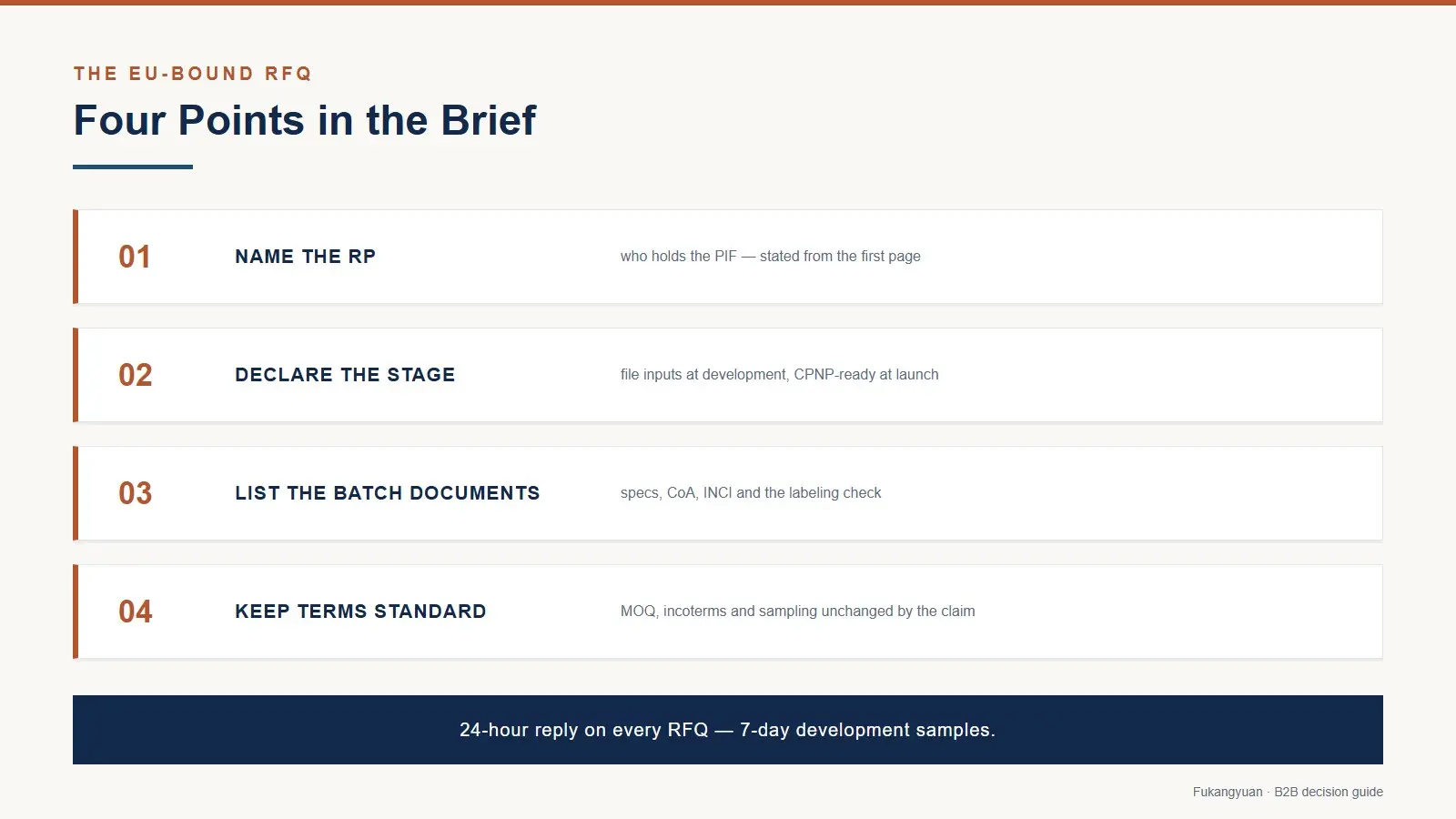
The trust signal in an EU RFQ is not a promise — it is a boundary. A factory that can say what it does not do is one whose file you can actually build on. The split below is the honest version.
| Factory delivers | Buyer & RP own |
|---|---|
| GMP-compliant batch production | CPNP notification |
| Stability, micro and exposure data | PIF custody and update |
| Raw material specs, INCI, label-ready artwork review | Safety assessor engagement |
| Batch records and CoA per shipment | Market claims and labeling wording |
If a supplier offers to "handle EU compliance" end to end, ask who holds the PIF and who signs the safety report — the answers tell you what the offer actually contains.
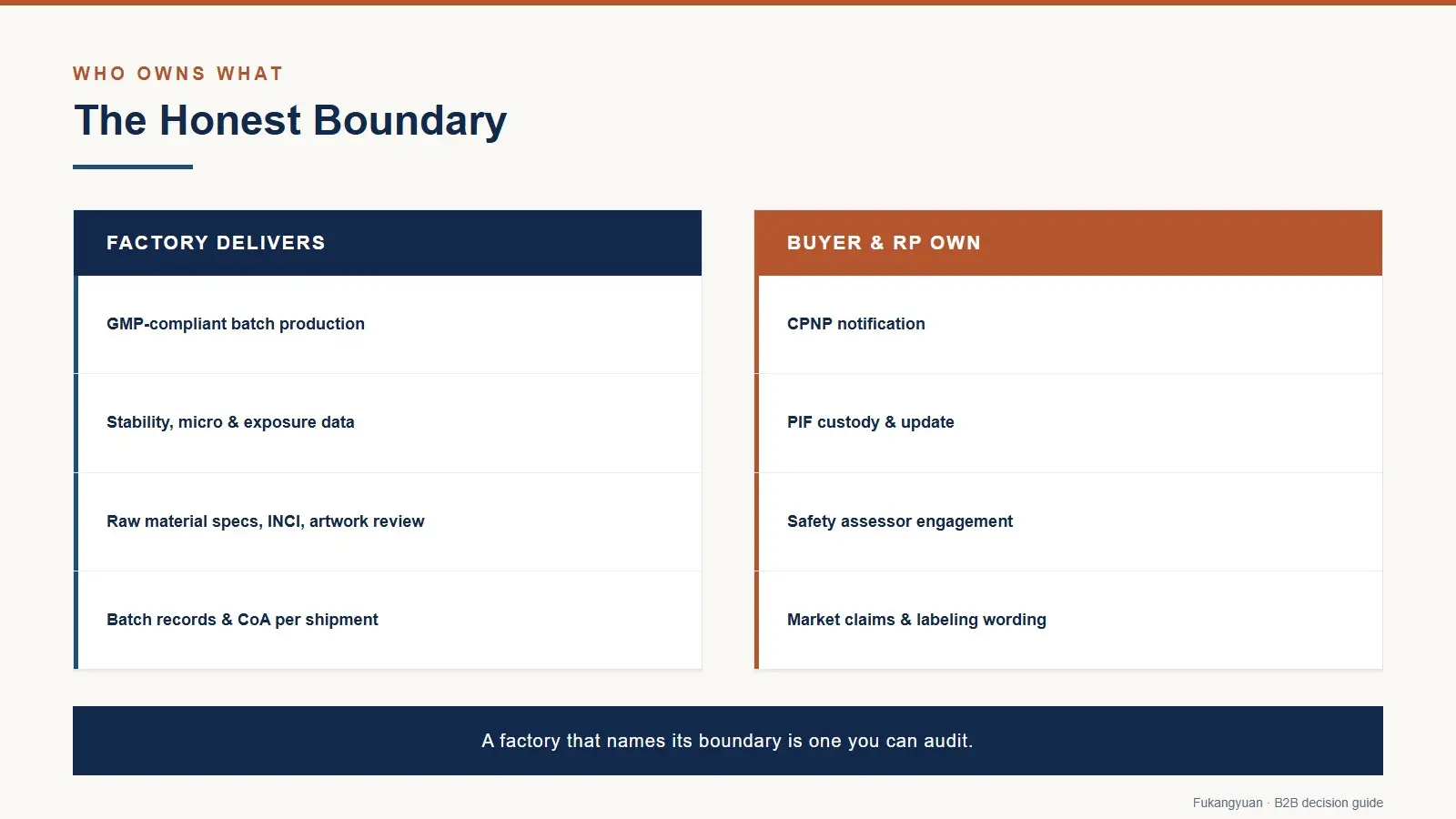
Writing the RFQ: Four Points for an EU-Bound Order
Name the market and the Responsible Person
The PIF is held by an EU-established RP. State who will hold it — or that it is open — so the file is built to the right role from the first page.
Declare the stage of the file
GMP evidence and safety-report inputs at development; the CPNP-ready file at launch. An undeclared stage is how a quote covers the wrong file.
List the batch documents
CoA, raw material specifications, INCI list and a labeling review — named in the RFQ so they are built into the order, not negotiated after it.
Keep the commercial terms standard
MOQ, incoterms and sampling follow the usual quote structure — the compliance work adds a documentation line, not a separate pricing system. Read the anatomy of an OEM quote and its seven levers.
B2B Sourcing & Procurement Parameters
MOQ Policy
from 1,000 pcs — flexible by formulation & packaging
Sample Policy
7 days — R&D lab prototyping for quality, stability & sensory
Shipping & Incoterms
FOB · CIF · EXW — Shanghai & Guangzhou
Production Lead Time
fast-track with pre-approved stock packaging
Specific values finalized during official quotation.
How to Verify the Compliance Story Before You Order
Verification here is file-shaped: every claim is a document with a named owner. Start with the factory landscape for choosing who to shortlist. The facility credentials underneath: FDA Registered Facility · GMPC Certified · ISO 22716 · Class 100,000 Cleanroom (20,000+ m² factory · 15+ years biotech R&D).
GMP scope, not just the certificate
An ISO 22716 certificate is only as good as its scope — confirm it covers the product category you are ordering, and that it is current: the 12-point checklist for verifying whichever factory you quote.
Ask for the data package, not other customers' files
A factory with EU order history can show the shape of the safety-report input package — composition, stability, micro, exposure — without touching anyone else's confidential data.
Label review before tooling
Labeling errors are the most common launch blocker. The label, the PIF and the notification must agree — check the tie before artwork is committed.
Make the batch file travel with the goods
A CoA plus batch records on every shipment — the per-batch proof that the product at the port is the product in the file.
Frequently Asked Questions
Do I need an EU Responsible Person before my product can launch?
Yes — the PIF and the CPNP notification sit with an RP established in the EU. Name who will hold it in the RFQ, so the file is built to the right role from the first page.
Can the Chinese factory file CPNP for me?
The notification runs through the Responsible Person — the factory's standing is to supply the data it is built on: composition, stability, micro, exposure. If your RP is already set, the factory's file inputs go straight in.
What is the CPSR and who writes it?
The two-part safety report: Part I is built from the factory's data by a qualified safety assessor; Part II is the assessor's signed statement. The factory's lab data is the raw material of the report — literally.
Does my formula need to change for the EU?
Often only small: the prohibited and restricted substance lists, claim wording — no medical claims — and labeling rules. The factory runs the check against the EU lists before the formula is locked.
Does EU compliance change the MOQ or the quote structure?
The commercial structure — MOQ, incoterms, sampling — follows the standard quote: the anatomy of an OEM quote and its seven levers. What compliance adds is a documentation line: data packages, certificates and batch records.
How do I verify the factory's GMP claim?
Certificate with a scope that names your product category, a current validity, and the data package behind it — then the 12-point checklist for verifying whichever factory you quote. Batch-level documents are the test that repeats with every shipment.
Tell Us Your EU Launch Plan — Get the Compliance File Map
Submit your technical formulation specifications or product requirements. A dedicated product manager on every RFQ — reply within 24 hours.