One Question First: Who Owns the Formula?
Private label, OEM and ODM are used so loosely in this industry that two factories can quote the same sentence in completely different ways. Before any of the cost or timeline conversations, settle the one question that makes the other two legible: who owns the formula — and who is allowed to make it.
Private label
You select an existing formula — the factory’s or a licensed one — and put your brand on it. There is no development phase: sampling is confirmation, not creation. It is the fastest route to shelf, and it is built for categories where the format is proven and speed matters more than exclusivity.
OEM
You bring the formula — or a hard benchmark to match — and the factory manufactures to your specification. You own the intellectual property; the factory owns execution. It is the right model when the formula itself is your differentiator and you will defend it across markets.
ODM
The factory develops the formula to your brief, and you own the result — stated in writing before development starts. It is the slower, R&D-intensive path, and it is the only one that builds something that does not exist yet. Read the seven specification fields an ODM brief must carry.
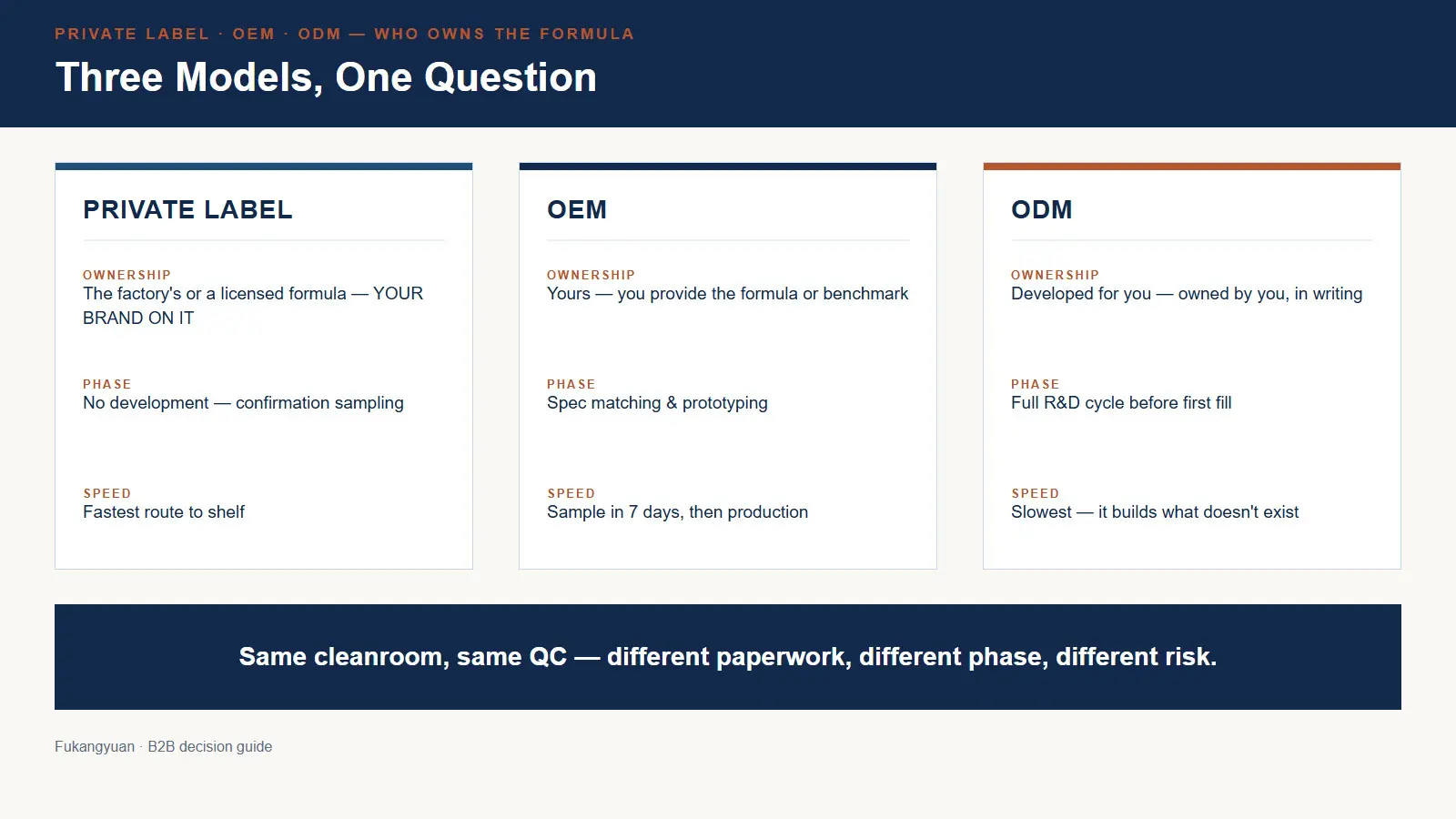
The Three Models, Line by Line
Same facility, same cleanroom, same QC discipline — different paperwork, different phase, different risk. The table is the honest version of the comparison.
| Dimension | Private Label | OEM | ODM |
|---|---|---|---|
| Formula ownership | The factory’s or a licensed formula — your brand on it | Yours: you provide the formula or the benchmark | Developed for you; owned by you — in writing |
| Development phase | None — confirmation sampling only | None to light — spec matching and prototyping | Full R&D cycle before first fill |
| What the 7-day sample covers | The selected formula, confirmed | Your formula or the matched benchmark, prototyped | Stage samples of the developing formula |
| Where your budget goes | Packaging and brand build | Formula fidelity and QC depth | R&D hours and iteration |
| Typical buyer | First SKU, fast market test | A formula you own or must replicate | A product that must not exist elsewhere |
The facility parameters — cleanroom, water, utilities, QC — are identical across models. What changes is the phase between "signed" and "filled".
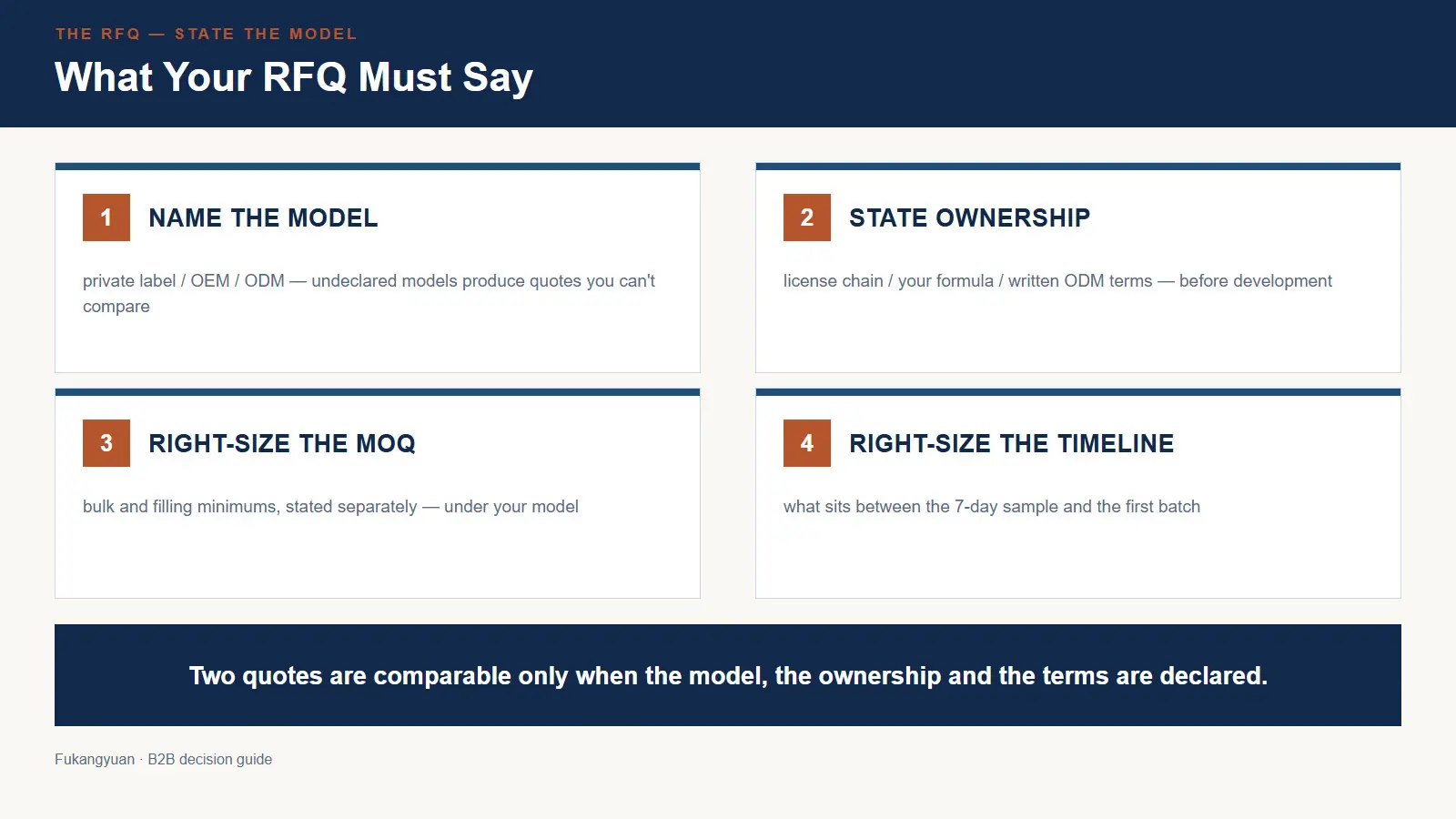
What Changes in Your RFQ Depending on the Model
An undeclared model is how two quotes that look comparable stop being comparable. Four fields decide whether the quote you receive is built around your model or around the factory’s default.
Name the model explicitly
A quote for "private label sheet mask" and a quote for "OEM serum from our formula" are different documents. An undeclared model is how two quotes that look comparable stop being comparable. Read the anatomy of an OEM quote and its seven levers.
State ownership before development
Private label: confirm the license chain. OEM: hand over the formula and the benchmark expectations. ODM: agree formula ownership and data terms in writing first — it is one of the specification fields that belong in any RFQ.
Right-size the MOQ question
Ask for bulk and filling minimums stated separately under your model — the floor moves with the structure.
Right-size the timeline question
Ask what sits between the sample and the first batch under your model — for ODM it is a development cycle, for the others it is packaging and compliance.
B2B Sourcing & Procurement Parameters
Standard terms of engagement. The facility parameters do not change with the model — these do.
MOQ Policy
from 1,000 pcs — flexible by formulation & packaging
Sample Policy
7 days — R&D lab prototyping for quality, stability & sensory
Shipping & Incoterms
FOB · CIF · EXW — Shanghai & Guangzhou
Production Lead Time
fast-track with pre-approved stock packaging
Specific values finalized during official quotation.
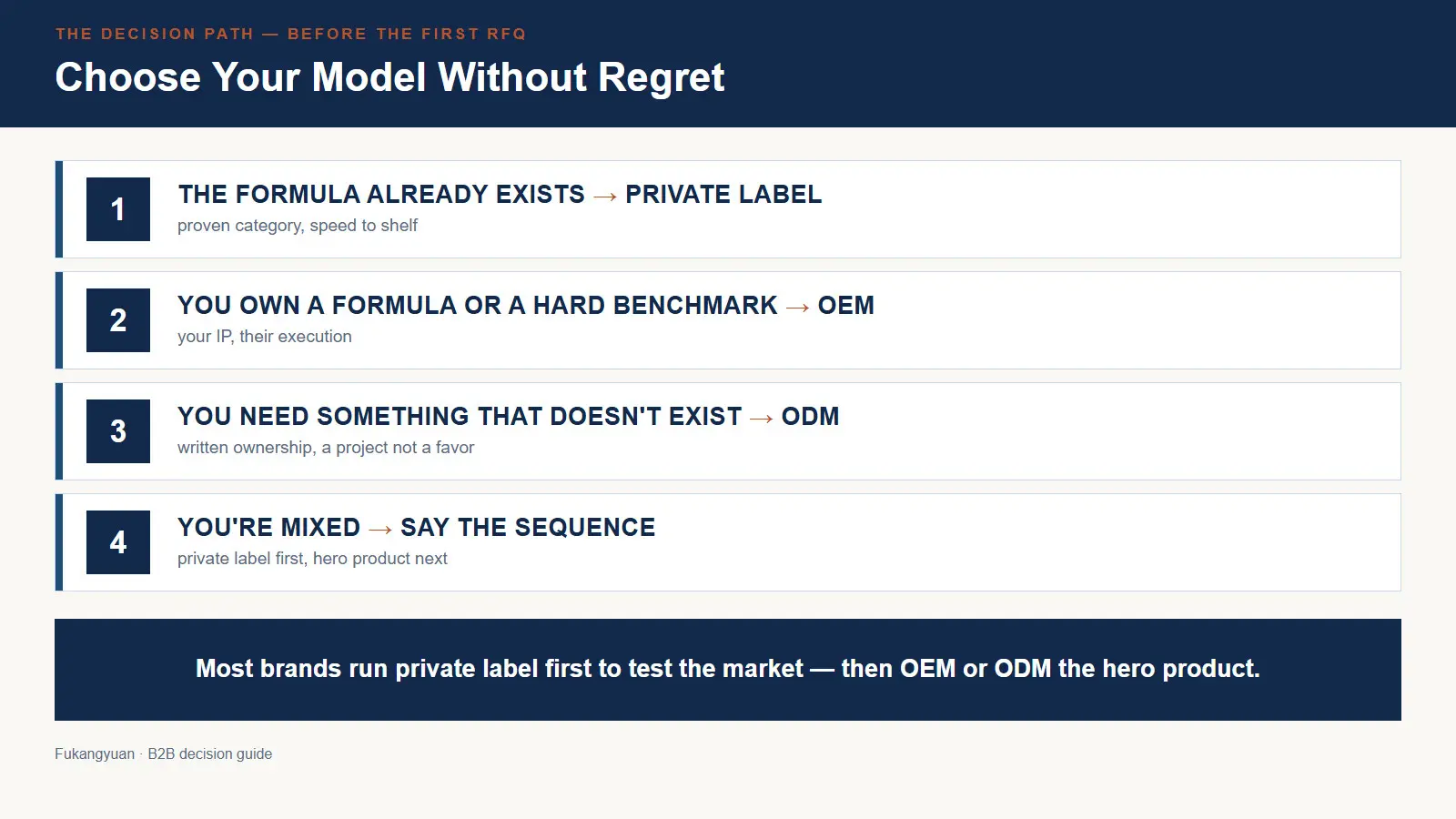
Choosing Without Regret: The Decision Path
Four questions settle the model before the first RFQ — so the quote you receive is the quote you planned for.
If the formula already exists — private label
Proven category, speed to shelf, lowest friction. The first SKU of most brands should start here.
If you own a formula or a hard benchmark — OEM
Your IP, their execution. Value lives in fidelity and QC depth, and in the documentation that travels with the goods.
If you need something that does not exist yet — ODM
A development project with a written ownership agreement — not a favor.
If you are mixed — say the sequence
The common path: private label first to test the market, then OEM or ODM the hero product. State the sequence in the RFQ and the factory plans capacity and sampling for both stages. Read the 12-point checklist for verifying whichever factory you quote.
Engineered for Safety, Certified for Export
The compliance file, documentation and logistics are identical across models — the cleanroom does not change with the paperwork.
FDA Registered Facility
GMPC Certified
ISO 22716
Class 100,000 Cleanroom
20,000+ m² factory · 15+ years biotech R&D
See the factory landscape for choosing who to shortlist and what "FDA-registered" covers once the model is chosen.
Frequently Asked Questions
Direct answers on ownership, MOQ, sampling and sequence — the six questions that decide which model you quote.
Can one factory do all three models?
Yes. The same facility runs private label, OEM and ODM — what changes is the development phase and the paperwork, not the cleanroom. State your model in the RFQ and the quote is built around it.
Is private label cheaper?
Not automatically. It removes the development phase, so you reach the first batch faster and with less friction. Unit economics still follow the cost levers — batch size, format, active load, packaging, compliance scope, shipping terms and sampling.
Who owns the formula in each model?
Private label: the factory’s or a licensed formula, with your brand on it. OEM: yours — you provide it. ODM: developed for you and owned by you, stated in writing before development starts.
Can I start private label and move to OEM later?
That is the common sequence. Test the market on an existing parameter set, then develop your hero formula. Tell the factory the sequence and it plans sampling and capacity for both stages.
What does the 7-day sample cover under each model?
Private label: the selected formula, confirmed. OEM: your formula or the matched benchmark, prototyped by the R&D lab. ODM: stage samples of the developing formula. Quality, stability and sensory — before you commit.
Which model fits a first-time importer?
Usually private label for the first SKU. The compliance file, documentation and logistics are identical across models — nothing is lost by starting simple and developing the differentiator next. See what "FDA-registered" covers once the model is chosen.
Tell Us Your Model — Get a Matching Quote & Sample Plan
Connect directly with Fukangyuan's technical formulation and manufacturing team. A dedicated product manager on every RFQ — reply within 24 hours.