PDRN Skincare Manufacturing: OEM/ODM Factory Guide 2026
A B2B Manufacturing Guide for Brands Launching PDRN Serums, Ampoules & Masks
MOQ from 1,000 pcs · Samples in 7 days · FDA & ISO certified · Reply within 24 hours
The definitive B2B technical guide for beauty brand founders, product developers, and procurement executives seeking turnkey formulation, salmon DNA active stability, cleanroom production, and worldwide regulatory compliance.
Why PDRN Projects Fail at the Specification Stage
Polydeoxyribonucleotide (PDRN) is a DNA-based active with a credible mechanistic story and a real, growing consumer vocabulary behind it. Most PDRN projects stall for the same commercial reason: the specification was never written down, so the quotation, the formula and the claim are all built on different assumptions.
Molecular Weight Mismatch
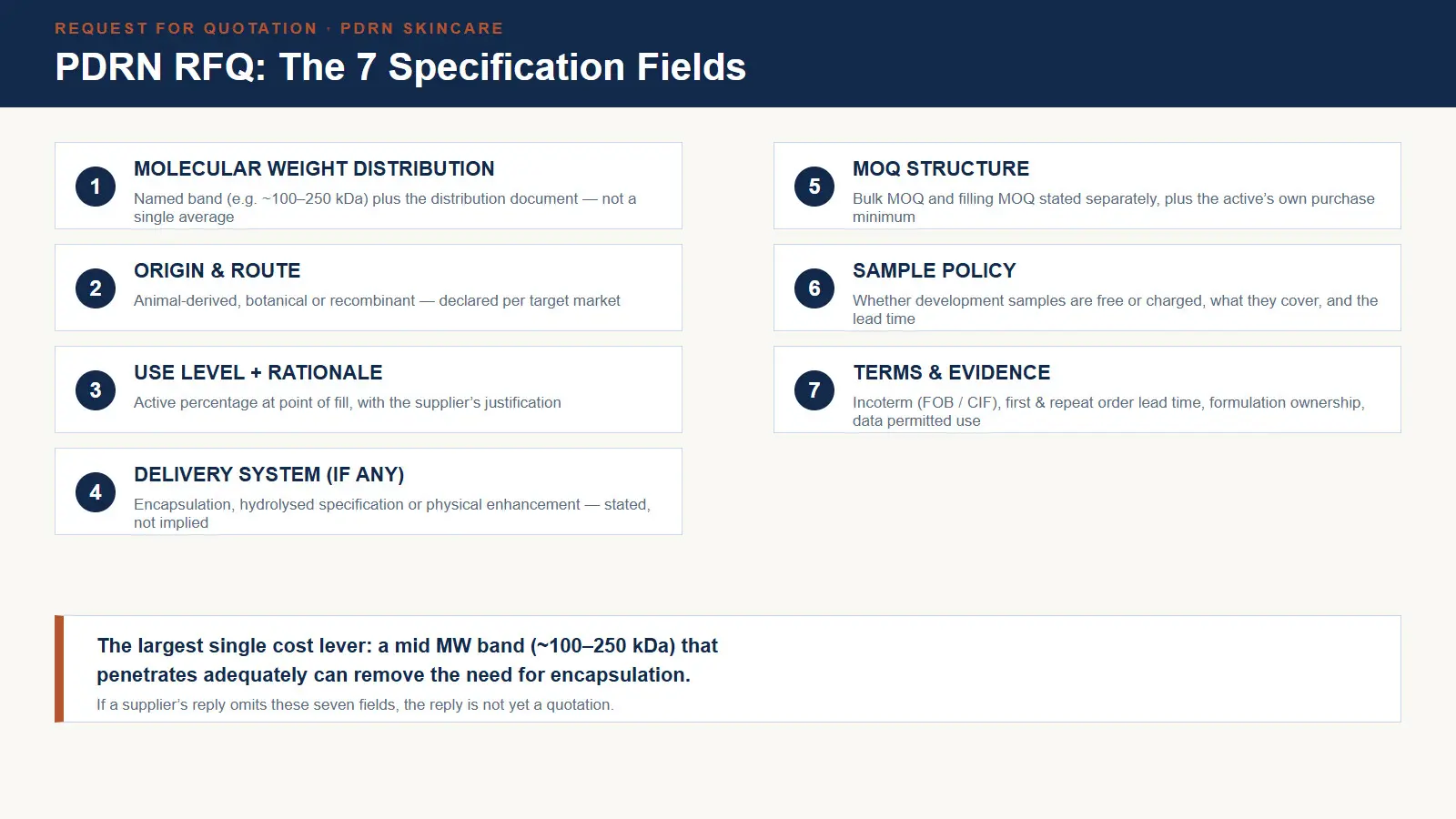
Above ~500 kDa, passive penetration falls significantly, and native PDRN — a 50–1,500 kDa mixture — cannot cross intact stratum corneum unaided. If penetration is part of your claim, a delivery system is not optional; it is the largest single cost lever in the project.
Thermal Denaturation
PDRN's double-helix structure is heat-sensitive, and conventional hot emulsification risks fragmenting the active before it ever reaches the bottle. Verify that the factory uses a cold-feed, low-shear vacuum dispersion process and ask for the thermal history of the active phase.
Ionic Carrier Incompatibility
Because PDRN carries negatively charged phosphate backbones, combining it with cationic surfactants or unshielded multi-valent metal ions can trigger flocculation, cloudiness and viscosity collapse. Request the compatibility data before you commit to the formula.
Preservative Interference
Nucleic acid actives are sensitive to aggressive preservation strategies and extreme pH. Your formula needs a preservation matrix that is compatible with the active — ask for challenge-test support, not just a preservative list.
The 5-Gate Supplier Verification Checklist
Before issuing a Purchase Order (PO) to an OEM/ODM skincare manufacturing facility, brand owners must rigorously audit each technical gate to guarantee batch-to-batch active stability.
Gate 1: Raw Material Extraction Integrity & Purity Verification
Conventionally, PDRN is a mixture of deoxyribonucleotides purified from salmonid sperm DNA — Oncorhynchus mykiss (rainbow trout) or Oncorhynchus keta (chum salmon). Demand a certificate of origin and species declaration, plus a batch certificate of analysis covering purity and residual protein.
Gate 2: Controlled Low-Temperature Emulsification Technology
Verify that the factory runs a cold-process emulsification route, with the concentrated PDRN active phase integrated under low-shear vacuum agitation after the base cools — the route a vacuum homogenization line is built for.
Gate 3: Cleanroom Classification & Bioburden Defense
Nucleic acid formulas can serve as nutrient media for biological growth if unpreserved. Production must occur within certified Class 100,000 (ISO 8) cleanrooms with HEPA filtration and positive-pressure differentials.
Gate 4: Nano-Liposomal & Permeation Delivery Encapsulation
Assess whether the laboratory offers liposome encapsulation or a hydrolysed (size-reduced) specification instead of native material. Encapsulation measurably changes what arrives at the skin — an in-vitro study reported cumulative permeation of nanoliposome PDRN at 1.22× that of free PDRN over 24 hours — which is the question to ask when a supplier prices a premium delivery system.
Gate 5: Comprehensive Dossier & Accelerated Stability Validations
Ensure the manufacturer provides accelerated stability testing, freeze-thaw challenge testing and antimicrobial preservative-effectiveness verification before bulk packaging — and that the finished formula's active retention at end of shelf life is documented.
Every gate above maps to a document your supplier must produce. For the complete field-by-field walkthrough, read the full brand owner's guide to PDRN skincare specifications and evidence.
PDRN OEM/ODM Product Format Playbook
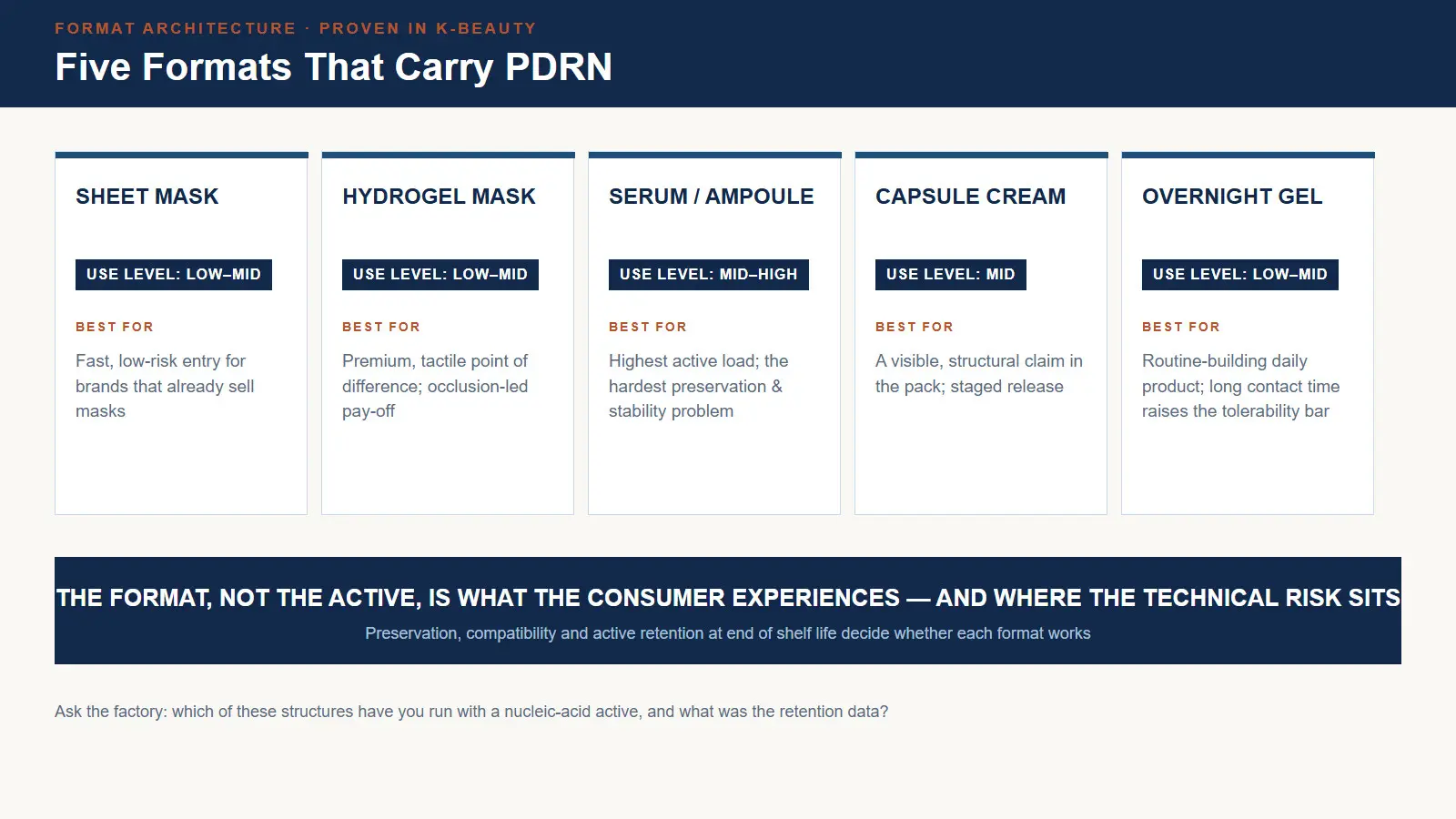
Explore five high-converting product formats engineered for optimal PDRN active stability, sensory luxury, and strong commercial positioning.
Bio-Cellulose Sheet Mask
The essence is a single-use, water-based system: preservation must suit the nucleic acid active. The fastest, lowest-risk entry for brands that already sell masks.
Thermo-Melting Hydrogel
Requires the active to survive gel-network formation and a longer wear time; the pay-off is sensorial and occlusion-led — a premium, tactile point of difference.
Serum Ampoule System
The highest active load in the assortment — and therefore the hardest preservation and stability problem. The format for brands that want the ingredient to carry the product story.
Micro-Capsule Cream
Capsules protect the active and stage the release visually — a visible, structural claim in the pack. Capsule fill and shell compatibility drive cost and yield, so ask for yield data.
Overnight Recovery Gel
Long contact time raises the tolerability bar and makes sensory residue a purchase blocker. The format for brands building a daily routine product.
PDRN OEM/ODM Sourcing & Formulation Parameters
Standard engineering benchmarks for technical formulation developers and supply chain directors configuring contract manufacturing contracts.
| Specification Line | Reference Benchmark | What to Request in Writing |
|---|---|---|
| Raw Material Source | Salmonid sperm DNA (O. mykiss / O. keta); botanical and recombinant routes exist | Certificate of origin + species/route declaration |
| Molecular Weight Distribution | Native mixture spans 50–1,500 kDa; ~100–250 kDa is treated as the balanced serum band | GPC distribution document — not a single average |
| Purity / Residual Protein | >95% pure active with inactivated proteins and peptides | Batch certificate of analysis |
| Structure | ~50% double-stranded deoxyribonucleotides | Structural characterization from the supplier |
| Delivery System | Encapsulation / hydrolysed specification / physical enhancement | Which one you are getting — stated, not implied |
MOQ Policy
from 1,000 pcs, flexible by formulation & packaging
Sample Policy
7 days, R&D lab prototyping
Shipping & Incoterms
FOB / CIF / EXW from Shanghai & Guangzhou
Production Lead Time
fast-track options with pre-approved stock packaging
Footnote: specific values finalized during official quotation.
Regulatory & Claim Guardrails: US, EU, China, Korea
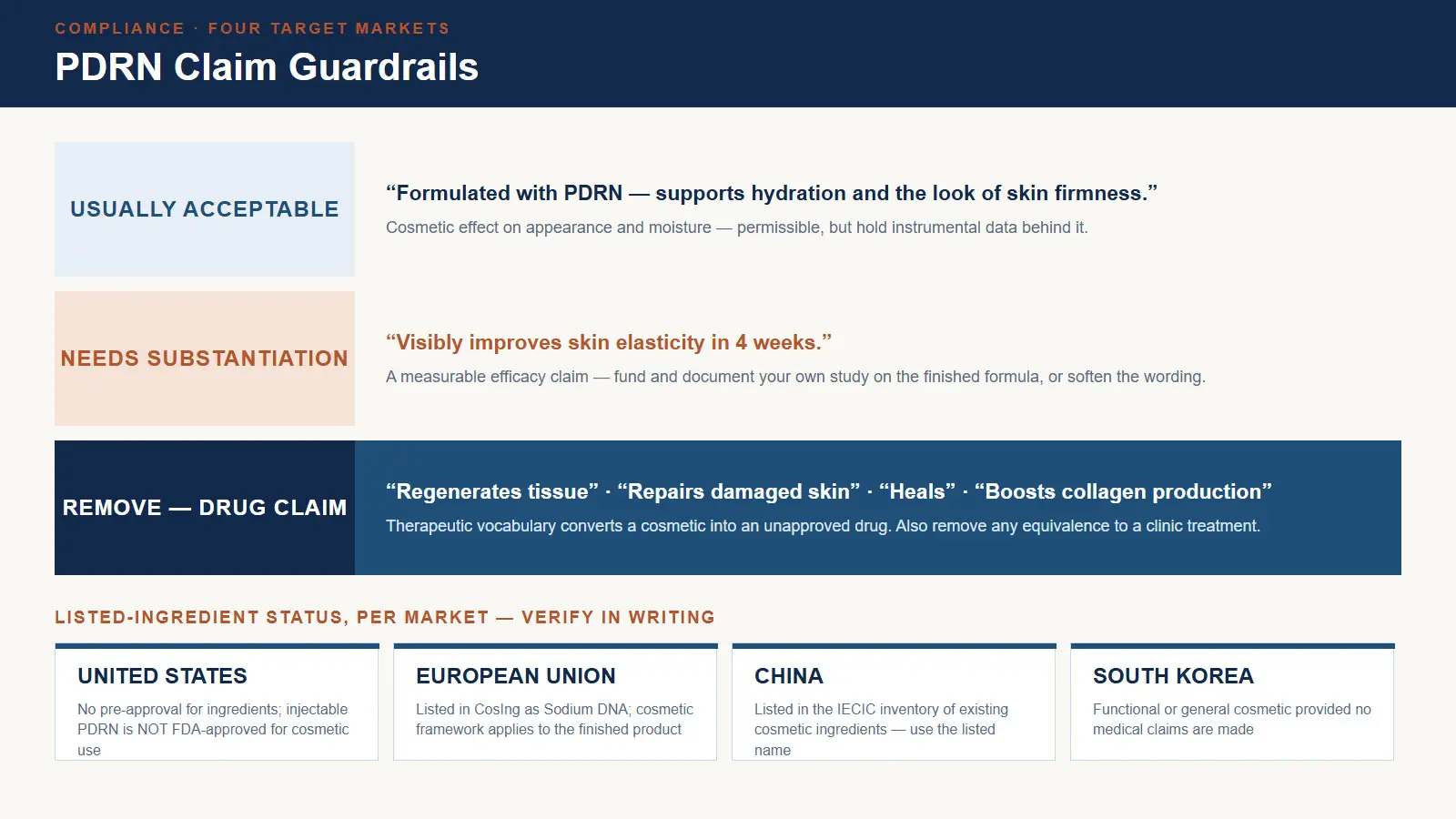
The ingredient is broadly permitted — listed in the EU CosIng database as Sodium DNA and in China's IECIC inventory — while the claim line is narrowly constrained, because the persuasive PDRN evidence lives in the injectable category, which a cosmetic product is not.
In all global cosmetic jurisdictions, brand owners must avoid claims regarding cellular regeneration, medical wound healing, deep tissue repair, or medical skin remodeling. Permissible language describes cosmetic effect on appearance and moisture: supports hydration, the look of firmness, visible tone evenness — each backed by instrumental data on your finished formula.
- INCI: Sodium DNA (listed)
- Claims: hydration, look of firmness
- MoCRA Facility & Product Listing ready
- Prohibited: "DNA Repair", "Wound Cure"
- Prohibited: Injectable comparisons
- Listed in CosIng as Sodium DNA
- Full PIF dossier & CPSR Part A/B
- Claims: hydration, visible tone evenness
- Prohibited: healing or regeneration language
- Prohibited: SCCS unapproved bio-claims
- Listed in the IECIC inventory — use the listed name
- Filing obligations apply to the finished product
- Standard filing claims: Moisturizing, soothing
- Prohibited: "Medical grade", "Regeneration"
- Prohibited: Uncertified whitening claims
- Topical PDRN treated as functional or general cosmetic
- The condition: no medical claims made
- Claims: hydration, look of firmness
- Prohibited: "injectable results" or skin-booster comparisons
- Prohibited: Clinical wound repair labels
Acceptable
supports hydration and the look of skin firmness
Needs substantiation
visibly improves elasticity in 4 weeks - own instrumental data
Remove
regenerates tissue, repairs damaged skin, heals, boosts collagen production - drug claim risk
Market status: US - injectable PDRN is not FDA-approved for cosmetic use · EU - listed in CosIng as Sodium DNA · China - listed in the IECIC inventory · Korea - cosmetic if no medical claims.
Skincare OEM/ODM Manufacturing Landscape
A transparent comparative reference for procurement officers evaluating large multi-category contract manufacturers versus dedicated agile biotech skincare partners.
| Evaluation Dimension | FKY Biotech (Skincare Specialist) | COSMAX (Verified Benchmark) | Other Industry Peers (General Knowledge) |
|---|---|---|---|
| Establishment / Heritage | 15+ Years Specialized Skincare R&D | Founded 1992 (South Korea) | NOX Bellcow (Guangzhou), Kolmar (Korea), Intercos (Italy) |
| Audit / Verification Status | Verified Factory Dossier | Official Public Records | Peer Benchmark Reference |
| Global Regulatory Certifications | FDA Registered, GMPC, ISO 22716 Certified | Full Corporate Global Accreditations | Global Enterprise Certifications |
| Cleanroom & Plant Capacity | 20,000+ m² Facility / Class 100,000 Cleanroom | Multi-National Manufacturing Plants | Large-scale industrial cosmetic facilities |
| Category Specialization | Sheet & Hydrogel Masks, Serums, Bio-Creams | Full-Category ODM / OBM | High-capacity mask and makeup manufacturing |
| Service Model & Sizing | Agile Private Label, Custom PDRN Active Formulations, Flexible MOQs | Turnkey OBM Solutions (Enterprise Focus) | Massive Scale Industrial Batch Production |
| Procurement Flexibility | Fast Sampling (7 Days) / Low Batch Pilots (Subject to quote) | Standard High-Volume Enterprise MOQs | Strict high volume commitments |
Strategic Sourcing Summary for Brands
While global mega-conglomerates provide comprehensive enterprise OBM planning for multinational accounts, agile specialized manufacturers such as FKY offer beauty startups, indie brands, and clinical dermatological lines deeper technical nimbleness, rapid formulation iterations and flexible pilot MOQs.
Pharmaceutical-Grade Manufacturing Facility Standards
Precision active ingredients require strict environmental controls to preserve bio-activity and prevent particulate contamination.
Class 100,000 Cleanroom (ISO 8)
Automated air handling systems maintaining controlled temperature and humidity, positive differential pressure and multi-stage HEPA filtration to eliminate airborne microbial particles.
EDI Deionized Ultrapure Water
Multi-stage Reverse Osmosis (RO) paired with Continuous Electrodeionization (EDI), delivering the ultra-pure water process that keeps metal ions from destabilizing PDRN chains.
Homogenizers with Nitrogen Blanketing
High-shear emulsifiers equipped with sealed nitrogen purge chambers, preventing oxidative decomposition of sensitive bio-active ingredients during pilot and full-scale manufacturing.
Frequently Asked Questions
Q1: Can your factory formulate PDRN serums, ampoules and masks?
Yes. We formulate PDRN across the five formats that carry the active in retail - sheet mask, hydrogel mask, serum/ampoule, capsule cream and overnight leave-on gel - with a preservation strategy designed for a large, water-soluble, nucleic-acid active.
Q2: What PDRN specification should we specify in our RFQ?
State the molecular weight distribution (a band such as ~100-250 kDa for serums), origin and route (animal-derived, botanical or recombinant), use level, and whether you need a delivery system - plus MOQ structure, sample policy and terms. A reply that omits these fields is not yet a quotation.
Q3: What is the MOQ for a PDRN product?
Our standard starting point is 1,000 pcs. In the quotation we state the bulk and filling minimums separately - for a first launch, the active's own purchase minimum is often the binding constraint.
Q4: How long do development samples take?
Samples in 7 days, prepared by our R&D lab for quality, stability and sensory evaluation before you commit to a campaign.
Q5: How do we avoid drug claims on PDRN packaging?
Build a claim register before the artwork: keep cosmetic-effect language such as "supports hydration and the look of firmness", fund substantiation for measurable claims, and remove therapeutic vocabulary - "regenerates tissue", "repairs damaged skin", "heals" - plus any equivalence to a clinic treatment.
Q6: What evidence can the factory support for the finished formula?
Preservation and compatibility data per format, active retention at end of shelf life, and a menu of instrumental testing (hydration, TEWL, elasticity) - with the permitted-use terms for any supplier data stated in writing.
Request a PDRN Specification Assessment & Sample Kit
Connect directly with OEM/ODM formulation specialists. Receive custom PDRN sample prototypes customized for your target market and skin-type positioning within 7 business days.