The Signal: Volume Is Growing Faster Than Value
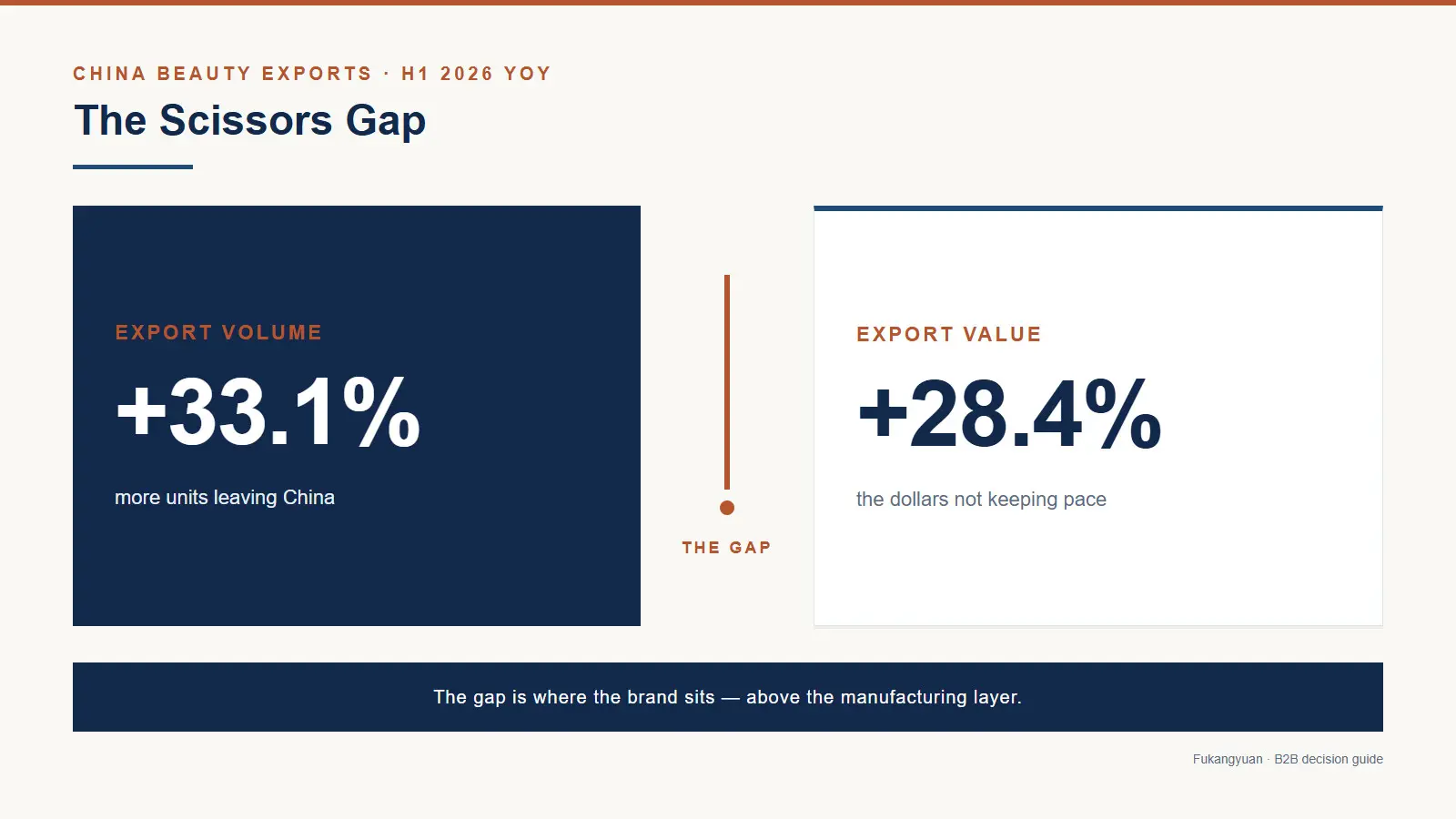
China's beauty exports are compounding — and the shape of the growth matters more than the headline. Through the first half of 2026, export value was climbing at 28.4 percent a year while export volume climbed at 33.1 percent: the scissors gap the industry report flags in one sentence — scale is growing, but unit value is not rising with it. Where that missing value sits is the whole question for a brand buying from China.
| Data point | Value | Source |
|---|---|---|
| 2025 beauty export value | About US$7.82B, +9.2% year on year | KPMG 2025 China Beauty Market Industry Report |
| H1 2026 export value | US$4.577B, +28.4% year on year | 2026 China Beauty Going-Global Report (Wu Xiaobo channel excerpt, 2026-09-28) |
| H1 2026 export volume | +33.1% year on year | Same report |
| US share of export value | 18.7 percent — a large part of it packaging and intermediates, not finished brand goods | KPMG 2025 report |
| US category growth | Sunscreen +19% · body care +16% · hair essences near +60% · premium colour only +3% | Circana, via the same report |
Source: 2026 China Beauty Going-Global Report (Wu Xiaobo channel excerpt, 2026-09-28); KPMG 2025 China Beauty Market Industry Report; Circana category data as cited in the report. Figures as published by the cited sources.
What the Scissors Gap Means for Your Brand
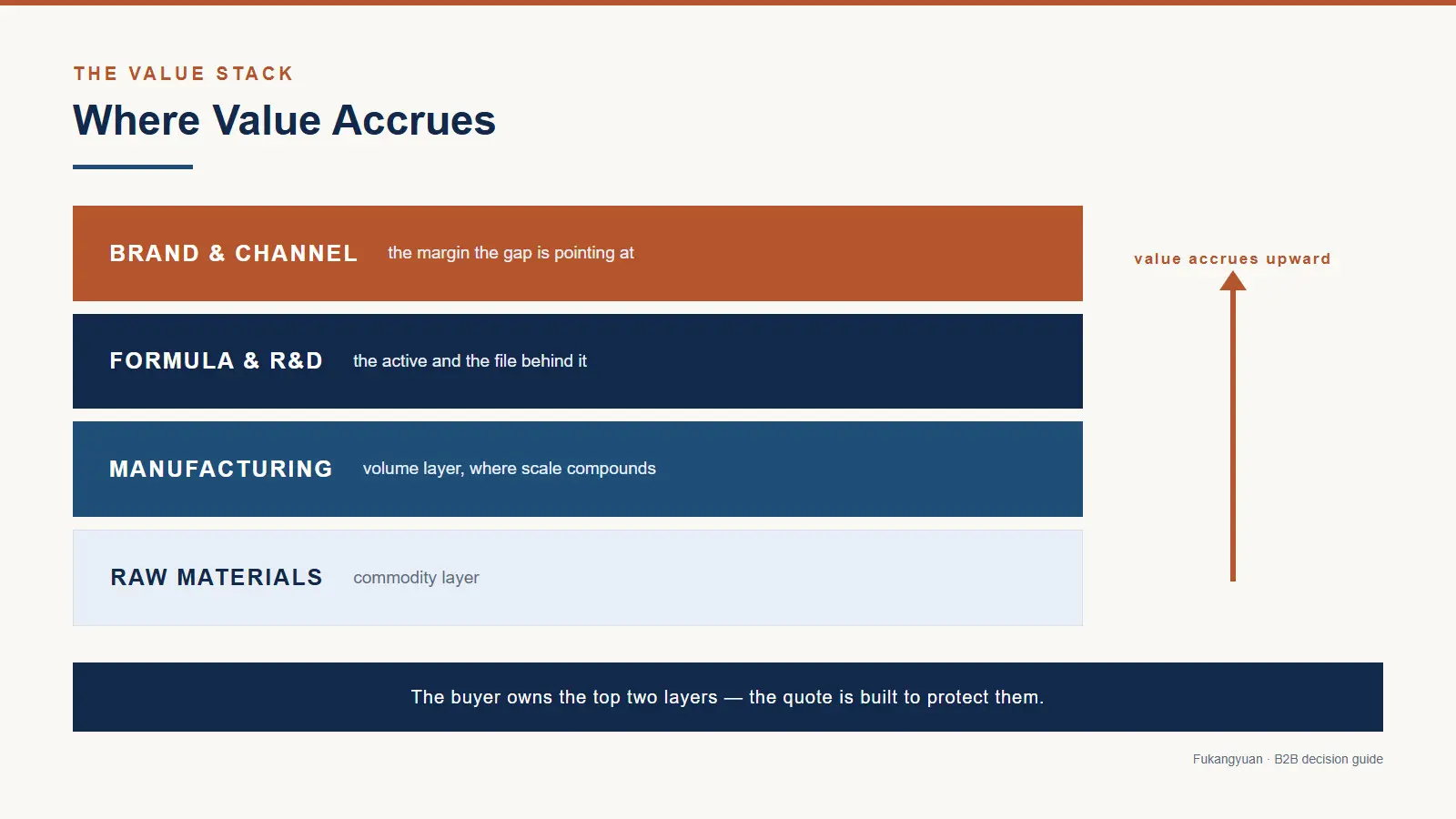
The gap is not a supply-chain problem — it is a map of where value accrues. Three readings, in the order a buyer should use them.
The value sits above the manufacturing layer — Volume that grows faster than value means the marginal dollar is being earned in formulation, brand and channel — the layers your brief controls. Buying flexibly is how a first batch keeps those layers yours instead of paying to learn them.
Demand is moving to problem-solving — The report's own line: consumer demand is shifting from "looking good" to "solving problems" — functional categories, and functional categories run on fast R&D, flexible production and multi-SKU small-batch launch. That is the capability set the report names as the China supply chain's advantage zone.
The category order tells you where the SKU earns — In the US structure above, sunscreen, body care and hair essences are growing while premium colour barely moves — the pilot SKU should sit where the demand is, not where the shelf is crowded.
The Capability Stack: Small-Batch, Multi-SKU, Fast Launch
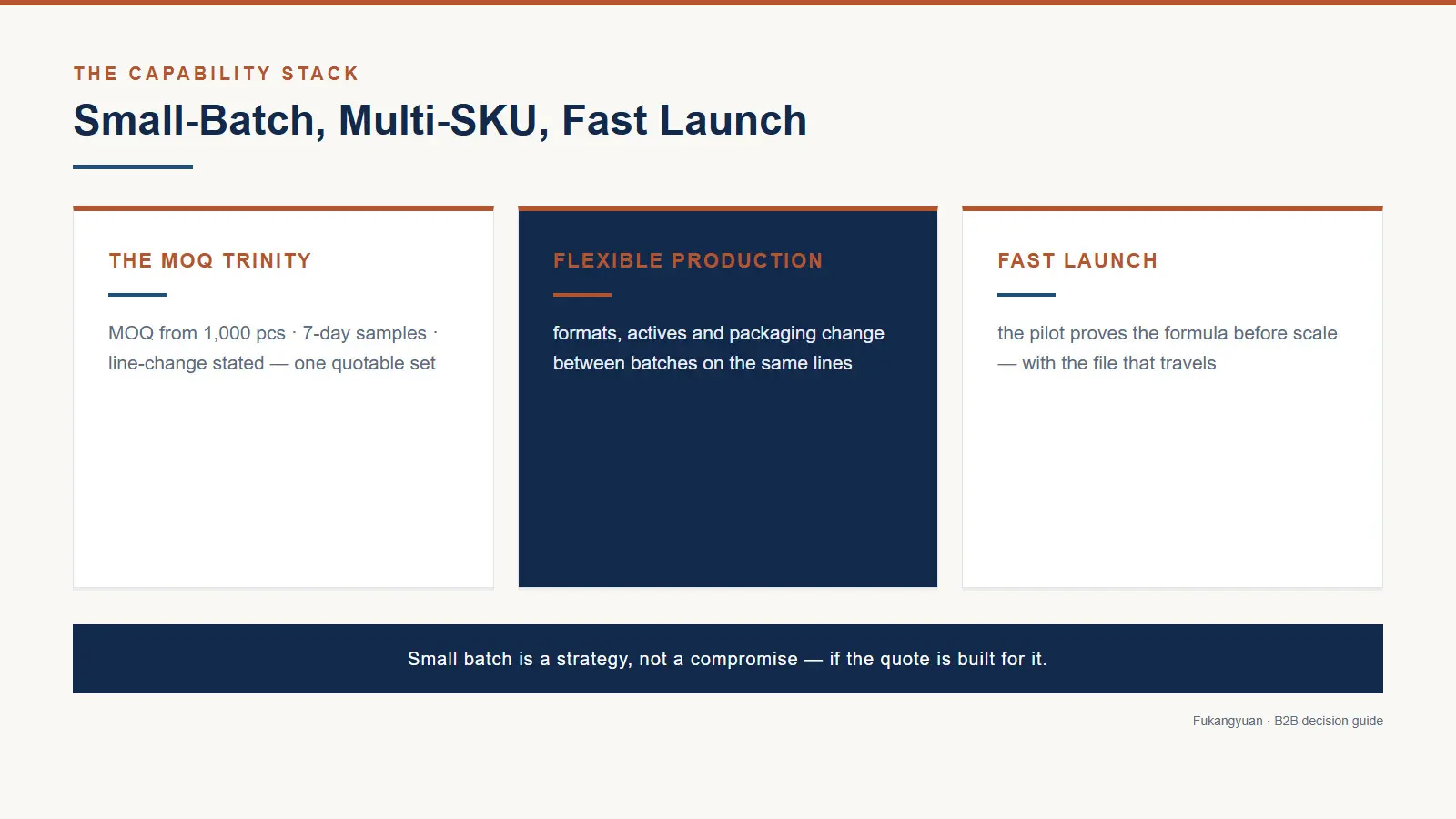
"Flexible" is a word factories love and buyers should interrogate. The honest version has three named parts — and each one is a field in the RFQ, not an adjective on the brochure.
The MOQ trinity
Minimum order, sampling and line-change are one quotable set — the trinity. A factory that states all three up front (MOQ from 1,000 pcs as the standard line, 7-day development samples, line-change stated per format) is showing you the quote structure; one that hides any leg is building it after you sign.
Flexible production
Formats, actives and packaging change between batches on the same lines — a mask line that runs sheet, hydrogel and gel, a tube line that swaps essences. Flexibility is a production fact: which formats and actives the facility actually runs, and how the die and the line-change are handled.
Fast launch
The pilot proves the formula before scale: development samples in 7 days, a batch tier for the pilot, and a documentation file that travels with the goods so the small batch is not a compliance shortcut.
How to Quote a Small-Batch Order: The Self-Consistent Structure
A small batch costs more per unit — setup, formula lock and documentation are spread over fewer pieces. The discipline is not to hide that; it is to build the quote so the structure is visible and the sequence pays for itself. Four moves:
Price the tiers, not the single batch — Pilot, standard and scale sit on one unit-price curve. The quote shows all three tiers so the small batch is a step, not a stranded decision.
Use stock packaging for the pilot — Pre-approved stock packaging removes tooling from the pilot's cost line — the fastest path to a first market test, with custom packaging priced as its own tier move.
Keep line-change a stated line — Where a format or essence swap happens between SKUs, the line-change is named in the quote — a mechanism line, not a surprise. The anatomy of an OEM quote and its seven levers is the full structure.
Sequence the batches — Pilot validates formula, feel and documentation; the second batch validates demand; scale comes with data, not with hope. The trinity is what makes the sequence executable at small size.
B2B Sourcing & Procurement Parameters
MOQ Policy
from 1,000 pcs — flexible by formulation & packaging
Sample Policy
7 days — R&D lab prototyping for quality, stability & sensory
Shipping & Incoterms
FOB · CIF · EXW — Shanghai & Guangzhou
Production Lead Time
fast-track with pre-approved stock packaging
Specific values finalized during official quotation.
Where to Point the First Small Batch
The first small batch should buy information, not shelf space. Three targeting calls, in order:
Pick the functional category with demand — The growth order in the table above is the shortlist: a problem-solving SKU in a growing category, not a me-too in a flat one. Where the active is the story — an ingredient like PDRN — the formula file carries the claim: see how PDRN works in OEM formulas.
Pick the format with the most flex — Mask formats are the flexible core of the line — sheet, hydrogel, gel on shared infrastructure: the format and specification fields that make a mask line flexible.
Pick the model that keeps the layers yours — Private label keeps the formula and the brand in your hands from batch one: private label vs OEM vs ODM — which model fits your brand.
Frequently Asked Questions
Does a small batch really cost more per unit?
Yes — setup, formula lock and documentation are spread over fewer pieces. The discipline is the quote structure: tiers shown up front, stock packaging on the pilot, line-change named as a line — so the small batch is a priced step, not a premium with no map.
How low can the first batch go?
The standard line is MOQ from 1,000 pcs, and it moves with formulation and packaging — the quote states the exact line for your SKU, including the tier structure above it.
What does multi-SKU flexibility actually cover?
Formats, actives and packaging across batches on the same lines — a mask line that runs sheet, hydrogel and gel, or a tube line that swaps essences. Die-cutting and line-change are spec fields: state the SKU plan in the brief and the quote reflects it.
How fast does a new SKU move from brief to sample?
Development samples run the standard 7-day line from an agreed brief; mass-production lead time is set per batch size and packaging in the official quotation — the durations that matter are stated, the ones that don't are not guessed.
Exports are growing — isn't the supply side crowded?
Volume growth means capacity exists; the scarce part is flexible, documentation-ready production at small size. That is what the 12-point checklist for verifying whichever factory you quote is for.
First-time importer — start small or start at scale?
Start with the pilot tier: it validates formula, feel and documentation before the scale commitment, and the batch tiers make the sequence cheap to execute. The model choice — who holds the formula — is made in batch one, not batch five. private label vs OEM vs ODM — which model fits your brand
Send Your SKU Plan — Get a Small-Batch Quote with Tiers
Submit your technical formulation specifications or product requirements. A dedicated product manager on every RFQ — reply within 24 hours.
Related OEM guides: OEM Cost Breakdown 2026 | 12-Point Factory Audit Checklist | Top OEM Mask Manufacturers in China | Private Label vs OEM vs ODM