
The Format Week: Four Prestige Launches, One Format
In one week in October 2026, four prestige beauty brands launched sliced hydrogel under-eye patches — a format that had been led by value packs — at premium prices, with broad media attention. That is not a forecast. It is the category telling you where the shelf is moving, and what the new entry point looks like for a brand planning an eye-patch line.
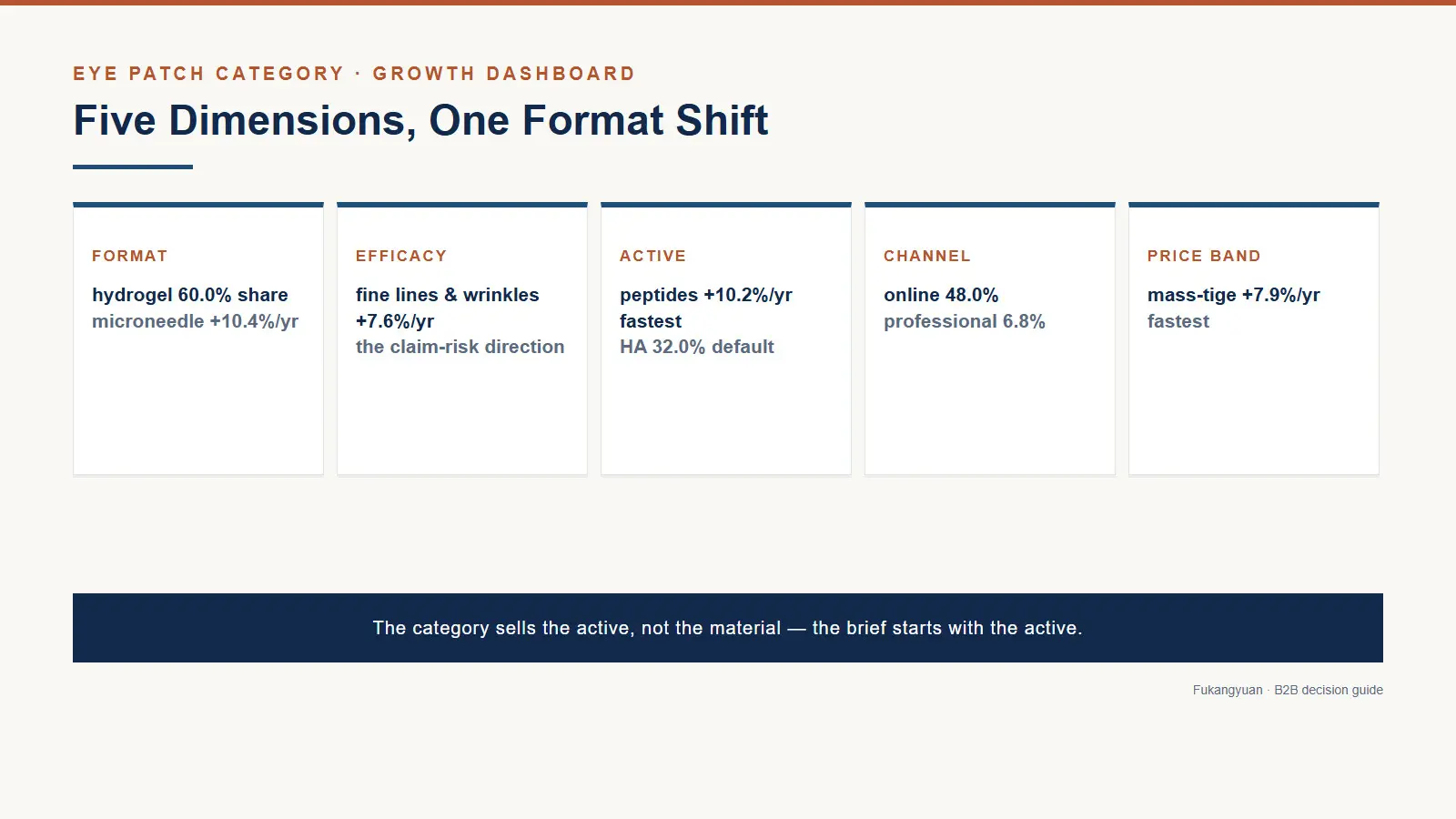
The numbers behind the week come from a commercial research publisher's category file, captured in full text and graded as secondary compilation — use them as the structure read, not as a market share verdict. The table is the five dimensions: format, efficacy, active, channel and price band.
| Dimension | Fastest growing | Share & structure | Buyer implication |
|---|---|---|---|
| Format | Microneedle 10.4 percent per year | Hydrogel 60.0 percent share, the lead; sheet and fiber 4.7 percent | Hydrogel stays the core format; sliced is its premium cut |
| Efficacy | Fine lines and wrinkles 7.6 percent per year — sold as firming | Dark circles and brightening 35.0 percent share | The growth direction carries claim risk — section 4 is the map |
| Active | Peptides 10.2 percent per year | Hyaluronic acid 32.0 percent share at 6.4 growth; collagen 6.7 percent | The active is the selling point, not the material |
| Channel | Online 8.5 percent per year | Online 48.0 percent share; professional 6.8 percent | The professional channel is a lower-MOQ B-side entry |
| Price band | Mass-tige 7.9 percent per year | Mass 45.0 percent share; premium 6.9 percent | Mass-tige is the key interval for quote capability |
| Market size | US$1.3B in 2025 toward US$23.9B by 2034, 7.0 percent per year | Single source, one defined scope — read with the scope line | The size figure is one of two circulating scopes — cite the scope |
Source: Dataintelo Eye Patches & Masks Market report (updated 2026-10-10), captured in full text; figures as published. Scope covers under-eye patches and eye masks in hydrogel, sheet and fiber, dissolving microneedle, reusable silicone and cooling gel formats; sleep masks, steam masks and full-face masks are excluded. A second commercial source circulates a smaller scope for the same category — the scope definition travels with any citation.
Sell the Active, Not the Material: The Category Shift
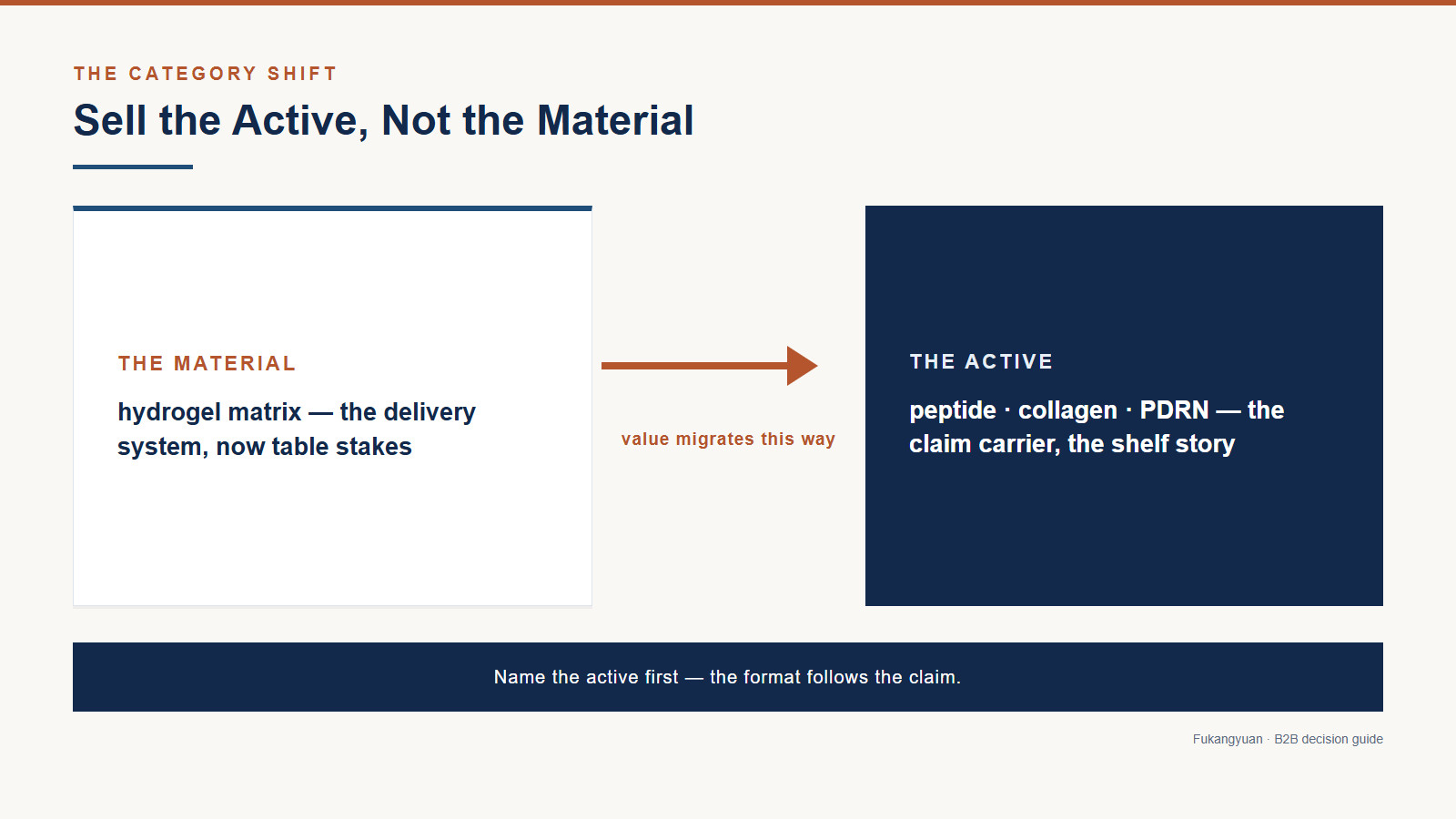
The same report's sharpest line: brands now sell patches by the active ingredient rather than the material. The hydrogel matrix became table stakes — the delivery system — while the peptide, the collagen, the PDRN became the shelf story. Three consequences for a brief:
Hyaluronic acid is the default, not the claim — At 32.0 percent share and 6.4 growth, HA is the baseline ingredient of the category — present in almost every formula, and no longer the reason a buyer picks a line.
Peptide is the growth vector, collagen is the proven one — Peptides grow at 10.2 percent per year — the fastest active in the category; collagen at 6.7 percent runs above the category average as the ingredient buyers already trust. A peptide-forward line with a proven active underneath is the honest shape of the brief. Where an active like PDRN carries the story, the formula file carries its weight: see how PDRN works in OEM formulas.
The matrix is specified, not sold — The hydrogel matrix is a specification field — weight, feel, fit — not the headline. The headline is the active and the evidence behind it. the hydrogel matrix specification
The Formats: Sliced Hydrogel, Microneedle, Reusable Silicone
Three formats carry the category. Two are the production core, one is the evaluation direction — the honest map, which is the one a quote can be built on.
Sliced hydrogel — the premium cut
Individual patches cut to the under-eye shape instead of a full sheet: the format the prestige launches standardized, and the one where active concentration, fit and shelf read all point the same way. It runs on the shared hydrogel infrastructure — the die changes, the line does not.
Dissolving microneedle — the growth format, the evaluation direction
At 10.4 percent per year the fastest format in the category, with a delivery mechanism that changes the claim conversation. Capacity for it is an evaluation decision per brief — the quote states what the line runs today, and what it is being built for.
Reusable silicone and cooling gel — the repeat-use position
The durable-format corner of the category: a device the buyer keeps, repositioned around cooling and repeat use. A different packaging and QC story than the disposable formats — named in the brief, quoted as its own line.
The Claim Boundary: Where Growth and Rules Collide
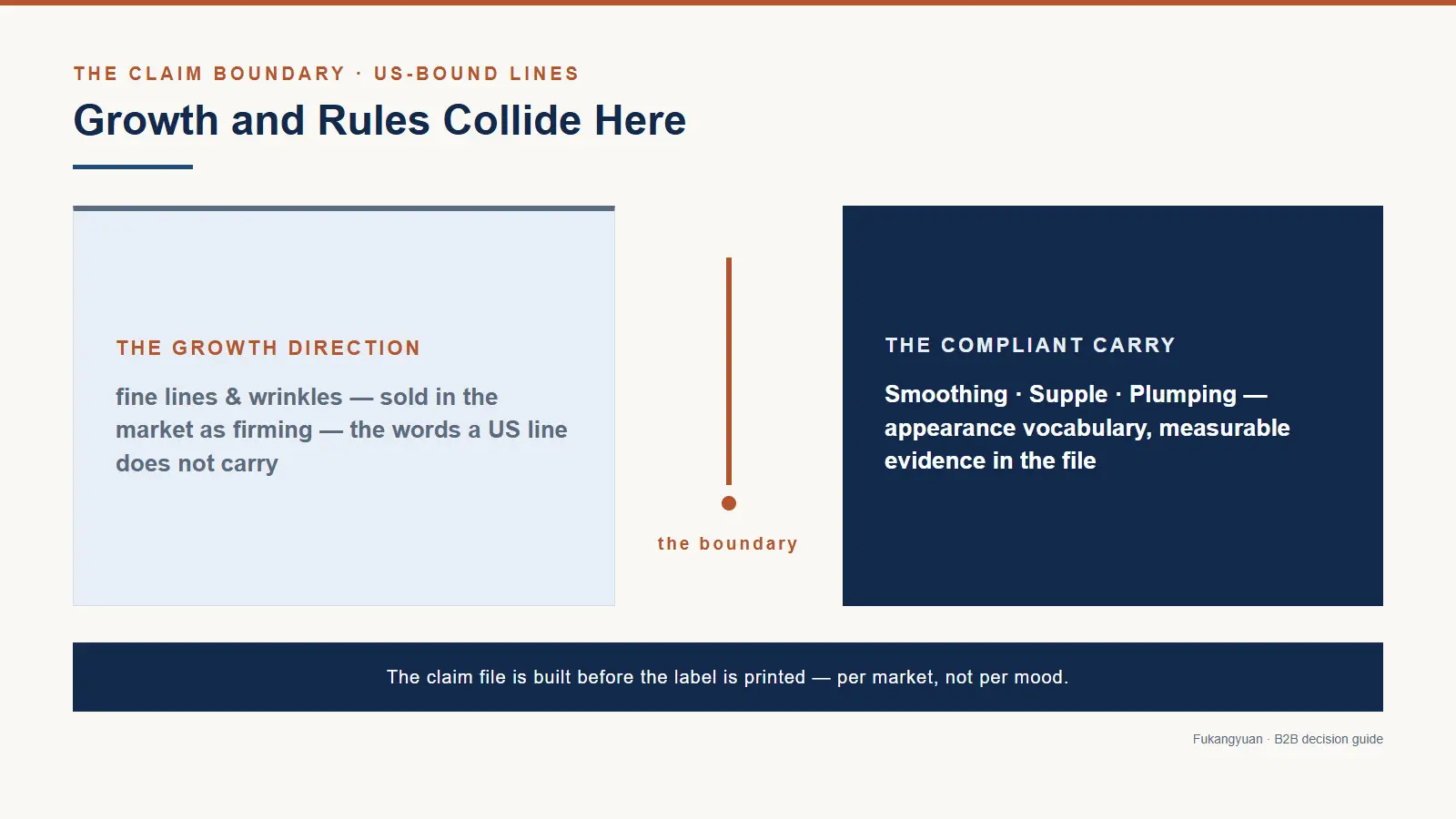
The fastest-growing efficacy in the category — fine lines and wrinkles, sold in the market as firming — is exactly the vocabulary the US market rules push out. The collision is the business decision: follow the growth into a claim you cannot carry, or carry the same demand in the vocabulary you can. The second one is the product strategy.
The boundary, stated as it runs for a US-bound line: the drug-suggestion words — firming, tightening, anti-aging, wrinkle treatment — are the avoidance set. The demand they describe is carried in appearance vocabulary: Smoothing, Supple, Plumping — and the difference is built on measurable evidence, not adjectives: water-content readings, firmness meter data, the de-puffing time window. The claim file is per market, not per mood: the EU runs its own rulebook — the compliance file for a market-bound order.
Name the evidence before the adjective — Every claim in the label has a measurement behind it — the protocol is agreed in the brief, the data sits in the file, the label quotes the result within its market's vocabulary.
The claim file is a deliverable — Per-market claim mapping — which words carry which evidence in which market — is part of the order documentation, delivered before the label is printed, not after the first question.
The growth direction stays in scope — Avoiding a word is not avoiding the demand: smoothing, supple and plumping answer the same under-eye brief the category is growing on — the file is what makes it defensible.
The MOQ Benchmark: 100 Pieces, and the Tier Structure That Answers It
The same report cites the competitive benchmark twice: Korean ODM producers supply the format at a 100-piece minimum order — the bar a retailer or influencer can launch a patch line against with very little capital. And it puts the scale of the channel in one sentence: the ten leading under-eye patch listings on Amazon each sell between 10,000 and 90,000 units a month, the leader near 90,000.
The honest position on the benchmark: the 100-piece bar sets the expectation the pilot conversation will be priced against. The standard line here is MOQ from 1,000 pcs with the tier structure above it — pilot, standard, scale — and the quote states the exact line per format, including where a smaller first run would or would not sit. A factory that quotes the 100-piece bar against a line it cannot run is the one that fails the first batch, not the first order. the small-batch tier structure for a pilot order the anatomy of an OEM quote and its seven levers
B2B Sourcing & Procurement Parameters
MOQ Policy
from 1,000 pcs — flexible by formulation & packaging
Sample Policy
7 days — R&D lab prototyping for quality, stability & sensory
Shipping & Incoterms
FOB · CIF · EXW — Shanghai & Guangzhou
Production Lead Time
fast-track with pre-approved stock packaging
Specific values finalized during official quotation.
Where to Point the First Eye-Patch Line
The eye area is the fragmented-time category — the use moment is short, repeated and specific: the late night, the travel day, the recovery window after a treatment. Three targeting calls, in order:
Pick the professional channel for the first run — The professional segment is the lower-MOQ B-side entry in the channel data — the salon and treatment positioning carries the format's premium read without the mass-shelf price war.
Pick the mass-tige interval for the price — Mass-tige is the fastest-growing price band — the quote capability that matters is the one that lands there, not the one that chases the top shelf.
Pick the active-led hero SKU — One hero — peptide-forward, proven-active underneath — with the claim file built per market. The range grows from the hero, not around it.
Frequently Asked Questions
What is a sliced hydrogel eye patch?
Individual under-eye patches cut from the hydrogel matrix instead of a full sheet — the format the prestige launches of October 2026 standardized. The slice concentrates the active on the target area, fits the contour without bridging, and reads as premium on the shelf.
Should the brief lead with the active or the format?
With the active — the category shifted to selling patches by the active ingredient rather than the material. The hydrogel matrix is specified as the delivery system; the peptide, collagen or PDRN carries the claim and the story.
The fastest growth is anti-aging efficacy — can we claim it?
The growth direction — fine lines and wrinkles, sold in the market as firming — sits in the drug-suggestion vocabulary a US-bound line avoids. The demand is carried in appearance terms: Smoothing, Supple, Plumping — with the measurable evidence in the file, per market. The claim file is built before the label is printed.
What does the 100-piece MOQ benchmark mean for my order?
It is the competitive bar the pilot conversation is priced against. The standard line is MOQ from 1,000 pcs with the tier structure above it — the quote states the exact line per format, and a smaller first run is priced as a step, not a premium with no map. The small-batch tier structure for a pilot order is the full mechanics.
Are microneedle eye patches available?
Microneedle is the fastest-growing format at 10.4 percent per year — capacity for it is an evaluation decision per brief. The RFQ names the format; the quote states what the line runs today and what it is being built for.
Which channel should a first eye-patch line target?
The professional channel runs on lower-MOQ entry and treatment positioning; online carries 48.0 percent of the category and is where the Amazon-scale listings live. The channel choice sets the MOQ line, the packaging format and the claim file — name it in the brief.
Send Your Eye-Patch Brief — Get a Format Quote & Claim File
Submit your technical formulation specifications or product requirements. A dedicated product manager on every RFQ — reply within 24 hours.