
What Is PDRN Skincare? A Brand Owner's Guide
Ask what is PDRN skincare and you will get the same answer everywhere: a DNA fragment extracted from salmon sperm, studied in regenerative medicine, now popular in serums and masks. That answer is accurate and almost entirely useless to the person who has to decide whether to put it on a purchase order.
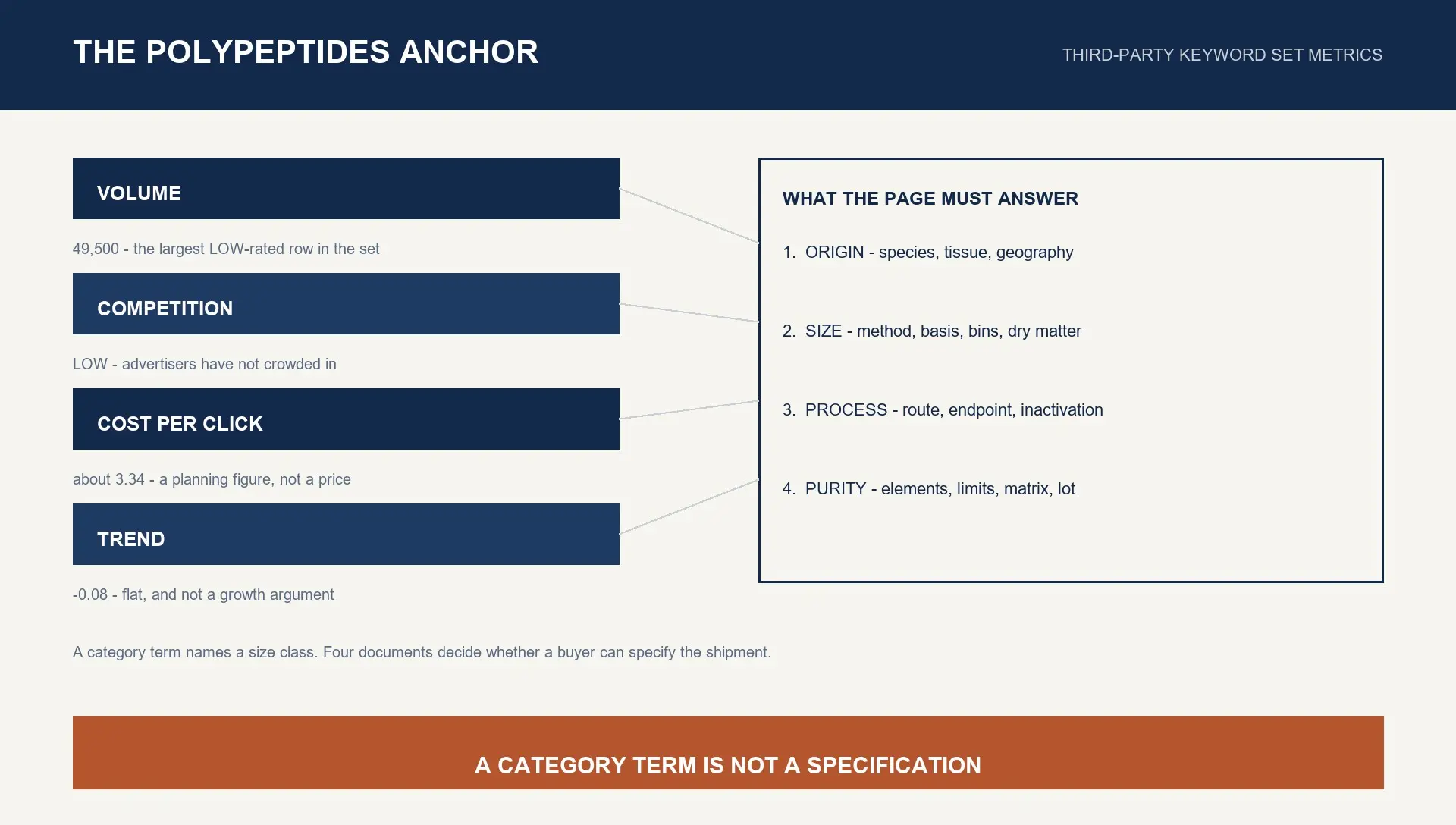
The reason is that the question brand owners actually face is a different one. It is not "what is this ingredient" but "if I launch it, which specification do I buy, at what use level, in which format, with which claim, from which supplier, and at what cost of evidence?" Those six sub-questions are commercial, not pharmacological, and none of them is answered by a mechanism diagram.
This matters more for PDRN than for most actives because the ingredient arrives with a regulatory and evidence inheritance that does not transfer to a cosmetic product. PDRN is a registered drug in at least one major market, with a clinical literature built on injection rather than topical application. A brand that borrows the injectable story to sell a cream is, in effect, importing both the credibility and the liability — and only one of those is usually intended.
So this guide is deliberately written from the purchase-order side of the desk. Section one sets out the five filters that decide whether a PDRN line is worth launching at all. Sections two through five cover the specifications that determine whether the product can work: raw-material source, molecular weight and delivery, format and use level. Sections six to nine cover what it costs, how the market is being sized (and why the published numbers disagree by more than fifty times), where the claim line sits in four target markets, and how to score a supplier. The closing sections give a twelve-month roadmap, a set of buyer actions, and six questions we are asked most often.
One framing note before the detail. PDRN is a poor candidate for a "me too" launch and a good candidate for a specification-led launch. The ingredient is not scarce, the claims are constrained, and the differentiation available to a brand sits almost entirely in the parts nobody puts on the front of the pack: molecular weight, delivery system, use level justification and claim discipline. That is what the rest of this article is about.
What is PDRN skincare for a brand owner: five filters before you launch
The first question is not whether PDRN is trending. It is whether your brand can pass five filters, and the filters are designed to fail early rather than to encourage a launch.
| Filter | What it asks | Passes when | Fails when |
|---|---|---|---|
| 1. Category fit | Does the format you already sell suit a large-molecule, water-soluble active? | You sell masks, ampoules, essences, gels or creams with a water phase | Your hero products are anhydrous oils, balms or powder formats |
| 2. Claim room | Is your planned marketing sentence defensible without drug language? | You are prepared to sell hydration, barrier support and visible tone evenness | Your pitch depends on repair, regeneration or wound healing |
| 3. Evidence budget | Can you fund your own topical testing, or will you rely on supplier data? | You can fund at least instrumental hydration, TEWL and elasticity work | You need clinical-grade claims but have no testing budget |
| 4. Format feasibility | Can your dosage form carry enough active and preserve it? | Your system tolerates a preservative strategy compatible with nucleic acids | Your system's preservation or pH window degrades the active |
| 5. Supply access | Can you obtain a documented, consistent specification with a paper trail? | Your supplier provides molecular weight distribution, purity and origin documents | The supplier can only offer "PDRN" as a line item with no specification |
Two failures across five filters should stop the launch; three should stop it immediately. In practice the filters that fail most often in buyer conversations are two and three — claim room and evidence budget — because PDRN's public narrative is unusually rich in outcomes that a cosmetic product cannot legally promise.
The filter that is most often underestimated is five. PDRN is sold at many specification levels, and the same product name can sit under raw materials of very different molecular weight ranges, purity and processing history. A brand that does not specify what it is buying is not buying an ingredient — it is buying a label.
There is one more consideration that is not a filter but a strategic one. Because PDRN is easy to include and hard to differentiate, the ingredient tends to compress into a price war when everyone specifies it identically. Brands that win on PDRN are, in our experience of evaluating formulation briefs, the ones that win on specification and claim discipline rather than on inclusion. Section five is where that differentiation becomes concrete.
What is PDRN made of: the raw-material spec that decides your product
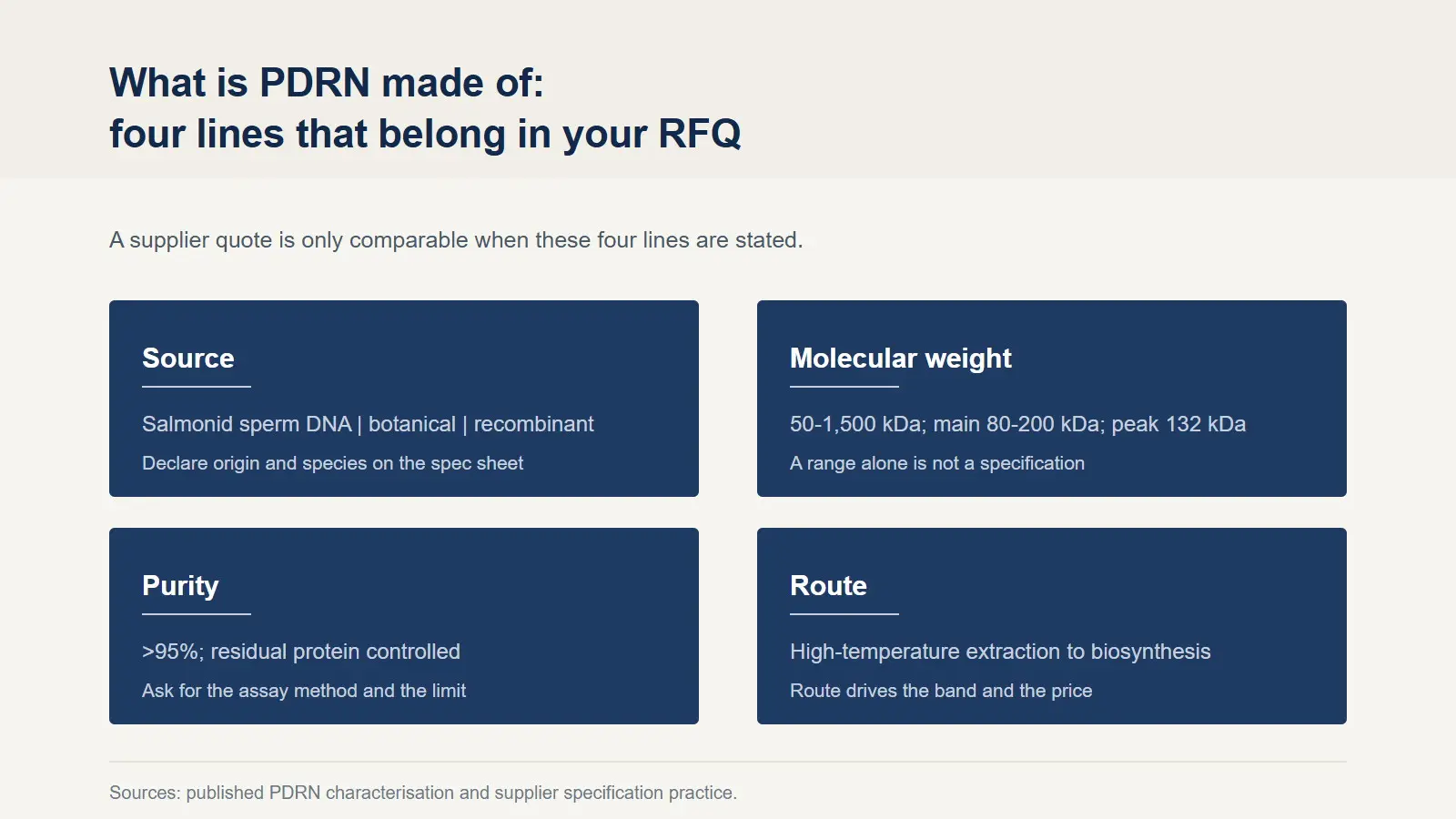
What is PDRN made of is a question with a commercially precise answer, and the precision is the point. PDRN is not a molecule but a mixture of deoxyribonucleotides obtained by controlled purification and sterilisation of sperm DNA from salmonids. The peer-reviewed characterisation most widely cited describes a mixture with molecular weights ranging between 50 and 1,500 kDa, derived from Oncorhynchus mykiss (salmon trout) or Oncorhynchus keta (chum salmon) sperm DNA, most commonly represented in the 80–200 kDa band with a peak at 132 kDa, recovered at more than 95% purity with inactivated proteins and peptides, and composed of roughly 50% double-stranded deoxyribonucleotides (Source: Squadrito et al., Frontiers in Pharmacology, 2017;8:224 — opened access).
Four of those numbers are procurement-relevant rather than pharmacological, and each maps to a document you should be able to demand.
| Specification line | What the reference data says | Why it changes your product | Document to request |
|---|---|---|---|
| Source species / tissue | Salmon trout (O. mykiss) or chum salmon (O. keta) sperm DNA | Sperm cells are chosen because they yield highly purified DNA without peptide, protein or lipid carry-over from somatic cells | Certificate of origin and species declaration |
| Molecular weight distribution | Mixture 50–1,500 kDa; most represented 80–200 kDa, peak 132 kDa | The same "PDRN" label can be supplied at very different size profiles, and size governs penetration | MW distribution curve (GPC or equivalent), not a single average |
| Purity / residual protein | >95% pure active; proteins and peptides inactivated | Residual protein is the immune-reaction and stability risk you are being asked to accept | Batch certificate of analysis with purity and residual protein |
| Structure | Around 50% double-stranded deoxyribonucleotides | Double-stranded content behaves differently in formulation than single-stranded oligonucleotide mixtures — do not assume equivalence | Structural characterisation from the supplier |
| Manufacturing route | High-temperature extraction and purification | Thermal history affects fragment size distribution and batch reproducibility | Process description plus batch-to-batch consistency data |
Two supply-side developments are worth knowing because they change the negotiation. First, plant-derived PDRN has entered the literature and the raw-material market: a 2025 study proposed low-molecular-weight PDRN extracted from peony (Paeonia lactiflora) with reported effects on skin cell proliferation and migration, upregulation of extracellular matrix gene expression, and reduced reactive oxygen species; brown algae and other botanical sources have followed into development. Second, recombinant PDRN (rPDRN) moves production from extraction to biosynthesis. Both routes exist primarily because a meaningful share of the target market will not accept an animal-derived active on ethical, religious or vegan-positioning grounds — and because botanical supply does not depend on a fishery.
For buyers, the practical consequence is simple: "PDRN" alone is not a purchase specification. A quotation that does not state source species or botanical origin, molecular weight distribution, purity, and whether the active is animal-derived or recombinant is not comparable with any other quotation, and any price comparison built on it is meaningless. This is the single most common sourcing error we see on this ingredient, and it is also the easiest to fix: put the four lines into your RFQ as mandatory fields.
There is also an industry-standard development worth citing in supplier conversations. A group standard for cosmetic-ingredient Sodium DNA covering technical requirements, testing methods, inspection rules and labelling and packaging has been published in the Chinese market (T/SDCIA 1019—2025), describing material derived primarily from male fish testes. The value of such a standard to a buyer is not that it certifies any particular supplier, but that it gives you a vocabulary of testable properties — purity, molecular weight, microbiological limits — that you can write into a purchase contract instead of relying on a supplier's adjective.
What is PDRN good for: what the evidence covers, and what it does not
What is PDRN good for is where the industry's language most often outruns its evidence, and the reason is structural rather than dishonest. PDRN's clinical base was built on injection, in a drug context, with endpoints such as wound healing and tissue repair. A retail serum is a topical cosmetic. The two do not share a delivery route, a dose at the target tissue, or a regulatory category, and evidence from one cannot be used to substantiate claims for the other.
It is worth stating the drug status plainly, because it sets the outer boundary of everything you can say. PDRN is described in the pharmacological literature as a proprietary, registered drug with tissue-repairing, anti-ischemic and anti-inflammatory activity, and its clinical development path in Italy dates to regulatory approval for superficial wounds, skin ulcers and dystrophic connective tissue disease. In the United States, injectable PDRN is not FDA-approved for cosmetic use; without that approval there is no federal verification of safety or efficacy for the injectable route (Source: Dermatology Times, "Social Media Mythbusters: PDRN Serums", 2026-07-11). That is a statement about the injectable, not about cosmetic ingredients — and the distinction is exactly the line a brand owner must be able to hold in a marketing meeting.
Sort every candidate sentence into three buckets before it reaches a designer.
| Bucket | Example sentence | Why it sits there | What to do |
|---|---|---|---|
| Acceptable as cosmetic | "Formulated with PDRN; supports hydration and the look of skin firmness." | Describes cosmetic effect on appearance and moisture, consistent with a cosmetic function | Keep, and hold instrumental data behind it |
| Needs substantiation | "Visibly improves skin elasticity in 4 weeks." | A measurable cosmetic efficacy claim; permissible only with your own or properly licensed test data | Fund and document the study, or soften the wording |
| Potentially a drug claim | "Regenerates tissue", "repairs damaged skin", "heals", "boosts collagen production", "promotes cell regeneration" | These describe a therapeutic action and are the vocabulary of the injectable literature, not of a cosmetic | Remove. This wording is what converts a cosmetic into an unapproved drug |
| Comparative to a drug or device | "Injectable-level results", "same effect as a clinic treatment" | Implies equivalence to a regulated therapeutic intervention | Remove entirely |
The middle bucket is where money is actually spent, and it is worth being realistic about it. Because a topical product must show an effect through the stratum corneum at a use level the formula can tolerate, the topical evidence base for PDRN is thinner and slower to build than the injectable one, and a brand that plans to lead with efficacy claims should budget for its own instrumental work rather than licensing a supplier's slide deck.
There is a defensive reason to do that work as well. Supplier data on this ingredient is frequently published as sponsored content in trade media, carrying a disclosure that the content was produced by the sponsor and not independently edited. That does not make the data false, but it means the conclusions have not been through independent review — and a brand that repeats a supplier's comparative claim in its own marketing owns that claim. Request the underlying study report, not the media reprint, and check the permitted-use terms attached to the data before it appears in advertising.
The practical summary for a brand owner is short. PDRN is a legitimate cosmetic ingredient with a credible mechanistic story and a real, growing consumer vocabulary behind it. It is also an ingredient whose most persuasive evidence lives in a category you are not selling in. Treat mechanism as context, treat injected clinical data as off-limits for claims, and treat your own topical testing as the only asset that converts PDRN from a trend keyword into a defensible product.
What is PDRN in Korean skincare: the format playbook you can copy
What is PDRN in Korean skincare is a question about formats, not about molecules. The Korean market's contribution to this ingredient was never the clinical story — that came from regenerative medicine elsewhere — it was the demonstration that a large, water-soluble, preservation-sensitive active could be built into a retail product architecture rather than sold as a clinic service.
Two regulatory features make that architecture portable. In Korea, topical cosmetic products containing PDRN are regulated as functional or general cosmetics provided they do not make medical claims — a conditional category rather than a prohibition. And as a cosmetic ingredient, the material is listed in the EU CosIng database as Sodium DNA and in China's IECIC inventory of existing cosmetic ingredients, which means it is a listed ingredient in two of the world's three largest cosmetics frameworks rather than a new substance requiring a novel-ingredient pathway. Those two facts together explain why PDRN moved into masks and serums quickly and without a regulatory bottleneck, and they are the first thing to verify with your supplier: listed-ingredient status, per market, in writing.
The format playbook itself is narrower than it looks. Five structures carry almost all the PDRN retail presence, and each has a different technical constraint that determines whether the active survives the process.
| Format | Typical use level band for the active | Technical constraint that decides success | Best fit for a brand that |
|---|---|---|---|
| Sheet mask (essence-soaked) | Low to mid | The essence is a single-use, water-based system: preservation must suit nucleic acids, and the substrate draws active away from the skin surface during wear | Already sells masks and wants a fast, low-risk entry |
| Hydrogel mask | Low to mid | Requires the active to survive gel-network formation and a longer wear time; pay-off is sensorial and occlusion-led | Wants a premium, tactile point of difference |
| Serum / ampoule | Mid to high | Highest active load in the assortment, therefore the hardest preservation and stability problem; viscosity must not break on ageing | Wants the ingredient to carry the product story |
| Capsule / encapsulated cream | Mid | Capsules protect the active and stage the release visually, but capsule fill and shell compatibility drive cost and yield | Wants a visible, structural claim in the pack |
| Overnight wrapping / leave-on gel | Low to mid | Long contact time raises the tolerability bar and makes sensory residue a purchase blocker | Wants a routine-building daily product |
Two format trends are worth naming because they show where the retailed versions of this ingredient are heading, without implying any particular supplier's product. The first is the pigmented gel mask, where a coloured hydrogel carrier is used both to signal the ingredient to the consumer and to hold a high-water gel against the skin for longer than a sheet mask allows. The second is the overnight wrapping mask built around a leave-on occlusive gel, which extends contact time and pairs PDRN with a caffeine or similar sensory partner. In both cases the commercial logic is the same: the format, not the active, is what the consumer experiences, and it is also where the technical risk sits.
That inversion is the practical lesson for a brand owner, and it is the point at which the PDRN decision stops being an ingredient decision. If your supplier can source PDRN but cannot solve preservation, stability and sensorial performance in the specific format you want to sell, you have not solved the launch — you have solved the label. When you evaluate manufacturers on this ingredient, ask which of the five structures they have actually run with a nucleic-acid active, what the ageing and compatibility data looked like, and what the active's retention is at end of shelf life. A factory that can answer those three questions for two formats is worth more than one that can quote a lower raw-material price for five.
Molecular weight: the one spec that decides whether your formula can work
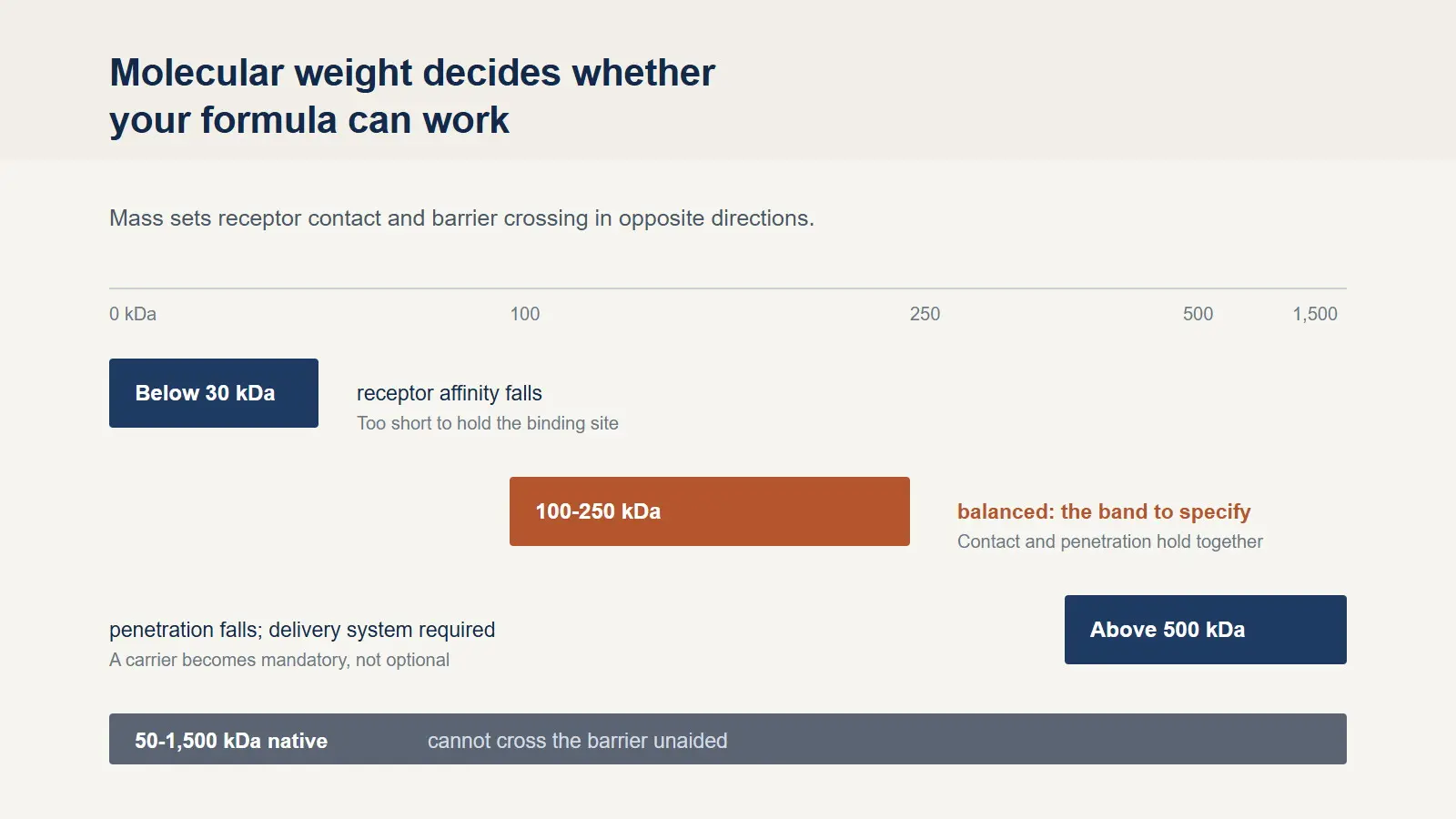
If a brand owner remembers one technical fact from this article, it should be this one: a large-molecule nucleic acid cannot cross intact stratum corneum passively. With a molecular weight range of 50 to 1,500 kDa, native PDRN sits well above the size at which passive skin permeation becomes plausible (Source: industry technical review of PDRN delivery systems, 2026-06-08). A formulation that lists the active but does not address delivery is, in permeability terms, a well-marketed moisturiser.
The size problem has an upper and a lower bound, and both are commercially important.
| Molecular weight band | Penetration reality | Receptor-engagement reality | Commercial reading |
|---|---|---|---|
| Above ~500 kDa | Passive penetration is significantly reduced | Adequate | Buying this band without a delivery system means paying for an active the skin will largely not see |
| Roughly 100–250 kDa | Considered the balanced specification for serums: structural stability, epidermal interaction and texture are traded off most favourably | Adequate | The band to specify if you want one number in your RFQ |
| Below ~30 kDa | Penetration improves | Receptor binding affinity falls, so biological engagement weakens | Smaller is not automatically better; over-hydrolysis is a real failure mode |
| 50–1,500 kDa (native mixture) | Cannot cross the barrier unaided | Intact | Use only with an engineered delivery system, or in formats where barrier crossing is not the mechanism |
The middle band is the answer to the question most brand owners should be asking their supplier: "what molecular weight distribution are you supplying, and why that one?" A supplier who can explain the trade-off between penetration and receptor engagement is a supplier who has characterised the material. A supplier who answers "standard PDRN" has not.
Where native material is used, delivery engineering is not optional. Three routes are in commercial use, with different cost and claim profiles.
| Delivery route | How it works | What it buys you | What it costs you |
|---|---|---|---|
| Encapsulation in nanoliposomes | The active is carried inside lipid vesicles that interact with and cross the barrier | Quantified permeation gain: cumulative skin permeation of PDRN in nanoliposomes was reported 1.22 times higher than free PDRN over 24 hours (Source: PubMed 39995124, 2025) | Additional formulation complexity, a second stability question, and a higher unit cost |
| Size reduction / hydrolysis | The native mixture is deliberately hydrolysed towards the lower band | Better penetration without a carrier; simpler formula | Receptor-engagement loss below roughly 30 kDa; requires a specification you can verify |
| Physical enhancement (microneedle-type structures, spicule systems) | Discrete structures create micro-channels that improve access | Strong sensorial point of difference and a visible technology story | Tolerability and regulatory-adjacent scrutiny; not suitable for sensitive-skin positioning |
The 1.22-times figure deserves to be read carefully, because it is the kind of number that gets stretched in marketing. It is a permeation endpoint measured in vitro over 24 hours for an encapsulated version against the free active — not a clinical wrinkle or firmness result, and not a claim you can transfer to a finished retail product without your own testing. Its value to a buyer is narrower and more useful: it demonstrates that encapsulation measurably changes what arrives at the skin, which is the question you should be asking when a supplier proposes a premium price for a delivery system.
Put those three elements together and the sourcing instruction is short. Specify molecular weight distribution, decide explicitly whether you are buying native plus delivery or hydrolysed and simpler, and require the supplier to state which of the two you are getting in the certificate of analysis. Then design your claim around what the combination can actually demonstrate. The difference between a PDRN product that works and one that merely contains PDRN is almost never the concentration on the label — it is whether anyone in the supply chain was asked to specify the size of the molecule.
Use level, cost structure and MOQ: the seven lines your RFQ must contain
Most PDRN cost conversations start in the wrong place. Buyers typically ask for a price per kilogram of active and compare suppliers on that number, when the actual cost of a PDRN product is dominated by three other items: the delivery system, the stability and compatibility validation, and the dosage-form engineering required to carry the active without losing it.
That is not an argument that the active is cheap. It is an argument that the active is rarely the largest line in the quotation, and that optimising the smallest line while leaving the others unspecified produces a product that will fail at the stability stage and consume the saving several times over.
Seven fields should appear in any PDRN request for quotation. If a supplier's reply omits them, the reply is not yet a quotation.
| # | RFQ field | What to specify | Why it decides cost |
|---|---|---|---|
| 1 | Molecular weight distribution | A band (for example around 100–250 kDa) plus the distribution document | Determines whether a delivery system is required at all — the largest single cost lever |
| 2 | Origin and route | Animal-derived (salmonid sperm DNA) or botanical / recombinant, declared per market | Changes both raw-material cost and which markets and consumer segments are addressable |
| 3 | Use level and its justification | The active percentage at point of fill, with the supplier's rationale | Links directly to unit cost and to whether the claim you want is supportable |
| 4 | Delivery system, if any | Encapsulation, hydrolysed specification, or physical enhancement — stated, not implied | Typically the second-largest cost item and the main driver of sensorial risk |
| 5 | MOQ structure | Bulk (料体) MOQ and filling MOQ stated separately, with the active's own purchase minimum | A low filling MOQ is meaningless if the active has its own, higher, minimum order |
| 6 | Sample policy | Whether development samples are free or charged, the charge, what it covers, and the lead time | Determines the real cost of validating format and tolerability before committing |
| 7 | Commercial terms and evidence | Incoterm (FOB / CIF), lead time for first order and repeat order, formulation ownership, and permitted-use terms for the supplier's efficacy data | The clause that decides whether you can use the data you were given |
Two of those fields deserve commentary because they are where buyers most often lose money.
The MOQ structure field is not one number but two. A manufacturer may be able to run a small filling batch, but if the active itself carries a higher minimum purchase quantity, your effective minimum is the larger of the two. For a first launch, this is frequently the binding constraint, and it is better discovered in the quotation stage than after the formula has been approved. If your brand needs to start genuinely small, the fastest path is usually to begin on a stock or lightly adapted base formula and move to a custom formulation once volume justifies it — which is a formulation-strategy decision, not simply a price negotiation.
The permitted-use field is the one buyers forget. Supplier efficacy data normally arrives with terms attached: who may cite it, in which markets, in which media, and for how long. A brand that builds a launch campaign on a supplier's comparative figure and later discovers the permission does not extend to paid media has an expensive problem. Put permitted use in the same document as price, and negotiate it at the same time.
Finally, treat the delivery-system question as the negotiation's centre of gravity. Value engineering on this ingredient looks like this: if you specify a mid-range molecular weight band that penetrates adequately, you may not need encapsulation at all, and the saving is larger than anything available on the active's per-kilogram price. Conversely, if the format requires long contact time and the claim requires penetration, paying for a delivery system is the only honest route to the evidence. Deciding which of those two situations you are in, before the RFQ goes out, is where a brand owner adds the most value to a PDRN project — and it costs nothing but a specification.
Market sizing: why four respected reports disagree by more than fifty times
Market numbers on this ingredient are a trap, and the trap is worth understanding because it will appear in your investor deck if you let it.
| Source | Scope as described | Value reported | Implied growth |
|---|---|---|---|
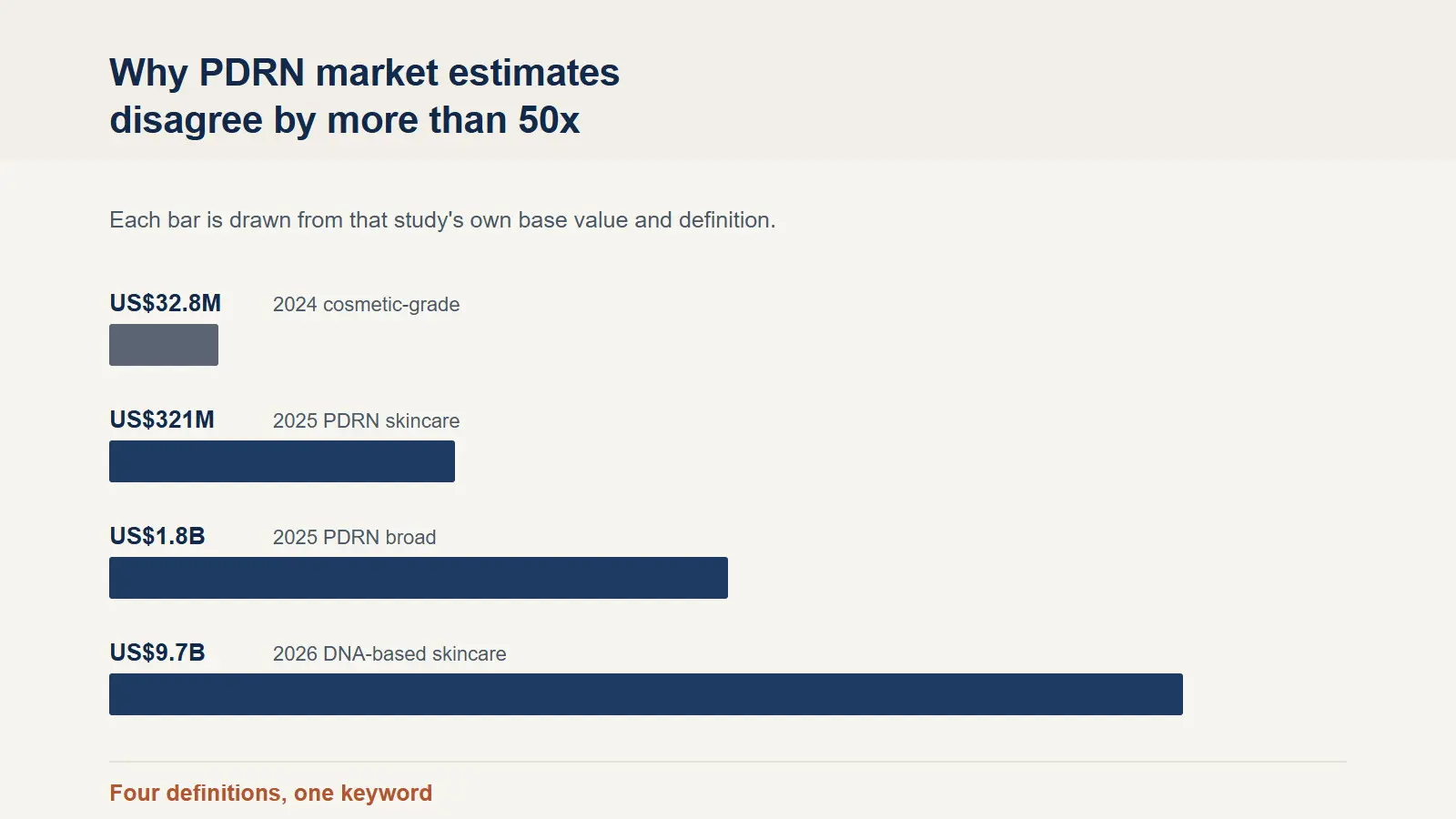
| Cosmetic-grade PDRN market | Cosmetic-grade material | Roughly US$32.8 million in 2024, reaching US$662.5 million by 2032 | 43.3% CAGR |
| Chinese-language consulting estimate | Global PDRN market | About RMB 180 million in 2023, projected RMB 3 billion by 2030 | 43% CAGR (2024–2030) |
| PDRN skincare market (research house A) | PDRN skincare products | US$321.2 million in 2025, US$811.4 million by 2035 | Moderate single-digit-to-low-teens |
| PDRN market (research house B) | PDRN market, broader definition | US$1.8 billion in 2025, US$4.2 billion by 2034 | 9.8% CAGR |
| DNA-based skin care market (research house C) | Entire DNA-based skincare category | US$9.7 billion in 2026, US$13.9 billion by 2033 | Mid single-digit |
Read the table as a buyer rather than as a marketer and three things stand out.
First, the spread is roughly fifty-fold for overlapping years. A 2025 figure of US$321 million and a 2025 figure of US$1.8 billion differ by a factor of about 5.6 within a single year — and if you set the 2024 cosmetic-grade figure of US$32.8 million against the 2025 broad-market figure of US$1.8 billion, the apparent spread is over fifty times. Nobody in that table is necessarily wrong. They are measuring different things: raw-material revenue, finished-goods retail value, a skincare-product subset, and an entire DNA-based category are four different markets that happen to share a keyword.
Second, the highest growth rates attach to the narrowest definitions. The 43% CAGR figures belong to cosmetic-grade material and to a Chinese-language estimate of the global PDRN market, while the broadest definition — DNA-based skincare — grows in the single digits. This is a common pattern: a small base makes a high percentage easy. A brand that quotes the 43% figure while describing a broad market is not lying, but it is pairing a numerator from one definition with a denominator from another, and a diligent investor or retailer will notice.
Third, almost none of these numbers are about your addressable market. Your serviceable market is not "the PDRN market". It is the number of units you can sell in your price band, through your channel, in your markets, in the formats you can manufacture. For most emerging brands that is a number in the tens of thousands of units, and it is derived from channel data rather than from a global report.
What should a brand owner do with this? Use demand signals rather than market sizes for the marketing case, and be explicit about their provenance. The keyword data on this ingredient is a better instrument than the market reports, provided its origin is stated. Search demand for the head question is modest but real — the phrase "what is pdrn skincare" carries an estimated search volume of around 590 per month at a keyword difficulty of about 24%, indicating an accessible rather than a saturated term — and there is measurable adjacent demand around the mask format, with "pdrn mask" at roughly 1,000 and "pdrn face mask" at roughly 480 in the same source (Source: keyword package supplied metrics, Semrush free tool, United States database, 2026-09-17; treat as indicative, not audited).
A second, independent signal is important because it points the other way, and buyers should see both. In Amazon's own search data, the term "pdrn mask" ran at roughly 2,006 weekly searches with a −18.9% change over four weeks in the 23 August to 5 September window, and "salmon dna mask" and "pdrn hydrogel mask" also weakened. That is Amazon marketplace search volume, not Google volume, so it cannot be compared with the figures above — but as a directional read on retail velocity it says the format's momentum has cooled from its peak after a fast rise.
The honest synthesis for a launch case is therefore: the ingredient has durable, growing informational demand and a retail format whose spike has partially normalised. That is a reasonable basis for a considered launch and a poor basis for a "the market is growing 43% a year" headline. If you must put a number in a deck, put your own bottom-up unit estimate there, cite the channel data behind it, and note the definition you used. It is less exciting and much harder to attack.
Claim boundaries: where the line sits in four target markets
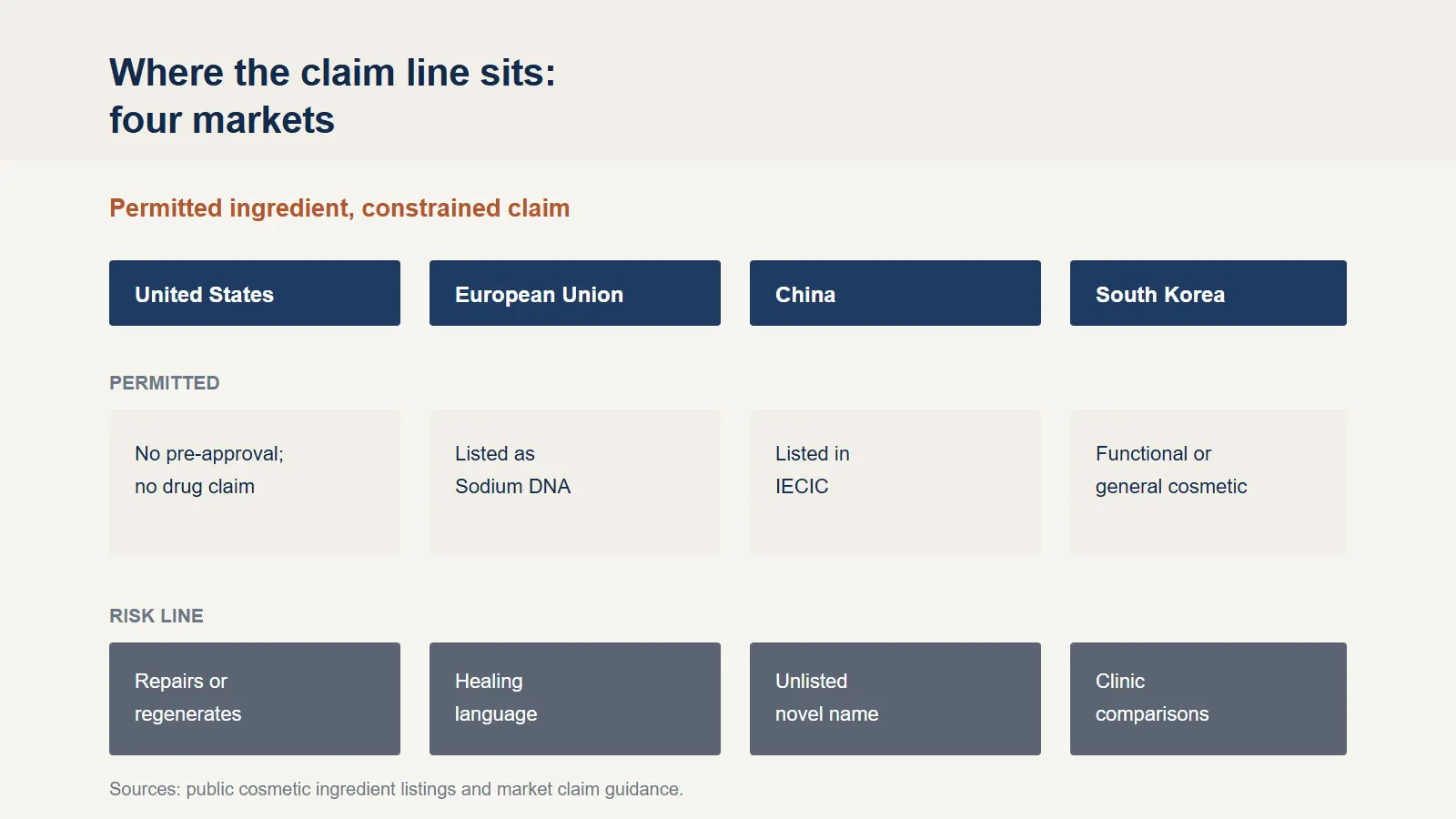
The claim line for PDRN is stricter than for a novel botanical, and the reason is the ingredient's own history. Because PDRN is a registered drug elsewhere and carries a wound-healing literature, the sentences that feel most natural to a marketer — repair, regenerate, heal, restore damaged skin — are precisely the ones that reclassify a cosmetic as an unapproved therapeutic. The marketing risk on this ingredient comes from its credibility, not from its novelty.
| Market | How the ingredient is positioned | What the framework requires of a brand | The sentence that causes the problem |
|---|---|---|---|
| United States | Cosmetic ingredients are not pre-approved by the FDA; the material can be used as a cosmetic ingredient where no drug claim is made. Injectable PDRN is not FDA-approved for cosmetic use | Facility and product obligations under the modernised cosmetics framework still apply to the brand placing the product on the market | "Repairs damaged skin" or "regenerates tissue" — the fastest way to be assessed as an unapproved drug |
| European Union | Listed as Sodium DNA in the CosIng ingredient database; cosmetic framework applies, with notification obligations | Ingredient listing does not authorise therapeutic claims; environmental and other claim rules apply separately to packaging and advertising | "Healing" or "regeneration" language, and any equivalence to a medical procedure |
| China | Listed in the IECIC inventory of existing cosmetic ingredients, so it is treated as an existing rather than a new cosmetic ingredient | Use the listed ingredient name; registration or filing obligations apply to the finished product | Inventing a novel botanical PDRN name not on the inventory without the new-ingredient pathway |
| South Korea | Topical products containing PDRN are treated as functional or general cosmetics provided no medical claims are made | The condition is the entire substance of the rule | Any clinic-reference vocabulary: "injectable results", "same as a skin booster" |
Read the table across markets rather than down it and a single operating rule emerges. The ingredient is broadly permitted; the claim is narrowly constrained. PDRN's listing in the EU and Chinese inventories and its workable Korean status mean a brand can plan multi-market distribution without a regulatory bottleneck on the substance itself. What it cannot do is carry the clinic vocabulary across the border with the material.
Three practical measures follow, and all three are cheap.
First, build a claim register before the formula. Take every sentence anyone wants to put on the pack, in the launch deck or in paid media, and sort it into the three buckets from Section three: acceptable, needs substantiation, or potentially a drug claim. Doing this in week one costs a morning; doing it after the artwork is signed costs a reprint and possibly a listing takedown.
Second, separate the consumer claim from the technical story. There is no rule against explaining, in trade or professional material, that PDRN has a regenerative-medicine heritage — that context is what makes the ingredient interesting. The constraint applies to what you claim the product does. Professional-channel technical documents and consumer-facing advertising are different media with different tolerances, and brands that keep them separate can be accurate without being reckless.
Third, make permitted use of evidence a contractual term. If your claim rests on a supplier's study, your exposure rests on the permission attached to it. Specify the markets, media and duration in which you may cite it, and require the underlying report rather than a media summary.
One further caution applies specifically to comparative language. Any wording that positions a cosmetic as equivalent to a clinic treatment, an injectable or a medical device is not a strong claim — it is a category change, and it is the single most common way this ingredient gets brands into difficulty. If a launch strategy depends on that comparison, the strategy, not the wording, is what needs revisiting.
Supplier diligence: a twelve-question PDRN scorecard
Evaluating a manufacturer for a PDRN project is different from evaluating one for a conventional skincare brief, because the ingredient's difficulty is not availability but engineering. Almost any factory can buy a drum of PDRN. Fewer can tell you what is in it, keep it stable in your chosen format, and prove it with documents you can put in front of a retailer.
The scorecard below is designed to be used as written, with a score of 0 to 3 per question. Questions 3, 4 and 7 are treated as gates rather than scored items: a supplier that cannot answer them competently should not proceed to sampling, because the answer will not improve later.
| # | Question to ask | What a strong answer contains | Weight |
|---|---|---|---|
| 1 | Which molecular weight distribution do you supply, and why did you choose it? | A named band with a distribution document, and an explanation of the penetration-versus-engagement trade-off | High |
| 2 | Is the material animal-derived, botanical or recombinant, and can it be declared per market? | A clear declaration with documentation, plus a botanical or recombinant alternative if your market needs one | High |
| 3 | What specification document will accompany each batch? | Purity, residual protein, molecular weight distribution, microbiological limits — a certificate of analysis, not a datasheet | Gate |
| 4 | Which dosage forms have you run this active in, and what did the compatibility work show? | Named formats with compatibility and ageing data, including active retention at end of shelf life | Gate |
| 5 | How do you preserve a nucleic-acid active in a water-based system? | A specific preservation strategy compatible with the active, with challenge-test support | High |
| 6 | If penetration matters, what delivery options do you offer and at what cost position? | Encryption-free comparison of encapsulation, hydrolysed specification and physical enhancement, with cost and stability implications of each | Medium |
| 7 | What are your bulk MOQ and your filling MOQ, and what is the active's own minimum? | Two separate numbers plus the raw material's minimum, stated together | Gate |
| 8 | What is the sample policy, charge, scope and lead time? | Development-sample terms that let you validate format and tolerability before committing to a campaign | Medium |
| 9 | Are development samples chargeable, and what do they include? | A clear split between free assessment samples and charged development samples with stability work | Low |
| 10 | What instrumental or clinical evidence can you support for the finished formula? | A realistic testing menu with timelines and cost, and the willingness to run work on your behalf rather than only licensing their own | High |
| 11 | What permitted-use terms attach to your efficacy data? | Written terms covering markets, media and duration, plus the underlying report on request | High |
| 12 | Who owns the formula, and what happens to the specification if we part ways? | Written formulation ownership and continued-supply or specification-transfer terms | Medium |
Two notes on using the scorecard. First, the questions are ordered so that the expensive mistakes surface early: a supplier that fails on question 3 or 4 has not yet begun the technical work that makes a PDRN project viable, regardless of how attractive the price looks. Second, resist the temptation to collapse this into a price comparison. The three gate questions have no price dimension — they test whether a specification exists, whether the format has been validated, and whether the minimum order is actually achievable — and they are the three that determine whether the project reaches a shelf at all.
A twelve-month launch roadmap
Sequence is the whole discipline of a PDRN launch, and the sequence most projects get wrong is doing packaging and pre-launch marketing before claim substantiation. When the claim then has to be rewritten, every asset that carries it must be redone.
| Phase | Action | Deliverable | Decision it locks in |
|---|---|---|---|
| Month 1 | Pass the five filters; write the claim register and sort every candidate sentence | Claim register | Whether the project proceeds, and the outer boundary of all marketing |
| Month 1–2 | Decide the specification: molecular weight band, origin and route, use level target | Specification brief | The cost structure and whether a delivery system is required |
| Month 2–3 | Score manufacturers on the twelve-question card; request specification documents and permitted-use terms | Supplier shortlist | Who manufactures, and on what evidence terms |
| Month 3–4 | Validate the dosage form: compatibility, preservation, sensorial performance in the chosen format | Prototype and compatibility data | The format, and whether it survives ageing |
| Month 4–5 | Commission your own instrumental testing on the finished formula, or license data with written permitted use | Efficacy evidence pack | The claim you can actually publish |
| Month 5–6 | Run tolerability and stability work; confirm active retention at end of shelf life | Stability dossier | Shelf-life claim and market eligibility |
| Month 6–9 | Finalise artwork and copy within the claim register; prepare professional-channel technical material | Approved assets | Nothing new — this phase executes earlier decisions |
| Month 9–12 | Launch; monitor claim complaints and adverse reports; plan the second format | Post-launch surveillance file | Whether the range extends or the claim tightens |
The deliberate trade-off in this roadmap is that evidence precedes launch rather than running alongside it. That is the opposite of the sequence used for low-risk ingredients, and the reason is the risk structure of this specific active: for a conventional moisturiser, a conservative claim costs a little conversion, whereas for PDRN a claim that crosses into therapeutic language can force a relabel or a withdrawal. Building the evidence first is slower by two to three months and removes the failure mode that is most expensive to reverse.
There is a second benefit that is easy to overlook. The evidence pack assembled in months four to six is also the asset that makes the second and third format extensions cheaper — the same compatibility and efficacy framework can be reused across a mask, a serum and a cream, which is precisely the range architecture that the Korean market demonstrated for this ingredient in Section four.
What to do next
If you are evaluating PDRN for a 2027 launch, the highest-value next action is not a price request. It is a specification request: ask your candidate manufacturers for the raw-material documentation first, then a development sample built in the format you intend to sell.
Specifically, ask for three documents before any quotation is discussed. A certificate of analysis showing purity and residual protein. A molecular weight distribution showing the band you would actually receive, not a single average. And a source and route declaration stating whether the material is animal-derived, botanical or recombinant, in terms your target markets accept. A supplier who can produce those three in a day has demonstrated more capability than a supplier who can produce a lower price in an hour.
Then ask one engineering question and listen for the specificity of the answer: "in which of our formats have you run a nucleic-acid active, and what was the active retention at end of shelf life?" That single question separates manufacturers that have solved preservation and compatibility for this class of molecule from those that are still extrapolating from a conventional serum.
For readers who want to go deeper on the surrounding decisions: the 2026 efficacy skincare guide comparing PDRN, peptides, retinol and hyaluronic acid sets out evidence and sourcing comparisons for the actives PDRN is most often specified alongside; the guide to low-MOQ skincare OEM solutions for global buyers explains how to structure a first order when your volume is small and the active has its own minimum; and the overview of sheet masks from China for global buyers is the most direct route into the format that carries most PDRN retail presence today.
Put molecular weight distribution, delivery system and permitted use of evidence on the same negotiating table as unit price — and put them there first. On this ingredient, that is the difference between buying a specification and buying a label. When you are ready, send us your specification brief and we will come back with a format-by-format assessment rather than a single number.
Frequently asked questions about PDRN skincare
Q1: What is PDRN serum, and is it the same as the injectable?
No, and conflating them is the most common error in this category. The injectable is a regulated drug product administered into the dermis. A PDRN serum is a topical cosmetic applied to the skin surface. They share a raw material family and very little else: the delivery route, the dose reaching the target tissue and the regulatory category are all different. A serum formulation therefore cannot borrow the injectable's clinical conclusions, and should not attempt to.
Q2: What is PDRN good for in a topical product?
For a cosmetic, the defensible territory is appearance and moisture: supporting hydration, the look of firmness, and visible tone evenness, each backed by instrumental testing on your finished formula. Where the topical evidence is thinner than the injectable evidence is in structural endpoints, which is why we recommend budgeting your own measurement work rather than licensing a comparison against a clinic treatment.
Q3: What is PDRN made of, and can I source a plant-derived version?
Conventionally it is a mixture of deoxyribonucleotides purified from salmonid sperm DNA, with molecular weights spanning 50 to 1,500 kDa and most commonly represented in the 80–200 kDa band, recovered above 95% purity. Botanically derived low-molecular-weight versions exist — peony extract is the best documented, with brown algae and other sources in development — and recombinant production is emerging. If your market or your consumer requires a non-animal active, specify that requirement in the RFQ rather than discovering it after the formula is fixed.
Q4: What is PDRN in Korean skincare, and can I source the same formats?
It is a format architecture rather than a different molecule: masks, hydrogels, serums, capsule creams and leave-on overnight gels, built around the same active. In Korea, topical products containing it are treated as functional or general cosmetics provided no medical claims are made. The formats are sourceable elsewhere, but the constraint that travels with them is engineering, not geography — preservation, compatibility and active retention in each structure are what determine whether the copy is achievable.
Q5: What molecular weight should I specify, and does it need a delivery system?
A band around 100–250 kDa is generally treated as the balanced specification for serums, trading penetration against receptor engagement and texture. Above roughly 500 kDa, passive penetration falls significantly and a delivery system becomes necessary if penetration is part of your claim; below roughly 30 kDa, receptor binding affinity weakens. Native full-range material requires encapsulation or physical enhancement. Decide which of those situations you are in before you send the RFQ — it is the largest single cost lever in the project.
Q6: What can I legally say on the packaging?
Anything that describes a cosmetic effect and that you can substantiate. Nothing that describes a therapeutic one. "Supports hydration and the look of firmness" is ordinarily acceptable; "regenerates tissue", "repairs damaged skin", "heals" or "boosts collagen production" are the sentences that risk reclassifying the product as an unapproved drug, and comparing a cosmetic to a clinic treatment does the same. Build the claim register in week one and the packaging will not need to be reprinted.