


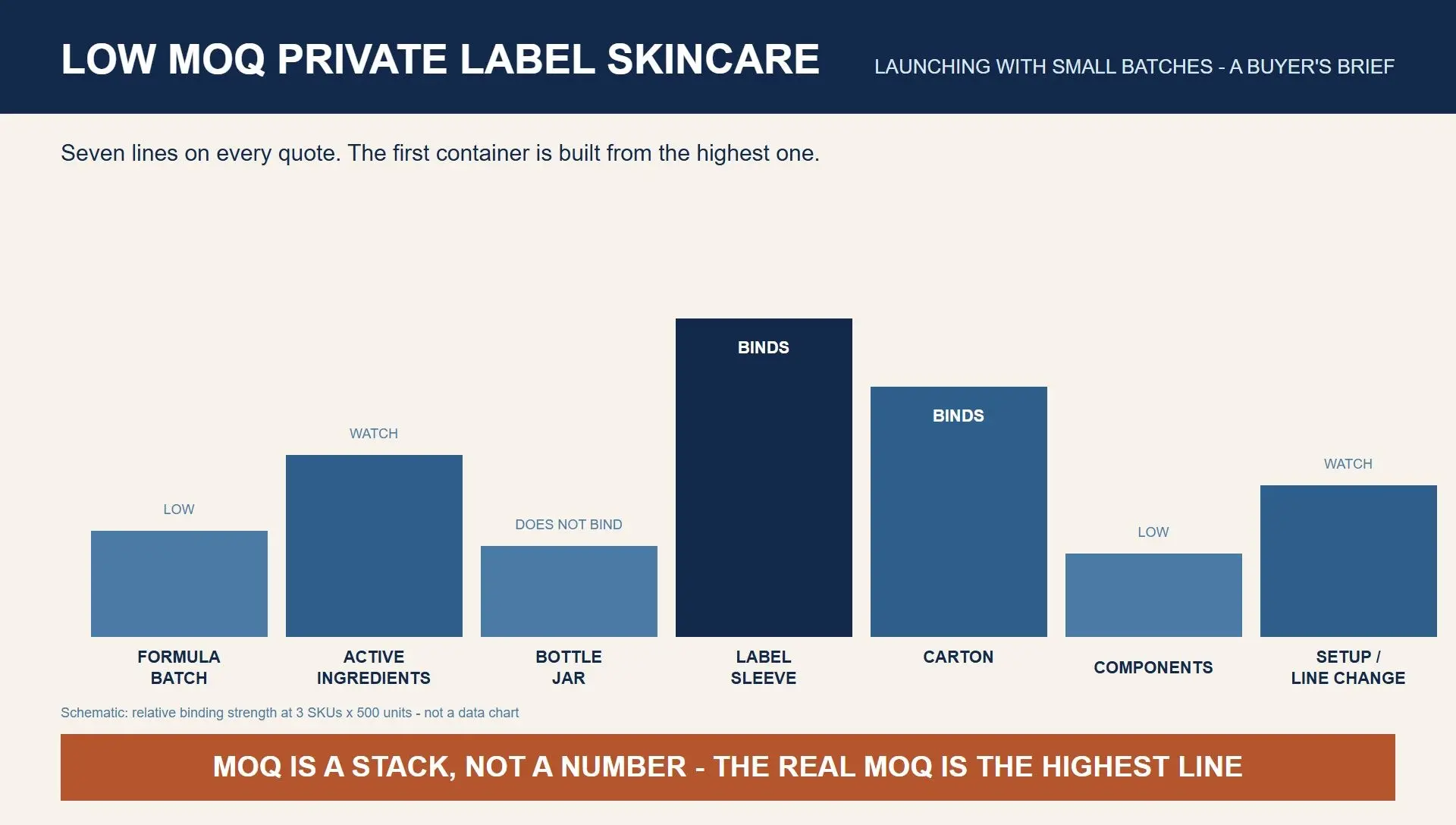
Collagen Capsule Cream Benefits: Format and Private Label Guide
"Collagen capsule cream benefits" is the question buyers ask when they first see the jar: a cream carrying a population of small gel capsules that burst on contact with the skin, most of them a pink or red hue that signals a salmon-derived or collagen-active core. The format broke out of Korean retail between 2025 and 2026 and is now sitting on mass retail shelves and marketplaces in the United States, which means it has crossed from trend to shelf — and from shelf to your buyer's question list. The question a brand owner has to answer is not "does it work". It is "what am I actually buying, can this be manufactured at scale in a controlled way, and what does private label of it look like at each level of ownership."
This guide treats a capsule cream as what it actually is: a two-component system. A cream base does what a cream base does — occlusion, emollience, the everyday vehicle. The capsules do something a plain cream structurally cannot: they hold a concentrated aqueous core of actives under a thin biopolymer wall, and that wall lets you make a claim about where and when the active is released that no homogenised formula can make. Because the two components fail in different ways and cost different things, the benefits conversation splits in two as well — the base has its claims, the capsule has its own, and a supplier who presents them as one blur is describing a marketing decision, not a product.
By the end you will have the specification fields a capsule system has to declare in writing, a comparison of the three production routes that actually scale, an honest read of the market data (seven research houses, roughly an order of magnitude apart), the cost stack that separates a capsule cream from a plain cream on the quote, and the three levels of private label — from relabelling an existing system to owning a custom capsule specification — with the document pack to request before any sample is paid for.
Collagen Capsule Cream Benefits: What You Are Actually Buying
The benefits question, answered honestly, starts with an inventory. When a consumer scoops a capsule cream, they are taking home two distinct objects in one jar:
- A cream base — an emulsion doing what any cream does: occlusive film, emollient load, preservative system, pH balance. Its benefits are the benefits of a well-made cream, and its claims should be the claims of a cream. The base is the part your existing formulation team already understands; a buyer's specification frame for facial cream is a reasonable place to start if you have not done that comparison recently. - A population of microcapsules — thin-walled gel spheres, typically a fraction of a millimetre in diameter, each carrying a concentrated aqueous core. The wall is a biopolymer film (gelatin, alginate, or a protein-polysaccharide complex coacervate, depending on the route). The core is where the "collagen capsule cream" claim lives: collagen peptides, a salmon-derived PDRN-type active, a peptide complex, or a blend. On contact with skin, the wall softens and breaks — with skin temperature and mechanical shear doing the work — and the core is released at the point of application, at a concentration far above what the surrounding cream can carry.
That structure is why the word "benefits" has to be split. The base's benefit is a cream benefit: moisture, emollience, a comfortable finish. The capsule's benefit is a release benefit: a locally concentrated dose of the core active, delivered at the moment and place of application, in a form the consumer can see. Those are two different claims, two different evidence files, and two different cost lines. A quotation that bundles them into a single "collagen capsule cream" line with one assay is not a quotation — it is a position, and the position is that you will not be able to audit it.
There is a second, quieter reason the split matters. The visible capsule is a retail event — the product's shelf story is the moment the bead breaks on the cheek. That means the capsule's physical behaviour (size, uniformity, burst consistency) is as much a product specification as its chemistry. Two jars with identical ingredient lists can be different products if one releases 90% of its core on contact and the other needs a full massage to break. The specification has to say which one you are buying.
Buy the two components separately: the base is a cream specification, the capsule is a release specification — and only the second one justifies the "capsule" in the name.
Anatomy of a Capsule Cream: The Specification a Jar Must Declare
"Collagen capsule cream" is a category name. The specification is the seven fields below, and a supplier who can complete them in writing is describing a system they manufacture; a supplier who responds with the retail brochure is describing a system they resell.
| Specification field | What to demand in writing | What it determines | A weak answer looks like |
|---|---|---|---|
| Core active identity and assay | Active name(s), concentration in core, per-batch assay | The actual "benefit" claim and its cost line | "Collagen complex, standard load" |
| Shell wall material (INCI) | Full INCI declaration of the wall film | Ingredient list, allergen diligence, vegan/animal-derived questions | "Natural film" |
| Particle size distribution | Median diameter plus the spread (not a single figure) | Texture, burst behaviour, content uniformity | "Micro size" |
| Burst mechanism | Trigger (skin temperature / shear / hydration) and expected release fraction on contact | The consumer experience the retail story promises | "Bursts on skin" |
| Content uniformity | Capsule count per gram of cream and distribution method | Scoop-to-scoop consistency, per-unit experience | "Evenly dispersed" |
| Stability envelope | pH range, ionic strength tolerance, preservative compatibility, storage conditions | Shelf life of the system, not just the cream | "12 months" |
| Batch traceability | Core batch, wall batch, blend batch linked to the finished lot | Recall behaviour, complaint resolution, audit trail | A single lot number |
Two of those fields do the heaviest commercial lifting. Particle size distribution is the difference between a product and a mood: a median of 300 micrometres with a tight spread breaks promptly and reads as a fine, even texture; 800 micrometres with a wide spread sits in the jar as visible beads and changes the product's whole feel — and its claim about "where and when" the active releases. And burst behaviour is the field the retail image was built on, so it is the one a compliance or quality team will probe first: what fraction of the core releases on contact, under what conditions, and how is that measured from batch to batch?
The wall material row is where most buyers' diligence stops and where it should start. A gelatin wall is an animal-derived protein that belongs on your allergen and labeling conversation; a complex coacervate wall made from protein and polysaccharide has its own INCI story; an alginate wall changes the chemistry of what the capsule tolerates. The wall is not packaging — it is a declared ingredient of the finished product, and its declaration travels with your formula into every market you list.
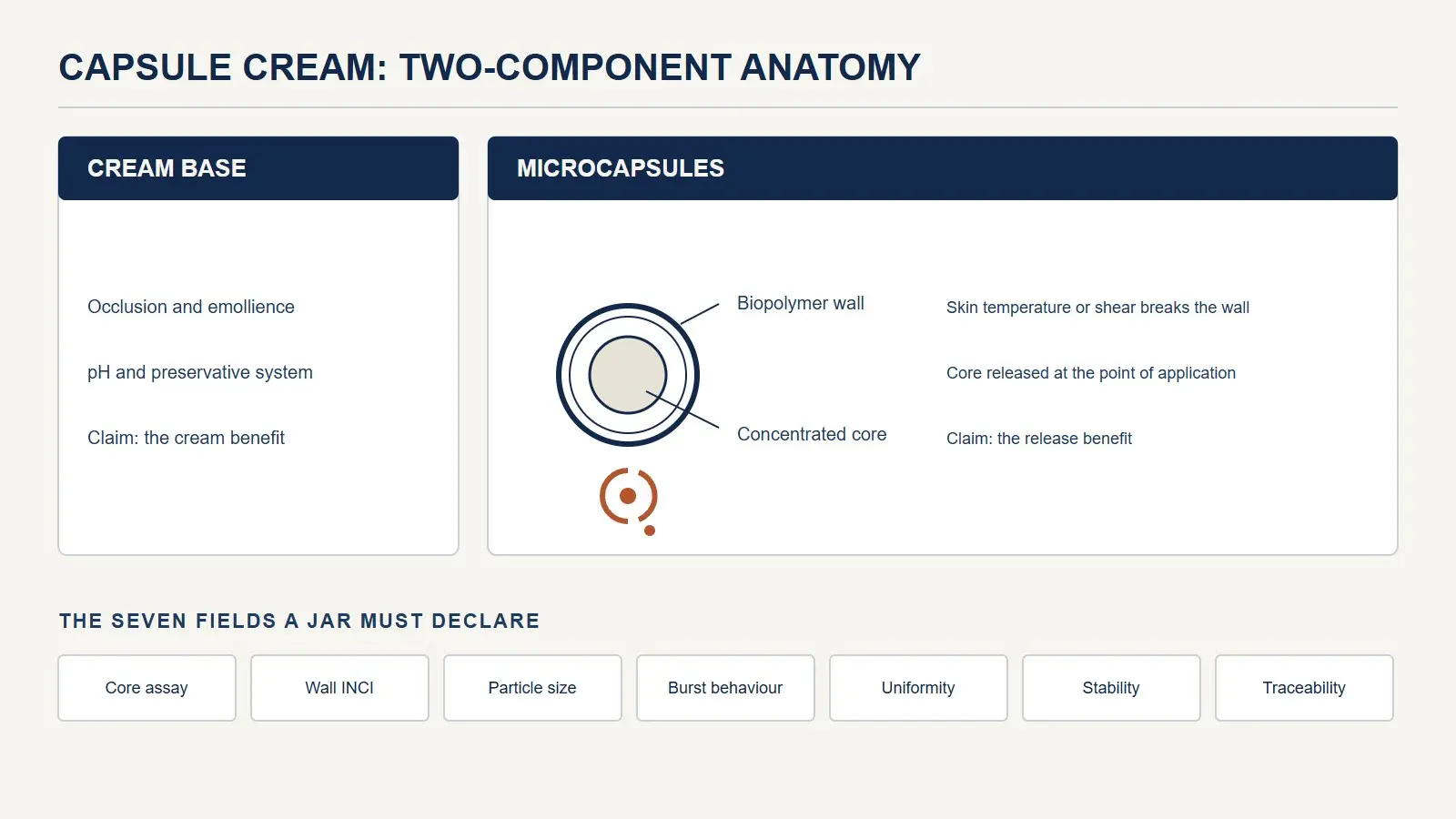
The capsule is a declared ingredient, not packaging: its wall, its core and its particle size all belong on your formula sheet and in your compliance file.
How the Capsules Are Made: Three Production Routes That Actually Scale
Every capsule cream is built by one of three routes, and the route is a bigger decision than the active. It sets the cost, the stability envelope, the scale ceiling and — through yield — the price floor of the finished jar.
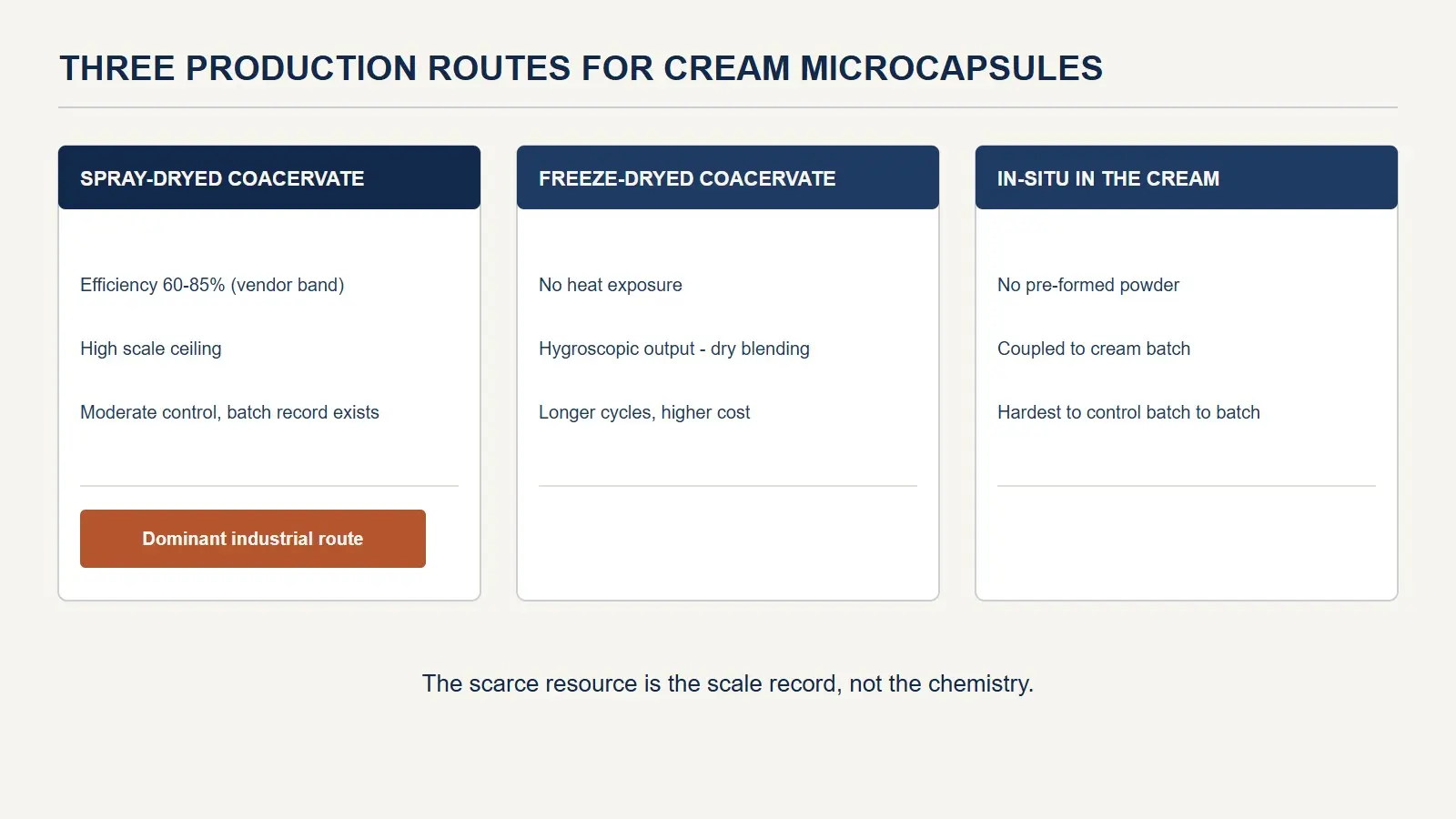
Route 1: Pre-formed microcapsules by complex coacervation plus spray drying. A protein and a polysaccharide are brought into a mutual-precipitation (coacervation) state around the core, and the droplets are dried into stable beads by spray drying. This is the dominant industrial route, and it is the one the literature treats as its main battleground — peer-reviewed reviews of spray- and freeze-dried microcapsules prepared by complex coacervation exist precisely because their stability behaviour is the engineering problem to solve. Process equipment vendors quote a typical encapsulation efficiency band of 60–85% for spray-dried systems, which means a defined fraction of the active does not end up inside a bead and must be accounted for in the cost model. Universities and technology-transfer offices (UC Davis among them) have published single-step spray-dried coacervate processes, so the chemistry is not the scarce part — the scale record is.
Route 2: Pre-formed microcapsules by freeze drying. Same coacervation chemistry, but the beads are freeze-dried instead of heat-dried. The route protects thermally sensitive cores better and is the answer when the core active degrades under spray-drying temperatures. It is also the slower, more capital-intensive route: freeze-drying cycles are long, and the beads come out hygroscopic, which then argues for a dry-blending step into the cream rather than a wet one.
Route 3: In-situ formation in the cream. The wall components and the core are added as separate streams into the cream matrix and coacervate into beads during the final mixing step. No pre-formed powder, no separate drying line — and no batch record for the capsule independent of the cream batch. The route is elegant and it is the hardest to control batch to batch, because the beads are being born inside a moving emulsion whose pH, ionic strength and shear are all part of the recipe.
| Route | Core protection | Typical efficiency band | Scale ceiling | Control difficulty | Cost implication |
|---|---|---|---|---|---|
| Complex coacervation + spray drying | Good for heat-tolerant cores | 60–85% (vendor-reported) | High — continuous drying | Moderate; batch record exists | Lowest of the three at volume |
| Complex coacervation + freeze drying | Best — no heat exposure | Lower; hygroscopic output | Moderate — long cycles | Moderate | Highest cycle cost; dry blending needed |
| In-situ coacervation in cream | Dependent on cream chemistry | Not separately reported | Low — coupled to cream batch | Highest; no independent capsule batch record | Lowest setup, highest risk premium |
The practical question is not which route is "best" — it is which route your supplier has run at your volume, for a shelf life you can defend. A laboratory efficiency number is a research result; a batch record across a dozen production runs at 500 litres is a product.
Collagen Capsule Cream PDRN: The Pink Capsule Trend, Described Without a Brand Name
The most visible version of this format carries pink capsules, and the pink is not cosmetic: in the products that pushed the format onto mass shelves, a pink or red hue signals a core loaded with a salmon-derived PDRN-type active, often blended with collagen peptides. When buyers search "collagen capsule cream pdrn" they are describing exactly that configuration — a collagen-framed cream whose release event is a PDRN core.
A few things are worth separating in that configuration.
- The core is a formulation choice, not a format property. The same capsule system that carries a PDRN core can carry collagen peptides, a peptide complex, a niacinamide-hyaluronic core, or a blend. The format is the vehicle; the active is the payload. A manufacturer whose capsule line is pinned to one hero core is selling you a product, not a platform — ask what other cores have run through the same wall chemistry before you assume the switch is easy. - The claim space of the core is the claim space of the active. Whatever substantiation file exists for the payload active is the file that carries the capsule's claim — encapsulation does not extend a claim, it changes the delivery description. If the core active's evidence base only supports "hydration and comfort" language, wrapping it in a capsule gives you "hydration and comfort, released where you apply it" — which is a retail difference, not a regulatory one. - The trend is real and it is K-beauty-driven. The format's breakout ran through Korean retail and export lines in 2025–2026 before appearing on US mass shelves; the efficacy comparison frame for PDRN-class actives against collagen, peptides and hyaluronic systems remains the right lens for deciding what the core should be.
The capsule is a vehicle, the core is the payload: a supplier pinned to one hero core is selling a product, not a platform — and your SKU flexibility is priced into that distinction.
Collagen Capsule Cream Korean: Where the Format Comes From and What That Means for a Western Buyer
The search "collagen capsule cream korean" is a sourcing query wearing a consumer costume: the person typing it has seen the format in Korean retail content, it has crossed to their market, and now they want the same product language without the brand. The honest answer to that query has three parts.
Part one: the format is exportable, the brand is not. The capsule cream broke out of Korean retail and export lines in 2025–2026 — the same window in which K-beauty as a trade flow kept compounding (on-site reporting put the broader K-beauty sales surge at 53% during the period) — and then appeared on US mass shelves and marketplaces in standard 50-gram-class jars. What traveled across that path was a format: a two-component cream with a visible release event, a pink-capsule colour code, and a shelf story built on the burst moment. What did not travel — and cannot be traveled by a private label buyer — is the brand equity around it. If the business case is "sell what the Korean market has already educated," the education transfer is real but it is transferable only through your own retail presence, not through the format's provenance.
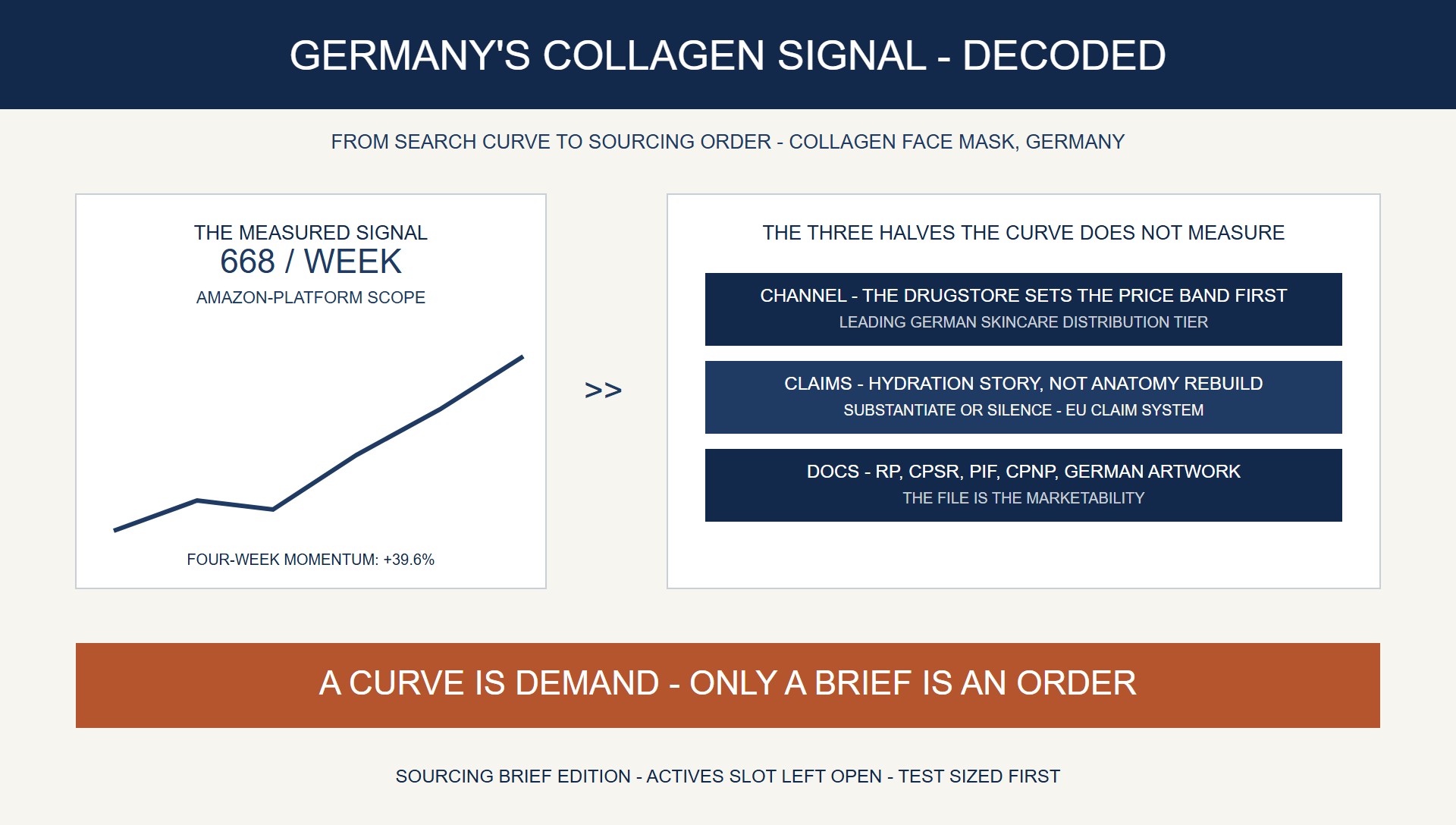
Part two: the collagen base is large and flat, which is exactly what a format innovation is for. The marketplace demand data in the queue's word pack reads honestly: the US "collagen face mask" signal is large — a weekly average of 19,066 in the Amazon-internal window of 23 August to 5 September, 2026 — but its four-week change is +1.6%, which is a plateau, not a ramp; the German "kollagen maske" signal is smaller at 668 per week but running +39.6% over four weeks, the strongest collagen-format signal in the dataset. A flat, large base plus a rising format signal is the classic situation for a differentiation purchase: the category does not need more collagen, it needs collagen that looks and feels like something new on the shelf. The cross-format collagen buyer's picture is the right companion read for how collagen demand distributes across masks and creams.
Part three: "Korean" in the product description is a claim with a supply-chain answer. If your pack or your brief says "Korean-style" or implies Korean formulation, the substantiation question is where the formula was developed, where the capsule system was qualified, and whether the manufacturing record supports the language. "Korean" is a provenance claim about a process asset, not a colour or a texture — the same discipline that applies to any origin naming, and the one buyers most often inherit from a supplier's marketing page without checking.
Stability and Shelf Life: The Part the Retail Image Never Shows
The retail image of a capsule cream is the capsule breaking on the cheek. The manufacturing image is the capsule breaking in the jar — slowly, invisibly, over six to twelve months — and that is the failure mode a buyer is actually underwriting when they sign a capsule cream line.
The physics is unforgiving. A capsule wall is a thin biopolymer film in direct contact with the cream matrix, and the matrix is chemically active: it has a pH, an ionic strength, a preservative system and a water activity, all of them designed for an emulsion, none of them designed for the film. Three failure paths dominate:
- Wall erosion from the matrix. If the cream's pH or ionic strength sits outside the coacervate's stability window, the wall thins progressively. The product does not "break" — it stops being a capsule product somewhere around month six, with the actives now homogenised into the base and the release story already dead. The consumer still sees beads in the jar; the product no longer does what the beads promise. - Moisture migration and in-jar dissolution. Cream is a water-rich phase. Over time, water activity at the wall interface softens the film and dissolves a fraction of the population before the jar is even opened. The classic end state is a cream with a faint gritty residue and a "burst" that no longer bursts — content uniformity has quietly converted into content loss. - Freeze–thaw and thermal cycling. Hygroscopic capsules (the freeze-dried route in particular) take up and release water through shipping and storage cycles. Each cycle stresses the wall; repeated cycling is the standard destroyer of hygroscopic powders, and a capsule that survives formulation may not survive distribution.
None of this is hypothetical, and all of it is testable — which is the point. The stability file for a capsule cream has to include, at minimum:
| Stability parameter | Test posture | What a missing curve means |
|---|---|---|
| Burst / release fraction over time | Accelerated (e.g. 40 °C / 75% RH) at defined intervals | The "release" claim is unverified past formulation day |
| Content uniformity drift | Capsule count per gram at each interval | Scoop-to-scoop experience is not guaranteed on the shelf |
| Wall integrity | Visual + size distribution over time | Erosion rate is unknown |
| In-jar dissolution | Active concentration in the base phase over time | Content loss is unquantified |
| Open-jar performance | Use-period behaviour after opening | The retail experience is untested |
Ask for the accelerated stability curves of the capsule system itself — if a supplier cannot produce a burst-rate-over-time graph, the "release" claim is a formulation-day promise, not a shelf-life fact.
The Cost Stack: What Capsules Actually Add to a Plain Cream
A capsule cream quote is a plain cream quote plus five lines that should exist, and a buyer's job is to make those lines exist. Where a "premium capsule technology" sits as a single unexplained uplift, the quotation is not a cost structure — it is a margin.
| Cost line | What drives it | The question that makes it visible |
|---|---|---|
| Encapsulation process step | A separate production step (or line) with its own batch record, or none at all if in-situ | "Is the capsule a discrete step with its own batch number, or part of the cream batch?" |
| Encapsulation efficiency loss | 60–85% typical band means 15–40% of the loaded active is not in a bead | "What fraction of the core active is accounted for outside the capsule population, and how is it treated?" |
| Scale-up and qualification batches | Route qualification, stability qualification, formula–process lock | "How many qualification runs have been done at my order volume, and are they in the price or in the project fee?" |
| Packaging adaptation | Jar geometry, opening size, scooping behaviour, cap and spatula decisions | "What packaging changes does this format force, and what do they cost per unit?" |
| Quality control expansion | Particle size, burst fraction, content uniformity — new test items per lot | "Which of these are tested per lot, at what frequency, and what is the hold point?" |
| Wall material input | The film is a declared ingredient with its own purchase line | "What is the wall material, what is its INCI, and what is its cost treatment?" |
| Retention and traceability | Core, wall and blend batches retained and linked | "What is retained per lot, and for how long?" |
Two of those lines are where the honest and the dishonest quote diverge. The efficiency loss line: a supplier running the spray-dried route at the low end of the efficiency band is consuming more of your hero active than one at the high end, and the difference is real money at your core's price — which is why the assay and the efficiency belong in the same conversation. And the qualification line: if your volume is the first volume this system has run at, the scale-up risk is not zero; it is simply unpriced, and unpriced risk in a new format is how a "good deal" becomes a stalled launch.
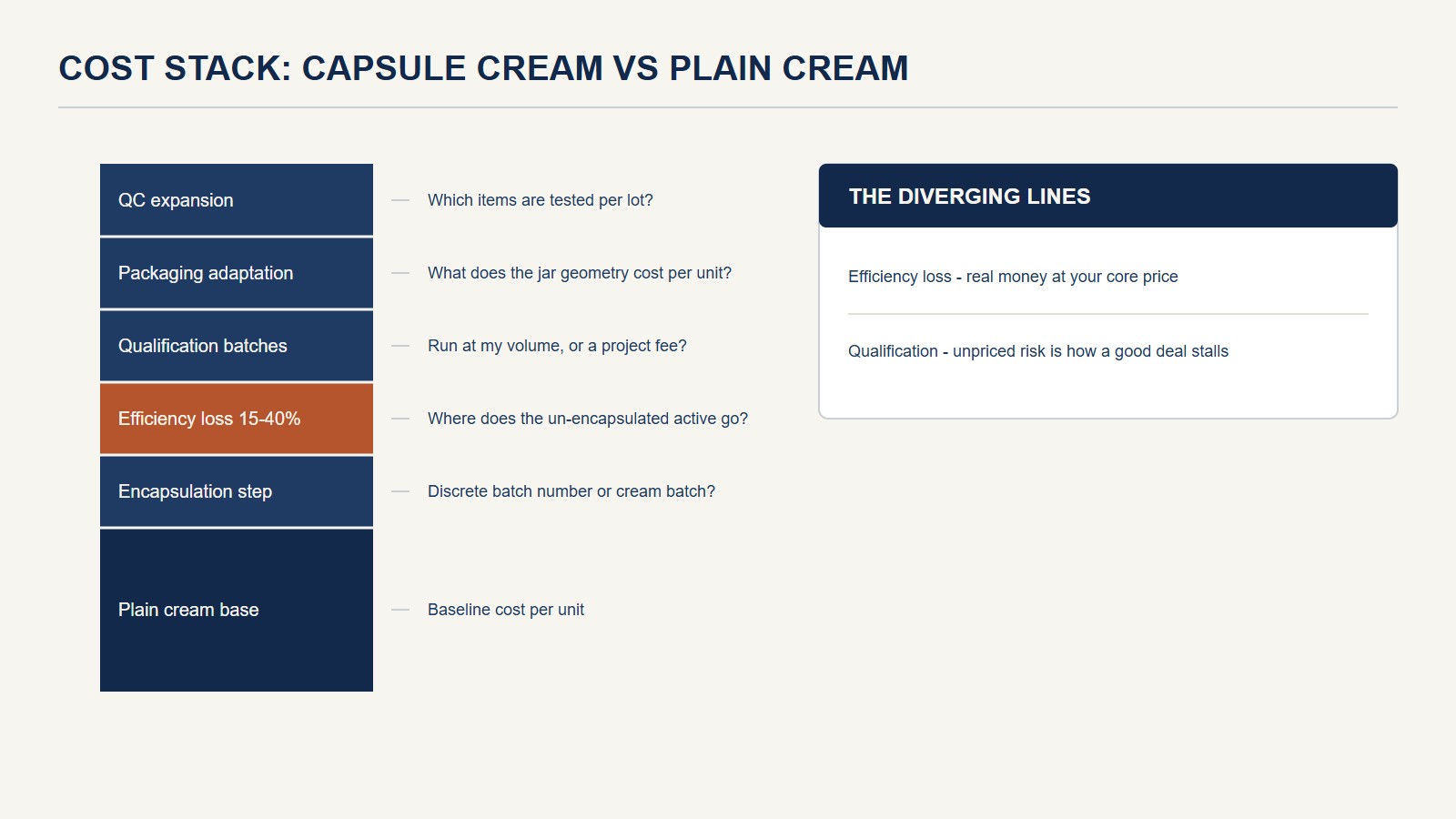
A capsule cream quote that does not show its five added lines is a plain cream quote with a premium attached — make the lines exist before you compare numbers.
The Market Data, Read Honestly: Seven Houses, One Order of Magnitude Apart
The collagen market is large, growing, and — like every market with enough demand — estimated differently by every house that measures it. The seven figures below are the 2025 base-year values from the major research publishers, pulled for this guide to show the spread rather than to pick a winner:
| Research house | 2025 base (USD) | Forward figure | CAGR (stated) | Scope note |
|---|---|---|---|---|
| Precedence Research | 12.24 B | ~29 B by 2035 | — | Global collagen, broad application scope |
| Grand View Research | 11.4 B | 26.2 B by 2033 | 10.9% | Global collagen market |
| Fortune Business Insights | 11.71 B | 13.02 B in 2026 | — | Global collagen market |
| Future Market Insights | — | 6.2 B in 2026 → 10.8 B by 2036 | 5.6% | Collagen, named-player framing |
| GM Insights | 5.2 B | 8.7 B by 2034 | — | Global collagen, narrower framing |
| LinkedIn Pulse (secondary digest) | 7.4 B (skincare collagen) | 11.8 B by 2032 | — | Skincare segment only |
| Mordor Intelligence | 1.16 B | 1.42 B in 2026 | — | Narrowest definition in the set |
The spread is not noise to be averaged away. It is a statement about definitions: which applications are in scope (cosmetic only, or including biomedical and food-adjacent uses), which geographies, which base year. A 12-billion estimate and a 1.2-billion estimate can both be "correct" about the collagen market, because they are measuring different markets with the same word. The discipline for a buyer is the same one applied to the mask-format data in the companion piece: use the direction for strategy — every house in the set shows growth — and use your own channel data for the budget.
Your channel data, for this format, is the marketplace demand picture in the queue's word pack: the US collagen mask signal at 19,066 weekly searches on a +1.6% four-week change (large and flat), and the German collagen-mask signal at 668 per week on a +39.6% change (small and rising). Neither number is a Google search volume — both are Amazon-internal, weekly-granularity, window 23 August to 5 September 2026 — but they answer the procurement question that the seven-house table cannot: where is collagen demand actually converting right now, and is it flat or moving? Large-and-flat plus a format that visibly differentiates on the shelf is the profile that argues for a differentiation SKU, not a category-bet SKU: the capsule cream is not "collagen, but bigger" — it is the way a flat collagen category gets a new retail moment.
Three Levels of Private Label: From Relabel to Owned Capsule System
"Private label a capsule cream" is not one purchase; it is three purchases with different prices, different lead times and different ownership outcomes. The level you can buy depends on what the manufacturer already has — and on how much of the capsule's exclusivity your shelf story actually needs.
Level 1 — Relabel an existing system. The manufacturer's qualified capsule cream, your label. Fastest launch, lowest MOQ, zero formulation control and zero differentiation: whatever core, wall and particle size the house system runs, that is what your jar carries, and other buyers can buy the same system. Level 1 answers "get the format on my shelf this season" — nothing more.
Level 2 — Re-core an existing capsule platform. The manufacturer's qualified wall chemistry and process, with your core active (PDRN-type, collagen peptide type, a peptide complex, a blend) at a concentration you specify. This is where most differentiation purchases start, because the retail event — the visible burst of a recognisable colour — is largely a core decision: the hue, the payload story, the assay. The gating question is the platform's core history: how many different cores have run through the same wall, and with what stability record. A platform that has only ever run one core is a product with a variant option, not a platform.
Level 3 — A custom capsule specification. You specify the core, the wall material, the particle size class, the burst behaviour and the stability envelope; the manufacturer qualifies the system for you. This is the only level at which the capsule is an asset you own rather than a feature you rent — and the only level where "your" product cannot be sold to your competitor. It is also the level where lead time, qualification batches and the IP conversation all move, and where a low per-unit price can quietly be a high total price once the project fees land.
| Level | What you get | What you control | MOQ driver | Lead-time driver | Ownership outcome |
|---|---|---|---|---|---|
| L1 Relabel | House capsule cream, your label | Packaging, price, channel | Finished-goods inventory | None — shelf-ready | Nothing; the system is shared |
| L2 Re-core | Platform wall + your core | Core active, concentration, hue | Core qualification batch | Core stability re-qualification | Your core spec; the platform is shared |
| L3 Custom system | Your capsule specification | Core, wall, size, burst, envelope | Process qualification at your volume | Route qualification + stability program | Formula and process IP per contract |
The decision criterion is the shelf story, not the quote gap. If the story is "we carry a K-beauty-style capsule cream," Level 1 or 2 is honest. If the story is "our capsule system," then Level 3 is the only level that can say that — and the IP clauses in H2 十 are what make it true. The low-MOQ frame for getting a first capsule batch moving is worth reading before the Level 2 conversation, because the first-batch decision sets the rhythm of everything after it.
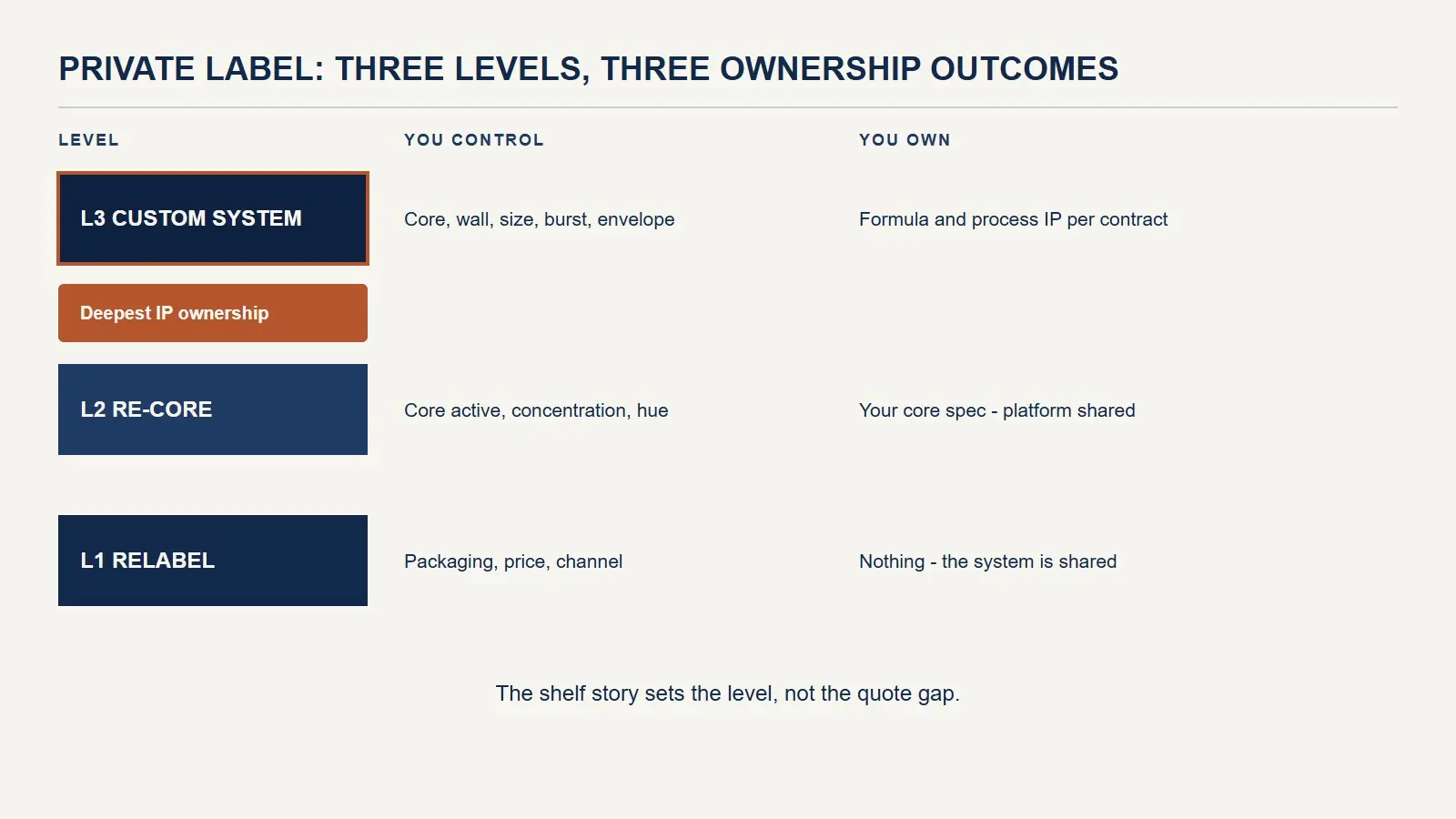
The level you buy is set by the exclusivity your shelf story needs: "we carry a capsule cream" is a Level 1/2 story; "our capsule system" is only true at Level 3.
What to Demand Before Any Sample Is Paid For: The Document Pack
Five documents decide whether a distributor, a retailer or your own quality team can clear a capsule cream line. Treat them as a gate that opens before money moves, not as a file that arrives with the first shipment.
| Document / item | What it proves | What it does not prove |
|---|---|---|
| Core Certificate of Analysis, per batch | Active identity and assay for the exact lot you receive | Nothing about in-jar behaviour over time |
| Wall material INCI declaration + allergen / animal-origin statement | Labeling position and vegan/animal-derived stance | Compatibility with your specific base |
| Particle size distribution report | The texture and burst class you are buying | Uniformity drift across shelf life |
| Burst / release test report | Release behaviour on contact, per the stated method | Release behaviour at month six — that is the stability curve |
| Accelerated stability curve (burst fraction + content uniformity over time) | The shelf-life fact behind the "release" claim | Distribution-environment performance (freeze–thaw, heat cycles) |
| Encapsulation efficiency record for the route | How much active actually ends up in beads | How the loss is treated in your quotation |
| Qualification batch record at your order volume | Scale record for the system you are buying | Performance of your specific formula |
| Retention sample policy | The audit trail for complaints and recalls | A substitute for per-lot testing |
| Formula and process IP clause | Who owns the capsule system | Non-infringement — patent clearance is a separate workstream |
The IP row deserves the second reading. A capsule cream is a process asset wearing a formula: the wall chemistry, the coacervation parameters and the drying or mixing profile together make the product, and a contract that assigns the "formula" while leaving the "process" with the manufacturer has assigned you the less valuable half. At Level 3, the clause must name the process; at Level 2, the clause must at minimum grant you an unrevocable licence to the platform for your core; at Level 1, there is nothing to assign, and the contract should say so in plain words, because the shared-platform reality is the whole of your differentiation risk.
A capsule cream is a process asset wearing a formula: a contract that assigns "the formula" but not "the process" assigns you the less valuable half — and switching factories takes the capsules with the manufacturer.
Frequently Asked Questions
Q1: Do collagen capsule cream benefits hold up beyond the shelf image?
The honest answer is "two different benefits, one jar." The cream base delivers what a well-made cream delivers — moisture, emollience, a comfortable finish. The capsules deliver something structurally different: a locally concentrated core, released at the point and moment of application, in a form the consumer can see. Both are real when the system is specified properly; both are unprovable when the supplier presents them as a single blur. The benefits are legitimate — and the legitimate way to claim them is as two claims with two evidence files.
Q2: How is a capsule cream different from a regular collagen cream?
A regular collagen cream is a single-phase system: the collagen is dispersed through the matrix at whatever concentration the emulsion tolerates. A capsule cream concentrates the active inside a thin wall and releases it on contact with skin, so the effective local dose at the point of application is far above the matrix concentration — and the consumer sees the release event. The difference is when and where, not how much collagen: two jars can carry the same total collagen and be completely different products.
Q3: What is actually inside the capsules?
Two objects: a core and a wall. The core is a concentrated aqueous solution of the active — collagen peptides, a salmon-derived PDRN-type active, a peptide complex, or a blend such as niacinamide with hyaluronic acid. The wall is a thin biopolymer film, most often a protein–polysaccharide complex coacervate (gelatin-based in many systems, which is an animal-origin fact that belongs on your labeling and allergen conversation), or an alginate film. The colour of the capsule is the colour of the core — which is why the pink version reads as a PDRN-framed product in retail content.
Q4: Is encapsulation just a marketing device?
It is a real engineering process — peer-reviewed literature, university technology transfer and patent filings all treat coacervate microencapsulation as substantive science, and a capsule line is a separate production step with its own batch record when it is done for real. The honest test is verification: if the supplier can produce the particle size distribution, the burst/release report and the accelerated stability curves, encapsulation is the product. If those three documents do not exist for the jar in front of you, then in your supply chain it is a marketing device — real in the world, unverifiable in your file.
Q5: What does private label of a capsule cream cost, and what is the MOQ?
The price is set by the level, not by the format. Level 1 (relabel a house system) prices as finished-goods inventory with a low MOQ and no project fees. Level 2 (re-core a platform) adds core qualification and core stability re-qualification — the MOQ is driven by the core batch, and the lead time by the re-qualification. Level 3 (custom capsule system) adds route qualification at your volume, a stability program and project fees on top of the per-unit price. Ask for the three numbers separately — MOQ, qualification cost, per-unit — because a low per-unit figure with a large qualification bill is a different purchase than a high per-unit figure with no project fee.
Q6: How stable is a capsule cream on the shelf?
Stability is a property of the system, not of the cream: the wall sits in a chemically active matrix and erodes, softens or dissolves at a rate set by pH, ionic strength, preservative chemistry and water activity. A capsule cream with a qualified stability envelope keeps its burst behaviour for the declared shelf life; one without it quietly stops being a capsule product somewhere mid-shelf-life. The only acceptable answer to "how stable" is the accelerated stability curve — burst fraction and content uniformity plotted over time — not a number of months.
What to do next
If your buyer list already includes "capsule cream" — or if your own shelf plan does — the next move is a sample conversation, not a price conversation. Send us the core you are considering (a PDRN-type active, a collagen peptide type, a peptide complex, or a blend), the price point you are defending, and the channel the jar will land in. We will respond with a capsule cream sample set — two to three capsule systems across routes, so you can feel the burst difference in your own hand — together with the specification sheet template from this guide and the per-level MOQ and lead-time table for your volume.
The format is real, the routes are documented, and the market data is as divergent as any honest market data is. The only variable left in the decision is the system on your shelf — and that one is still unpriced.
Send us your capsule cream brief and put the capsule conversation on the sample table.
Sources and Further Reading
1. Grand View Research — Collagen Market — https://www.grandviewresearch.com/industry-analysis/collagen-market (2025: USD 11.4B to 2033: USD 26.2B, CAGR 10.9%) — commercial research house 2. Precedence Research — Collagen Market — https://www.precedenceresearch.com/collagen-market (2025: USD 12.24B, predicted to roughly USD 29B by 2035) — commercial research house 3. Fortune Business Insights — Collagen Market — https://www.fortunebusinessinsights.com/industry-reports/collagen-market-101842 (2025: USD 11.71B to 2026: USD 13.02B) — commercial research house 4. Future Market Insights — Global Collagen Market — https://www.futuremarketinsights.com/reports/collagen-market (2026: USD 6.2B to 2036: USD 10.8B, CAGR 5.6%) — commercial research house 5. GM Insights — Global Collagen Market — https://www.gminsights.com/industry-analysis/collagen-market (2025: USD 5.2B to 2034: USD 8.7B) — commercial research house 6. Mordor Intelligence — Global Collagen Market — https://www.mordorintelligence.com/industry-reports/global-collagen-market (2025: USD 1.16B to 2026: USD 1.42B, narrowest definition in the set) — commercial research house 7. LinkedIn Pulse (secondary digest, not primary research) — Skin Care Collagen Market Forecast 2026-2034 — https://www.linkedin.com/pulse/skin-care-collagen-market-forecast-20262034-trends-xoy6f (skincare collagen 2025: USD 7.4B to 2032: USD 11.8B) — secondary, not independently editorially reviewed 8. Peer-reviewed review: "Spray- and freeze-drying of microcapsules prepared by complex coacervation" — https://www.sciencedirect.com/science/article/abs/pii/S0268005X23001960 (stability behaviour as the engineering question) 9. UC Davis Office of Technology Transfer — One Step Process of Forming Complex Coacervation During Spray Drying — https://techtransfer.universityofcalifornia.edu/NCD/30011.html (single-step spray-dried coacervate precedent) 10. US Patent US20210316265A1 — Microencapsulation (complex coacervation microcapsules stabilise bioactive components and control their release) — https://patents.google.com/patent/US20210316265A1/en 11. Pilotech process guide (August 2026, equipment vendor, secondary) — Spray Drying vs. Complex Coacervation — https://www.shpilotech.com/spray-drying-vs-complex-coacervation/ (typical spray-drying encapsulation efficiency band 60-85%, vendor-reported) 12. AP Dynamics — Analysis of Microencapsulation Techniques (October 2025, vendor, secondary) — https://apdynamics.com/microencapsulation-techniques/ 13. Retail and consumer format observation: US mass-retail and marketplace listings (50 g-class jars, pink PDRN capsules breaking on the skin) and consumer threads — format observation only, not efficacy data; no competitor brand names used, per the sourcing rule 14. On-site 2026 K-beauty sales surge reporting (k-beauty-sales-surge-53) — on-site established figure (+53%) 15. Demand data: Amazon-internal weekly search volume (window 2026-08-23 to 2026-09-05), from the queue word pack — not Google search volume 16. Keyword metrics: Semrush free online tool, United States database, 2026-09-17 — indicative, unaudited; the A5 main word carries no measured volume (data source not configured, which is not the same as zero demand)
Scope and interest disclosure: items 1-6 are commercial research-house estimates whose base years and scopes (full application vs cosmetic-only, global vs narrow definition) are mutually inconsistent — the article treats the spread itself as the analysis object and names each house and base year at the point of use. Item 7 is a secondary digest used only to show the width of the definition spectrum. Items 11-12 are vendor process documents; efficiency figures are vendor-typical bands and are labelled as such at each use. Item 13 supports format existence and appearance only, never an efficacy claim. Item 15 is an e-commerce platform signal and is not interchangeable with Google search volume.