

Wholesale Skincare for Estheticians: The Channel Playbook
Wholesale Skincare for Estheticians: One Supplier, Two Order Sheets
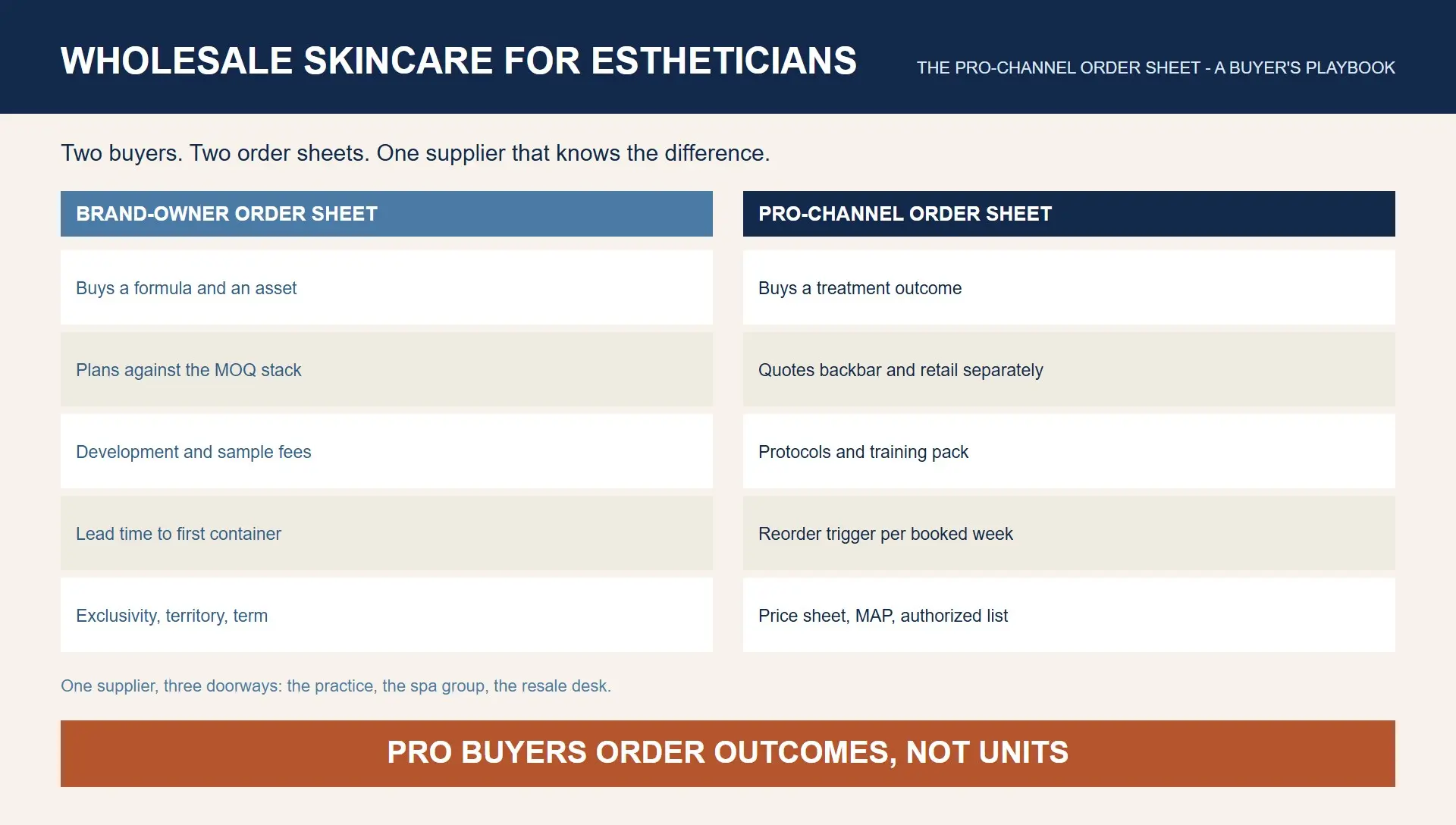
A search box says wholesale skincare for estheticians, and a catalogue opens — and the buyer on the other side of that phrase is not the founder the earlier guides were written for. The esthetician, the spa owner, the licensed reseller: they order skincare against a different instrument. A brand owner signs a purchase order for products. A professional-channel buyer orders against a treatment menu: how long the step takes, how the skin looks on day three, what the client can take home, and what happens to the price when another clinic lists the same line cheaper. The jar is the delivery mechanism, not the decision.
That reframing is not wordplay — it changes what you ask a supplier for before the first PO. It changes which lines on the quote matter (a backbar size is not the same SKU as its retail twin, priced, packed and reordered on their own lines), what ships with the product (protocol sheets and ingredient training are line items in the professional channel, even when nobody prices them on the page), and which paperwork the law attaches to the strength you want to sell (the honest answer on high-percentage acids is a documentation boundary, not a marketing opinion).
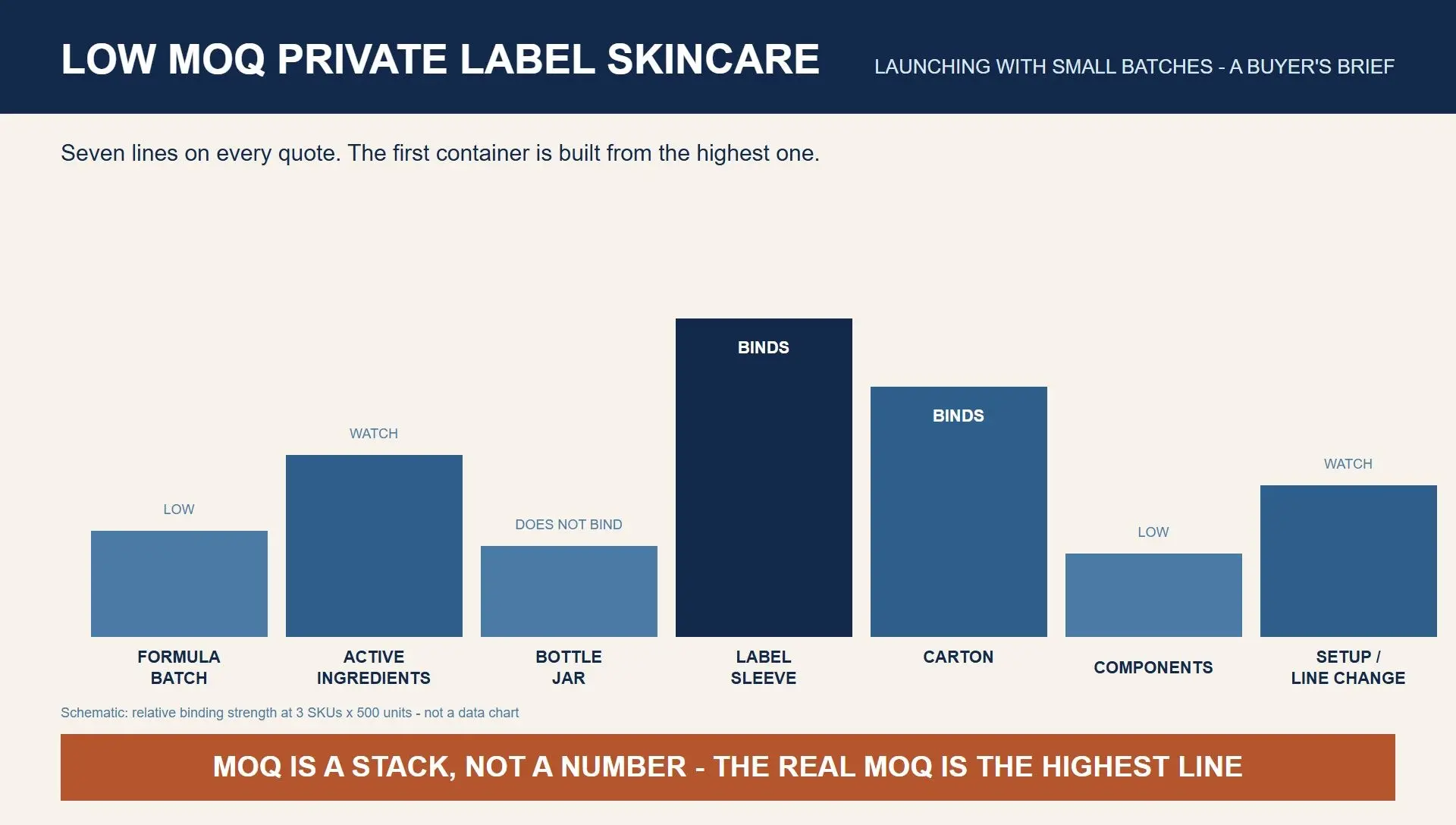
Scope note first, so nobody is misfiled. The questions the brand-side buyer asks — which model to sign, who owns the formula, what the MOQ stack really is — are answered once and for all in the ownership ledger and the low-MOQ stack guide, and the launch sequence lives in the five-decision playbook. This piece is for the other side of the counter: wholesale for estheticians, spa retail, and reseller distribution — the channel that buys outcomes. It assumes you already know what private label is; it does not assume you already know how the professional order sheet differs from the brand-owner one. That difference is the whole subject.
The reader map, kept honest: a licensed esthetician running a treatment room orders the protocol and the backbar, and pairs each with a retail take-home; a spa owner does the same across several rooms and thinks in chair turnover; a reseller — online or B2B — buys the assortment and the price protection, and sells through their own channel. One supplier, three doorways into it, two order sheets underneath. Every section below is written so each of those buyers can find their own column.
The professional buyer is purchasing treatment outcomes — the jar is only the delivery mechanism.
The Market Numbers, Read by Boundary: $13B, $45B and $247B Are Three Different Questions
The professional-channel buyer who asks "is this segment worth building a line for" deserves the same honest treatment the market sections in our other guides get: the research houses do not agree, because they are not counting the same thing. Four dated sources, four boundaries:
| Institution (report date) | What is actually counted | Base value | Forecast / structure | The boundary that moves the number |
|---|---|---|---|---|
| Business Research Insights (2026-07) | Professional skincare products, global | US$13.03B (2026) | — | Narrow "pro line" boundary |
| The Business Research Company (2026-08) | Professional skincare products, global | US$45.57B (2025) | US$48.47B (2026); CAGR 6.3% | Broad product boundary |
| Fortune Business Insights (2026) | Professional beauty services | US$247.6B (2026) | US$432.6B by 2034; 7.22%; US to $75.9B by 2032 | Services, not products |
| Global Market Statistics (2026) | Application shares of pro skincare products | retail 43% · spas & salons 27% · medical 22% · other 8% | — | Shares, not size |
Read the rows against the question. The two product estimates span $13B to $46B — a 3.5× gap — and neither is wrong: one counts the narrow professional-line supply base, the other a broad product boundary that folds in adjacent retail distribution. Quote whichever matches how you sell, or quote both and say so — a business plan sized against the wider number and executed against the narrower one is where channel budgets die. The $247.6B services row is the more useful figure for a treatment-room buyer anyway: that is the economy your clients are already participating in, growing at 7.22% toward 2034, with the US alone projected at $75.9B by 2032 (Fortune Business Insights, 2026). Product is the input line; the service economy is the demand curve.
The shares row is the one most often misquoted. Professional skincare products sell more through retail (43%) than through spas and salons (27%) (Global Market Statistics, 2026). For an esthetician that is not a warning — it is the opening: the channel where your authority converts is precisely the 27% where the product arrives with a protocol and a face behind it. And for a reseller, the 43% is the battlefield you are entering with someone else's trust. Direction for strategy, your own channel data for budget: the spread itself is the analysis object, and any number quoted without its boundary is marketing.
Three market sizes, one discipline: quote the number whose boundary matches your question.
The Esthetician Buyer vs the Reseller Buyer: What Each One Actually Optimizes
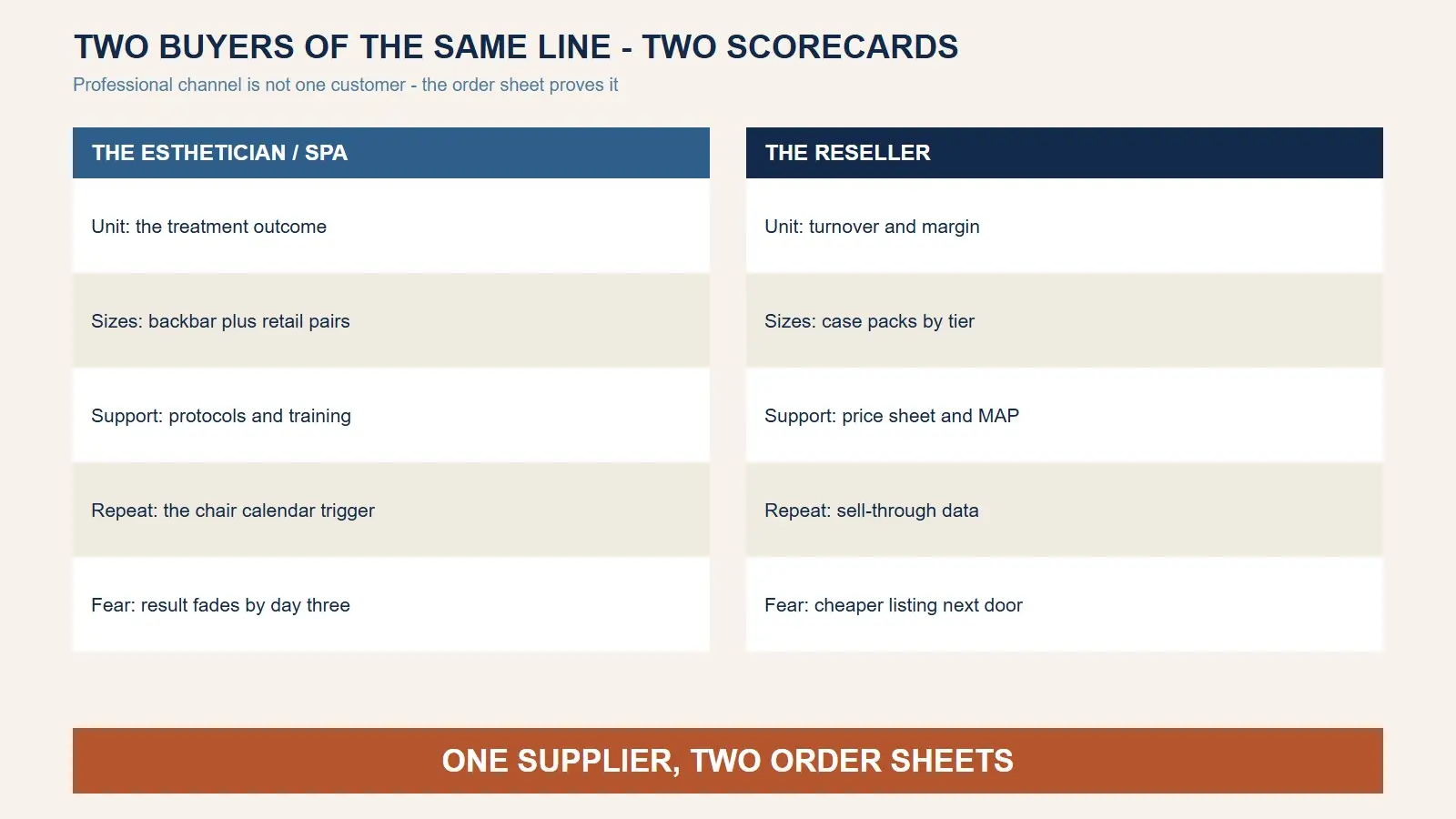
Suppliers that say "professional channel" as if it were one customer are selling to a memory of one. The practice and the resale desk optimize different objects, and the order sheet each signs proves it:
| Dimension | The practicing esthetician / spa | The reseller (online or B2B) |
|---|---|---|
| The unit of purchase | The treatment outcome — minutes, finish, day-three skin | Turnover — sell-through rate, weeks of inventory |
| What the size means | Backbar size = cost per service | Case pack = margin per carton |
| The retail event | Take-home pair sold in the chair, minutes after the result | Listing sold against a competitor's price on a search page |
| Support consumed | Protocols, training, recertification, menu design | Price sheet, MAP enforcement, assets, authorized status |
| The failure they fear | A result that fades before the next appointment | A cheaper listing of the same line next door |
The columns explain the whole buying conversation. The treatment-room buyer asks whether the acid resurfaces in six minutes and whether the client will wear it back to the following appointment — which is why the professional line ships as pairs: the backbar size for the room and the retail size for the client's bathroom, same INCI story, different economics. The reseller asks whether you will honour the price sheet — which is why that relationship lives or dies on distribution discipline, not formula quality. A supplier who pitches the reseller's assortment talk to the esthetician (or the practice's protocol talk to the reseller) loses both.
And a supplier who only sees one buyer at the "professional" desk usually ends up structuring the catalog wrong: the SKU list stays retail-shaped, the backbar sizes are afterthoughts, the training pack is a PDF afterpaywall, and the price sheet has no MAP — four defects, each one an invitation for a better-organized competitor to take the channel. The rest of this piece walks each of those lines: the pair math (H2 四 and H2 五), the support and price structure (H2 六 and H2 七), and the legal strength boundary that decides what either buyer is allowed to sell (H2 八).
The Backbar Line: Why Professional Sizes Are a Different SKU, Not a Bigger Jar
Most wholesale skincare suppliers quote the backbar line separately from the retail line — not as a courtesy, but because the two products are manufactured, filled, packed and reordered on different economics. The backbar (the jar, bottle or airless pump that lives on the treatment trolley) is bought by a business whose cost object is the service minute; the retail twin is bought by a client whose cost object is the month. Getting that split onto the quote is the first professional-channel skill:
| Order line | What it is actually for | What the buyer optimizes | What must be written |
|---|---|---|---|
| Backbar size | Treatment consumption in the room | Cost per application × steps per hour | Size per protocol step, yield per fill |
| Retail size | Take-home continuity between visits | Attach rate, margin per unit sold | Paired SKU to the same protocol step |
| Refill logic | Trolley rotation without shelf clutter | Refill pouches vs new airless units | Whether refills are offered and on what terms |
| Opening kit | First-room stocking | A full menu cycle, not a shelf block | Kit contents per treatment, not per SKU |
| Reorder trigger | Busy-season continuity | Weeks of cover per protocol | The lead time that protects a booked calendar |
Two structural notes that keep this honest. First, the numbers belong to the supplier, the structure belongs to the buyer: this house does not print absolute unit prices or percentages that no one can verify — what transfers between suppliers is the shape of the quote (the five lines above, each quoted separately), and the MOQ mechanics behind them — how a line's minimum gets built and where it binds — are walked through line by line in our low-MOQ stack guide. Second, the backbar is a product decision disguised as a size decision: a 500 ml jar that sits open on a trolley is a contamination story and a spatula tax; the professional formats that survive audits are closed-system airless pumps and single-dose ampoules for the actives that need it — the same formulation logic our ingredient guides call "the delivery is the product," pointed at the treatment room instead of the shelf.
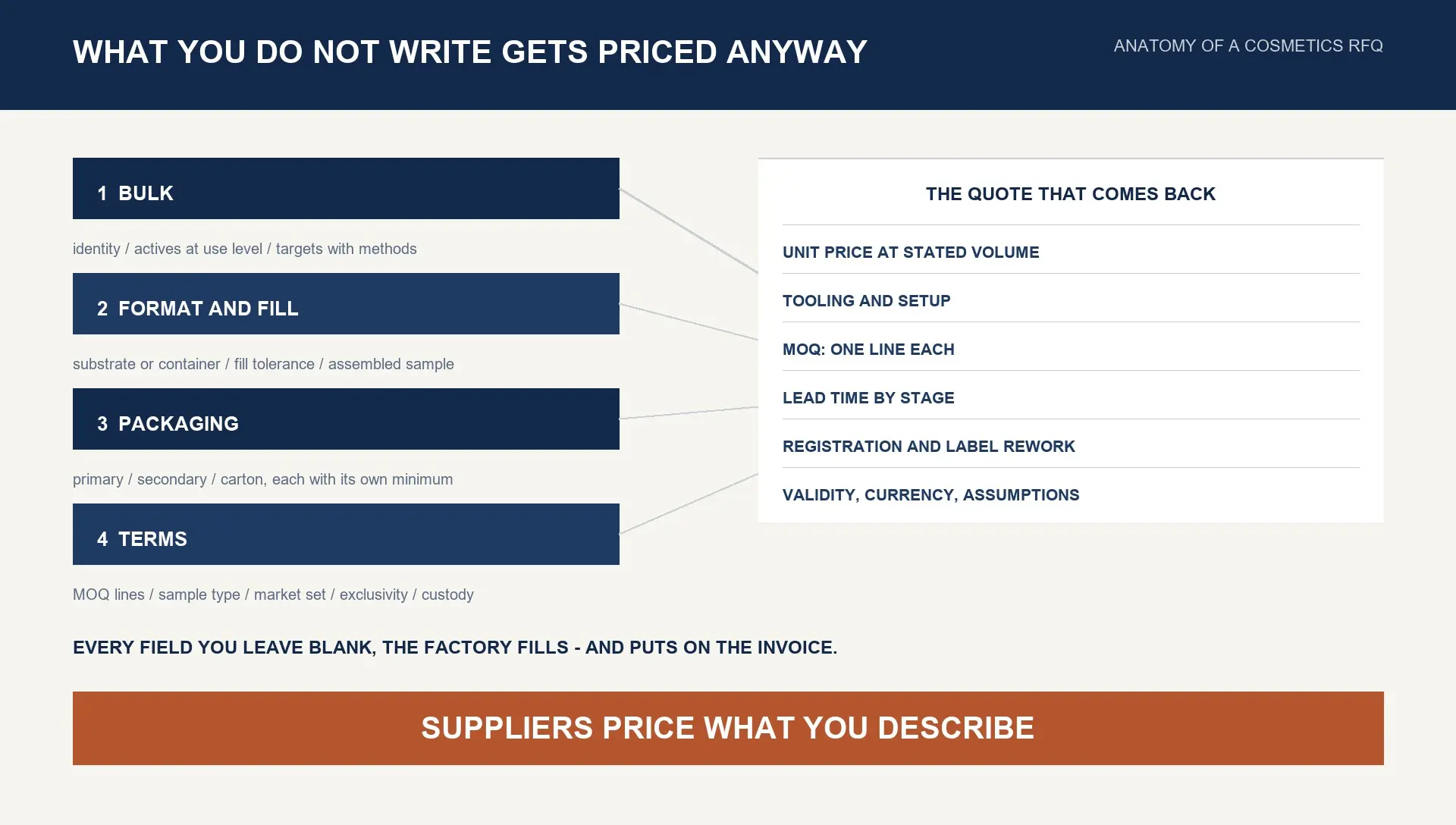
Ask the question that sorts suppliers in one exchange: "Quote me the backbar line and the retail line separately — sizes, pack formats, refills and reorder triggers included." A supplier whose catalog was built with the channel in mind answers with two tables in an hour. A supplier whose catalog was retail-shaped answers with one table and a volume discount.
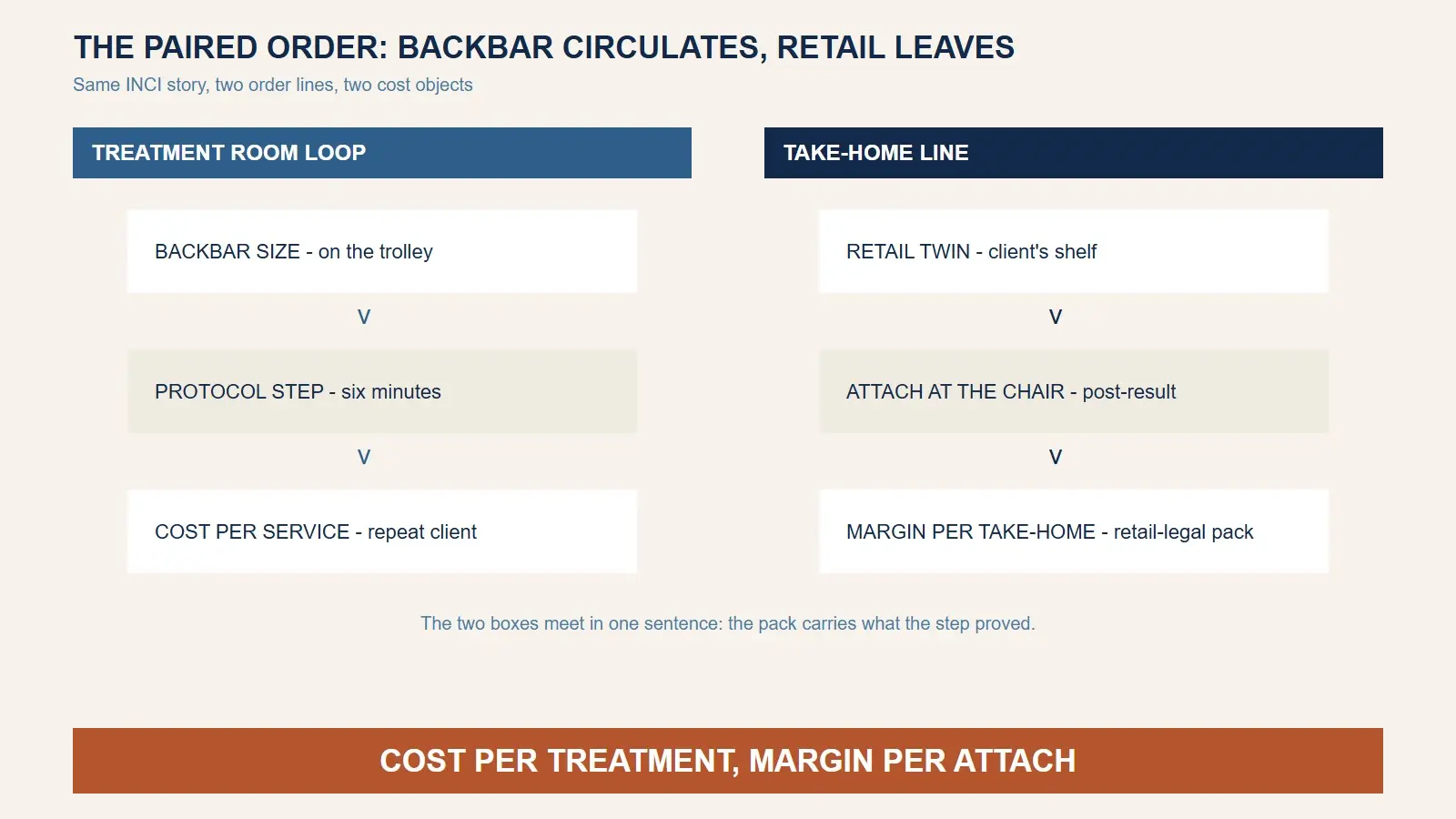
The backbar and the retail twin are two SKUs with one story — a quote that merges them has told you neither.
The Retail Attach: the Second Sale Already Standing in Your Treatment Room
Every facial is a retail event that most rooms leave unfinished. The client has just watched and felt a result performed on their own skin, in the exact format the professional line was built to deliver — and the take-home item that matches that step is the easiest sell in beauty distribution, because it is not a pitch, it is a continuation. This is the mechanism behind the market shares in H2 二: professional lines reach the 43% retail economy through the treatment room's own hand, not through a shelf next to someone else's brand.
The attach structure, as a procurement checklist: match the retail item to the protocol step, not to the jar — the client who saw an enzyme step gets the enzyme home, the one who felt the barrier cream gets that cream; keep the INCI story identical so the at-home result reinforces the in-room result instead of arguing with it; price the pair so the treatment can be the entry and the retail can be the repeat — a margin structure where the backbar subsidizes the outcome and the take-home carries the profit is the shape professional lines actually sustain themselves on; and hold the claims discipline: the retail twin must carry retail-legal language on its pack regardless of what the professional step is allowed to be (the strength boundary in H2 八 makes this non-optional).
The adjacent economics are not unique to the facial room — the same frequency-and-format logic drives repurchase in the body-care extensions we mapped for hand-mask retail angles, and the channel's attention economy (who discovers the line, where the trust transfers) is the subject of our Sephora × TikTok Shop coverage. What belongs to this section is the part every pro-channel buyer controls: the take-home line is not an add-on to the service menu — it is the service menu's second page.
Training Is the Product: Protocols, Education and Support in Writing
The line between a professional brand and a retail brand that likes big jars is not the formula — it is the paperwork that arrives before the first shipment does: the protocol sheet for each treatment step (contact time, layer order, contraindications, expected skin response), the ingredient education for the person touching the client's face, the recertification path when the line reformulates, and the launch support that converts a menu from a plan into bookings. In the professional channel, these are not bonuses; they are the reason the client completes the course of treatments and comes back between them.
Put the expectation on the table in procurement terms, because that is what makes it testable: ask what ships with the line at opening — protocol sheets per treatment (not per product), usage cards the client keeps, patch-test guidance for the acid steps, and the language pack if your clientele needs one; ask what happens at revision — when an active or an INCI changes, the protocol has to be re-issued, and a supplier who cannot describe that workflow will let your menu drift out of sync with your packs; and ask who does the training — a dedicated educator, a certification program, a video library with dates on it. A supplier who answers these in an afternoon is running a professional channel. A supplier who answers "we can send you the catalog" is running a wholesale counter.
The economics behind why this line item is invisible on price lists: the treatment room's real cost object is the practitioner's minutes and the client's confidence between visits — support assets are what convert a product sale into a repeatable service with predictable consumption. That is also the reason the strongest professional lines treat training as a retention mechanism for the buyer, not a giveaway: the esthetician who is certified on a system reorders the system, and the supplier who withdrew the education after year one discovers that menu inertia cuts both ways.
The Price Sheet: Wholesale Tiers, MAP, and the Authorized Territory
For the reseller half of the channel, the product is the assortment and the real purchase is the price sheet — and the price sheet is a legal document wearing a spreadsheet costume. Its structure, quoted in the order it should arrive:
Tier definition. Which tier you sit in (practice, spa group, online authorized, B2B distribution) is a written status, not a volume accident — the tiers should differ by price, by terms and by what the supplier does when each one grows, and the criteria should be on the page before you negotiate anything.
MAP clause. A minimum advertised price is the reseller's protection against the exact failure named in H2 三 — the cheaper listing of the same line next door. What makes a MAP real is not the clause but the mechanism: who monitors, what the violation ladder is (warning → suspension → deauthorization), and whether the supplier enforces it against its own house channels too. A MAP that exempts the brand's own storefront is a suggestion.
Authorized list and territory. Ask to be named on the authorized reseller list — and ask what the supplier does about the unauthorized ones, because clients and clinics verify, and the verification page that only shows winners will not convince a treatment room that has just seen a "professional" size on a discount marketplace. If the line is sold under any territory understanding, the non-circumvent logic is the same one the brand-side buyer signs into: the exclusivity math (territory, term, scope) is written out in the ownership ledger piece, and it applies symmetrically on the channel side.
The cost-and-time shape underneath. Every price sheet is ultimately a projection of cost lines and lead-time lines; and which of those lines you own versus your supplier holds depends on the model you sign into — the map of those models sits on our three-model comparison page. No absolute prices here, per house discipline: prices are the supplier's numbers; the structure is yours to demand.
The one-sentence test of a professional-channel price sheet: does it contain clauses that protect the buyer who follows the rules from the buyer who breaks them? If the answer is no, you are not being recruited into a channel — you are being handed inventory.
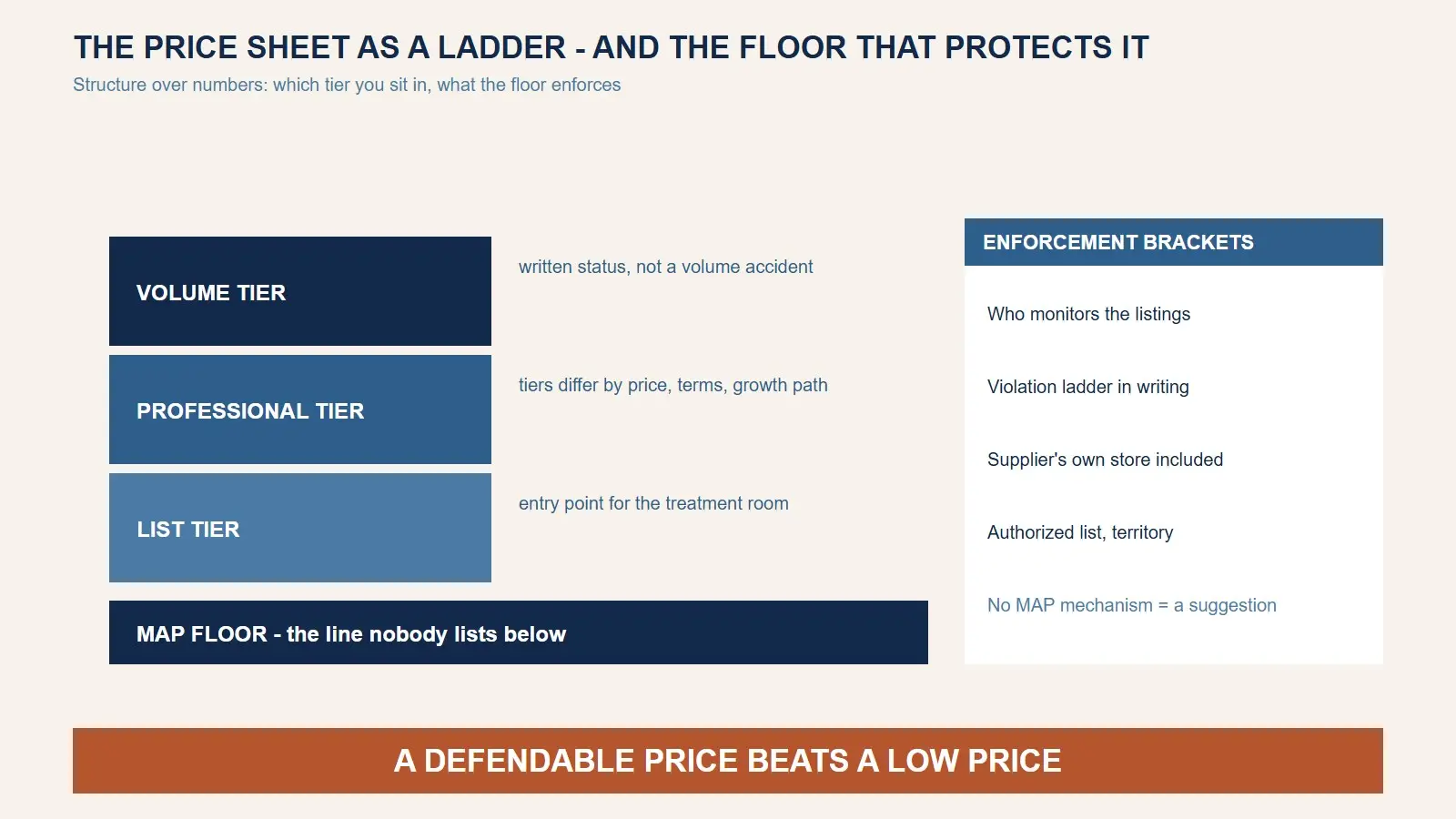
A defendable price beats a low price — the clause that protects your margin is the one you ask for before the order.
Professional Strength, Legal Boundary: the AHA Line and the OTC Shelf
The phrase "professional strength" is where the channel's marketing and the regulator's arithmetic disagree, and the disagreement is the most useful map a professional buyer can own. Three fixed points, all sourced, none invented:
| Strength line | What governs it | The consumer-shelf condition | What the professional side changes |
|---|---|---|---|
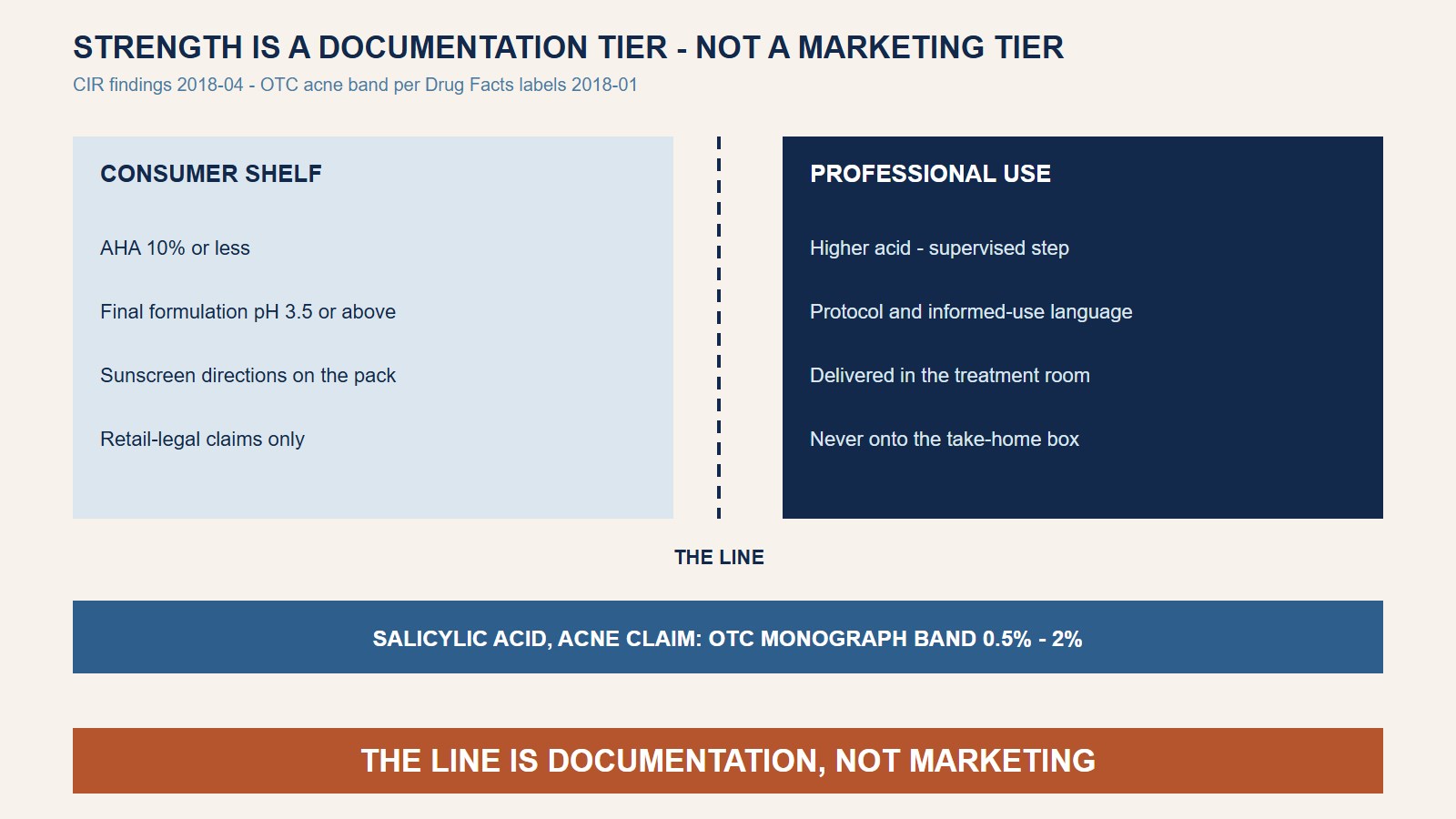
| Alpha hydroxy acids (glycolic, lactic, malic) | Cosmetic Ingredient Review expert-panel findings — quick-reference table, cir-safety.org, posted 2018-04 | Safe at 10% or less, at final formulation pH 3.5 or above, formulated to avoid added sun sensitivity or with daily sunscreen directions on the label | Above the line, the acid is not "stronger retail" — it is a professional application with different usage, disclosure and supervision framing |
| Salicylic acid with an acne claim | FDA's OTC acne monograph, as printed on Drug Facts labels (DailyMed, sample label 2018-01-05) | Acne-active listings run the monograph band — 0.5%–2% as the labeled active | Outside that band, an acne claim stops being cosmetic language; a "professional peel" step is an in-room service, not a take-home product with a number on it |
| The claim attached to the strength | Marketed-use reality, not ingredient optimism | The pack must say what the retail-legal product does, regardless of the step that preceded it | The protocol sheet, informed-use language and practitioner supervision are the professional half of the same sentence |
Read the table the way a buyer needs to. The CIR condition is not a ceiling on science — it is the boundary at which the documentation obligations change: a consumer AHA product at 10% and pH 3.5 ships with sunscreen guidance on the pack; a 20% or 30% acid belongs to the treatment step performed by the trained hands that the protocol in H2 六 was written for, and it cannot silently move onto the take-home shelf. Same molecule, same supplier, two different paperwork stacks — and this is precisely where the "professional" brand that is really a retail brand gets caught, because its pack copy promises the in-room result on the at-home box.
And the US side of that promise is not a style question. The claim boundary, the responsible-party duties and the enforcement posture that decide which sentences survive an FDA conversation are the subject of our MoCRA supplier-selection coverage — for a channel buyer the practical import is narrower but harder: whatever the acid concentration, the retail twin's claims must be retail-legal, and the professional step's claims must be delivered by the professional step's documentation. Strength is not a marketing tier. Strength is a documentation tier.
The line between professional and retail is not a percentage on the bottle — it is the paperwork behind the application.
Ten Questions the Professional-Channel Buyer Asks Before the First Case
The questions below are the order sheet in interrogative form — each one has a document answer, and a supplier who answers them separately and in writing has already separated itself from the wholesale counter:
1. Will you quote the backbar line and the retail line separately — sizes, pack formats, refills, reorder triggers? 2. What is the full price sheet — tiers, volume breaks, and which tier my channel status sits in? 3. Is the MAP clause written, who monitors it, and what happens to violators — including your own storefront? 4. What training ships with the line at opening — protocol sheets per treatment, usage cards, patch-test guidance, and who delivers it? 5. When a formula or INCI changes, how is the protocol re-issued and how fast? 6. Which of the skincare suppliers for dropshipping can also hold professional stock — and does per-order fulfilment touch backbar rotation and lot dating? 7. What is the reorder lead time at my treatment volume, and what replenishment trigger protects a booked calendar? 8. Am I on the authorized reseller list, and what does the supplier do about unauthorized listings of the same line? 9. Can the full menu cycle — backbar, retail pairs, and education — be bought as one opening kit, and what is in it? 10. What documentation pack covers the professional-strength items — CIR/FDA framing, informed-use language, and the claim boundary for the retail twin?
Three of these — the protocol re-issue (5), the dropship-versus-backbar question (6) and the documentation pack (10) — are where a supplier's operating discipline becomes visible, and the deep version of that audit is the 12-point factory audit checklist that brand-side buyers use; run the same card from the channel side. When all ten answers arrive, put them in one table beside the previous supplier's and compare the document columns, not the adjectives — because in this channel, as on the brand side, the only asset that survives is the paperwork.
A professional line without protocol paperwork is a retail line that grew up in a bigger jar.
The Channel Playbook, Summed in Four Moves
Four moves carry the piece. One: read the market numbers by boundary. The $13B and the $46B are both real and they answer different questions; the $247B services economy is the demand curve your treatment room rents. Quote the row whose boundary matches your business, or quote the spread and say so. Two: split the two order sheets. The practice optimizes outcomes and chair minutes; the reseller optimizes margin and price protection; a supplier who pitches one to the other is selling inventory, not a channel. Three: put the invisible line items in writing. Backbar versus retail sizes quoted separately, protocol sheets and training shipped before the first case, MAP with a mechanism, authorized status with enforcement — none of these are on a price list until you ask, which is exactly why they are the negotiation. Four: respect the strength line. The consumer shelf has a documented boundary (CIR's AHA condition, the OTC monograph band); above it, the product is a service step with supervision paperwork, and the take-home twin must never inherit the in-room claim.
The buyer who leaves with that list can do what the catalogue never offered: turn "wholesale for professionals" from a discount request into a channel specification — the document against which any supplier's answer can be scored, in the same way the brand-side buyer scores a quote against the seven-line MOQ stack. Different sheet, same discipline: the structure belongs to you.
Frequently Asked Questions
Q1: What is the difference between professional wholesale and ordinary skincare wholesale? The order object. Ordinary wholesale buys shelf product by the case; the professional channel buys a treatment outcome — protocol steps first, the backbar size that delivers them, the retail twin that continues them, and the training that makes both repeatable. A professional line is defined by the paperwork, not the jar size.
Q2: Which market figure should a spa business plan against? The one whose boundary matches your question. For product supply, the dated product estimates span roughly $13B to $46B globally; for the demand environment your rooms are selling into, the professional-services figure ($247.6B in 2026, heading to $432.6B by 2034) is the relevant curve. Plan budgets on your own consumption data, and direction on the boundaries.
Q3: What does "professional strength" mean legally? On the consumer shelf, a documented boundary. For alpha hydroxy acids, the CIR condition for consumer use is 10% or less at final pH 3.5 or above with sunscreen directions; for acne claims, salicylic acid runs the OTC monograph band of 0.5%–2%. Above those lines the product belongs to a supervised treatment step with its own disclosure language — not to a take-home box.
Q4: Can I dropship a professional line instead of holding stock? You can dropship the retail twin; you cannot dropship the treatment room. Backbar is consumable inventory inside your service cycle, so the fulfillment question resolves into the same stack math — which is answered line by line in the low-MOQ guide linked above — while per-order dropshipping only changes who holds the retail stock and on whose SLA. Decide the retail model first, then ask about lot dating and rotation terms.
Q5: How do I keep another reseller from undercutting me? Through the clause, not the hope: a MAP written with a monitoring owner and a violation ladder, a supplier that enforces it on its own storefront too, and your name on the authorized list so treatment-room buyers can verify where the line is legitimate. Where enforcement is absent, price-sheet tiers collapse to a race — that is the failure mode this channel punishes hardest.
Q6: What should a supplier's training pack contain before I stock a new line? Protocol sheets per treatment (contact time, layer order, contraindications), ingredient education for staff, patch-test and informed-use guidance for active steps, the revision workflow for formula changes, and dated materials. If a supplier cannot list those five artifacts in one reply, the line is not ready for a treatment room.
What to do next
Send us your channel: the treatment menu or resale model, the formats you consume, your client volumes and your market. What comes back is the professional price-sheet structure filled for your channel — backbar and retail lines quoted separately, tier and MAP terms in writing, the protocol and training pack shipped before the first case, and reorder lead times at your volumes, with the MOQ lines split by format. A dedicated product manager on every RFQ — reply within 24 hours.
Sources and Further Reading
Market and regulatory sources (institution + date as cited in the tables):
1. Business Research Insights, Professional Skincare Market (2026-07): global professional skincare products valued at US$13.03B (2026). 2. The Business Research Company (distributed via Research and Markets) (2026-08): professional skincare market US$45.57B (2025) → US$48.47B (2026), CAGR 6.3%. 3. Fortune Business Insights (2026): professional beauty services US$247.6B (2026) → US$432.6B by 2034, CAGR 7.22%; US services to US$75.9B by 2032. 4. Global Market Statistics (2026): professional skincare products application shares — retail 43%, spas & salons 27%, medical institutions 22%, others 8%. 5. Cosmetic Ingredient Review Expert Panel, quick-reference findings table (cir-safety.org, posted 2018-04): alpha hydroxy acids safe for consumer use at 10% or less, final formulation pH 3.5 or above, formulated to avoid added sun sensitivity or with daily sunscreen directions. 6. Drug Facts labeling via DailyMed, US National Library of Medicine (sample label dated 2018-01-05): salicylic acid presented as the acne active within the OTC monograph band (labeled example 2%).
Site internal references:
7. Starting a skincare brand — the five-decision sequence: https://www.fkybeauty.com/news/how-to-start-a-skincare-brand-in-2026/ 8. Low-MOQ stack guide (the MOQ math behind both order lines): https://www.fkybeauty.com/news/private-label-skincare-low-moq-launching-small-batches/ 9. Private label vs white label — the ownership ledger (territory, term, scope): https://www.fkybeauty.com/news/private-label-vs-white-label-skincare-which-model-fits/ 10. Three-model comparison (private label / OEM / ODM): https://www.fkybeauty.com/private-label-vs-oem-vs-odm-which-model-fits-your-brand/ 11. Hand masks — frequency, format and retail angles: https://www.fkybeauty.com/news/hand-mask-benefits-use-frequency-retail-angles/ 12. Sephora × TikTok Shop — the channel attention economy: https://www.fkybeauty.com/news/social-commerce-hits-an-inflection-point-sephora-tiktok-shop-and-youtube-amazon-are-rewriting-how-beauty-launches/ 13. MoCRA supplier-selection guide — US claim and documentation discipline: https://www.fkybeauty.com/news/mocra-2026-full-enforcement-compliance-mandates-supplier-selection-guide-for-skincare-brands-exporting-to-the-u-s/ 14. 12-point factory audit checklist — the operating-discipline card: https://www.fkybeauty.com/how-to-verify-a-chinese-skincare-oem-factory-12-point-audit-checklist/