

Tripeptide Spec Sheet: Sequence, Copper and the Lipid Tail
Tripeptide Is a Specification Word, Not a Marketing Word
A buyer who types tripeptide into a sourcing search is not browsing. The word is a count: three amino acids, linked in a defined order, and that order is the reason the molecule does anything at all. Compare it with the word above it in the same file: peptide, which the client's third-party keyword set records at roughly 368,000 monthly searches with HIGH competition, versus 14,800 for the tri- form at LOW competition and a cost-per-click of $7.44 - the highest CPC attached to any low-competition row in the archived extract of that 243-keyword file.
That combination - a small audience paying a high price - is the signature of a specification, not a trend. People searching the generic word are comparing products. People searching the structural word are writing a brief. And a supplier who answers the second buyer with the first buyer's vocabulary loses the enquiry in one sentence.
Scope note, because this site has already answered adjacent questions. Which peptide family to choose against PDRN, collagen and hyaluronic acid is a formulation-decision problem, worked through in the ingredient decision matrix and in the efficacy ingredient comparison guide; what a copper peptide serum does on the shelf is covered in this site's GHK-Cu and SNAP-8 peptide serum piece; how peptides are made under contract is the subject of the peptide manufacturing guide. This piece answers a different question: how to read a peptide's architecture as a purchasing specification - what the name commits to, what a modification changes, and which numbers have to appear in writing before a formula brief becomes a signed order.
The reader map: a formulator who needs the molecule described precisely enough to reproduce it; a brand owner who needs to know what "contains peptides" is actually worth on a claim; a procurement lead who needs to compare two supplier quotes that look identical and are not. Every section below is written so each of those three can find their own column.
The number inside an ingredient name is a purchasing instruction: it tells you which residues, which metal and which tail to ask about.
Three Residues and a Copper Site: What the Molecule Actually Commits To
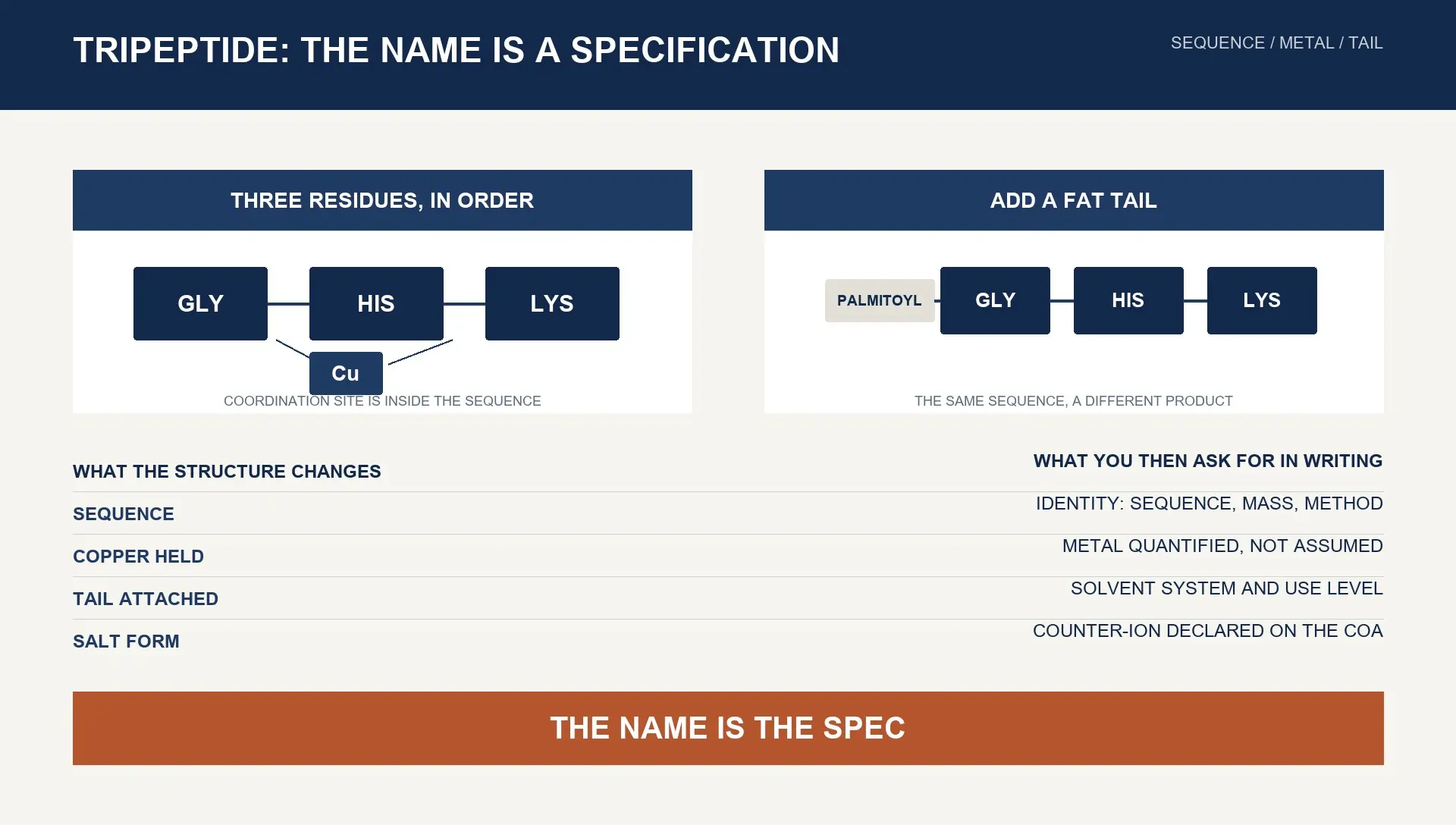
The three-residue molecule the whole category argues about is GHK - glycyl-L-histidyl-L-lysine, three residues in a fixed order. The review that gathered most of its literature (Pickart, Vasquez-Soltero and Margolina, BioMed Research International, 7 July 2015) records where it came from: isolated in 1973 as an activity in human serum albumin, later established as a three-residue peptide with a strong affinity for copper, which readily forms the copper complex the ingredient suppliers sell. The same review reports that the free peptide circulates in human plasma at roughly 200 ng/mL around age 20 and about 80 ng/mL by age 60 - a decline the authors link to regenerative capacity. Treat that as literature context, not as a claim about your product; nothing on a label may be built from someone's plasma level.
What matters for procurement is why the sequence is the specification. In the GHK-copper complex the review describes the copper(II) ion held by three nitrogen donors: the imidazole nitrogen of the histidine side chain, the alpha-amino nitrogen of the glycine, and the deprotonated amide nitrogen of the glycine-histidine bond. Three attachment points, all of them inside the sequence. Change the order and you change the geometry; change the geometry and you have a different molecule with a different affinity - which is why the same file carries a separate row for ahk cu, the alanine-terminated analogue, with its own search volume and its own price signal.
The affinity itself is reported as a number worth putting in a supplier question. The review cites a binding constant for GHK of log10 16.44 against albumin's 16.2 - close enough that the peptide can take copper from the protein that normally carries it. And it reports the consequence that a formulator should care about: copper's redox activity is silenced while the ion is held by the peptide, which is the mechanism by which the complex delivers copper without the free-ion oxidative damage that uncomplexed copper would cause.
Read as a specification, the architecture generates three written asks before any sample is approved:
| Structural fact | What it commits you to in writing | The vague answer to reject |
|---|---|---|
| Sequence (which residues, in what order) | Sequence stated in the certificate of analysis, matched to the INCI name and, where available, the catalogue identifier | "Peptide complex" with no sequence |
| Metal coordination (which ion, how many, expressed how) | Copper content expressed as a percentage or as a metal-to-peptide ratio, with the method used | "Contains copper" |
| End group and salt form (free acid, acetate, trifluoroacetate) | Salt form and counter-ion declared, because they change assay behaviour and regulatory paperwork | "Lyophilised powder" |
The sequence is not a story about the ingredient; it is the reason three specific fields must appear on the certificate.
Chain Length Is Readable From the Name - and the Demand Follows the Number
Peptide nomenclature is not decorative. The prefix is a count: di- is two residues, tri- is three, tetra- four, penta- five, hexa- six, deca- ten, and the prefixes oligo- and poly- describe short and long chains without committing to a number. A buyer who can read the prefix can read a formulation brief without a chemist in the room, and can tell immediately when a supplier's technical page is hiding something.
That reading skill has a commercial edge, and the client's keyword file shows it. The archived extract of the 243-keyword third-party set records the whole ladder of structural words sitting in low competition, while the generic category word is saturated:
| Chain-length word | Residues | Monthly volume (third-party set) | Competition | What a buyer is specifying |
|---|---|---|---|---|
| dipeptide | 2 | 18,100 | LOW | Two-unit building blocks; solubility and stability behave differently again |
| tripeptide | 3 | 14,800 | LOW | The GHK class - a copper-coordinating sequence |
| tetrapeptide | 4 | 2,900 | LOW | Longer signal fragments; more sequence to reproduce |
| pentapeptide | 5 | 1,900 | LOW | The lipidated matrikine fragment family |
| hexapeptide | 6 | 2,900 | HIGH | Neuro-modulator-style naming territory; crowded |
| decapeptide | 10 | 1,900 | LOW | Ten-residue claims; small audience, high click price ($4.86) |
| oligopeptide | few | 8,100 | LOW | A band, not a molecule - the vaguest defensible answer |
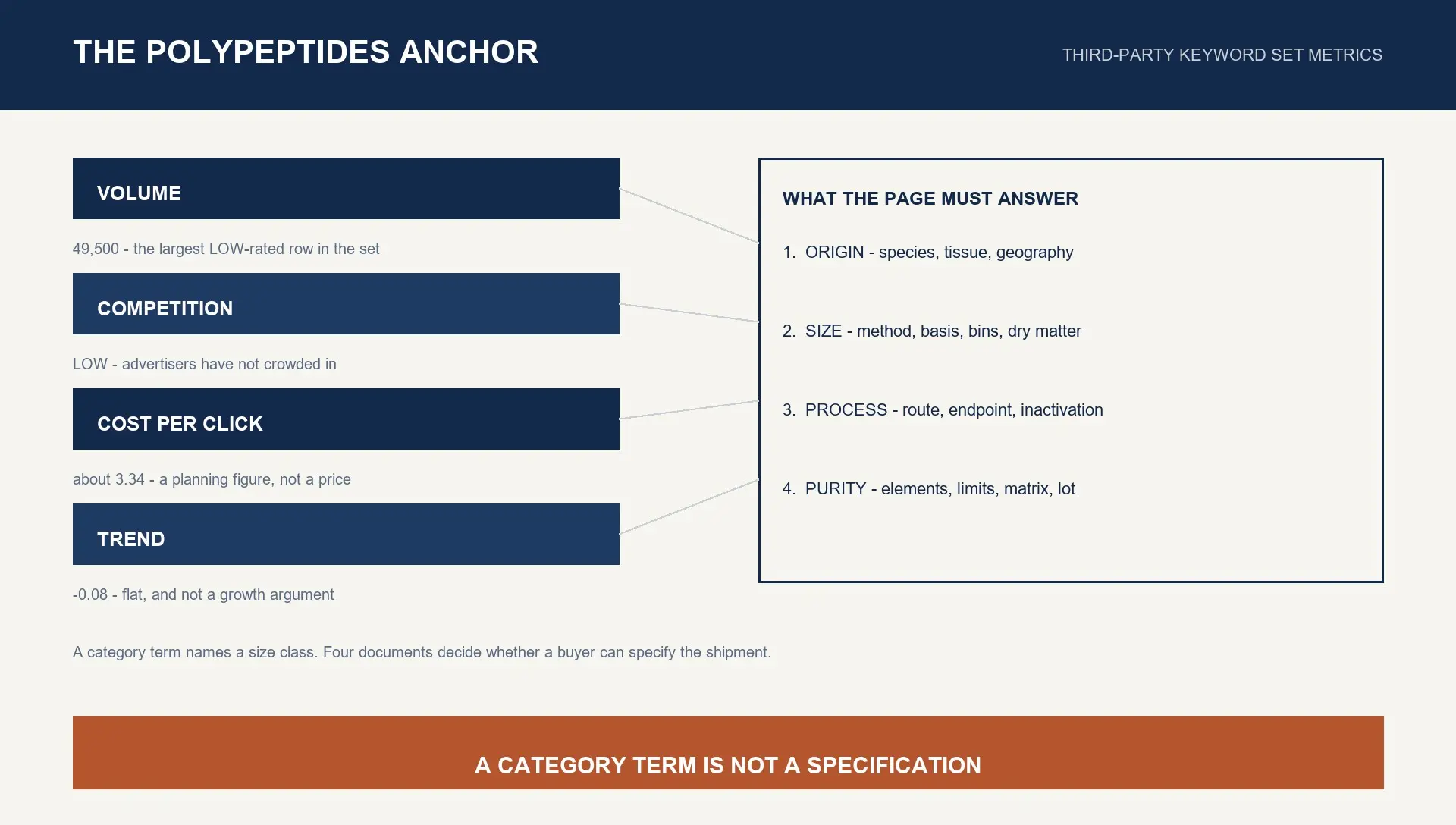
| polypeptides | many | 49,500 | LOW | A category anchor, not a specification (analysed as its own piece) |
| peptide | any | 368,000 | HIGH | The word consumers type; not reachable as a ranking target |
| ghk cu | 3 + Cu | 40,500 | HIGH | The specific molecule; already contested |
Read the ladder as a market map rather than a list. The generic word at 368,000 is where the traffic is and where you will not win: HIGH competition, and a searcher who arrives there is not yet specifying. The structural words below it - two, three, four, five, ten residues - each carry a real audience at LOW competition, because each one is a person who has already decided what they want. The one exception in the ladder is hexapeptide, which is already HIGH: six-residue naming was colonised by marketing earlier than the rest, which is itself a warning about where a term goes once a claim attaches to it.
Two honest limits on this table. First, these are third-party keyword-set metrics from a client file, not Google-verified search volumes, and they are counts of queries - not counts of purchase orders. Second, a low-competition word with 1,900 searches is a small room; the point of the ladder is not that each room is big, but that the uncontested demand in this category is distributed across the structural layer rather than the category layer. Direction for strategy, your own enquiry data for budget.
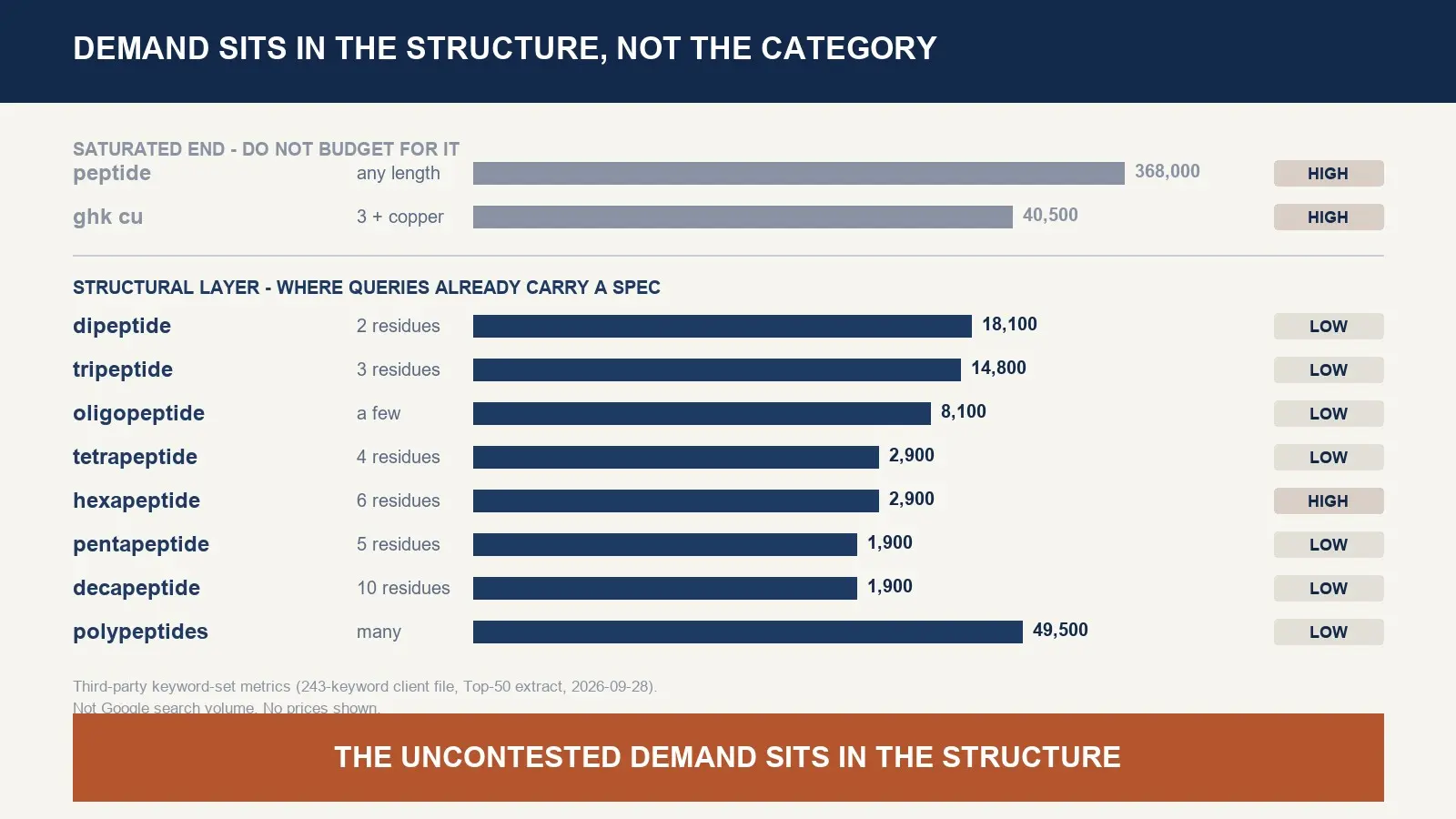
In this category the uncontested demand is in the structure layer, not the category layer.
The Modification Is the Technology: Lipid, Acetyl, Copper
The reason a modified peptide is priced differently from the sequence it is built on is delivery, and the literature is unusually concrete about it. The 2015 review summarising the formulation work reports distribution coefficients for the copper complex in octanol against phosphate-buffered saline of logD between -2.38 and -2.49 across pH 4.5 to 7.4 - a strongly hydrophilic molecule. Skin's outer layer is not a hydrophilic environment. That single number is the whole commercial argument for attaching something fat to a peptide, and it is also the number that tells you why a bare sequence in a watery serum is a different product from a lipidated one at the same declared percentage.
The same review reports two more findings that belong in a specification rather than a press release. Permeability coefficients for the copper complexes increase with rising pH, and in a membrane model of the stratum corneum only the three-residue sequence and its copper complexes migrated - which is why the pH of your finished formula is a delivery variable, not only a comfort variable. And the peptide is described as susceptible to proteolytic enzymes and prone to hydrolytic cleavage under oxidative stress, which is why the delivery conversation in this ingredient family is about protection, not about concentration.
Three modification families do most of the work in commercial cosmetic peptides, and each one changes a different column of your spec sheet:
| Modification | What it changes on the molecule | What you must now ask for | The failure it prevents |
|---|---|---|---|
| Lipid attachment (palmitoyl- prefixes) | Adds a fatty-acid tail, raising lipophilicity so the molecule interacts with a lipid barrier rather than only with water | The peptide identity plus the tail, the solvent system it arrives in, and how the supplier's use level is calculated | Paying a peptide price for a molecule that stays on the surface of the formula |
| N-terminal acetylation (acetyl- prefixes) | Caps the amine end; changes charge, and changes the name buyers search | The exact INCI string, not the shortened marketing version of it | Two suppliers quoting "the same" peptide under different salts |
| Metal coordination (copper and other complexes) | The ion is held by the sequence; redox behaviour is muted while bound | How metal content is expressed, and the assay method behind it | A "peptide" specification that never mentions the metal it is named for |
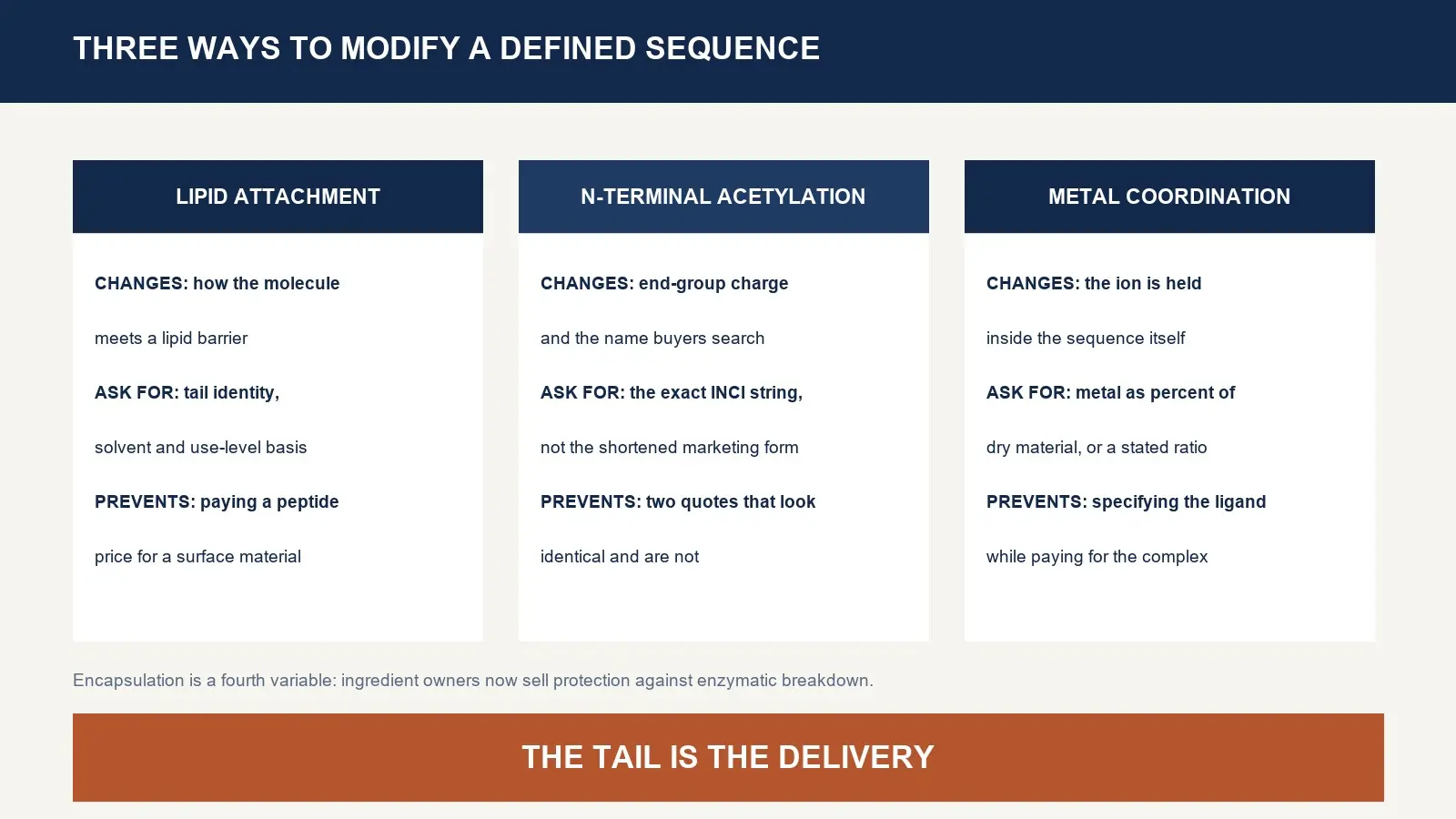
Encapsulation sits alongside these three as a fourth variable, and it is where the ingredient suppliers themselves have moved. In 2026 the owner of one of the best-known peptide trade names announced a biodegradable sub-micron lipid capsule designed to protect the peptide from enzymatic degradation on the way into the skin (supplier announcement reported by Global Cosmetic Industry, 17 August 2026; trade press, 4 May 2026 - supplier-published claims, not independently reviewed). The useful inference is not "buy the capsule version"; it is that the ingredient owner considers unprotected peptide delivery a real limitation, which means a supplier who quotes you a peptide percentage with no word about protection, pH or compatibility has answered a question you did not ask.
This is also where this site's existing guides take over, so the arithmetic is not repeated here: the full stability programme - antioxidant network, chelation, packaging, challenge testing and the recovery-at-timepoint data you should require before paying for a development batch - is worked out in the vitamin C stability and formulation guide; the carrier options that decide whether an active survives the shelf are covered in the encapsulated cream format piece and, for mask substrates specifically, the hydrogel versus sheet decision guide. What is specific to a peptide is the proteolytic and metal-coordination angle: your preservative and emulsifier choices are not only stability inputs, they are partners in a competition for the same ion.
A logD near minus two is not a chemistry footnote - it is the reason the tail exists and the reason your formula pH belongs in the specification.
A Trade Name Is Not an Ingredient: The 0.01 Percent Problem
Ask a supplier for "Matrixyl" and you have asked for a brand. The Cosmetic Ingredient Review's safety assessment of the palmitoyl and myristoyl pentapeptide ingredients lists MATRIXYL as a trade name mixture containing 0.01 percent palmitoyl pentapeptide-4 - the peptide is the ingredient, the rest of the trade material is solvent, preservative and carrier, and the trademark belongs to a specific ingredient supplier group, which markets it today as a licensed ingredient brand with usage rules attached. Two consequences follow, and both are purchasing problems rather than naming problems.
First, the percentage on your brief and the percentage in your supplier's document are different numbers. A use level quoted for a trade-name mixture applies to the mixture; the active peptide in that mixture is present at a fraction of it. If you specify "1 percent" without stating what the one percent of is, two suppliers will both comply and ship products that differ by orders of magnitude in peptide. The correct sentence in a brief names the INCI ingredient and then states the target level of the peptide itself, with the supplier's mixture concentration attached as a separate figure.
Second, the trade name carries obligations the INCI name does not. Marketing use of a licensed ingredient brand is permission-based: the ingredient owner's own guidance restricts how the mark is used, and a brand that prints a licensed name it was never granted is a compliance problem in a market where the label is the file. This site's rule is the same one it applies to every trademarked term: the INCI name goes in the technical documentation and the label; a supplier's trademark stays out of headlines and artwork unless you hold permission to use it. The same discipline is why this piece never prints a competitor or retail brand name.
The naming layers, from what a supplier invoices to what a buyer types:
| Layer | Example as it really appears | Where it belongs | What it can never do |
|---|---|---|---|
| Supplier trade name | A branded peptide complex with its own marketing dossier | Purchase order, raw-material specification, supplier's own literature | Serve as the ingredient identity on your label |
| INCI name | Palmitoyl pentapeptide-4 (and the lipidated forms around it) | Ingredient listing, safety assessment, technical brief | Tell you the concentration of the mixture you were quoted |
| Search shorthand | What a formulator types when they already know the molecule | Your content, catalogue fields and attribute lists | Substitute for the salt form or the assay |
The practical test is one question, asked in writing: "State the INCI name, the percentage of that INCI ingredient in the material you are quoting, and the percentage of that material you propose to use in the finished formula." A supplier who answers with three numbers has a specification. A supplier who answers with a brand name has a brochure - and, as the review of this ingredient family keeps showing, the interesting part of the product is exactly the part a brochure skips.
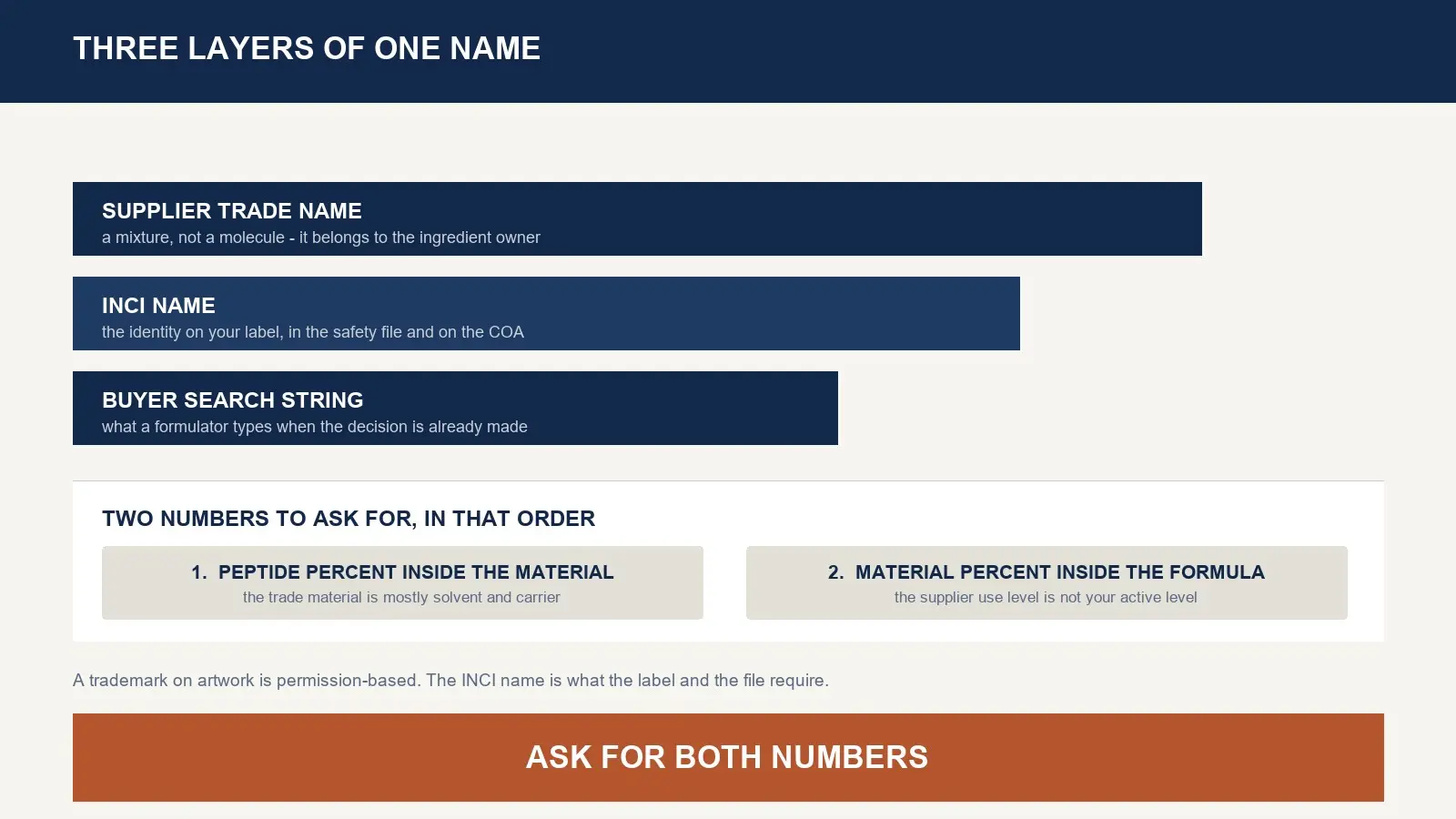
Ask for both numbers: the peptide inside the material, and the material inside the formula.
Purity and Content Are Two Columns, and Most Briefs Only Have One
A certificate of analysis for a peptide usually reports several different things, and the word "purity" is the one most often quoted alone. It should not be. Purity measured by chromatography describes what fraction of the detected peaks is the target molecule. Peptide content describes how much of the material in the vial is actually peptide once water, salt and residual solvent are accounted for. A lyophilised peptide supplied as an acetate salt can carry a high chromatographic purity and a modest peptide content at the same time, and both numbers are honest - they just answer different questions.
For a copper complex there is a third column, and it is the one most often missing. If the metal is part of the molecule's identity, the metal has to be quantified somewhere: either as a percentage of copper in the dry material, or as a stated ratio of copper to peptide. A specification that gives peptide purity and never mentions copper is describing the ligand, not the complex - and the complex is what the literature, the price and the buyer's expectation are all about.
The same logic runs downward into the finished product. A serum's declared peptide level can be expressed as the raw material in the formula, as the peptide in the raw material, or as the peptide in the finished product. Only the last of these is what a claim or a comparator is actually about, and it is the one that requires a method. This is the same dose-response discipline this site applies elsewhere: the 24k gold evidence-tiering piece separates what an ingredient can be shown to do from what it is permitted to say, and the hand-mask format guide does the same for how much product a format can physically carry.
The fields to require, in the order a quality manager will ask for them:
| Spec field | What a complete answer looks like | What a partial answer looks like |
|---|---|---|
| Identity | Sequence, molecular weight, and the reference used to assign them | Trade name only |
| Chromatographic purity | Percentage, with the method and the gradient or detection basis stated | "High purity" |
| Peptide content | Percentage on an as-supplied basis, with water content reported separately | Content omitted entirely |
| Salt form and counter-ion | Declared (for example acetate), with the consequence for assay noted | Silent |
| Metal quantification (complexes) | Copper as percent of dry material or as a stated ratio, with method | "Contains copper" |
| Microbiological and preservative state | Limits, method, and the preservative present in the liquid mixture | Certificate silent on the carrier |
| Stability at use level | Recovery at defined timepoints under defined storage, not a shelf-life assertion | Expiry date only |
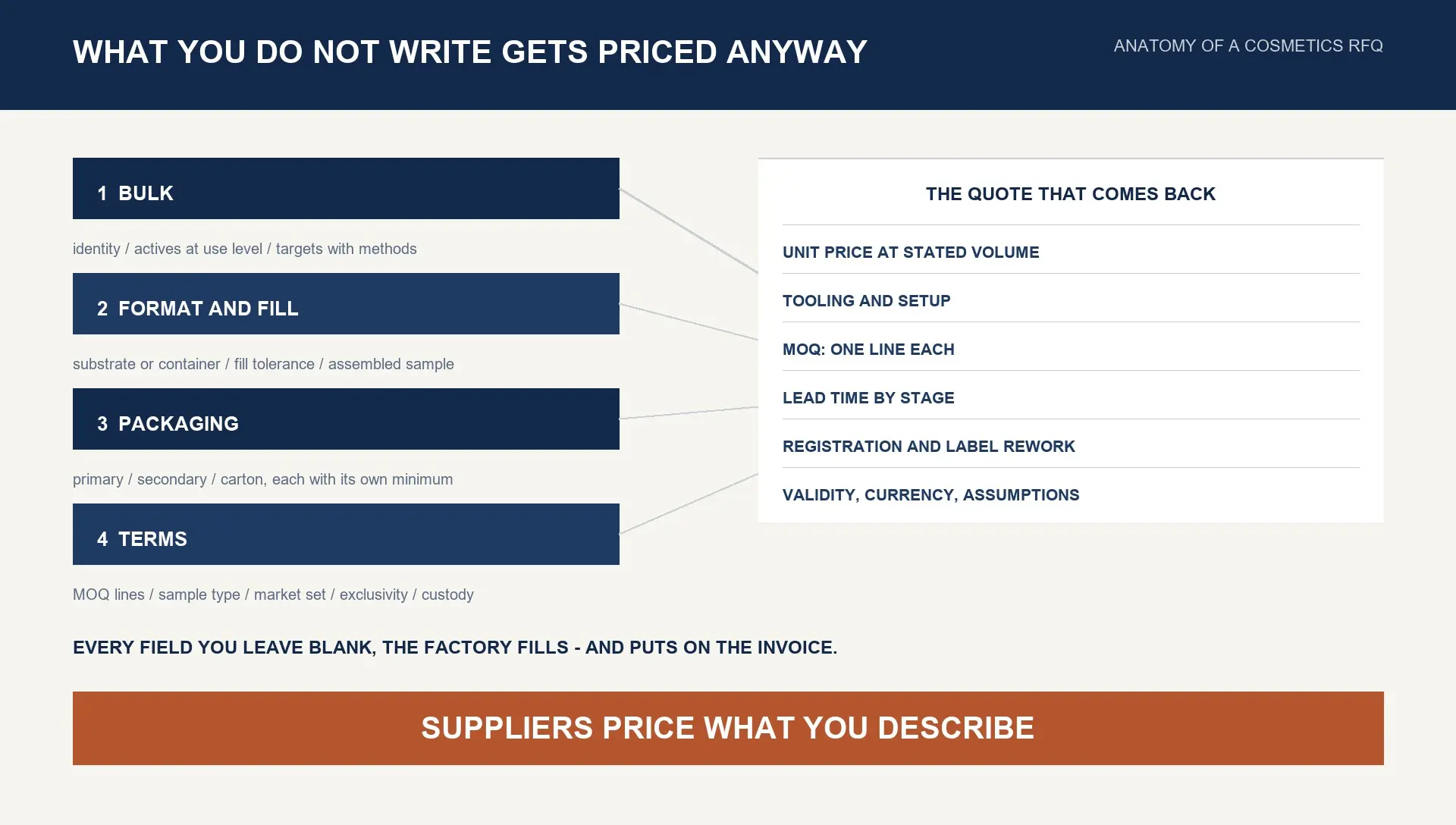
Read as a purchasing rule: every field you leave implicit becomes a field the cheapest bidder will optimise. This is the same asymmetry the low-MOQ guide describes for packaging and batch lines - the specification you did not write is the specification somebody else priced against (the low-MOQ stack guide), and the ownership question behind it - who holds the documents that make these numbers repeatable - is settled in writing in the rights-ledger guide.
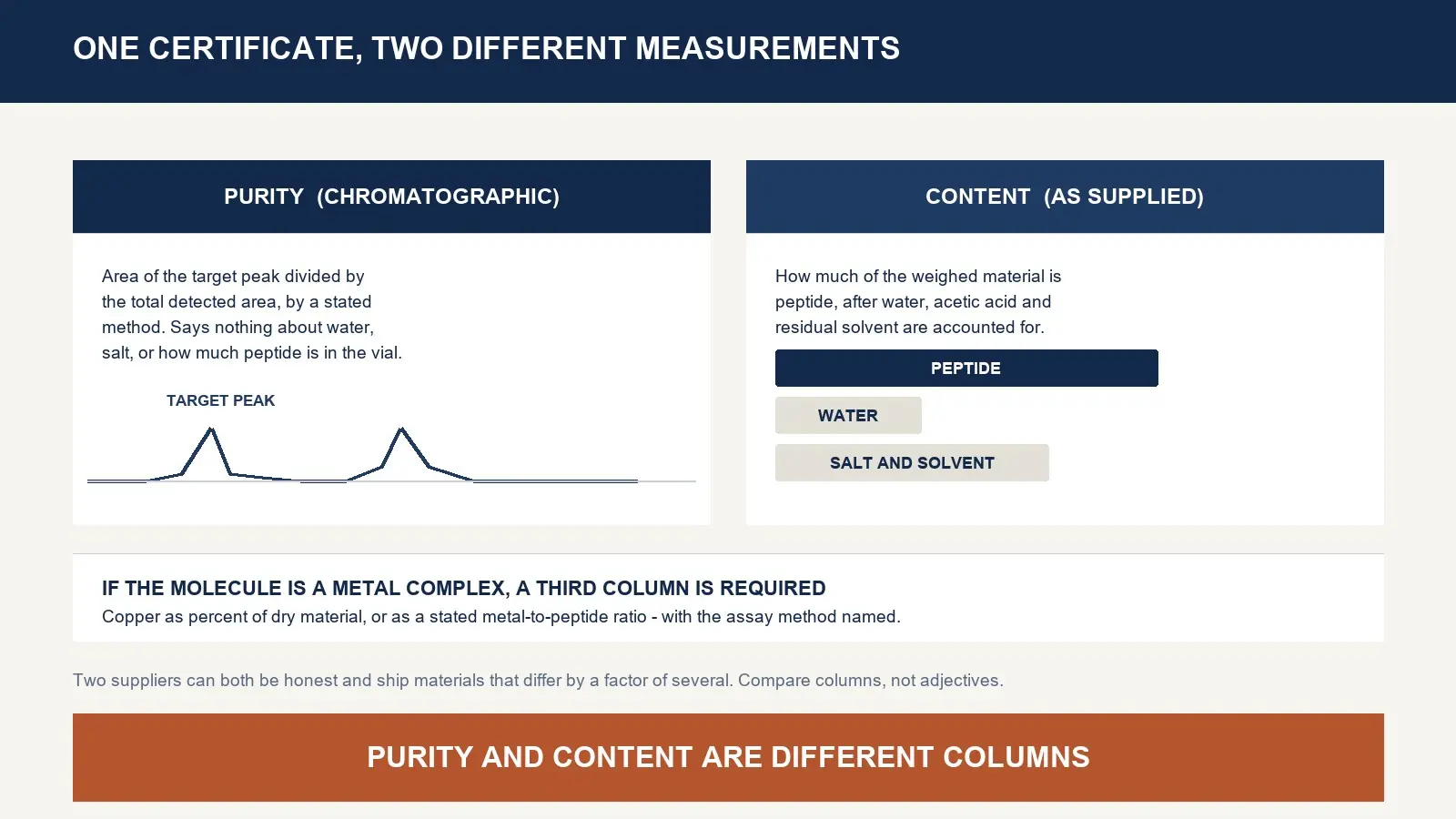
The Stability Envelope: What the Literature Actually Fixes
Formulation conversation in this ingredient family collapses quickly into opinion, so it is worth separating what has a measured value attached from what does not. From the review's formulation section there are four usable facts. The peptide is stable in water across pH 4.5 to 7.4 for at least two weeks at 60 °C, which is an accelerated-condition starting point rather than a shelf-life promise. It is prone to hydrolytic cleavage under oxidative stress, which makes the oxidant pathway - not the peptide alone - the thing to control. It is highly hydrophilic at those pH values, with the logD figures quoted above. And it is less stable in the presence of a negatively charged lipid, which is a compatibility fact with direct consequences for anionic emulsifier and vesicle systems.
Those four facts generate four questions that belong in a development brief, and none of them is "how much do you charge":
1. What is the pH of the finished formula, and what happened to the peptide assay at that pH over your claimed shelf life? Permeability in the membrane study rose with pH, so the same molecule behaves differently across the pH range a brand might choose. 2. Which lipids and surfactants are in the system, and what is their charge? An anionic lipid system is not a neutral carrier choice for this molecule. 3. What is in the preserve-and-stabilise package, and does any of it compete for the metal? Chelators are standard equipment in a cosmetic emulsion; in a metal-coordinated active they are a question, not a default. Ask what the chelator did to the copper assay. 4. What protection, if any, sits between the peptide and the skin's enzymes? The literature's own framing is that proteolytic susceptibility is the delivery problem; a supplier who has no answer has simply sold the ligand.
The stability programme that answers questions like these - the five-component plan, the recovery-at-timepoint data, the packaging decisions - is laid out in the vitamin C stability guide on this site and is not repeated here. What is specific to this ingredient family is that the metal has to survive as well as the peptide, which means your stability protocol needs an assay for two objects, not one.
The Naming System Buyers Actually Type - and Why Your Pages Must Match It
There is a quiet reachability argument inside all of this. The strings a technical buyer types look strange to a marketing department and completely natural to the person writing the brief: pal ghk, ghk cu, acetyl hexapeptide 38, acetyl glycyl beta alanine, and the INCI-style copper reading of the same sequence. In the client's third-party keyword file these are not noise: the two-token shorthand for the lipidated shorthand carries a CPC of $10.36 on roughly 210 monthly searches, the highest click price anywhere in the archived extract, on a term most suppliers will never put on a page. The INCI-style dipeptide string carries 260 searches at a CPC the file records as $0.00 - which does not mean the term is worthless; a zero in that column means no auction data was recorded against it, and a term with no advertisers and real queries is exactly the kind of gap a technical page can own.
The commercial point is that a supplier page written in category language ("advanced peptide complex", "youth-signalling technology") is invisible to the buyer who arrives in structural language, and the reverse is also true: a page written only in structural language loses the buyer who is still deciding what category to enter. Both jobs are legitimate, and they are different jobs.
| String as typed | What it actually identifies | Competition in the file | Where a supplier should carry it |
|---|---|---|---|
| pal ghk | Lipidated form of the three-residue sequence | MEDIUM | Attribute fields and catalogue rows, not headlines |
| ghk cu | The copper complex of the same sequence | HIGH | Product page body and FAQ, where a comparison is possible |
| copper tripeptide | INCI-style reading of the same complex | HIGH | Ingredient and specification tables |
| acetyl hexapeptide 38 | A specific acetylated six-residue string | HIGH | Exact-match technical listing only if you actually supply it |
| acetyl glycyl beta alanine | An INCI-style dipeptide string | LOW | Attribute fields; the zero-CPC row, no advertisers |
Three practical rules follow. Publish the exact INCI string for what you can actually supply - a term you cannot fulfil is a term you should not chase, and the file's HIGH rows are already crowded with pages that chase them. Put structural strings in fields, not in promises: the attribute list is where a formulator filters, and the headline is where a claim gets read by a regulator. And keep the naming consistent across the whole chain - the raw-material specification, the technical page, the label artwork and the customs paperwork should contain one ingredient identity, because the moment they diverge you have manufactured your own discrepancy, which is exactly the failure mode the bee-venom guide documents for a different active.
For the site-level version of this argument - what a peptide serum's own ingredient architecture should look like when it is aimed at a consumer label - see the GHK-Cu and SNAP-8 peptide serum guide and the range landing page at our peptide category.
Reading the Demand Asymmetry Honestly - Including the Claim That Did Not Survive Checking
An ingredient story written from keyword data has an obligation to check its own arithmetic, and this one found something worth publishing. The draft behind this piece argued that the lipidated shorthand carries a click price roughly four times that of the structural word itself. Recomputed against the archived extract of the client's keyword file, that is not right: $10.36 against $7.44 is 1.4 times, not four. The four-fold gap is real only when the comparison is made against the generic category word - $10.36 against $2.18 for the plain word peptide, which is 4.75 times, or against $2.67 for the molecule's own crowded shorthand, which is 3.9 times. The multiple was attached to the wrong denominator, and the corrected version is still the more useful sentence: the more specific the language, the more each click is worth.
What the corrected numbers actually support, in a table a purchasing team can use:
| Comparison | Numbers (third-party set) | Ratio | What it tells a supplier |
|---|---|---|---|
| Structural word vs generic category word | 14,800 vs 368,000 searches | 1 : 25 | You will not win the category word; do not budget for it |
| Structural word vs molecule shorthand | 14,800 vs 40,500 searches | 1 : 2.7 | The molecule name is bigger but HIGH competition - a page, not a campaign |
| Click price, specific vs generic | $10.36 vs $2.18 | 4.75 : 1 | Specificity is where paid traffic prices commercial intent |
| Click price, specific vs structural | $10.36 vs $7.44 | 1.4 : 1 | The ladder is gradual, not a cliff - don't over-claim it |
| Low-competition rows, click price range | $0.00 to $7.44 | - | Zero means no auction data, not no value |
Three reading rules keep this honest. These are third-party keyword-set metrics from a 243-keyword client file, not Google-verified search volumes, and they measure queries rather than purchase orders. A small volume with a high click price is a real room, not a big one - the 210-search term is a formulator's term, and formulators are a small population who buy in large quantities, which is precisely why it is worth serving and not worth building a media plan around. And the direction of the trend column is not a forecast: within this file's rows the structural word shows a modest positive trend reading while several neighbours show negative ones, which is noise at this sample size rather than a signal, and this piece does not treat it as one.
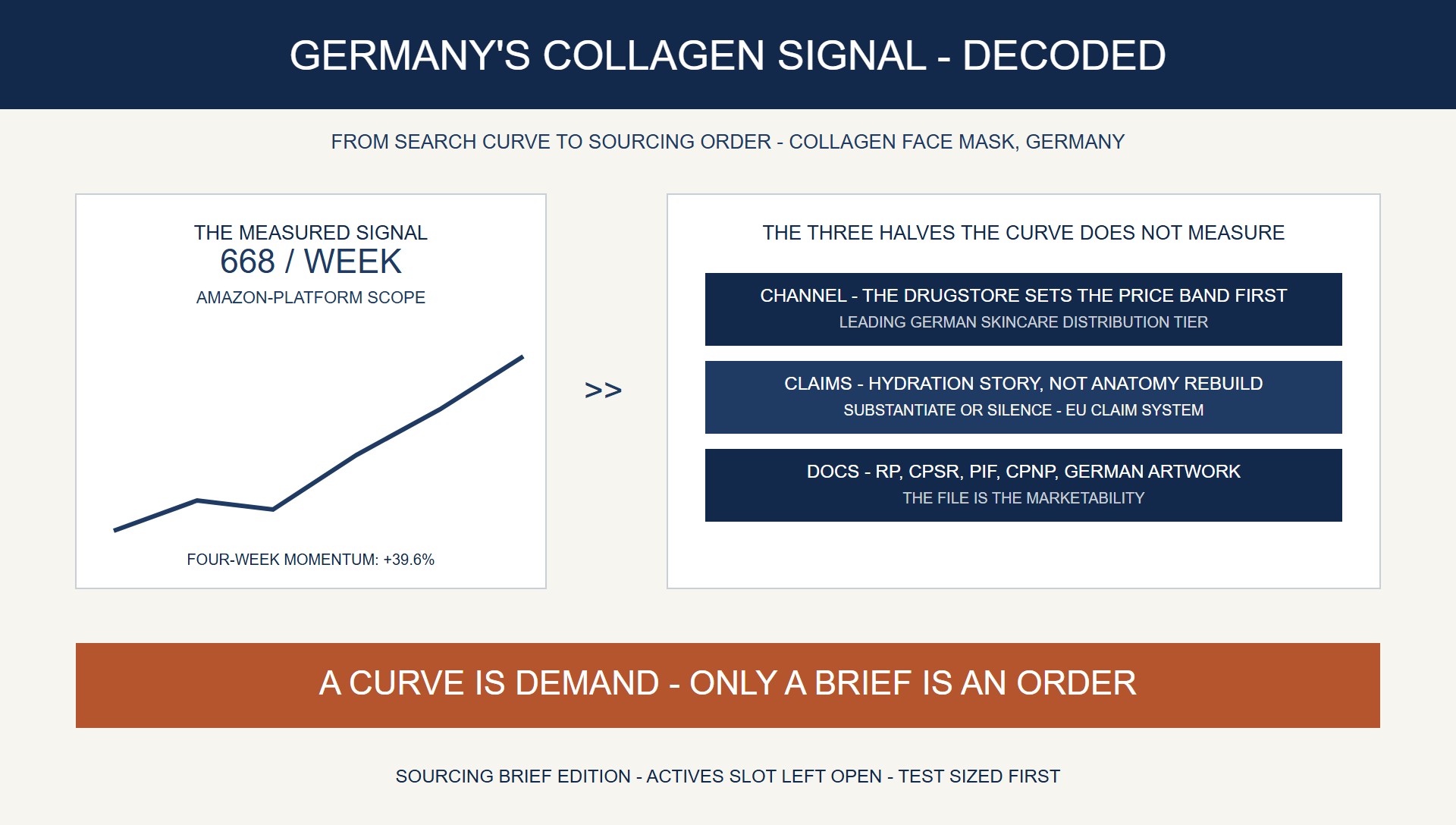
The strategic conclusion is narrow but durable. In this ingredient family the paid and organic competition is concentrated on the category word and on the molecule's popular shorthand. The structural layer - the words that name how many residues and what is attached - is where enquiries arrive already specified, and where most suppliers have no page at all. That is a content and catalogue decision, not a claim about efficacy, and it is exactly the kind of translation this site asks for whenever a trend curve is mistaken for an order book (the Germany collagen-mask signal-to-order analysis).
The Eight Written Asks, in the Order They Should Be Asked
Everything above collapses into a short list, and the order matters because the early answers disqualify cheaply. Ask all eight in one message, before a sample fee moves, and require the answers in a document rather than in an email body.
| # | Ask | The form a good answer takes | The form a bad answer takes |
|---|---|---|---|
| 1 | Exact identity | INCI name, sequence, molecular weight, reference | A brand name or a family name |
| 2 | Both percentages | Peptide share of the supplied material, and proposed use level of that material | One percentage, unspecified basis |
| 3 | Purity and content, separately | Chromatographic purity with method; peptide content with water and salt reported | "99% pure" |
| 4 | Metal quantification (if a complex) | Copper as percent of dry material or as a ratio, with method | Silence about the metal |
| 5 | Salt form and counter-ion | Declared, with the assay consequence noted | "Powder" |
| 6 | Compatibility screen | Behaviour against your emulsifier charge, chelator presence and finished pH | A generic solubility line |
| 7 | Stability at use level | Recovery at defined timepoints in your matrix, not the raw material's expiry | Shelf life of the raw material only |
| 8 | Claim boundary in writing | What the supplier's dossier supports, and what it explicitly does not | Marketing copy offered as substantiation |
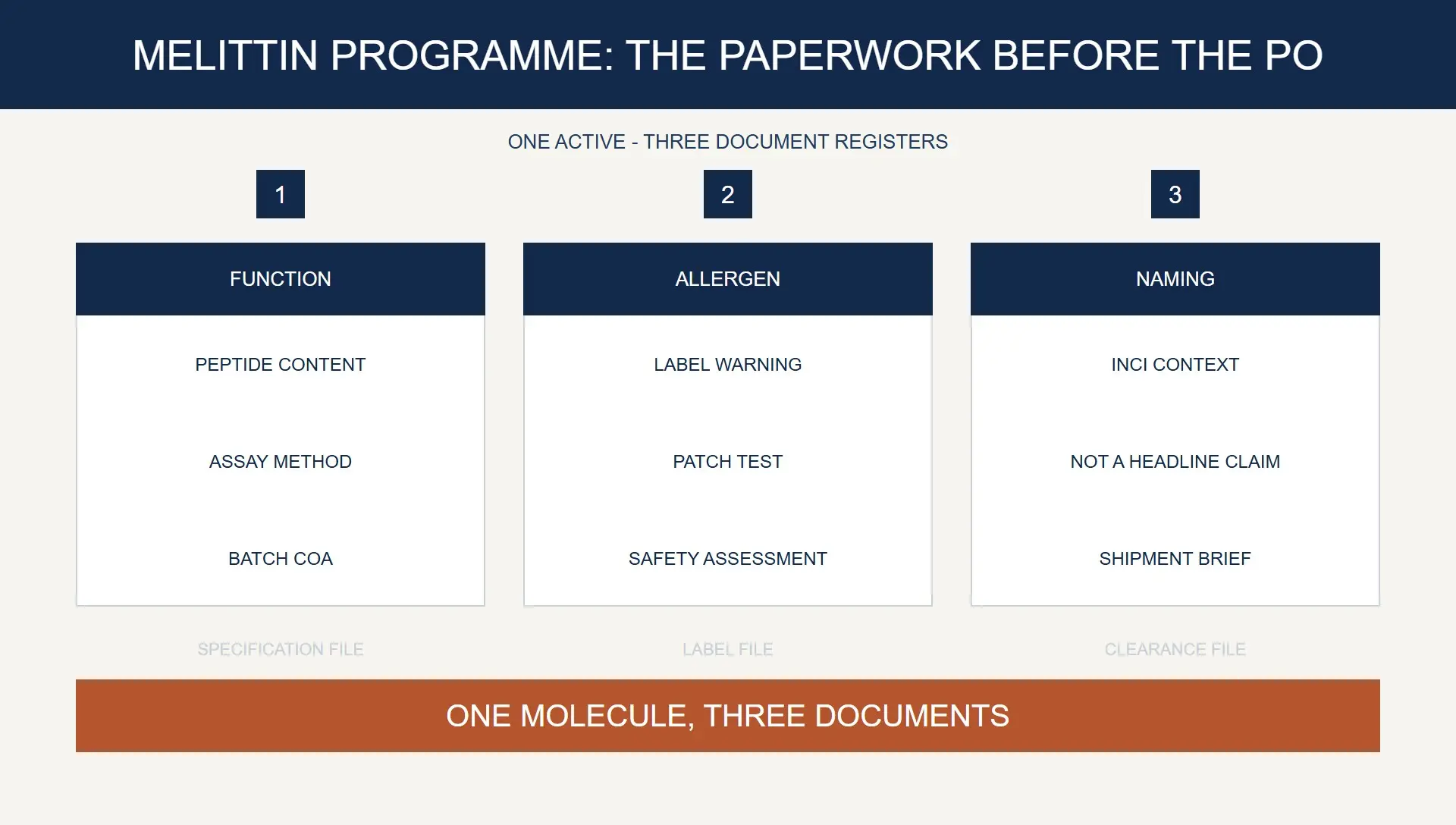
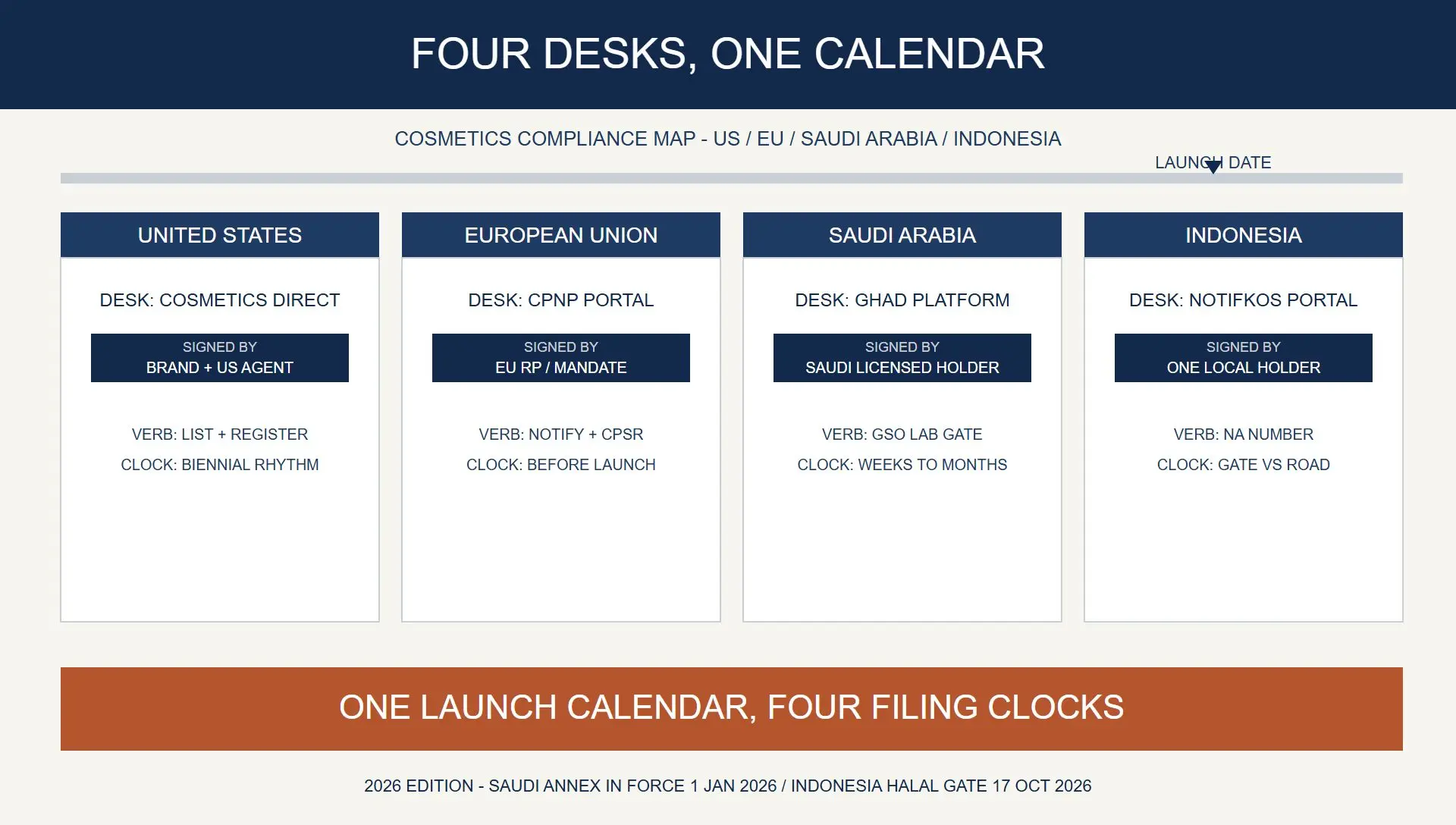
Two of these deserve a comment because suppliers routinely answer them wrongly rather than dishonestly. Ask 6 is a compatibility question, not a solubility question: a material that dissolves happily in a beaker can still be the wrong choice for an anionic vesicle system or a chelated emulsion, and the review's own findings say so. Ask 8 is a legal question, not a technical one: the literature in this family is rich - placebo-controlled facial studies with around 70 participants, twelve-week protocols, biopsy endpoints, and a claim in the review that the peptide shifts expression across thousands of genes - and all of it is literature about an ingredient, written by authors whose affiliation is an industry research laboratory, which the reader is entitled to weigh. None of it converts into permission to print a therapeutic outcome on your carton. The claim discipline is the same one this site applies to every market it writes about: the words you may print, the words you must print and the words you may never print are mapped for a risk-bearing active in the bee-venom file chain, and the multi-market filing mechanics that decide who signs them are in the four-desk map and the EU importer's guide.
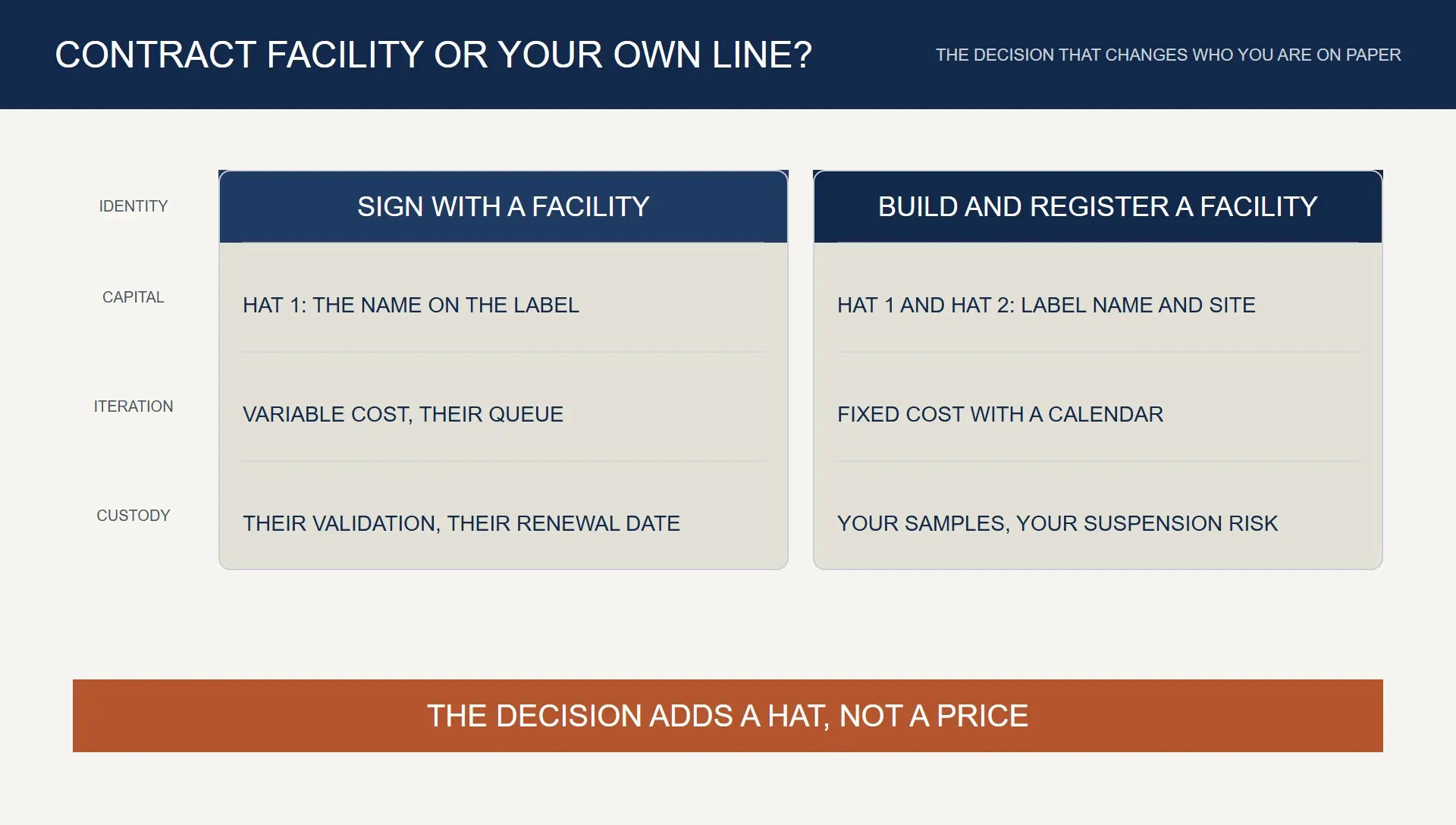
A final sequencing note, because the architecture question is not free. Specifying a peptide by sequence, salt and metal is more work at the enquiry stage than picking a catalogue active, and the extra work is exactly what buys you reproducibility between batches and between suppliers. If you are still deciding whether that level of control is worth the calendar time it costs, the trade-off is worked out in buyer terms - capital, iteration clock and file custody - in the make-or-buy decision test, and the launch order that puts these asks in the right week is in the five-decision playbook.
Ask the eight questions before the sample fee moves; the answers are cheaper than the batch they prevent.
Frequently Asked Questions
Q1: Is a tripeptide the same thing as a peptide serum? No. The category word describes a size class; the structural word describes a defined three-residue sequence, and in cosmetic use the interesting part is usually what is attached to it - a copper ion, a lipid tail, or an acetylated end. A "peptide serum" can contain several sequences at unknown levels; a specification names each one.
Q2: Why does the same peptide appear under two different names on two supplier quotations? Because one of them is probably a trade name and the other is the INCI name. A branded peptide material is often a mixture carrying a small percentage of the active, so the two quotations may describe the same molecule at different dilutions. Ask for the INCI name plus both percentages and the comparison becomes possible.
Q3: Does a higher purity number mean a better raw material? It means a better number in one column. Purity, peptide content, water and salt form are four different measurements; a high chromatographic purity can sit alongside a modest peptide content. For a metal complex, insist on the metal being quantified as well.
Q4: What pH should the finished formula sit at? That is a decision with trade-offs rather than a fixed answer, and it belongs to your full formula, not to the peptide alone. What the literature does establish is that permeability of the copper complexes rises with pH and that the peptide is measured stable across a mildly acidic to neutral range under accelerated conditions - so test your own matrix and ask for recovery data instead of adopting a number from a paper.
Q5: Peptide serum private label - can we use the supplier's ingredient brand on our pack? Only with permission. Licensed ingredient marks are marketing assets belonging to the ingredient owner, with usage rules attached. The INCI name goes on your ingredient list and in your technical file; a trademark goes on your pack only if you hold the right to put it there.
Q6: Is the research on this molecule strong enough to build claims on? Build the specification on it; build the claims on your own substantiation. The published reviews describe in-vitro, animal and small placebo-controlled cosmetic studies, and their authors include an industry research laboratory. That is a reason the ingredient is worth formulating, not a permission to print an outcome.
Q7: How do we compare two suppliers who both say they supply it? Line up the eight written asks and compare answers, not prices. Identity, both percentages, purity and content separately, metal quantification, salt form, compatibility data, recovery at use level, and the supplier's own statement of what it will and will not support. Two suppliers who look identical on a price sheet usually diverge on at least three of those lines.
Sources and Further Reading
Literature and safety documents - Loren Pickart, Jessica Michelle Vasquez-Soltero and Anna Margolina, "GHK Peptide as a Natural Modulator of Multiple Cellular Pathways in Skin Regeneration", BioMed Research International, vol. 2015, article 648108, 7 July 2015 (PMC4508379) - source for the sequence, the 1973 isolation, the plasma-level figures, the copper coordination chemistry, the binding constants, the logD and pH-stability data, the proteolytic and anionic-lipid findings, and the cosmetic study summaries. Author affiliation disclosed: the authors work at an industry skin-biology research and development laboratory; the review's conclusions were not independently re-tested for this article. - Cosmetic Ingredient Review, safety assessment of the myristoyl and palmitoyl pentapeptide ingredients (panel report, PDF) - source for the characterisation of a well-known peptide ingredient brand as a trade name mixture containing 0.01 percent palmitoyl pentapeptide-4. The report's own publication date was not verified in this pass; the quotation is used only for how a trade name relates to an INCI ingredient. - Wikipedia, "Palmitoyl pentapeptide-4" and "Copper peptide GHK-Cu" - background on the matrikine classification and the 2000 commercial launch of the lipidated pentapeptide. - Croda Beauty Actives product pages for the Matrixyl ingredient brand, and Global Cosmetic Industry (17 August 2026) and SpecialChem (4 May 2026) coverage of the supplier's capsule delivery announcement - supplier-published material, used only as evidence that the ingredient owner treats unprotected peptide delivery as a limitation.
Demand data - Client third-party keyword-set metrics: 243-keyword file, archived Top-50 extract dated 2026-09-28. Volumes, CPC and competition ratings are third-party keyword-set metrics, not Google-verified search volumes, and are counts of queries rather than of orders. The original spreadsheet was not available in the local archive at execution time, so no collection date beyond the extract's own file date is claimed.
On this site - GHK-Cu and SNAP-8 peptide serum benefits - the consumer-facing ingredient architecture this specification layer feeds. - Peptide manufacturing, OEM/ODM factory guide and the peptide category page - where these specs are supplied. - Ingredient decision matrix - choosing between families rather than specifying inside one. - Vitamin C stability and formulation guide - the stability programme this piece references instead of repeating. - Melittin bee venom: five files before the first PO - the file-chain and claim-boundary discipline applied to a different active. - Contract cosmetic manufacturer vs in-house - who holds the documents behind these numbers.
What to do next
If you are specifying a peptide active for a 2027 launch, send us the sequence, the form and the finished-format target - we will answer with the INCI name, both percentages, purity and peptide content as separate columns, the metal quantification method, and recovery data at your formula's pH. Standard response within 24 hours, standard samples in 7 days, MOQ from 1,000 pieces.
Get your quote and MOQ table - tell us the architecture you need and we will price that, not a substitute.