

Collagen Face Mask Germany: Reading a Trend as a Sourcing Order
A Curve Is Not a Brief: What Germany's Collagen Signal Actually Sells
Every sourcing quarter produces the same scene: a brand team presents a rising search curve for a collagen face mask Germany launch, the room nods, and a factory gets an email asking for "the collagen mask, the one that is trending in Germany." The curve is real; the conclusion drawn from it is usually not. A search curve measures one half of demand - the wish side. The other half, the feasible side, is built from channel economics, claim limits and documentation, and it decides whether the wish ever reaches a shelf.
This piece is a translation exercise, not a trend report. Germany's collagen-mask signal is one of the cleanest teaching cases on this site because all of its moving parts are measurable: the search line itself (tracked weekly, platform-scoped), the market it points at (a skincare segment in the multi-billion range growing at mid-single-digit rates), the channel that actually distributes it (a drugstore-led system that decides your price band before your factory does), the scientific ceiling on what a collagen product may promise to a European consumer, and the fast-moving adjacent concept - PDRN - that is chasing the same "regenerative" story from behind. Read together, these five layers convert a curve into a signable sourcing brief. Read separately, they are the five ways trend SKUs die.
Two disciplines apply throughout, and they were established in pieces already on this site - the salmon DNA sourcing guide and the vitamin C stability stack - so this article links rather than repeats: first, search numbers are platform-scoped, and the momentum figures quoted below come from Amazon-side weekly tracking of German demand, not from Google, and are treated as direction, not truth; second, declining lines are never used to argue growth - when a number falls, the sourcing response is a re-signal, not a re-spend. What follows does the other work: measuring the feasible half.
The Signal, Measured Honestly: 668 Searches and What They Do Not Say
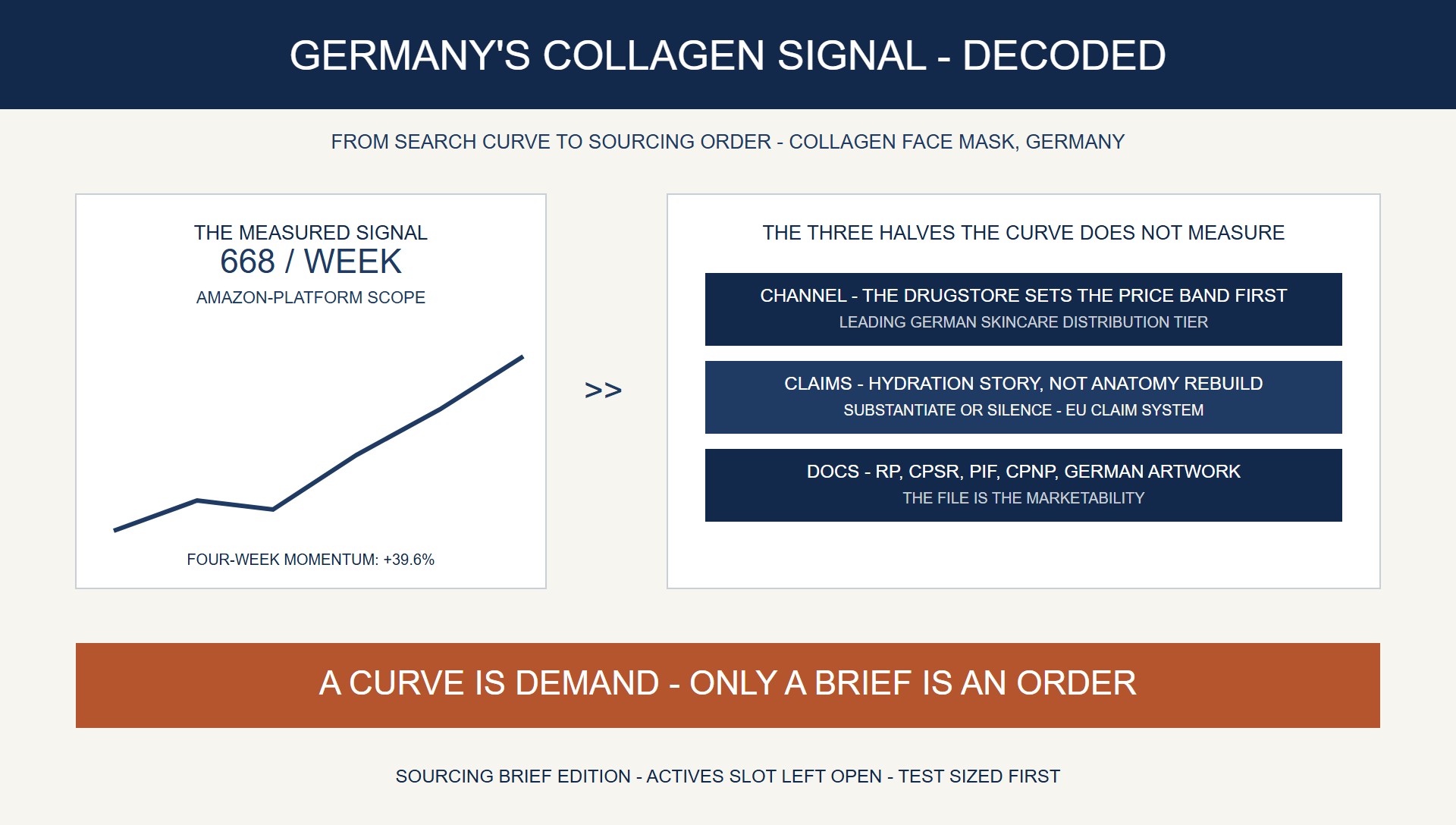
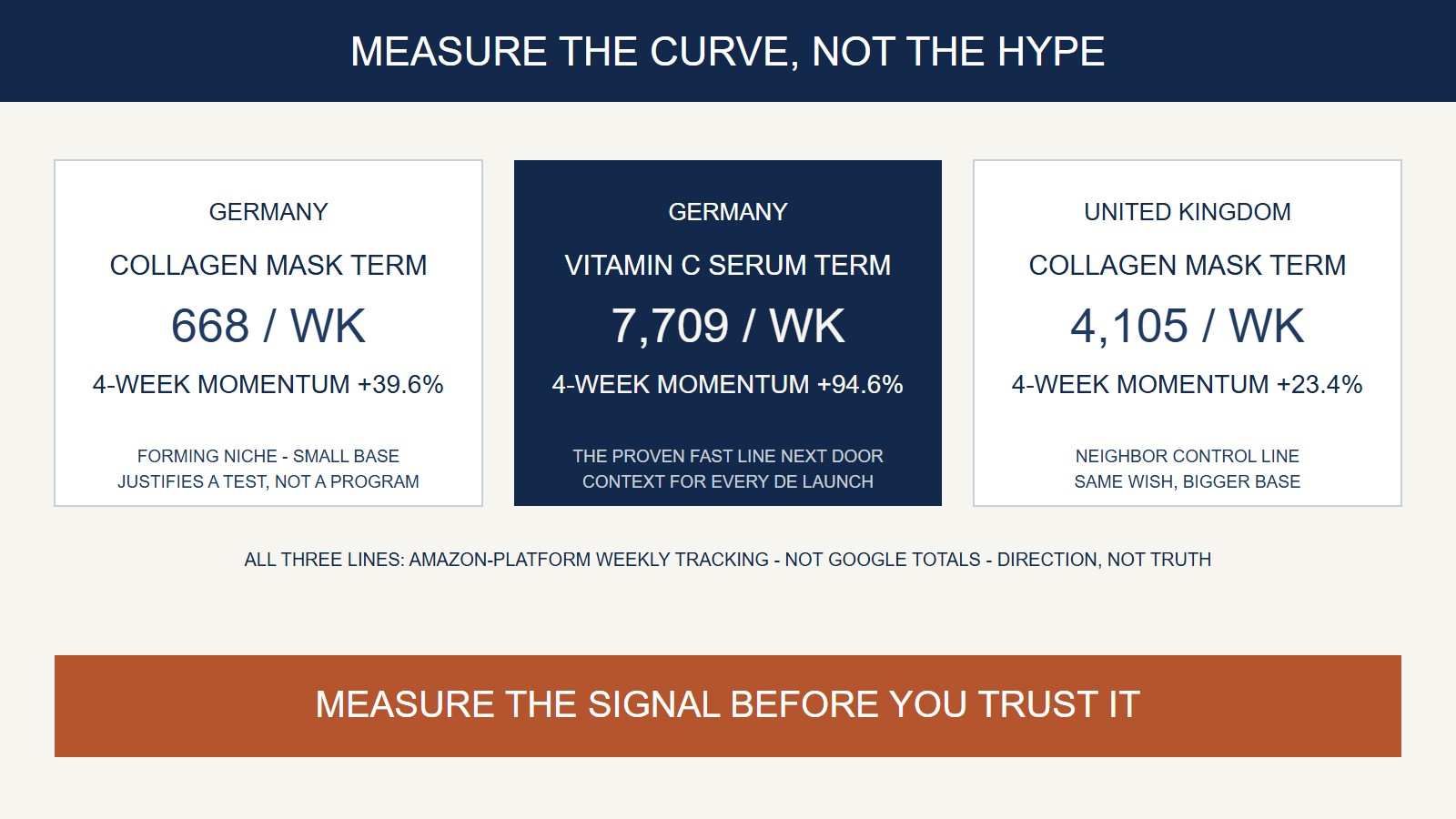
Take the German collagen-mask query line at face value for a moment. In the tracked window, the category's German search line runs around 668 weekly queries and rose 39.6% over the four weeks measured - the numbers come from our keyword pack's Amazon-platform tracking of `kollagen maske`, Germany. Three honest qualifiers before anything is built on them.
First, the scope. These are Amazon-side figures, not Google totals; they capture purchase-intent queries inside one commerce system during one promotional-adjacent window. They are demand-shaped data, not demand data. A +39.6% four-week move inside a single platform is a trigger to investigate, not a license to order.
Second, the base. A line at roughly 668 weekly is a niche-forming signal, not a mass-market one. Compare the same tracked window's German lines: the mother term `collagen face mask` on the German platform sits an order of magnitude lower than its US twin (19,066/wk, flat-to-softening at +1.6%), while vitamin C serum in Germany runs 7,709 weekly and up 94.6% over four weeks - the German market's proven fast line. The contrast is the actual insight: in Germany right now, the search-verified growth story is brightening-adjacent serums; collagen is an early-forming curve whose growth rate is impressive precisely because the base is small. Small-base momentum is the most misread number in commerce. It justifies a test order, not a program.
Third, the direction of use. The right question is never "is the curve rising?" but "what does a rising curve sell for?" In Germany, the collagen search is overwhelmingly a topical sheet/cream ritual search - a consumer looking for a five-minute self-care event with an anti-aging vocabulary, not an ingestible-collagen shopper (that demand runs through supplements and is a different retail universe, addressed later in this piece's claim section). The search answers which shelf you are auditioning for. It says nothing about the price the shelf tolerates, the claim the shelf permits, or the documents the shelf requires. All three decide the order.
A sourcing planner who buys the signal in full - "668, plus 39.6%, order 50,000 units" - is buying a number. A planner who reads the qualifiers is buying a position: an early-entry slot on a forming curve, sized as a test, priced to a channel reality, claimed inside the evidence, documented before the pallet moves. The next four sections build each half of that sentence.
The Ground Under the Curve: How Big Germany's Skincare Market Really Is
A signal has to land on ground that can carry weight, so the sizing question comes before the SKU question. The German skincare market measures, depending on whose boundary you accept, in the mid-single-digit billions of US dollars and grows at a healthy mid-single-digit compound rate. Mordor Intelligence's July 2026 assessment puts the Germany skincare product market at $5.74 billion in 2025, $6.04 billion in 2026, heading to $7.83 billion by 2031 (5.29% CAGR over 2026-2031). OpenPR's report summary from June 2025 sized the broader German cosmetics market at ~$15.84 billion in 2024 - a different perimeter (decorative included, whole-personal-care framing), not a contradiction. Spherical's framing cites Germany cosmetics import values around €2.7 billion for 2023 (via Statista), and Statista's December 2025 topic file splits German consumers into 32.1 million moderately and 17.4 million highly interested in skin and body care - the demand pool behind every number above.
| Institution (report date) | What it counts | Level / trajectory | Read for the collagen signal |
|---|---|---|---|
| Mordor Intelligence (2026-07-24) | Germany skincare products market | $5.74B (2025) → $7.83B (2031f), 5.29% CAGR | The ground floor: skincare itself is large, growing, and stable-growth - a trend SKU rides inside it, not on top of it |
| OpenPR summary (2025-06-30) | Germany cosmetics market, wider perimeter | ~$15.84B (2024) | Boundary check: "market size" answers differ by perimeter; always ask which box was counted |
| Spherical via Statista (2023 data) | Germany cosmetics imports | ~EUR 2.7B (2023) | The import channel exists at billion scale - foreign-manufactured face masks are normal German shelf content |
| Statista (2025-12-17) | Consumer interest stratification | 32.1M moderate / 17.4M high interest | The 17.4M highly-engaged pool is the realistic early audience for a premium-mask ritual format |
| Research & Markets (report window 2022-2027) | Category & channel structure | Facial care = largest and fastest skincare category; parapharmacies/drugstores = leading channel | The two structural facts that shape the collagen-mask brief more than any search line does |
The honest summary the table permits: the range itself is the analysis - an importer of record in Germany does not need the market's exact size; it needs to know that the market is large enough to carry many entrants, that facial care is where consumer attention compounds, and that German demand is normal for imports - roughly a €2.7 billion annual import line means the question was never "may foreign masks be sold here," only "on which terms." Those terms are channel economics, and the channel is not a supermarket aisle.
The Channel Is the Co-Author: How German Drugstore Economics Write Your Spec
In Germany, the shelf writes part of the product specification before the factory sees it. The structural fact, stated by two independent sources in the tracked window: the parapharmacy/drugstore channel is the leading skincare distribution channel in the country (Research & Markets' Germany skincare report), and a Verified Market Research April-2026 assessment puts the offline drugstore network - led by the dm-Markt and Rossmann chains, referenced here strictly as distribution channels, not brands to compete with - at roughly 44.75% of total market value in 2025. Add the premium-parfumerie layer (Douglas, whose own 2025 reporting showed resilience concentrated in Central and Eastern Europe) and the online layer (Amazon.de, whose purchase-intent data is literally the curve from H2 二), and the German market resolves into a tiered system with distinct economic physics per tier.
What each tier silently demands of a collagen face mask - the price-band logic, expressed structurally since the numbers belong to the supplier, not the article:
| Shelf tier | Its economic physics | What it forces into the product spec |
|---|---|---|
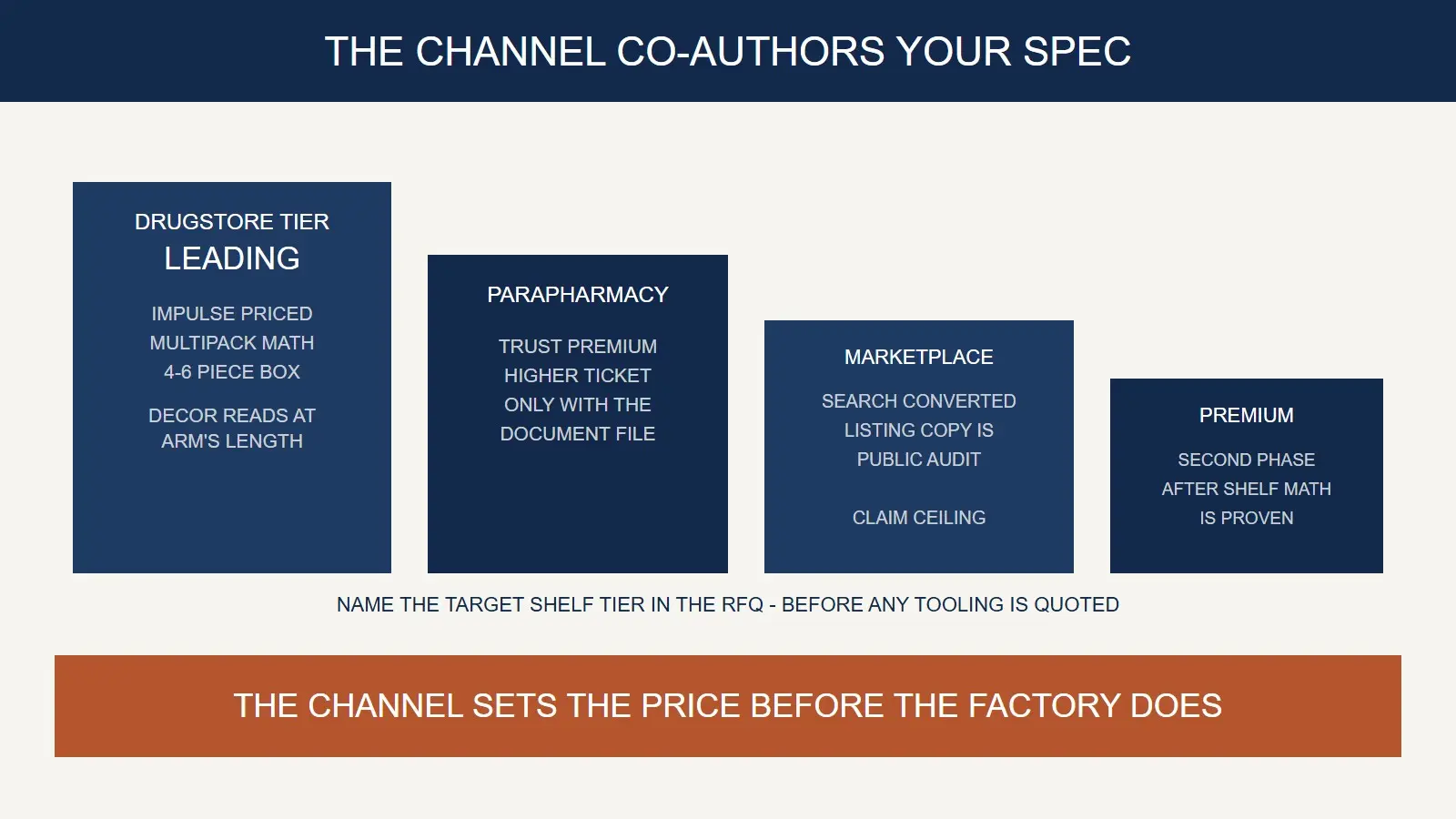
| Drugstore (leading tier) | High traffic, low attention span, impulse-priced units sold in multipacks; own-brand lines from the majors occupy the value shelves, leaving branded entrants to win on differentiation, not discount | Unit price must survive a single-hand lift decision; the multipack is the default format (a 4-6 piece box, not one luxury sheet); packaging must speak across an aisle, not across a screen |
| Parapharmacy / pharmacy-adjacent | Trust-mediated purchase, staffed or expert-adjacent, tolerates higher ticket for documented claims | This is where a collagen mask with an honest ingredient story (ferment-derived peptide complex, documented hydration testing) can live above the impulse band - but only with the file to back it |
| Premium (Douglas-tier and select retail) | Brand narrative, sensorial design, gifting occasions | Rarely the first landing for a trend-derived SKU; the format discipline acquired at drugstore tier is what later earns this shelf |
| Marketplace (Amazon.de) | Search-driven, review-compounded; the +39.6% four-week move lives here | The one tier where the trend curve directly converts; also the tier where claim text on the listing is instantly public - your claim ceiling (H2 五) becomes marketplace copy whether or not the packaging respects it |
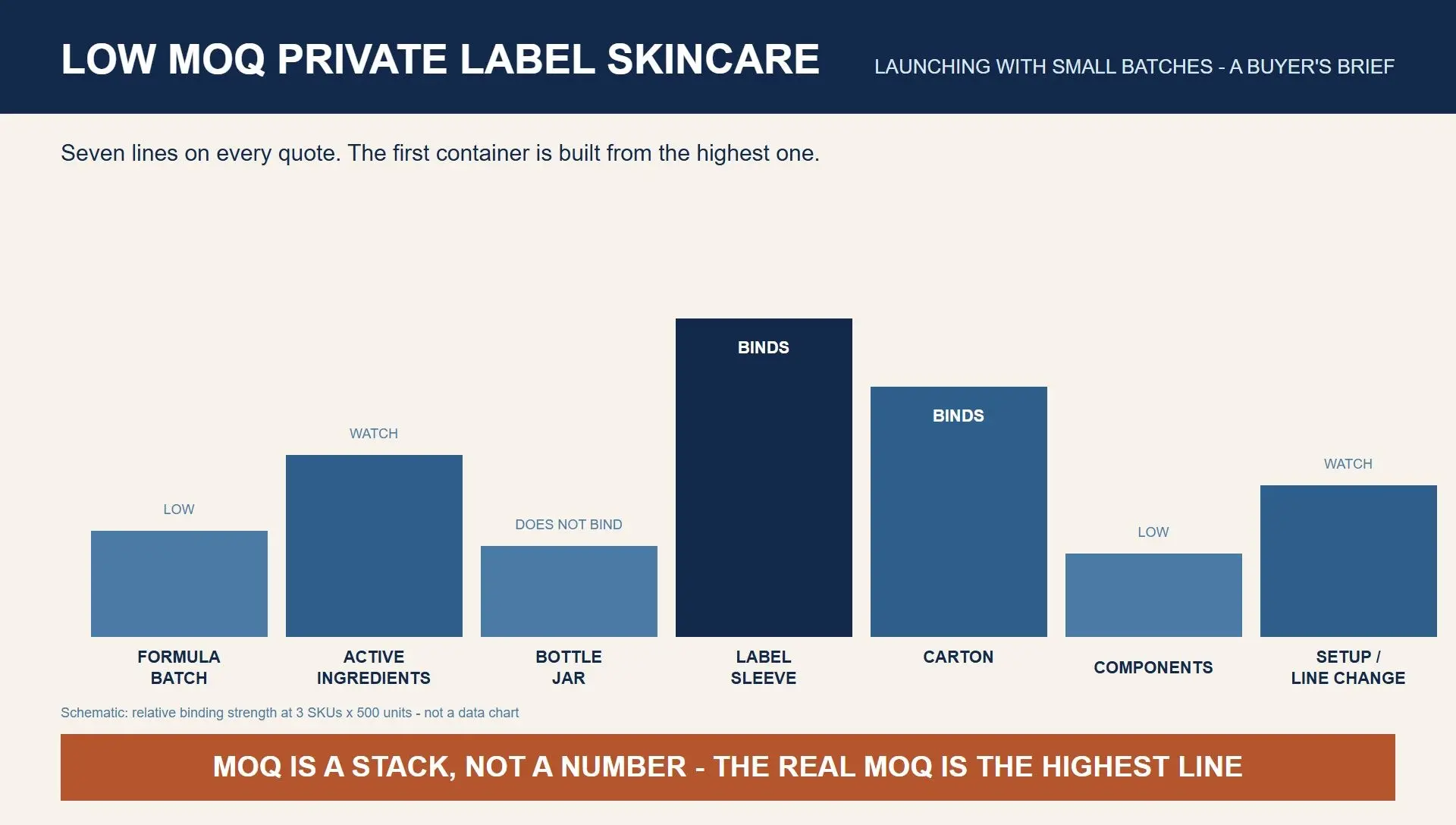
Two consequences for the sourcing brief, both structural and both quotable into an RFQ. First, format follows the dominant shelf: a Germany-first collagen mask program should be engineered as a drugstore-math multipack - filling weight per piece, foil sachet or carton format, unit-decor that reads at arm's length - and only then translated to other tiers. A program that starts as a single-premium-sheet beauty ritual and "also tries drugstore" pays the conversion cost twice; this site walked the format-versus-substrate decision once, in the hydrogel-versus-sheet-mask choice guide, whose matrix applies unchanged - what this section adds is only the German channel weighting on top of it. Second, price-band engineering precedes cost engineering: at drugstore math, the landed cost stack is not "what can we charge" but "what must production, packaging, documentation and certification sum to so the shelf can display the number it tolerates" - and the MOQ consequences of each line in that sum are exactly the stack logic already laid out in the low-MOQ launch guide. The German curve does not suspend the stack; it tells you which line binds first.
The Claim Ceiling: What a Collagen Mask May Honestly Promise a German Consumer
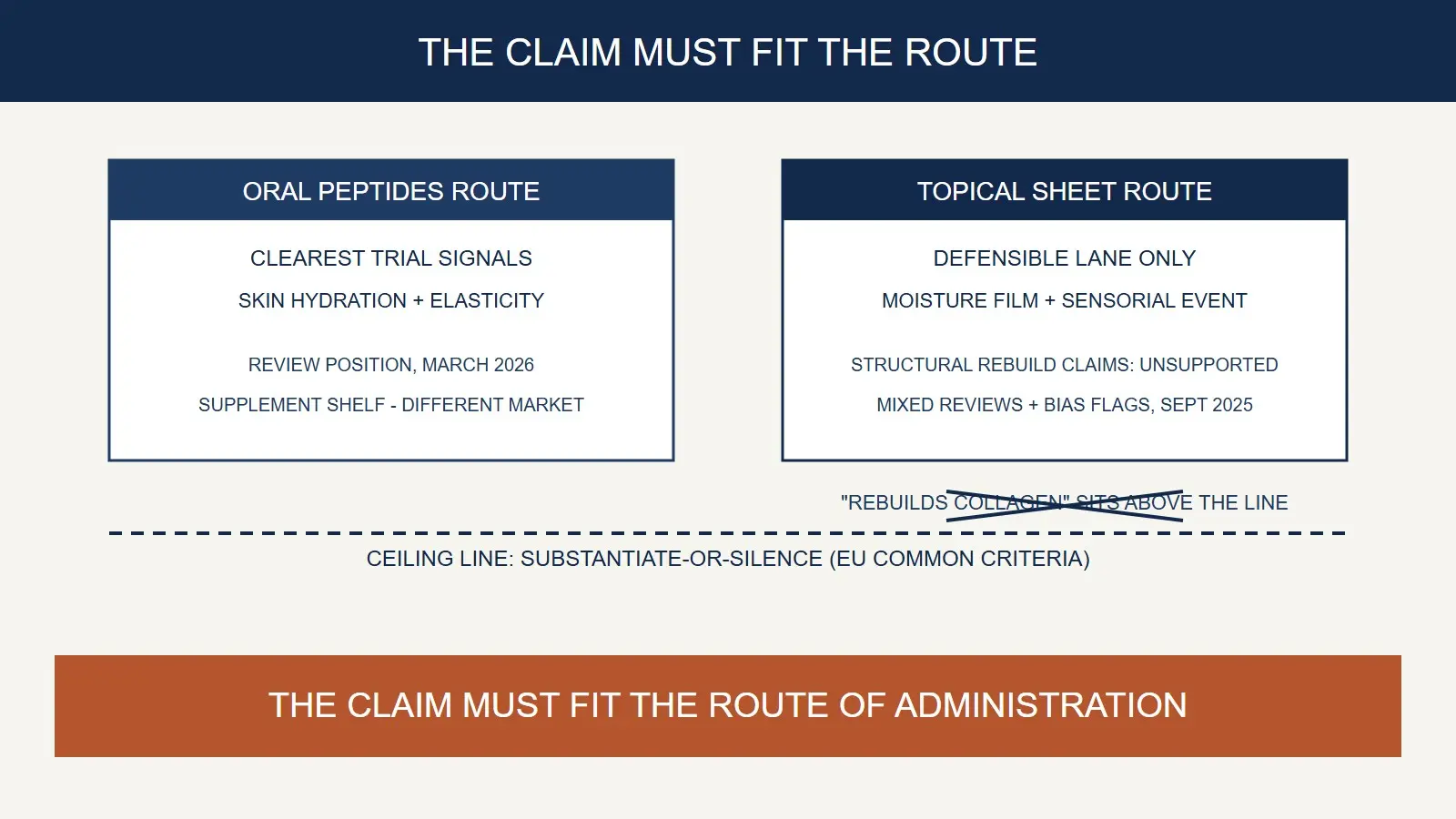
Here the search curve and the science diverge, and the divergence is the single most expensive misunderstanding a Germany-bound collagen SKU can carry. The consumer typing kollagen maske into a shop search is, in most cases, buying the idea of collagen replenishment - a firm, bouncy, age-defied skin. The literature the EU compliance system ultimately points back to tells a more constrained story, and two recent, trackable sources state it plainly. A March 2026 evidence review (skincited) summarizes the clinical picture on ingested hydrolyzed collagen peptides: the clearest and most consistent trial signals concern skin hydration and elasticity for the oral route. Meanwhile a September 2025 science-journalism review of the largest collagen meta-analyses (fit to health reporting, fitt) records the opposite posture for beauty claims generally: mixed results across studies, with explicit concerns about bias and study quality. Neither source says "topical collagen rebuilds dermal collagen," and no responsible sheet-mask brief should imply it.
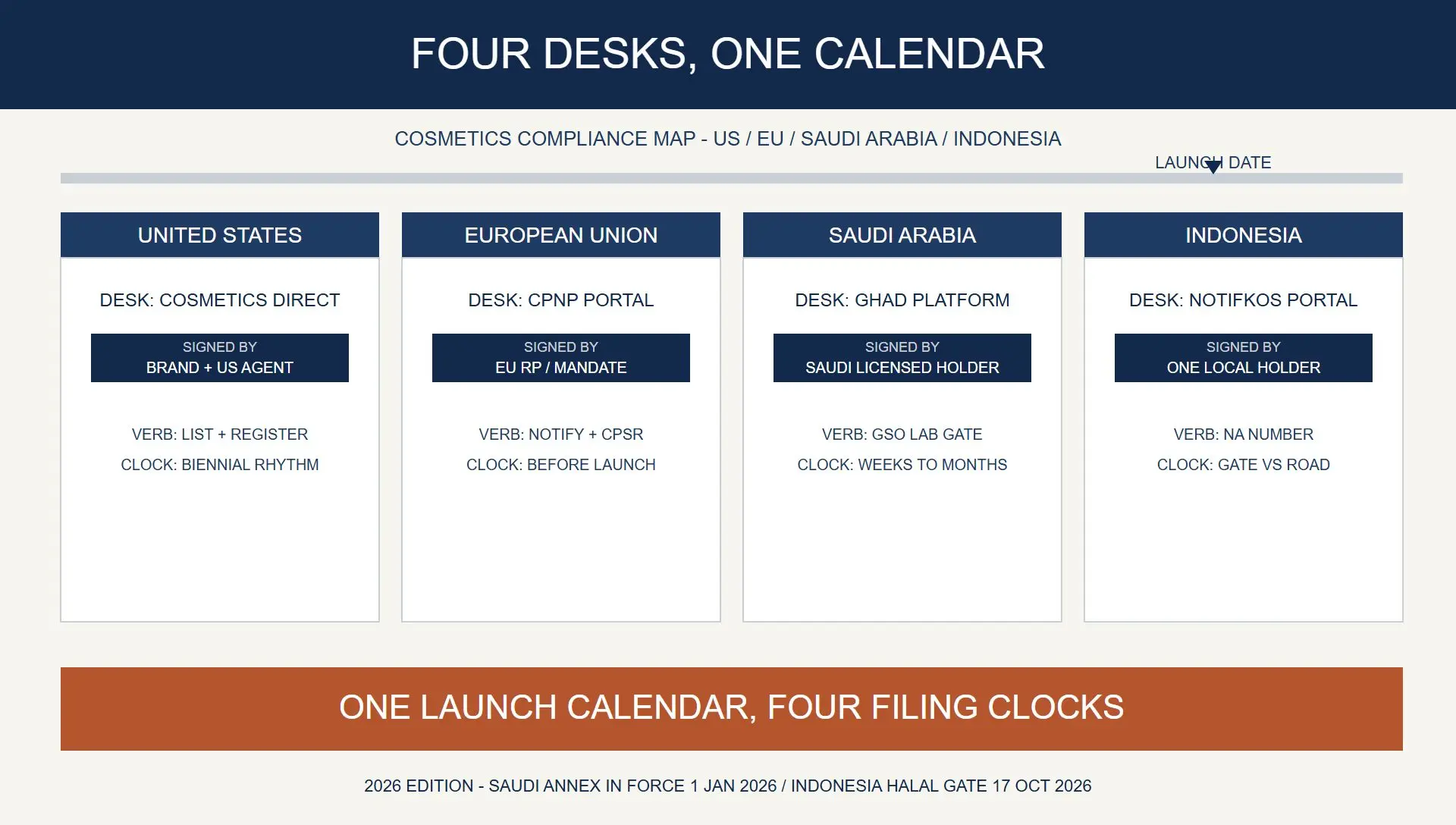
The compliance architecture on top of that evidential baseline is where German launches most often fail upward into regulator attention - and this site treats it at depth in the EU importer's compliance guide and in the four-desk filing map, so the reading here is one paragraph, not a chapter: every cosmetic claim on the EU market lives under the common criteria of Regulation 655/2013 (legality, truthfulness, evidential support, honesty, informed consumer scrutiny), the Responsible Person is the accountable signatory (Art. 16/19), and Germany's enforcement culture is active rather than nominal. A collagen mask's defensible claim vocabulary therefore sits on the hydration and sensorial side - immediate moisture, plumping appearance, soothing ritual, visible radiance after use - each substantiable with in-vitro, instrumental or consumer-perception testing sized to the claim. Its indefensible vocabulary includes structural collagen restoration from topical use - and, at the far boundary, any lightening-direction promise: German/EU-facing lines stay inside even-tone and brightening-adjacent phrasing with documented substantiation, never whitening-positioned language, which this site has flagged as a compliance-risk category since the first claim-mapping article.
The commercial translation is concrete and quotable into artwork sign-off: the claim must fit the route of administration. The search heat sells the collagen story; the packaging may sell the hydration evidence; the file must contain whatever the packaging says. A brand that internalizes this ships a mask marketed on "72-hour moisture reservoir appearance, bamboo-cellulose sheet, dermatologically tested" - a fully substantiable package - rather than one marketed on "replenishes lost collagen," a sentence whose first Amazon.de complaint or Weisheitszahn moment (consumer-watchdog or competitor challenge) becomes a marketability crisis on day one. The gap between the two sentences is where trend SKUs die in Germany, and the gap costs nothing to close at the spec stage.
The PDRN Adjacency: Concept Drift as a Leading Indicator, Not a Launch Plan
A second curve is moving inside the same German wish - and a buyer who tracks only the first is reading the market half a chapter behind. The substance: polydeoxyribonucleotide, marketed as PDRN, the K-beauty-originated ingredient line this site has covered from brand-decision, ingredient-comparison and sourcing angles (the brand owner's PDRN guide, the formulation matrix piece, the salmon DNA sourcing file) - and its retail behavior is now measurable on Western shelves with a freshness the collagen curve lacks.
Three dated readings, then the translation:
| Signal (source, date) | What was measured | What it means for a Germany-bound brief |
|---|---|---|
| Retail-tracking file (Gravel, 2026-05-30) | 28+ PDRN SKUs across 18 US brands; launches accelerated 9 → 17 between Q4-2025 and Q1-Q2-2026 (US shelf, tracked scope) | Supply-side velocity outruns search-side confirmation: the regenerative narrative is being stocked aggressively - a positioning cue, not a demand number, and a US-scoped one |
| Consumer-beauty press (Allure, 2026-04-30) | Editorial record of PDRN "quickly taking over" K-beauty-adjacent routines, with the article itself asking whether the bubble bursts | The cultural phase change is visible to the press before the market prices it; by the time a claim needs defending in court or on a listing, early entrants are already repositioning |
| This site's keyword-pack tracking (§七, Amazon-platform scope) | pdrn mask, US: 2,006/wk, -18.9% over four weeks (weakening); pdrn mask, UK: 397/wk, +12.5% (oscillating); no Germany line for the term is configured - blank means unmeasured, never zero | The pdrn skincare trend on the search side is not confirmed growth - while the shelf is stocking, the US search line is cooling; the disciplined reading of divergence is caution, not acceleration; and per the data-honesty rule this site applied to the salmon-DNA line in late September, weakening lines may never be used to argue growth |
The sourcing translation lives on three levels. Positioning: German consumers arriving via kollagen are in the replenishment vocabulary - the same psychological room the PDRN story rents. A mask line designed only as "collagen" today is exposed to repositioning within two seasons as shelf narrative moves; a line engineered as hydration + viscoelasticity story with a flexible actives slot can migrate without re-tooling. That flexibility is a specification, decided before the first tool is paid for. File: whichever actives the brand chooses, the substantiation duty is identical - and the PDRN regulatory posture (cosmetic ingredient under EU rules, with novel-ingredient status to verify per material) is walked once on this site's PDRN pages; the German brief simply inherits it. Timing: the observed pattern - supply velocity ahead of search confirmation - has a clean operational translation: ride the curve with a test-sized order, not a program-sized order, and keep the actives slot open for the next migration. Germany's collagen signal is an early-forming niche (H2 二); adjacent-concept drift is a leading indicator of how early the niche may reshape itself. The buyer who reads both is not predicting the future; the buyer is refusing to be surprised by it.
Translating the Signal: What a Collagen Face Mask Germany Brief Must Contain
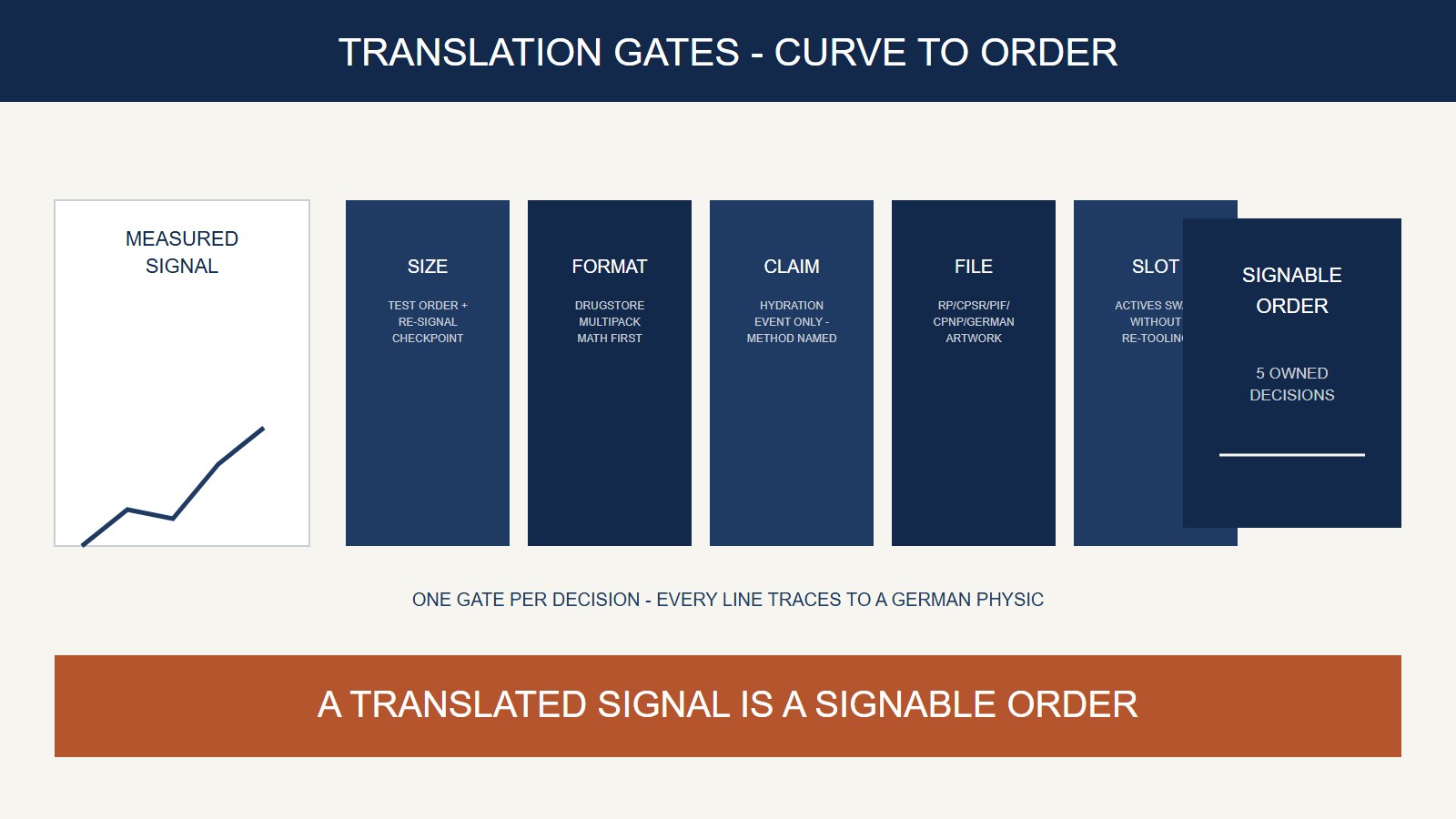
A brief is a curve with ownership written onto it. Everything above - the measured signal, the market ground, the channel physics, the claim ceiling, the concept drift - earns its keep only when it converts into specification lines a factory can price and a brand can sign. The translation table below is the article's deliverable: the left column is what the German signal says, the right column is what the brief must contain, and the middle column is the decision that connects them. A private-label face mask program built from the right column alone works in any market; what makes it Germany-specific is that every line traces to the channel-and-evidence physics of the previous five sections.
| What the signal says | The decision in between | What the brief must contain |
|---|---|---|
| Forming-niche demand (668/wk, +39.6% four-week, single-platform scope) | Commit to a test, not a program: sizing is the decision the curve cannot make for you | Initial order at the stack's binding line (see the low-MOQ guide) with a written re-order trigger: a named metric, a named threshold, a named date for the re-signal check |
| Drugstore-math shelf (multipack impulse economics dominate the leading channel) | Engineer the unit, then count the units: format follows the dominant shelf | Sheet material + essence fill weight + sachet/carton format specified to multipack display logic; single-use decor legible at arm's length; a 4-6 unit box architecture, not one luxury sheet |
| Hydration-side evidence only (oral-strong, topical-modest asymmetry) | Sell the event, not the anatomy: the claim must fit the route of administration | Claim set limited to substantiable hydration/sensorial vocabulary; a named substantiation plan per claim (instrumental, consumer-perception or in-vitro), filed before artwork approval; zero whitening-direction language anywhere |
| 17.4M highly-engaged consumers + transparent-sourcing trend lines | Price the trust layer: parapharmacy tolerance exists only with documents | Document pack as an order line, not a favor: CPSR-ready safety file, testing reports with named methods, INCI at submission grade, stability data sized to shelf life in the target climate |
| PDRN drift (supply outrunning search) | Design the flexible slot: the actives story will move | Base formula with a defined actives swap window - documented compatibility for a peptide or ferment slot without re-tooling the sheet or fill system - so season-two repositioning is a paperwork change, not a capital one |
| German labels and German-language artwork | Translate obligations, not just claims | Label artwork in German with compliant INCI nomenclature, RP details, batch/expiry coding, and the country-of-origin statement - artwork locked only after the file review, never before |
The brief's shape is now visible from both ends: a drugstore-math collagen mask multipack, engineered around a substantiated hydration event, carrying a file chain that a parapharmacy buyer could audit, with one actives slot deliberately left open toward the drifting concept next door. Nothing in that sentence required the 39.6% to be true in the way a purchase order requires things to be true. The curve got read; the brief got written. The remaining sections protect it: the paper chain that makes the brief executable (H2 八) and the five failure modes that eat programs which skipped it (H2 九).
The Paper Chain: What Makes a Germany-Bound Mask Executable, Not Just Importable
Every section above ends with a document, and the German market is unusually honest about that: the market that led the EU's enforcement culture does not separate a product from its paperwork. The chain is short, and this site has walked each link at depth - the EU guide for the regulatory spine, the launch playbook for who signs each link, the four-desk map for how the EU column compares to the other three - so what follows is the chain itself, six links, each with its owner.
Link 1: the Responsible Person. An EU-established RP whose name appears on every label; mandateable, not optional, and the single point through which the whole file becomes someone's legal responsibility. For a non-EU brand this is the first signature of the program, priced as a service contract and exited as a contract - the portability thinking from the four-desk map applies unchanged. Link 2: the CPSR. A safety assessment by qualified assessor per product, not per formula family; a four-piece multipack of one formula is one assessment, a four-piece multipack of four formulas is four, and the assessor's calendar is the reason the EU notification "clock" is really a dossier lead time. Link 3: the PIF. The Product Information File that holds formula specs, manufacturing evidence to GMP standards, the safety assessment, proof of claimed effects and the animal-testing-compliance record, kept at the RP's address and inspectable on request. The GMP line is where an OEM partner's factory audit stops being a marketing page and starts being a shelf prerequisite - the 12-point audit checklist maps that conversation. Link 4: the CPNP entry. The notification itself, composed from links 1-3 and completed before first sale - the shortest link in the chain and the one that fails loudest when its inputs were improvised. Link 5: the German label. INCI nomenclature, RP address, batch and expiry coding, function claims inside the H2 五 ceiling, German-language where the shelf demands it - artwork as a compliance object, not a design deliverable. Link 6: the retention-and-recall file. Retained-sample practice, batch traceability, and a named person for vigilance duties; Germany's cosmetovigilance infrastructure (its own market-report category, per Spherical's 2025 framing) reflects a system that expects recalls to be executable, not hypothetical.
The chain's economic reading for a trend-derived SKU is one sentence: documentation is not a cost line that follows the product; it is the product's marketability, and a buyer who prices it separately from the formula prices the wrong thing. A program that budgeted CPSRs, RP mandate, German artwork review and the test panel before the first container is the one that can survive a re-order trigger - and re-order is the entire point of a test-sized launch (H2 七). The curve does not care about any of this; the shelf does.
Five Ways a Trend SKU Dies in Germany, and the Insuring Line in Each
The failure modes of signal-driven launches are consistent enough to list, and cheap enough to insure against - because each one is prevented by a decision that costs nothing at brief stage and everything later.
① The momentum misread. Buying the +39.6% instead of the 668: program-sized orders justified by small-base single-platform growth, then discovered at month five that the curve was a signal to investigate. Insurance line, written into the order confirmation: a re-signal checkpoint - named metric, named platform scope, named date - before production slots beyond the first batch are reserved. The test order stays a test until the checkpoint, not until the money is spent.
② The claim overdraft. Packaging and listings that spend evidential credit the file cannot cover - "rebuilds collagen," "restores lost structure" - and the overdraft is called by the first consumer complaint, competitor challenge or marketplace moderation pass, because Amazon.de copy is public audit material at zero cost to the auditor. Insurance line: artwork sign-off requires the substantiation matrix (claim → method → report → date) as a named attachment; no matrix, no print. This is the same habit the claims-register articles on this site preach, now with a German enforcer behind it.
③ The channel-cursed price. A premium-format mask shipped into drugstore math, or a drugstore-format mask shipped into premium shelves - the spec exists, the economics don't. Insurance line: the brief names the target shelf tier first, and the format (piece count, material, decor, carton) is engineered to that tier's decision physics before any tooling is quoted. A 4-6 piece sachet architecture and a single gilded sheet are different products wearing the same word.
④ The concept tail-end. Launching the collagen story exactly as the shelf narrative migrates to the next regenerative word - arriving at the party on the way out. Insurance line: the base formula keeps the documented actives-swap window (H2 七), so season-two repositioning is paperwork; and the order cadence (test → checkpoint → re-signal) makes a full program commitment structurally impossible before the drift is visible.
⑤ The file-free entrant. A beautiful mask with a foreign RP gap: no EU-established responsible person contracted before artwork, assessor booked after formula freeze, PIF scattered across three email threads - and the launch date, set by the marketing calendar, dies in the dossier queue. Insurance line: the compliance chain is sequenced first in the project plan (links and owners named in H2 八), and the launch date becomes its output, never its input.
Five lines, five cheap clauses, one sentence of generalization worth posting above the sourcing desk: trend demand is rented at retail price; the brief owns nothing until the documents sign for it.
| Failure mode | The insured decision | Where it is written |
|---|---|---|
| Momentum misread | Re-signal checkpoint before expansion batches | Order confirmation |
| Claim overdraft | Substantiation matrix attached to artwork sign-off | Print release |
| Channel-cursed price | Shelf tier named before format engineering | The RFQ itself |
| Concept tail-end | Actives-swap window + test-first cadence | Formula brief |
| File-free entrant | Compliance chain sets the launch date | Project plan |
FAQ: The Germany Collagen Questions Factories Get Asked
Q1: Is a private label face mask program the right vehicle for a trend like this? For a forming-niche signal, yes - with the brief's discipline from H2 七. A shared catalog format lets you test the German shelf at drugstore math without funding tooling, and the re-signal checkpoint decides whether a custom program is justified on measured evidence rather than a four-week curve. The program to skip is the one that inverts those two steps.
Q2: How do I verify the German demand numbers before I commit? Treat this article's method as the checklist: separate the scope (which platform's purchase-intent data), check the base (668 is a forming line, not a mass line), compare neighbors (the UK collagen-mask line grew +23.4% while the US mother term stayed flat - forming curves behave differently per market), and watch adjacent concepts (the PDRN drift). A number that survives all four checks is still only a trigger for a test order.
Q3: Can I sell a collagen mask in Germany with "anti-aging" positioning? Within the EU claim system, function words must be substantiated, honest and understandable to the average consumer - and the collagen-specific versions of "rebuild/restore" language fail the evidential test for topical use. Defensible positioning lives in the hydration-event vocabulary: moisture, plumping appearance, soothing ritual, visible radiance after use - each with its named test method on file.
Q4: What does the full collagen face mask Germany compliance path look like, start to first sale? Six documented links: EU Responsible Person mandate → CPSR assessment(s) → PIF assembly at GMP standard → CPNP notification → German-compliant artwork with the H2 五 claim set → batch retention and vigilance readiness. None of the links is long; all of them are serial in practice because each needs the previous one's finished document. A realistic program puts the file first and lets the launch date fall out of it.
Q5: Which format should the German launch take? Start where the channel is: a multipack in the drugstore decision band, engineered to the sheet-math logic this site's format guide maps. The premium single-sheet and the parapharmacy-documentized lines are second-phase extensions of a proven first program, not parallel launches - each multiplies the assessment and file load by the formula count, which is the same per-variant math every filing desk on the four-desk map runs.
Q6: Should we add PDRN to the line now instead of collagen? Not instead - the German signal for collagen masks is the measured one, and the PDRN search lines currently confirm less than the shelf stocking suggests (the divergence is documented in H2 六). The disciplined move is the brief's flexible actives slot with a documented swap path, so whichever concept the data confirms next is an iteration, not a relaunch. Riding two curves with one file chain is the only version of "trend chasing" that survives audit.
What to do next
If the German curve is on your desk - or any forming signal you want translated into a brief that can actually be signed - send the question the way a factory can answer it: shelf tier, format math, claim set, document chain. Get your quote and MOQ table, built per pack architecture and per market, with the compliance-file lines priced as named items, not buried in a rounded number. A dedicated product manager on every RFQ - reply within 24 hours, sample packs in 7 days, MOQ from 1,000 pcs.
→ Get your quote and MOQ table
Sources and Further Reading
Market and science figures cited as of publication - platform-scoped search lines come from the keyword pack's own tracking (Amazon-side, not Google totals, noted in place); confirm current market data with each named institution before financial decisions:
- Germany skincare product market: $5.74B (2025) → $6.04B (2026) → $7.83B (2031f), 5.29% CAGR 2026-2031 - Mordor Intelligence, Germany skincare products market report, 24 July 2026 - Germany cosmetics market ~$15.84B (2024), perimeter note - OpenPR report summary, 30 June 2025 (secondary press distribution; perimeter differs from skincare-only figures, stated as such) - Offline drugstore network (dm-Markt, Rossmann - named as distribution channels) ≈ 44.75% of 2025 market value; channel-tier analysis - Verified Market Research Germany beauty & personal care assessment, 7 April 2026 (secondary market-research source) - Parapharmacies/drugstores leading skincare channel; facial care largest and fastest-growing category (2022-2027 window) - Research & Markets, Germany skincare market report (report window as published) - Germany consumer interest stratification: 32.1M moderate / 17.4M high interest in skin & body care (2023 basis) - Statista topic dossier, 17 December 2025; cosmetics import line ~€2.7B (2023) via Spherical Insights citing Statista (secondary restatement) - Douglas premium-channel resilience and CEE concentration (FY 2024/25) - Global Cosmetics News, 16 May 2025 - Oral collagen peptides: clearest trial signals for skin hydration and elasticity; review summary - skincited evidence review, 21 March 2026 (secondary science-communication source) - Beauty claims on collagen: mixed results across largest reviews, explicit bias and study-quality concerns - fitt science reporting, 2 September 2025 (secondary; the underlying reviews are the primary layer) - PDRN retail velocity: 28+ US SKUs across 18 brands; launch counts 9 → 17 from Q4-2025 to Q1-Q2-2026 - Gravel retail-tracking file, 30 May 2026 (market-intelligence platform, tracked scope); cultural record of PDRN's ascent and the bubble question - Allure, 30 April 2026 (editorial; contains affiliate-commerce disclosure per its own note) - Search lines (kollagen maske DE 668/wk +39.6%; vitamin C serum DE 7,709/wk +94.6%; collagen face mask UK 4,105/+23.4%; pdrn mask US 2,006/−18.9%; UK 397/+12.5%) - this site's keyword-pack tracking, Amazon-platform scope, non-Google, stated in place as demand-direction evidence only - EU claim and compliance framework (Reg. 655/2013 common criteria; Art. 16/19 RP architecture) - as documented in this site's EU importer's compliance guide and the four-desk filing map, linked above; this piece does not restate them - Further reading on this site: the salmon DNA sourcing guide, the vitamin C stability stack, the hydrogel-vs-sheet format guide, the collagen capsule cream line, the low-MOQ stack guide, the launch playbook, the 12-point factory audit, the brand owner's PDRN guide and the ingredient-matrix piece - each linked in place; none restated.