
Melittin Bee Venom in Skincare: Five Files Before the First PO
Melittin Bee Venom: One Molecule, Three Paperwork Problems
A buyer who types melittin bee venom into a sourcing brief is not asking the same question as the buyer searching collagen or niacinamide. With a familiar active the work is choosing a concentration and a supplier. With a venom-derived peptide the same molecule arrives as three different objects at once: it is the functional lead you specify, the allergen your label has to speak to, and the literal word that a customs officer or a marketplace reviewer will stop on. One ingredient, three paperwork problems - and all three land on the same purchase order.
That is why this piece is not a science explainer. The peptide's biology is documented elsewhere and is not the buyer's bottleneck: the bottleneck is that a range containing it either arrives with a complete file chain or it arrives as a recall conversation later. Bee venom has spent years positioned as a novelty in premium anti-aging ranges; the search-side data in the client's keyword file suggests the interest has outgrown the novelty framing - and novelty positioning is exactly what a risk-bearing active cannot survive in a regulated market. Specification positioning can.
What the literature does establish, and what a buyer needs in writing, are different things. Research describes melittin as the dominant peptide of honeybee venom (apitoxin) and places its share of the venom's dry weight between 40 and 50 percent, with some analytical work reporting 40 to 60 percent (Antibiotics, 8 December 2021; Toxins, March 2021; Journal of Chromatography A, 3 December 2025). The same body of work describes it as a 26-residue cationic amphipathic peptide of about 2,840 Da that binds lipid bilayers, forms pores and disrupts membranes - with haemolysis and concentration-dependent cytotoxicity recorded in vitro (Molecules, 7 October 2025; Journal of Chromatography A, 3 December 2025). Read as a formulator, that is a beautiful and uncomfortable sentence: the property that makes melittin interesting is the same property that makes it a safety question. There is no version of this ingredient where the efficacy story and the risk story are separate files.
The honest handling of that fact is the structure of this piece. First, what is actually in the vial, and what the composition sheet must say. Second, the allergen and labelling file - including the part that is not a footnote. Third, the naming problem nobody puts in a brief: what happens when "venom" appears on a declaration or a listing. Fourth, how to read the demand numbers without over-reading them. Fifth, the delivery and stability constraints that decide whether the peptide survives your formula. Sixth, the category line: why the same word can sit in a cosmetic file in one market and a drug file in another. Then the five documents, the claim map, the test protocol, and the FAQ.
The selling point and the risk of this ingredient are the same molecule - your file chain has to say so twice, in different registers.
The Composition File: Bee Venom Allergy Starts on the Specification Sheet
Most failed sourcing conversations about this ingredient start in the same place: the supplier answers "bee venom, yes we have it" and the buyer accepts an INCI line with no substance document behind it. Bee venom is not a single molecule and cannot be specified as one. It is a mixture whose composition decides both what your product does and what your label must say, so the first file is a composition dossier - and it is where the bee-venom-allergy conversation actually begins, because the allergens in venom are named components, not an undifferentiated risk.
Honeybee venom contains a peptide fraction (melittin, apamin, adolapin, and the mast cell degranulating peptide), an enzyme fraction (notably phospholipase A2 and hyaluronidase), biogenic amines such as histamine and epinephrine, plus lipids, carbohydrates and free amino acids (Antibiotics, 8 December 2021). Within that mixture, melittin is the dominant peptide at 40-50 percent of dry weight (Antibiotics, 8 December 2021; Toxins, March 2021), while phospholipase A2 is reported at 10-12 percent (Microbial Pathogenesis, 28 January 2020). The clinical literature goes further and gives the buyer a naming system: Api m 1 is phospholipase A2 and Api m 2 is hyaluronidase, both treated as major allergens, and melittin is catalogued as Api m 4 (Key Issues in Hymenoptera Venom Allergy: An Update, February 2017). A specification that reports only "bee venom extract 0.3 percent" tells you nothing about which of those components your product carries, at what load, measured how.
| Fraction | Named members | What a buyer can act on | Dated source |
|---|---|---|---|
| Principal peptide | Melittin, 40-50% of venom dry weight; 26 residues, ~2,840 Da, cationic and amphipathic; C-terminus is a peptide amide | Set the assay target and the identity test; the amidated form is the native molecule, so ask which form you are buying | Antibiotics 2021-12-08; Molecules 2025-10-07; EBI PDBe venom-therapy explainer |
| Other peptides | Apamin, adolapin, mast cell degranulating peptide | Decide whether you are buying a purified melittin or a whole-venom extract - the two are not interchangeable documents | Antibiotics 2021-12-08 |
| Enzymes | Phospholipase A2 (10-12% dry weight), hyaluronidase | These are the major allergens in the clinical naming system (Api m 1, Api m 2) - declare or exclude them deliberately | Microbial Pathogenesis 2020-01-28; Hymenoptera allergy update 2017-02 |
| Biogenic amines | Histamine, epinephrine | Relevant to tolerance claims and to who uses the product; a reason the sensory story needs a caution story | Antibiotics 2021-12-08 |
| Membrane behaviour | Pore formation, lipid-bilayer binding, haemolysis, concentration-dependent cytotoxicity (in vitro) | Concentration is a specification, not a boast - the reason the file must state what is actually in the formula | Journal of Chromatography A 2025-12-03 |
Two things follow. First, the aggregate claim that peptides make up 70-80 percent of venom dry weight - the figure that circulates in ingredient marketing and in the draft that prompted this piece - is not what the dated analytical papers we checked say; they give per-component bands (melittin 40-50 or 40-60, phospholipase A2 10-12). Treat the 70-80 percent sentence as an audit question to your supplier, not as a fact to print. Second, the two sourcing routes are different products: a defined melittin (synthetic or purified, assayable against a reference standard, sequence and amidation state identifiable) versus a whole apitoxin extract (a mixture whose allergen enzymes you cannot assume away). A supplier who cannot tell you which one they are quoting has not answered the first question.
"Bee venom" is not a specification. Purified melittin and whole-venom extract are two different documents, and only one of them can support a stated peptide content.
Documentation, Not Headlines: Where Venom Peptides Belong
There is a naming caution in this category that no ingredient brief mentions, because the people writing briefs have never had a shipment held. Melittin, apitoxin and the broader venom peptides family are legitimate cosmetic ingredient terms. They are also, in plain English, the names of toxins. That dual reading is not a marketing problem; it is a document-placement problem, and it costs money in two specific places: customs declarations and marketplace listing review.
The mechanism is simple. A customs officer processing a carton does not read your technical dossier; they read the product description on the declaration. A marketplace reviewer does not evaluate your formulation logic; they pattern-match the words in your listing against prohibited and restricted categories - and "venom" sits close enough to a biocide/poison category to attract a question, a takedown, or a request for paperwork you did not plan to produce. Neither of those desks is being difficult. Both are doing exactly what they are paid to do with a word that has two meanings.
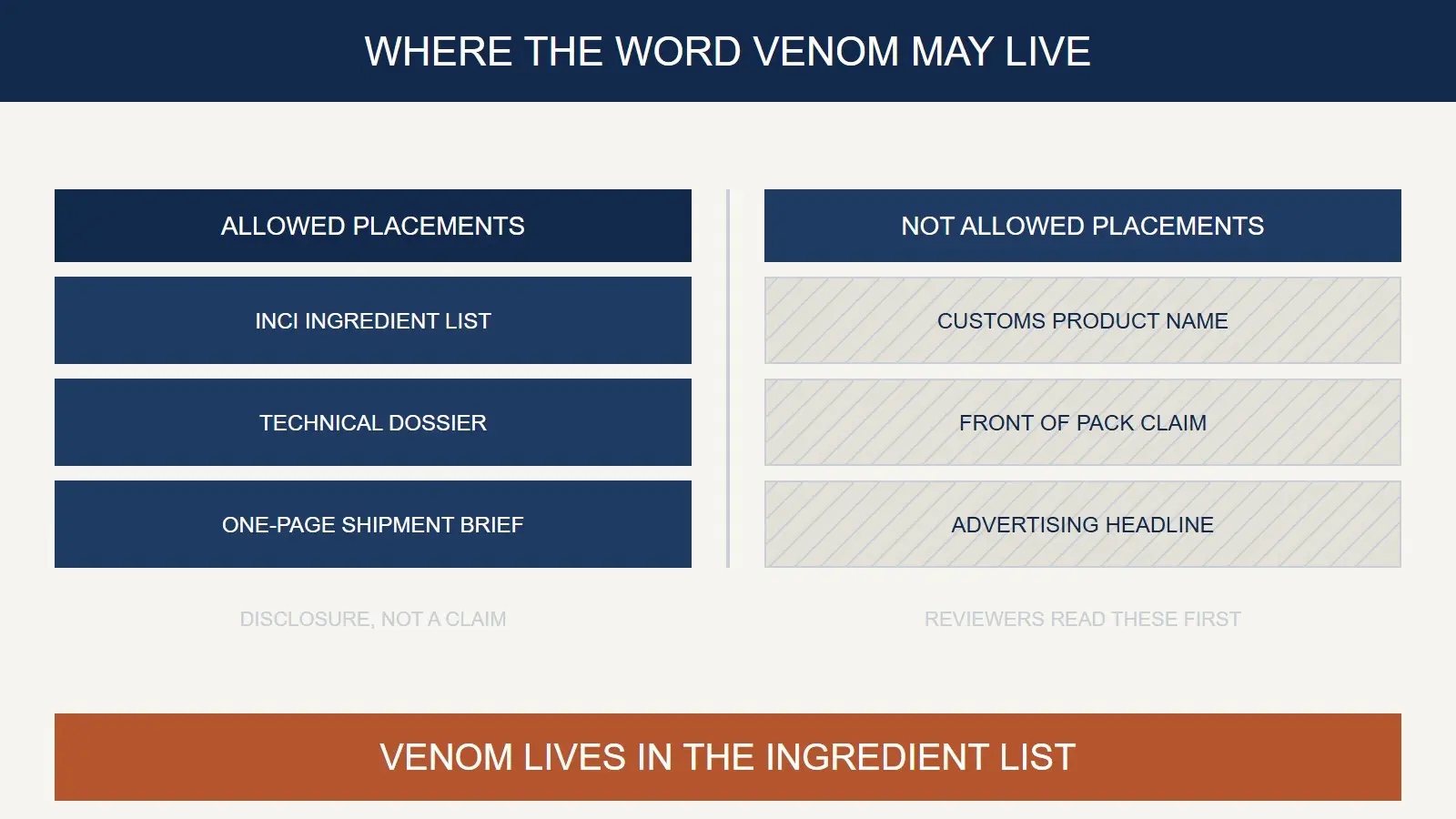
The rule that keeps both desks quiet is a placement rule, and it is worth writing into your packaging and listing templates before the first carton ships. Keep the venom vocabulary in ingredient and INCI contexts; keep it out of headline claim positions. On the pack, the INCI list carries Bee Venom Extract or the exact name your safety assessment declares - that is a regulated disclosure, not a claim, and it belongs there. On the declaration, the product name should read as what it is (a face cream, a serum, a mask), not as the ingredient that gives it its story. On the front of the pack and in the ad headline, the claim should describe the cosmetic result you are permitted to describe, and the species-and-molecule story stays in the attribute fields, the ingredient list, and the technical page - which is where the buyers who search by exact ingredient names actually find you (see the peptide range page at www.fkybeauty.com/peptides/ and the family explainer on GHK-Cu and SNAP-8 peptide serum benefits).
Then prepare the document the reviewer will ask for: a plain-language ingredient brief, half a page, written for a non-formulator. It should state what the material is, that it is used as a cosmetic ingredient at a stated load, that the finished product carries a safety assessment, where the allergen warning appears on the pack, and which markets the product is placed on. One page, no jargon, no efficacy narrative - the point is to answer the reviewer's question before they form it. Suppliers who sell this family should have that brief on file per formula, because it is the cheapest item in the whole chain and the one buyers forget to ask for.
A second-order naming trap, straight from the client's keyword file: the same set that contains melittin also contains snake venom peptide, flagged HIGH competition. Species words travel. A buyer who builds a "venom" concept across species ends up with a brand story that mixes a bee-derived material with a snake-derived marketing trope - which is exactly the confusion that makes a reviewer, a certifier, or a halal or vegetarian auditor ask a question you cannot answer with your dossier. Specify the species, and market the species. The same file's tier column (the full metrics table appears below) also shows the honest scale of the whole bee-venom word family: it is a small, technical, low-noise cluster - not a category-wide demand wave, and it should not be briefed as one.
Customs reads your declaration, not your dossier - put "venom" in the ingredient list, and put a one-page plain-language brief in the shipment file.
Reading the Signal Honestly: 6,600, 590, 140 and 368,000 Are Four Different Questions
The draft that prompted this piece argued that bee venom actives were moving from niche to mainstream, and supported that with keyword data. The data is real, but it is third-party keyword-set data from a client file - not a Google total, not a sales figure - and once you read it row by row it says something narrower and more useful than "the category is booming".
| Term as recorded in the client keyword file | Volume | Competition | Trend column | CPC | What this row can support in a brief |
|---|---|---|---|---|---|
| melittin | 6,600 | LOW | 16.0 | 2.5 | A technical term with real, uncontested search volume - enough to justify a specification page, not enough to justify a mass-market launch |
| melittin bee venom | 590 | MEDIUM | 23.45 | 1.24 | The strongest momentum inside the bee-venom cluster in this file - a compound, high-intent phrase: people typing both words are specifying |
| venom peptides | 140 | LOW | 2.05 | 0.00 | A near-zero-base phrase: fine as a documentation word, too small to build a range on |
| snake venom peptide | 390 | HIGH | 8.58 | 0.00 | Adjacent species word with paid competition - evidence that the "venom" umbrella is contested ground, not yours |
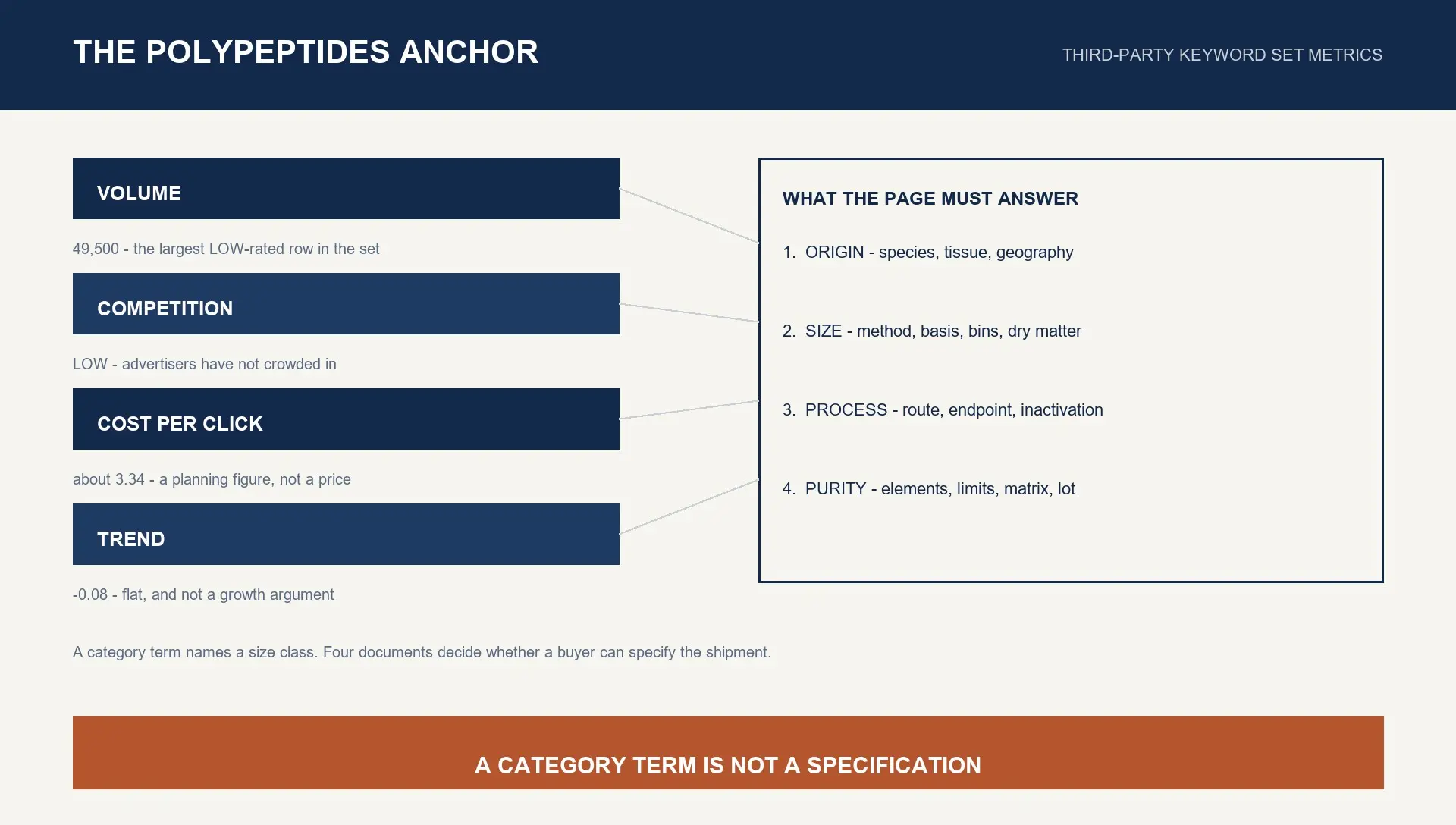
| ghk cu | 40,500 | HIGH | 20.0 | 2.67 | Where peptide budget actually goes: copper peptides are the established peptide buying lane |
| peptide | 368,000 | HIGH | 8.92 | 2.18 | The head term - enormous, saturated, and the reason an ingredient story needs a long tail to be findable |
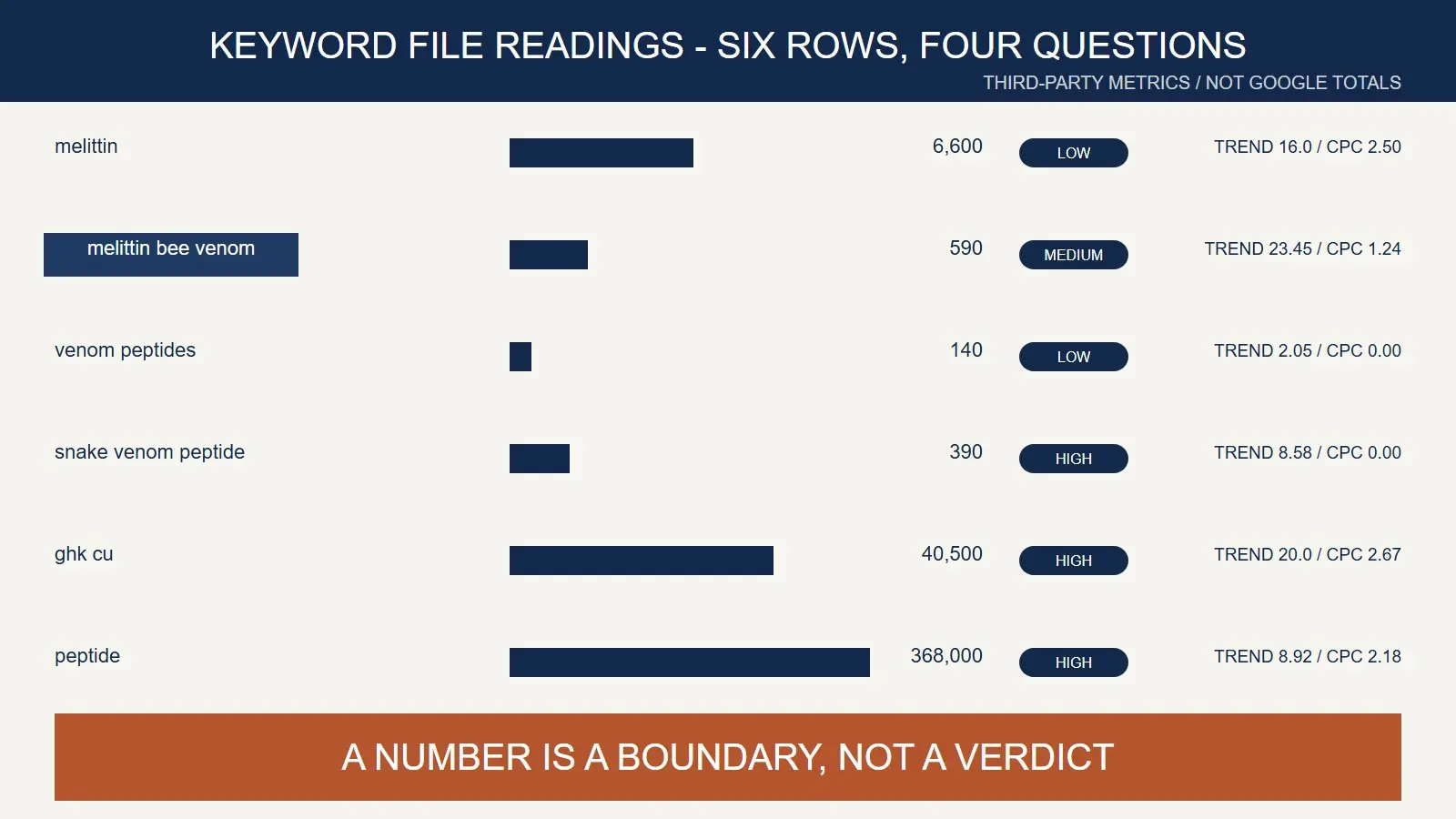
Four readings, in the order a buyer should use them.
One: the trend column is momentum, not size. The compound phrase carries the highest trend value within the bee-venom rows of this file (23.45), but on a base of 590 monthly searches. The draft's phrasing - the strongest positive trend in the entire data set - does not survive checking against the whole extract: fish collagen peptide records 30.19 and ghk cu 20.0 in the same column, both on much larger bases. Small-base momentum is the most misread number in this category. It is a legitimate trigger for a test order - a documented formulation, a small batch, a claim review - and it is not a trigger for a program.
Two: low competition on a low base is not an open market; it is an unproven one. The file's own tier column marks melittin as an A-level, low-competition term with 6,600 searches, but marks the compound phrase B-level with MEDIUM competition. Read together: the ingredient name is uncontested because it is technical, not because nobody wants it. That is the classic shape of an emerging specification term - plenty of room to rank, very little room to forecast.
Three: CPC 0.00 means "no auction recorded", not "no value". Two of the six rows carry a zero cost-per-click. On a 140- and a 390-search base, advertisers simply do not bid enough to generate a reliable figure. Treat a zero CPC as missing data - and treat the 2.5 on melittin as the signal that some commercial interest is real.
Four: the money in peptides is not in bee venom yet. The comparison rows matter: ghk cu (40,500) and peptide (368,000) are where peptide purchasing volume sits, and both are HIGH competition. If your objective is peptide relevance this season, the copper-peptide lane is the proven buyer; if your objective is differentiation with a documented risk file, bee venom is the niche. They are different bets, and a single brief should not pretend to be both. The ingredient-selection matrix for that choice is already worked on this site in PDRN vs collagen vs hyaluronic acid and in the 2026 efficacy ingredient guide - the point here is the measurement discipline, not the comparison.
One further boundary: this file is a keyword file, and its own "suggested landing field" column routes these terms to product attributes and detail pages, not to editorial - which is why the terms are already assigned on this site to the peptide category page. Editorial's job is different: to answer the questions a buyer asks before they can specify. Those questions are the next four sections.
Handling the Molecule: Apitoxin in Cosmetics Meets pH, Heat and the Surfactant Problem
The formulation constraint for apitoxin in cosmetics is not exotic - it is the standard peptide constraint plus one property that makes it sharper. Peptides are sensitive to pH, heat and processing; that is true of the whole class and is why stability work exists at all (the stability stack for a notoriously unstable active is walked through in this site's vitamin C stability guide and will not be restated here). What melittin adds is that its defining biological behaviour is a membrane interaction: the analytical literature describes a 26-residue cationic amphipathic peptide that binds lipid bilayers with high affinity and forms pores in them, with haemolysis and concentration-dependent cytotoxicity recorded in vitro (Molecules, 7 October 2025; Journal of Chromatography A, 3 December 2025; Antibiotics, 8 December 2021).
For a buyer, that sentence has three practical consequences, and none of them are marketing.
It interacts with your delivery system by design. A pore-forming amphipathic peptide in an emulsion is not an inert passenger. It is surface-active, it partitions toward interfaces, and it will behave differently in a liposomal or encapsulated system than in a simple cream. That is a genuine engineering question to put to the supplier in writing - is the material supplied as a powder for cold-phase addition, in a solubilised concentrate, or already encapsulated - and it is the same question this site's capsule and encapsulated-cream guide treats as a format decision. Ask which one you are being quoted, because "melittin" as a line item on a price sheet does not tell you.
Its activity is concentration-dependent, which cuts both ways. The same literature that describes membrane activity by concentration also describes cytotoxicity by concentration. That is the strongest argument in this piece for publishing the actual use level and its assay basis rather than a headline percentage. "Concentration is a claim, not a boast" is a marketing sentence; the version that survives audit is: state the use level, state the analytical method that verifies it, and keep both inside the range your safety assessment signed off.
Heat and process compatibility must be tested at your process, not in theory. Bee venom material in cosmetics is typically added at the cool-down phase; high-heat homogenisation, low-pH water phases and long hold times are the three conditions most likely to degrade a peptide load. Cold-process-compatible systems and encapsulation options should be discussed before the sample fee is paid, because they change the base, the packaging and the cost stack at once. The written ask is short: peptide assay recovery at T0 / T3 / T6 at your storage conditions, in our base, using your stated method.
Note the honest limit of what this section can tell you. The published analytical work we checked characterises high-purity melittin and its stability behaviour as a research and pharmaceutical-analysis subject; it does not publish cosmetic-formulation recovery data for finished creams and serums. So the load-bearing document is your own stability record with your supplier, generated on your base at your use level - not a journal citation. Ask for it as a named line item, in writing, before the first batch is committed.
Is Bee Venom Skincare a Cosmetic? The Same Word Sits in Two Different Legal Files
Ask whether bee venom skincare is a cosmetic and you have asked the wrong question, because the answer depends on which file the words are currently in. This is not a theoretical point. In the United States, the National Library of Medicine's DailyMed label database carries product listings for transdermal patches whose active-ingredient declarations include bee venom - a drug-label context, with strength expressed as 1 g in 100 g, and directions and warnings written like any other external analgesic ("for external use only", "avoid direct contact with eyes", a "ask a doctor if pregnant or nursing" style consultation line). Records inspected 14 October 2026. The same ingredient word, in a different product format and a different claim position, is filed under an entirely different regulatory regime.
That is the practical lesson for a buyer specifying this active: the ingredient does not choose its regulatory category; your format and your wording do. A serum that says it supports the appearance of firmness is in a cosmetic file. A patch that says it addresses a physiological condition is in a drug file, and everything downstream - registration route, testing, liability, who may sell it - changes with it. Nothing about the venom itself moved the line. Your brief did.
| Which file the word is in | What the file is called | What it requires of you | What it forbids |
|---|---|---|---|
| Cosmetic (EU) | CPNP registration plus a Safety Assessment (CPSR) signed by a qualified assessor under Reg. (EC) 1223/2009 | Full composition, exposure calculation at your use level, the allergen question answered on the assessment, labelling per Annex rules; claims held to Reg. (EU) 655/2013 | No medicinal effect implied; no claim without substantiation you physically hold |
| Cosmetic (US) | MoCRA facility registration and product listing, with the responsible party holding the safety substantiation dossier | Substantiation on file for each product, adverse-event handling, labelling accuracy - depth covered in the site's four-market map, not restated here | No "FDA approved" framing; no claim that outruns the file |
| Drug / OTC-adjacent | Labelled drug product with declared actives and strengths (the DailyMed pattern above) | Monograph or application pathway, GMP for drug product, strength labelling, mandatory warning text | Not a route a cosmetics OEM brief should drift into by accident - the fastest way in is a therapeutic claim |
| Platform review | Marketplace listing and category review (not a law, but it closes carts) | Plain-language ingredient brief, INCI accuracy, images that match the declared category | Toxicology-adjacent wording in headline positions; species-ambiguous "venom" branding |
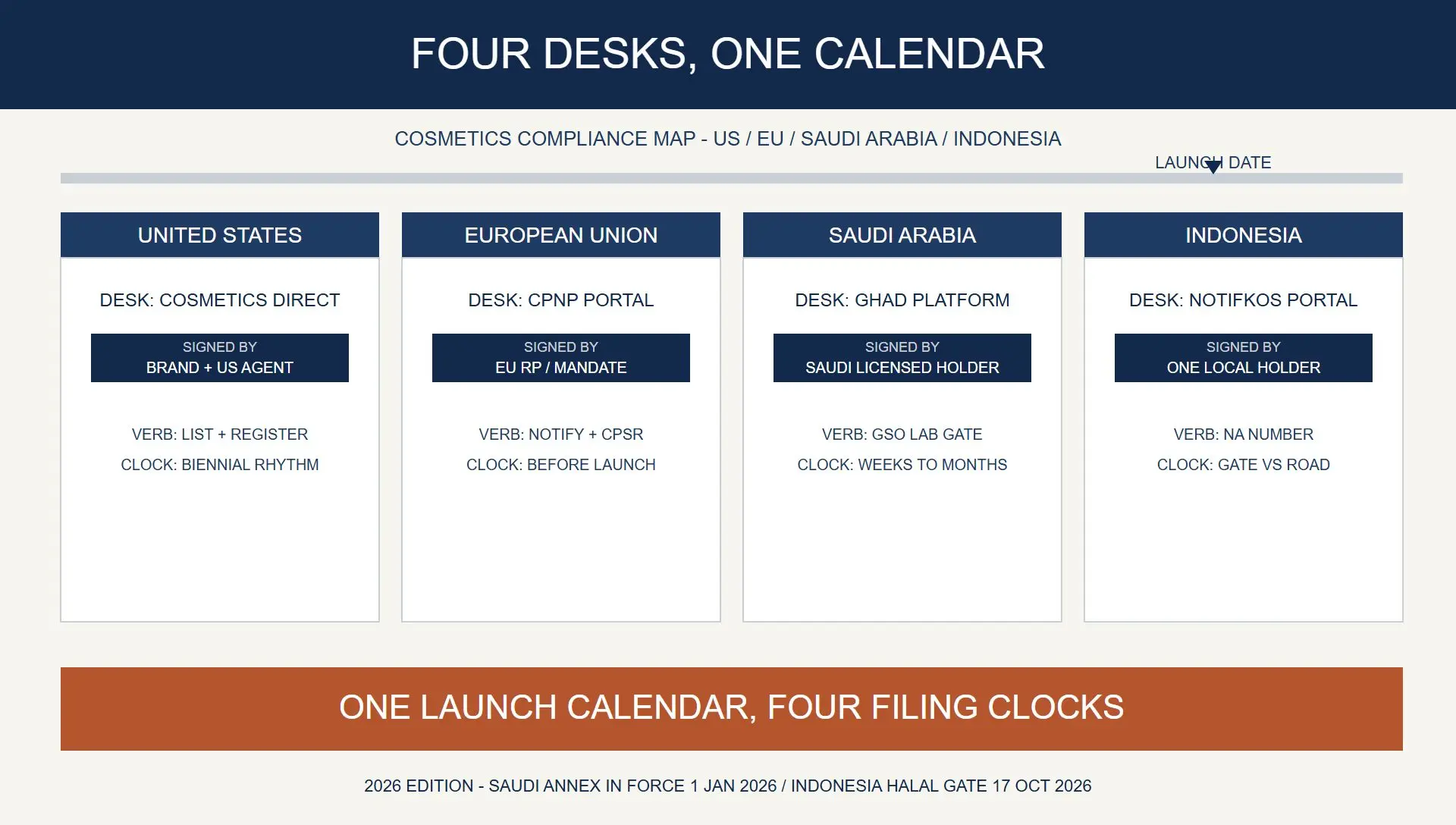
The two rows that matter most for a first melittin programme are the cosmetic rows, and both of them are already mapped on this site: the EU importer's compliance guide and the four-desk filing map walk registration, the responsible-person question and the declaration-versus-gatekeeping split, so they are linked rather than repeated. What this piece adds is one specific instruction: do not let a bee-venom SKU be the product that teaches your team where the drug boundary is. The learning is cheaper on the paper than on the shelf, and the cheapest place to buy it is the safety assessment - which is the next section.
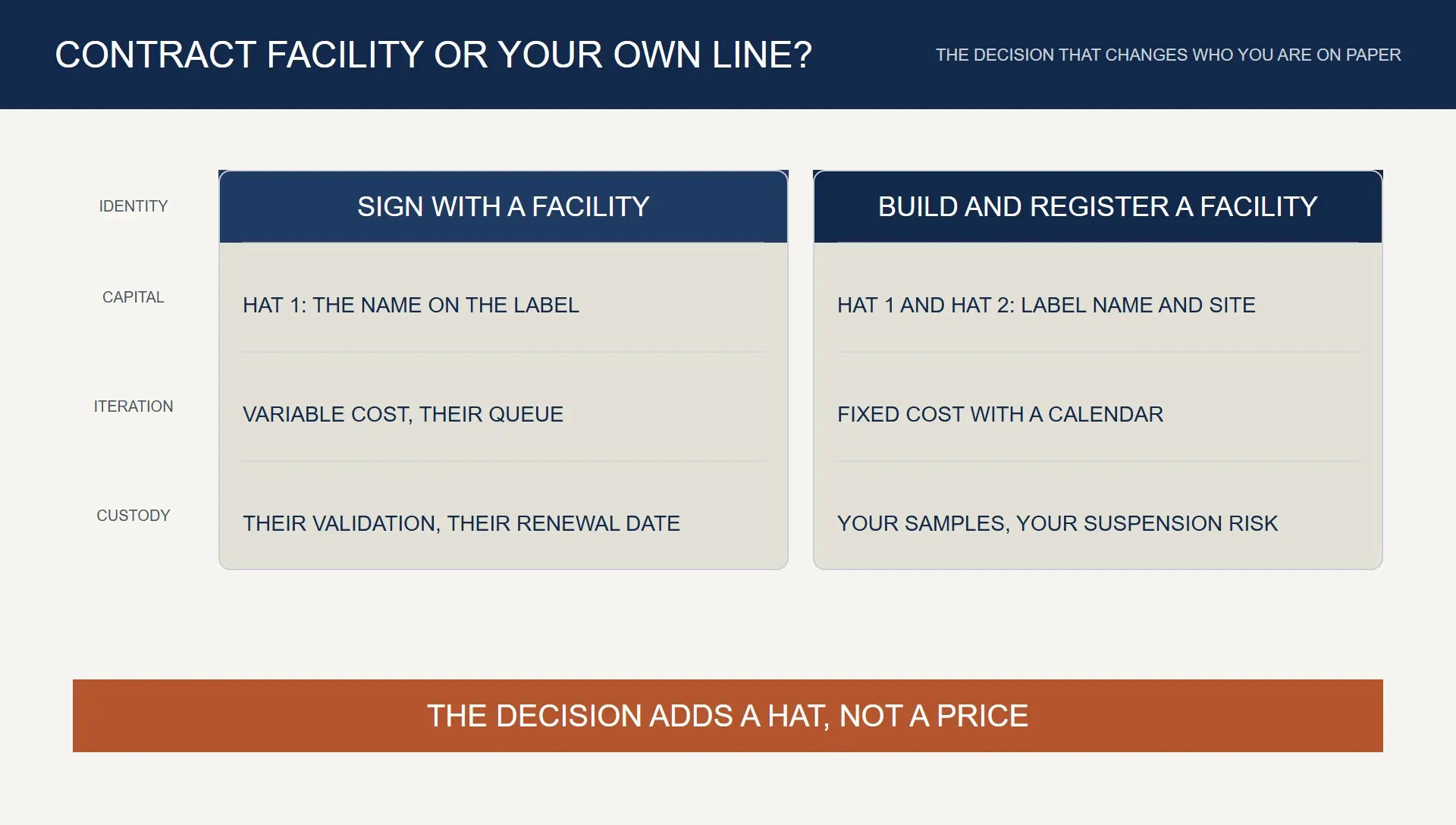
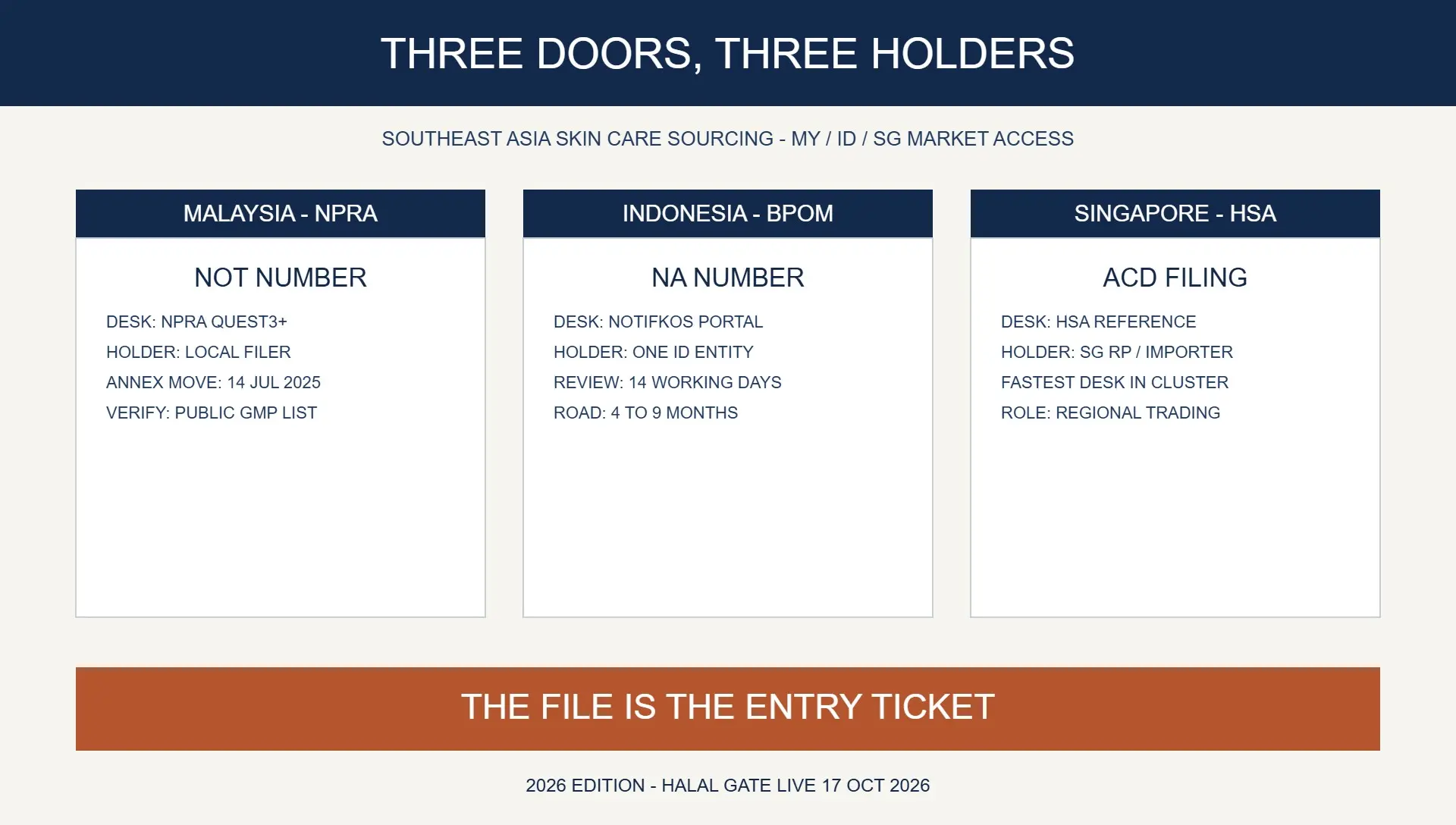
One more distinction worth holding: the site's own Malaysia and SEA market-access guide documents that notification numbers in some markets are held by a local entity, not by the factory. For an ingredient that carries an allergen warning and a possible review question, that matters twice: the entity holding your notification is the entity that will be asked about the label. Ask before you book the order whose file chain you don't hold - the ownership lines are worked through in private label vs white label.
Your format and your wording decide the regime - the ingredient word itself never has.
The Allergen File: Labelling, Patch Testing and Who Signs It
The draft this piece was built from put it plainly: bee venom allergy is a documented, clinically significant sensitivity, and any product carrying apitoxin requires clear labelling, a patch-test recommendation and an honest risk statement - and it correctly noted that this is not a compliance footnote. The clinical literature is consistent with that framing and adds the specificity a buyer needs: the venom's major allergen components are named molecules - phospholipase A2 as Api m 1, hyaluronidase as Api m 2, and melittin as Api m 4 (Key Issues in Hymenoptera Venom Allergy: An Update, February 2017) - and the peptide fraction of venom is described in the toxicology literature as producing allergenic effects alongside its cytolytic and pro-inflammatory ones (Molecules, 7 October 2025). A sting-allergic population is a real, identifiable, self-selecting group. They will read your label.
Three consequences for the file chain, in the order they cost money.
One: the safety assessment is the load-bearing document, and it must be told what the material is. A cosmetic safety report is an exposure-and-hazard calculation, not a formality. When the ingredient is a known-sensitiser family, the assessor needs the composition dossier from section two (which components, at what assay, at what use level), the intended application type and frequency, and the target area - face, eye contour, body, leave-on or rinse-off. "Bee venom extract, 0.2 percent" without an assay and without the component story is not enough for a rigorous assessment, and an assessment that is not rigorous is the document a marketplace reviewer or an enforcement officer will ask for first. The EU and US mechanics of who signs and who holds the file are mapped in the site's EU compliance guide and in the MoCRA filing map on this site; what is specific here is that for this ingredient you should ask the assessor a direct question and keep the answer: at what use level, in which format, did you conclude the product is safe, and what label warnings did that conclusion assume?
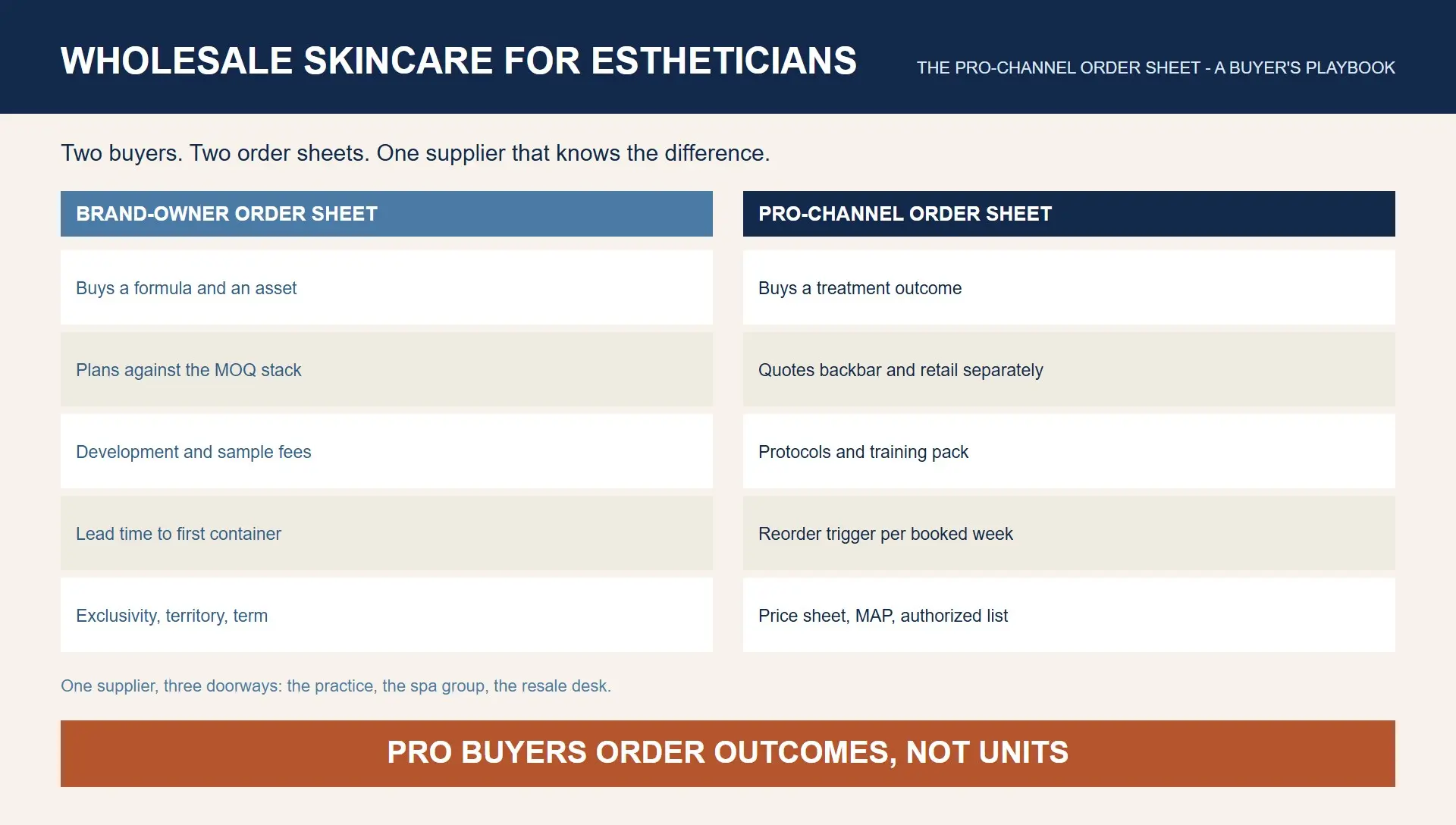
Two: the patch-test recommendation is a product deliverable, not a suggestion. Write it into the packaging artwork and the insert, not into a customer-service script: a stated application area, a stated wait time, and a stated stop condition ("do not use if you have ever reacted to a bee sting; discontinue if redness or itching occurs"). It belongs in the same document set as the protocol sheet a professional channel would hand a client - the treatment-room logic in wholesale skincare for estheticians makes the point that a protocol is a product, and here the protocol is a safety instrument with two lines on it. If your distribution includes salons or clinics, this line is where an allergen product either gets a trained gatekeeper or does not.
Three: the honest risk statement is a conversion asset, used correctly. Sensitivity-first copy - explicit, prominent, no hedging - is what separates a technical brand from one that will eventually be photographed next to a rash. It also disciplines your own assortment: a leave-on serum, a rinse-off mask and an eye-area product with the same peptide are three different exposure calculations, and the allergen question is answered three times, not once. The mask-format decision (substrate, load per sachet, occlusion time) is already walked on this site in the hydrogel-versus-sheet format guide and the 2026 mask range piece - the point for a venom programme is that format is a safety variable before it is a cost variable.
Vegetarian and vegan positioning belongs in the same file. Bee venom is animal-derived by definition; a melittin programme should decide early whether it is marketed as a "bee-derived actives" line (with the sourcing story, the harvest method and the welfare question documented) or as a peptide line where the material is a recombinant or synthetic-identity peptide. Those are different label claims, different audiences and different documentation - and, for markets where halal certification is a gate, a different conversation with the certifier. The certification mechanics are covered in this site's halal buyer guide and will not be re-derived here; what matters is that the species and production route are decided before the artwork, not discovered after it.
The Five Files: What to Demand in Writing Before the First Purchase Order
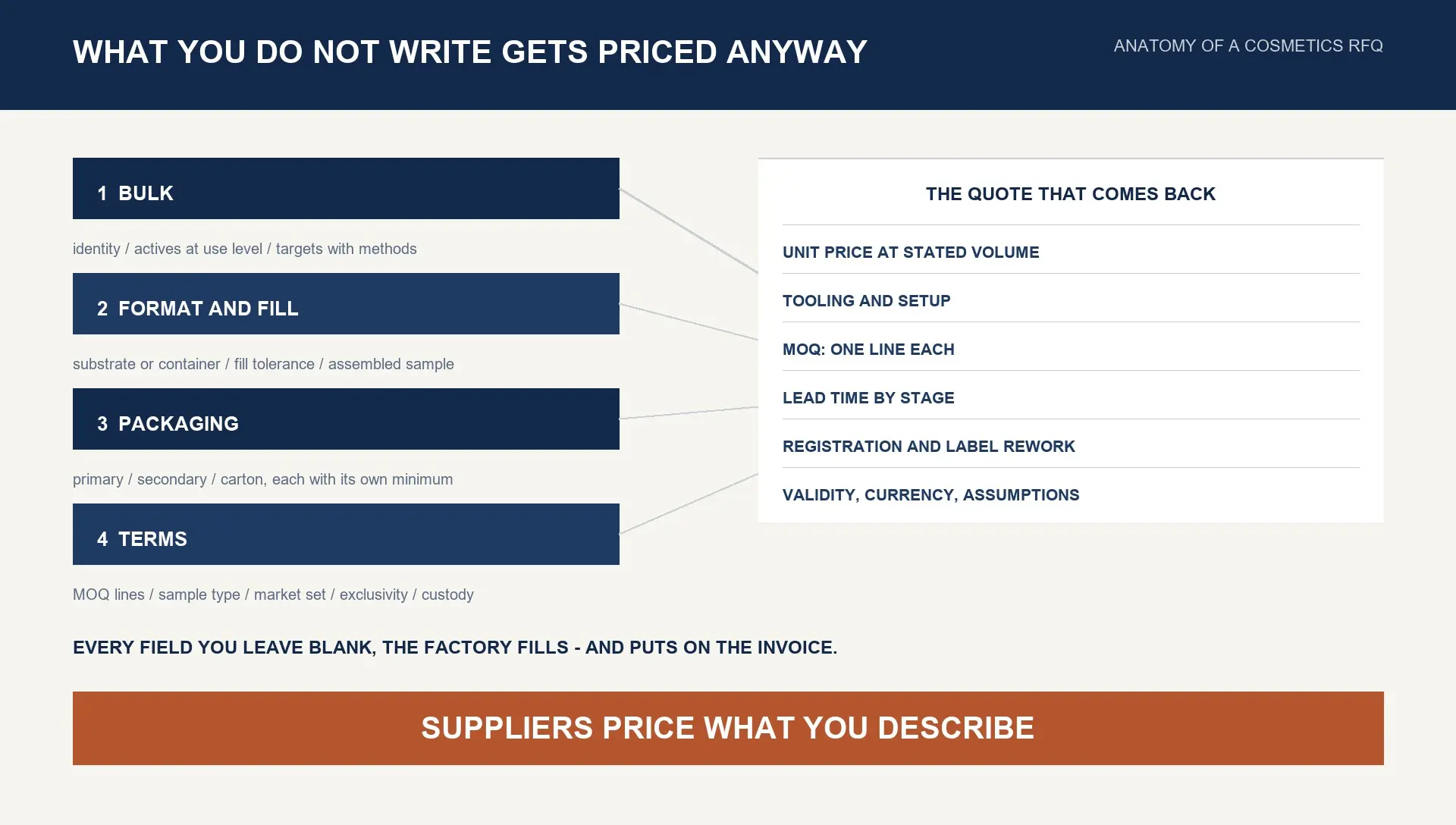
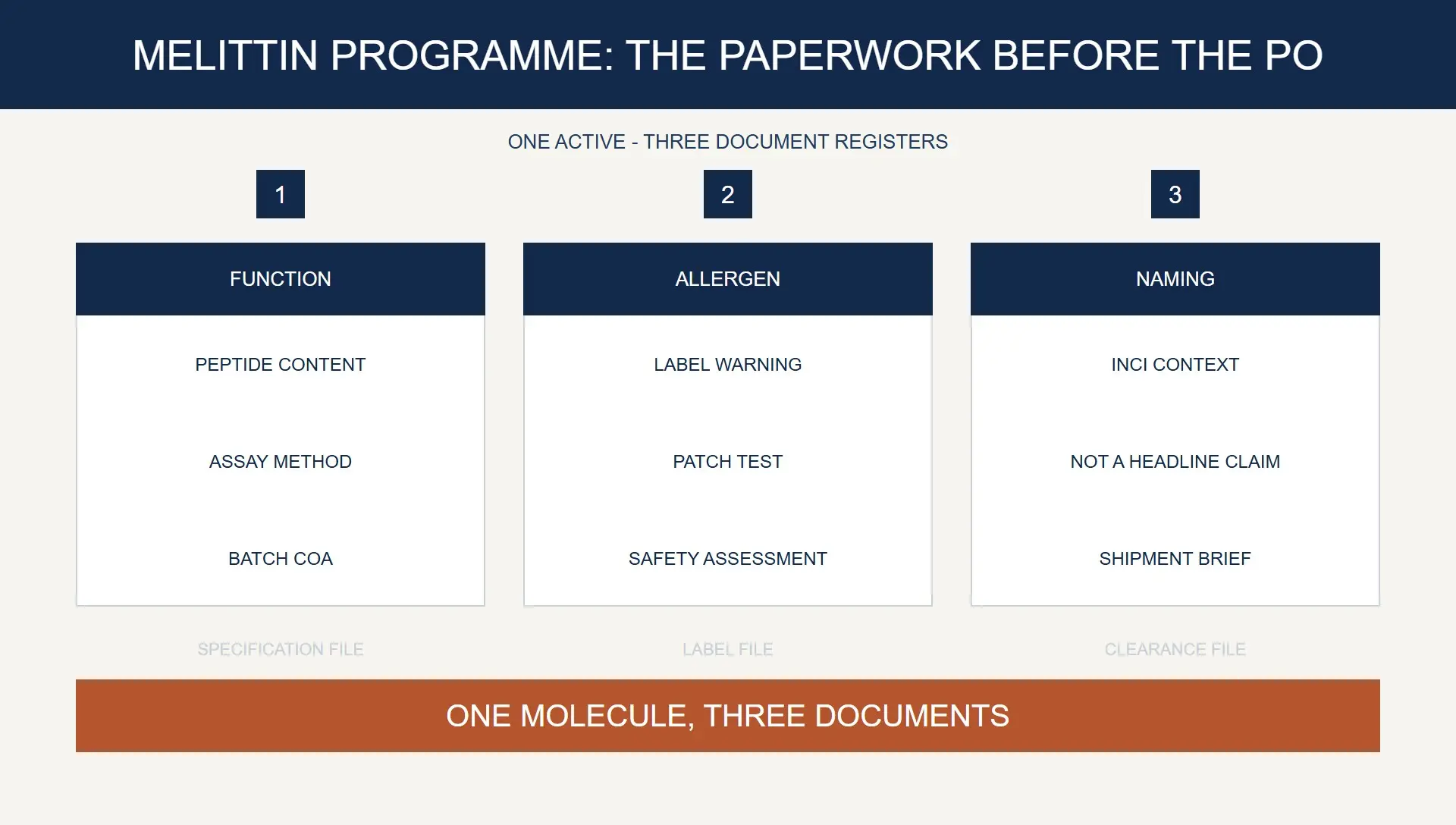
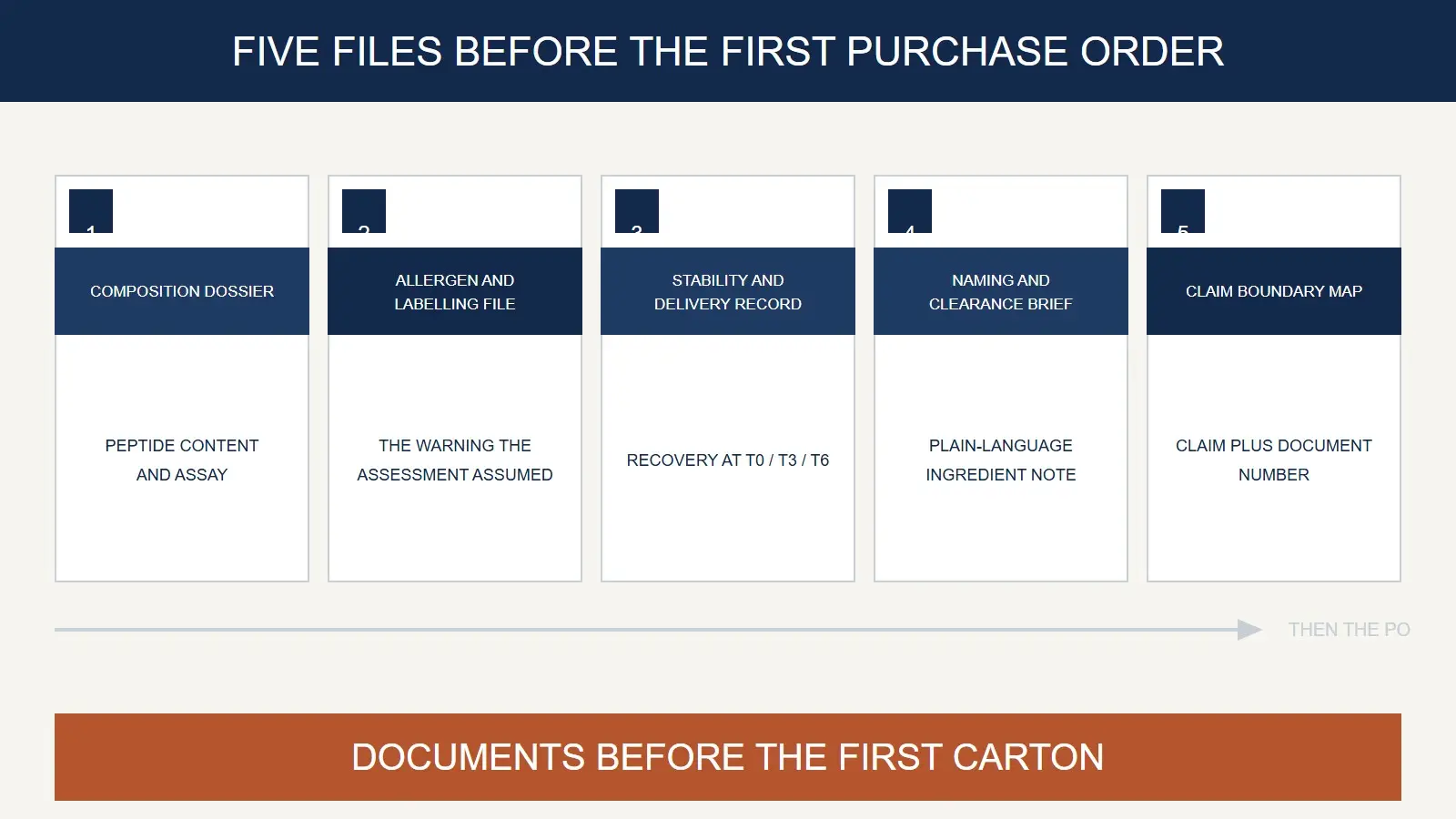
Everything above is a document. That is the useful reduction: a risk-bearing active is not a formulation problem first, it is a paperwork problem first, and the paperwork has a fixed shape. Ask for these five, in this order, in writing, before the first PO - and treat an unwilling answer as information.
| File | What must be in it | Who produces it | Who signs it | What it stops |
|---|---|---|---|---|
| 1. Composition dossier | Which material (purified melittin vs whole apitoxin extract), assay method and result, peptide content, source species, production route, batch COA | Ingredient supplier | Supplier QA + your technical review | A quote that cannot be verified; claims that cannot be substantiated |
| 2. Allergen and labelling file | Safety assessment at your use level/format/target area, the warning text it assumed, patch-test wording, INCI name as declared | Qualified safety assessor (EU CPSR / US responsible party) | Assessor or responsible party | Label enforcement risk; a reviewer's first question |
| 3. Stability and delivery record | Assay recovery at T0/T3/T6 in your base at your conditions, pH and temperature envelope, cool-down vs encapsulation route, packaging compatibility | Formulator/factory with the ingredient supplier | Your QA, against your spec | A product that loses its peptide load on the shelf, silently |
| 4. Naming and clearance brief | Half-page plain-language ingredient brief; declaration product name; listing copy that keeps venom wording out of headline positions; per-market category mapping | Brand + factory document desk | Your regulatory reviewer per market | Customs holds and marketplace takedowns |
| 5. Claim boundary map | Every claim line with the substantiation document that supports it; explicit never-print list (therapeutic verbs, sting-protection language, cure/regrow wording) | Brand legal + marketing | Named approver per market | The moment your cosmetic becomes a drug by accident |
Two commercial notes, because the paperwork has a price and a lead time.
The first is that file cost scales with format count, not with brand size. Every additional SKU carrying the same active - the serum and the wash-off mask and the eye product - is a fresh exposure calculation in file 2, and in several markets a fresh notification or registration line. The per-variant math is the same one this site documents on the filing desks in the four-market map; the mistake is briefing three formats and pricing one dossier.
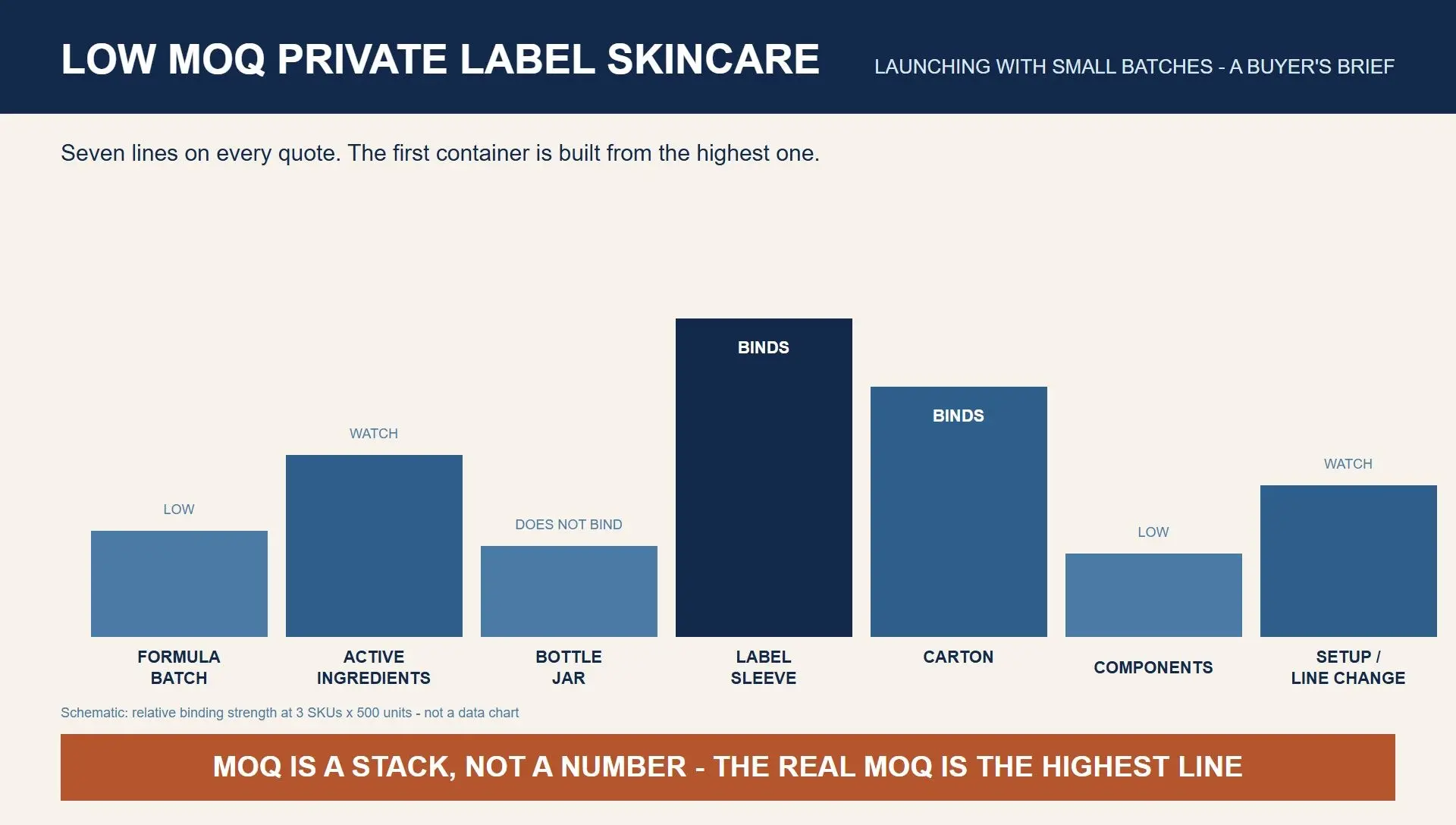
The second is that a small first order is what makes these files affordable. A documented test batch - one format, one use level, one market - buys you the assessment, the stability record and the clearance brief at a scale where a rejection is a lesson rather than a loss. The minimum-order mechanics are already worked here in the low-MOQ stack guide and the low-MOQ OEM solutions piece, including the fact that the binding line is usually packaging and labels rather than the bulk; the sequencing that puts documents before dollars is the subject of how to start a skincare brand. What this piece adds is the ingredient-specific line: for a melittin programme, file 2 gates everything else - there is no point engineering stability into a product whose safety conclusion has not been reached, and the safety conclusion needs the composition dossier from file 1 first.
Five files, in order: composition, allergen, stability, naming, claim map. Nothing on this ingredient is a formulation problem before it is a paperwork problem.
The Claim Map: What You May Print, What You Must Print, What You May Never Print
Most claim guidance is a one-direction exercise: here is what you are not allowed to say. A bee venom programme needs the two-directional version, because there are words you are obliged to add as well as words you are obliged to remove - and the obligation to add is exactly what the ingredient's admirers forget while writing the exciting sentence. The framework used on this site for inert premium actives (the 24K gold evidence-tiering piece) asked "does it actually deliver?"; the question here is different: what can this product say, and what must it say, to remain a cosmetic.
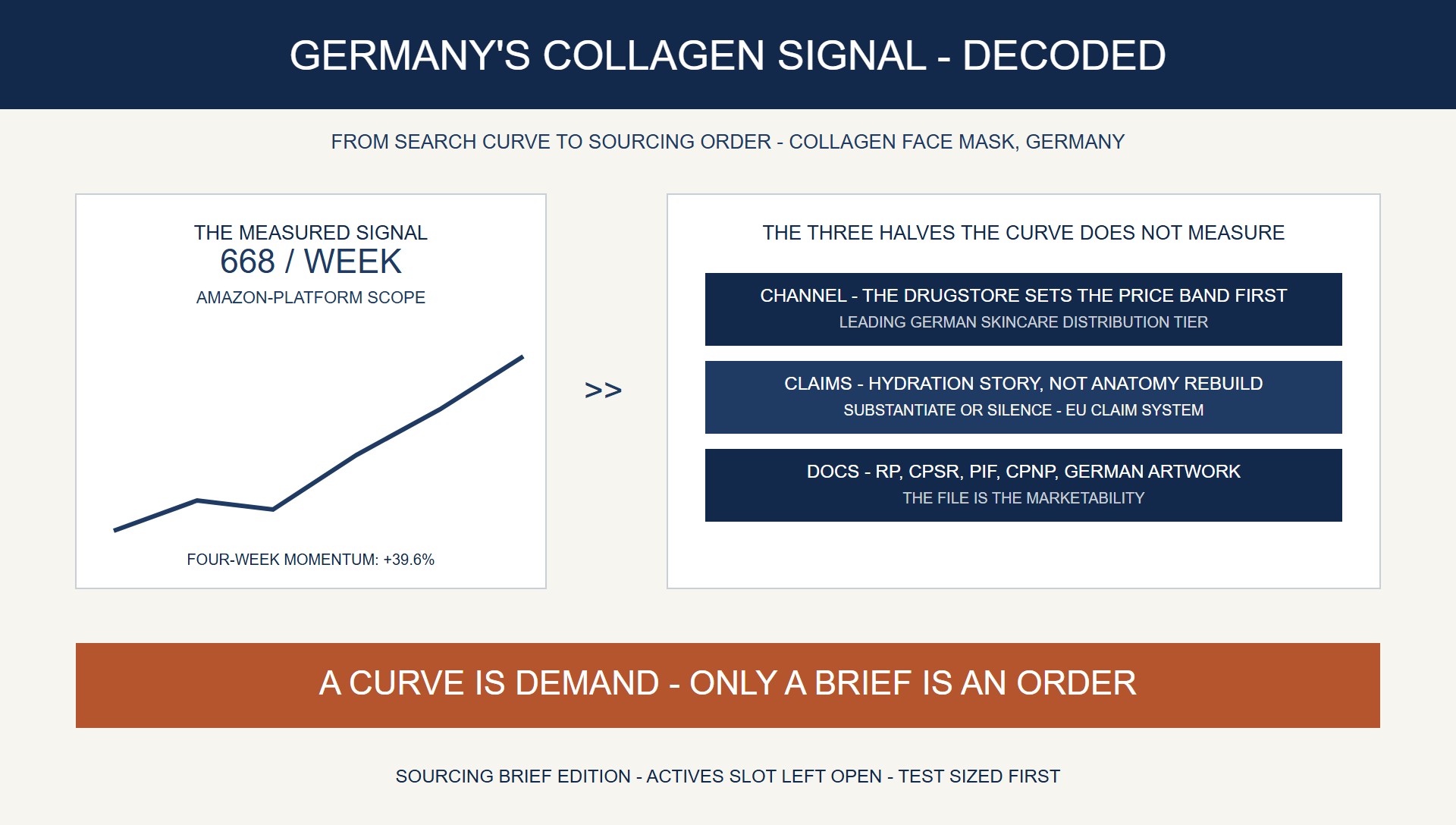
The never-print column is not a matter of taste. No therapeutic verbs anywhere: no treats, cures, heals, repairs tissue, regrows, no reference to medical conditions. The published science on this molecule is largely in-vitro and mechanistic - membrane binding, pore formation, downstream pathway effects described in research literature - and the correct citation framing is "research describes", never "our product does". This is the same route-of-administration and evidence-quality discipline applied to collagen in this site's German market analysis: a mechanism observed in a laboratory is not a finished-product outcome, and the gap between the two is where enforcement lives.
The must-print column is where this ingredient is unlike a filler or a fragrance. The allergen warning, the patch-test recommendation, the "do not use if you have reacted to bee stings" line and the exact INCI declaration are all print obligations, and each one needs a document behind it (the safety assessment conclusion, the label artwork, the composition dossier). A buyer who treats the warning text as a legal team's afterthought will discover that the warning is the part the marketplace reviewer reads first.
| Claim position | Cosmetic-safe form (example wording, to be substantiated per market) | Evidence that must exist on file | Status |
|---|---|---|---|
| Front-of-pack benefit line | "Supports the appearance of firmer-looking skin" / "for a plumped, smooth-looking finish" | Substantiation for the specific wording you chose; stability record if the claim rests on the peptide | May print - with proof |
| Sensory/texture claim | "Fast-absorbing serum with a noticeable finish" | None beyond the formulation itself; must not be dressed up as a physiological effect | May print |
| Ingredient truthfulness | "Contains melittin-rich bee venom peptide at X percent, assay method stated" | Composition dossier + assay; INCI matching the formula | Must print accurately |
| Allergen communication | "Not suitable if you have ever reacted to bee stings. Perform a patch test before first use." | Safety assessment conclusion + label artwork version control | Must print |
| Mechanistic storytelling | "Research describes melittin as a 26-residue peptide that interacts with lipid membranes" | Cited dated literature; framing kept as literature, not outcome | May print, framed as research |
| Therapeutic positioning | Any of: treats, cures, heals, repairs, regenerates tissue, regrows, anti-inflammatory for a condition, "venom works like a neuromodulator" style comparisons | No dossier exists that makes these cosmetic claims | Never print |
| Sting/protection framing | "Protects against insect bites", repels, or any pesticide-adjacent idea | Biocide registration, not a cosmetic file | Never print |
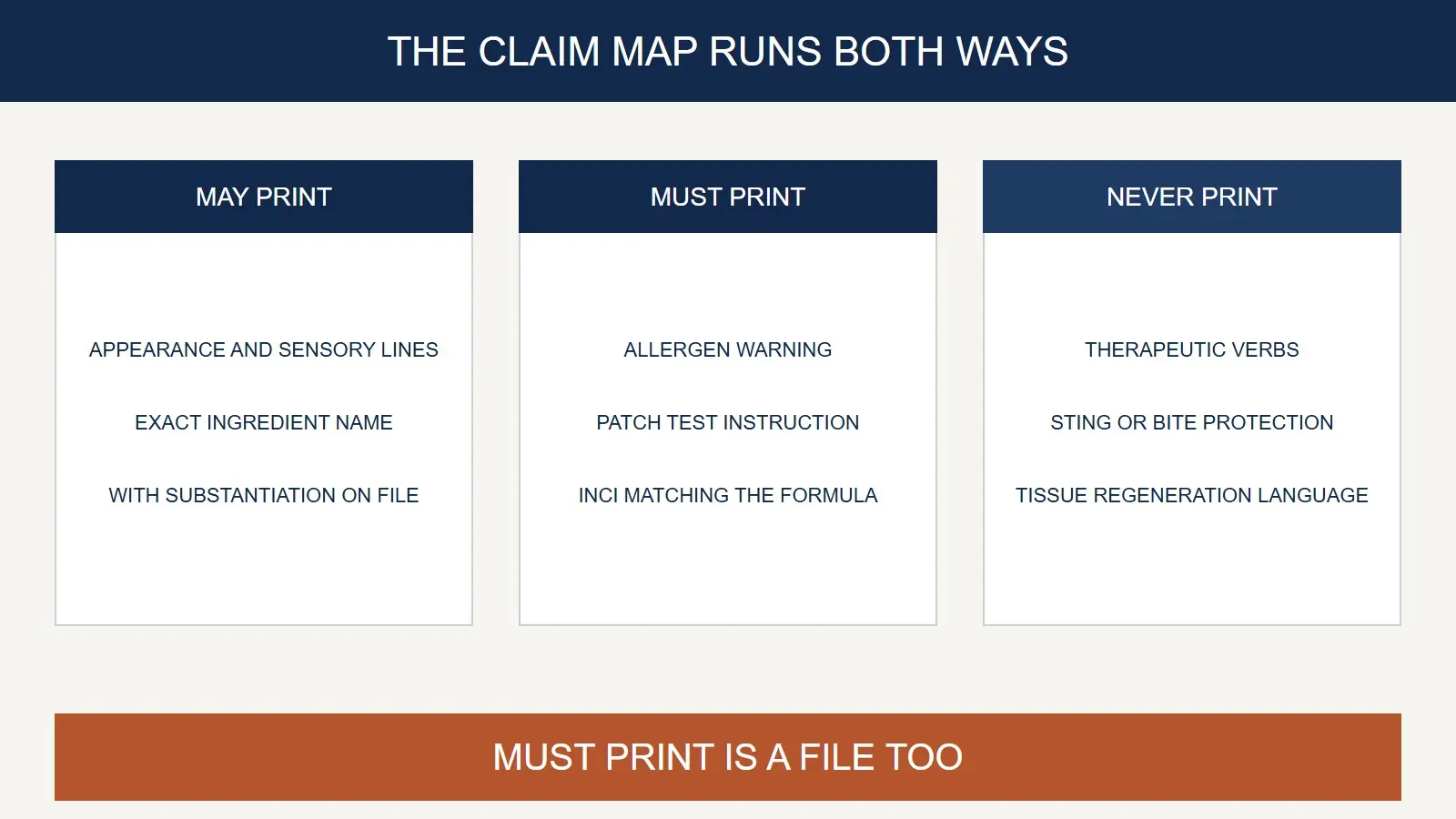
The practical way to enforce this table is to make it a sign-off artifact: the claim line, the document number that supports it, and the named approver, in one row, before artwork is released. The substantiation expectation in the EU is codified (Reg. (EU) 655/2013 common criteria) and the US equivalent is the responsible party's obligation to hold substantiation - both are covered in depth on the compliance desks this site already documents, and neither is re-derived here.
The Sourcing Routes: Purified Melittin, Whole Apitoxin, and a Premix You Should Ask For
The commercial decision this ingredient forces is upstream of the formula: what are you actually buying? Three routes exist, they are not interchangeable, and each has a different file chain and a different minimum-order profile. The honest version - the one a supplier should give you unprompted - is that the route you choose determines whether you are buying an assayable material or a story.
| Route | What arrives | Specification you can verify | File burden | Typical commercial shape |
|---|---|---|---|---|
| A. Defined melittin (purified or synthesised peptide) | A peptide with an identity test | HPLC assay against a reference, peptide content, MW/sequence identity, amidation form, endotoxin/heavy-metals per pharmacopoeial logic | Lowest ambiguity: one composition dossier carries the whole programme | Low absolute volume, high unit cost, tight cold-chain and storage discipline; often the reason a first programme is tiny |
| B. Whole apitoxin extract | A venom mixture, peptide fraction plus enzymes | Peptide content by assay, plus the allergen-enzyme question you cannot assume away (PLA2 10-12% of dry weight in the literature bands cited above) | Highest: the safety assessment must address the enzyme components | Cheaper per unit, more variable between batches; batch-to-batch COA review becomes a real QC line |
| C. Supplier premix / dosed base | A ready-to-use concentrate with the peptide already solubilised | Recovery data in their carrier, plus your own confirmation in your base | Middle: their stability record plus your verification | Fastest to sample; MOQ behaves like a formula line, so the binding constraint moves to packaging (the stack logic in the low-MOQ guide) |
Ask four questions and the route answers itself. Which material is this, by name and assay? What does the COA measure, and against what reference? Which venom components are present, and at what level - specifically the enzyme fraction? What does your stability record show in the base I will actually sell? A supplier who answers those in writing is offering a documented material; one who answers with an origin story is offering route B with route A's price promise.
Two structural cautions. First, peptide purity moves behaviour far more than the copy implies, and this is the same specification-first logic that makes exact ingredient names searchable for technical buyers - the naming-system argument made for copper peptides in this site's GHK-Cu and SNAP-8 explainer applies here in reverse: if your technical page cannot name the material and its assay, the formulator who would have specified it cannot find you. Second, there is no published cosmetic-use consensus to hide behind - the analytical and clinical literature we checked concerns venom composition, melittin characterisation and allergy, not finished-product dosing standards for cosmetics. Any "industry standard percentage" quoted at you in this category is a commercial opinion, and should be written into your specification as your decision, tested at your use level, not inherited.
Buy the assay, not the anecdote: if the route cannot be named, measured and documented, it is not a specification - it is a story with a price.
How This Programme Usually Fails: Five Patterns Worth Pricing Against
Read the failure modes as pricing signals, because each one has a line item that would have prevented it.
The novelty relaunch. A range adds the ingredient for the story and buys no composition dossier. Predictable endpoint: a claim review at a marketplace desk, or a retailer asking for a document nobody produced. The prevention is file 1 and file 5, both cheap relative to a delisted launch.
The unlabelled allergen. The product is technically fine and the label is not: no patch-test wording, no bee-sting caution, an INCI line that does not match the formula. This is the failure that cannot be fixed with a marketing budget, only with a re-print - and the reprint is priced by the carton, not by the campaign. Prevention: file 2 signed before artwork, with version control.
The silent decay. Stability was assumed. The peptide load at T0 was real; at T6 on a retail shelf nobody can say. The customer who receives the product six months after you manufactured it is the one who finds out, and their review is the assay. Prevention: file 3 with recovery numbers in your base, not in the supplier's brochure.
The declaration mismatch. The marketing name went on the paperwork. "Venom" in the product-name field of a customs declaration invites a question that delays a container, and a headline claim that drifts toward physiology is how a cosmetic starts being treated as a drug. Prevention: file 4, and the four-file category table in section six.
The species-blur. The brand story mixes bee-derived material with snake-venom imagery because both are "venom" and one of them photographs better. Then a certification question, a vegetarian claim, or an auditor's query arrives and there is no document that answers it cleanly. Prevention: pick the species and the production route before naming the range, and let the naming follow the dossier.
Notice what all five have in common: none of them is a formulation failure, and all of them are visible before the first PO if the questions are asked in the order the five files are written. That is the entire argument of this piece, restated as a loss list.
Frequently Asked Questions
Q1: How is melittin different from "bee venom" as an ingredient line on a specification? Bee venom (apitoxin) is the whole mixture; melittin is one molecule inside it - the dominant peptide, reported at 40-50 percent of the venom's dry weight, with some analytical work giving 40-60 percent (Antibiotics, 8 December 2021; Toxins, March 2021; Journal of Chromatography A, 3 December 2025). Specifying "bee venom extract" does not tell a buyer what peptide load is present or whether the allergen enzyme fraction is in the vial. Specify the material, the assay, and the number.
Q2: Is a bee venom allergy warning required on the label, or is it optional courtesy copy? Treat it as required, not courteous. Venom allergens are named components in the clinical literature - Api m 1 (phospholipase A2), Api m 2 (hyaluronidase), Api m 4 (melittin) (Hymenoptera venom allergy update, February 2017) - so the caution belongs inside the safety assessment's assumptions, and the label text has to match what that assessment concluded. The patch-test instruction and the "do not use if you have reacted to bee stings" line are part of the file, not decoration on the pack.
Q3: Can we put a venom-derived peptide in a sheet mask? Format-wise, yes - the substrate and load-per-sachet logic is covered in this site's format guide and the 2026 mask range piece. Safety-wise, a mask is a different exposure calculation from a serum (occlusion time, dose per application, rinse-off or leave-on), so it is a second safety assessment, a second label check, and in several markets a second notification line. Price the format, then price the file.
Q4: Will customs stop a shipment because of the word "venom"? Not as a rule - but the declaration's product-name field is the place where it becomes someone else's judgment call, and marketplace review desks behave the same way with headline wording. The control is placement: declare the product as what it is (cream, serum, mask), keep venom vocabulary in the ingredient list and the technical document set, and ship a half-page plain-language ingredient brief with the batch.
Q5: Does the research support anti-aging claims for this ingredient? Research describes melittin as a membrane-active 26-residue peptide with cytolytic and pro-inflammatory properties recorded in laboratory settings (Molecules, 7 October 2025; Journal of Chromatography A, 3 December 2025); it is not a body of cosmetic finished-product efficacy trials. The claims you may print are cosmetic-appearance claims you can substantiate - and the honest framing of anything mechanistic stays in the "research describes" register. That gap is exactly what the claim map in section nine exists to police.
Q6: How small can a first melittin programme be? Smaller than a normal launch, and it should be - one format, one use level, one market, with the composition dossier, the signed safety assessment at that use level, the stability record in your base, the clearance brief and the claim map all produced before the carton count matters. The minimum-order structure that makes this affordable (and the fact that the binding line is usually packaging, not bulk) is documented in this site's low-MOQ stack guide; for an allergen-bearing active, the small first order is not timidity, it is the only version of the programme that gets fully documented.
Sources and Further Reading
Figures cited as of publication. Keyword numbers are third-party keyword-set metrics from the client's keyword file (243-keyword set; the extract used for verification is dated 28 September 2026) - they are not Google-verified search volumes and are not presented as such. Confirm current composition, allergen and regulatory positions with the primary sources and with counsel in each target market before production decisions.
- Melittin as the major peptide of honeybee venom; composition families (peptides melittin/apamin/adolapin/MCD; enzymes PLA2 and hyaluronidase; biogenic amines histamine and epinephrine); melittin 40-50 percent of dry weight; 26-residue cationic amphipathic structure - Antibiotics (MDPI), 8 December 2021 - Melittin 40-50 percent of dry weight with PLA2 and apamin among other major components - Toxins (MDPI) 13(3):191, March 2021 - Melittin 26 amino-acid residues, ~2,840 Da, sequence GIGAVLKVLTTGLPALISWIKRKRQQ-CONH2; venom compounds described as producing cytolytic, neurotoxic, pro-inflammatory, allergenic and antimicrobial effects - Molecules (MDPI) 30(19):4003, 7 October 2025 - Melittin principal component at 40-60 percent of venom dry weight; lipid-bilayer binding, pore formation, haemolysis and concentration-dependent cytotoxicity; analytical characterisation and stability evaluation of high-purity melittin - Journal of Chromatography A (Elsevier), article published 3 December 2025 - PLA2 10-12 percent of venom dry weight; melittin approximately 50 percent - Microbial Pathogenesis (Elsevier), 28 January 2020 - Bee venom allergen naming system: Api m 1 = phospholipase A2, Api m 2 = hyaluronidase (major allergens), melittin = Api m 4 - "Key Issues in Hymenoptera Venom Allergy: An Update", February 2017 - Native melittin as a 26-residue peptide amide (C-terminal processing) - Protein Data Bank in Europe (EMBL-EBI) educational article on bee venom therapy - US DailyMed label records for transdermal bee venom products: bee venom declared among active ingredients with strength expressed as 1 g in 100 g, plus external-use and eye-contact warnings - US National Library of Medicine DailyMed listings, inspected 14 October 2026 - Keyword metrics (volume, CPC, competition, trend columns for melittin, bee-venom phrases, ghk cu, peptide) - client keyword set (243-keyword file; local extract dated 28 September 2026), third-party metrics, page-assignment purpose stated in place - Claim substantiation and filing architecture (Reg. (EC) 1223/2009, Reg. (EU) 655/2013, MoCRA responsibilities, notification-holding entities) - documented on this site in the four-market filing map and the EU importer's guide, linked in place; this piece does not restate them - Site layers this piece leans on and does not repeat: the marine-origin sourcing and claims guide, the vitamin C stability programme, the encapsulated-cream format layer, the hydrogel-versus-sheet substrate decision, the 24K gold evidence-tiering piece, the German market-signal translation, the professional-channel order sheet, the low-MOQ stack, the ownership ledger and the launch sequence - each linked above at the point of use, none re-derived.
What to do next
If a bee venom or melittin programme is on your sheet - or any active that arrives with an allergen question attached - send the request the way the five files are built: material and assay, use level and format, target market, and the label wording you intend to carry. Get your quote and MOQ table, with the composition dossier, safety assessment support, stability record, clearance brief and claim-map lines named as items rather than folded into one rounded number. A dedicated product manager on every RFQ - reply within 24 hours, sample packs in 7 days, MOQ from 1,000 pcs.