

FDA Cosmetic Registration Requirements: The Four-Desk Map
Four Filing Desks, One Launch Date: Why 2026 Is the Year of the Compliance Map
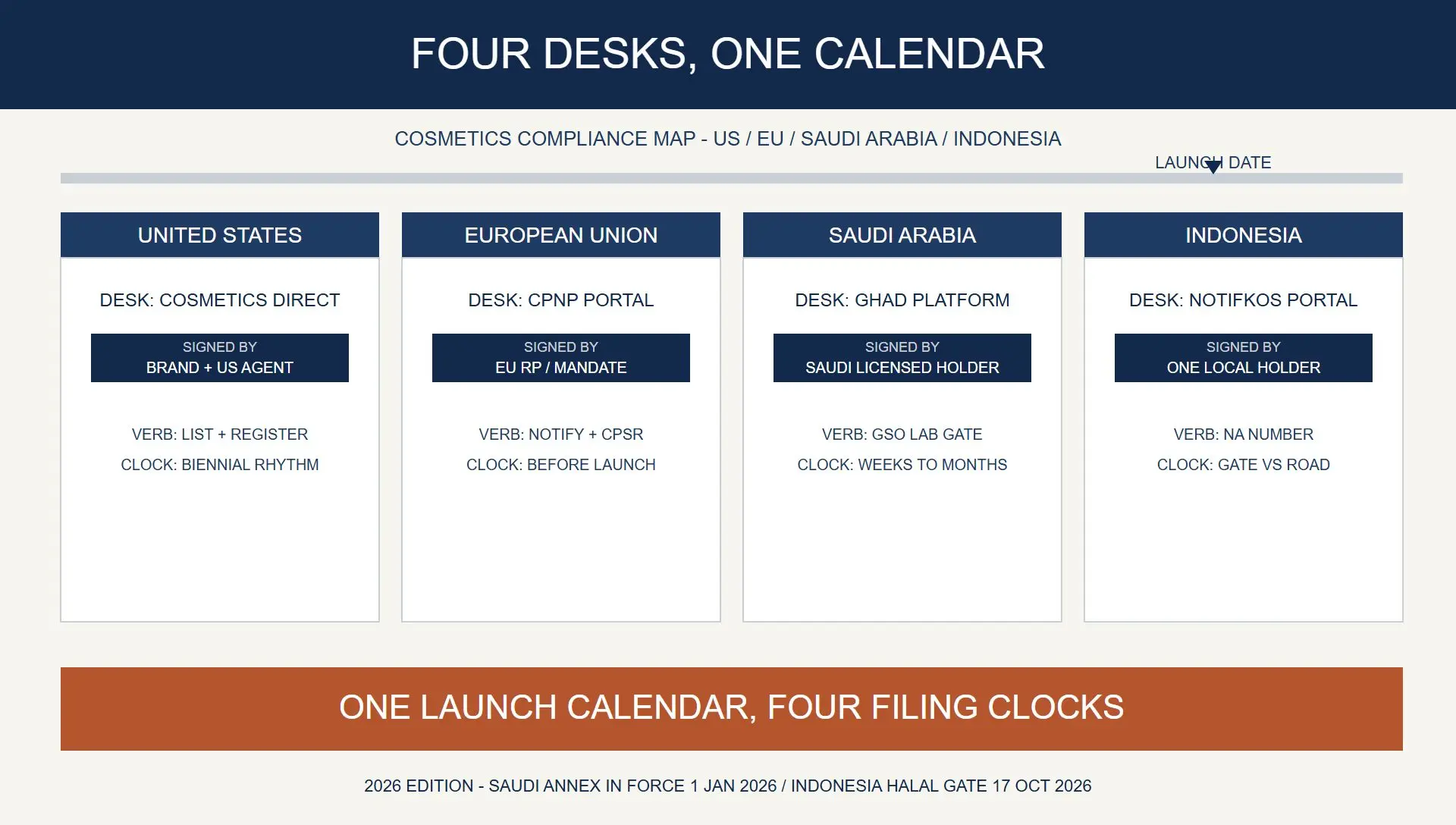
Read the search phrase fda cosmetic registration requirements literally for a second and notice what it assumes: that "registration" is one thing, done at one desk, in one language. It is not. The same facial cream that is listed with FDA in Washington, notified under the European Union's CPNP by a responsible person established in the Community, registered through Saudi Arabia's GHAD platform by a licensed Saudi importer, and given an NA number by Indonesia's BPOM has passed four different legal verbs — each with its own holder of record, its own reviewer (or non-reviewer), its own clock and its own definition of who is allowed to sign. A brand planning three or four markets at once does not have one compliance problem. It has four filing desks standing behind one launch date.
2026 is the year all four desks changed something at once. Saudi Arabia's updated cosmetic ingredient standards became fully binding on 1 January 2026 — importing or manufacturing non-compliant cosmetics turned prohibited, after a September 2025 addition of 21 new banned ingredients including dibutyltin maleate and 4-nitrosomorpholine (cosmetics industry regulatory tracker, 21 August 2026). Indonesia's halal certification mandate landed 17 October 2026 — five days from this writing — a wall already walked through in our Southeast Asia filing guide. The United States moved from MoCRA's grace years into full enforcement, with facility registration renewals on a biennial cadence that is not tied to the calendar year, as a law firm's 26 December 2025 client alert put it. And the EU's notification infrastructure kept hardening around what was always the real requirement: not the portal entry, but the dossier and the responsible person standing behind it.
The buying consequence is a sequencing consequence. Most brands research regimes one at a time — read about MoCRA, then CPNP, then the Gulf, then Indonesia — and each solo guide is honest about its own market while quietly assuming the reader has only one. Multi-market files are not a stack of single-market projects; they are a map, because content (the formula, the safety assessment, the label master) partially travels between desks while authority (who may submit, who must exist locally) never travels at all. This piece is that map: one comparison table across the four regimes, one section per desk that states only the cells a multi-market buyer needs, and a filing order at the end that survives contact with a launch date. The deep dives already exist on this site and will not be repeated: MoCRA's full-enforcement anatomy for the US, the EU importer's compliance guide for Europe, the BPOM clock and holders for Indonesia. What is new here — and what no single-market guide on this site has covered — is Saudi Arabia's desk, and the act of reading four desks as one system.
One product, four verbs, four signatures: the map is the deliverable, not the memo per country.
Registration, Notification, Listing, License: Four Verbs, Four Legal Logics
Before the country sections, the vocabulary — because mistranslating the verbs is how launch plans die politely. Regulatory English uses four near-synonyms for four very different legal operations:
Registration implies the authority accepts the file into a register it maintains and may act on — the record exists because the government keeps it. Notification implies the authority receives and stores a declaration made by an accountable private party; the legal weight sits on the notifier's dossier, not on an approval stamp. Listing is narrower still: an itemization of what exists, usually tied to a registered facility. License is a different animal entirely — permission to operate (import, warehouse, distribute), which in several of these regimes is the hidden prerequisite behind the cosmetic file.
Mapped across the four desks:
| Jurisdiction | The operative verb(s) | Who submits | Does the authority review pre-market? | Official filing fee structure | The clock | The local-presence answer |
|---|---|---|---|---|---|---|
| United States (MoCRA) | Facility registration + product listing | The US-or-foreign manufacturer, processor or distributor of record (not the retailer) | No approval; registration/listing are records, backed by safety-substantiation duties | No government registration fee — cost sits in compliance work, not receipts | Registration + listing cadence: renewals biennial, unlinked to the calendar year (firm alert, 2025-12-26); changes update within 60 days (reported 2024-02) | Foreign establishments must designate a US agent; agent is a contact, not an entity |
| European Union (1223/2009) | Notification via CPNP | The Responsible Person established in the EU — importer, manufacturer or mandate-holder | No approval; RP self-declares against a mandatory dossier (CPSR + PIF) | The portal entry itself is an information step; the spend is in the safety assessment | Notification must be complete before placing on market; dossier must be live the day the first unit ships | RP must be EU-established — the non-transferable signature |
| Saudi Arabia (SFDA) | Notification/registration via GHAD | A Saudi-licensed local entity — importer/distributor with commercial registration and import-distribution permits (regulatory guides, 2025-05-16 / 2026-10-02) | Substantive screening: files are assessed against Gulf standards (GSO 1943, 2528, 2020) with lab testing as the practical gate | No SFDA registration fee for cosmetics (fee-list tracker, 2026-09-24); the money is in testing + the local holder's services | Weeks-to-months typical; ingredient-standard revisions (2025-09 addenda) re-open live files | The holder must be Saudi-licensed; the brand cannot self-file from abroad |
| Indonesia (BPOM) | Notification producing an NA number | One local entity per product (own PT PMA or licensed distributor) | Administrative review of the PIF; technical rejection common on ingredient-list mismatch | Fee bands by origin (ASEAN 1× vs non-ASEAN 3×), per shade/variant | 14 working days is the gate; 4–9 months is the road | Local entity required; one holder, renewal leverage — full treatment in the SEA guide linked above |
Read down the review column and the regimes split into two philosophies: declaration regimes (US, EU — the government stores what an accountable private party attests) versus gatekeeping regimes (Saudi, Indonesia — a local-licensed intermediary and/or the authority screens the file). The split predicts everything else about your project: where the money goes (assessment work vs holder services + lab), what "compliance ready" means (airtight dossier vs a signed local partner), and which failure hurts (a false attestation in the first pair; a missing holder in the second).
The fee column deserves one honest line: none of these four desks charges a cosmetics price sheet the way a distributor does. Two (US, Saudi) have no registration fee for cosmetics at all in the cited sources; the EU's notification is an information duty whose cost hides in the mandatory safety report; Indonesia's is a published band structure that multiplies per variant. The invoice a buyer should actually fear in every regime is the paperwork invoice — the assessments, tests and local signatures that make the free-or-cheap filing possible. This site's price discipline says the same thing from the other side: the cost-structure page maps where quotes are actually built.
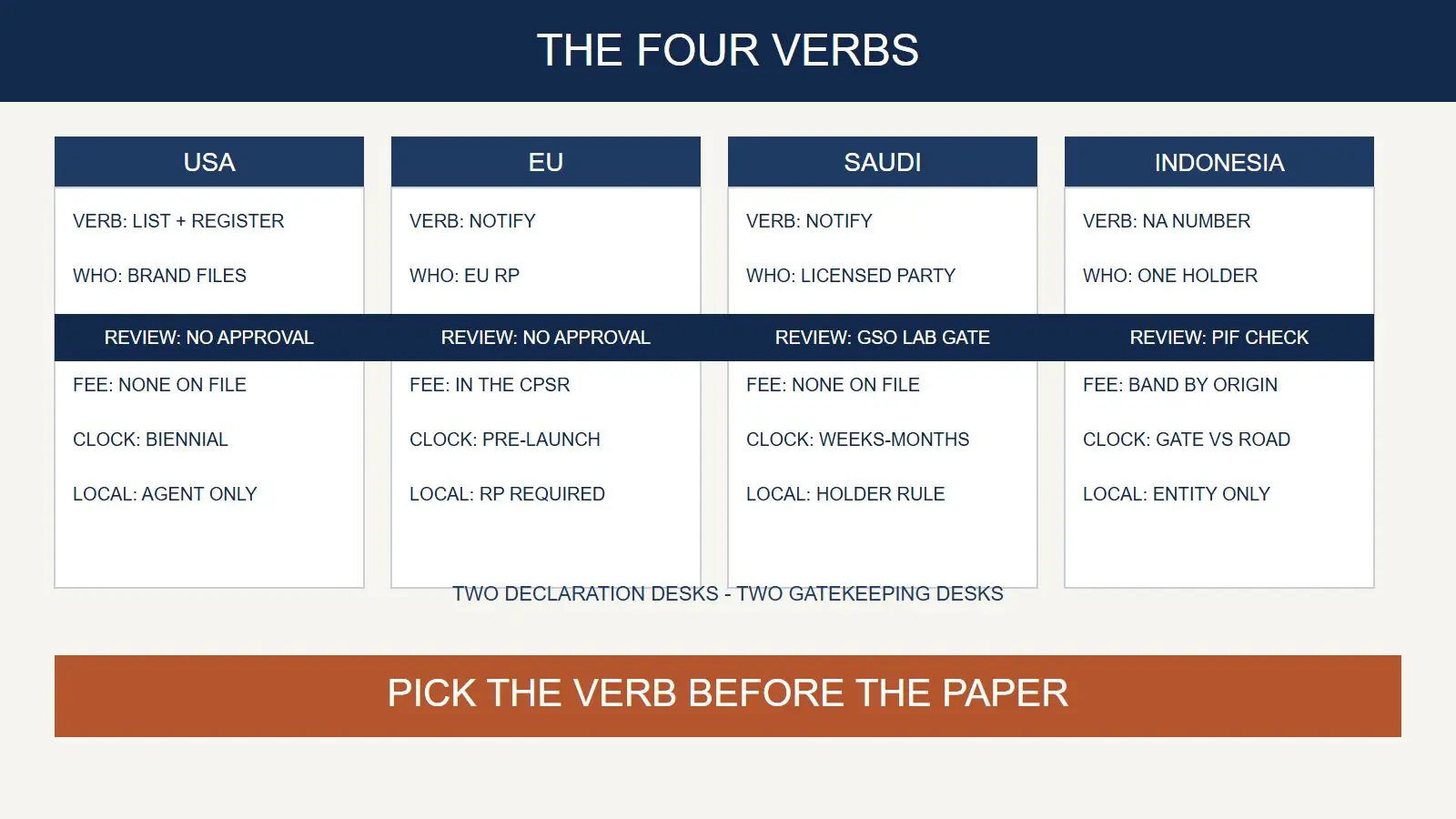
Learn the verb before you budget the paper: two of these desks keep a stamp, the other two only keep your word.
United States: What FDA Cosmetic Registration Requirements Actually Cover
The American desk is the one buyers arrive with the most (inverted) assumptions about, so it gets its precise cell-by-cell treatment here — and the full anatomy stays where it belongs: the MoCRA enforcement guide on this site carries the enforcement-depth argument once; this section maps the filing structure only.
Start with the correction that saves fortunes: there is no FDA "approval" for a cosmetic in the drug sense; the regime is registration + listing + substantiation, and the phrase FDA approved belongs on labels nowhere. What MoCRA actually requires is two records filed through FDA's Cosmetics Direct / CTeW channel: a facility registration for each establishment that manufactures or processes the product (which is also where the "supplier selection" clause bites — your contract factory's facility, not just your brand, must be in the system), and a product listing keyed to those facility numbers. Manufacturers, processors and distributors of record carry the duty; a pure retailer typically does not.
The structural cells a multi-market buyer needs:
Who signs. The submitting entity can be foreign — but a foreign establishment must designate a US agent for communications, an obligation FDA confirmed in its final registration/listing FAQ set (reported 11 December 2024). Compare the table in H2 二: the US agent is a contact channel, not a holder — the only one of the four desks where the government will not route accountability through a licensed local business.
The clock. Registration is not a one-time badge: updates within 60 days of changes were in FDA's early compliance expectations (reported 2024-02), and renewals now run on a biennial cadence unlinked to the calendar year — the earliest registrations cycling back around (Venable client alert, 26 December 2025). Practically, a brand's compliance calendar needs the registration anniversary as a standing entry, because the renewal window is yours alone to remember.
The file behind the filing. Registration and listing are cheap to complete and expensive to be honest about: every listed product needs safety substantiation on file, adverse-event monitoring in place, and labeling that meets the ingredient-declaration rules. The desk does not check your claim before launch — it builds the case file against you after. That is the declaration-regime bargain in its purest form, and it is exactly why the factory-dossier habit (INCI at submission grade, retained samples, per-batch records) doubles as US armor: a MoCRA-clean factory file is your substantiation stack.
Where the OEM conversation touches this desk. If your manufacturing is overseas, two facts decide the US column of your map: the facility register covers establishments, so your factory must be registered as a condition of a clean listing story, and the US agent designation is a service you arrange, not a partner you depend on. Neither one holds your number hostage — the US cell is the only one of four where the brand's own name can sit on every record. For a first-market choice, that is a real advantage; for a claims culture, it is also the desk where sloppy attestation burns longest.
European Union: The CPNP Is the Last Step, Not the First
Brands that shop the EU the way they shop America land the plane before boarding: they ask about "CPNP registration" as if the portal were the requirement. It is not. Under Regulation 1223/2009, the CPNP entry is the final click in a chain whose hard part exists before any portal opens — the Responsible Person, the Cosmetic Product Safety Report, and the Product Information File that the RP is legally the custodian of. The importer-facing version of this chain is walked end-to-end in this site's EU compliance guide; here, only the four cells that matter on the multi-market map:
Cell one — who may sign. The notifier must be a Responsible Person established in the EU (the Regulation's Article 16/19 architecture, as restated across the compliance-guide literature through 2024): the manufacturer established in the Community, or the importer, or a third party with a written mandate. A non-EU brand's first EU act is not paperwork, it is appointing a person — and that appointment, like Indonesia's holder, determines whose name the product's compliance identity lives under. The one genuinely differentiator worth learning early: the RP can be a service — mandateable — which makes the EU signature rentable in a way Jakarta's is not.
Cell two — what must already exist when you notify. The CPNP entry summarizes what the CPSR and PIF already assert: formula (quantitative INCI at submission grade), specifications, GMP evidence, exposure data, the safety assessment signed by a qualified assessor, labeling. The portal asks less of you because the dossier asked everything of you first. That asymmetry is why an OEM partner's regulatory-desk quality shows up on the EU calendar: a factory that delivers CPSR-ready documentation collapses the pre-notification phase; one that delivers a sample cannot start the clock at all.
Cell three — the review answer. No approval. The Commission stores the notification; market surveillance afterwards reads the dossier. Like the US, the EU is a declaration regime — and both share the same enforcement texture: the state does not stop you launching, then does not negotiate once it questions you.
Cell four — the clock, and the desk next door. Notification must be complete before the product is placed on the market — there is no waiting period to schedule around, only the dossier's own lead time. One trap multi-market brands still spring in 2026: the UK is a separate desk. Post-Brexit, Great Britain runs its own SCPN submission with its own UK-based Responsible Person; an EU notification does not clear London. A "Europe launch" that skips the UK column is a two-market launch — fine as a decision, fatal as an assumption.
Set against the table in H2 二, the EU cell reads: notification verb, rentable-but-mandatory local signature, no fee at the portal, maximum spend in the assessment, zero pre-market review — the most dossier-governed of all four desks. Brands that understand the EU requirement as "a safety assessment with a portal attached" sequence it correctly; brands that understand it as "a form" discover the assessment in month five.
Saudi Arabia: The Gulf's Strictest Desk, Filed by a Saudi Signature
This is the column the other three country guides on this site do not cover, and for a brand mapping 2026-2027 expansion it is the one that rewards reading early. Saudi Arabia's cosmetic regime is run by the Saudi Food and Drug Authority (SFDA), and its architecture is closer to Jakarta's than to Washington's: the brand cannot simply appear at the portal. Notification must be filed by a Saudi-based licensed party — an importer or distributor holding a valid commercial registration plus the import-and-distribution permits (step-by-step guides dated 2025-05-16 and 2026-10-02 state the rule in the same words). The electronic filing runs through the GHAD platform, and the substantive screen is the set of Gulf standards the file must satisfy — GSO 1943, GSO 2528 and GSO 2020 (CosmeticsAssessment, 21 August 2026; ChemLinked's Saudi framework entry, 12 May 2026). Where the EU asks for a safety assessment signed by an assessor, the Saudi desk asks for the assessment's practical cousin: laboratory conformance against the GSO texts — microbiology, stability-relevant parameters, restricted-substance levels and labeling in the required bilingual form. That testing is the desk's true center of gravity: it has lead time, it produces pass/fail events on your formula rather than your paperwork, and repeated failures burn the relationship with the local holder's queue, not yours.
The fee column carries an unexpected headline fact for buyers who assume "stricter means more expensive": there is no SFDA registration fee for cosmetics (PharmaKnowl's July-2026 SFDA fee tracker, updated 24 September 2026, states it flatly: the paid licensing lines are for devices and establishments, not cosmetic product notification). Saudi's cost sits exactly where this article keeps saying costs sit — in the holder relationship and the testing program, not in a receipt.
And then the 2026 move that makes the timing section below genuinely time-sensitive. SFDA's updated cosmetic ingredient standards became fully binding on 1 January 2026: importing or manufacturing non-compliant cosmetics is prohibited from that date, and the September 2025 revision added 21 new banned ingredients to the list (industry regulatory tracker, 21 August 2026). Practically: a formula that sailed in 2024 can be a 2026 rejection — the screening question to ask any manufacturer is no longer "is this compliant?" but "compliant against which annex version, dated when?", the same dossier-version habit Indonesia's Reg. 25/2025 now forces and that the Southeast Asia guide walked through. Four-desk buyers should read that alignment as the real story of 2026: the gatekeeping regimes are converging on dated ingredient-list discipline — annex version becomes a contract clause, and the factory's ability to re-screen a formula against a new list becomes a qualification criterion next to GMP.
One Gulf-specific adjacency belongs on the record: the market where the Saudi desk sits is the same market where halal integrity moves product, and the sourcing method — audit scope, certification paths, factory qualification — was built once for exactly that question in the Halal OEM buyer's guide. It is linked, not re-taught; what matters inside the compliance map is only the stack position: halal documentation is a market-access asset in the Gulf, while in Indonesia after 17 October it is a legal prerequisite. Different weights, same folder.
For an OEM buyer the Saudi column converts into three questions per supplier conversation: Does your regulatory desk screen formulas against the post-September-2025 annex and date the screen in writing? Can the dossier be delivered in a shape a Saudi holder can upload to GHAD without invention? Which GSO test reports do you already hold? A manufacturer who answers those three is selling Gulf access with the cream. One who answers with a factory video is selling a sample.
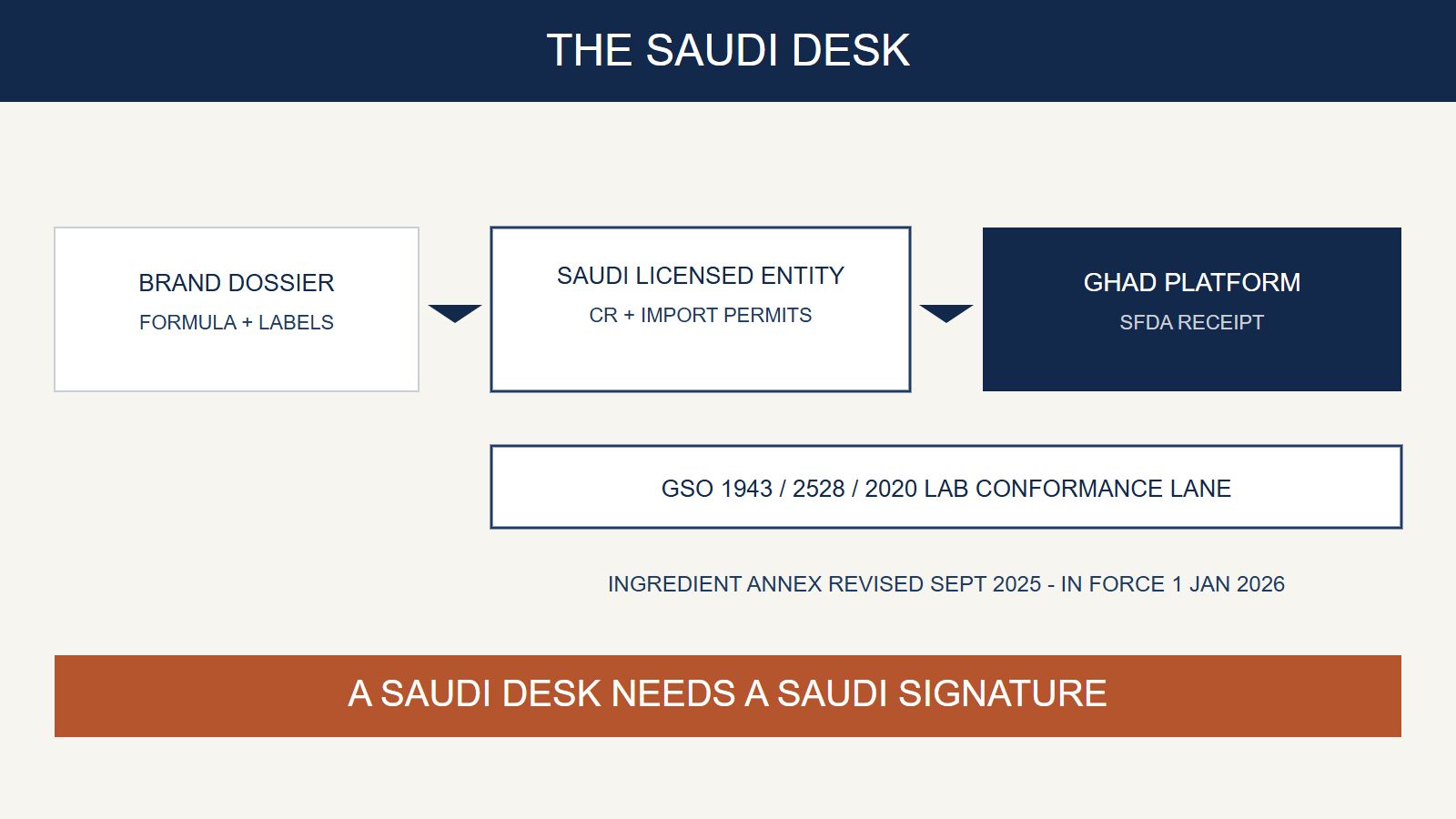
Saudi Arabia's desk is free to enter and expensive to be ready for — the invoice is the lab, and the signature is not yours to give.
Indonesia: One Portal, One Holder, One Clock — the Cell, Not the Chapter
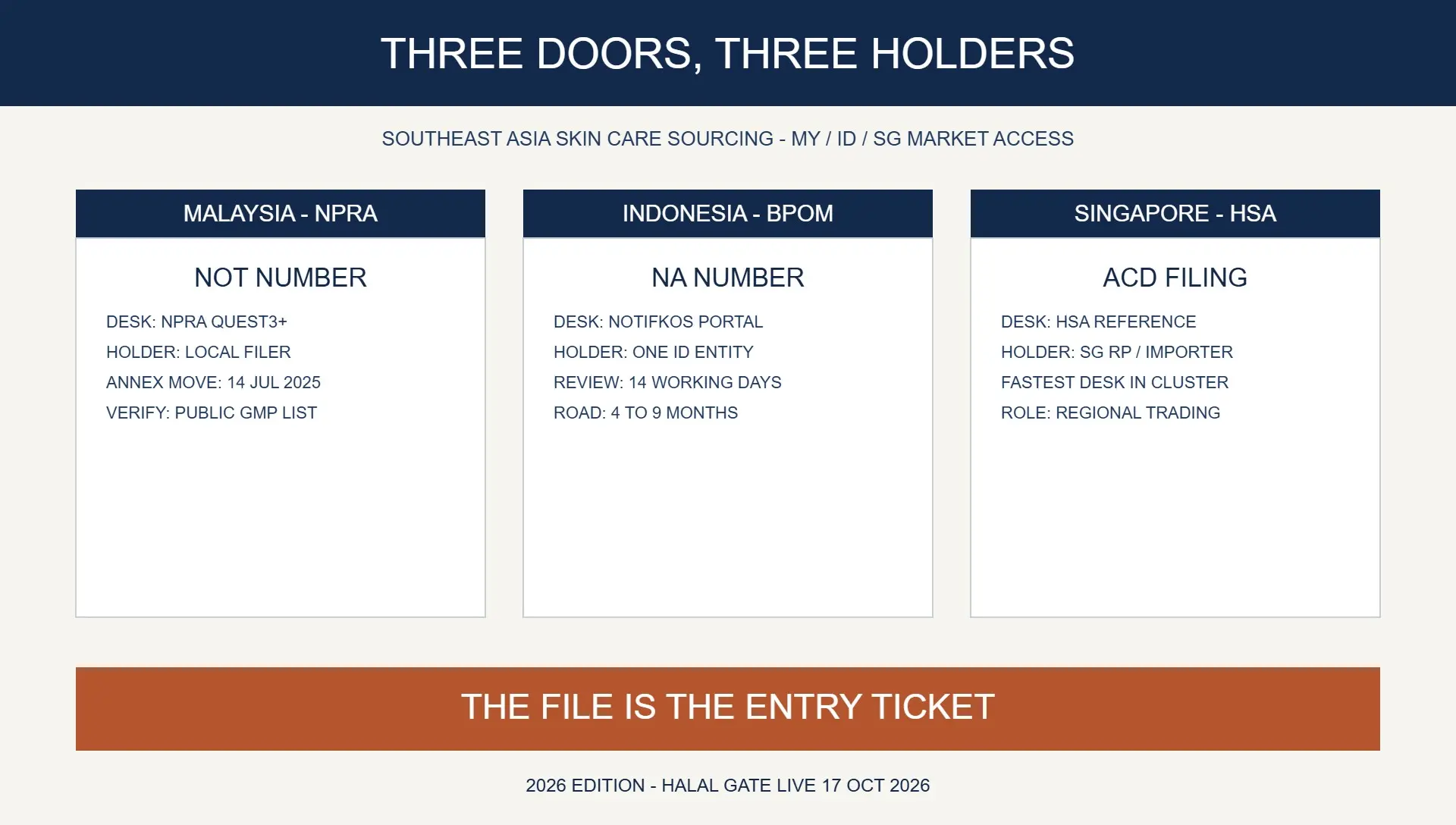
The Indonesian column of the map has already had its chapter: the Southeast Asia filing guide published on this site walked the BPOM desk end to end — the NA number that gates sale, listing, sampling and testers alike; the rule that only a locally registered entity can hold a notification, one holder per product; the distributor-held-number lock-in that turns renewal into a hostage negotiation; Notifkos' ~14 working days as the gate against the 4-to-9-month road of entity setup, PIF assembly and halal audit; the ingredient annex (Reg. No. 25 of 2025) as the year's leading cause of technical rejection; the NKIT kit mathematics; and the 17 October 2026 halal mandate five days from this writing. None of that is re-taught here. What the compliance map adds is a single comparative observation: of the four desks, Indonesia is the one whose local-presence answer is structurally hardest — the EU's responsible person can be mandated, the US agent is a contact, Saudi's holder is a licensed commercial relationship — but Indonesia's holder is the product's legal existence in the market, one-per-number, renewed through whoever signed. Buyers sequencing four markets should therefore treat the Indonesian column as the calendar's anchor and every other column as parallelizable against it — an ordering decision whose machinery (who sets the launch date, who absorbs the slip) is the subject of H2 九, and whose MOQ-side consequences (a market that charges per variant disciplines the SKU plan before marketing discovers it) were walked in the low-MOQ stack guide.
Do You Need a License for Cosmetics? What the Four Regimes Ask Instead
The question is one of the most searched in the industry for a simple reason: "license" is the word people reach for when they sense a gate but cannot see it. The honest four-desk answer is that none of these regimes licenses a cosmetic product — you do not apply for, and are never issued, a permit-to-sell-a-cream. What they require instead is four substitute constructions, and once you see them as substitutes, the map's pattern snaps into focus:
The US substitute: records plus accountability. No license, but registration + listing on file, safety substantiation held, adverse-event duties carried, labeling compliant. The gate is not permission; it is proof you followed a ruleset, assembled before anyone asks and judged afterwards.
The EU substitute: a person, not a paper. No license; an established Responsible Person whose signature converts your product from a formula into a compliant object. The closest the EU comes to licensing is that nothing can be notified without an entity that can be held liable — a who requirement wearing a what question's clothes.
Saudi's substitute: a licensed holder for a fee-free file. The product isn't licensed — but it cannot be filed except through a party that itself is licensed (commercial registration + import and distribution permits, per every Saudi filing guide cited in H2 五). The licensing energy of the system moved one floor up, from the product to the person who may stand at the door.
Indonesia's substitute: the number is the license. A BPOM NA number functions as a de facto market license — revocable, holder-bound, required even for samples — with the holder's own permits doing the licensing job underneath.
Read together, the four substitutes deliver the practical lesson the phrasing of the question hides: stop asking what the product needs and start asking who is allowed to sign. Licenses attach to people and premises; registrations attach to files; and the brand that owns neither a signature nor a file owns neither market. (The one genuinely product-level approval adjacent to skincare lives in a different genre: the US OTC monograph drugs — sunscreens and some acne actives — which are not cosmetics in this map's sense, and where "FDA approved" is sometimes the actual mechanism; mixing the two categories into a label claim is a different article's kind of trouble.)
The Local-Signature Matrix: Who Must Be Local, and What Travels
Two years of reading these desks side by side produces one rule, and this article's Indonesian chapter said it first for two countries: files travel, signatures don't. The compliance map is the same sentence multiplied by four. Below, every "local presence" requirement in this map, decomposed into what it actually is — because "needs a local party" hides three different power relationships:
| Desk | The local party | What they must be | Can the brand keep control? | What transfers if the relationship ends |
|---|---|---|---|---|
| United States | US agent | A designated contact for foreign establishments (FDA FAQ, reported 2024-12-11) | Fully — records stay in the brand's name; the agent holds nothing | Everything, trivially: change the designation |
| European Union | Responsible Person | EU-established legal person, mandateable by contract (1223/2009 Art 16/19 architecture) | High — the mandate is a service contract; the dossier can be drafted to be portable | The RP role transfers; the dossier must travel with it — specify PIF ownership in the mandate |
| Saudi Arabia | Licensed importer/distributor holder | Saudi CR + import-distribution permits; files through GHAD (guides 2025-05-16 / 2026-10-02) | Moderate — the holder is a commercial gatekeeper, not a formality | Notification standing transfers only if the holder cooperates: negotiate file-extraction terms before the first shipment, not after the renewal talk |
| Indonesia | Notification holder | Locally registered entity — own PT PMA or licensed distributor; one holder per product (SEA guide, 2026-08-13) | Low unless self-owned — the number is the distributor's leverage | Nothing moves without the holder's signature; the guide's multi-year lock-in warning exists because brands learned it the hard way |
The matrix's gradient — trivial transferability at the left, structural hostage risk at the right — is the single most decision-relevant line on the page, and it maps one-to-one onto the ownership thinking this site applies to labeling deals: the compliance file is a power line, not a paperwork line (the ownership ledger develops the argument for the formula/label/exclusivity side; the four rows above are its regulatory twin).
Three buyer rules fall out of the matrix. Rule one: in the two right-hand columns, the holder agreement is priced into the product, whether or not an invoice names it — margin conversations with a Saudi or Indonesian distributor that ignore file custody are leaving money on the table in one direction and risk in the other. Rule two: write the exit before the entry. The EU mandate, the Saudi file-extraction clause and the Indonesian service agreement all have the same sentence that nobody writes at signing: what happens to the number, and to the dossier behind it, when we part. Rule three: the left-hand columns are not "easy", they are "different". The US and EU desks free you from holder risk and load the entire weight onto the quality of your own file — which is exactly why, in a four-market project, the factory's regulatory desk is the quiet decider: the desks without gatekeepers are the desks where a submission-grade dossier is the access ticket.
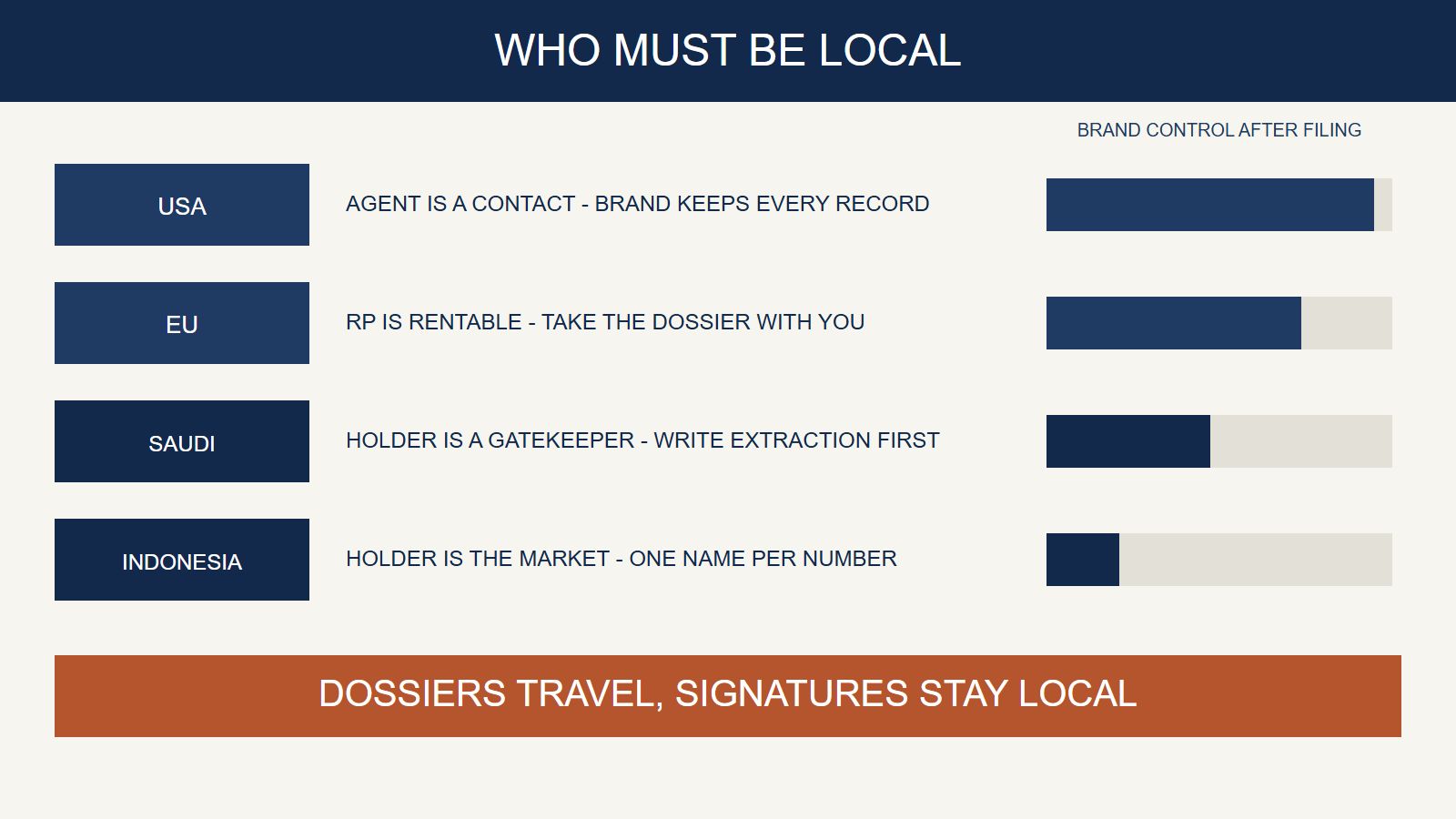
Every regime demands a local signature; only two of them let you keep the pen — so buy the exit clause before the first container.
Sequencing Four Markets: The Filing Order That Survives Contact with a Launch Date
Three regimes' worth of dossiers can share most of their content; four regimes' clocks cannot share a single day. That asymmetry — content converges, calendars don't — is the whole sequencing problem, and it resolves into a dependency graph rather than a checklist:
| Phase | What runs | What it unlocks | Depends on | Typical failure if skipped |
|---|---|---|---|---|
| P0 — master file | Formula freeze at INCI-quantitative grade, safety assessment package, label master, GMP evidence — built once to the strictest desk's standard in the plan | Every downstream filing has raw material | A manufacturing partner with a submission-grade regulatory desk | Each country's file is rebuilt from scratch; annex versions drift apart |
| P1 — the long poles, in parallel | Saudi: pick and contract the licensed holder, open the GSO testing program against the post-2025-09 annex. Indonesia: entity-vs-distributor decision, holder agreement with exit terms, PIF assembly toward BPOM | The two gatekeeping columns whose lead time is the launch date | P0 (you cannot test or assess what you change next week) | Holder conversations start after artwork approval; renewal hostage risk is discovered at month nine |
| P2 — the fast columns, in parallel | US: facility registration + product listing via Cosmetics Direct, agent designation, substantiation on file. EU: RP mandate signed, CPSR finalized, CPNP entry composed from P0 | The two declaration columns, ready any time the campaign is | P0 (and for EU, the assessor's calendar) | "Easy" markets treated as afterthoughts; the EU's rentable signature assumed free of contract design |
| P3 — labels and variants | Per-market artwork: NA/NKIT print rules (Indonesia), bilingual labels (Saudi), ingredient declaration (EU/US), variant count decisions under per-variant filing economics | Sellable stock | P1 + P2 numbers existing | Artwork approved against a formula version the annex moved under; variant sprawl multiplied by desks that charge per shade |
| P4 — standing obligations | US renewal anniversary (biennial, calendar-unlinked), annex-version re-screens when a regime revises (Saudi 1 Jan 2026 was the recent fire drill), holder re-negotiations before renewal windows | Continued market existence | All of the above, remembered | Files that were compliant at launch quietly age out; nobody owns the version watch |
The graph's headline: the two gatekeeping desks set the calendar; the two declaration desks can move at campaign speed. A brand launching US + EU + Saudi + Indonesia in one year is really running a Saudi-and-Indonesia project with a fast, precise American-European trailer attached — which is precisely the sequencing mindset the launch playbook argues as a general rule (start from the slowest named owner, parallelize the rest); this section just names the four owners.
Content reuse deserves one honest qualification. The P0 master file travels well across the declaration desks — an EU-grade CPSR is close to what US substantiation wants, and both eat the same INCI architecture. It travels partially to the gatekeeping desks: BPOM's PIF and SFDA's GHAD pack want the same physics but different formats, translations and annex-version answers. The practical rule: build P0 to the EU's assessment depth, then translate format, never substance, for the Gulf and Indonesia — a formula that passes the strictest written assessment does not need three separate formulas for three markets, it needs three cover sheets. The manufacturing partner whose desk can produce those cover sheets on demand is selling calendar compression; the one that emails a MSDS PDF typed for a customs form is selling nothing.
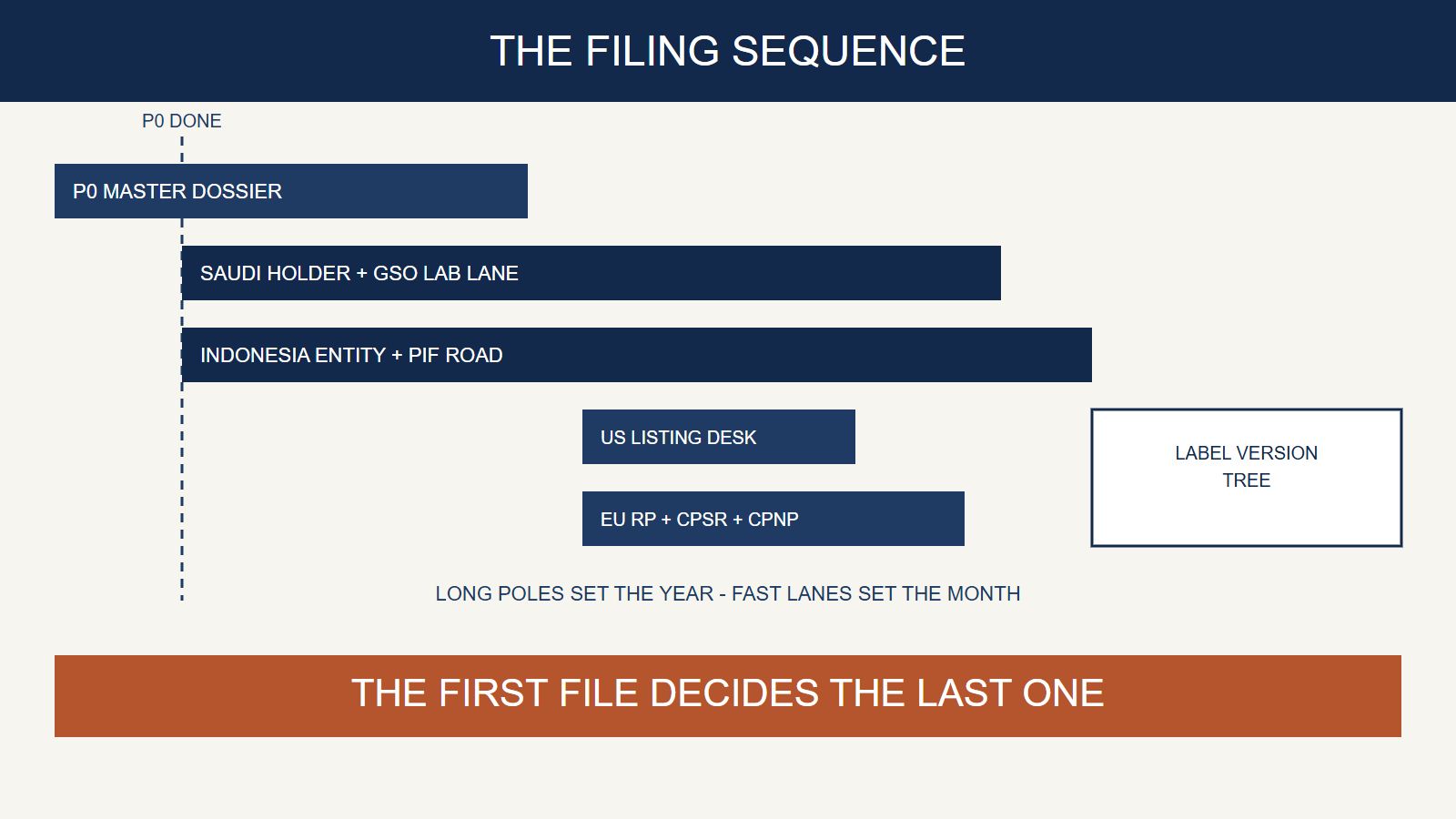
The sequence question has one-line answers per market: Saudi and Indonesia decide the year, the US and EU decide the month, and P0 decides all four.
The Cost-and-Time Shape of a Four-Market Launch
House rule: no absolute prices, no supplier quotes — the numbers belong to the supplier, the structure belongs to the buyer. What a four-market buyer can carry between partners is the shape of the cost-and-time conversation, and across four desks the shape has five lines. Anyone who has used the low-MOQ stack guide will recognize the method; this applies it to regulatory paper instead of packaging, without re-walking the stack.
Line one — the assessment buys three, feeds four. The safety report and PIF architecture built for the EU desk is the nearest thing on the map to a shared utility: it doubles as US substantiation (declaration regimes want the same evidence shape), supplies the physics layer of BPOM's PIF, and pre-screens most of what a GSO lab panel will look for. Budget it once, at EU depth, and it is the cheapest line on the whole map. Budget it four times country-by-country and it becomes the most expensive — which is the same economy argument the ownership pages make about formulas, now in regulatory clothing.
Line two — the signatures rent by contract, not by invoice. No desk sells "the holder" as a priced product; holder and RP costs hide inside distribution margins, service agreements and mandate fees — priced, per H2 八, whether named or not. The buyer's move is to force them onto separate paper: what does the Saudi holder relationship cost, what does file extraction cost, and what does the EU mandate cost at exit? The answers are supplier-specific by design; the question is the deliverable.
Line three — the testing lane is the Gulf's toll booth. GSO conformance testing has lead time and pass/fail events with your formula as the sample. Its cost shape is fixed (a panel per formula family per update) but its calendar cost is variable — and the variable is dominated by how early the formula is frozen against the current annex. Teams that start testing after artwork budget discover the test is the artwork's dependency, not its sibling.
Line four — the clock columns are asymmetric by design. From P0-complete: US listing is a form filled in hours, the EU notification a portal step after the assessor signs, Saudi screening weeks-to-months behind a holder and a lab, Indonesia a 14-day gate standing at the end of a 4–9-month road. A plan that averages these into "three months to compliance everywhere" has described none of them.
Line five — renewals are the quiet annuity. Biennial US anniversaries untied to calendars, EU dossiers that must survive assessor turnover, Saudi and Indonesia holder agreements with renewal windows, and ingredient annexes that move (21 new bans in September 2025; a January-2026 enforcement wall) without notifying your inbox. Compliance cost is not an event with a quote; it is a standing subscription whose price is set by whoever holds your versions.
Put on one table, the five lines are one structural picture — no money column, every ownership column:
| Cost-and-time line | US | EU | Saudi | Indonesia | The written ask |
|---|---|---|---|---|---|
| Assessment builds | substantiation stack | CPSR + PIF (the engine) | fed by EU-grade physics + GSO panel | PIF, same physics, BPOM format | "Quote the master dossier as its own line item." |
| Signatures | agent designation (free-standing) | RP mandate (rentable) | licensed holder (embedded in trade) | one local holder (structural) | "Name every signature, its owner, and its exit clause." |
| Lab/testing | none pre-market | assessor workflow | GSO conformance = the gate | annex pre-check avoids rejection | "Show the test list against the current dated annex." |
| Clocks | hours-to-file | after-assessor | weeks-months | gate vs road | "Calendar each desk separately; never average." |
| Renewals | biennial anniversary | assessor continuity | holder re-negotiation | holder renewal + halal standing | "Who owns the version watch — in writing?" |
Count five lines, four desks and one rule: everything the governments give for free, somebody in the chain will have charged for — make sure it is your line item, not their margin.
Six Failure Modes of a Multi-Market Launch
Single-market guides collect single-market mistakes; the four-desk map has its own error species, all born from assuming a pattern that holds in one regime holds in another. Six of them, each insured by a line that can be written before money moves:
① The verb swap. A team trained in MoCRA treats CPNP as "the EU listing" and books the portal as the project milestone — then discovers the RP mandate and assessor queue are the real critical path. Mirror-image failure: an EU-trained team books Saudi's free registration as "just a notification," ignoring that the desk's substance is the holder relationship plus the GSO lab. Insurance: the H2 二 table as the first slide of every launch meeting.
② The rentable-signature assumption. The EU RP is mandateable, so buyers generalize "signatures are rentable" to Gulf and Indonesia — where the local party is not a service line but a commercial gatekeeper with renewal power (H2 八, right-hand rows). Contracts copied from the EU's mandate template leave file-extraction silence exactly where silence costs the most. Insurance: per-desk exit clauses, drafted desk by desk, not one template four times.
③ The annex-version drift. Four regimes update ingredient lists on four schedules (Saudi's September-2025 addenda enforced from January-2026; Indonesia's Reg. 25/2025 into 2026 dossiers; the EU's technical adjustments; US monograph-adjacent rules). A formula frozen for desk A in 2024 can fail desk B in 2026. Insurance: the re-screen trigger — a dated annex check at every P0 refresh, named in the quality agreement.
④ The "Europe means EU" plan. UK SCPN with UK RP sits outside CPNP, and the September-2026 vintage of retail conversations proves brands still discover this at artwork stage. Insurance: "Europe" is banned as a market unit in the launch spec; desk names only.
⑤ The averaged clock. "Three months for compliance" budgets the mean of four distributions and guarantees variance: US hours, EU assessor-dependent, Saudi lab-dependent, Indonesia road-dependent. Launch dates set on averaged calendars slip at the gatekeeping desks first — and slip there costs containers, not emails. Insurance: the P1/P2 split as the project spine; declaration desks tracked as fast lanes.
⑥ The orphaned renewal. Biennial US anniversaries untied to years; dossiers whose assessor left; holder agreements whose renewal window is the only window. Multi-market compliance is mostly standing obligations with no fire alarm — nobody emails when your anniversary arrives. Insurance: one calendar file listing every dated duty across four desks with named owners, refreshed quarterly. This is the compliance-folder habit the launch playbook preaches as exit documents; four desks just quadruple its pages.
| Failure mode | The insured sentence | Where it gets written |
|---|---|---|
| Verb swap | "Name the desk's verb before naming its deadline." | Launch kickoff doc, per market |
| Rentable-signature | "Holder and mandate contracts differ structurally." | Legal review matrix |
| Annex drift | "Dated annex screen at every formula freeze." | Supplier quality agreement |
| Europe-means-EU | "Desk names, not continent names." | Launch spec, artwork brief |
| Averaged clock | "Two long poles, two fast lanes; never one number." | Project plan, Gantt spine |
| Orphaned renewal | "One calendar, four desks, named owner per duty." | Standing-obligations folder |
Multi-market failures are rarely compliance failures — they are pattern transfers from a desk where the pattern worked.
FAQ: The Questions the Four Desks Keep Fielding
Q1: FDA cosmetics regulations changed a lot since 2022 — what is the current state in one paragraph? MoCRA turned American cosmetics from an honor system into a records system: facilities that manufacture or process register, products are listed against those facility numbers (Cosmetics Direct/CTeW), foreign establishments designate a US agent, safety substantiation must exist before launch rather than on request, adverse events are reported, and the whole thing now runs on a renewal rhythm — biennial and unlinked to the calendar year per the late-2025 law-firm guidance. The enforcement posture matured with it; the deep anatomy lives in this site's MoCRA guide rather than in a FAQ answer.
Q2: What must a non-US brand actually do to enter the American desk? Register the facility (your contract factory's site counts as a facility under the establishment definition), list each product, name a US agent if the submitter is foreign, and hold the substantiation dossier before the first sale — four actions, all cheap to file and only expensive to fake.
Q3: Can the same CPNP notification cover the United Kingdom? No. The UK operates a separate SCPN gate with its own UK-established Responsible Person; CPNP covers the EU/EEA perimeter. A launch that needs London gets a second signature, a second portal and (usually) a second label panel — treat it as a fifth desk on your calendar, not a footnote.
Q4: What exactly do FDA cosmetic registration requirements mean for a foreign manufacturer with no US office? The foreign manufacturer registers its establishment(s) and gets a US agent designated before submitting. Nothing in the American desk forces incorporation, a warehouse or a subsidiary — which is what makes the US the left column of H2 八's transferability gradient.
Q5: Is Saudi Arabia's desk really free if there is no registration fee? The filing is; the readiness is not. The cost shape is the licensed holder relationship plus the GSO conformance testing program (plus translations, plus re-screening at annex updates like the September-2025 revision). "No fee" is an accurate portal fact and a misleading budget fact — the same sentence that applies to Washington and Brussels with different nouns.
Q6: Which market should set the launch date in a four-desk plan? Whichever one you hold least power in. For most foreign brands that is Indonesia (holder + road + halal standing) or Saudi (holder + lab lane); the declaration desks then track to that anchor instead of pretending to one shared "compliance quarter."
Q7: Can one formula safely serve all four markets? Usually yes — with discipline. Physics (actives, concentrations, restrictions) can converge on one master if the formula is frozen against the intersection of the four current annex versions; format (labels, declarations, translated panels, dossier cover sheets) diverges by desk. The intersection method is the only version where "global SKU" is not marketing language, and it is a documentation service, which is exactly what a submission-grade factory's regulatory desk is being paid for.
Q8: Where do the model-choice questions (private label vs OEM vs ODM) fit on this map? Before it, not inside it. The filing-holder logic differs between buying a formula you do not own and owning one you filed — the ownership analysis lives in the three-model guide and the private-label ownership ledger; this map assumes the model is chosen and asks only who signs, where, and when.
What to do next
Before the four desks become four fires: request a quote built the way a multi-market launch actually reads — one master dossier, four filing formats — and get the MOQ table that shows which line binds when Saudi's testing lane, Indonesia's holder road, and the EU's assessor calendar all point at one launch date. A dedicated product manager on every RFQ — reply within 24 hours, sample packs in 7 days, MOQ from 1,000 pcs, with the submission-grade documentation line (dated-annex INCI screening, CPSR-ready safety package, GHAD-format and BPOM-format cover sheets) quoted as its own written item, not promised in prose.
→ Get your quote and MOQ table
Sources and Further Reading
Regulatory snapshots cited as of publication — confirm current procedures, annex versions and fees with each authority (FDA Cosmetics Direct/CTeW, EU CPNP under 1223/2009, SFDA/GHAD, BPOM Notifkos, HSA for UK SCPN) before filing decisions; several sources below are secondary industry or legal trackers and are flagged as such:
- Saudi ingredient standards fully binding from 1 January 2026; 21 banned ingredients added September 2025 (incl. dibutyltin maleate, 4-nitrosomorpholine); GCC filing comparison — CosmeticsAssessment regulatory guide, 21 August 2026 (secondary industry source) - Saudi cosmetics framework: GSO 1943 / GSO 2528 / GSO 2020 conformance architecture — ChemLinked Cosmepedia country entry, 12 May 2026 (secondary regulatory-information source) - SFDA fee schedule tracker — "no fees for cosmetics registration with the SFDA"; paid lines cover establishment/device licensing — PharmaKnowl SFDA fees page, updated 24 September 2026 (secondary consultant source) - Saudi notification must be filed by SFDA-licensed local companies holding import/distribution permits — MSCT regulatory guide, 16 May 2025; and Saudi cosmetics registration step-guide, 2 October 2026 (secondary; portal of record: SFDA GHAD) - GHAD electronic platform for Saudi cosmetic notification — InstaCertify service brief, 17 November 2025 (secondary) - US MoCRA facility registration: biennial renewal unlinked to the calendar year; earliest registrations cycling — Venable client alert, 26 December 2025 (law-firm secondary citation of FDA rule) - Foreign establishments must designate a US agent — FDA final registration/listing FAQ — Law-firm report via Lexology, 11 December 2024; 60-day update window after changes — FDA compliance-policy report, 20 February 2024 (secondary) - EU Responsible Person architecture, Reg. (EC) 1223/2009 Art. 16/19; CPNP notification before placing on market; UK SCPN separate gate — EU compliance guides: Reguloo (11 August 2023), JJR Lab (25 October 2024), EKOTOX CPNP explainer (undated; restates the Regulation's notification duty) (secondary; the Regulation text is the source of law) - Indonesia (BPOM), Malaysia (NPRA) and Singapore (HSA) desks — as documented in this site's Southeast Asia filing guide (primary citations there carry report dates: Live and Work Indonesia 2026-08-13; NPRA pages 2025-07-14 / 2026-09-28) - Further reading on this site: MoCRA enforcement guide, EU importer's compliance guide, launch playbook, ownership ledger, three-model guide, low-MOQ stack guide, esthetician channel playbook, 12-point factory audit, Halal OEM buyer's guide and the cost-structure page — each linked in place above; this piece does not restate them.