


Polypeptides: Why Flat Demand Still Needs a Specification Page
What the Polypeptides Row Actually Says
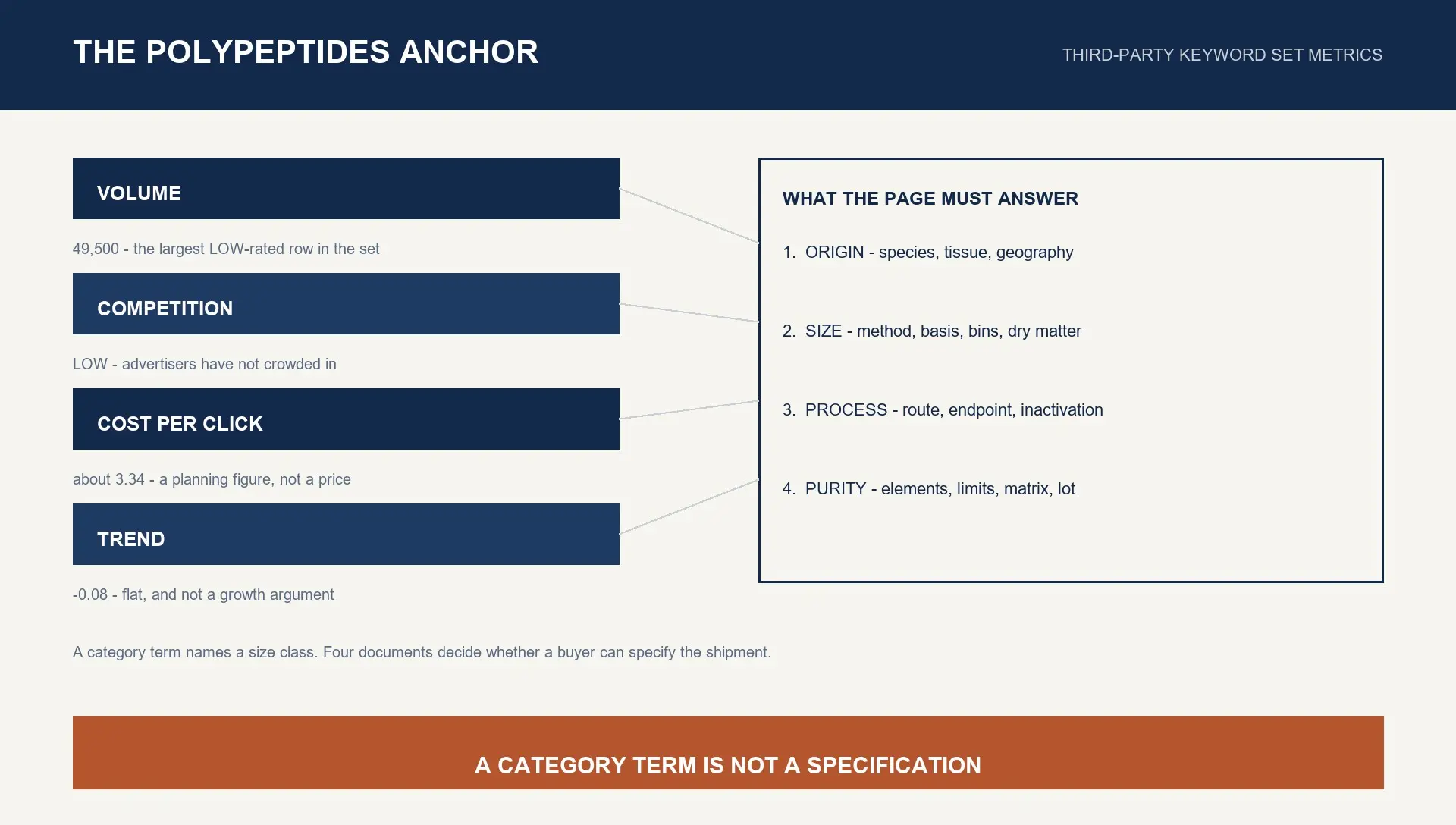
There is a row in the client keyword set that behaves unlike the rows around it. The polypeptides row carries a volume of 49,500 with a LOW competition rating, a cost-per-click of about 3.34 and a trend of −0.08 - the last figure meaning, in plain language, that nobody is in a hurry either to discover it or to abandon it. It is the largest-volume row in the whole 243-keyword file that still carries a LOW rating. Read carelessly, that combination invites the wrong conclusion: a big number with a flat line and no competition looks like an accident waiting to be corrected. It is not an accident, and it is not an opportunity in the way a rising curve is an opportunity. It is something rarer and more useful - a category term that has already finished growing and still has to be answered.
Three cautions before anything is built on that row. First, provenance: these are third-party keyword-set metrics supplied with the client's 243-term keyword file, not Google Search volume, not a Google Ads export, and not a statement about how many humans typed the word this month. Anyone quoting 49,500 as a Google figure is quoting something nobody measured. Second, direction: a trend of −0.08 cannot be used as evidence of growth, in this piece or in a board paper. The honest reading is that the term is mature, and maturity is a different commercial argument - the one made in the next section. Third, breadth: the word is generic. It is used for feed proteins, for enzyme preparations, for injectable drug substances and for nutritional hydrolysates. A skincare business does not own a word like that; it can only build a page that answers the questions the word points at.
So what does the row actually say? It says that a stream of people arrives at the category by its size-class name rather than by a molecule name, and that the advertising market has not crowded in to intercept them. Both halves matter. The first is a demand fact: buyers searching a category term are usually already inside the category, comparing rather than discovering. The second is a supply fact: paid competition follows perceived transactional value, and a term that spans five industries is expensive to bid on and hard to convert, which is exactly why the rating stayed LOW. That gap is not a loophole. It is a description of a term that cannot be answered by a page that only repeats it.
The distinction that decides everything downstream is between a name and a specification. A name tells you what class of material is in the drum. A specification tells you what is actually in your formula: which feedstock, cleaved by which route, to which distribution, tested to which limits, declared on your label as which entry. The gap between those two is where formulation failures, rejected shipments and unprintable claims live. Everything below this section is about that gap, and about what a page has to publish so that a buyer can move from the word to a purchase order.
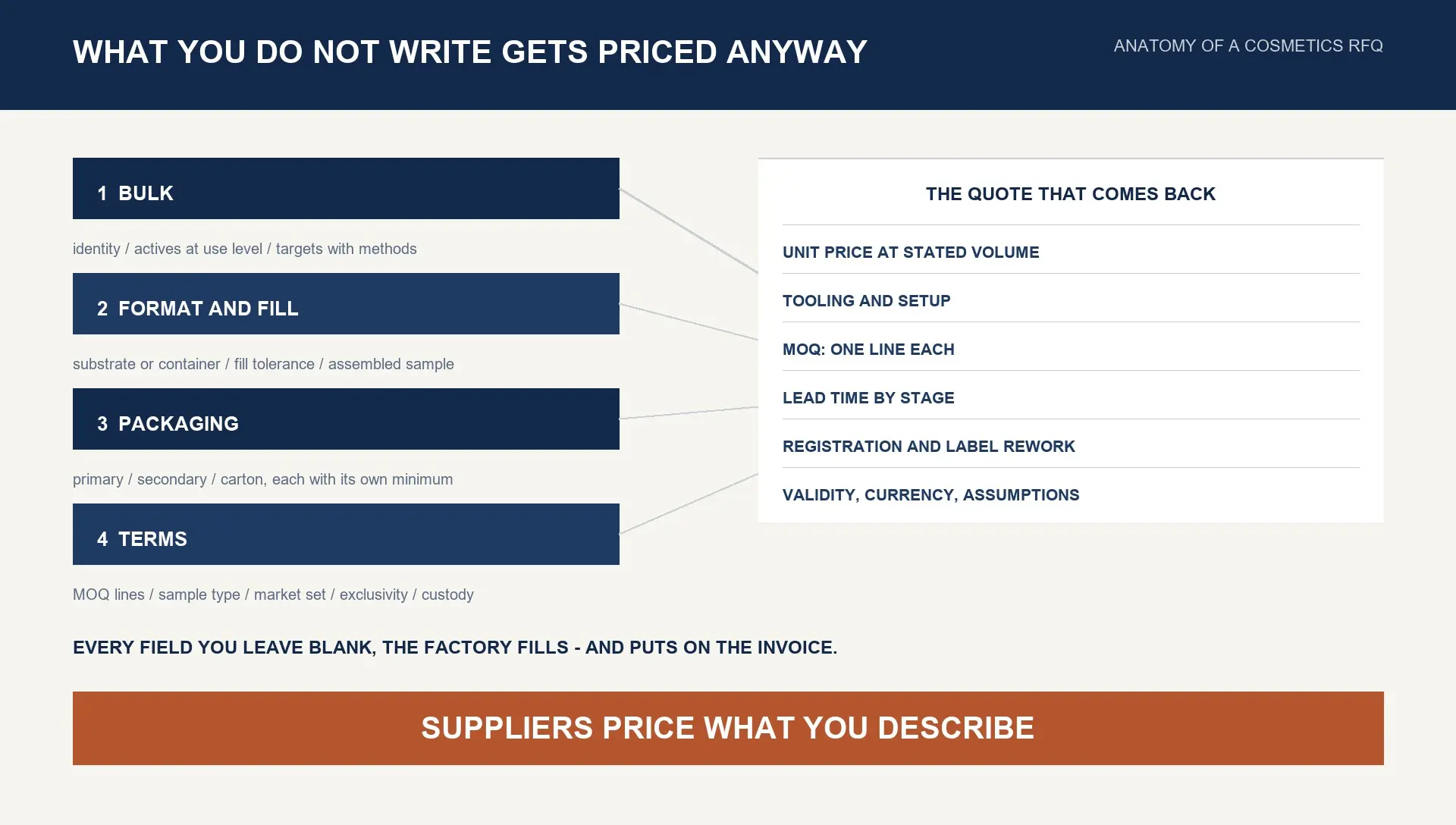
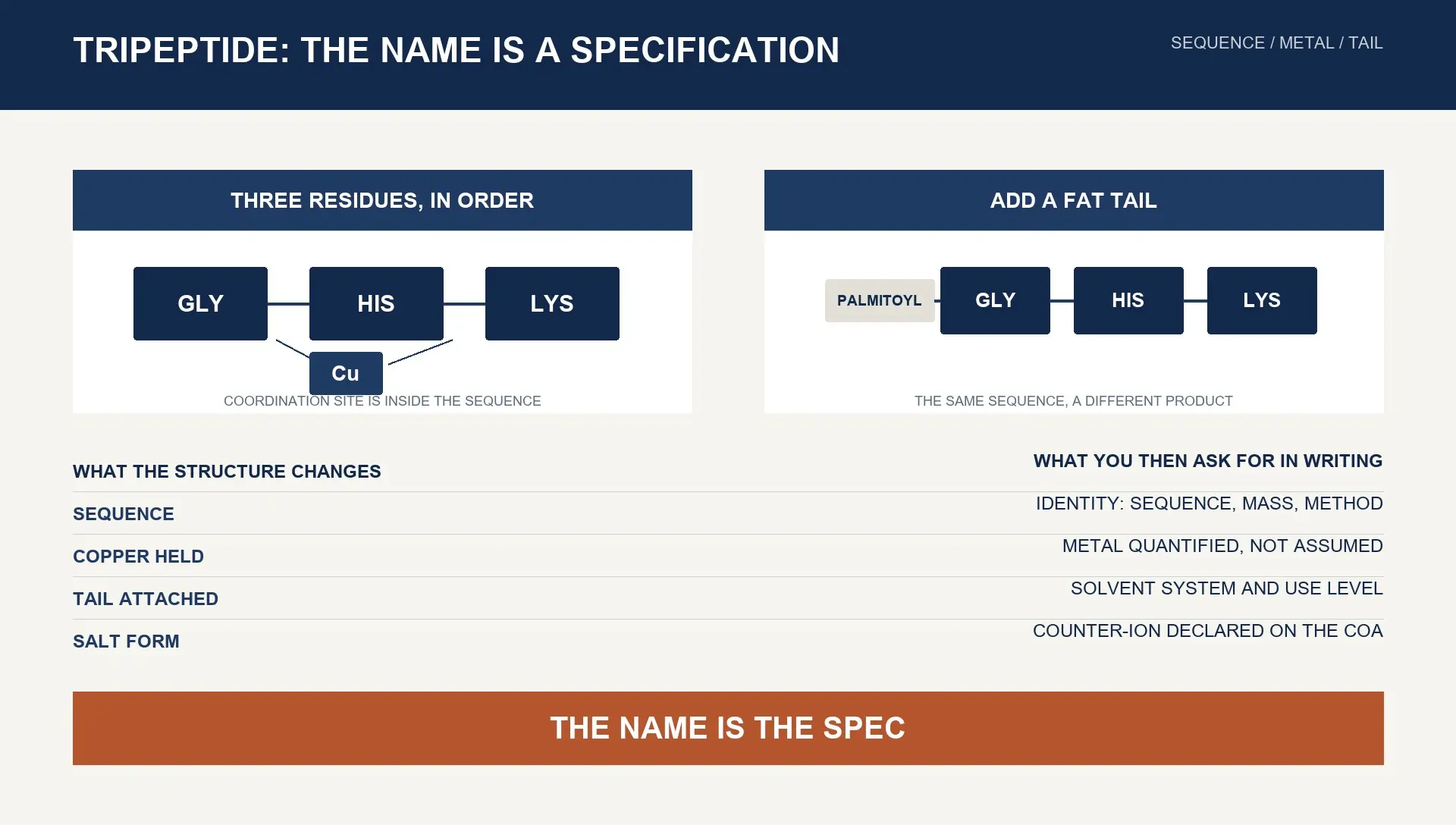
Scope note, so nothing here is duplicated. If you need to know why a named peptide's architecture is worth money - residue count, the lipid tail, the copper complex, the two percentages that have to be asked separately - that is answered in the tripeptide specification guide, and this piece deliberately does not re-open it. If you need to know how to write the enquiry document that gets a comparable quote, that is the RFQ field anatomy guide. If you are deciding which active to put in which SKU slot, that is the three-ingredient selection guide. What this piece answers is the question none of them answer: when the traffic arrives on a category word rather than a molecule word, which fields has the page already got to carry before the conversation can become technical.
A category term is a door, not an answer - and the page behind it either carries the four specification fields or it carries only vocabulary.
Flat Is Maturity, Not Death
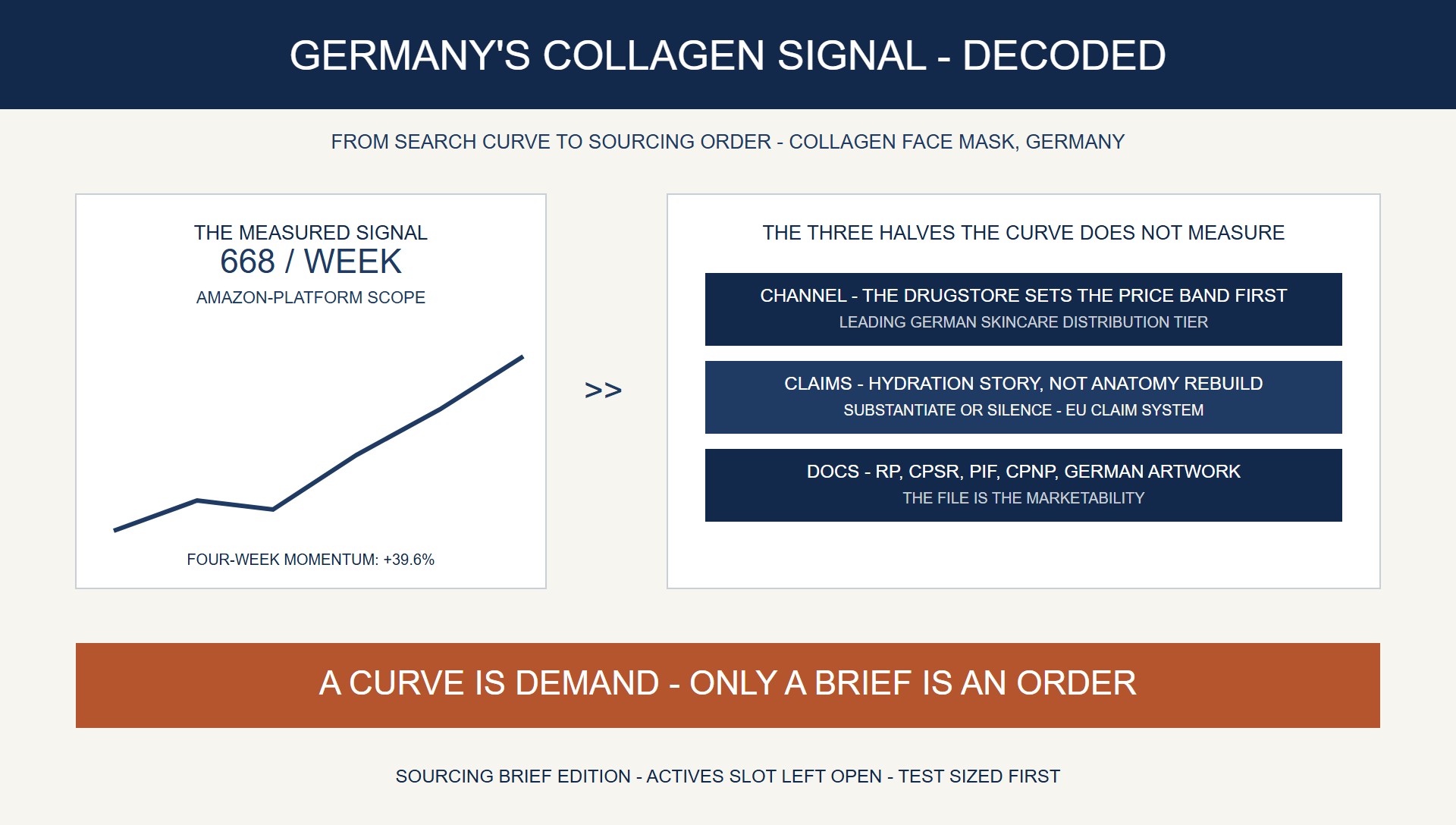
A cynical reading of a flat line is that the category is going nowhere. That reading has a testable prediction, and the prediction fails. Categories that are genuinely dying do not hold a LOW competition rating at forty-nine thousand; they get abandoned by advertisers before the volume finishes falling. And categories that are merely fashionable do not stay flat - they spike, collect every available supplier's marketing budget, and collapse inside a trend cycle. The site's own record contains a worked example of that second shape: a concept whose shelf presence accelerated while its search interest weakened, which is a divergence, not a growth signal, and was treated as such in the German collagen signal analysis. The same discipline applies here, in the opposite direction: a flat line is not a decline either. It is the shape a category makes once the discovery phase is over.
What actually changes when a category matures is the composition of the person typing the word. In the discovery phase, the traffic is people asking what the thing is. In the mature phase, the traffic is people who already know what it is and are asking a narrower question with their fingers: which supplier, which origin, which grade, which price band, which documentation. That is why mature category terms are disproportionately transactional per unit of attention, and why they are also disproportionately badly served: the content built for the discovery phase - explainers, listicles, before-and-after copy - answers a question the current visitor stopped asking two years ago.
There is a budget consequence, and it is the reason this section exists rather than being a paragraph. Content built on a rising curve is rented. It ranks while the curve is up and while everyone else's version of it is still thin, and then the category's vocabulary changes and the asset has to be rebuilt. Content built on a flat curve is owned. Nobody is going to out-publish you on a term that has stopped being interesting, and the buyers arriving there are not going to stop arriving, because they are not arriving out of curiosity - they are arriving out of a purchasing routine. A page that answers the four specification questions behind a mature category term is an asset with a long amortisation window; a page that rides a rising term is a campaign.
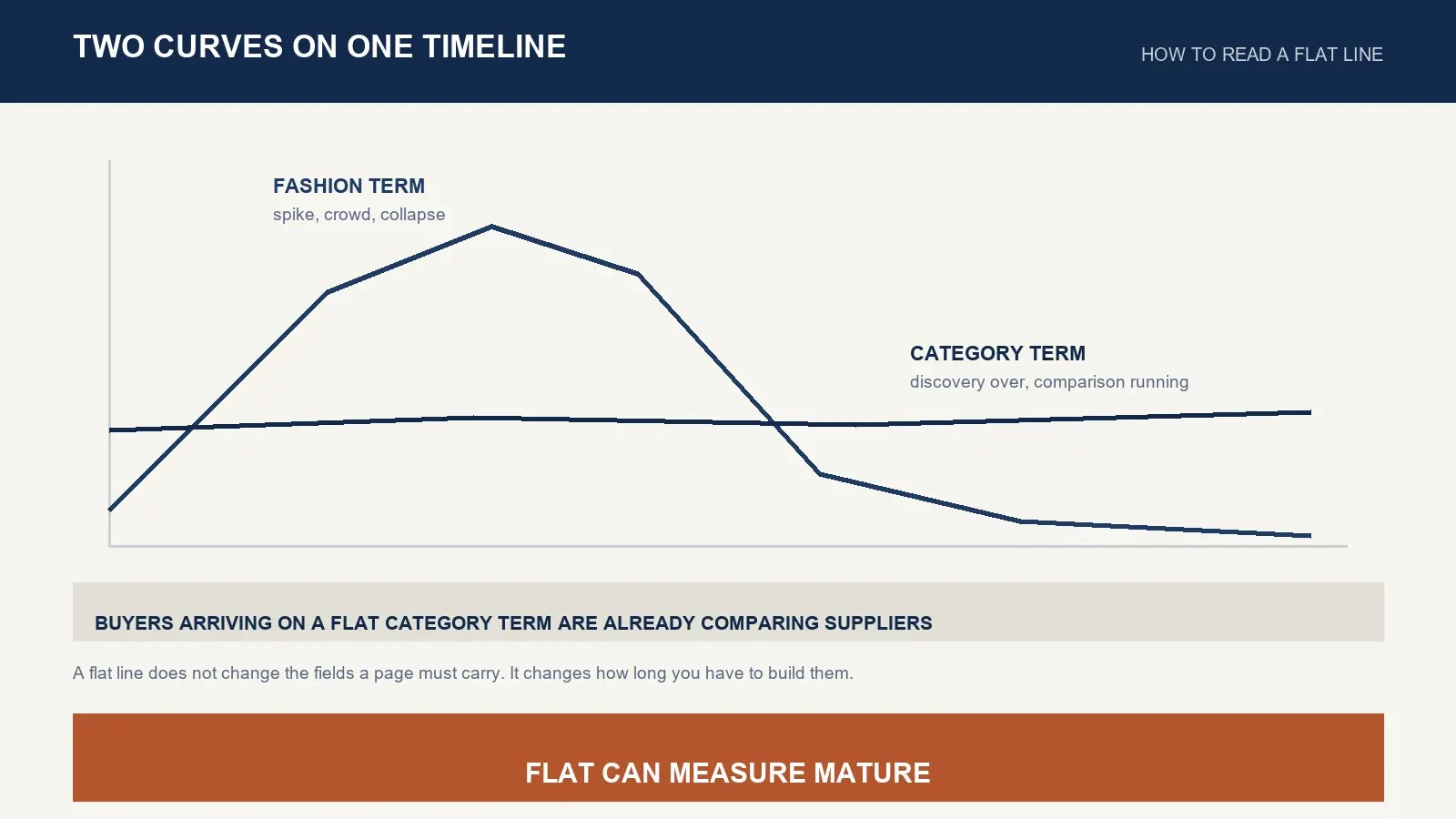
The counter-test is worth running explicitly, because it exposes what the metric is actually for. Suppose the trend column read +2.0 instead of −0.08. Would the page you need change? The fields would be identical - origin, distribution, hydrolysis route, impurity limits. The only thing that changes is how crowded the advertising gets and how long you have before competitors publish the same answers. A flat curve does not reduce the value of the page; it increases the time you have to build it properly. That is the whole argument, and it is also the reason this piece refuses to present 49,500 as a growth story: the number's commercial value is durable precisely because the curve is not rising.
One honest limit on all of this. The metric set is one third-party estimate of one keyword file, taken at one point in time, for a term that spans industries. It supports a decision to build the page; it does not support a forecast of what the page will earn. Anyone who needs the second thing needs a different instrument - your own enquiry log, your own sample-request conversion rate, and the count of RFQs that arrive naming a class rather than a molecule. Those are numbers a skincare business already has and usually never reads.
The Family Behind the Anchor: Where the Uncontested Volume Sits
An anchor term is never alone, and reading it alone is how teams make expensive mistakes. The same keyword file that carries the anchor row carries an entire family of size-class and structure-class names, and the family is where the actual architecture decision lives. Below is every row in the extract that belongs to the chain-length class, plus the head term and the copper-peptide cluster for contrast. All figures are third-party keyword-set metrics from the client 243-term file; they are not Google volumes, and the trend column is a direction indicator, not a forecast.
| Term in the keyword set | Volume | Competition | CPC | Trend | How the row behaves |
|---|---|---|---|---|---|
| polypeptides (anchor) | 49,500 | LOW | 3.34 | −0.08 | Largest LOW row in the file; flat; generic across industries |
| dipeptide | 18,100 | LOW | 1.74 | −13.76 | Large volume, sharply negative direction - do not read as rising |
| tripeptide | 14,800 | LOW | 7.44 | 1.11 | The expensive-click structure row; handled in the P2 architecture piece |
| oligopeptide | 8,100 | LOW | 2.36 | −0.95 | Sits between the anchor and the named-molecule rows |
| tetrapeptide | 2,900 | LOW | 4.47 | 1.02 | Small, uncontested, specification-shaped |
| pentapeptide | 1,900 | LOW | 3.02 | −1.82 | Same profile as above |
| decapeptide | 1,900 | LOW | 4.86 | 1.00 | Same profile as above |
| nonapeptide | 1,900 | LOW | 1.27 | −0.40 | Same profile as above |
| octapeptide | 590 | LOW | 0.00 | −0.16 | Thin; no advertiser bid recorded |
| small peptides | 260 | LOW | 0.00 | −0.20 | Thin; consumer phrasing of a technical idea |
| poly peptides | 140 | LOW | 0.00 | 10.41 | Spacing variant of the anchor, not a separate demand |
| peptide (head term) | 368,000 | HIGH | 2.18 | 8.92 | The whole category's front door, and the most contested row here |
| ghk cu peptide / copper peptide ghk cu / ghk copper peptides | 33,100 each | HIGH | 1.40 | 15.99 | One demand, three spellings |
Two arithmetic facts fall out of that table, and both are decision-relevant.
First: the uncontested family is a portfolio, not a page. The eleven chain-length rows sum to 100,090 - which is 27.2% of the head term's 368,000, and, more usefully, spread across eleven rows that all carry a LOW rating. The anchor alone accounts for 49.5% of that family total. Seven of the eleven rows have a negative trend column. So the picture is not "one big word nobody is bidding on"; it is a mature family of size-class names, half of its volume in one generic word, the rest in narrow specification-shaped words that no consumer ever types. A single page cannot own a family like that, and a team that publishes one page and stops has answered the door and left the rooms empty.
Second: the file double-counts, and you have to clean it before you add it up. The copper-peptide cluster is reported three times at 33,100 each with identical trend and CPC values - the same underlying demand under three spellings, contributing 99,300 to any naive total. The anchor's own two-word spacing variant, recorded at 140, is the same phenomenon in miniature. Any volume aggregation you do on a keyword file without deduplication is an artefact of the file's structure, not of the market's. This is worth stating in a piece about a category term, because the temptation with a family table is exactly to sum it and present the sum as demand.
What the family tells a manufacturer is structural rather than commercial. The narrow rows - tetrapeptide, decapeptide, nonapeptide, octapeptide - are words a person types when they already have a specification in front of them. The broad rows - the anchor, small peptides, the head term - are words a person types when the specification has not been written yet. Your page's job is to convert the second group into the first, by giving them the fields that a specification is made of. That is also why the anchor must be used as a category anchor and never as a product claim: the term is a size class, and the regulator's own vocabulary for the class is more candid than most marketing. The FDA's definition of peptones - the food-side analogue of this whole family - describes them as "the variable mixture of polypeptides, oligopeptides, and amino acids" produced by partial hydrolysis of casein, animal tissue, soy protein isolate, gelatin, egg albumin or whey protein. A variable mixture. That is the class, stated by an authority, in the authority's own words.
And note what that definition does not do. It does not tell you the distribution, the route, the limits or the origin - the four things the rest of this piece is about. It also sits on a boundary that cosmetics labelling never resolves: the same regulator defines a protein as an alpha-amino-acid polymer with a specific, defined sequence, greater than forty residues, and a peptide as a polymer of forty or fewer. A material reported at 500 to 30,000 daltons straddles that line - at an average residue mass of 135 daltons, 30,000 daltons is roughly 222 residues - and it has no defined sequence at all, because it is a mixture. The category word names a size class; the label regime names an entry; neither of them names your shipment. Those are three different acts of description, and a buyer who conflates them is the buyer who later discovers that the drum does not match the formula.
One Weight Number on a Spec Sheet Is Three Different Claims
Ask for the molecular-weight distribution of a protein hydrolysate and you will get a number. What that number asserts depends entirely on how it was produced, and the technical record contains all three kinds side by side. The Cosmetic Ingredient Review's scientific literature review on hydrolyzed source proteins - the expert-panel document that gathered supplier-reported data on this class - is the clearest place to watch the three forms collide, because its own tables mix them.
At the class level, the review states that methods used to manufacture protein hydrolysates typically yield broad molecular weight distributions of 500 to 30,000 daltons, and that certain enzymes - it names papain - can routinely yield narrower distributions of 500 to 10,000 daltons. It then does something almost no ingredient page does: it converts those figures into residue counts, using an average amino-acid residue mass of 135 daltons, giving roughly 4 to 220 residues under the broad distribution and 4 to 74 under the narrow one. That single conversion is the most useful line in the whole document for a buyer, because it says what the class actually is: not a molecule with a length, but a population with a range - and a range whose upper end, on the broad side, is two hundred residues long.
Then the ingredient-level table reports something different again.
| Ingredient as reported to CIR | Figure given | What kind of assertion that is |
|---|---|---|
| Hydrolyzed amaranth protein | ~1500 Da | Nominal average - a single point, no spread |
| Hydrolyzed elastin | ~1000-4000 Da | A stated range - still no shape inside it |
| Hydrolyzed hazelnut protein | 510-1000 Da, mode value | The band containing the tallest bar - not the average, not the whole sample |
| Hydrolyzed soy protein | ~1000 Da; 490-1030 Da mode value | Both a nominal average and a modal band, for the same ingredient |
| Hydrolyzed keratin / milk / corn-soy / silk protein | ~1000 Da each | Nominal averages that look identical and are not comparable |
| Distribution bins, hazelnut | <300 / 300-510 / 510-1000 / 1000-2990 / 2990-5020 / >5020 Da | A histogram expressed as boundaries |
| Distribution bins, soy | <290 / 290-490 / 490-1030 / 1030-4890 / 4890-10150 / >10150 Da | A histogram with different boundaries, same ingredient class |
Read the last two rows against the middle ones. The same material that is summarised as "~1000 Da" is also described as six bins extending past 5,020 - and for soy, past 10,150. A nominal average, a modal band and a distribution are three different claims, and a specification that does not say which one it is using has not specified anything. Four materials in that table are reported at approximately 1,000 daltons each. They are not four versions of the same ingredient; they are four different feedstocks, four different routes and four different populations that happen to share a rounded average.
This is where a category page either earns its traffic or wastes it. The sentence "low molecular weight for better absorption" is a claim about a mechanism that a size average cannot support, and it is also a claim that puts the buyer in front of a regulator. The site has an older explainer that asks the consumer-side version of the question directly - is smaller molecular weight better in hydrolyzed collagen - and that question is worth reading as a buyer, because it is the question your marketing team will ask and your specification has to survive. The manufacturing-side point is narrower and more defensible: size affects how a hydrolysate behaves in a formula - solubility, viscosity, odour, what it does to a cream's feel - and the only way any of that can be reproduced between batches is if the page states the reporting basis and the method behind the number.
So the field list for this section is short and it is not rhetorical. Ask for: the method used (size-exclusion chromatography is the ordinary answer for a distribution; a membrane cut-off is a different thing entirely and produces a different population); the reporting basis (number-average, weight-average, or a modal band, or a stated percentage of material below a threshold); the bins or the polydispersity, not just the central value; and the basis of the sample - the dry ingredient, not the solution it is shipped in, since several of the CIR-described materials are supplied as 5% or 30% active solutions. A supplier who can answer those four questions has a process. A supplier who answers with "~1000 Da" has a number, and you will discover what kind of number it was on your second batch.
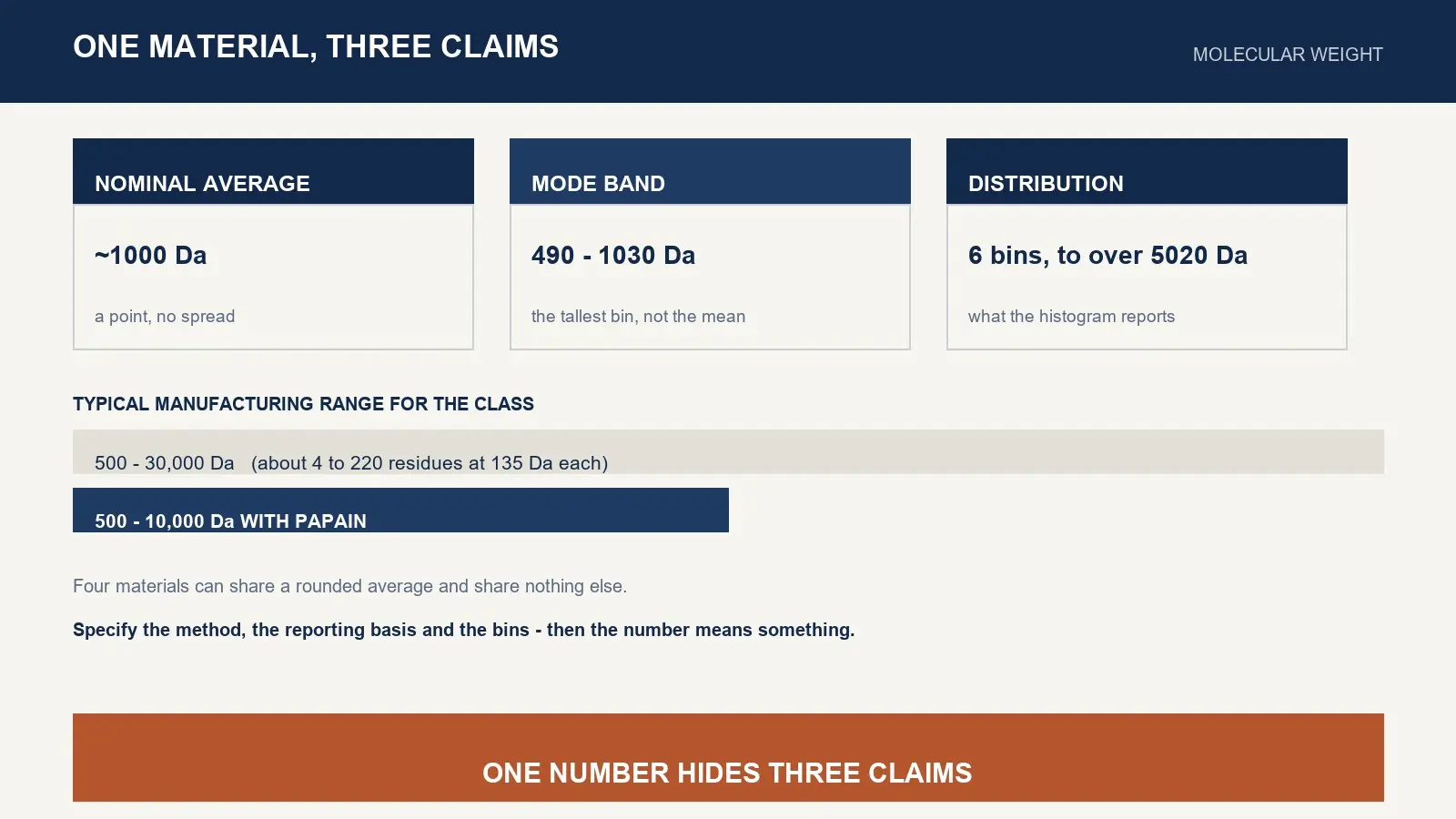
Three ingredients can share a rounded average and share nothing else - which is why the reporting basis, not the number, is the field worth specifying.
Degree of Hydrolysis Is a Process Declaration, Not a Size
The second specification question behind the category word is the one most often collapsed into the first. Degree of hydrolysis and molecular size are related the way a recipe is related to a cake: one describes what was done, the other describes what came out, and neither can be inferred from the other without a method.
Start with the boundary, because it is the part the label does not tell you. The CIR review is explicit that these materials are prepared from proteins by partial hydrolysis, and that the definitions exclude the complete hydrolysis products of proteins - the amino acids. That is a class boundary drawn by process extent, and it is the reason a drum labelled with amino acids and a drum labelled with a hydrolyzed protein are not two grades of one thing. They are two different classes with different behaviour, different regulatory descriptions and, in the case of the free-amino-acid entries, a different concurrent review at CIR. A buyer who treats "hydrolyzed" as a gradient word rather than a boundary word will eventually accept a substitution that changes the formula's behaviour.
Then look at how the routes differ, because the route is what a supplier can actually commit to.
| Route as described in the technical record | What it sets | What the document must show |
|---|---|---|
| Alkaline hydrolysis followed by enzymatic hydrolysis (the described route for hydrolyzed collagen from bovine or fish collagen) | Two-stage process; the second stage runs to the desired molecular weight | Which alkali, which enzyme, and the setpoint that ends stage two |
| Enzymatic hydrolysis, mild conditions, 4-6 hours, then pH adjustment to neutralise the enzyme (hydrolyzed keratin from wool, reported at ~1000 Da) | A timed enzyme step with an inactivation decision | Enzyme identity or class, contact time, inactivation evidence |
| Protease, 2 hours, then heat inactivation at 140 degrees C for 30 minutes, repeated if a gelatin test loses viscosity (hydrolyzed milk protein) | A functional test used as the endpoint criterion | That the endpoint was tested, not assumed |
| Acid hydrolysis of a colloidal protein solution to a prescribed time and temperature (hydrolyzed amaranth protein) | Time and temperature as the whole control | Whether salt and by-product load differ from an enzyme route |
| Enzyme concentration and contact time reported as process parameters: maximum degree of hydrolysis 43% at 110 LAPU per gram of protein after 15.5 hours, yielding small peptides below 6.5 kDa with most below 1.04 kDa plus free amino acids (hydrolyzed serum protein) | A quantified extent of cleavage, with a particle outcome and a free-amino-acid fraction | Both the DH figure and the size outcome - they are different measurements |
That last row is the one to hold onto, because it shows the two quantities being reported separately in the same experiment: 43% at a stated enzyme load and time, and a size population below 6.5 kDa with most below 1.04 kDa. If the two were the same measurement, one of them would be redundant. They are not. The first describes how far the cleavage reaction was taken; the second describes what the fragments weigh. A specification that quotes only one of them is asking the supplier to choose which promise to keep.
There is a commercial reason to care. The route determines things a formulator cannot fix afterwards: the salt load left by an acid hydrolysis, the odour profile of a keratin hydrolysate, the residual enzyme activity risk in a milk-protein hydrolysate (which is precisely why the described process repeats the heat inactivation until a gelatin viscosity test stops responding), and the free-amino-acid fraction, which affects how a powder behaves on a shelf. It also determines what a supplier can commit to. "Enzymatically hydrolyzed" is a process promise. "Low molecular weight" is a measurement. "Natural" is neither.
The practical ask, in one line: request the route, the endpoint criterion, and the inactivation evidence in writing, alongside the size figure - and treat a supplier who cannot state the endpoint criterion as a supplier who is reporting a batch result rather than controlling a process. That distinction is exactly the one the RFQ field guide makes at order level; here it applies to a single raw material.
The INCI Declared Name Carries the Source and the Route, and Nothing About Size
The third specification question is the one hiding in plain sight, because it is the only field a buyer can read without asking anybody. Every cosmetic sold in both of the markets that matter for this class carries a declared name for the ingredient, and the rules that produced that name are worth knowing - not for their own sake, but because they tell you exactly what the label cannot tell you.
The two regimes converge on the same principle and reach it by different roads. In the European Union, the ingredient list must be given in descending order of weight at the time the ingredients are added, with materials below 1% permitted in any order after those above 1%, and the Commission is required to compile a glossary of common ingredient names taking account of internationally recognised nomenclature including INCI. In the United States, the declaration must list each ingredient in descending order of predominance, with fragrance and flavour permitted to be declared as such, and the name used must come from a hierarchy: the name specified by the Commissioner for cosmetic ingredient labelling; failing that, the name adopted in a defined sequence of reference compendia - the CTFA Cosmetic Ingredient Dictionary second edition of 1977, with its own list of names expressly not adopted, then the United States Pharmacopeia nineteenth edition of 1975, the National Formulary fourteenth edition, the Food Chemicals Codex, and the USAN and USP dictionary of drug names; failing all of those, the name generally recognised by consumers; and failing that, a chemical or technical name.
| Element of the declared name | What it encodes | What it does not encode |
|---|---|---|
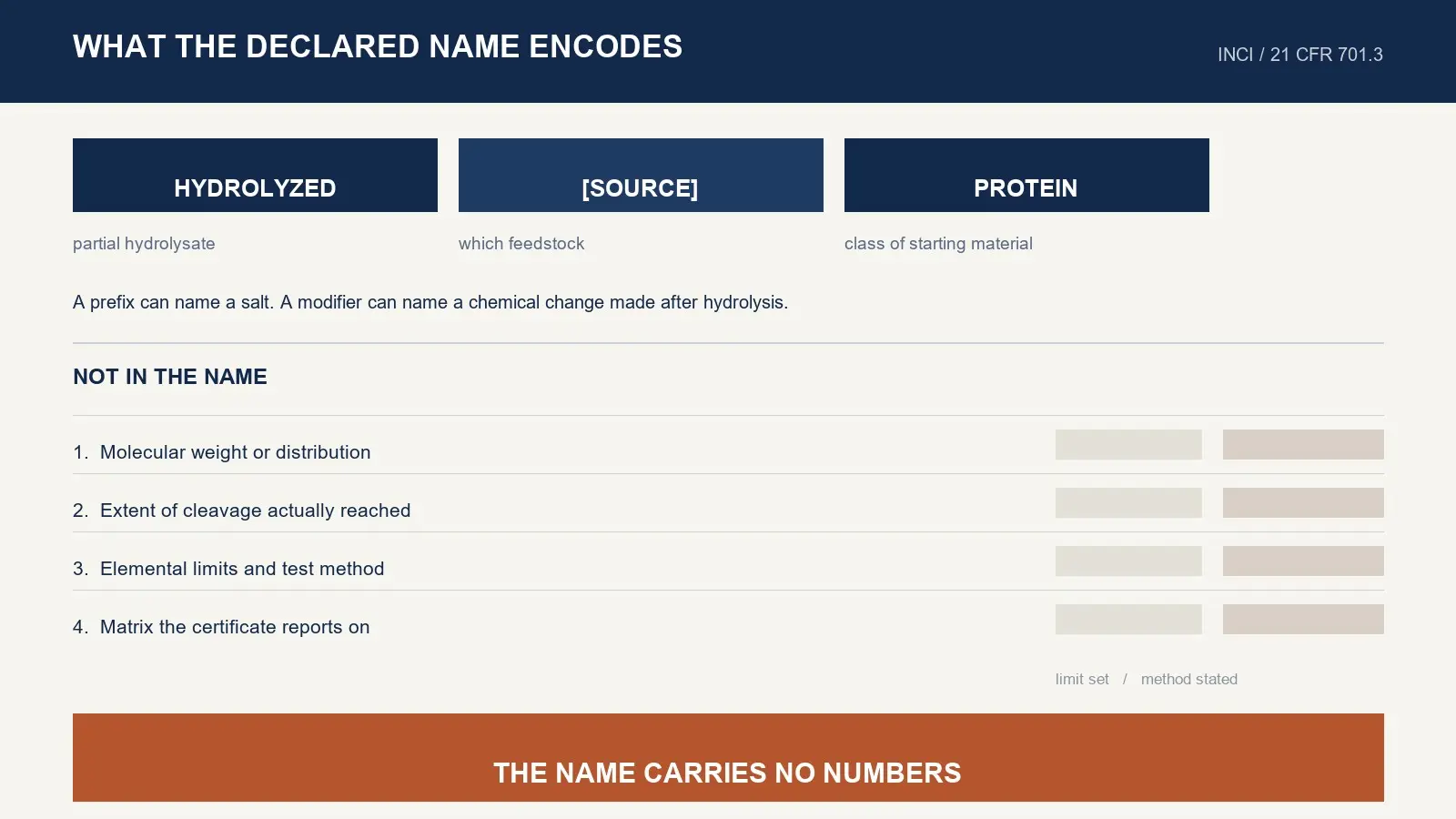
| Hydrolyzed | That the material is a partial hydrolysate of a named protein | How far the hydrolysis was taken; the distribution |
| [Source] - collagen, elastin, keratin, soy, wheat, milk, silk, amaranth, hazelnut | The feedstock the protein came from | Which part of which animal or plant; where it came from |
| Protein / Collagen / Elastin | The class of starting material; for collagen, the definition adds a compositional marker - a significant level of hydroxyproline residues | Molecular weight; extent of cleavage; metals |
| Ammonium / Calcium prefix | That the material is the corresponding salt of the hydrolysate | Residual salt load; pH consequence in your formula |
| Quaternised forms - hydroxypropyl trimonium, steartrimonium | That a chemical modification was performed on the hydrolysate | Which safety consequences follow - see the next section |
Two consequences follow, and both are actionable.
The first is that the declared name is a legal artefact, not a marketing choice - and it is a thin one. Look at what the dictionary definitions in the technical record actually say: "Hydrolyzed X Protein is the partial hydrolysate of X protein derived by acid, enzyme or other method of hydrolysis." Source, partial, three permitted route families, and silence on everything quantitative. Several of these entries share a CAS range number - 73049-73-7 appears against hydrolyzed actin, hydrolyzed albumen, hydrolyzed casein, hydrolyzed conchiolin protein and hydrolyzed egg protein, with one entry annotated as generic to peptides obtained by the hydrolysis of animal tissue proteins. A registry that assigns one number across five named materials is telling you something honest: these are variable mixtures, and the naming system is not trying to pretend otherwise. Your specification has to do the work the naming system declines to do.
The second is that the label is not a complete record of what arrived. The US rule expressly does not require declaration of incidental ingredients present at insignificant levels with no technical or functional effect - including processing aids added during manufacture and removed or converted before packaging. The EU list is ordered by weight at the time of addition, which is a different basis than weight in the finished product. Neither of those provisions is a loophole; both are reasons why two products declaring the same ingredient can have been made from materials that are not identical. If the difference between your two supplier samples is in a carrier, a solvent residue or an enzyme that was inactivated in the vat, no label anywhere will tell you - only the raw material specification will.
This is also the point at which the category word's SEO behaviour and its compliance behaviour collide usefully. The declared name is what an ingredient database, a retailer's compliance portal, a formulator's library and a generative answer engine all read. A page that reproduces the declared name accurately, and then states in plain language what the name does not cover, is the page that gets cited. A page that substitutes its own preferred phrase for the declared name is the page that gets skipped - and, in the European Union, the page whose client has a labelling problem rather than a ranking problem.
The declared name is the one specification field you can read without asking anyone - and it answers none of the four questions a buyer actually needs.
Elemental Impurity Limits: Four Metals That Are Prohibited Substances
The fourth specification question - purity and heavy metals - is the one where buyers most often ask the wrong thing. The usual question is "are you compliant?" and the usual answer is "yes." Neither is usable. The reason is structural, and it is worth stating precisely, because once you see it the field writes itself.
In the European Union, the four elements that dominate conversation around mineral and animal-derived impurities are not regulated by limit. They are listed as prohibited substances in the regulation's annex of substances not to be incorporated in cosmetic products:
| Element | Annex II entry | CAS | EC number | Status in the regulation |
|---|---|---|---|---|
| Arsenic and its compounds | 43 | 7440-38-2 | 231-148-6 | Prohibited substance |
| Cadmium and its compounds | 68 | 7440-43-9 | 231-152-8 | Prohibited substance |
| Mercury and its compounds | 221 | 7439-97-6 | 231-106-7 | Prohibited substance, except the special cases in Annex V |
| Lead and its compounds | 289 | 7439-92-1 | 231-100-4 | Prohibited substance |
What makes a product containing them lawful is a different provision: the rule on traces of prohibited substances, which permits the non-intended presence of a small quantity of a prohibited substance where it stems from impurities in natural or synthetic ingredients, from the manufacturing process, from storage, or from migration from packaging, and is technically unavoidable in good manufacturing practice, provided its presence conforms with the general safety requirement. Read that carefully. The law does not say "up to X milligrams per kilogram is compliant." It says the substance is banned, and that a residue is tolerated when you cannot avoid it and your process is sound.
There is therefore no compliance number to copy. Any limit in a specification is a commercial term that somebody chose, and the buyer's job is not to verify that the number is legal - it is to find out where the number came from. That reframing is the most valuable thing a category page can offer, because it converts a yes/no question into four answerable ones: which elements; which limit; measured by which method; on which matrix.
The technical record shows what a real answer looks like. Among the supplier data gathered in the CIR literature review, one manufacturer's declared specification for a hazelnut protein hydrolysate reads: heavy metals below 20 parts per million, arsenic below 2 parts per million. Two numbers, one total and one element-specific. That is the form. Notice what it does and does not do: it commits to a ceiling, it separates the aggregate from the individual element, and it says nothing about the method or the matrix - which means a buyer who stops reading there has inherited the supplier's assumptions about both.
| Field | Weak version | Version a buyer can act on |
|---|---|---|
| Scope | "Heavy metals tested" | Named elements: lead, arsenic, cadmium, mercury - plus the aggregate figure, if one is used |
| Limit | "Meets specifications" | A number per element, with units, plus the basis (dry material or as-supplied) |
| Method | none stated | An elemental technique with an instrument class, and the reporting limit of that method |
| Matrix | none stated | The raw material as shipped - not the finished product, not a previous batch |
| Frequency | "We test" | Per lot or per campaign, with the certificate tied to the lot number actually dispatched |
| Provenance | "Low contamination risk" | Feedstock identity and origin, because the exposure profile follows the feedstock |
Two practical notes on the method row, because it is where the quiet failures happen. An elemental technique with a reporting limit of, say, 5 parts per million cannot substantiate a 2 parts-per-million specification for a single element - the number is below the measurement, and the certificate will read "less than" where you need a value. And a result reported on the finished cream is not a result on the raw material: dilution flatters everything. Ask which the certificate is reporting before you accept it, and ask for the reporting limit alongside the result.
If your destination market is outside the European Union, the arithmetic changes but the logic does not. Several jurisdictions do publish numeric maximums for these elements rather than a prohibition-plus-trace rule, and those numbers change. Verify against the current text of the destination standard before you write a limit into a specification, and never import a limit from a supplier's template into a market whose rule you have not read. The EU compliance guide on this site covers the responsible-person and documentation side of that problem in the importer's guide to EU cosmetic compliance; the four-market procedural comparison is in the registration requirements map. Neither is re-opened here. What matters for a raw material is upstream of both: the impurity profile is set in the drum, and the finished product's dossier can only describe what the drum already contains.
The regulation bans the element and tolerates an unavoidable trace - so the limit in your specification is a commercial term you must set, not a legal line you can inherit.
Origin Is a File, a Claim and a Risk at the Same Time
The first of the four questions - marine, bovine, porcine or plant-derived - looks like a marketing decision and behaves like three decisions at once. It sets which documents you must hold, which words you may print, and which risk profile the finished product inherits. A category page that treats origin as a story is the page that gets a purchase order rejected by a retailer's compliance team.
Origin is a file. Species and tissue identity are the first things a market asks about, and they are not interchangeable answers. A bovine-derived material brings tissue-restriction history with it: the same technical record that documents this ingredient class also notes, in its non-cosmetic section, that the US FDA has defined peptones as generally recognised as safe direct food substances - describing them as a variable mixture produced by partial hydrolysis of casein, animal tissue, soy protein isolate, gelatin, egg albumin or whey protein - while separately prohibiting the use of cattle spinal cord in human food under a distinct regulation. That prohibition is not a cosmetics rule, and this piece does not pretend it is. It is evidence of something more useful for a buyer: the tissue identity of an animal-derived feedstock is a regulated fact in adjacent categories, and it does not stop being a fact because the material has been hydrolysed. The documentary consequences of species choice - the Halal and religious-claim files, the species-declaration logic for marine by-product feedstocks - are worked in detail in the Halal buyer's guide and in the salmon-sourcing and claims piece. Neither is repeated here; the point is that origin is the field those files are built on.
Origin is a claim boundary. A plant-derived feedstock is the only one of the four families that can carry a vegan positioning claim, and even that is a claim about the ingredient, not about the finished product, and it is subject to whatever certification the retailer accepts. Marine-derived material is the family most often assumed to be vegan, and it is not. Porcine and bovine material determines not only the claim set but the market set: some markets are effectively closed by species choice before a single document is filed. The pattern is worth writing on the page in one sentence, because buyers discover it late: origin is decided by the market you most want to enter, not by the story you most want to tell.
Origin is a risk profile, and the record is unusually direct about it. In a sensitisation study of protein hydrolysates in hair-care products covering almost 2,200 patients across three groups, the technical record reports positive reactions to three of the twenty-two hydrolysates tested, with all twelve reactors responding to a quaternised collagen derivative - hydroxypropyl trimonium hydrolyzed collagen - and every one of those twelve being female patients with atopic dermatitis. The same review reports no adverse reactions to hydrolyzed elastin, hydrolyzed keratin, hydrolyzed milk protein, hydrolyzed wheat protein or hydrolyzed sweet almond protein in that study. Separately it describes a cluster of case reports in which hydrolyzed wheat protein was implicated: three reported cases of wheat-dependent exercise-induced anaphylaxis in Japan linked to a soap containing the ingredient, and several cases of contact urticaria and positive patch tests in individuals using creams containing it.
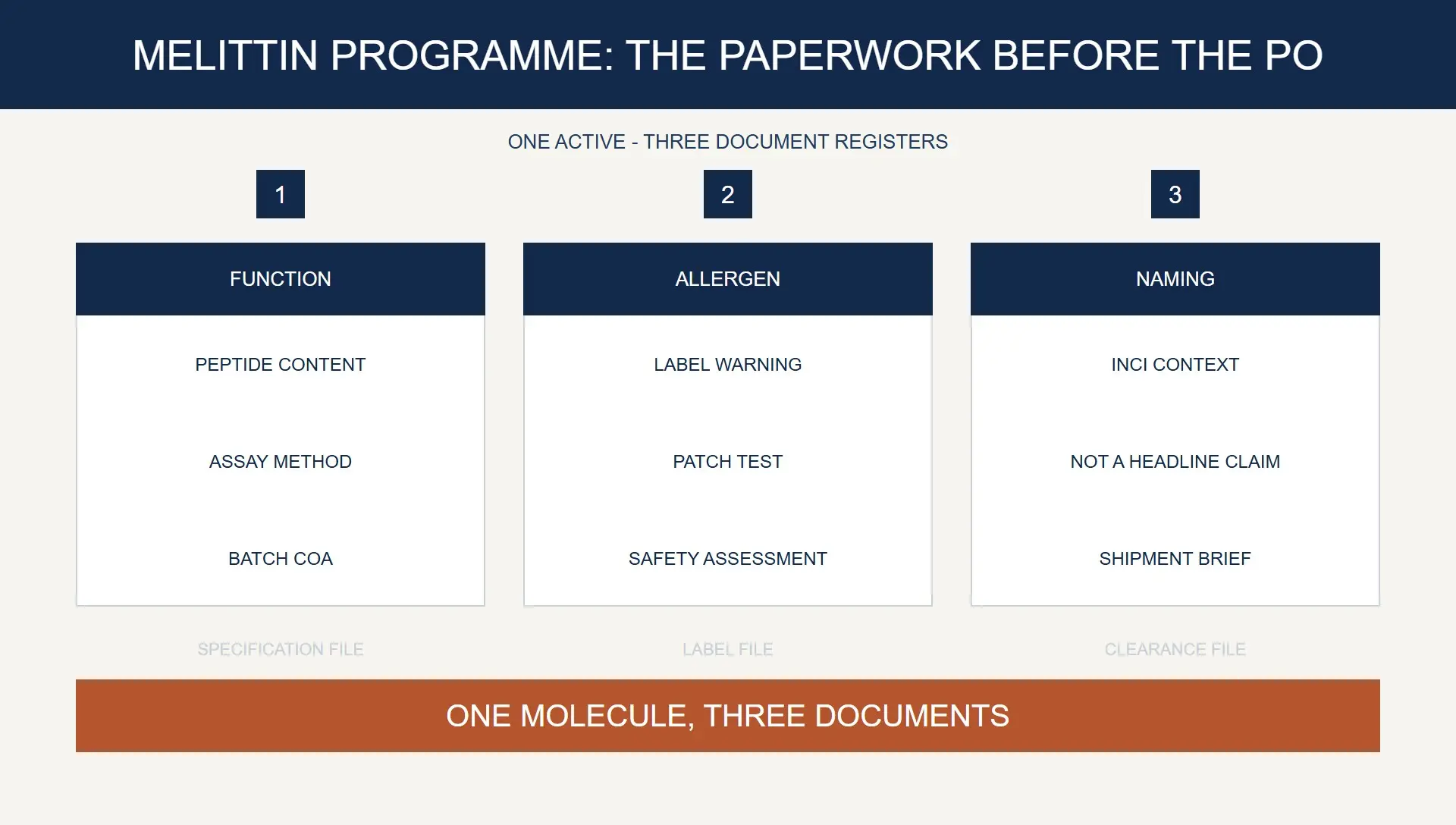
The mechanistic detail in that last body of work is the part a specification should carry, because it is the part that contradicts the intuitive assumption. In an immunoblotting study of nine patients sensitised to hydrolyzed wheat protein, the reactions occurred mostly with large random peptide aggregates, and the researchers concluded that hydrolysis of the proteins did not destroy pre-existing epitopes and may have created multi-epitopic entities - some carrying charged groups - that allow immunoglobulin E bridging on mast cells and basophils and increase solubility and transport. Read that as a procurement lesson rather than as biology: cleaving a protein is not the same operation as removing its allergenic recognition sites, and a modification step that improves a cosmetic property - quaternisation improves substantivity and solubility - produces a new material with its own name and its own record. This is the same structural problem the bee-venom piece handles from the other side, where the selling point, the allergen and the declared word are one molecule: the five files to hold before a first purchase order.
So the origin field on a category page is not a paragraph about the sea or the soybean. It is four lines: species and tissue; geography of the feedstock; whether any chemical modification was performed after hydrolysis, and under which declared name the result is sold; and which of the three consequences - file, claim, risk - the buyer needs to see before sampling. The collagen-side version of that decision, where the same feedstock question is asked at range level rather than class level, is worked through on this site's collagen cluster page, the Collagen 2.0 sourcing guide.
What a Polypeptide Category Page Has to Carry
Everything above points at one deliverable, and it is not a better article about the word. A category page exists to convert a class-level visitor into a specification-level buyer, and it does that by publishing the answers to the four questions before they are asked. Here is the field stack, in the order a technical buyer tends to need it.
| Question | What the answer filters | The written ask | Document that answers it |
|---|---|---|---|
| Which species and tissue, which geography? | Claim set, market set, allergen file, religious-certification path | Species and tissue named; feedstock geography named; modification declared by name | Raw material declaration + origin statement |
| Which molecular-weight figure, on which basis? | Formula behaviour: solubility, viscosity, feel; reproducibility between lots | Method, reporting basis, bins or polydispersity, dry-matter basis | Characterisation report |
| Which hydrolysis route, and where was it stopped? | Class membership (partial vs complete), salt load, odour, residual activity | Route, enzyme or reagent class, endpoint criterion, inactivation evidence | Process description + batch record extract |
| Which elements, which limits, which method, which matrix? | Market access, dossier content, supplier credibility | Named elements, per-element limits with units, method reporting limit, matrix, lot linkage | Certificate of analysis tied to the dispatched lot |
Notice what is not on that list: efficacy. That is deliberate, and the next section explains why. Notice also that every row is a document rather than a sentence. A category page that publishes four documents outperforms one that publishes four adjectives, and the reason is not stylistic - it is that the person arriving on a class-level word is, in a mature category, usually a person whose next step is internal: a formulator who has to defend a choice, or a procurement lead who has to compare two suppliers on something other than enthusiasm.
That is the two-audience problem, and the source draft names it correctly: a formulator and a procurement officer need different documents, and both belong on the same page. The split is not a matter of reading level. It is a matter of what each of them has to attach to an internal approval.
| Audience | What they must be able to copy into a file | What they will not get from a category page |
|---|---|---|
| Formulator / R&D | Characterisation basis, route and endpoint, solubility and pH behaviour, compatibility constraints, use level range | Stability data in their specific system - that is a trial, not a page |
| Procurement / quality | Named elements and limits, method, matrix, lot linkage, MOQ and lead-time structure, documentation set delivered with shipment | Their own market's current regulatory text - that is a lawyer or a compliance lead |
The sequencing rule that follows is the one most sites get wrong. The anchor page should not be the deepest page on the subject; it should be the hub. Under it sit the class-level specification pages - one per route or one per feedstock family - and under those sit the product-level pages with their own declarations. A single page that tries to be all three ranks for nothing and converts nobody, and it also creates the worst structural problem in category content: cannibalisation. One anchor term, one page. If two of your pages both open with the same class-level phrase, you have not doubled your coverage; you have split it and handed your own pages a competition to lose.
Which brings the ordering logic back to the metric table in section three. The eleven-row family is not a list of pages to write. It is a map of where the specification conversation starts at each entry point: someone entering on the anchor word needs the four questions asked of them; someone entering on a narrow structure word already knows two of the answers and needs the documents; someone entering on the head term needs to be disambiguated before anything else. The page's job changes with the door, and the fields stay the same. That is the entire difference between owning a category term and merely publishing about it.
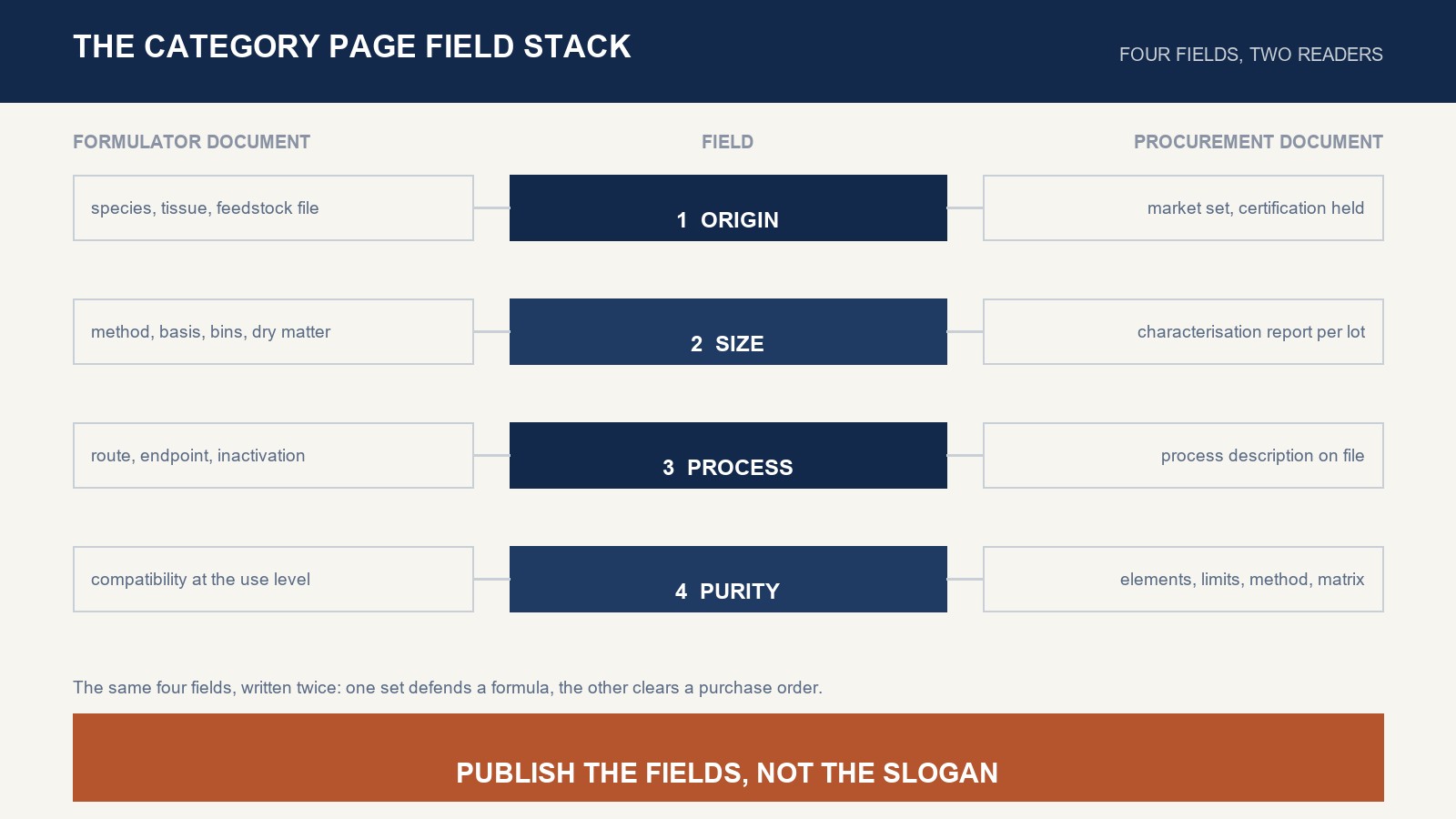
A category page earns its traffic by publishing four documents, because the visitor's next action is internal - somebody has to approve the file.
The Claim Ceiling Comes From the Function List, Not From the Literature
There is an asymmetry in this ingredient class that surprises teams the first time they hit it: the technical record is fuller than the label is allowed to be. The literature describes activities; the naming system assigns functions; and the two are not the same document.
Start with the ceiling, because it is concrete. In the ingredient definitions gathered by the CIR review, the functions assigned to hydrolyzed proteins are hair conditioning agent, skin-conditioning agent - miscellaneous, and, for particular entries, nail conditioning agent (calcium hydrolyzed collagen, hydrolyzed keratin), film former (hydrolyzed gadidae protein, hydrolyzed wheat protein) and light stabilizer (hydrolyzed lupine protein). That is the vocabulary the classification system hands you. It is a functional description of what the material does in the formula, not a statement about what it does to skin physiology - and the difference is exactly where enforcement lives.
Now look at what the research record contains. The same review notes that biologically active peptides may be derived from soy protein hydrolysis and describes activities reported in that literature, including angiotensin-converting-enzyme inhibitory and antioxidant properties, alongside surface-tension effects. Read the review's own framing: these are reported properties of peptides obtained from a food protein, in a document whose stated safety focus for cosmetic use is irritation and sensitisation, and whose summary states that systemic exposure from cosmetic use would be far below exposure from food. Research describes an activity. A label prints a claim. Those are two different acts, and the second one requires substantiation that the first one never promised.
That distinction is not a caution about this class in particular; it is the operating rule of the whole efficacy-claims environment, and this site has treated it from three directions: the dose-response era piece, the delivery-versus-dosage piece, and the legal-liability piece on a tested claim that failed. None of them is repeated here. What follows is the class-specific map.
| Claim layer | Wording that can be supported | Wording that requires a file you may not have | Wording that should not be printed |
|---|---|---|---|
| Identity | Declared name of the material; source species named; partial-hydrolysate description | Any statement that implies a defined single molecule | A trade name printed where the declared name belongs |
| Function in the formula | Conditioning, film-forming, humectant-type description of the ingredient's role | Viscosity or stability benefit in a specific system | Any benefit asserted without your own trial in that system |
| Composition | Amino-acid profile of the material; nitrogen or residue markers where measured | A percentage of active in the formula, unless the two-percentage question has been answered upstream | A purity figure presented as a content figure |
| Physiology | Neutral description of what research describes, with the study context stated | A consumer-facing benefit derived from in-vitro work | Verbs of treatment, cure, healing or structural change |
| Origin and ethics | Species and tissue stated factually; certification named and held by whoever holds it | Vegan or vegetarian positioning without the certification the retailer accepts | Any religious or ethical claim carried on an ingredient's behalf rather than a product's |
| Safety | Irritation and sensitisation data actually held for the specific material and modification | "Suitable for sensitive skin" | "Hypoallergenic" as a substitute for a test you did not run |
The row that catches most brands is the last one in the physiology layer, and it is also the one where a category page is most likely to create the problem. Marketing teams writing about a mature class reach for the strongest verb available, and in this class the strongest verbs are the ones borrowed from a research literature that was never describing a cosmetic. The fix is not softer copy. It is a sentence that says what kind of evidence exists - "the literature on soy-derived peptides describes antioxidant activity in vitro" is a usable sentence; "peptides protect skin from oxidative damage" is a claim that needs a substantiation file, a specific use level, a specific system and a specific market's tolerance.
One more ceiling, from the regulation side rather than the marketing side. In the European Union the ingredient list is ordered by weight at the time of addition, and any functional statement on the label must be one the product can substantiate; the site's green and digital claims guide coverage covers what happens when an environmental or natural descriptor is printed without a file behind it, which is the same failure mode wearing a different coat.
Frequently Asked Questions
Q1. Is a flat trend line a reason not to build the page? No - it is a reason to build it properly. A flat curve in a category term says the discovery phase is finished and the comparison phase is running, which is when specification content earns its place. The trend column here is −0.08, and this piece deliberately does not present that as growth. What it does present is the counter-test: if the figure read +2.0, the four specification fields would be identical, and only the advertising crowding and your time window would change.
Q2. Does the declared ingredient name tell me the molecular size? No. The declared name encodes that the material is a partial hydrolysate, which source protein it came from, and whether it is a salt or a further-modified derivative. It encodes nothing quantitative: not the distribution, not the extent of hydrolysis, not the impurity profile. Several materials in this class also sit under a shared CAS range number, which is the registry's own way of saying these are variable mixtures.
Q3. Which molecular weight number should I ask for? Ask which kind it is before you ask what it is. A nominal average, a modal band and a distribution across bins are three different claims - the technical record contains all three for the same class, and four different materials reported at approximately 1,000 daltons are not comparable. Then ask for the method and the basis: size-exclusion measurement of a distribution is not the same act as a membrane cut-off, and a figure reported on a 30% active solution is not a figure on the dry material.
Q4. Is a hydrolyzed protein the same thing as its amino acids? No, and the boundary is drawn by the definitions rather than by marketing. This class is defined as the partial hydrolysis product of a protein, with the complete hydrolysis products - the amino acids - explicitly excluded. Extent of hydrolysis and fragment size are also separately measured quantities: the record describes an experiment reaching a maximum of 43% hydrolysis at a stated enzyme load and time, yielding peptides mostly below about 1 kilodalton plus a free-amino-acid fraction. Both figures were needed because they describe different things.
Q5. What is a compliant heavy-metal limit for a peptide hydrolysate? There is no such number to inherit. In the European Union, arsenic, cadmium, mercury and lead are listed as prohibited substances, and their presence is permitted only as a technically unavoidable trace in good manufacturing practice, subject to the general safety requirement. So the limit in your specification is a commercial term you set: name the elements, set a per-element figure with units and a basis, state the method and its reporting limit, and state the matrix. A supplier example from the technical record reads heavy metals below 20 ppm with arsenic below 2 ppm - a ceiling plus an element-specific ceiling, with method and matrix left to ask about.
Q6. Does plant-derived mean I can print a vegan claim? It means the feedstock is not animal, which is a necessary condition and not a sufficient one. Vegan positioning depends on the certification the retailer accepts, on processing aids and carriers that may never appear on a label, and on whether the claim is being made for an ingredient or for the finished product. Marine-derived material is the family most often assumed to be vegan and is not. Decide origin from the market you must enter, not the story you want to tell.
Q7. What changes in the order when the active is a peptide class rather than a named molecule? Three things, and all of them are documents. The certificate of analysis has to characterise the material rather than identify a single compound; the sample round has to test the class behaviour in your system, because a rounded average does not transfer between lots; and the MOQ conversation splits, because a class material is often a stock item while a defined molecule is a made-to-order one. The minimum order structure for a first run is worked through in the low-MOQ launching guide, and the field-by-field enquiry document in the RFQ guide.
Sources and Further Reading
- Cosmetic Ingredient Review Expert Panel, Scientific Literature Review: Hydrolyzed Source Proteins as Used in Cosmetics, 21 May 2012 - Chemistry (500-30,000 Da typical distributions; 500-10,000 Da with papain; 135 Da average residue mass and the 4-220 / 4-74 residue conversion), Method of Manufacturing (alkaline plus enzymatic collagen route; keratin 4-6 h enzyme step; milk protein 2 h protease with 140 degrees C inactivation and a gelatin viscosity endpoint; amaranth acid hydrolysis; serum protein maximum hydrolysis of 43% at 110 LAPU/g after 15.5 h, fragments below 6.5 kDa with most below 1.04 kDa), Impurities (supplier declaration: heavy metals below 20 ppm, arsenic below 2 ppm), Table 1 (definitions and assigned functions), Table 2 (ingredient-level molecular weights), Figure 1 (molecular weight distribution bins), Non-Cosmetic (FDA peptone GRAS definition at 21 CFR 184.1553; the 40-residue protein and peptide boundary; 21 CFR 189.5 cattle spinal cord prohibition), Sensitization and Case Studies (the approximately 2,200-patient study; twelve reactors to hydroxypropyl trimonium hydrolyzed collagen; wheat-dependent exercise-induced anaphylaxis and contact urticaria reports; immunoblotting findings on large peptide aggregates and preserved epitopes), and Summary and Data Needs. - Regulation (EC) No 1223/2009 on cosmetic products - Article 17 (traces of prohibited substances), Article 19(1)(f) (ingredient list in descending order of weight at time of addition; below-1% ordering), Article 24(2) (glossary of common ingredient names taking account of INCI), and Annex II entries 43, 68, 221 and 289 (arsenic, cadmium, mercury and lead compounds as prohibited substances). Full text retrieved 19 October 2026. - 21 CFR 701.3 - Designation of ingredients, Electronic Code of Federal Regulations, title 21 current as of 16 October 2026, retrieved 20 October 2026: paragraph (a) descending order of predominance with the fragrance and flavour exception, paragraph (c) the naming hierarchy including the CTFA Cosmetic Ingredient Dictionary second edition of 1977 and its list of names not adopted, paragraph (f) the below-1% grouping alternative, and paragraph (l) incidental ingredients and processing aids. - Third-party keyword-set metrics from the client 243-term keyword file (local extract of 49 rows): volumes, competition ratings, cost-per-click and trend figures quoted in sections one and three. These are keyword-planning metrics, not Google Search volume, and the original spreadsheet was not available in the local archive, so no collection date is asserted. - On this site: the tripeptide specification guide (architecture and the two percentages), the RFQ field guide (order-level fields), the bee-venom five-file guide (allergen and naming risk), the contract-versus-in-house decision, the German collagen signal analysis, the hydrolyzed collagen molecular weight explainer, the hyaluronic-acid naming explainer, the dose-response era piece, delivery versus dosage, the SPF claim liability piece, the ECGT claims piece, the salmon sourcing piece, the low-MOQ guide, the peptide serum ingredient comparison, the GHK-Cu peptide serum page, the Collagen 2.0 sourcing guide, the EU importer compliance guide, the Halal buyer's guide, the PDRN manufacturing guide, the small-batch manufacturing guide, and the twelve-point factory audit checklist.
What to do next
If you are specifying a protein-hydrolysate or peptide-class material for a 2026 or 2027 range, the shortest path is to start from the four fields rather than the four adjectives. Send us the target market, the format and the use level you are working to, and tell us which of the four you already know: species and tissue, molecular-weight basis, hydrolysis route and endpoint, elemental limits with method and matrix. Where a figure is not yet fixed, we will quote the material against a stated basis rather than a rounded average, and we will show you the characterisation and certificate structure your quality team will receive with the shipment.
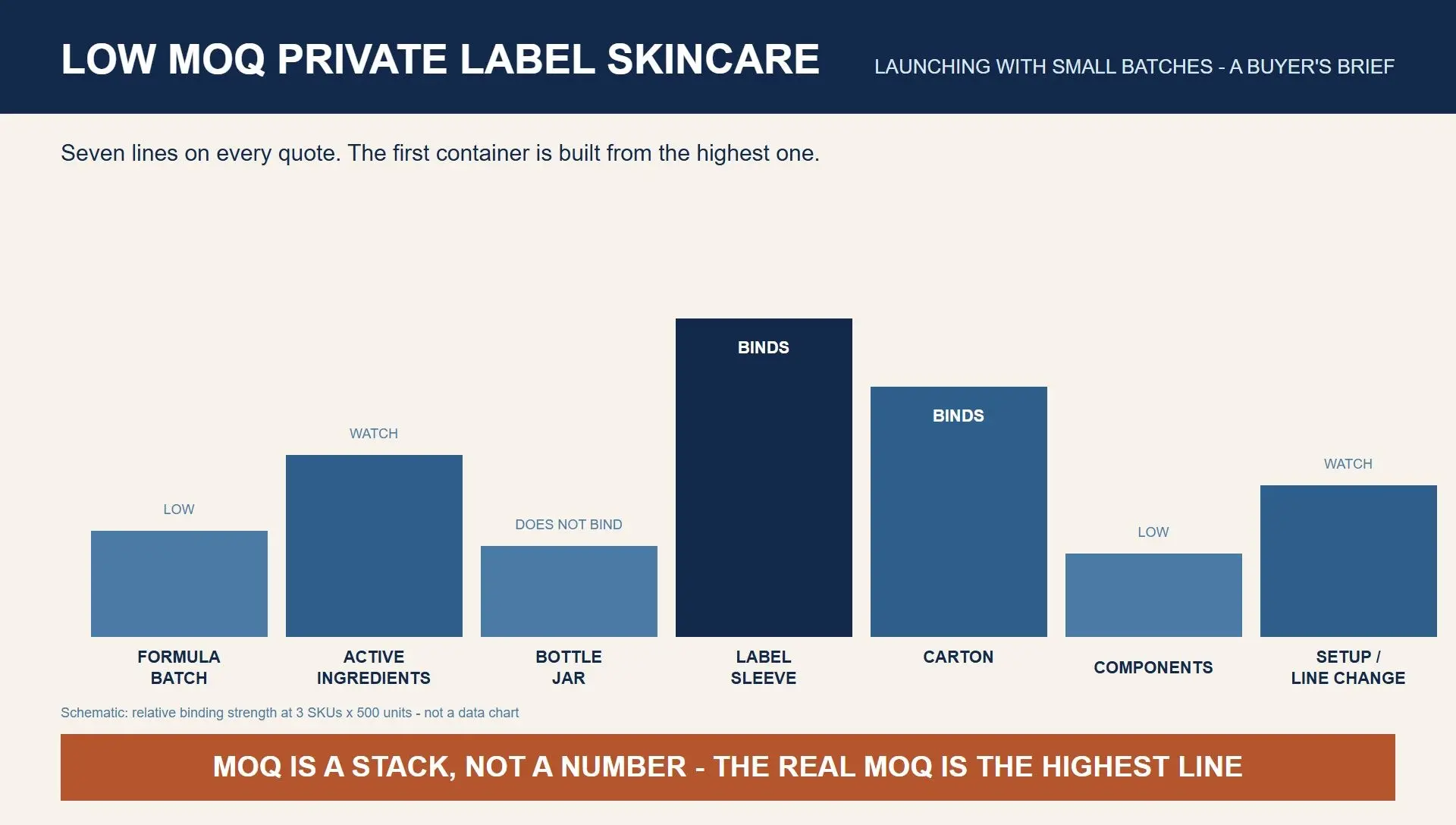
A dedicated product manager on every enquiry - reply within 24 hours, standard sampling in 7 days, and MOQ from 1,000 pieces on standard formats, with the batch, component and packaging lines quoted separately so you can see which one binds. Request a quote and the MOQ table for the class you are specifying, and we will return the documentation set before the sample round rather than after it.