

Private Label Skincare Low MOQ: Launching with Small Batches
Private Label Skincare Low MOQ: The Stack Behind the Number
The first question every buyer asks a factory is the same, and every factory answers with a number: "What's your MOQ?" The answers arrive confidently and are never the same — fifty units here, five thousand there, ten thousand over there — and all of them can be technically true. The question that makes private label skincare low MOQ a real category instead of a search phrase is the one underneath: which line of the quote is that number sitting on. Because the MOQ you plan your launch around is not the number in the email. It is the highest line of a stack — and most first-container launches stall on a line the buyer never asked about.
A working definition, from the one source in the trade that gets the structure right (Made By Genie, Low MOQ Cosmetic Manufacturing Guide, 2025-12-17): the MOQ is not one number, it is three classes of number. The formula or batch line — how much product the factory must make in one production run, which is low when it rides the factory's standing batch and higher when it is your own development batch. The components line — bottles, pumps, caps, labels, cartons — where every physical part carries its own supplier minimum and print-run floor. And the ingredients line — active and base-ingredient lot sizes, plus the under-used material that either rides into your next batch or is written off. The rule that organizes everything else in this piece: the real MOQ is the highest of these three. A factory that answers "500" has told you one line of the stack. It has not told you which one — and the line that binds your first container is usually not the one it named.
Why the buyer should care about the stack rather than the number: the number moves with the season and with the factory's appetite; the stack is structural. The lines that bind at 500 units per SKU are the same lines that bind at 5,000 — they simply stop binding at different points, and the points are knowable before the PO. A launch plan built on the lowest published number in the market is a launch plan built on a line that does not apply to your order. A launch plan built on your own stack, with the binding line named in writing, is a launch plan with a date on it — and that is the entire difference this piece exists to draw.
This piece works that stack through for a buyer launching small. What the published "low MOQ" ranges actually say once they are read honestly (H2 二), how the two launch paths — relabel versus custom — sit on different threshold lines (H2 三), the seven lines your quote must show separately (H2 四), what dropshipping does and does not change (H2 五), the three thresholds that define the cost of custom (H2 六), why "USA" in the search box is a market requirement (H2 七), and the arithmetic of a first container at three SKUs by five hundred units (H2 八). One scope note first: which model to buy — private label, OEM or ODM — is one level up, and it is answered in our three-model comparison page. This piece answers what the number you plan around is, and how to force every factory quote onto the same lines so the numbers can finally be compared with each other.
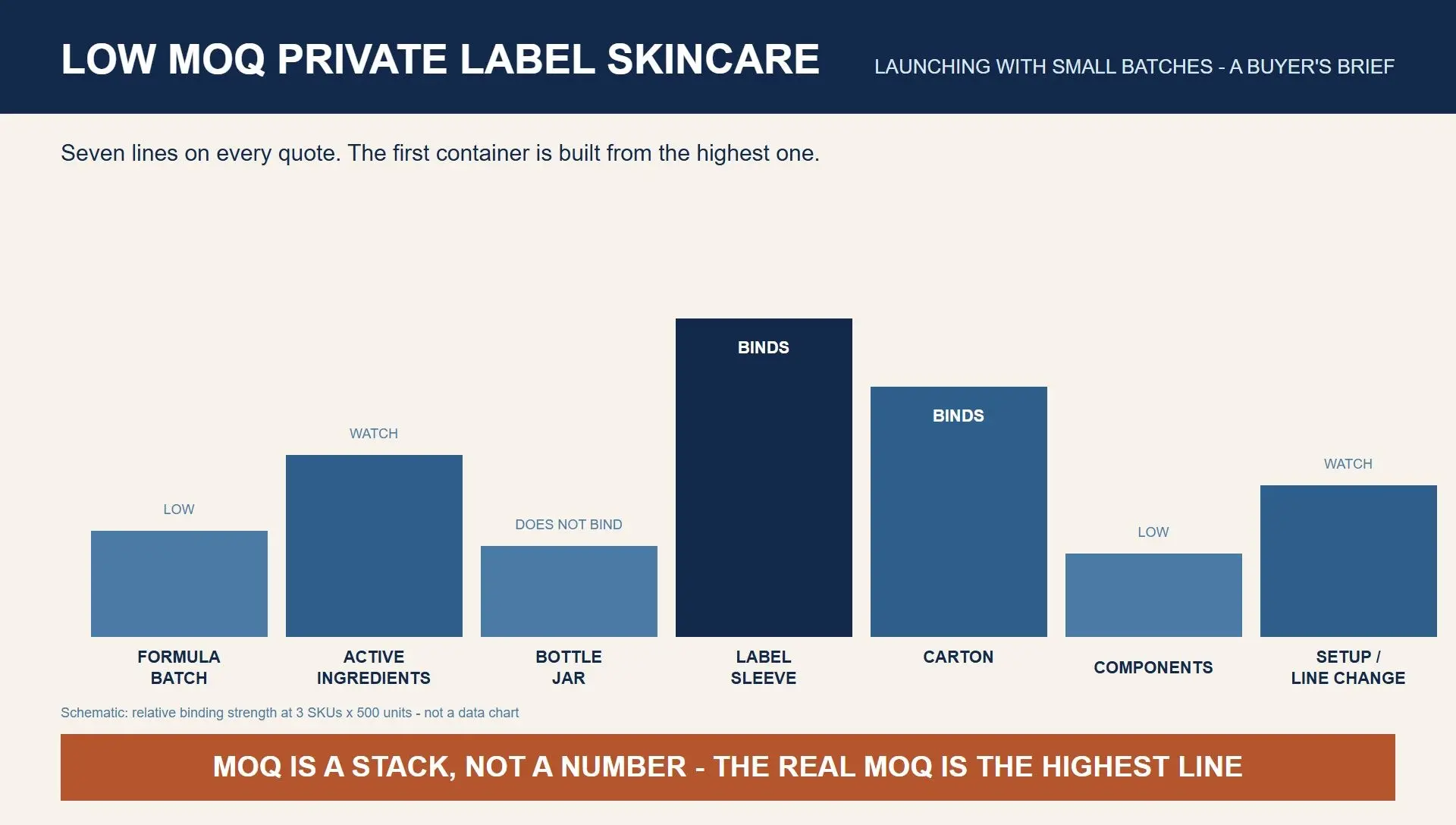
MOQ is a stack, not a number — and the real MOQ is the highest line.
The Published "Low MOQ" Ranges, Read Honestly: 50 to 10,000 Units Is the Data
Every factory that wants the keyword writes a "low MOQ" page, and the published numbers, gathered from four dated sources across twenty-four months, look like this:
| Source (date) | Published "low MOQ" claim | Line of the stack being quoted |
|---|---|---|
| MetaCn Beauty (2024-06-17) | White label from 50 units; full custom typically around 10,000 | 50 = shared standing-batch formula line; 10,000 = a full-custom development batch |
| The Good Karma Wellness (2025-12-26) | Typical runs of 500–5,000 units per SKU | The blended formula-plus-packaging line, small-brand scope |
| Sheleys (2026-04-16) | 1,000–3,000 per SKU; some programmes from 100–500 | The per-SKU programme line; the low tail is the shared-formula path |
| Made By Genie (2025-12-17) | No single number — "the real MOQ is the highest of these three" | The structural read: three classes of line, one binding line |
Read the column before the number. The published range spans fifty units to ten thousand — a 200× spread — and the honest answer is not that one source is wrong and three are right. Each source is quoting a different line of the same stack: the 50 is a shared formula on a factory standing batch with standard components already in stock; the 500–5,000 is a small-brand blend where packaging starts to appear; the 1,000–3,000 is a per-SKU figure for a programme; the 10,000 is a full-custom development batch — the highest line of a stack with no shared anything in it. The spread is the data. It is the stack, rendered in numbers that were never meant to be compared with each other, and a buyer who sorts them by date rather than by line will inherit the spread as a launch risk.
So the reading discipline is simple, and it is the only honest one: do not compare published numbers against each other — compare them against the lines of your own quote. When a factory's page says "from 100 units", the question is not whether 100 beats another factory's 500; the question is which line the 100 sits on, and what the other six lines will be on your first PO. A number without its line is a marketing artifact. The same discipline applies to your own budget: the first-container figure you defend to your co-founder or your investor should be the highest line of your own stack, not the lowest line of anyone's website.
One data-boundary note, in the house style: the four sources above are the dated ones that survived verification. An undated claim of "25 units" circulates in the trade; it is cited nowhere in this piece for the same reason any unverified number is excluded — it cannot be checked, and an unchecked number in a buyer's launch plan is a liability, not a fact. None of the sources publishes absolute unit prices, and none is needed here: the argument is structural, and structure is what you can plan with. The unit prices are the factory's number, the stack is yours.
A 200× spread across four dated sources is not a data error — it is four quotes of four different lines.
Two Launch Paths: Relabel Versus Custom, Sitting on Different Threshold Lines
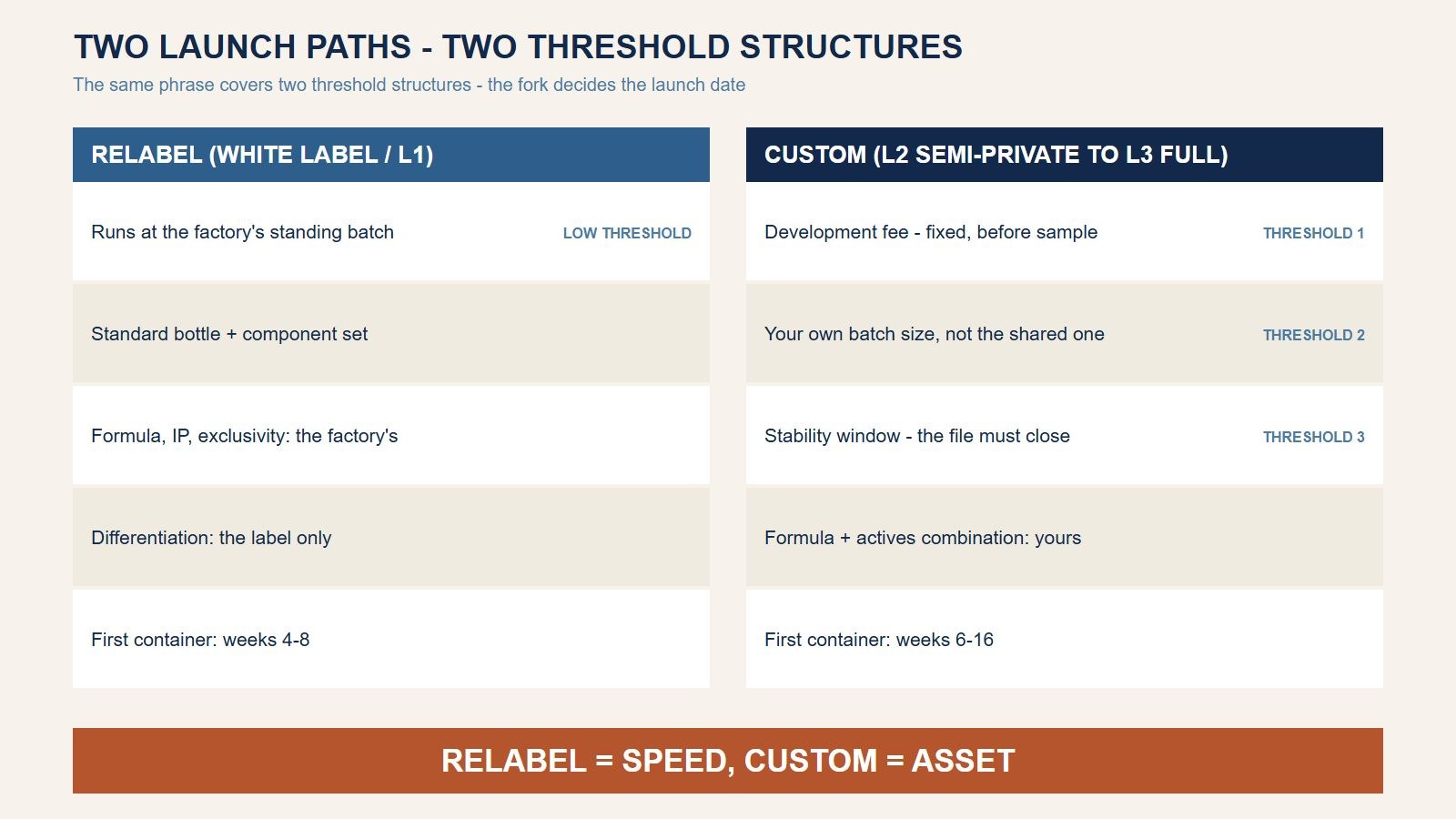
The buyer who wants a low MOQ is usually standing at a fork the search results do not draw: the same phrase — "private label" — covers two different paths with two different threshold structures. Relabel (the trade's "white label", the L1 step) is the factory's standing formula and standard components, run at the factory's batch size, carrying your label. Custom (L2 semi-private with your actives on a base formula, L3 fully developed from your brief) is a formula built for you, running at your batch size, carrying your file. The format ladder — where each step sits and what it changes — was walked through for encapsulated creams in our L1/L2/L3 coverage; here the question is the threshold structure of each path, because that is the number that decides whether the launch happens in eight weeks or in twenty.
The two paths are not a price difference on one curve; they are two curves. Relabel's threshold is low on the formula line — the factory's standing batch exists whether you order it or not, so the batch itself is not your cost — but it is high on the asset line: the formula, the actives combination and the differentiation story belong to the factory, and the only part of the product that is genuinely yours is the label. Custom inverts the structure: the formula line carries a development fee and your own batch size, typically the highest lines of the early stack — but the asset line is where the value accrues, because the formula is yours or exclusively licensed to you, the actives combination is yours, and the file that supports your claims is built for your product rather than for the factory's catalogue.
The procurement question is therefore not "which is cheaper" — on the first PO, relabel almost always is — but "which threshold can my launch date carry". A range that must differentiate on a third-party actives story, a texture system, or a claim that needs a file, cannot be a relabel range: the moment the claim needs documentation, the asset line has already cost you, on a timeline that has already run. A range that is a market test — three products, one claim pillar, one season of sell-through data — is exactly what relabel is for, and its low threshold is the point of it, not a compromise. The ownership ledger behind each path — who holds the formula, the IP, the exclusivity and the compliance file — is priced as quote lines in H2 六, where the custom path's three thresholds get their working form.
The planning sentence for the fork: if the range's identity is in the label, buy speed; if the range's identity is in the formula, budget the three thresholds now — because the second structure cannot be added later without re-running development, and re-running development is the most expensive sentence in a small-brand budget.
The Stack, Line by Line: Seven Rows Your Quote Must Show Separately
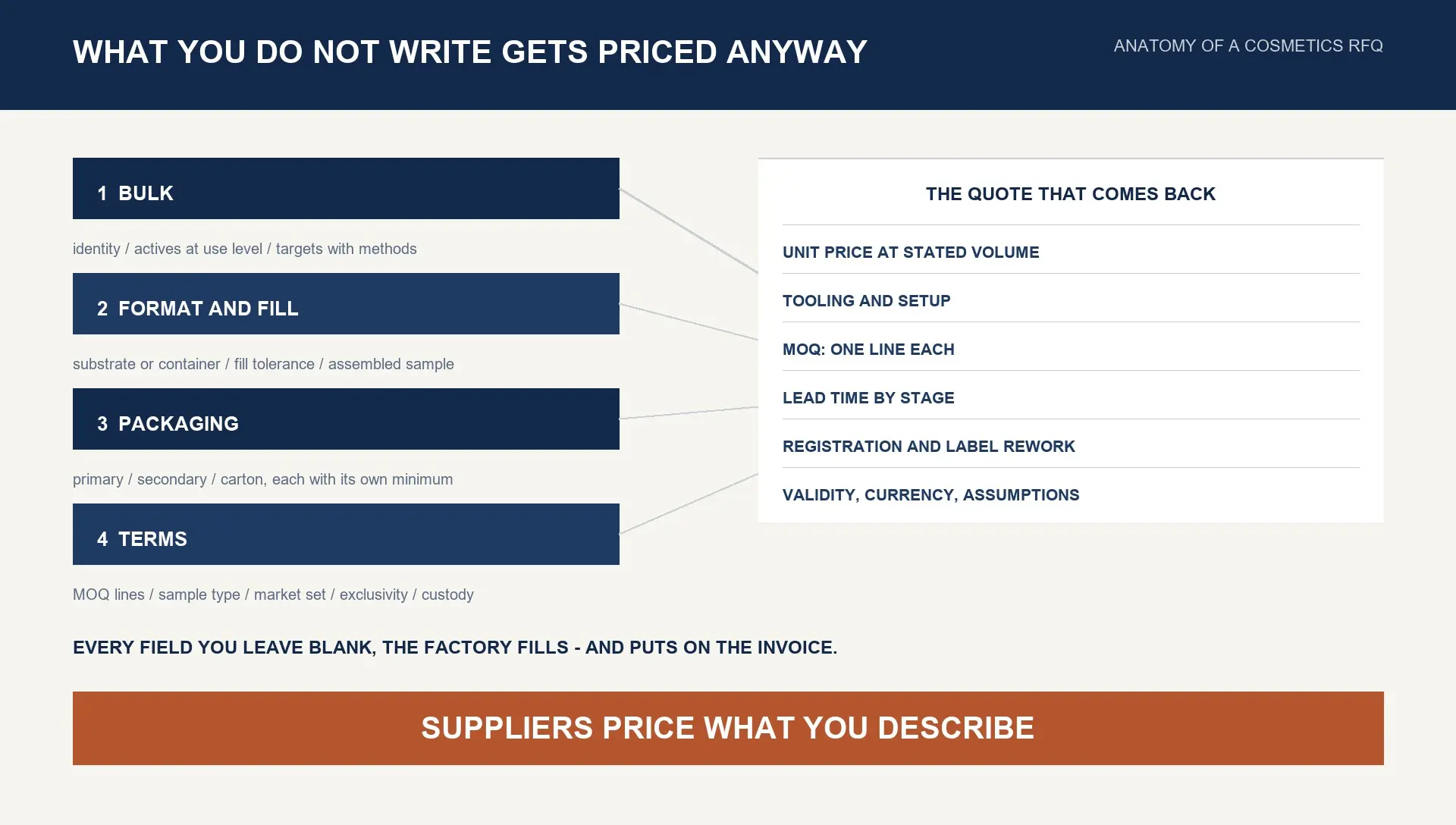
Expand the three classes to the seven lines that actually appear on a quote, and each line gets its own "what sets it" and its own written ask:
| Stack line | What sets it | Typical direction at small volume | What to ask for in writing |
|---|---|---|---|
| 1 · Formula / batch | Development batch (your formula) or standing batch (the factory's) | Shared batch = lowest; your own batch = the development curve | Formula MOQ per formula ID — the number, separately |
| 2 · Active ingredients | Active lot sizes, plus under-used material that may not carry into the next batch | Higher per unit as volume falls; high-cost actives dominate the line | Active lot size per formula; the under-use policy |
| 3 · Bottle / jar | Mold run (custom) or stock run (standard) | Standard stock bottles = low; a custom bottle's mold run = the new ceiling | Bottle MOQ, and which stock bottles run lower |
| 4 · Label / sleeve | Print-run minimum, per design | Often the binding line at 500 units — three designs, three runs | Label MOQ and minimum print run, per design |
| 5 · Carton | Per-SKU carton run plus freight cubic | Rises with SKU count, not with unit count | Carton quantities per SKU; the freight-cubic note |
| 6 · Components (pump, dropper, cap) | Component supplier volume pricing | Flat until you cross a supplier's volume step | Component MOQs, listed part by part |
| 7 · Setup / line change | A fixed fee, not units — amortized across the batch | The flat line a small batch cannot avoid | The setup fee, and how it amortizes |
The rule from the top of the piece now has its working form: the effective MOQ is the highest of these seven lines. A quote that presents "MOQ: 500" has presented the lowest line it hoped you would read. The mechanism of where the stack binds — and why the low-MOQ category works at all — is worked through in our low-MOQ OEM coverage; this table is the version you bring to the quote call, line by line, and hold the call against.
Two lines deserve extra attention because they behave differently from the rest. The active-ingredient line is the only place where the factory's commercial policy meets chemistry: under-used actives either carry into your next batch — which quietly couples your batch sizes, because the remainder of this batch becomes the floor of the next — or they are written off, which quietly taxes every small batch you will ever run. Ask which, in writing, before the sample. The setup line is the only one that is a flat fee: it does not scale with units at all, which is exactly why a 500-unit batch carries a disproportionate share of it, and why the per-unit price on small batches stays high even when every unit line on the quote reads "low". The flat line is the reason "small batch" and "low unit price" are two different requests.
The written ask is the deliverable of this section, not a suggestion: ask for the seven lines, separately, in writing, for your exact range. Most factories can give you two of the seven — the formula MOQ and the bottle MOQ are the ones they advertise. The other five are the ones your first container is actually built from. A factory that will not split the lines has answered the question before you asked it: it is selling you a number, and the number is the one that does not bind.
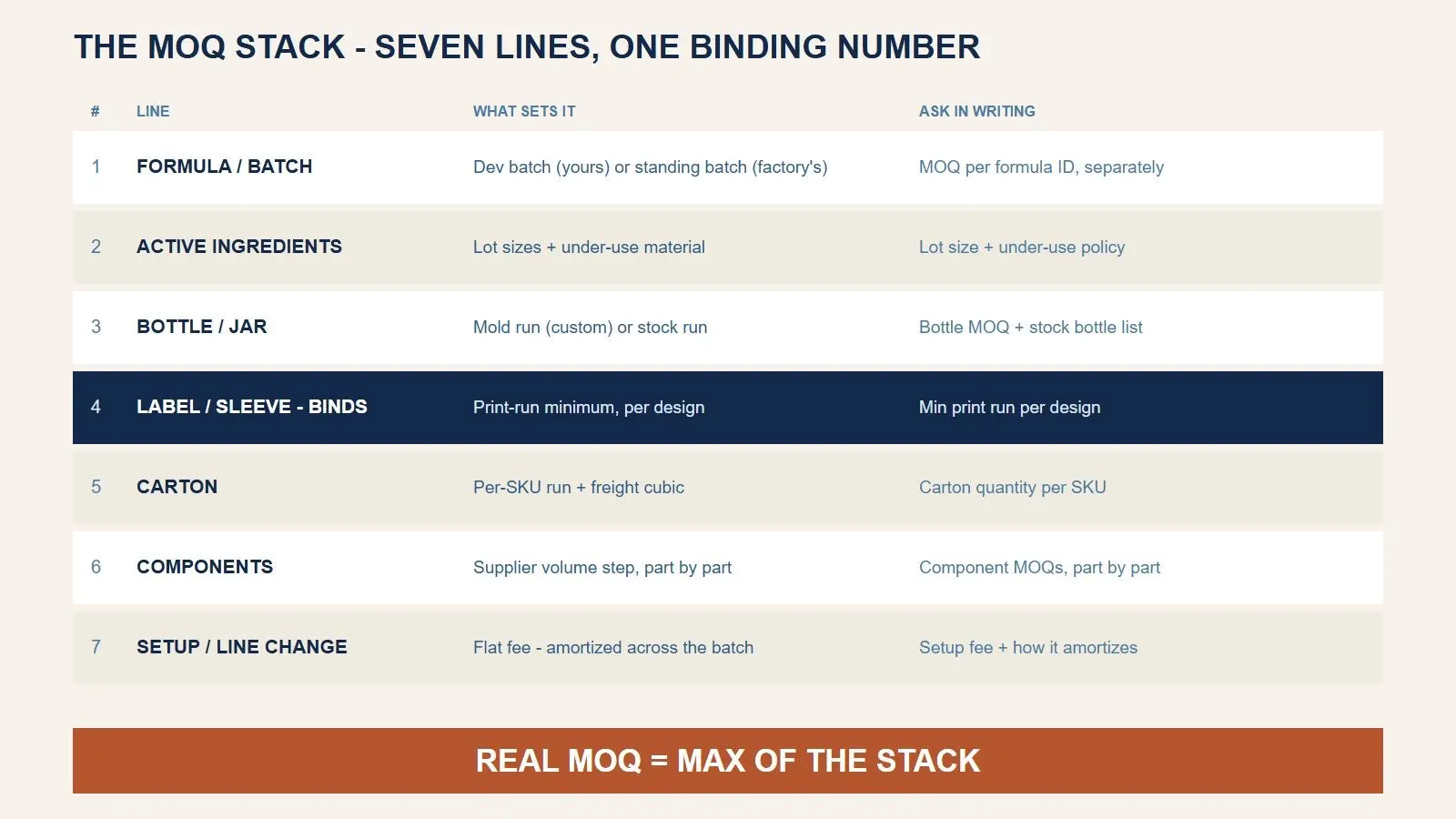
A quote that shows one number is showing you the lowest line.
Private Label Skincare Dropshipping: A Different Inventory Model, Not a Lower MOQ
The second tracked phrase in this piece's queue targets the dropshipping variant of private label skincare, and it arrives with a false promise: that outsourcing the inventory removes the MOQ problem. It does not. Dropshipping changes who holds the stock and how the order flows; it does not touch a single one of the seven lines. The comparison, structural and complete, is the only honest one:
| Dimension | Small-batch launch (you hold the container) | Dropship model (factory / 3PL ships per order) |
|---|---|---|
| Inventory risk | You carry the first container from day one | Per-order; the factory or 3PL holds stock |
| The MOQ stack | All seven lines apply, once, per batch | All seven lines apply, repeatedly, as batches roll |
| Unit-price structure | Setup and development amortize across the container | The amortization base shrinks to each rolling batch — per-unit cost rises |
| Lead time / SLA | One production window, then your warehouse | A per-order processing SLA you must contract, test and audit |
| Demand data | Yours — the sell-through belongs to your systems | Shared with, or held by, the fulfilment side — access must be contractual |
| Compliance file | Identical: the file is per product, not per model | Identical: the file is per product, not per model |
Read the last row first, because it is the one the search phrase conceals: the compliance file does not change with the inventory model. The stability data, the CoA, the safety-assessment input, the INCI and allergen declaration — the file is built per product, and a dropshipped product is still a product. What dropshipping does change is the amortization base. In the small-batch model, the setup fee and the development cost spread across one container and are done; in the dropship model, each rolling batch carries a slice of the same flat lines on a smaller base, which is why the per-unit price structure — not the MOQ — is the number that decides whether the model is economically viable for your margin. Small batches that roll often are still small batches; the flat lines do not learn to like them.
The SLA row is the second one that needs a contract rather than a promise. Per-order processing means your delivery date is a function of the fulfilment side's queue, and a queue you cannot audit is a date you cannot promise your retail. The written asks are three: the processing SLA in weeks per order volume, the stock-replenishment trigger that keeps your product from going out of stock mid-season, and access to the sell-through data — because demand data held by someone else is a forecast you will have to rent back.
So the correct use of the dropshipping keyword is as a question, not a shortcut: can my first product run dropshipped to test the market before I commit to a container? The answer is yes for a relabel product on a standard component set — a low stack, per-order feasible — and usually no for a custom-formula product, where the development fee has already been paid against a batch that now rolls in small slices and the flat lines keep their full weight. Run the unit-price structure before the answer, on the seven-line table from H2 四, and keep the one invariant: the model changes the economics of the rows, never the existence of them.
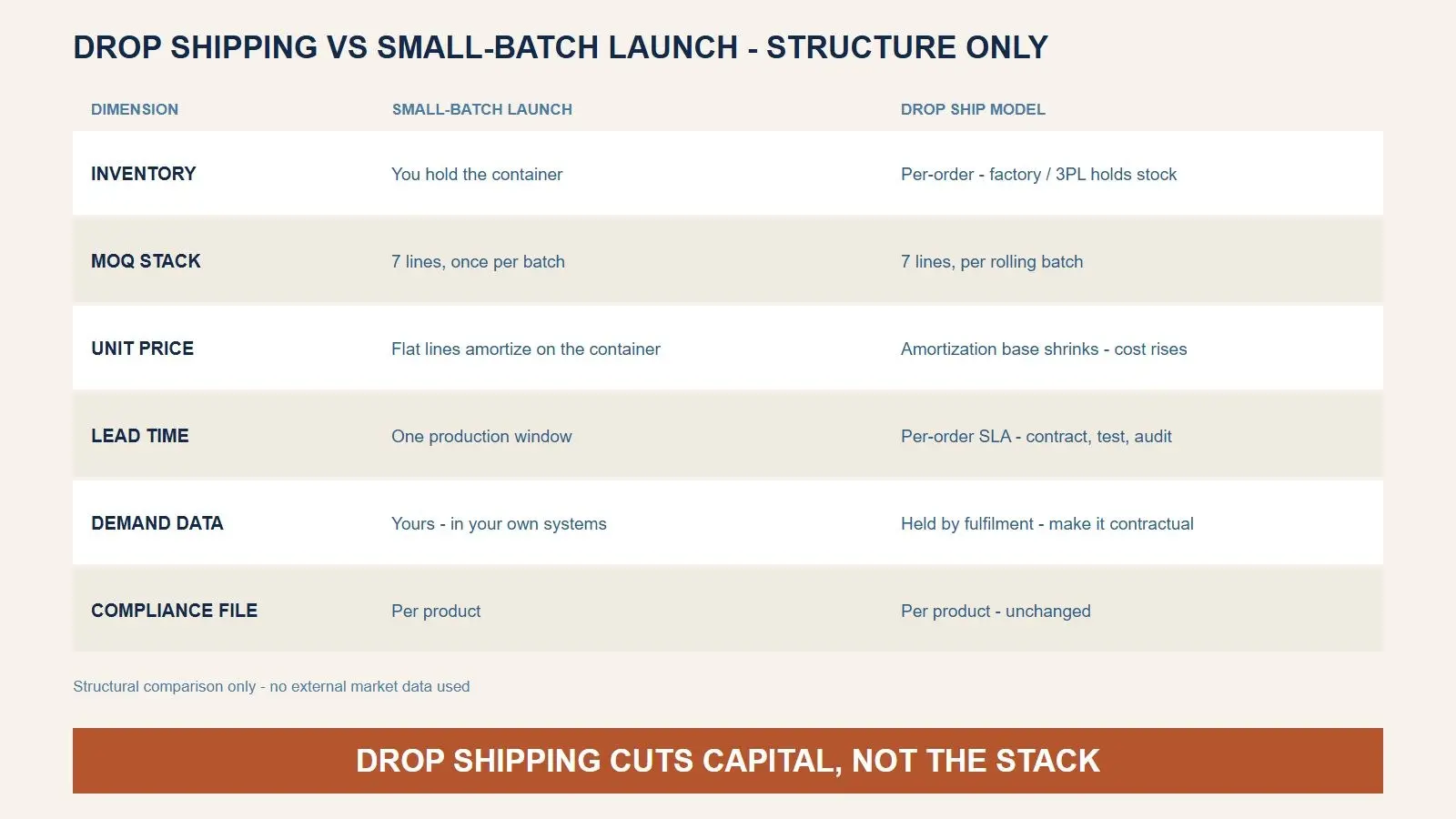
Dropshipping cuts the capital at risk, not the stack — the same seven lines apply per batch.
Custom Formulation: The Three Thresholds That Define What "Low" Costs
A custom formulation skincare manufacturer will quote you a low MOQ on the formula line and a standard one on the packaging line — and both quotes can be honest, because the question the buyer actually needs answered is which lines move when development enters the stack. Three lines move, and each of the three is a threshold rather than a price, which is why it survives contact with your budget sheet:
One: the development fee — a fixed line, paid before the sample. It is the entry ticket to your own formula, and its size is set by the scope of the brief — the formats, the actives, the target markets — not by your volume. It is the only line on the stack that you pay even when the batch is small, and the line whose absence in a "custom" quote should stop the conversation: a custom formula with no development line is a shared formula wearing your sticker.
Two: your own batch size — the formula line stops being the factory's standing batch. Relabel rides the standing batch; custom runs your batch. Your batch is typically larger than the standing batch it replaces — that is the honest direction of the formula line when development enters — and it is why a "low MOQ" on a custom quote is low relative to your own batch, not low relative to a relabel batch. The comparison the search results set up, custom-versus-custom at different volumes, is the only comparison that is fair; custom-versus-relabel on one number is the 200× spread of H2 二 reproduced inside a single quote.
Three: the stability window — a time threshold, not a unit threshold. The file must close: accelerated stability, real-time data, the protocol, the curves. In weeks, this is the longest line of the early stack, and it is the line that decides whether your launch date is a date or a wish. The seven-day sample standard our factory runs buys the first look at the product; the stability window buys the claim, and the claim is what the range is made to carry.
The three thresholds together are the real entry cost of the custom path — and the reason it is not "a more expensive relabel" but a different structure. The price architecture of these lines, including where the sample fee sits and what the offset structure is, is priced as quote lines in our private-versus-white-label coverage. The planning move is to know which thresholds you are buying before the first call: a brand that needs an asset in year two should budget the development fee and the stability window in year one, because both are fixed lines that do not shrink with your batch. The only line that shrinks is the per-unit amortization — and that shrinks with your sell-through, not with your ambition.
The "USA" in the Search Is a Market Requirement, Not a Map Pin
The third phrase in this queue — custom skincare manufacturer usa — reads like a location and behaves like a market requirement, and for a buyer launching small, treating it as the map pin it appears to be is the one geography error that can cost a first container. The search is not asking where the factory is. It is asking three structural questions with a country name as shorthand, and each of the three is answerable without a map:
First, who is closest to the paperwork. For the US market, the MoCRA duties — facility registration, product listing, the responsible-party file — sit on the import side of the chain, and the distance between that file and the manufacturing file (stability, CoA, safety-assessment input) is a real cost in version control. The 2026 full-enforcement mandates and what they change in supplier selection is the US-side map; the EU-side equivalent — who must be your Responsible Person, what the CPNP notification requires of the importer — is in our EU compliance guide for importers. Geography changes who is closest to the paperwork; it does not change that the paperwork exists.
Second, how fast the audit and correction loop runs. A same-day or one-day flight means an on-site audit is a planning line; a long-haul means the third-party report plus a video audit is the first layer and the on-site visit is the second. And every label correction, every reformulation request, pays the same distance twice — in and back. For a small-batch buyer specifically, the correction loop is where geography shows up in the P&L, because small batches are re-ordered often and re-worked faster. A launch that runs small and iterates is exactly the launch where a slow correction loop is most expensive.
Third, what "USA" actually guarantees at the manufacturing site. A US address whose production sits in the Far East, or a "US factory" that is a fill-and-label house running imported bulk, answers the search phrase perfectly and the market requirement not at all. The verification is the same discipline as the model question — the scope of GMP, the actual production site, the export-file practice — and it is market-independent: the five-dimension checklist does not change because the flag does.
The planning conclusion: write the requirement, not the pin. "Manufacturer with the compliance file one hop from mine, an on-site audit reachable in a day, a correction loop under two weeks" is a sentence every candidate anywhere can be scored against. "In the USA" is a sentence only some candidates pass, and the ones that fail it may still be the ones your launch date can carry. The full geography table for the model decision, with the same five dimensions, sits in the ownership piece; here the point is narrower — for a small launch, the three structural questions above are what the country name is doing in the search box.
The First Container, Worked: Three SKUs at 500 Units, and the Line That Binds
The stack becomes arithmetic the moment a range is named. The worked example below is the standard first container for a small brand — three SKUs, 500 units each, one shared standard bottle, actives drawn from two shared pools — with the seven lines filled in as lines rather than as one number. The range it assumes is the one the five-decision sequence prescribes: 2–3 SKUs, one format family, one claim pillar — the first decision in starting a brand is the range, and this arithmetic is what that range costs.
| Stack line | Filled for 3 SKUs × 500 units | Binding? |
|---|---|---|
| Formula / batch | Three shared-batch formulas (relabel) — or three development batches (custom, each its own) | No — the low line by design |
| Active ingredients | Two active lots from shared pools; under-use carries per policy | Watch — the under-use policy decides the coupling |
| Bottle / jar | 1,500 units on one standard bottle — under a typical stock-bottle MOQ | No — the bottle does not bind here |
| Label / sleeve | Three designs × 500 = three print runs against a per-design minimum | Yes — the print-run minimum is usually the ceiling |
| Carton | Three per-SKU carton runs; freight cubic set by the largest | Yes, second binding line |
| Components | One component set (standard pump / cap) — supplier volume step shared | No at this volume |
| Setup / line change | One setup if the three run as one batch sequence; more if sequenced separately | Watch — the flat fee's amortization base is 1,500 |
Read the binding column and the launch plan writes itself. At 500 units per SKU, the bottle rarely binds — the label and the carton do. Three designs means three print runs, and the print-run minimum is a number set by the printer, not by your range; the carton run is set by the same SKU count that set the label count. The formula line is low by design (shared batch), the components line is low (standard set) — and the two lines that carry your identity, the design and the unboxing, are the two that carry the ceiling. That is the counterintuitive result of the small-batch world: the lines that make the product yours are the lines that cost the most per unit, and the line that makes it shippable is not the binding one at all. The second reading is the active line: two shared pools keep it at two lots, but the under-use policy decides whether lot two's remainder rides into your next batch or is written off — ask before the sample, because the answer is the difference between a policy and a hidden tax.
The structural alternative is the one the sourcing guides keep converging on, and it is worth stating in full: concentrate the first container on one hero SKU. One formula at 1,000 units beats four formulas at 250 — the flat lines (setup, development, stability) amortize across a doubled base, the label is one design instead of three, the carton is one run instead of four, and the sell-through data from a single hero is cleaner than the blended noise of a four-SKU launch. The three-SKU range arrives in the second container, where the active pools, the component set and the bottle are already proven, and the added SKUs cost print runs rather than development. Which structure is right is a sell-through question, not a preference question — but both structures are legible on the same seven-line table, and that is the point of this piece: at any volume, you can name the line that binds before the factory names it for you.
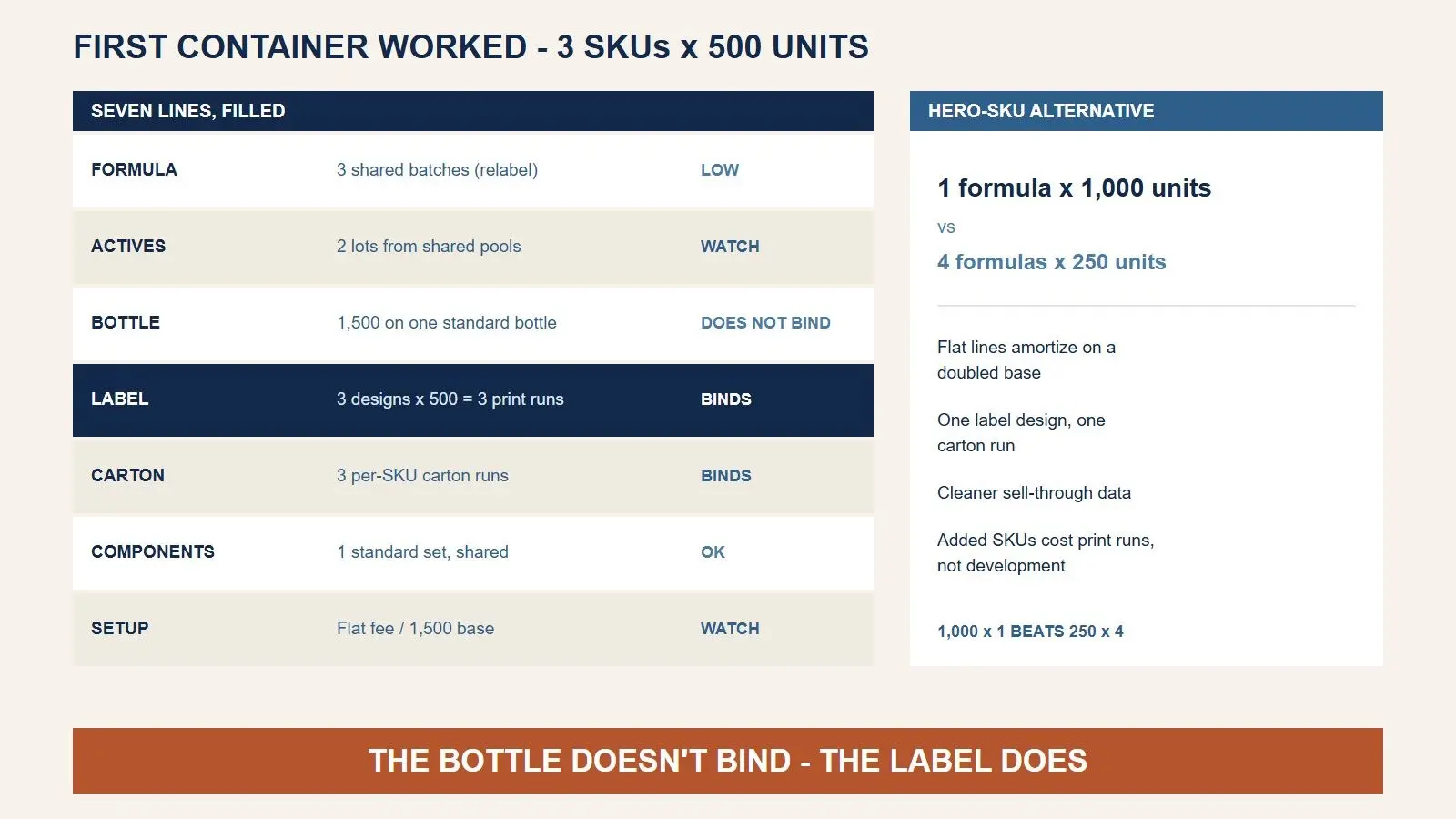
At 500 units per SKU, the bottle does not bind — the label does.
Ten Questions That Turn "What's Your MOQ?" into a Quote You Can Compare
The ten questions below are the seven-line table in interrogative form — each has a document answer, and a factory that answers the three MOQ lines separately in writing has already positioned itself on the shortlist:
1. What is the MOQ on the formula line, the packaging line and the component line — the three numbers, separately, in writing? 2. What is the setup fee, and how is it amortized across my first batch? 3. What is the active-ingredient lot size for my formulas, and what happens to under-used actives — carried into the next batch, or written off? 4. What are the label and carton print-run minimums, per design, for my SKU count? 5. What is the sample fee and the sample lead time — and is the fee offset against the first order, with parity samples? 6. Which standard bottles and component sets do you hold in stock that run at a lower MOQ than a custom build? 7. What is the reorder lead time at 500 units versus 1,000, and at which volume does the per-unit price structure step? 8. Do you run staged delivery — half of the first batch now, the remainder at week six — and at what fee? 9. Which components may I self-supply, and what is your incoming QC for buyer-supplied parts? 10. If the first container sells through in eight weeks, what is the fastest second batch — and which file line must close before it starts?
Questions three, eight and nine are where the factory's operating discipline shows up — the under-use policy, the staged-delivery fee, the incoming QC for your parts — and the deep version of that audit is the 12-point factory audit checklist, which is what the questions expand into once a candidate reaches the sample stage. When all ten answers are in front of you, put them on the seven-line table next to the previous factory's answers and the comparison is finally apples to apples — because the only thing both tables share is the line structure, which is the only thing that should be shared.
A factory that answers the three MOQ lines separately in writing is a factory you can compare.
The Small-Batch Launch, Summed in Four Moves
Four moves carry the whole piece. One: read the number as a line. Every published "low MOQ" — from the 50-unit white label to the 10,000-unit full custom — is a quote of one line of a seven-line stack, and the spread between them is the data, not a data error. Two: name your binding line. On the standard first container — three SKUs at 500 — it is the label print-run and the carton, not the bottle and not the formula; on the hero-SKU structure, it is the amortization base of the flat lines, and the answer is to double the base. Three: choose the path by the asset, not the price. Relabel buys speed on the factory's threshold; custom buys the formula on three fixed thresholds — the development fee, your batch, the stability window — and the decision is made on what the range must be able to claim in year two, because that is the moment the asset line pays or does not pay. Four: run the model you can audit. Small-batch with the data in your own systems, or dropship with a contracted SLA, a replenishment trigger and a unit-price structure that survives your margin — and the compliance file, which is per product in both models, built either way.
The buyer who leaves with the seven-line table can now do what the search box never promised: take any factory's "500" and see what it is the lowest line of. That is the difference between a launch planned on someone else's number and one planned on your own stack — and it is the whole of small-batch procurement, in one table.
Frequently Asked Questions
Q1: What is a realistic low MOQ for private label skincare in 2026? On the formula line, the dated sources span 50 units (a shared white label) to 1,000–3,000 per SKU for typical small-batch programmes, and a full custom development batch runs higher still — around 10,000 in the full-custom row of the source table. The number you plan with is not any of them: it is the highest of the seven lines on your own quote, and at small volume that is most often the label print-run, not the formula.
Q2: Should my first range be relabel or custom? Relabel if the range is a market test — three products, one claim pillar, one season of sell-through data. Custom if the range must carry an asset in year two: an actives story, a texture system, a claim that needs a file. The thresholds differ (H2 三 and H2 六), and the crossover is usually the second or third reorder — which is why the answer changes if you ask in month one versus month nine.
Q3: What usually binds the first container at 500 units per SKU? The label print-run and the carton, in that order: three designs mean three print runs against a per-design minimum, and the SKU count sets the carton runs. The bottle on a standard component set almost never binds at this volume, and the formula line on a shared batch is the low line by design (H2 八).
Q4: Does dropshipping make the MOQ lower? It makes the capital at risk lower. The seven lines apply per batch either way — dropshipping changes who holds the stock, the SLA, the unit-price amortization and who sees the demand data; it does not change a single line of the stack (H2 五). Run the unit-price structure before you sign the model.
Q5: What is the difference between a formula MOQ and a packaging MOQ? Two independent lines: the formula MOQ is the batch size of the product — the factory's standing batch on relabel, your own batch on custom; the packaging MOQ is the minimum run of the bottle, label, carton and components that carry it. The first container is built from the larger of the two — which is why a "low MOQ" advertised on the formula line can still stall on the packaging line (H2 四).
Q6: How do I compare two factories' low-MOQ offers? Force both quotes onto the same seven-line table before comparing anything — formula, actives, bottle, label, carton, components, setup, each line with its number in writing. The only shared structure should be the table; the moment the comparison happens on the single advertised number, the comparison is over and the guesswork has begun (H2 四, H2 九).
What to do next
Send us your range: the SKUs, the formats, your target volume per SKU and your launch market. What comes back is the seven-line MOQ table filled for your range — formula, actives, bottle, label, carton, components, setup — with the binding line named, plus the sample fee structure, the reorder lead time at your volume and the documentation pack for your market. A dedicated product manager on every RFQ — reply within 24 hours.
Sources and Further Reading
Structural sources (second-party; institution + date as cited in the table):
1. Made By Genie, Low MOQ Cosmetic Manufacturing Guide (2025-12-17): the three classes of MOQ (batch/formula, components, ingredients); "the real MOQ is the highest of these three"; the hero-SKU and staged-delivery strategies; the question list for manufacturers. 2. The Good Karma Wellness (2025-12-26): typical 500–5,000 units per SKU for small-batch private label programmes. 3. Sheleys (2026-04-16): 1,000–3,000 units per SKU; some programmes from 100–500. 4. MetaCn Beauty (2024-06-17): white label from 50 units; full custom typically around 10,000.
Site internal references:
5. Three-model comparison (private label / OEM / ODM): https://www.fkybeauty.com/private-label-vs-oem-vs-odm-which-model-fits-your-brand/ 6. Encapsulated cream private-label ladder (L1/L2/L3): https://www.fkybeauty.com/news/collagen-capsule-cream-benefits-private-label/ 7. Low-MOQ OEM mechanism: https://www.fkybeauty.com/blog/china-low-moq-skincare-oem-solutions-for-global-buyers/ 8. Private label vs white label — the ownership ledger: https://www.fkybeauty.com/news/private-label-vs-white-label-skincare-which-model-fits/ 9. MoCRA supplier-selection guide: https://www.fkybeauty.com/news/mocra-2026-full-enforcement-compliance-mandates-supplier-selection-guide-for-skincare-brands-exporting-to-the-u-s/ 10. EU CPNP compliance guide for importers: https://www.fkybeauty.com/eu-skincare-oem-cosmetic-compliance-guide-for-importers/ 11. Starting a skincare brand — the five-decision sequence: https://www.fkybeauty.com/news/how-to-start-a-skincare-brand-in-2026/ 12. 12-point factory audit checklist: https://www.fkybeauty.com/how-to-verify-a-chinese-skincare-oem-factory-12-point-audit-checklist/