
Cosmetic OEM Manufacturer: The RFQ Fields That Set Your Quote
A Cosmetic OEM Manufacturer Quotes Your Document, Not Your Ambition
Ask ten brands what went wrong with their first production run and you will get ten stories about the factory. Ask the factories, and the story is shorter: they quoted the document they were given. That is the uncomfortable core of this piece. A cosmetic oem manufacturer cannot price your ambition, your positioning or the version of the product that exists in your head at midnight. It prices the specification in front of it - and where the specification is silent, it does not leave the number blank. It fills the gap with a default, and that default is on your invoice.
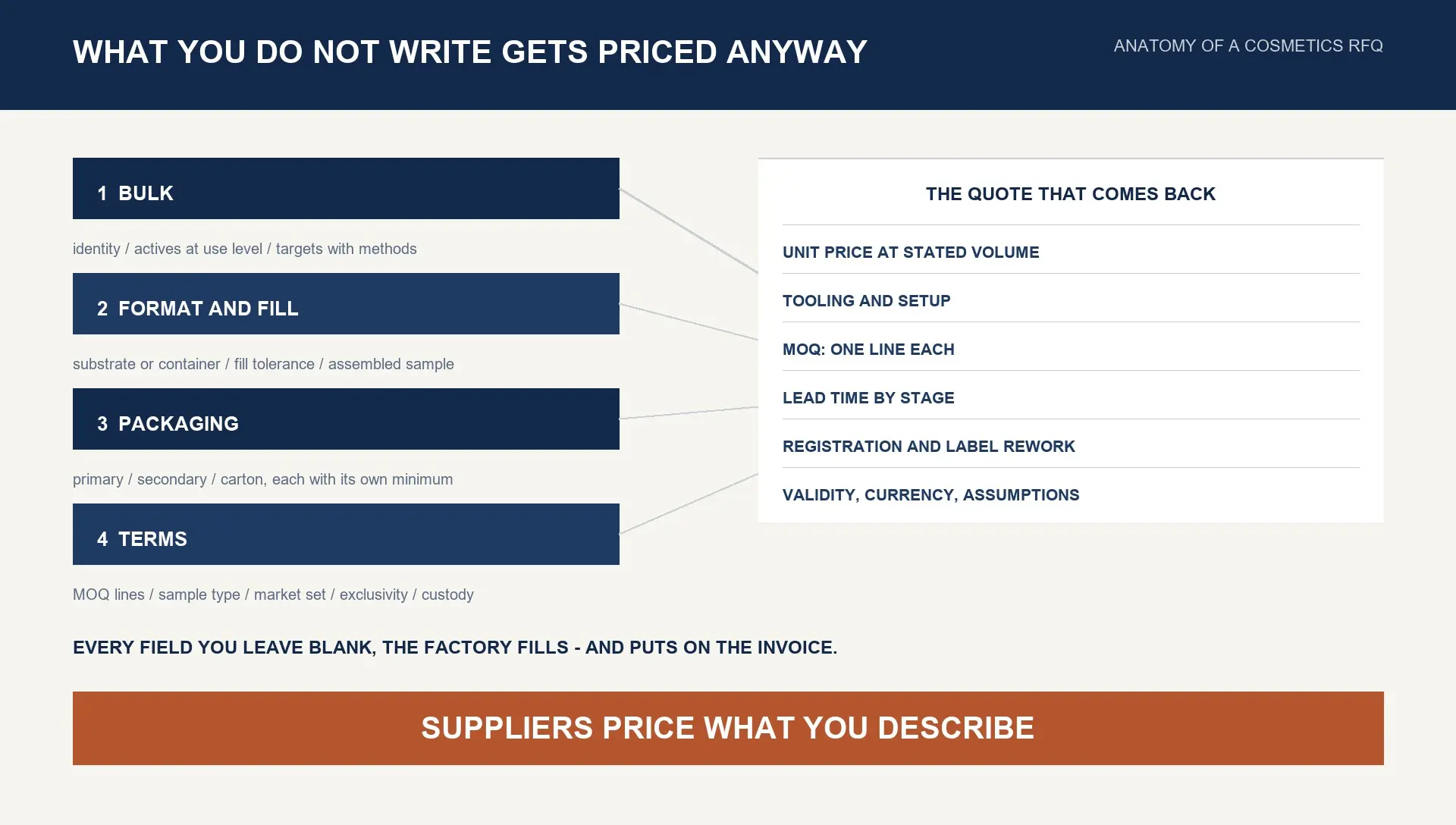
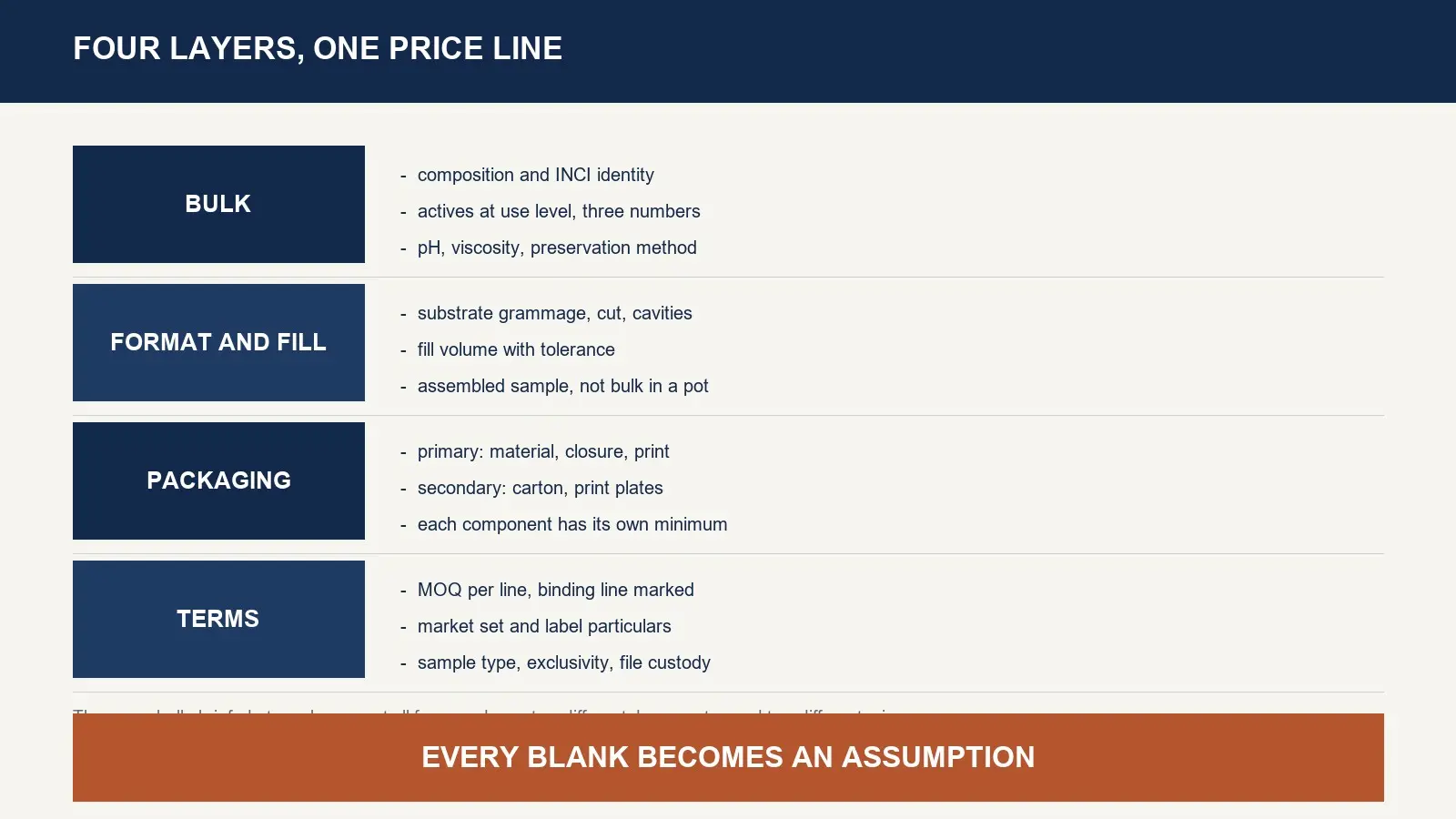
The reason this matters more in skincare than in most contract manufacturing is that the object being priced is a stack, not a line. There is the bulk - a mixture with a composition, a pH, a viscosity, a microbial profile and a stability behaviour. There is the format that carries it: a sheet substrate, a sachet, an airless pump, a jar. There is the packaging around the format: primary, secondary, carton, each with its own supplier, its own minimum and its own print process. And there is the compliance envelope that decides what the finished item is legally allowed to say, which market it can enter, and whose address has to appear on it. Four layers, several suppliers, one number on a quote sheet - and the number is only as comparable as the document that produced it.
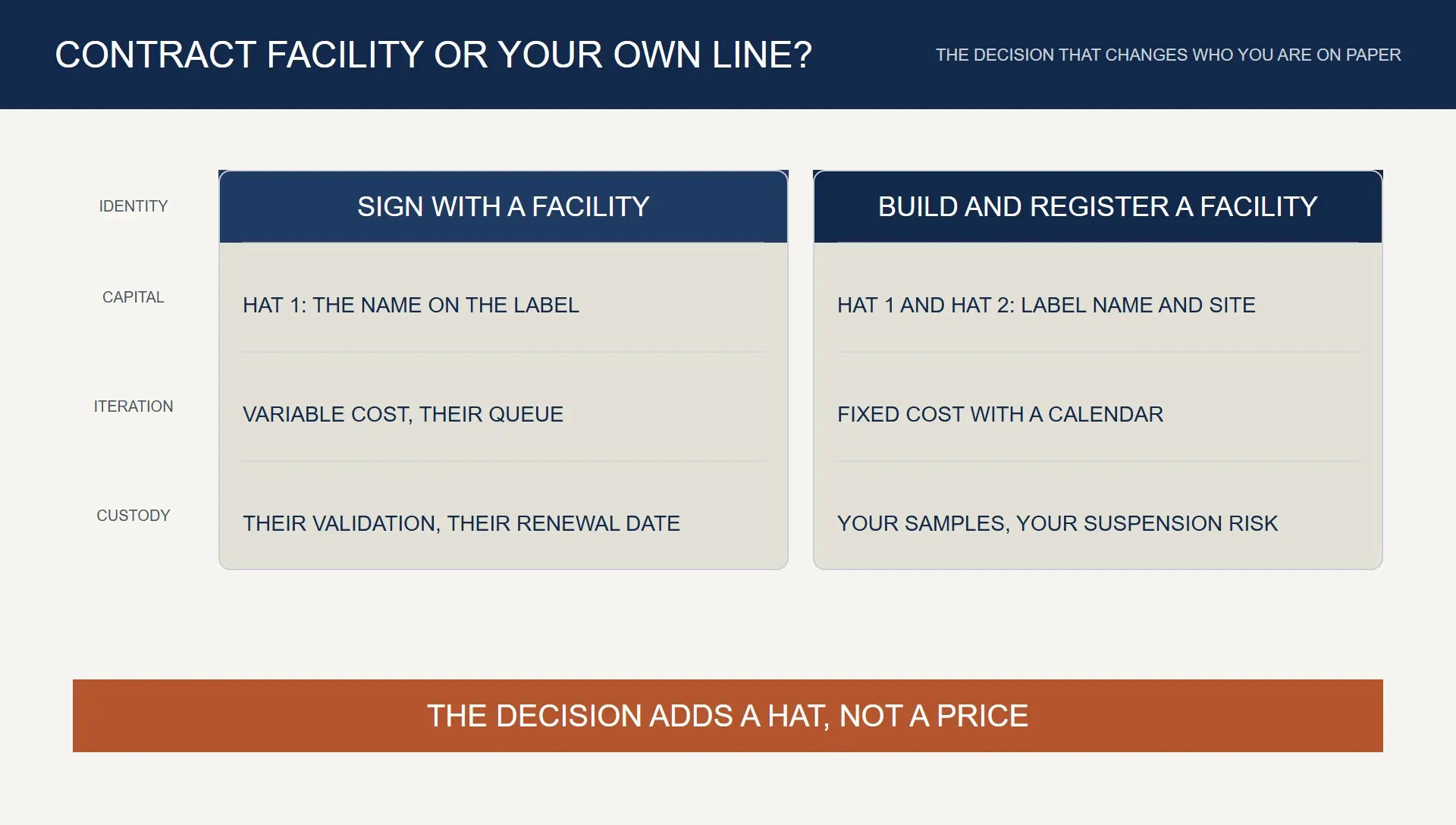
Scope note, so nothing is duplicated. How to vet a factory is answered in the twelve-point audit checklist; how a cost is built is answered in the OEM cost breakdown; which cooperation model to sign is answered in private label versus OEM versus ODM and in the rights-ledger guide; how low a minimum can go is answered in the low-MOQ stack guide; and the launch order that puts these steps in sequence is the five-decision playbook. This piece answers a question none of them answer: what has to be in the enquiry document itself, field by field, so that the quote that comes back is the quote you can compare.
The reader map: a founder ordering a first run, who needs the document to survive contact with a real factory; a procurement lead who receives three quotes and has to defend picking one; a category manager extending a range into a format the business has never filled before. Every section below is written so each of them can find the same field list and the same blank-versus-default logic.
A quote is not an opinion about your product. It is an answer to the specific document you sent - including everything you did not write.
What an RFQ Is - and the Four Documents It Gets Confused With
Request for quotation is one of the most overloaded three-letter terms in the trade, and the confusion is expensive, because each document does a different job and a factory prices only the one you send.
| Document | What it asks | What a correct answer contains | What it cannot do |
|---|---|---|---|
| RFI - request for information | "Do you make this at all, and how?" | Capability statements, site scope, markets served, sample policy in principle | Produce a price you can act on |
| RFQ - request for quotation | "What will this exact thing cost, at these quantities, on these terms?" | Unit price at stated volume, tooling and setup lines, MOQ per line, lead time per stage, validity period, and the assumptions the supplier made | Guarantee that two suppliers interpreted you the same way - unless the fields are named |
| Specification / tech pack | "What is the thing?" | Composition and identity, physico-chemical targets, format and dimensions, materials, artwork, tolerances, test methods | Say anything about price, exclusivity or delivery |
| Quality agreement / COA template | "How do we prove it, batch to batch?" | Release criteria, methods, retained-sample rules, deviation handling, who signs | Fix a cost |
| Manufacturing agreement | "What are our obligations for the next three years?" | Ownership, exclusivity scope, forecasting, minimum purchase, IP, termination and file handover | Replace the RFQ - the price is already agreed by then |
The practical rule is that the RFQ carries a compressed copy of the other four. It does not need the full quality agreement, but it needs the release criteria that affect cost. It does not need the manufacturing agreement, but it needs the exclusivity question, because exclusivity changes the price. It absolutely needs the specification - and this is where most first RFQs fail: the brand describes the outcome it wants ("a hydrating sheet mask, premium feel") and the supplier is left to invent the object.
There is a regulatory reason to think in fields rather than adjectives, and it is worth borrowing directly. The EU cosmetic product safety report must, as a minimum, contain the quantitative and qualitative composition of the product with chemical identity - chemical name, INCI, CAS and EINECS/ELINCS where possible - and each ingredient's intended function; the physical and chemical characteristics and the stability of the product under reasonably foreseeable storage conditions; the microbiological quality, including the results of the preservation challenge test; the purity of substances and mixtures, traces of prohibited substances where relevant, and the characteristics of the packaging material, in particular its purity and stability; and the description of normal and reasonably foreseeable use (Regulation (EC) No 1223/2009, Annex I, Part A, points 1 to 5). Read that list as a purchasing document and the point lands immediately: the regulator has already written your field checklist. Every field you leave out of the enquiry is a field somebody else fills in - the factory by assumption, and the safety assessor later, with change orders.
The specification is not paperwork that follows the product. In this trade, it is the product - everything else is a price for making it.
The Twelve Fields, and the Default Each Blank Invites
Below is the field set. It is deliberately written as field - blank - default - affected quote line, because that is the causal chain a buyer can actually use: you are not filling a form to be tidy, you are refusing to let someone else choose for you.
| # | Field | If you leave it blank, the supplier assumes | Which line of the quote it moves |
|---|---|---|---|
| 1 | Bulk identity - in-house catalogue formula, modified catalogue, or developed from scratch | Whatever is fastest to produce this month | Development fee, minimum batch size, lead time, who owns the formula |
| 2 | Actives at use level - INCI name plus the percentage of the active, not the trade material | The marketing name and its own default dose | Raw material cost, claim support, stability work required |
| 3 | Physico-chemical targets - pH range, viscosity, appearance, fragrance, colour | "Standard" for that format | Excipient choice, preservative system, homogenisation time, reject risk |
| 4 | Microbial and preservation basis - challenge-test expectation and method name | No test, or a test you were not told you paid for | Testing cost, release criteria, shelf-life claim |
| 5 | Format and dimensions - substrate weight and size, cut shape, cavity count, serum volume and fill tolerance | The format they already run | Substrate price, tooling, line speed, units per shift, MOQ |
| 6 | Packaging, three levels - primary, secondary, carton, each with material, closure, print method and artwork state | A packaging set from their current stock list | Tooling, minimum order per component, print setup, freight volume |
| 7 | Target market set - which countries, in which order | The domestic or most common export market | Registration and notification fees, label and carton rework, artwork versions, lead time |
| 8 | Labelling particulars needed - ingredient list order, batch coding, nominal content, warnings, language | A generic label template | Print plates, coding equipment, carton revisions, time |
| 9 | Quantities and forecast - trial run, first order, twelve-month band, repeat cadence | The minimum they can comfortably schedule | Every MOQ line, bulk pricing tier, material reservation |
| 10 | Sample definition - catalogue sample, modified sample, or development sample, and who pays | A free catalogue sample | Sample fee, freight, calendar weeks, expectation mismatch |
| 11 | Lead-time anchor - the date the goods must leave, not the date you want them | That you are flexible | Air versus sea, overtime, material availability, price |
| 12 | Terms envelope - Incoterms, currency, payment, validity period, exclusivity scope, file custody and handover | Their house terms | Effective landed cost, risk allocation, ability to move later |
Three notes keep this honest. First, this is a field list, not a form - a mature buyer sends six of these lines and gets a usable quote for a first sample round; sending all twelve is what you do before a purchase order. Second, the defaults in the middle column are what suppliers tell us they do, not an accusation: a factory that guesses is often guessing the same thing as its neighbours, which is why so many quotes look identical and so many finished products feel generic. Third, no percentage of price variance is quoted here, because there is no verifiable cross-factory figure in public sources; what can be shown is direction and mechanism - which line moves, and why.
The cosmetic manufacturing specification you attach to the enquiry does not have to be long. It has to be complete on the twelve axes. A one-page brief with twelve named lines outperforms a fifteen-page deck with three.
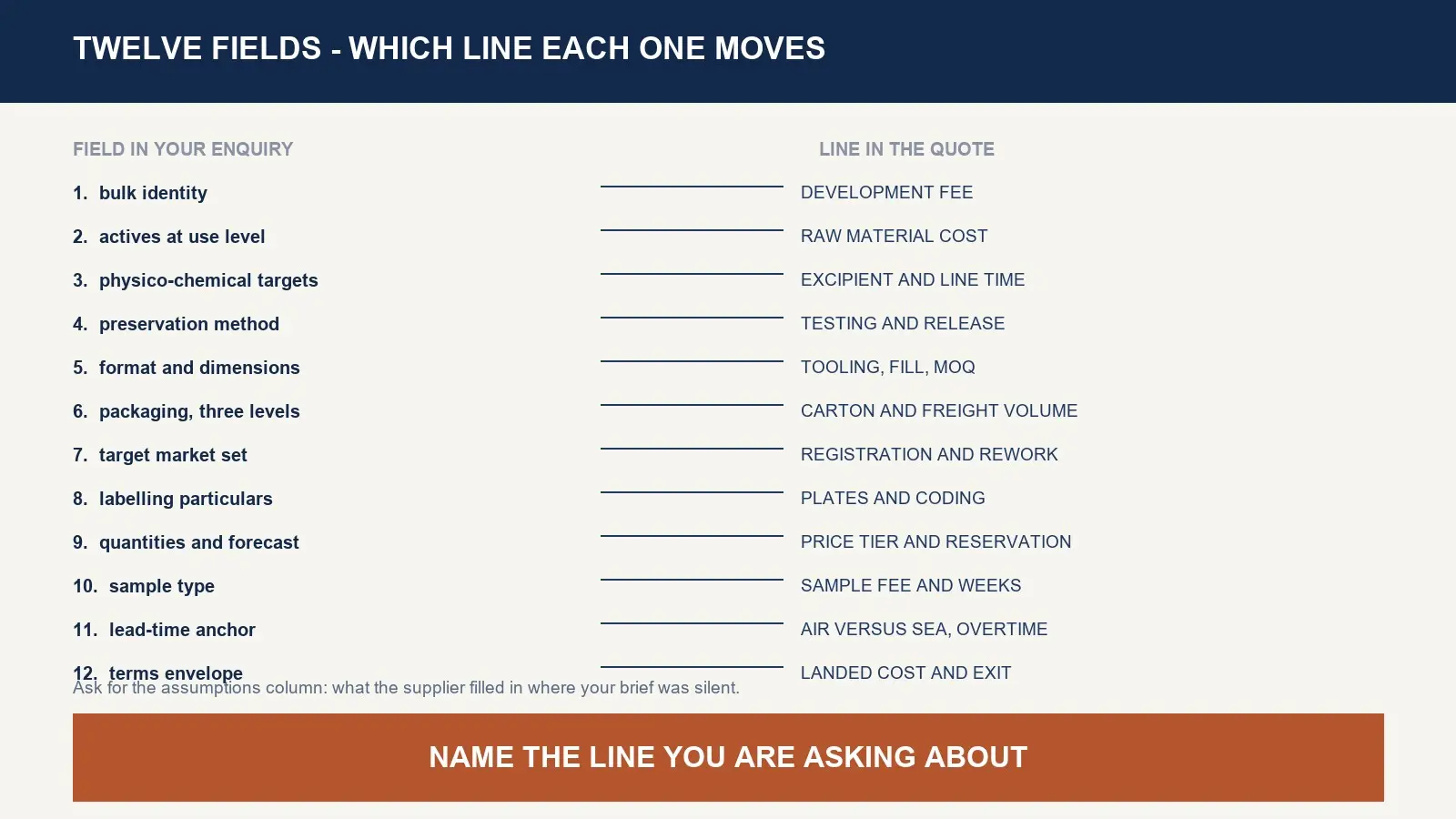
Name the line you are asking about, or accept that somebody else named it for you.
Layer One: The Bulk - Identity, Actives and the Numbers Behind the Name
The bulk layer is where the skincare oem manufacturer conversation either becomes a specification or collapses into a mood board. Three sub-fields carry most of the risk.
Which of the three things are you buying? There are only three objects available: an existing catalogue formula, a catalogue formula with named modifications, or a development from a brief. They differ in every dimension a buyer cares about - fee, calendar, minimum batch, and who owns the result. A modified catalogue formula is where most serious launches live, and the modification has to be named: which ingredient moves to what level, which sensory attribute changes, which claim becomes possible or impossible as a result. "Slightly richer" is not a modification; "increase the fatty-alcohol fraction so the cream passes the 40 degrees Celsius four-week check without phase separation" is.
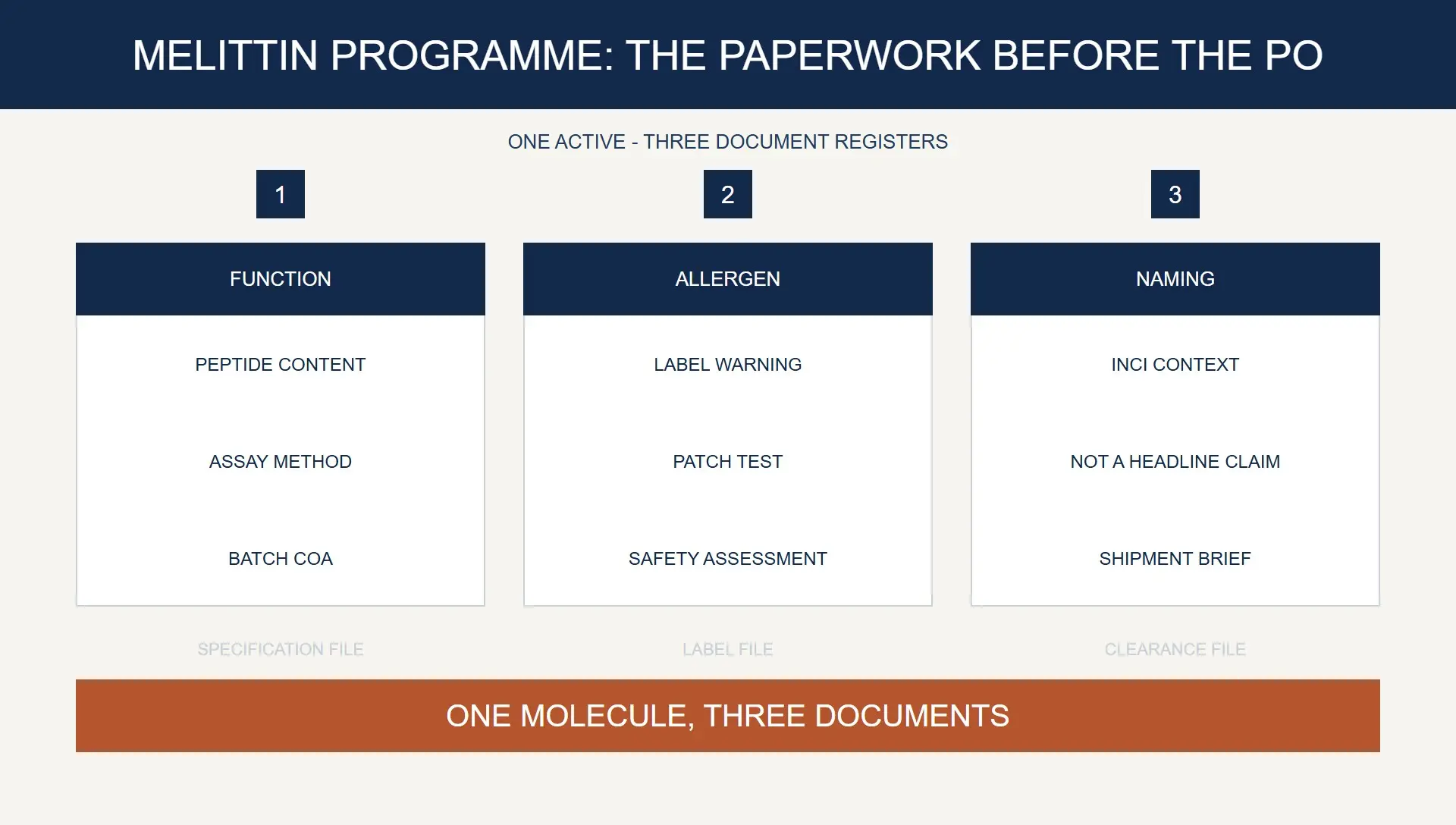
State the active, not the story. This site's guide to peptide architecture explains the mechanism in detail - a supplier's trade-name material can be a mixture carrying a fraction of a percent of the molecule you think you are buying, which is why the correct sentence names the INCI ingredient, the percentage of that ingredient inside the supplied material, and the percentage of that material in the finished formula (the specification guide). The same three-number discipline applies to any active: a botanical extract at 30x concentration is not the same instruction as 0.5 percent of the dry-equivalent. Where an active carries an allergen or a use restriction, the enquiry is also where the warning text gets decided, not discovered at artwork stage - the file-chain logic is worked through for a risk-bearing active in the bee venom guide.
Give targets with methods attached. pH, viscosity, appearance and the microbial basis are testable properties, and a property without a method is a preference. The EU safety report has to contain the product's physico-chemical characteristics and its stability under reasonably foreseeable storage conditions, its microbiological specification including the results of the preservation challenge test, and the purity of substances and packaging-material characteristics (Regulation (EC) No 1223/2009, Annex I, Part A, points 1 to 4). You do not need to reproduce that file in your RFQ - you need to stop writing "stable" and start writing "preservation efficacy to ISO 11930, results reported before first bulk order" (ISO 11930:2019 is the reference method for evaluating the antimicrobial preservation of a cosmetic formulation). One line, and the conversation moves from marketing to laboratory.
One more field in this layer that quietly costs money: what the bulk may not contain. Restricted-substance screens, animal-derived exclusions, the vegan or halal question, fragrance-free or essential-oil-free decisions - each one removes or permits excipients, and therefore removes or permits formula platforms the factory already runs. Say it at the top and the factory quotes from a real platform; say it after sampling and you have paid twice.
Layer Two: Format and Fill - Where the Same Bulk Becomes a Different Product
Two buyers can order the identical bulk and receive quotes that are not comparable at all, because one of them specified the format and the other described it. Format is where the manufacturing line actually touches your product, and every attribute you name is an attribute the planner can schedule.
For a sheet or hydrogel format, the field list is unromantic and specific: substrate type and grammage, cut dimensions and tolerance, the shape and whether a tool already exists for it, cavity count per tray, serum volume per sachet and its fill tolerance, the sachet material and seal parameters, and whether the finished unit is packed wet or assembled on the line. This is the arithmetic the format guides already do - why a substrate is a product decision rather than a packaging one is the hydrogel versus sheet choice, and the specification view of one specific format is the hydrogel mask page guide. What belongs in an RFQ is the numbers, not the reasoning.
For a cream or serum, the equivalent fields are the container geometry and closure, the fill range the line can actually hold, the overfill policy, the tolerances, and whether the device is airless, dropper or jar - because those choices decide which viscosity band the bulk may occupy, and therefore which excipients are available. A formula specified before the device is chosen is a formula that will be re-cut once the device reality arrives. Ask the equipment question early: what the line can do is documented on the capability side of this site's own manufacturing notes, where the homogenisation and substrate handling that decide your viscosity band are described (the equipment and format perspective).
Then there is the field almost nobody sends and almost everyone argues about later: the sample of the finished article versus the sample of the bulk. A beaker of serum tells you about scent, spread and colour. It tells you nothing about how that serum behaves after it has been through a fill line, sat in a carton for six weeks, or been opened in a bathroom. If your format has a delivery mechanism - a sheet, a patch, an airless pump, a dual-chamber system - the RFQ should require the assembled unit at the intended fill, not the bulk in a pot. It is a single sentence, and it is the sentence that prevents the most common post-sample disappointment.
Finally, name the batch-to-batch variables you care about: colour window, scent intensity, viscosity band, weight per unit. Every one you leave unstated is a variable the factory will resolve in favour of its own process stability - which is rational, and is not necessarily your positioning.
Layer Three: Target Market Is a Compliance Field, Not a Shipping Field
Most first RFQs put the destination in the shipping line: "CIF Los Angeles", "DDP Rotterdam", "air freight to Kuala Lumpur". That is the last field to move the price and the first field to move everything else. The market set decides what the product legally is, and therefore which documents must exist before a bulk order can be scheduled at all.
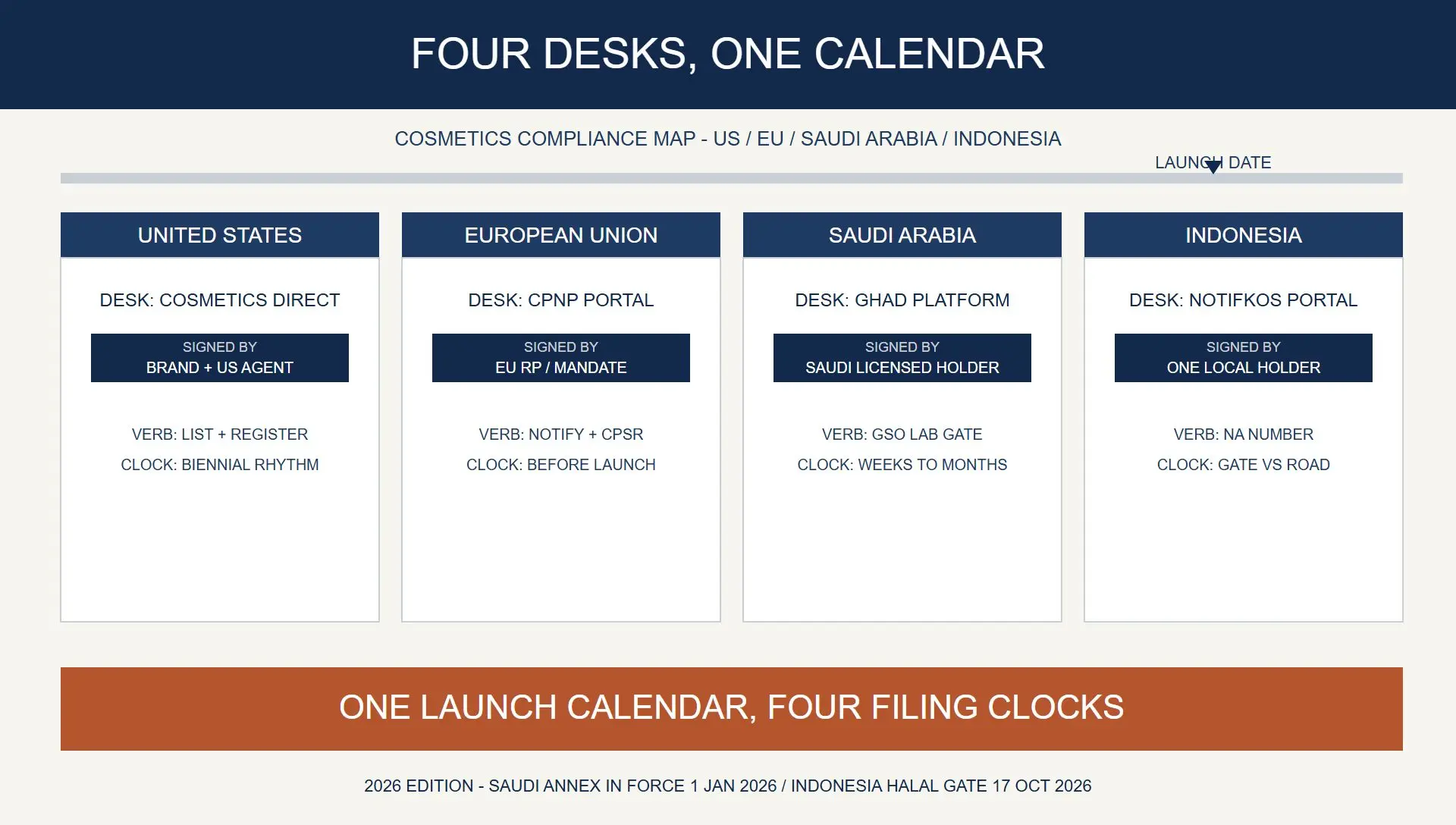
The mechanism differs by regime, and the distinction is the one this site's compliance map makes at length (the four-desk filing map, and for the EU specifically the importer's compliance guide). In the Union, a cosmetic cannot be placed on the market without a responsible person established there, a product information file that contains the Annex I safety report content, labelling under Article 19, and notification through the portal. In the United States, the manufacturing or processing facility must be registered and renewed biennially, while the responsible person - the entity whose name appears on the label - carries product listing, annual updates, safety substantiation records and the fifteen-business-day serious adverse event clock (FDA, Registration and Listing of Cosmetic Product Facilities and Products, page updated 9 September 2026; consulted 15 October 2026). Those are two different people in two different countries holding two different documents, and both of them are named in your enquiry, whether you name them or not.
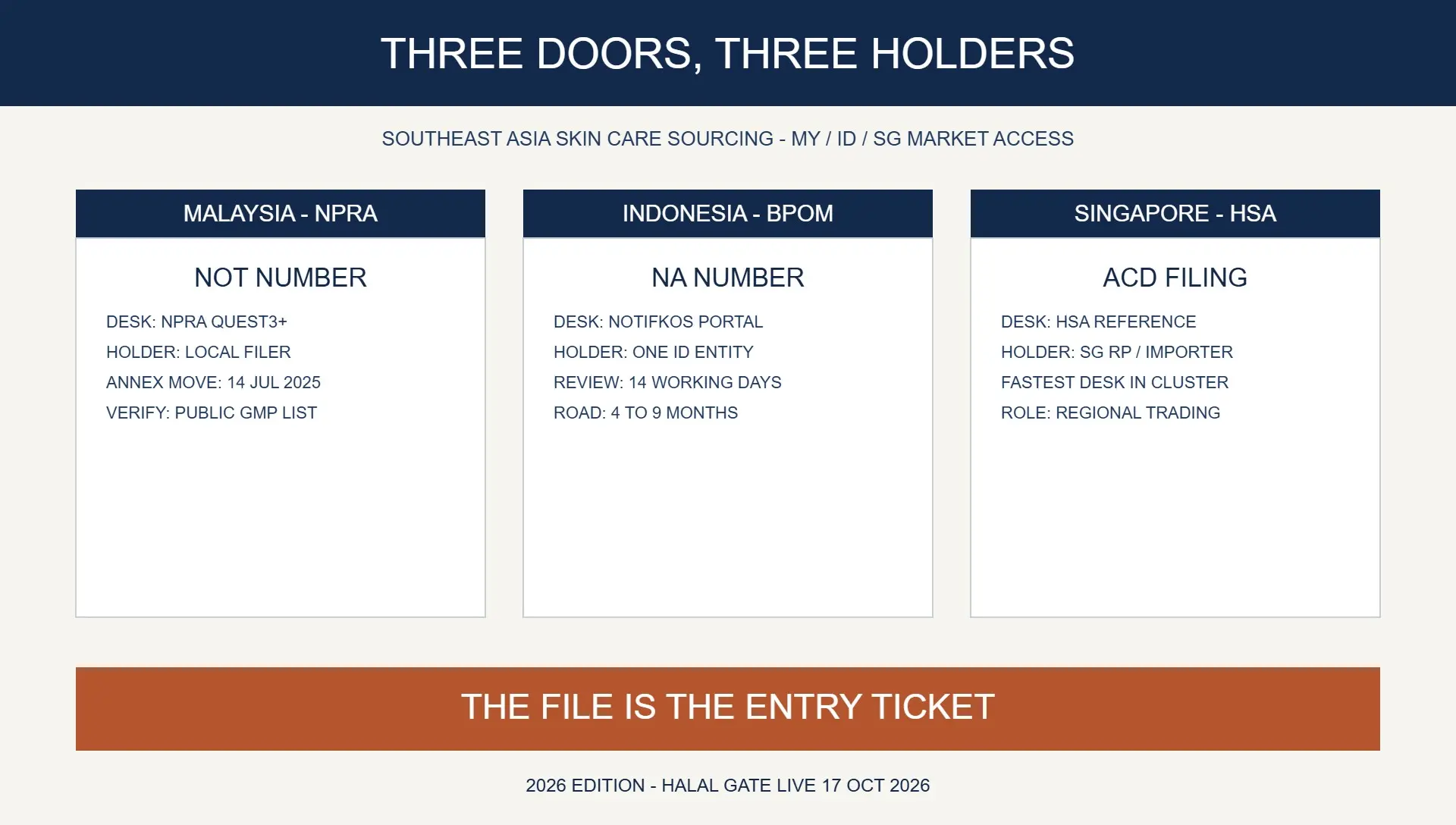
Here is where it becomes a quote line rather than a legal essay. Say the market set is the European Union plus the United Kingdom plus one Gulf market. That single sentence changes: the preservative and filter lists available to the formulator (Annex restrictions differ), the warning text and the ingredient-list presentation, the number of artwork versions and therefore the number of print plates, whether a halal-relevant audit trail is needed at the component level, and the calendar - because a notification or registration step that has to complete before first sale is a gate, not a task. The Southeast Asian pattern is the clearest illustration of the same logic: a notification number that only a local entity can hold, and a lead time measured in months rather than days (the market-access guide).
| If the RFQ names this market | The field that opens up | Who has to exist before the order |
|---|---|---|
| European Union | Safety report content per Annex I; Article 19 labelling; notification; GMP statement under Article 8 | A responsible person established in the Union |
| United Kingdom | Separate notification route and its own label set post-Brexit | A UK-based responsible person or an accepted transfer |
| United States | Facility registration and biennial renewal; product listing; substantiation records | A registered facility, and a named responsible person on the label |
| Gulf and wider GCC | Registration or notification per state, Arabic labelling, sometimes pre-shipment conformity steps | A local authorisation holder in several markets |
| Southeast Asian notification regimes | Local notification numbers held by local entities | An in-country holder, which is a partner decision, not a paperwork step |
The purchasing consequence is simple and rarely stated: a quote for the same product into one market and into four markets are two different products. If your ambition is four markets, ask for the four-market number now, or accept that the later revision arrives as a change order with the leverage reversed.
The destination line in your enquiry is not about freight. It decides which documents must exist before your bulk can be scheduled.
Layer Four: Terms - MOQ Lines, Sample Type, Lead-Time Anchor, Exclusivity, Custody
The fourth layer is where the custom cosmetic manufacturer conversation separates from the catalogue one, because custom work has terms attached that a shelf item does not.
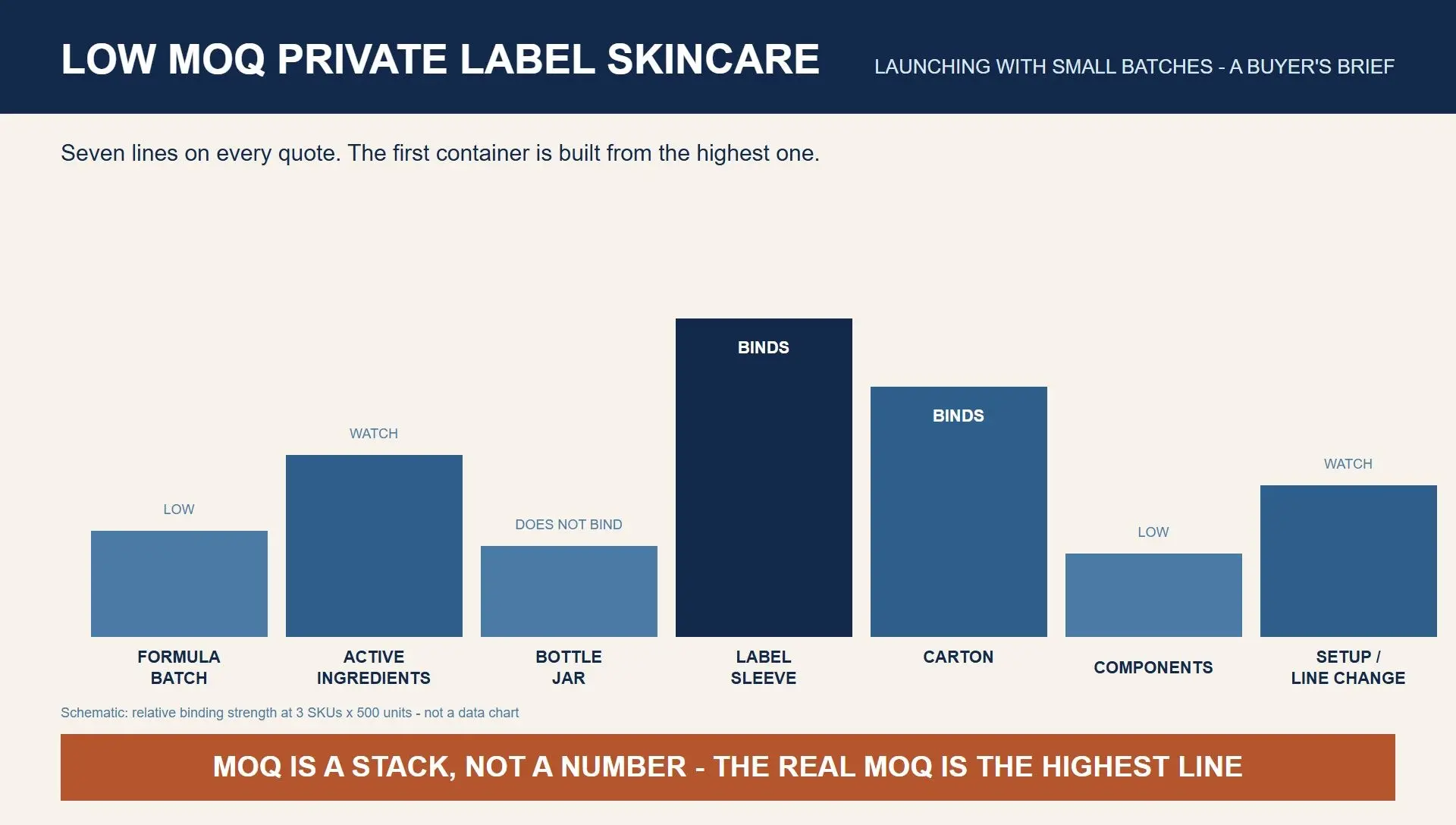
Minimums are asked line by line, never as one number. The reason is worked out in the low-MOQ stack guide and is not repeated here: a batch minimum, a component minimum, a print minimum and a carton minimum are four different suppliers with four different economics, and the binding one is usually not the bulk. What belongs in the RFQ is the request itself - "quote each line separately, and mark which line binds at my stated quantity" - plus your twelve-month band rather than a single optimistic order figure.
Sample type is a priced object. Three things get called a sample: a catalogue unit from the shelf, a modified unit built on an existing platform, and a development unit made against your brief. They differ in fee, in weeks, and - decisively - in who owns the resulting formula. Ask by name. If you ask for "a sample" and receive a shelf item, you have spent three weeks confirming that somebody else's product is not yours. The same discipline applies in reverse: if you want a development, ask what happens to the fee when the first bulk order follows, and get the answer in writing rather than in a sales email.
Give the factory a date to fail towards. "Lead time: 30 days" invites a defensive number. "Goods must leave in week 34 because the launch window is fixed; tell me which line is the constraint" invites a plan. The anchor is also where the packaging reality surfaces - the component that has the longest print or production cycle is usually the true schedule, not the bulk, a point the low-MOQ guide makes for first containers and which applies equally to a launch calendar.
Exclusivity is a scope question, not a favour. Territory, term and scope - and scope means the specific formula, not the category. A supplier who grants "this serum is yours" may be handing you a version of a base it sells to others with a different label. If exclusivity matters to your pricing, ask for it in the same document, and ask what it costs; exclusivity that is free is usually a promise that can be withdrawn. The ownership logic behind this - who holds the formula, the molecule name, the exclusivity and the compliance file - is the subject of the rights-ledger guide.
File custody belongs in the enquiry too. Ask, before you order, which documents exist for your product, who holds them, whether you receive copies, and what happens to them if you move production. This is the question that decides whether a later supplier change is a transfer or a restart - and it is the same question a risk-bearing active raises from the safety side (the five-file chain).
Terms asked at quotation stage cost a paragraph. Asked after the first purchase order, they cost a renegotiation - and the field list does not change with the label on the supplier: put the same twelve questions to an oem skincare manufacturer, a contract facility or a private-label house and the answers arrive in the same shape, which is precisely why they are worth standardising before you start comparing anyone.
Every term you ask for before the order is cheap. Every term you discover afterwards is a negotiation you have already lost.
Same Requirement, Three Ways to Write It
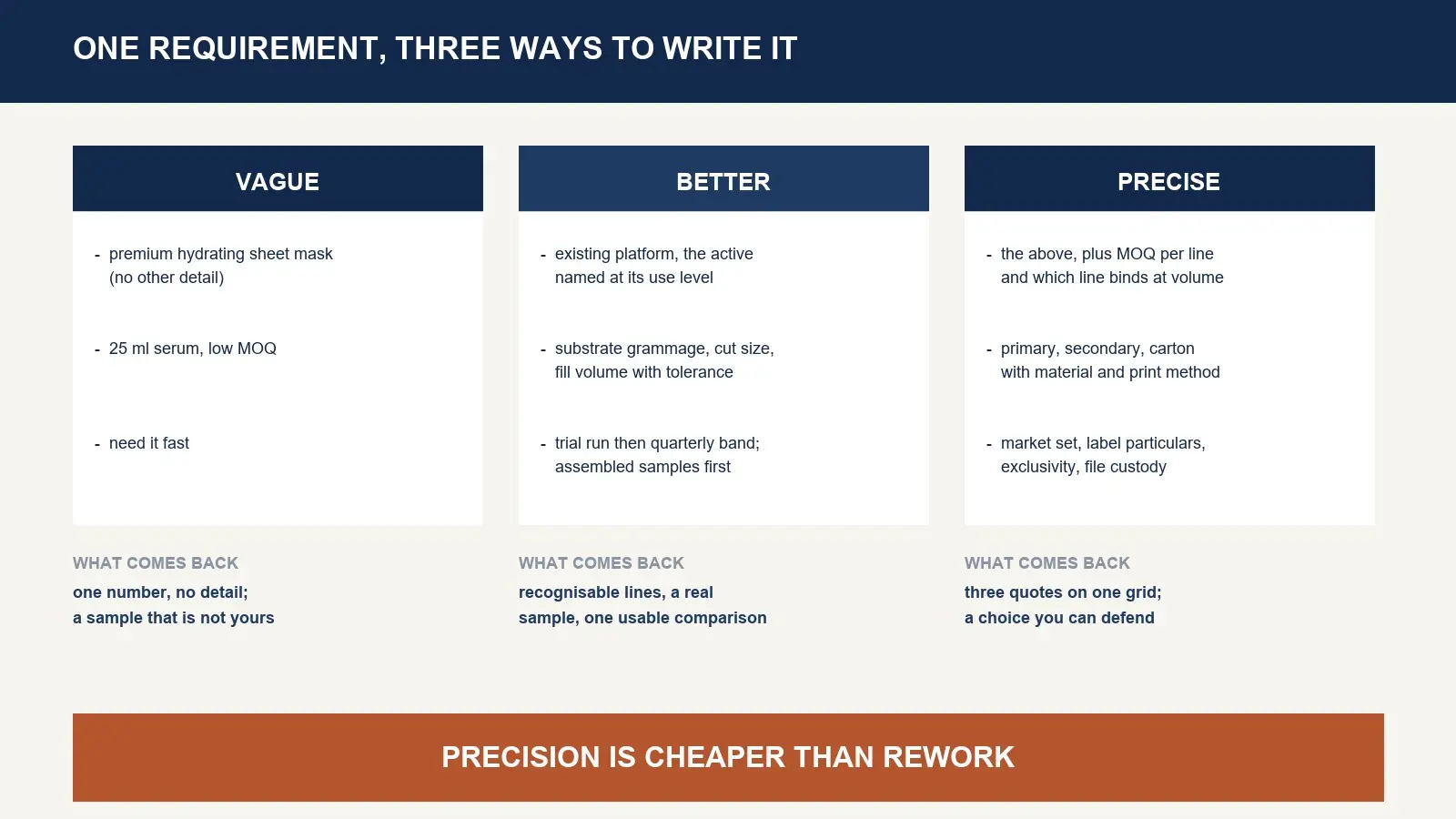
The fastest way to feel the difference is to write one requirement three ways and read what each one buys you. Below, the requirement is the same in all three rows: a hydrating sheet mask for a European launch with a second market later.
| What the enquiry says | What the supplier must assume | What comes back | |
|---|---|---|---|
| Vague | "Premium hydrating sheet mask, 25 ml serum, low MOQ, need it fast." | Their house formula, their existing die, their standard sachet, one market, minimum batch they can schedule, catalogue sample | One price, no comparable detail, and a sample that is somebody else's product |
| Better | "Existing platform with hyaluronic acid at named use level; 22 g Tencel-type substrate, 18 x 24 cm folded, 25 ml fill plus or minus 1 ml; aluminium sachet; EU launch, UK added later; trial 2,000 units, then 10,000 per quarter; assembled samples first; goods leaving week 34." | Little about the object; still assumes terms, print state, component ownership, challenge-test scope | A quote with recognisable lines, a real sample, and a usable comparison against one other supplier |
| Precise | The above, plus: each MOQ line quoted separately with the binding line marked; primary/secondary/carton each with material, closure, print method and artwork status; preservative efficacy to the named method with results before first bulk; pH and viscosity bands with tolerances; restricted-substance and animal-derived exclusions stated; two-market label sets with language and mandatory particulars listed; sample type and fee treatment in writing; exclusivity scope by formula; file list, custody and handover terms; quote validity period and currency. | Almost nothing | Three quotes that can be laid on one grid, and a decision you can defend internally |
Notice what the third column does not do: it does not ask for a lower price. Precision is not leverage against the supplier - it is leverage against your own uncertainty. The factory that receives the precise brief and quotes honestly is the one you want; the one that inflates on contact with detail was going to surprise you later anyway.
There is also a self-selection effect worth exploiting. Ask for the assumptions column: require every quotation to list what the supplier assumed where your brief was silent. It costs the supplier nothing, and it converts their private defaults into your public document - which is exactly the information a buyer usually extracts over three phone calls, if at all.
Comparing Two Quotes: Put Them on One Grid Before You Read the Price
Buyers compare quotes by reading two numbers and choosing the smaller one. That habit is the reason so many first orders go wrong, because a cosmetic oem manufacturer quotation is not a number - it is a bundle of twelve decisions, and two suppliers can arrive at the same figure having made entirely different ones.
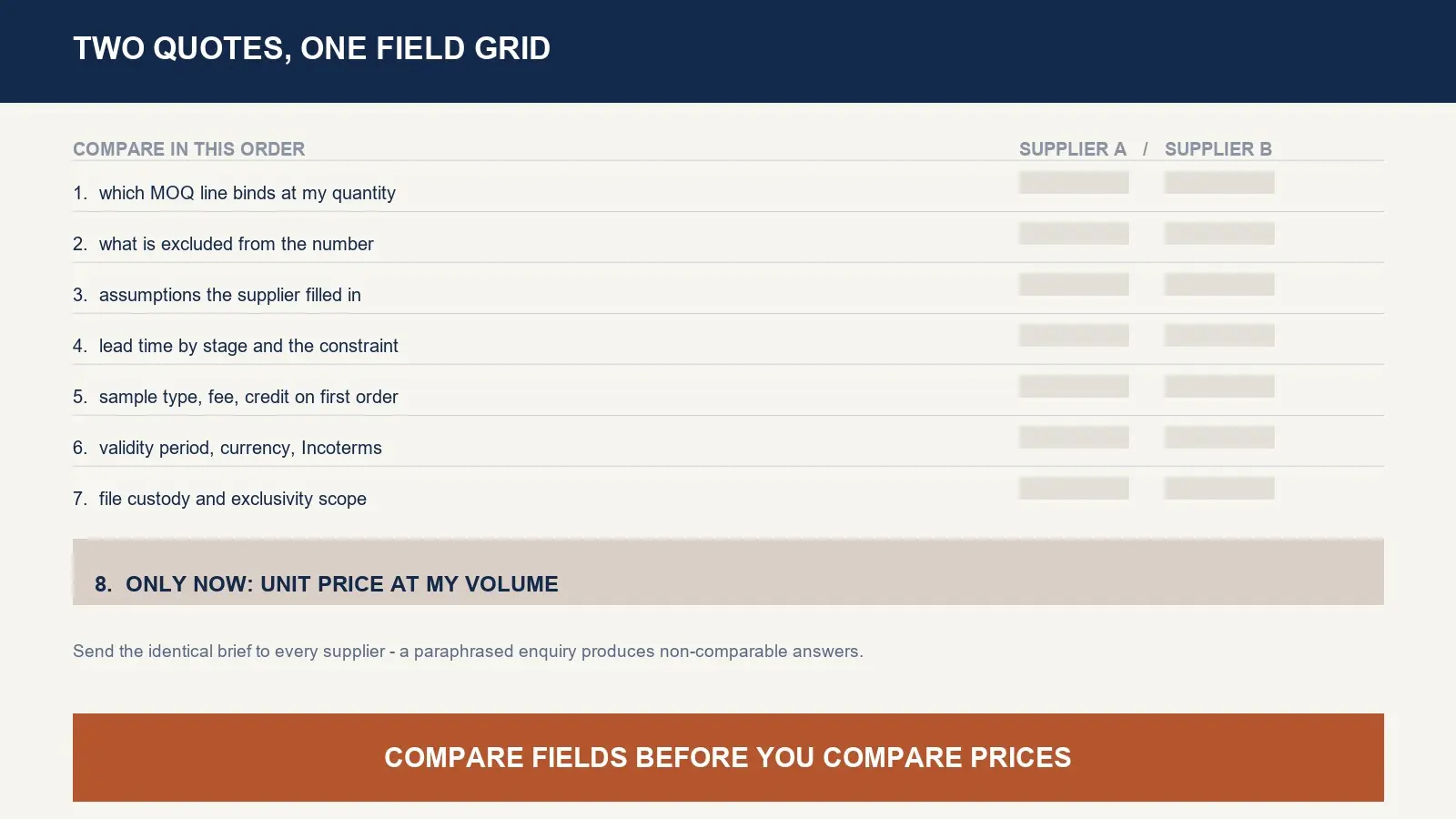
The fix is procedural. Require the quotation to come back in your format, on your field grid, with the same lines in the same order. Then compare in this sequence:
| Step | What you check first | Why it comes before price |
|---|---|---|
| 1 | Which MOQ line binds at your quantity, per component | A quote that binds on a carton minimum you did not know about is not a quote for your volume |
| 2 | What is excluded: testing, stability work, tooling, artwork, registration support, freight, insurance | The excluded items are where the real landed cost hides |
| 3 | The assumptions column - what the supplier filled in where you were silent | Two identical prices with different assumptions are different offers |
| 4 | Lead time by stage, and which stage is the constraint | A cheaper unit that misses your launch week costs more than the difference |
| 5 | Sample type, fee and whether it is credited on first order | This is where a development conversation usually stalls |
| 6 | Validity period, currency and Incoterms | A quote without a validity date is an option someone else holds |
| 7 | File custody, exclusivity scope, handover terms on exit | Decides whether changing suppliers later is a transfer or a restart |
| 8 | Then the unit price at the stated volume | Only now is it a comparable number |
Two supporting habits make this stick. First, keep a field register for the category: the same twelve axes reused across every enquiry, so your third supplier conversation is faster than your first and your internal reviewer can see why you chose what you chose. Second, when you send the same brief to several suppliers, send it identically - a paraphrased enquiry produces non-comparable answers and the buyer usually blames the suppliers.
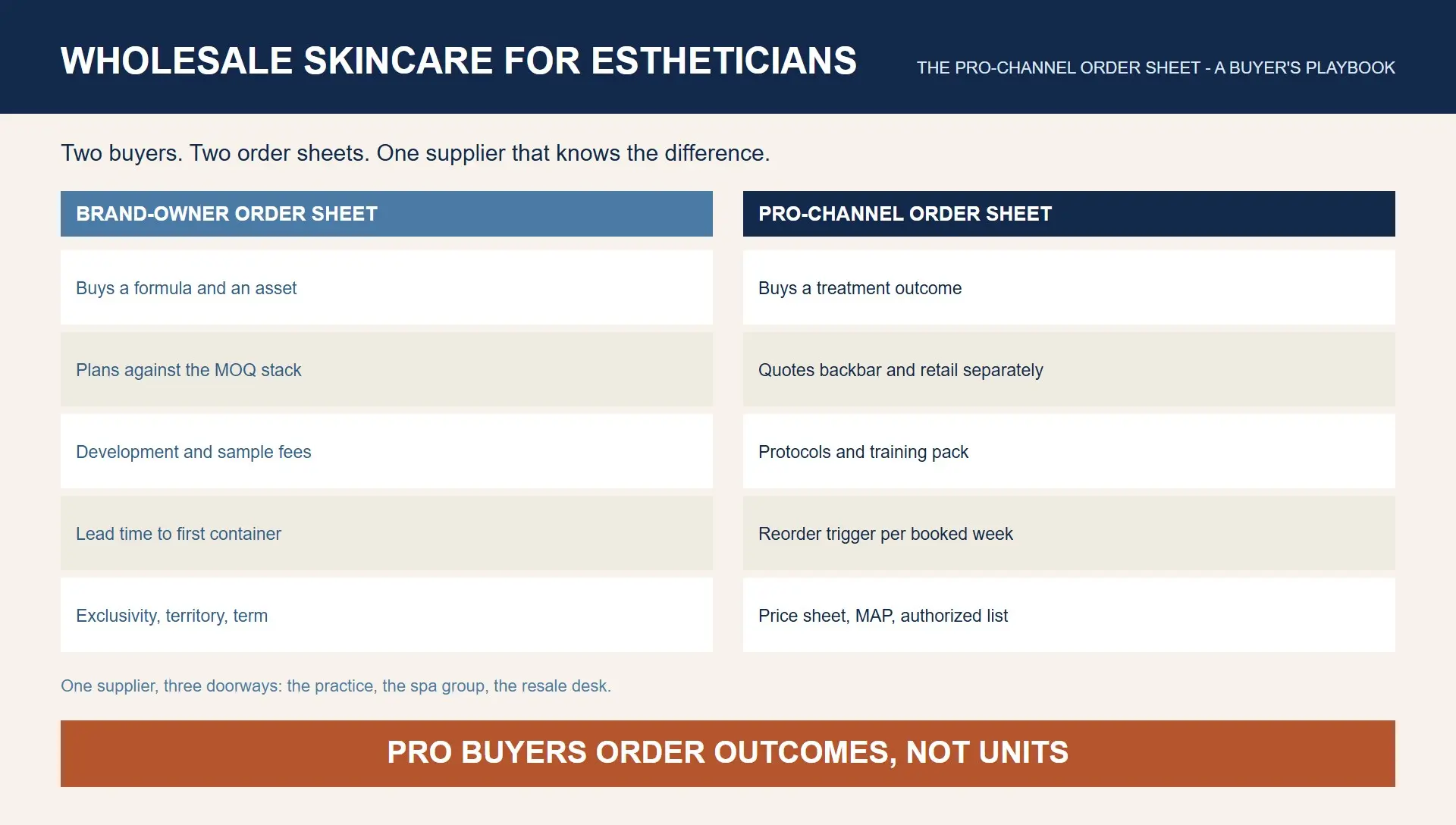
For the professional channel - spas, clinics, distributors buying a treatment line rather than a retail range - the same grid applies but the weighting changes, because backbar sizes, protocol sheets and price protection are additional lines on the sheet (the channel order-sheet guide). And if you are weighing whether any of this belongs in-house instead, the trade-off is a different question, answered as one (make or buy).
Compare the twelve decisions first. The unit price is only comparable after they are.
Seven Ways an RFQ Fails Quietly
None of these failures produce an error message. They produce a quote, a sample, and then a surprise - which is why they are worth naming in advance.
| Failure mode | Early signal | The one line that prevents it |
|---|---|---|
| Over-specified, too late | The brief arrives after sampling and re-prices everything | Freeze the fields that affect cost before the sample round; keep the cosmetic details open |
| Under-specified, too cheap | The lowest quote is also the shortest | Require the assumptions column; short answers mean invented defaults |
| Sample ambiguity | "We will send you a sample" with no type named | Name catalogue, modified or development sample, and who pays |
| Packaging not costed | Bulk price quoted; component prices "TBC" at order stage | Require primary, secondary and carton each with minimum, tooling and print method |
| Market scope missing | Label artwork surprises after the first production plan | State the market set and the mandatory label particulars you need in each |
| Exclusivity unstated | A competitor launches a near-identical claim from the same platform | Ask what is exclusive, in what territory, for what term, over which formula |
| Validity expired | A "quote" from eleven weeks ago used as a budget | Require a validity period and a currency on the face of the quotation |
There is an eighth, softer failure that is really a posture: sending a brief written for persuasion rather than for production. A document that spends two pages on brand story and four lines on the object produces a supplier who is selling to you, not building for you. The remedy is boring and reliable - put the field grid first, the narrative second, and keep the whole thing to two pages.
Frequently Asked Questions
Q1: How long should an RFQ be? Two pages. Length is not the goal; completeness on the twelve axes is. A one-page enquiry that names bulk identity, actives at use level, format and fill numbers, packaging at three levels, market set, quantities, sample type, lead-time anchor and terms beats a fifteen-page brand deck with three of them.
Q2: Should I send the same brief to several suppliers? Yes - identically. Any paraphrase changes the assumptions, and different assumptions produce prices that cannot be compared. Send the same document, require the same reply format, and put the answers on one grid.
Q3: Can I ask for a price before I have a formula? You can ask for a band, and a competent supplier will give one with the assumptions stated. What you cannot get is a comparable number, because the bulk is the largest single variable in the quote. Ask instead for their catalogue platforms nearest your brief and price two of them.
Q4: What is the one field buyers most often skip? Packaging detail - specifically the component minimums and print methods. It is the field that most often turns out to be the binding line, and the one that surprises buyers after the bulk price has been agreed.
Q5: Is an oem sample request the same thing as a pre-production sample? No, and the difference is commercial. A shelf or catalogue sample proves scent, colour and spread. A pre-production sample is built on the intended line, in the intended component, at the intended fill, from the intended batch. Only the second one tells you what your customer will receive.
Q6: Should I reveal my target price in the RFQ? Reveal the structure, not the number, until you have comparable quotes: your volume band, your market set, your packaging ambition and your launch week. Those let a supplier tell you what is achievable. A target price stated early mostly buys you a re-engineered formula you did not ask for.
Q7: What documents should exist by the end of the quotation stage? A specification you own, a quotation with an assumptions column, a sample evaluation record, the test and release criteria for the product, and a written statement of who holds each file. Those five are what make a second supplier conversation a transfer instead of a restart.
Sources and Further Reading
Regulatory and standards documents (primary) - Regulation (EC) No 1223/2009 of 30 November 2009 on cosmetic products - Article 8 (good manufacturing practice), Article 11 (product information file, including the description of the method of manufacture and the statement on GMP compliance), Article 19 (mandatory labelling particulars: nominal content, batch number, function, ingredient list and its ordering rules), and Annex I, Part A, points 1 to 5 (minimum content of the safety report: quantitative and qualitative composition with INCI/CAS identification; physico-chemical characteristics and stability; microbiological quality including preservation challenge results; impurities, traces and packaging-material characteristics; normal and reasonably foreseeable use). EUR-Lex consolidated text, consulted 19 October 2026. - ISO 11930:2019, Cosmetics - Microbiology - Evaluation of the antimicrobial preservation of a cosmetic product (reference method for the preservation efficacy test). Standard scope text, consulted 19 October 2026. - US Food and Drug Administration, Registration and Listing of Cosmetic Product Facilities and Products (page updated 9 September 2026) - facility registration and biennial renewal under section 607(a)(2), responsible-person definition and product listing duties, and the published counts of registered facilities and listed products as of 30 June 2026. Consulted 15 October 2026.
Market context - Mordor Intelligence, personal care contract manufacturing assessment (11 September 2026): US$27.03B in 2026 from US$24.98B in 2025, reaching US$40.09B by 2031 at 8.21 percent CAGR. Persistence Market Research (24 July 2026): North America holding roughly 31 percent of the segment in 2026, Asia-Pacific the fastest-growing region. Both are third-party research-house estimates with different boundaries; quoted as a range, not as a forecast of your category.
On this site - The twelve-point factory audit checklist - verifying a supplier, as opposed to briefing one. - The OEM cost breakdown - how a quote is built, which this piece deliberately does not restate. - Private label versus OEM versus ODM and the rights-ledger guide - which model, and who owns what. - The low-MOQ stack guide - why minimums are a stack of lines, not a number. - Peptide specification guide - the three-number discipline for actives, applied to one ingredient family. - The EU importer's compliance guide and the four-desk filing map - what the market-set field actually triggers.
What to do next
If you are briefing a production run for 2027, send us your field grid - or ask for ours. We quote each line separately (bulk, component, print, carton), mark which line binds at your quantity, list every assumption we made where your brief was silent, and return the specification, test criteria and file list in your name. Standard response within 24 hours, standard samples in 7 days, MOQ from 1,000 pieces.
Get the RFQ template, your quote and the MOQ table - tell us the format, the market set and the launch week, and we will price that, not a substitute.