
OEM Skincare Manufacturer Malaysia: SEA Market Access Guide
Sourcing Into Southeast Asia Is a Filing Question Before It Is a Formula Question
Type oem skincare manufacturer malaysia into a search box and the page fills with factory profiles: plant photos, certification badges, capacity claims. Almost none of it answers the question the phrase is really asking. A buyer typing those words is not shopping for a production line — they are trying to land skincare in Malaysia, Indonesia and Singapore, three markets where the product cannot legally exist on a shelf, a sampling table or an online listing until a local entity has filed and holds a number for it. The manufacturing is the easy half. The filing is the market.
That distinction changes the order of every conversation you will have this quarter. On the brand side, the five decisions — range, model, factory, sampling, compliance — are sequenced once in the 2026 launch playbook, and the ownership lines of each sourcing model are settled in the three-model guide. This piece covers what those guides deliberately left to a regional chapter: what happens when the market you are selling into runs on ASEAN Cosmetic Directive filings instead of MoCRA registration or CPNP, who is legally allowed to hold your product's number, and what a factory — Malaysian, Singaporean or Chinese — can and cannot hand you against those files.
Why now, in concrete terms: Indonesia's mandatory halal certification for cosmetics takes effect on 17 October 2026 — seven days from today's date. Under Government Regulation No. 42 of 2024, per a regulatory guide published 2026-08-13, cosmetics without BPJPH halal certification cannot be legally marketed in Indonesia after that date even if the BPOM notification number is valid. A halal file is not a stamp — it is a supply-chain audit of raw materials, process, packaging and storage. Brands treating this as a paperwork errand in October are discovering the paperwork has a lead time measured in months.
Scope discipline, so this is not a second MoCRA essay or a second halal guide. The US regime lives in the MoCRA enforcement piece, the EU one in the importer's compliance guide, and the halal sourcing method — audit scope, certification bodies, documentation — is answered once in the Halal OEM buyer's guide. Here, halal appears exactly where Southeast Asia makes it a filing gate and nowhere else.
In this region, the factory conversation starts with the dossier — everything else is a spec sheet.
The Regional Board, Read by Role: Manufacturing Desk, Registration Wall, Trading Counter
Before comparing countries, compare what the numbers can honestly say. Contract-manufacturing market sizing comes from global studies, and the two most quotable disagree because they count different things:
| Institution (report date) | What is actually counted | Base value | Forecast | The boundary that moves the number |
|---|---|---|---|---|
| Research and Markets (2025) | Global cosmetics contract manufacturing | US$17.8B (2023) | US$22.17B by 2028 · CAGR 4.4% | narrow "cosmetics CM" scope |
| Ocean Business (via Taiwan News, 2025-04-09) | Global personal care contract manufacturing | — | US$34.33B by 2030 · CAGR 8.04% | broader personal-care scope |
| Statista (2025) | SEA-6 personal-care retail revenue by country | Thailand ranks #1 among the six markets | — | revenue, not manufacturing |
| Industry trends deck (2025-11, republished copy) | Southeast Asia skincare retail | ≈ US$36.14B projected by end 2025 | — | retail demand, not CM supply |
Read the rows against the question you actually have. There is no authoritative "Southeast Asia contract manufacturing" figure in these sources — the two global numbers bound the industry at different scopes, the Statista row ranks demand countries, and the fourth row is a republished industry deck we flag as secondary and unaudited. Quoting any of them as "the SEA OEM market" would be fabrication. The honest read: demand in the region is large and demand-side rankings are public; the supply story has to be assembled country by country. That assembly is this article.
The three roles on the board are worth fixing in your head before any supplier shortlist:
Malaysia is the verification market. It is the one jurisdiction in this cluster where the regulator itself publishes a list of cosmetic manufacturers compliant with the ASEAN Guidelines for Cosmetic Good Manufacturing Practice — a page NPRA maintains and updates (its English manufacturer-compliance listing was current as of 28 September 2026). A claim becomes something you can open in a browser. We return to that in H2 五.
Indonesia is the registration wall. The largest Muslim-majority consumer market in the cluster, run on BPOM notification numbers (NA / Nomor Izin Edar) that every unit — including testers and event giveaways — needs before it touches a consumer, with the 2026-10-17 halal gate stacked on top. H2 四 walks the wall.
Singapore is the trading counter. Not bulk capacity — a regional desk: responsible-person filings, kitting and repack economics, premium listings, and the headquarters location for the distributor who will end up holding your numbers whether you planned that or not. H2 六.
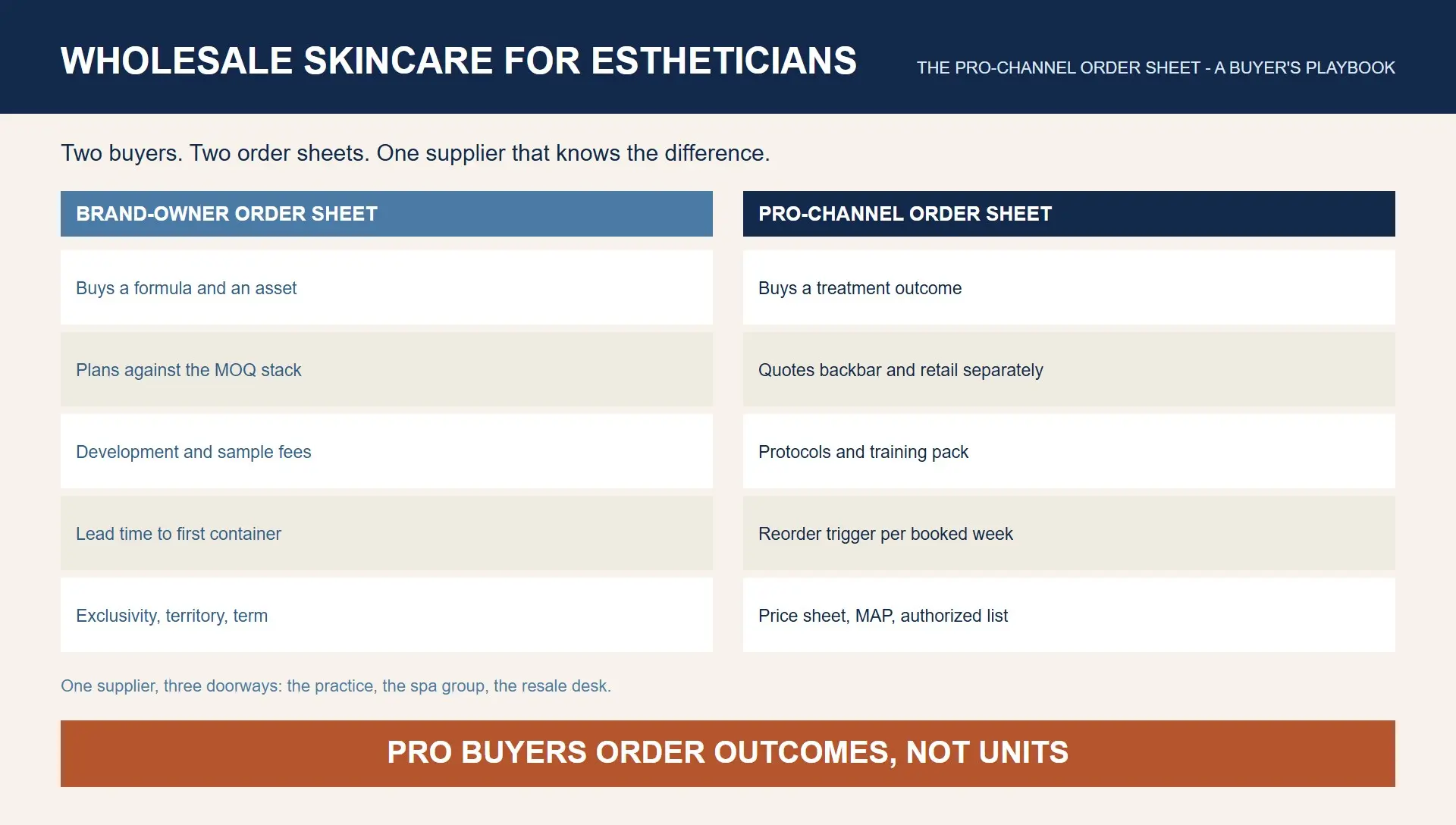
One more role you will meet on every quote: the distributor who is not a fulfillment company. In this region the same local entity frequently combines customs importer, notification holder and retail-channel operator — which concentrates leverage in one signature. The professional-channel guides on this site cover how channel partners buy (the esthetician/reseller split); in Southeast Asia, add one fact: whoever holds your NA number is the channel.
The regional board is not a cost map — it is a paperwork map: verify in Malaysia, register in Indonesia, desk in Singapore.
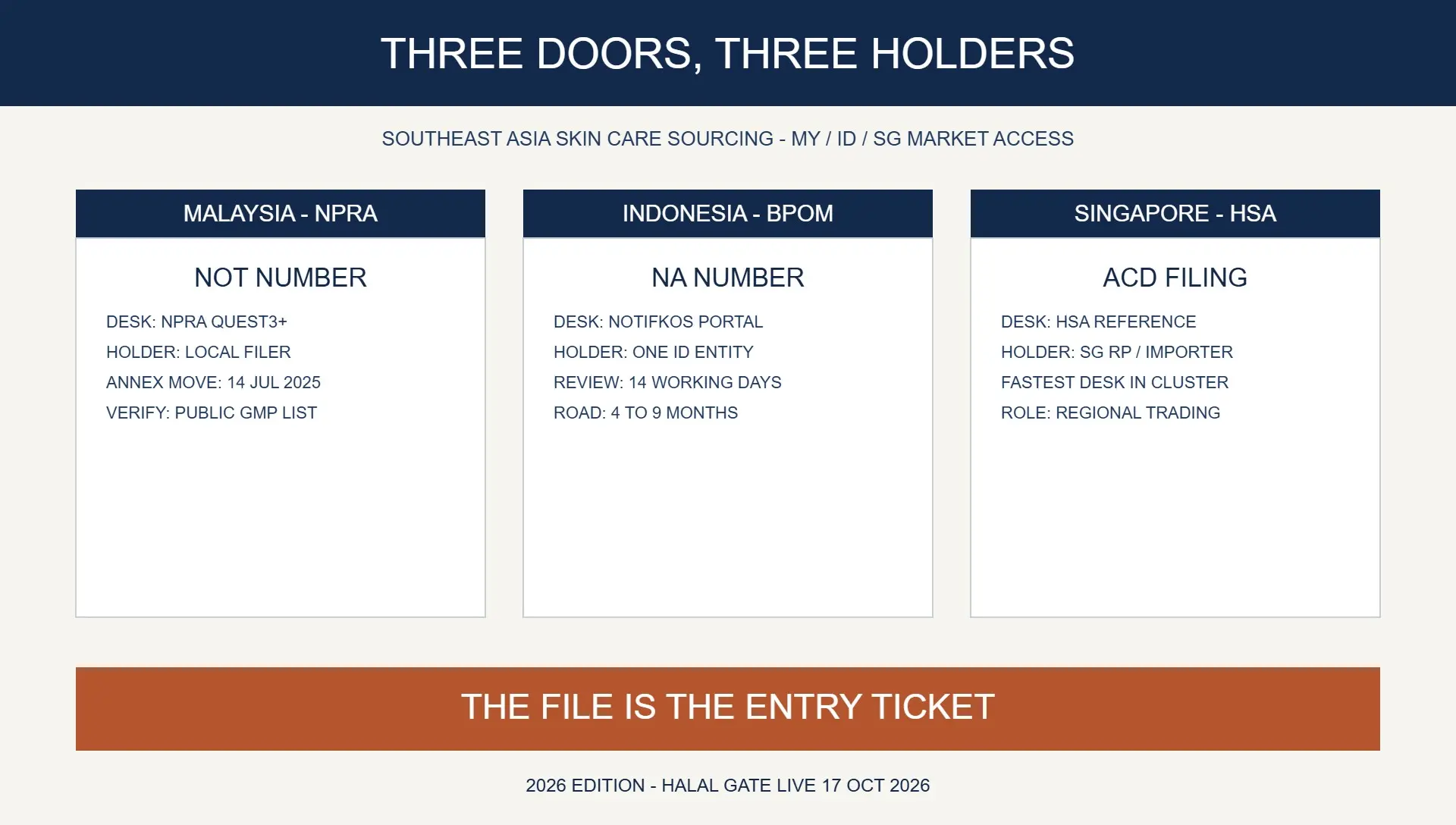
Three Doors, Three Dossiers: Who Holds the Number in Each Market
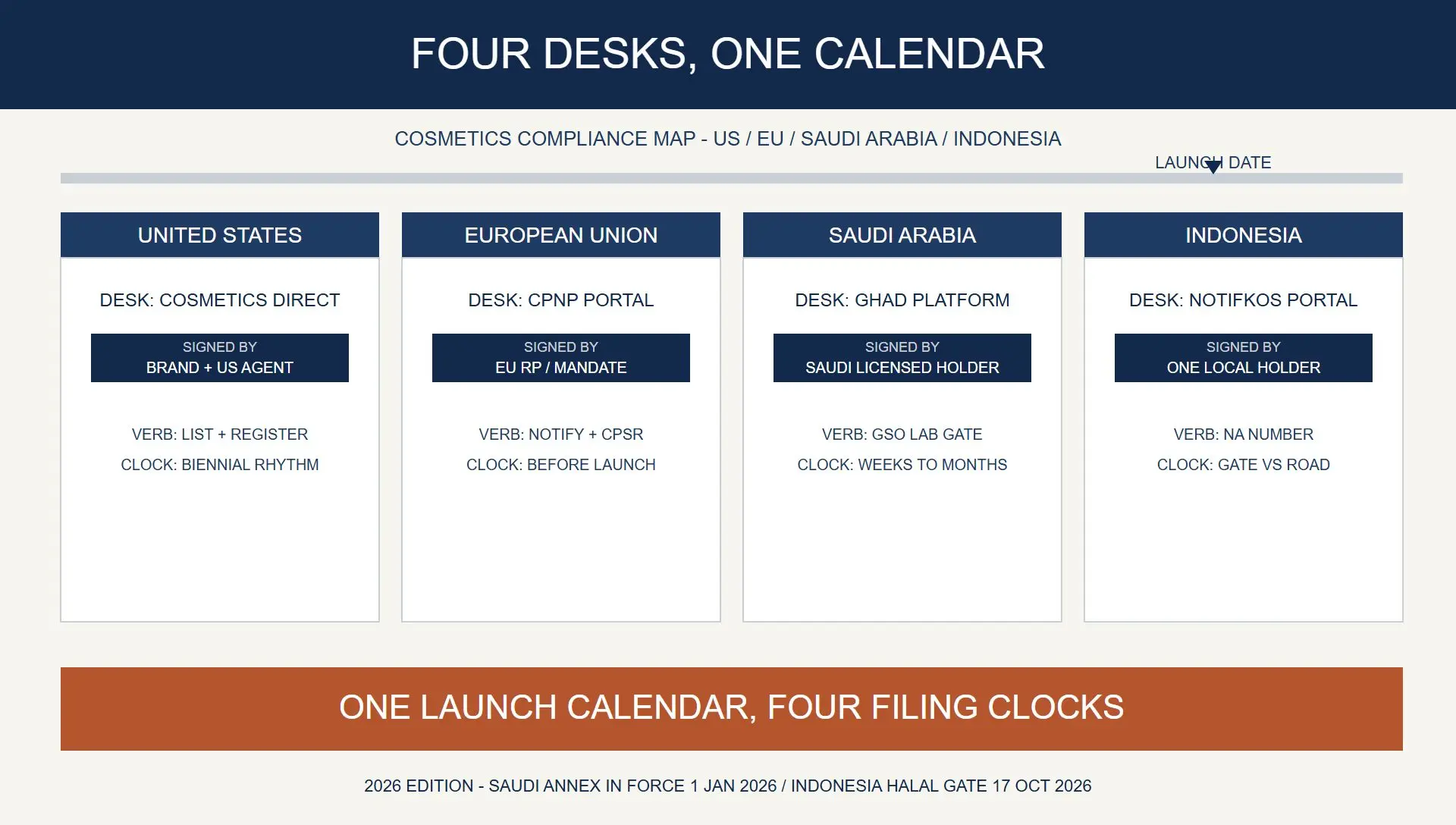
All three markets sit under the ASEAN Cosmetic Directive framework, harmonised across member states since 2008 — a shared ingredient philosophy, three separate filing desks. The framework is the reason a dossier can be adapted between countries; the three desks are the reason it can never be submitted once for all of them.
| Jurisdiction | The paper | Who can file and hold it | The desk | The clock |
|---|---|---|---|---|
| Malaysia — NPRA | Cosmetic product notification under the ACD scheme; a NOT number identifies notified products | Filed through Malaysia's regulatory system (QUEST3+); the applicant of record is a Malaysian-establishment party — confirm in writing whose name your notification sits in | NPRA (National Pharmaceutical Regulatory Agency), under Malaysia's Ministry of Health | Ingredient annexes move: NPRA Circular Pekeliling Bil 1/2025 (14 July 2025) updated the status of ingredients listed in the annexes to the Guidelines for the Control of Cosmetic Products — dossiers must track the annex version, not the launch-day snapshot |
| Indonesia — BPOM | NA number / Nomor Izin Edar — legally required before selling, sampling, or distributing testers, per the 2026-08-13 step-by-step guide | Only a locally registered Indonesian entity: your own PT PMA or a licensed local distributor acting as notification holder. One holder per product at a time | Notifkos (BPOM's digital portal) | Review itself runs ~14 working days (simple categories like perfumes from ~3 working days); end-to-end realistically 4–9 months; fee band by origin: ASEAN-manufactured ~1× vs non-ASEAN ~3×, charged per shade/variant (structure per source; verify on Notifkos) |
| Singapore — HSA | Cosmetic products are notified under the ACD scheme; HSA holds notification information and verification is done by checking ingredient lists against HSA guidelines (secondary consumer-verification guide, 2026-09-05) | A Singapore-based responsible party — typically the local importer or the brand's regional entity | HSA (Health Sciences Authority) | The fastest desk in the cluster — which is exactly why it becomes the default home for regional kits and premium listings |
The right-hand columns are the sourcing lesson, and they all say the same thing in three accents: the number is held by a person of record, not by the brand and not by the factory. In Indonesia that is explicit — one holder, and the 2026 guide warns in plain terms that brands registering through a third-party distributor without contractual planning "sometimes find themselves locked into an unwanted, multi-year exclusive distribution arrangement simply because the notification itself belongs to that distributor, not the brand." In Malaysia and Singapore the logic runs the same way: the filing entity is the accountable entity, and accountability is leverage.
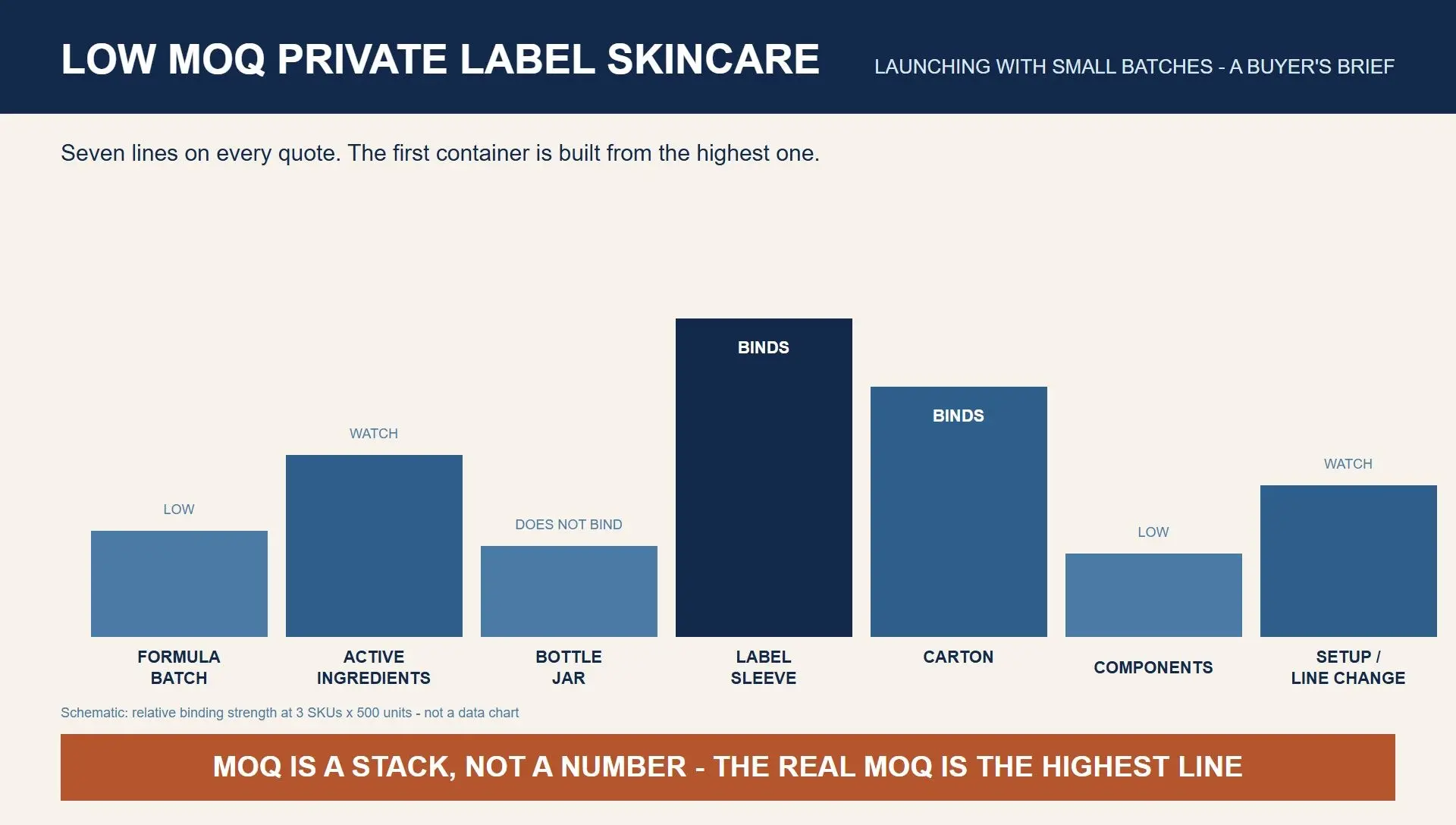
This is the regional instance of a line this site already drew once for private label: the compliance file is one of the four ownership lines (see the ownership ledger). What Southeast Asia adds is geography's hard edge: formulas travel in files, entities do not travel at all. Your partner in Jakarta cannot be your filer in Bangkok; your factory in Shenzhen cannot hold a Malaysian NOT number. Plan the holder list the way you plan the MOQ stack — as a structure with a named owner per line (the stack math is in the low-MOQ guide; we will not re-walk it here).
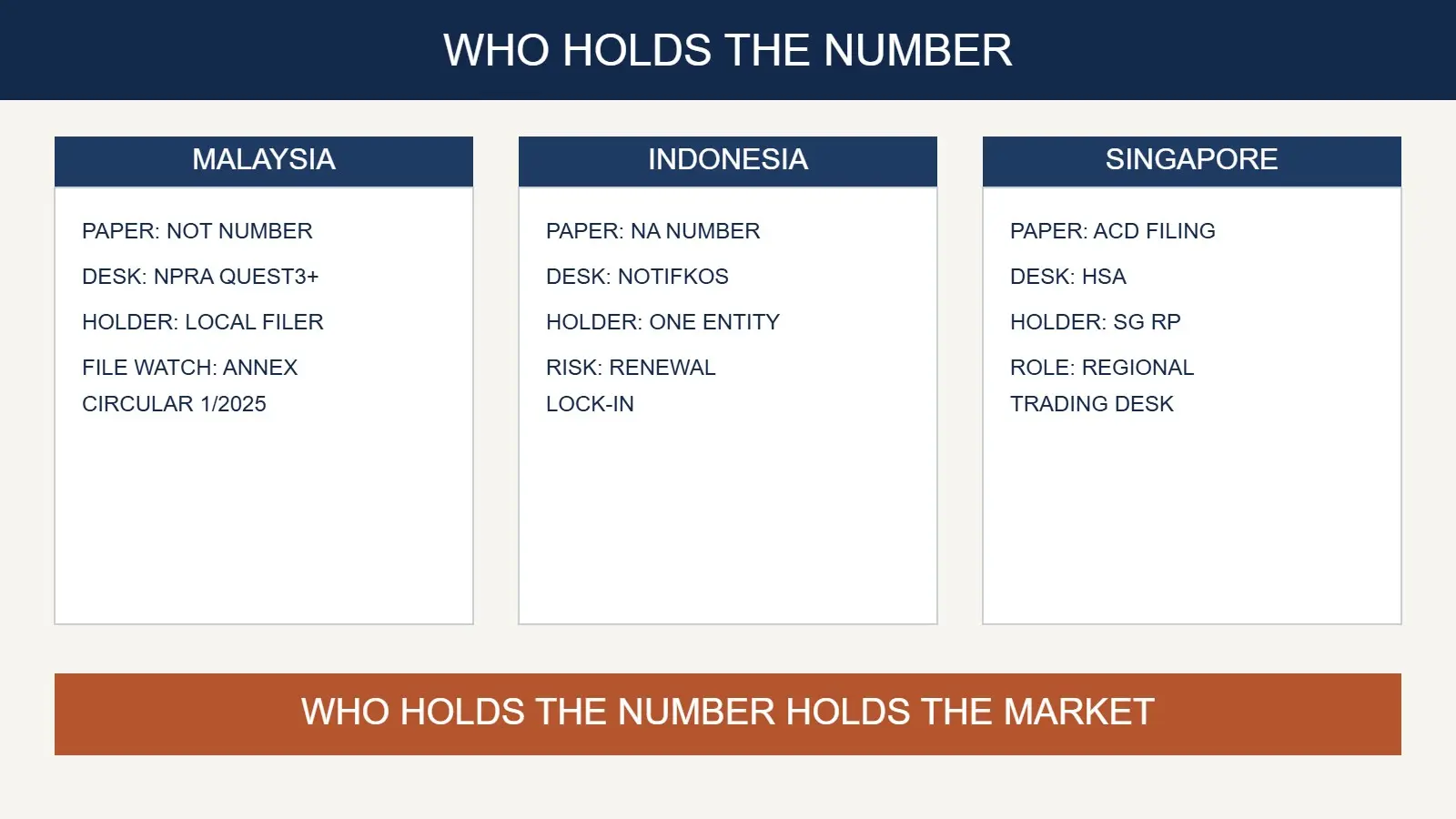
Formulas cross borders inside dossiers; no entity crosses borders inside your org chart. Name the holder before you name the hero SKU.
Indonesia Before the Shelf: The BPOM Clock and the 17 October Halal Gate
Indonesia is the market in this cluster where the paper has teeth, so it gets the deepest section. Everything below is sourced to a dated regulatory-consultant guide published 13 August 2026 and cross-referenced to two 2026 industry write-ups; where a number is a fee or a duration, treat the guide as a snapshot and confirm current values in Notifkos, the portal of record.
The number gates everything, including free. A cosmetic without a valid NA number cannot be sold, listed online, sampled, handed out as a tester, or used in influencer seeding. That scope is where foreign brands get their first enforcement lesson: a tester drop at a Jakarta pop-up is a market event in BPOM's eyes, not a marketing favor. The enforcement posture is public — recall actions against products marketed without proper permits have been on record since at least February 2025, when BPOM's actions on 91 illegal and hazardous cosmetics products without proper distribution permits were documented by an Indonesian regulatory law firm (2025-04-11).
Only a local entity files, and it files once. Foreign manufacturers cannot register directly. Your options are your own PT PMA or a licensed local distributor as notification holder — and BPOM allows one company to hold a product's notification at a time. The guide's warning is a structural one: register through a distributor without contract design and the renewal conversation is no longer commercial, because the number — your license to exist in the market — is in their name. Decide which you are buying: a filing service, or a distribution relationship dressed as one.
The dossier is a product document, not a form. Every submission needs a complete Product Information File: formulation, manufacturing process, safety assessment, labeling. The technical failure point in 2026 is named in the guide: BPOM Regulation No. 25 of 2025 — a significantly revised restricted-and-prohibited ingredient list that a June 2026 registration guide confirms became effective late 2025 and now governs ingredient compliance through 2026 — is "the single most common source of technical rejections." Practical translation for sourcing: the ingredient review happens before formulation is frozen, and whoever runs your formula needs to check it against the current annex before, not after, the dossier is assembled.
The clock most plans miss. Review through Notifkos runs ~14 working days once the file is right — quoted constantly as "two weeks to Indonesia." The same guide puts the realistic end-to-end — entity setup, document procurement, audits, halal certification, ingredient compliance review — at 4 to 9 months. Fourteen days is the gate; the road to the gate is months. Kits add a further layer: every component needs its own NA number first, then the bundle gets a separate NKIT number printed on outer packaging alongside its component list. Holiday bundle decisions taken in September are legal in time only if the component files already exist.
And from 17 October 2026, halal is a filing condition, not a label preference. Under Government Regulation No. 42 of 2024, BPJPH halal certification becomes mandatory for all cosmetics marketed in Indonesia after 17 October 2026 — valid NA number or not — per the August 2026 guide. BPJPH's process is a full supply-chain audit: raw-material sourcing, manufacturing process, packaging and storage. The guide's operational advice matches this site's house rule about files-before-dollars: halal readiness belongs inside formulation and factory selection, not bolted on after notification. The buyer-facing method — audit scope, documentation, how to qualify a halal-capable OEM — is answered in the Halal OEM buyer's guide; we link it, we don't re-teach it. What changes here is only this: for Indonesia, halal stops being a segment claim on 17 October and becomes the market's front door. One post-approval obligation worth reading twice: the notification holder carries the pharmacovigilance duty — adverse-event tracking, mandated reporting windows, recall exposure. That is leverage pointed back at the holder, and it is part of why who-holds-the-number is a contract question, not an administrative one.
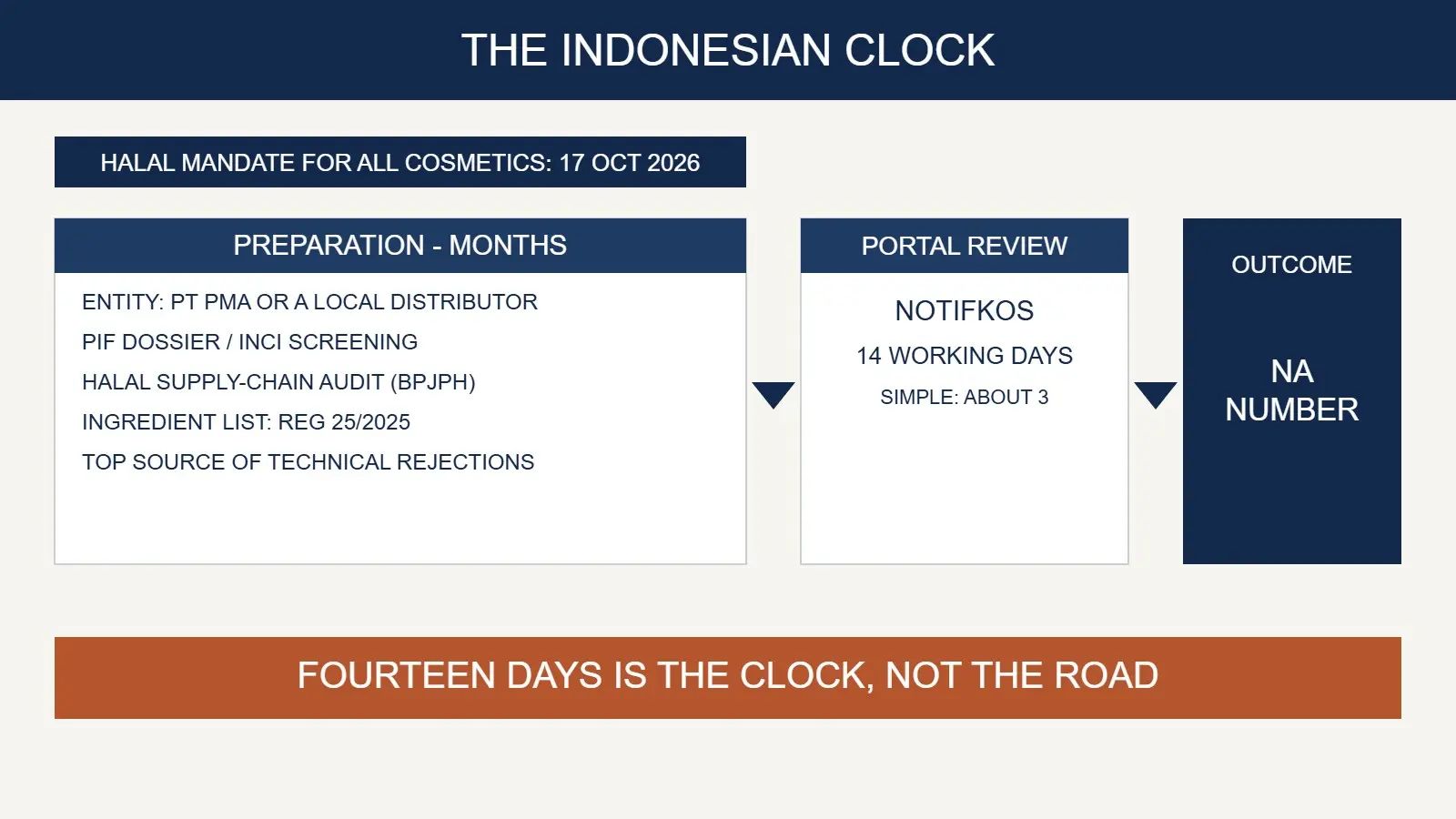
Fourteen working days is the gate. The road to the gate is four to nine months — and after 17 October 2026, halal certification is on that road, not at the finish line.
OEM Skincare Manufacturer Malaysia: The Credential You Can Open in a Browser
Most supplier claims are unfalsifiable at RFQ stage: "GMP-certified" is a sentence, not a document. Malaysia is the exception in this cluster, and it is a genuinely useful one. NPRA — the National Pharmaceutical Regulatory Agency — publishes a list of cosmetic manufacturers it treats as compliant with the ASEAN Guidelines for Cosmetic Good Manufacturing Practice; the agency's English manufacturer-compliance pages were current as of 28 September 2026, kept in a public, browsable format. A named Malaysian OEM partner either appears against those guidelines or does not, and checking takes one tab.
That single fact restructures the Malaysian sourcing conversation:
The four-step browser check. ① Ask the supplier, in writing, for their company name as it would appear on a regulatory filing — trading names and brand names are not the filing name. ② Open NPRA's published compliance listing and look for that legal entity. ③ Ask which products are already notified and in whose name your notification would sit — the applicant of record runs through QUEST3+, Malaysia's electronic regulatory system for product filings, and the answer tells you whether the supplier's regulatory function is an internal department or an outsourced broker. ④ Ask, specifically, which version of the ingredient annexes their current dossiers were assessed against — Malaysia's Pekeliling Bil 1/2025 (dated 14 July 2025) updated the status of ingredients in the annexes to the Guidelines for the Control of Cosmetic Products, and a dossier frozen before that circular is a dossier that has to be re-checked, not just re-submitted.
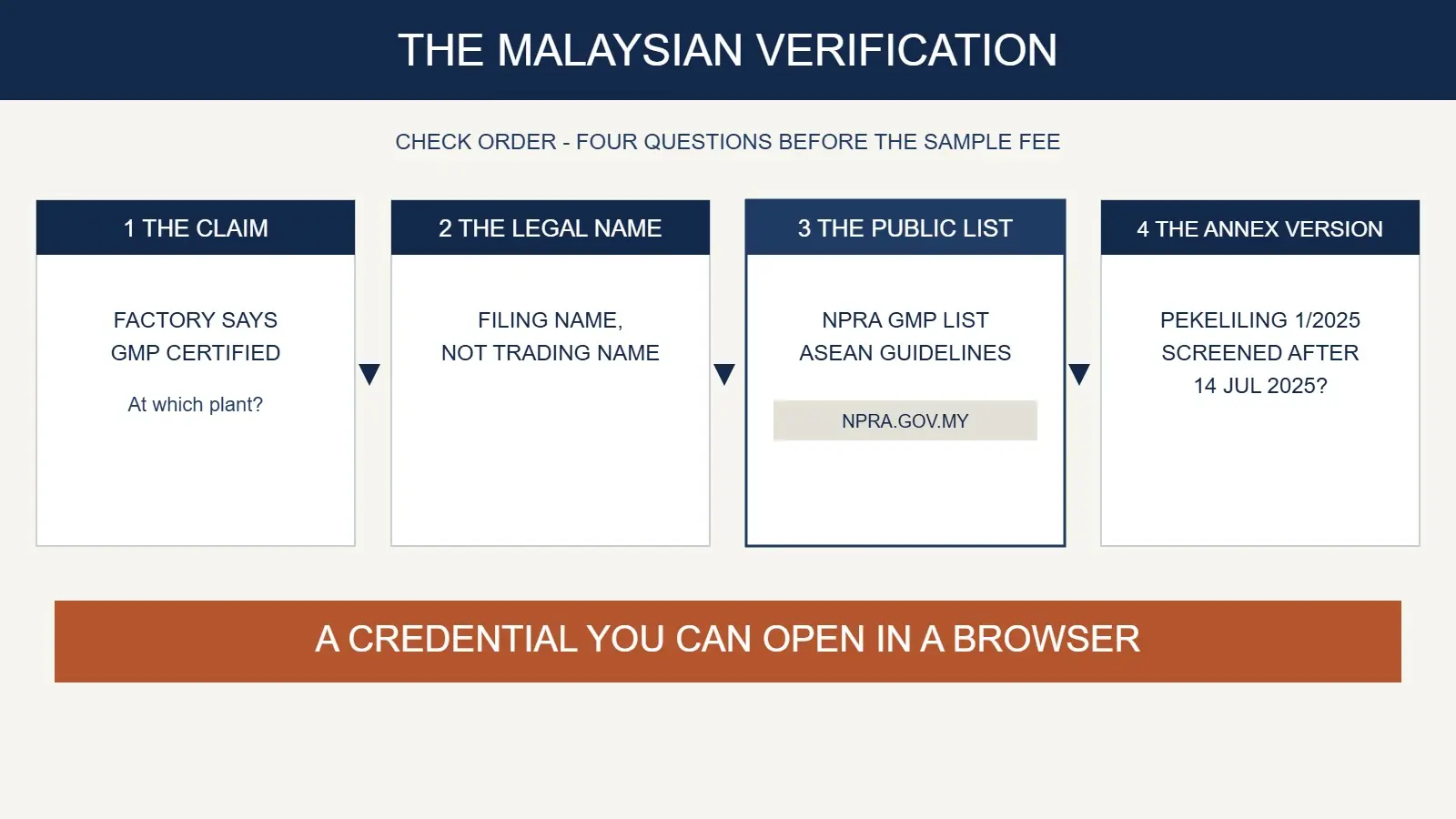
Why a Chinese or regional buyer should care about a Malaysian list. Three reasons. First, if your market entry includes Malaysia, the filing reality sits there regardless of where the cream is made — the notification is a Malaysian file with a Malaysian holder of record. Second, the list is a due-diligence pattern: a public regulator-maintained manufacturer register is the strongest cheap signal available anywhere in this cluster, and the audit habit transfers — the 12-point factory audit checklist on this site is built for suppliers that do not come with a public register, which describes every factory in the region outside Malaysia and most anywhere else. Third, Malaysia's combination — ACD notification plus published GMP verification plus a mature halal-industrial base — is what makes "Malaysian manufacture" a positioning asset for Muslim-market brands; the certification mechanics are covered once, properly, in the Halal OEM buyer's guide, and this article deliberately does not re-open them.
What an OEM partner — Malaysian or otherwise — actually owes you for this region. Not a promise of compliance; a document set that lets your holder of record file without invention: full INCI-level formulation with restricted-substance screening against the current annex versions (Indonesia: Reg. 25/2025; Malaysia: post-July-2025 circular), GMP evidence mapped to the ASEAN guidelines, stability and compatibility data supporting your claimed shelf life, statement of origin / manufacturing site for fee-band and import questions, and — where the SKU is meant for Indonesia after 17 October — halal-traceable material sourcing that survives a BPJPH supply-chain audit. That list is the regional version of the six-file gate on this site: documents before dollars (the ownership ledger explains why each file's owner decides the relationship's power balance). Ask for the pack at RFQ, not after PO — a supplier who answers the annex-version question in an hour has a regulatory desk; one who answers with a plant video has marketing.
A public GMP register turns "certified" from a claim into a browser tab — and a dossier-version question sorts real regulatory desks from brokers in one exchange.
The Singapore Desk: What an oem skincare singapore Partnership Actually Covers
Singapore rarely wins a bulk-manufacturing comparison and almost never needs to. Read the Singapore line in your shortlist the way its regulators are structured: as a desk, not a factory floor. The city-state runs cosmetics under the same ACD notification philosophy as its neighbors, with HSA as the reference authority — notification information sits behind a system a local responsible party operates, and ingredient-list verification against HSA guidelines is standard practice for anyone checking a product's standing (the consumer-facing verification guides circulating as of September 2026 describe exactly that workflow). The market's real products are three: the responsible person, the regional entity, and the re-export file.
A "partnership" with a Singapore-based OEM or trading-technical partner typically covers one or more of five things — and the procurement skill is knowing which five you are paying for, because their prices and lead times are completely different:
| What the arrangement is | What actually ships | What it's for | What to pin in writing |
|---|---|---|---|
| Regulatory desk service | Filed notifications, responsible-person coverage | Being legal without building a local entity | Who holds each number; what happens at renewal or exit |
| Regional kitting / repack | Bundles, cartons, multi-market labels | Gift sets and shelf programs across MY/ID/SG | NKIT math starts at component NA numbers — bundles inherit their files |
| Premium / fragrance manufacture | Small-batch finished goods | Positioning SKUs where "Made in Singapore" carries | MOQ stack per component line — the stack guide covers the arithmetic once |
| Sourcing office | Supplier qualification, QC presence | Auditing factories in the region without flying | The audit scope, report format, and who pays for re-runs |
| Distribution counter | Importer-of-record + channel access | Retail listings you cannot approach directly | The holder-of-record clause — see H2 三, then contract it before the first PO |
When Singapore is the wrong answer: cost-sensitive mass SKUs (the desk premium buys governance, not grams), first-container experiments (the first-container math binds on labels and cartons, not on the trading counter's city), and any decision framed as "we need an ASEAN origin for the fee band" — origin attaches to where the product is manufactured, which is H2 八's subject, not where the invoice is issued.
The one-sentence version: brands pick Malaysia to verify, Indonesia to sell, and Singapore to be legible to the other two — a corporate and compliance vantage point from which both harder markets can be held at arm's length. Just don't mistake the vantage point for the vault: the numbers still live in Jakarta and Kuala Lumpur, in someone's name.
Which Door First: A Sequencing Map by Buyer Profile
Three doors, one budget — the question is order, not worth. The ACD harmonization means the content of a dossier travels between countries better than in most other regimes; the holders, portals and clocks do not travel at all. Sequence by what your operation is actually doing this quarter:
| Buyer profile | File first | Why that order | The gate that decides launch date | The written ask that follows |
|---|---|---|---|---|
| Test-market drop (small e-commerce entry, sampling program) | Singapore desk, or Malaysian notification via a local filer | Fastest paper; smallest footprint | NA-less testing becomes illegal the moment Jakarta is touched | "No testers ship into Indonesia unless the number exists — quote me the compliant alternative (digital samples, in-market events after NA)." |
| Halal-positioned brand entering MY + ID | Malaysia notification | The verification base + halal-industrial ecosystem; ID entry then adapts the dossier | Indonesia's post-2026-10-17 halal gate: BPJPH audit scope reaches your material sourcing | Method → Halal OEM buyer's guide; ask the factory for halal-traceable material records from day one |
| Mass-market SKU, price-led | Indonesia — the volume market — with the holder contract decided first | Fee band and per-variant multiplication hit hardest here; every unneeded shade costs paper | One-holder lock-in vs own PT PMA cost | "We will hold our own numbers through our own entity or a service agreement that survives the distributor." |
| Premium / fragrance listing | Singapore desk | Positioning + regional distribution plumbing | NKIT: bundles need component numbers first | "Component NA numbers, then kit NKIT — before the gift-set artwork is approved." |
| Full three-market range | Malaysia + Indonesia dossiers in parallel, off one master file | ACD gives you shared ingredient/PIF work; the portals stay separate | Longest pole: entity setup + halal audit months, not the 14-day review | Single master dossier, country annexes: each holder gets a file they can submit without inventing anything |
The row that surprises most buyers is the last one. Running the files in parallel costs a little more in advisory fees and saves an entire launch season: the dossier content — INCI tables, safety assessment, labeling, process description — is largely common across the three desks, and the sequential habit ("one country at a time, to be careful") turns a 4–9 month problem into a 10–20 month one. Being careful in this region means one master file with country annexes, checked against each current ingredient list — Malaysia's July-2025 circular version and Indonesia's Reg. 25/2025 version — not three copies of a PDF drifting apart.
For the general build-order of a brand launch — range definition, model choice, factory qualification — the sequencing already published on this site applies unchanged; the launch playbook walks it, and this table assumes those decisions exist. What changes in a Southeast Asia launch is one fact sitting on top of them: every branch of the launch tree terminates in a named local holder. Build the holder list the way that playbook builds the exit-document list: one owner, one artifact, one signature per step.
Where a China-Based Factory Fits the Regional File Stack
This is the honest-plumbing section, and it earns its place because it is the question a Southeast Asia sourcing thread actually ends on: if the number lives with a local entity, what is the manufacturing partner on the other side of the ocean for?
Start with what a non-ASEAN factory cannot do, stated plainly: it cannot hold your Malaysian notification, cannot file into Indonesia's Notifkos, cannot be the responsible entity for an HSA-facing product. Filing rights are territorial; documents travel, entities don't. Any pitch that promises "we handle registration in Southeast Asia" deserves the holder-of-record question immediately: in whose name, in which portal, under what exit terms?
What a qualified factory can do is the other half of the deal — and in practice it is the heavier half. Four deliverables, each mapping to a file the local holder submits:
① The dossier at submission grade. INCI-level formula, restricted-substance screening against the current annex versions — Indonesia's Reg. 25/2025 list (the named "most common technical rejection" of 2026) and Malaysia's post-July-2025 circular — plus safety-assessment inputs, process description, and labeling artwork that survives each desk's format rules. A factory regulatory desk that checks the annex before the formula freeze is a factory that has shipped into this region before; one that checks after is a factory you fund twice.
② GMP evidence mapped to the ASEAN guidelines. The manufacturing-quality standard the ACD countries audit against is the ASEAN Cosmetic GMP guideline — not China's GB framework, not a generic ISO certificate photographed for a profile page. Ask for the mapping: which housekeeping, batch-record and retention practices satisfy the ASEAN text, documented as an audit response rather than claimed in prose. The public-list lesson from H2 五 applies to factories everywhere: build the file a regulator's pattern can be checked against. The 12-point audit checklist is written for exactly this kind of evidence-first qualification.
③ Halal-traceable production where the SKU needs it. For Indonesia post-17 October 2026 and for Muslim-market positioning generally, the factory's material sourcing, line segregation and records must survive a BPJPH-style supply-chain audit. The buyer-facing method — audit scope, certification paths, documentation — is answered in the Halal OEM buyer's guide; the point here is only the stack position: halal is a manufacturing-file attribute before it is a label, and no local filer can retrofit it for you.
④ The origin decision, priced honestly. Indonesia's notification fee is publicly band-structured by place of manufacture: roughly 1× for ASEAN-manufactured versus 3× for non-ASEAN-manufactured product, charged per shade or variant (per the August 2026 guide; confirm current values in Notifkos). Three consequences. A variant-heavy color range multiplies paper cost per shade, which is the regulatory mirror of the first-container rule the MOQ stack guide argues on commercial grounds: hero-SKU discipline is cheaper in every ledger. A Malaysian or ASEAN factory becomes worth its unit-price premium for Indonesia-bound lines when multiplied filing fees and holder logistics are counted — the cost-and-lead-time structure page is where this site prices "structure vs sticker." And a non-ASEAN factory that ships submission-grade files (①–③) converts its origin penalty into a paperwork advantage — paying the 3× band while the ASEAN incumbent cannot produce the dossier.
The buyer-side summary is a single sentence a Shenzhen or Jakarta or Kuala Lumpur supplier will all confirm: the local holder files your numbers; the manufacturing partner files your ability to have numbers worth filing. The US and EU versions of that sentence were written first (MoCRA enforcement, EU importer's guide); Southeast Asia is the same physics with three doors.
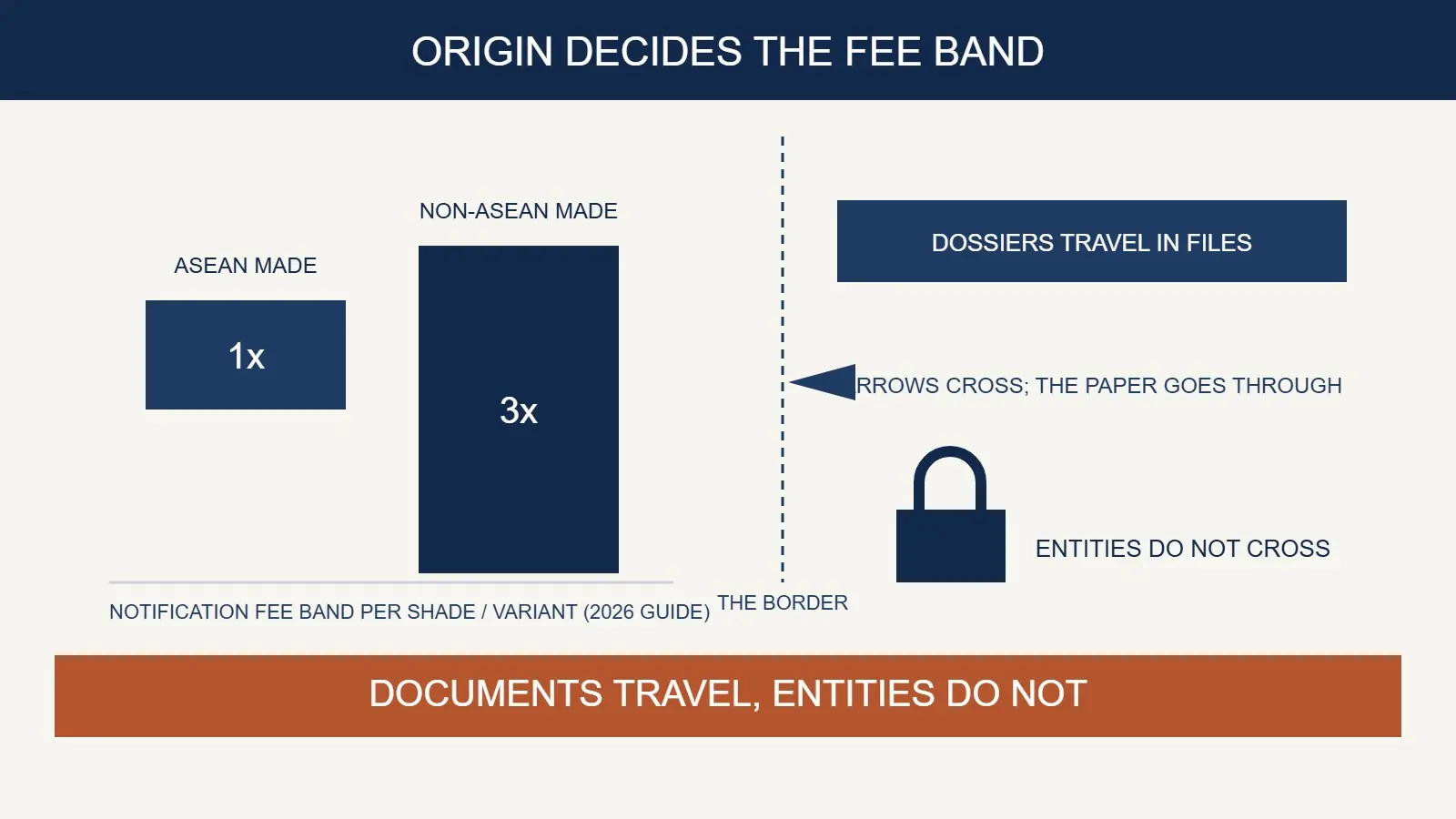
Documents travel, entities don't — which makes a submission-grade file pack the only portable asset a distant factory owns.
The Cost-and-Time Shape of a Three-Market Launch
House rule first: this site does not print absolute prices or supplier quotes — the numbers belong to the supplier, the structure belongs to the buyer. What transfers between factories is the shape of a cost-and-time conversation, and for a Southeast Asia launch the shape has five lines. Anyone who has read the low-MOQ stack guide will recognize the method; this section applies it to paper instead of packaging, and will not re-walk the stack math.
| Workstream line | Who owns it | What moves it | The binding constraint |
|---|---|---|---|
| Entity / holder setup (PT PMA, local filer, responsible person) | You + local counsel | Weeks to months | It is on the critical path in Indonesia; treat it as a founding decision, not a formality |
| Dossier assembly (PIF-grade file pack from the factory) | Manufacturing partner | Weeks, if the partner has a regulatory desk | Annex-version matching — Reg. 25/2025 and the July-2025 circular make stale files fail, not just wrong files |
| Portal review (Notifkos / QUEST3+ / HSA-facing filing) | Holder of record | ~14 working days (ID, simple categories faster); parallelizable across desks with one master file | The road-to-gate months are outside the quoted review days — plan the gate, budget the road |
| Label & artwork localization | Brand + holder | Weeks, running in parallel | Indonesia: NA/NKIT on pack drives the artwork lock; a kit artwork approved before component numbers exists on paper only |
| Halal certification (Indonesia, post-2026-10-17) | You + factory records + BPJPH audit | Months — supply-chain scope | Formulation and sourcing decide this before paperwork exists; retrofit is the expensive version |
Read as one timeline, the five lines explain the region's central planning fact: the calendar is set by the slowest of entity setup, dossier quality, and halal audit — never by the portal review that everyone quotes. A 14-working-day review arriving four to nine months after kickoff is normal; a launch plan whose only compliance entry is "two weeks for BPOM" is a launch plan that has not met the guide it cites. The sequencing tool from the launch playbook — each phase closing on a named written artifact — is the right instrument; this section just renames the artifacts for three new desks.
The MOQ conversation joins here and then exits, by design. Per-variant filing fees, per-line holder logistics and label-print realities all argue the same commercial line this site has drawn once: fewer, wider SKUs at first container, more on reorders. The arithmetic — binding lines, first-container math, hero-SKU logic — lives in the low-MOQ guide, and the professional-channel ordering layer that consumes it in the esthetician playbook. Southeast Asia's contribution is one addition: the SKU discipline now has a regulator's price tag attached, which makes it easier, not harder, to enforce inside a brand team.
Count five workstreams, three clocks and one rule: the portal review is the shortest line on the calendar — every other line is where launches actually stall.
Five Ways a Southeast Asia Launch Fails — and the Line Item That Prevents Each
The failure modes in this region are documented, patterned and — unlike most sourcing risks — cheap to insure against, because each one is prevented by a clause rather than a contingency budget. Five of them, in the order brands usually meet them:
① The hostage renewal. Your NA number sits in your distributor's name; at renewal, the commercial conversation and the market-access conversation become the same conversation, and they do not end where they started. The August 2026 guide states the mechanism flatly: the notification belongs to that distributor, not the brand, and one holder per product is the rule, not the default. Prevention: before the first PO, either file through your own entity or a service agreement whose exit terms transfer or replicate the number — an ask the holder-of-record clause (H2 三) makes concrete.
② The stale-annex rejection. The dossier was built against last year's restricted list; BPOM Reg. 25/2025 or Malaysia's July-2025 circular moved an ingredient; the file dies on technical grounds and the relaunch is scheduled around a resubmission queue. Named by the 2026 guides as the most common technical rejection of the year. Prevention: the RFQ question from H2 五 — which annex version was this formula screened against, and when? — plus a screening re-run before every dossier freeze, not only at first formulation.
③ The tester crime. A sampling program, a KOL parcel drop, a trade-show bowl of sachets — executed in Indonesia because "we're not selling yet." The law's scope is explicit: the number is required before the product reaches a consumer in any form, and the February-2025 recall record shows enforcement is active, not theoretical. Prevention: marketing calendars inherit the filing calendar — tester activity is scheduled after NA, per SKU, or the event uses digital samples and post-launch in-room demos.
④ The bundle without a birth certificate. A gift set goes into production because the components are all notified — but the kit itself needs its own NKIT number, printed on the outer pack with its component list, and the kit application presupposes the component numbers exist and match. Prevention: bundle concepts enter the filing queue at approval stage, alongside single-SKU dossiers — artwork locked after the NKIT math, never before.
⑤ The halal retrofit. The BPOM number arrives, production ramps — and the October 17, 2026 requirement lands on a supply chain whose material records cannot survive a BPJPH audit. Retrofit is not a form; it is re-sourcing, re-documenting, and in some cases reformulating, on a deadline that does not move. Prevention: the halal screen belongs to factory selection — the sourcing question from the Halal OEM buyer's guide — executed before tooling, because the audit reads the factory's records as they already are.
Notice what the five share: not one is a quality failure, not one is a pricing failure — all five are ownership failures. Someone owned a line item that should have had a named holder on the org chart, months earlier. Which is the regional restatement of this site's oldest rule: name the owner of every file before you sign the first shipment.
| Failure mode | The missing line item | Where it gets written |
|---|---|---|
| Hostage renewal | Holder-of-record + exit terms | Distribution agreement or filing-service contract |
| Stale-annex rejection | Annex-version screening attestation | Supplier quality agreement, refreshed at every dossier freeze |
| Tester crime | Filing status in the marketing calendar | Launch runbook: no sampling before NA, per SKU |
| Bundle without a certificate | NKIT in the product-approval queue | Bundle stage-gate: components → kit number → artwork |
| Halal retrofit | Halal-traceable sourcing at factory selection | RFQ requirement list + audit scope (see the linked buyer's guide) |
None of the five are quality or pricing failures — all five are ownership failures with dates on them.
FAQ: The Questions Southeast Asia Sourcing Threads Keep Asking
Q1: How do I verify that a claimed oem skincare manufacturer malaysia partnership is real? Start in a browser, not a showroom. NPRA publishes cosmetic manufacturers assessed as compliant with the ASEAN Guidelines for Cosmetic GMP (the agency's compliance listings were current as of 28 September 2026) — get the supplier's legal filing name in writing and check it against that public list. Then ask the two questions a real regulatory desk answers instantly: in whose name do current notifications sit under QUEST3+, and which version of the ingredient annexes — before or after the 14 July 2025 circular — were those dossiers screened against.
Q2: Who can legally hold my BPOM notification number in Indonesia? Only a locally registered Indonesian entity: your own PT PMA or a licensed local distributor acting as the notification holder. Foreign manufacturers — Indonesian or overseas — cannot file directly, and BPOM permits one holder per product at a time. Choose the holder structure the way you would choose a formula owner; per the 2026 step-by-step guide, registering through a distributor without exit terms is how brands end up locked into multi-year distribution they never negotiated for.
Q3: Can we sell samples and testers in Indonesia before the NA number arrives? No. The notification number gates sale, online listing, sampling, testers and event giveaways alike — the number is required before the product reaches a consumer in any form. Enforcement is documented, including recall actions against permit-less products recorded since February 2025. If the launch calendar cannot wait for the road to the gate (4–9 months, end-to-end), the compliant alternatives are digital sampling and post-NA in-market events.
Q4: Does the October 2026 halal requirement apply to imported products as well as local ones? Per the August 2026 regulatory guide, BPJPH halal certification becomes a condition for all cosmetics marketed in Indonesia from 17 October 2026 under Government Regulation No. 42 of 2024 — origin does not exempt, and a valid NA number does not substitute. The audit reaches the supply chain (materials, process, packaging, storage), which is why the requirement is a factory-selection input, not a paperwork errand; the sourcing method is covered in the Halal OEM buyer's guide linked above.
Q5: Is "two weeks" a realistic Indonesia registration timeline? It is a realistic portal review duration — roughly 14 working days once the file is correctly assembled (simple categories such as perfumes can clear in about 3 working days). It is not a realistic launch timeline: entity setup, dossier assembly, halal certification and ingredient screening run 4–9 months ahead of the gate. Plans that quote "two weeks to BPOM" are quoting the gate and skipping the road.
Q6: We manufacture in China — are Malaysia and Indonesia still reachable? Yes, with roles split: the factory supplies the submission-grade file pack (current-annex INCI screening, ASEAN-mapped GMP evidence, halal-traceable sourcing records), while the numbers sit with local holders in each market — no foreign factory can or should hold them. Price the structure honestly: non-ASEAN origin pays the higher notification fee band, roughly 3× against 1× for ASEAN manufacture, per shade or variant per the August 2026 guide — which is recoverable when the file pack clears first-pass review instead of joining the rejection queue.
Q7: Which of the three markets should a first-time ASEAN brand skip? Indonesia, unless the volume case is proven — it carries the longest road (entity + dossier + halal) and the most ownership leverage at stake. A first compliant footprint is usually the fastest desk (Singapore, or a Malaysia notification via a local filer) while the Indonesian holder structure is negotiated properly rather than under launch pressure. The sequencing table in H2 七 covers the profile-by-profile version.
Q8: Does holding an EU or US compliance file make any of this easier? Partially, and only inside the ACD perimeter: the region shares the ACD's ingredient philosophy since 2008, so an EU-grade safety assessment and INCI discipline usually map well onto Malaysian and Indonesian dossier fields — but each desk is a separate submission with its own annex versions, its own portal and its own holder. Harmonized philosophy is not a reciprocal registration; MoCRA files (US) and CPNP listings (EU) confer zero filing rights here.
What to do next
Before the file stack becomes your problem: request a quote built the way Southeast Asia actually prices — per market, per holder, per variant — and get the MOQ table that shows which line binds first when Indonesia's clock, Malaysia's annex version and Singapore's desk premium enter the same launch plan. A dedicated product manager on every RFQ — reply within 24 hours, sample packs in 7 days, MOQ from 1,000 pcs, with the submission-grade dossier line (current-annex INCI screening, ASEAN-mapped GMP evidence, halal-traceable sourcing records) quoted as its own written item, not promised in prose.
→ Get your quote and MOQ table
Sources and Further Reading
Regulatory snapshots cited as of publication — confirm current values and portal procedures with each authority (Notifkos / BPOM, NPRA Malaysia, HSA Singapore) before filing decisions:
- BPOM registration for cosmetics, the 2026 step-by-step guide — Live and Work Indonesia, 13 August 2026 (NA/NIE scope incl. testers; local-entity requirement; one-holder rule; PIF; Reg. No. 25 of 2025 as top technical-rejection source; Notifkos ~14 working days vs 4–9 month end-to-end; fee bands ASEAN 1× / non-ASEAN 3× per variant; NKIT; pharmacovigilance; GR No. 42/2024 halal mandate from 17 October 2026; ACD framework since 2008) — secondary regulatory-consultant source; portal of record: notifkos.pom.go.id - Indonesia BPOM enforcement note — 91 cosmetics recalled for missing distribution permits, February 2025 — SSEK Indonesian legal practice note, 11 April 2025 - BPOM Regulation No. 25 of 2025 ingredient list, effective late 2025 — Product Registration Indonesia guide, 17 June 2026; Indonesia's Decree No. 633/2025 on cosmetic ingredients — Reach24h regulatory brief - NPRA Malaysia: GMP-compliant cosmetic manufacturers listing under the ASEAN Cosmetic GMP Guidelines — official agency pages, current 28 September 2026; Pekeliling Bil 1/2025 on annex ingredient-status updates, 14 July 2025; QUEST3+ electronic filing system — NPRA notices - Singapore HSA: cosmetic product notification and ingredient-list verification — HSA materials via consumer-verification guide, 5 September 2026; ACD member-state list incl. Singapore — per the August 2026 Indonesia guide - Cosmetics contract manufacturing market outlook — Research and Markets, 2025 (US$17.8B in 2023 → US$22.17B by 2028, 4.4% CAGR) - Personal care contract manufacturing to US$34.33B by 2030, 8.04% CAGR — Ocean Business report, via Taiwan News, 9 April 2025 - SEA-6 personal-care revenue ranking (Thailand #1) — Statista, 2025; SEA skincare ≈US$36.14B projected end-2025 — industry trends deck (Nov 2025, republished copy, unaudited — flagged in-text as secondary) - Further reading on this site: the launch playbook, the three-model guide, the ownership ledger, the low-MOQ stack guide, the esthetician channel playbook, the 12-point factory audit, the Halal OEM buyer's guide, the EU importer's compliance guide and the MoCRA enforcement guide — each linked in place above; this piece does not restate them.