
Contract Cosmetic Manufacturer vs In-House: Four Switch Points
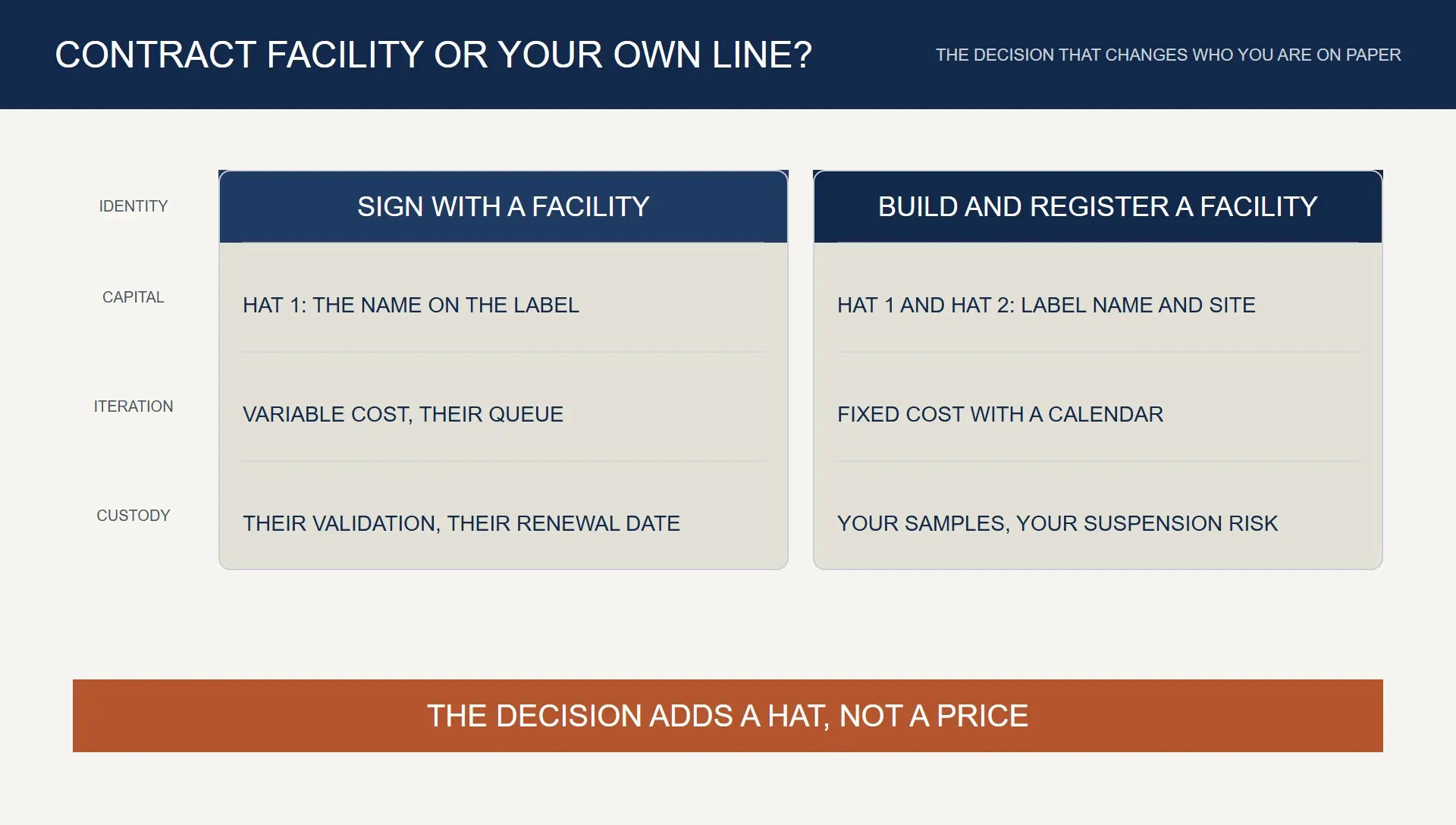
Contract Cosmetic Manufacturer vs In-House: The Decision Adds a Legal Identity, Not a Price
Ask a founder why they want their own production line and the answer is almost never a number. It is control, or speed, or the story they want to tell buyers, or the fear of a supplier who one day stops answering the phone. Ask the same founder what a contract cosmetic manufacturer is legally obliged to do for them, and the answer is usually vaguer than it should be. That gap - between the emotional object (control) and the mechanical objects (identity, capital, custody, clock) - is where make-or-buy decisions go wrong, quietly and expensively.
Begin by naming the object correctly, because the vocabulary in this category is doing real work on your side or against you. Outsourcing production to a contract facility does not remove you from the regulatory picture; it redistributes it. In the United States, under the Modernization of Cosmetics Regulation Act of 2022 (MoCRA), the facility that manufactures or processes cosmetics distributed in the US is the object that must register with FDA and renew that registration every two years, while the responsible person - defined as the manufacturer, packer or distributor whose name appears on the label - is the one who lists each marketed product, updates that listing annually, maintains the records supporting adequate safety substantiation, and reports serious adverse events within 15 business days (FDA, Registration & Listing of Cosmetic Product Facilities and Products, page updated 9 September 2026; MoCRA overview page, consulted 15 October 2026). Those are two different seats at the same table. Your company may hold one of them, or it may hold both - and choosing a production model is precisely the choice of how many seats you take.
Building a line is how you take the second seat. It is not a bad seat. It is a heavier one: you now own a registration with a renewal date anchored to the day you registered, a good-manufacturing-practice obligation that regulators will phrase in generalities you must translate into procedures, a retention-sample shelf, a stability programme, a water system, and a suspension exposure that, if it ever lands, stops every product made at that site at once. Outsourcing means the second seat belongs to somebody else, and your leverage over it becomes contractual rather than physical - a different discipline, and one this site has already worked through for the label-ownership questions in private label vs white label and for the order-size questions in the low-MOQ stack guide. This piece does not re-derive either of those. It asks the question that sits one step earlier, and it asks it in writing.
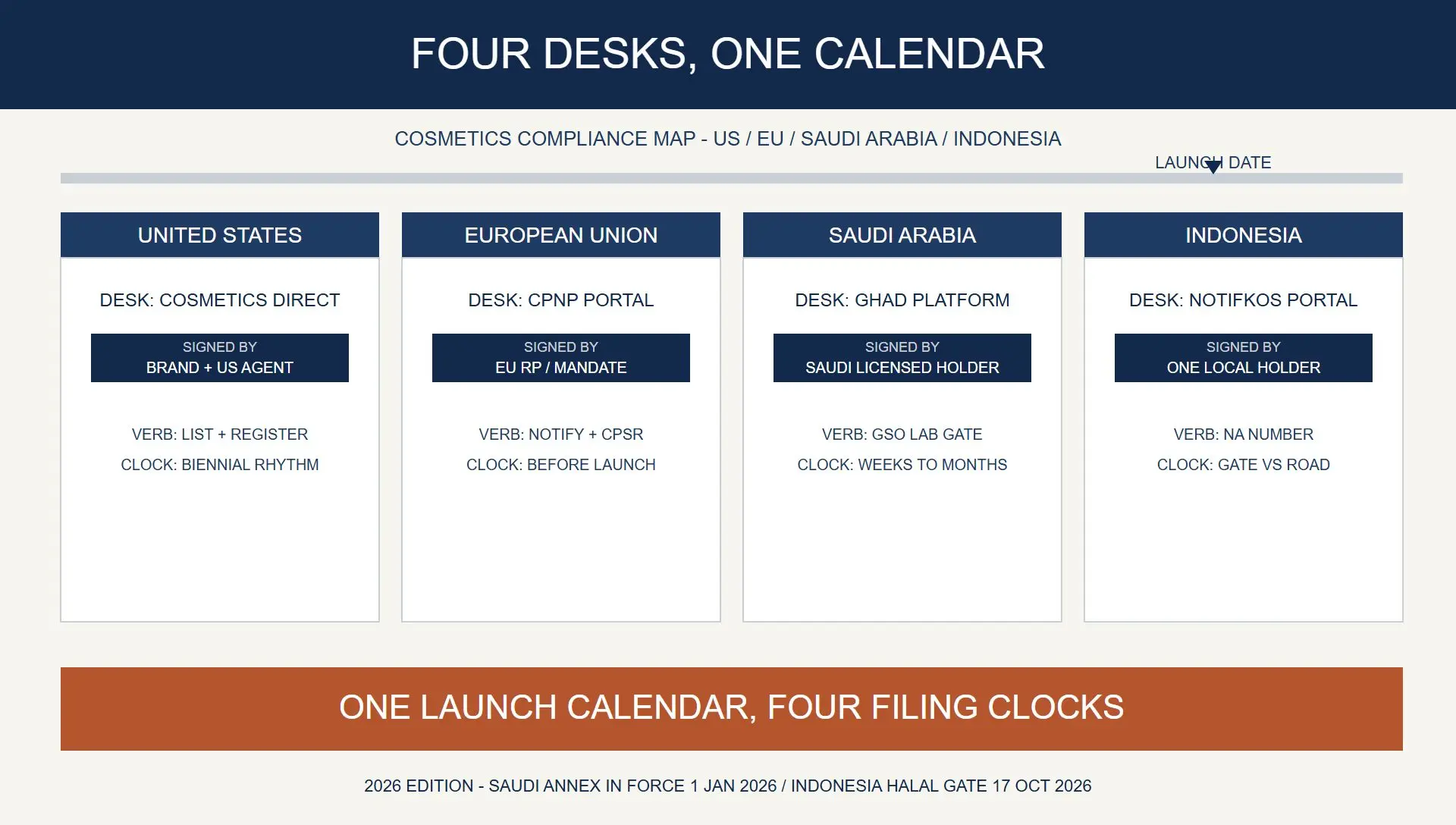
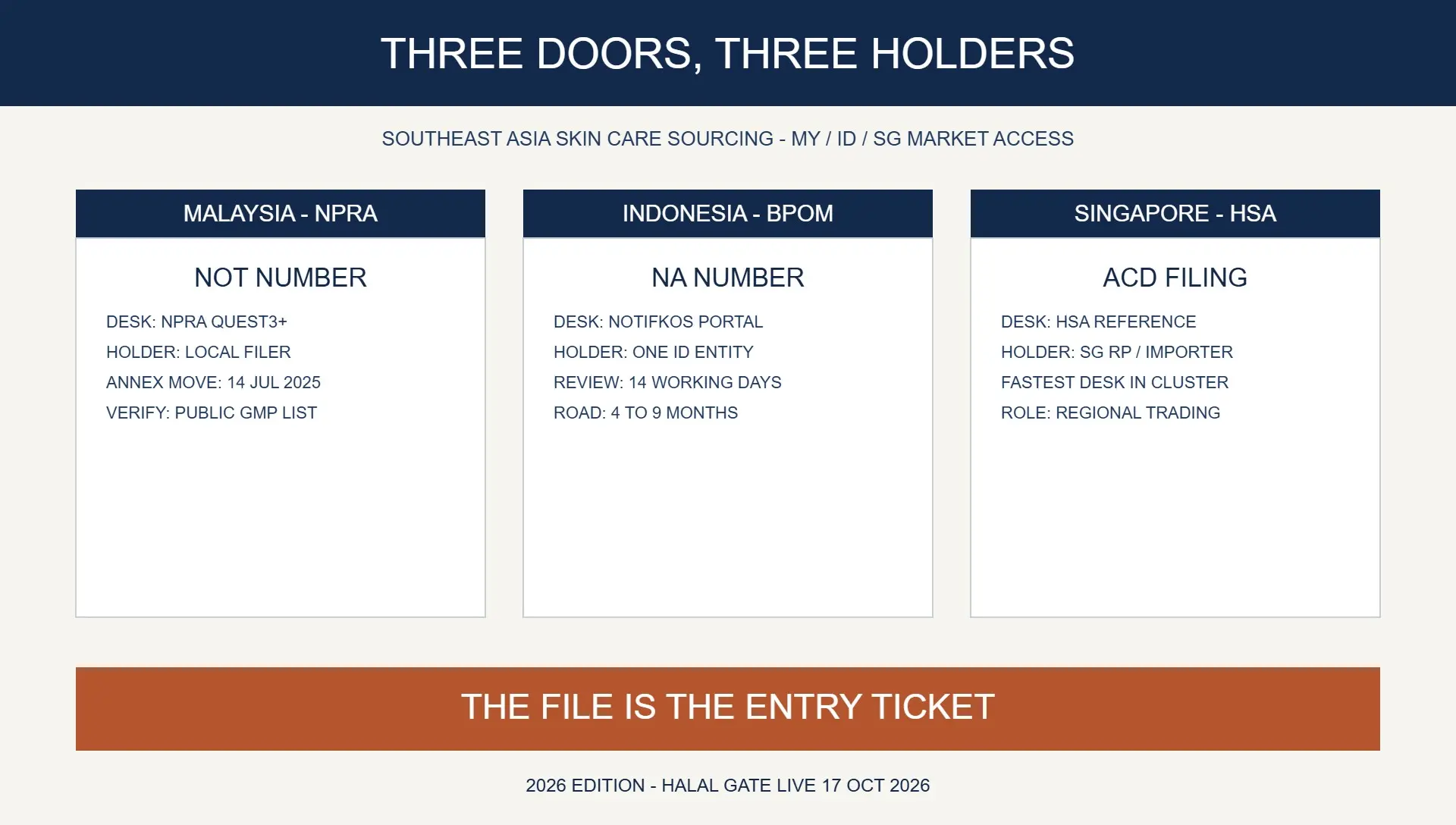
Four switch points decide it, and each one has a document that proves where it lands: volume (whose calendar absorbs your forecast error), cash (fixed cost with a renewal date against variable cost with a purchase order), iteration (how often you are allowed to change your mind, and what paperwork the change reopens), and custody (which files, samples and process knowledge physically live where). A fifth consideration - market access - is largely answered elsewhere on this site: in several markets the registration or notification number can only be held by a local entity, so "who am I on paper" is not a US-only question. See the four-desk filing map and the Southeast Asia market-access guide; both are linked, not restated.
One structural fact belongs on the table before any of the four switches, because it defines the shape of the market you are deciding inside. FDA publishes the counts: as of 30 June 2026 there were 16,398 unique, active registered cosmetic product facilities and 1,298,361 unique, active listed cosmetic products in the US system (FDA registration and listing page, data as of 2026-06-30). Dividing one published number by the other is arithmetic rather than citation: roughly seventy-nine listed products per registered facility. Whatever else is true about this category, the brand side is a long tail riding on a short list of production sites. Building your own site is therefore not a rebellion against the norm; it is a deliberate decision to step outside long-tail economics, and it deserves to be underwritten like that.
You are not choosing between two prices. You are choosing how many regulated seats your company occupies.
Two Hats, One Label: What the Registered Facility Owns and What the Responsible Person Keeps
The most useful thing a buyer can do with this decision is to write down, in one table, which obligations attach to which hat. Not because the table is elegant - because every column has a different failure mode, and because the vocabulary your suppliers use quietly assumes you have already filled it in.
| Obligation | Registered facility (manufacturer / processor) | Responsible person (the name on the label) | What it means for a make-or-buy call |
|---|---|---|---|
| Registration | Must register with FDA; renews every two years, anchored to the initial registration date | Not the registration holder unless it also owns or operates the site | Build a line and a renewal calendar arrives with the mixers |
| Product listing | Supplies the data a listing needs (formula, ingredients, of which the listing is built) | Lists each marketed product and updates it annually | Outsourcing keeps the listing duty on you, with the factory as your data supplier |
| Safety substantiation | Holds process validation, in-process controls, cleaning evidence | Must ensure and maintain records supporting adequate safety substantiation | The file lives with you either way; only its inputs move |
| Adverse events | Supports investigation: lot traceability, retained samples, batch records | Reports serious adverse events within 15 business days, with the label copy | In-house, the sample you need is down the corridor; outsourced, it is a written request |
| Enforcement exposure | Registration can be suspended where a failure cannot be isolated or is pervasive - and distribution from a suspended facility is a prohibited act | Subject to FDA's mandatory recall authority if the responsible person will not act | Site concentration is your risk too, whichever hat you wear |
| GMP | MoCRA directs FDA to establish GMP requirements for cosmetic facilities; the rules are still in development, with a draft guidance issued for comment | Verifies that the site it uses can meet them when they land | Today the languages actually audited are ISO 22716 and ASEAN GMP, not a US rule |
Read the table as a map of what actually transfers when you outsource. Only one column really moves. The other five stay attached to the name on the label - which is to say, to you. That sentence reverses the most common assumption in this category: outsourcing is not the option that removes accountability; it is the option that splits the paperwork across two addresses. The split is only safe when both sides have written down who holds what - and that is the same discipline this site teaches for market entry, in depth in the EU importer's compliance guide and in the four-desk filing map, neither restated here.
Two details from the primary text that buyers get wrong often enough to be worth stating. First, registration is not a badge of anything. FDA states that facility registration and product listing are "neither a cosmetic approval program nor a promotional tool", that a registration number does not indicate approval, and - as of an announcement dated 9 September 2026 - that it does not issue certificates or verification letters confirming that a facility is registered or compliant (FDA registration and listing page, What's New entries of 11 February 2026 and 9 September 2026). So the phrase to keep off your artwork is the one both suppliers and resellers reach for: there is no FDA approved cosmetic in this regime; the defensible form is registered facility, and it describes a site's paperwork, not your product's safety. Second, the small-business relief is narrower than the phrase suggests. MoCRA exempts certain small businesses from GMP, registration and product-listing requirements, but the exemption does not reach products that regularly contact the eye-area mucous membrane, products that are injected, products intended for internal use, or products intended to alter appearance for more than 24 hours where removal is not part of customary use (FDA MoCRA page, Exemptions, consulted 15 October 2026). A leave-on eye gel is therefore a category decision that becomes a registration decision - and if that is the product you planned to make yourself, the calendar starts before the first batch exists.
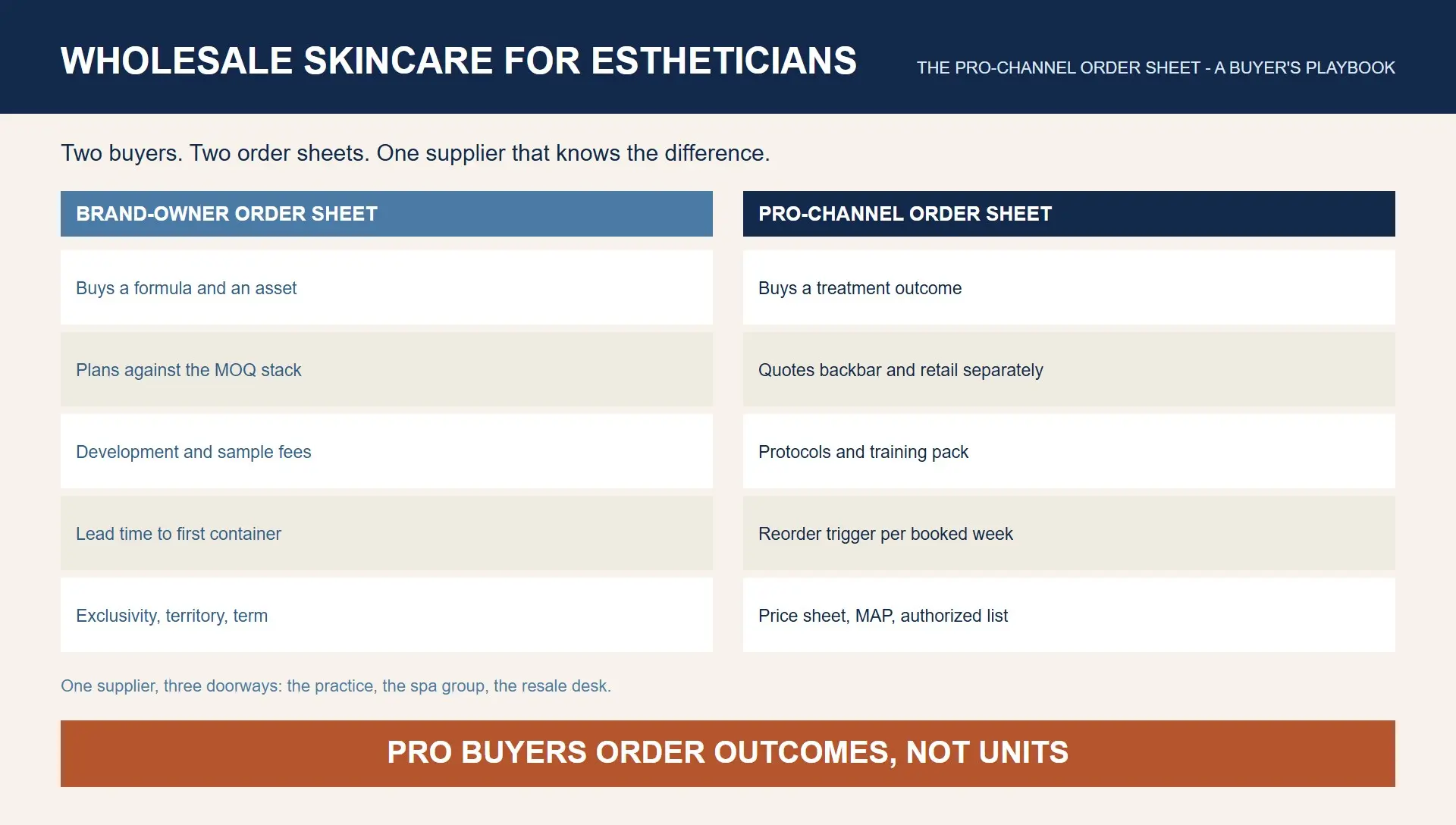
One more historical note, because it explains why suppliers' old paperwork is misleading: FDA's Voluntary Cosmetic Registration Program stopped accepting submissions on 27 March 2023 and was replaced by the mandatory system (FDA guidance on registration and listing, Section 607(c) discussion; FDA deadline explainer dated 13 June 2024). A "we are registered" claim that predates that change describes a list that no longer exists. If you are weighing whether a supplier's documentation quality is worth paying for, the buyer-side instrument already exists on this site - the twelve-point factory audit and the cost-and-lead-time desk at what OEM facial masks cost - and neither is re-derived below. The point of this section is only that under either production model, the buyer's leverage is the same instrument: a written list of who holds which file.
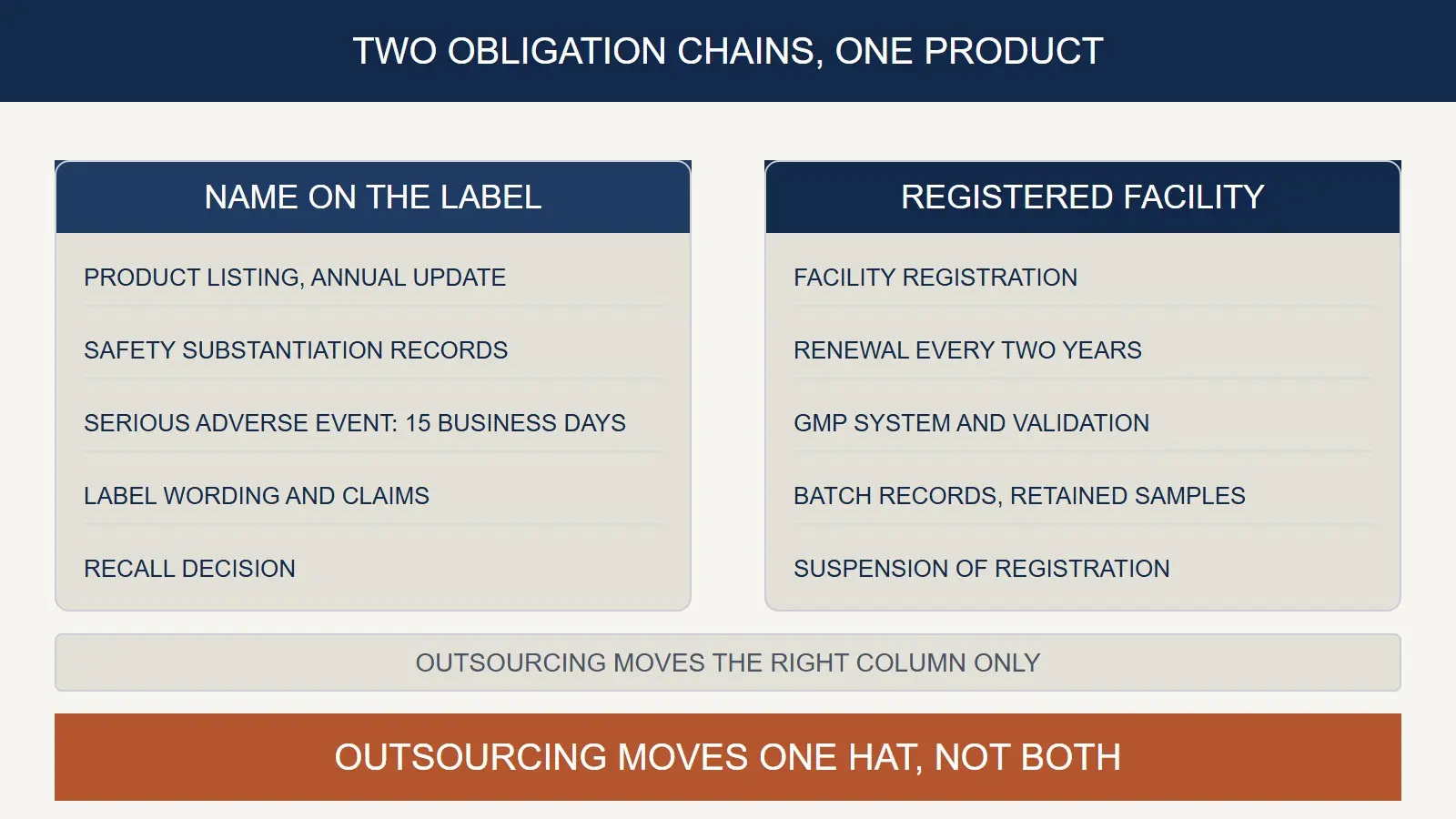
Outsourcing moves one hat, not both: the facility duties transfer, the label-name duties stay.
What a Contract Skincare Manufacturer Actually Sells You - and What It Never Can
The conversation gets clearer once you stop treating outsourcing as one product. What you buy from a contract facility is a stack of six separable services, each with its own price logic, its own file, and its own exit cost - and the buyer who quotes "the line" as a single number always gets a single number back.
| Service layer | What the facility delivers | The artifact that proves it | What it cannot deliver for you |
|---|---|---|---|
| Formulation | Starting formula, ingredient and supplier choices, preservation system | Formula sheet with INCI levels; challenge-test result; stability protocol | Your claim substantiation - and the ownership position |
| Sourcing | Raw materials and packaging on its purchase terms | Material specs, certificates of analysis per lot, approved-supplier list | Your tariff and landed-cost exposure |
| Manufacturing | Batch execution, in-process controls, yield management | Batch record, cleaning and changeover log, deviation report | A calendar you control - their queue is yours while you are small |
| Filling and packaging | Line speed, fill weight, carton, secondary packaging | First-article photos, fill-weight checks, line-trial notes | The packaging minimums that bind your launch |
| Testing and release | Micro, stability retention, assay at release | A certificate of analysis with the method named; retention samples with a stated hold period | The safety assessment signature, which belongs to the responsible person |
| Documentation | The market files a site can generate | Product information file inputs, GMP certificates, allergen data, ingredient decks | Your label name and your market entry identity |
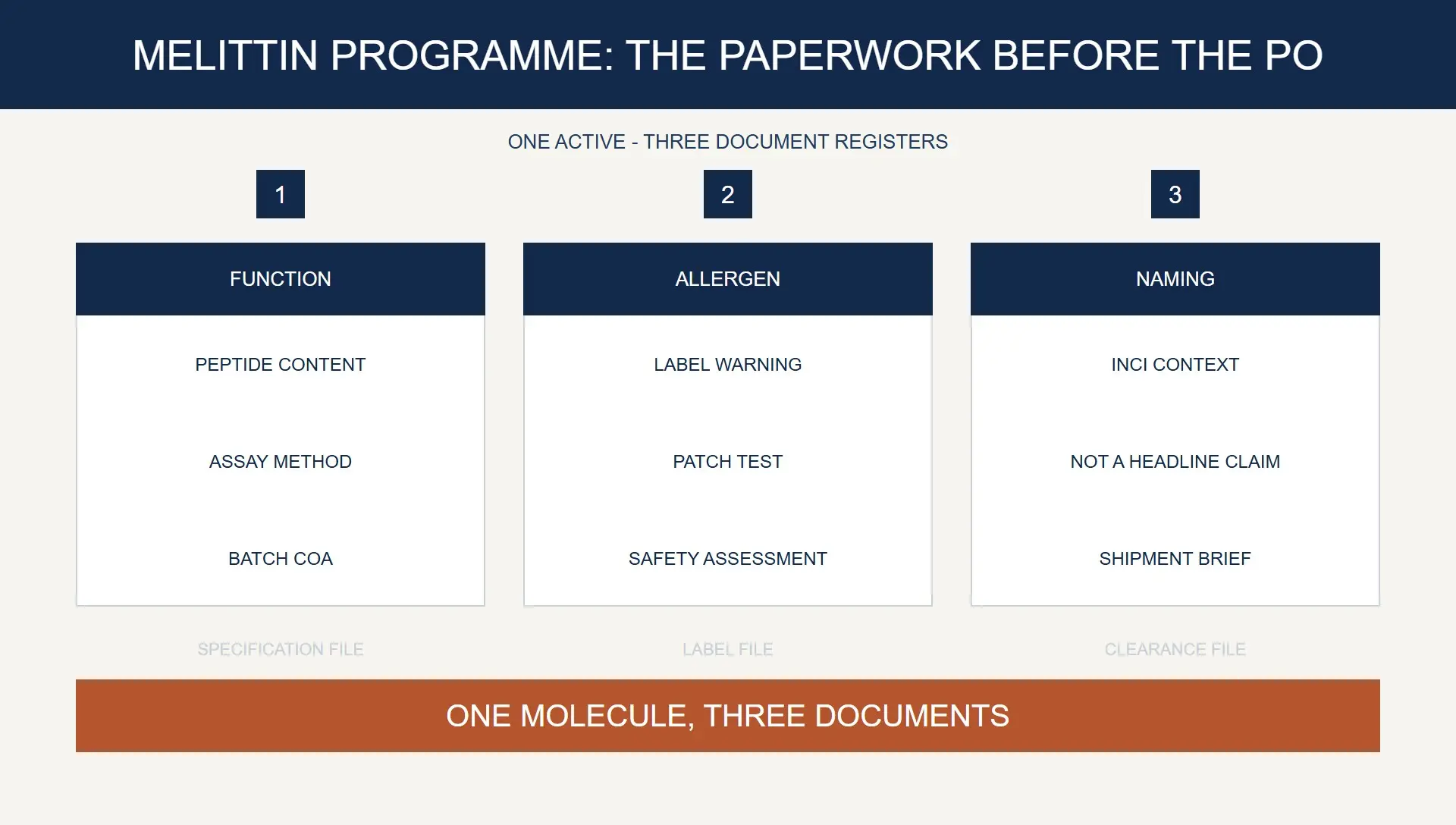
Two observations from that table are worth arguing with a supplier. The first is that the fifth and sixth rows are where deals actually break. Buyers negotiate fill weight and carton size, then discover nobody documented the assay method - and "peptide content by a named reference method" versus "active content: high" is a real difference when someone asks - or that retention samples are held for three months while the market expects shelf life plus a year. Our ingredient-side guide reaches the same conclusion from the other direction: it is the file chain that gates a purchase order, not the formula (the five-file framework for a risk-bearing active). The second is that the last column never changes hands. A facility can run the test; it cannot own your brand's legal exposure, your claims, or your identity in a market where a local entity must hold the notification number - which is why cross-border cost and filing questions stay attached to you even in the most full-service arrangement (the tariff analysis and the low-MOQ stack guide work those out; neither is repeated here).
There are two more words worth naming precisely, because deals built around them are often mis-sold as a middle path between the options. Toll filling means you supply or own the bulk and the site fills and packs it; contract packing narrows that further to filling and packing alone. These are not compromises between private label and custom formulation - they are different objects. They transfer the least formulation knowledge to you and the most inventory risk, and they are the right shape when your constraint is filling capacity rather than chemistry. They are the wrong shape when your constraint is process knowledge, because a site that only packs your bulk will never learn, or document, how it behaves. If a supplier offers only "private label or nothing," that is information about the six layers above, not about your options.
The Vocabulary Test: Private Label vs Contract Manufacturing, and Five More Words That Get Confused
Before a scored test means anything, the words in it have to mean the same thing to both parties. This site has already mapped the brand-side models in private label vs OEM vs ODM and worked the ownership consequences in the rights-ledger piece; the table below is deliberately narrower. It sorts the words that appear in manufacturing quotes, and its axis is who owns the formula against who owns the line - not who owns the brand.
| Word you will see in a quote | Who owns the formula | Who owns the production line | What the buyer is really buying | The written trap |
|---|---|---|---|---|
| Private label (stock formula) | The facility | The facility | A shelf-ready formula plus your artwork | An "exclusive" colour or scent that is not exclusive in the file |
| Custom formulation | Negotiated - frequently the facility | The facility | Development time, and a formula you may or may not carry away | Development-fee terms that buy access, not ownership |
| Contract manufacture | You | The facility | Capacity, a quality system and trained people against your formula | Specification drift when your formula runs on shared equipment |
| Private label vs contract manufacturing, as a comparison | Either | The facility | The choice of whose intellectual property you launch on | Quoting the two as one number so they cannot be compared |
| Toll filling / contract packing | You | The facility | Filling and packing hours, nothing else | Bulk arriving without a validated compatibility or hold-time record |
| In-house production | You | You | Assets, a compliance calendar, and the entire failure surface | Counting equipment and forgetting the file obligations |
Read the last column as the point of this section: the vocabulary is not pedantry, it is the difference between two quotes that are not comparable. A private-label quote and a contract-manufacture quote differ in who carries the reformulation cost when a market changes a rule, who pays for the stability retest when you want a different texture, and who can say no to a small batch. Blend them into one number and you have blended those three futures together - and the number will be wrong in whichever direction reality moves.
One more confusion worth clearing, because it is sold aggressively: contract manufacturing is sometimes marketed as turnkey, which quietly promises the documentation row of the previous table. Turnkey means one address generates most of the artifacts; it never means one address holds your obligations. The same limit applies at ingredient level: whatever the site does with the bulk, the paperwork trail for an active still has to be assembled, and for unstable or sensitive actives that trail is a programme rather than a certificate - the point this site develops for a notoriously unstable active in the vitamin C stability and formulation-protection guide, linked rather than re-explained. A useful way to test whether a supplier's "turnkey" is real: ask which of the six rows in the previous table they generate themselves, and which they obtain from a third party and forward. Both answers are fine; only the second one changes what you should write into the contract.
The Identity You Take On: Registration, GMP and a Calendar That Starts Before the First Batch
In-house skincare production is the option where the legal description of your company changes - and it changes on paper well before the first saleable batch exists. The obligation set is not mysterious. It is written down, and a buyer can put it on a checklist the same way they put a delivery date on one.
| Build-out obligation | What it is | When it starts binding | Who signs it |
|---|---|---|---|
| Facility registration (US) | The site that manufactures or processes cosmetics distributed in the US registers with FDA; the registration number is built on an FDA Establishment Identifier (FEI), which must be obtained first | Before goods enter US commerce, not at launch | Owner or operator of the site |
| Biennial renewal | Renewal is due every two years anchored to the initial registration date, not to a fixed calendar window; FDA added REGISTRATION STATUS and RENEWAL DATE fields to its Cosmetics Direct portal in February 2026 and sends reminders to the registered contacts | The day you register | The site operator - and somebody at the brand, by name |
| Material-change updates | Changes to facility information must be submitted; industry guidance describes a 60-day expectation for material changes | Every time you move a line, add a room, or change the operator | Site operator |
| GMP system | MoCRA requires FDA to establish good manufacturing practice regulations for cosmetic facilities; while that rulemaking is unfinished, the languages actually audited are ISO 22716 (EU) and ASEAN GMP (SE Asia) | Immediately - because customers audit against them before regulators do | A named QA owner with a documented procedures |
| Safety substantiation records | The responsible person must ensure and maintain adequate records; FDA mandates no specific tests but requires scientifically robust data | Per product, before listing | Responsible person, which is usually your brand |
| Product listing and annual update | Each marketed product is listed with its ingredients, with updates annually | At first listing | Responsible person |
| Serious adverse event reporting | Report within 15 business days, including a copy of the label; new information arriving within a year triggers a further 15-day report | The first complaint | Responsible person - and the site has to find the batch |
| Retention samples and traceability | Enough retained product, with lot-level records, to answer a complaint months after shipment | The first batch | Site QA, with a stated hold period |
| Stability programme | Real-time and accelerated protocols with a named assay method | Before you print a shelf life | Formulator plus laboratory |
| Water, cleaning and changeover validation | Utilities and cleaning procedures that survive an audit; shared equipment turns every formula into a cross-contamination question | Commissioning, before commercial batches | Site engineering with QA |
| Recall and suspension readiness | FDA can order a recall where a responsible person will not act, and can suspend a facility registration where a failure is pervasive or cannot be isolated | Every day the site is registered | Both hats, jointly, with a rehearsed procedure |
Three readings, all practical. One: the calendar is the point. A renewal anchored to an initial date is easy to miss precisely because nobody at the brand owns it; the industry learned that in 2026, when the first MoCRA renewal cycle arrived and facilities registered during the initial window were reminded that the obligation was theirs to track, not the agency's to chase (Wiley Rein client alert, 18 February 2026; independent compliance guide, 1 June 2026; FDA portal update, 11 February 2026). A brand that builds a line is buying a deadline it did not previously have to schedule. Two: "small business" relief is narrower than the phrase. The exemption does not reach eye-area mucous-membrane contact, injected products, products intended for internal use, or products that alter appearance for more than 24 hours where removal is not part of normal use (FDA MoCRA page, Exemptions, consulted 15 October 2026). A first in-house product that trips one of those lines means the registration clock starts before the commercial case exists. Three: registration is not a marketing asset. FDA says plainly that registration and listing are neither an approval programme nor a promotional tool, and that it will not issue certificates to say otherwise (FDA, 9 September 2026). The correct phrase on a spec sheet is registered facility, and it is a statement about paperwork at an address - not a claim about safety, and never the phrase regulators and platforms both flag.
If you decide to outsource instead, the same table becomes an audit instrument: you are not taking on these obligations, but you are depending on someone else to have discharged them, and you should be able to say which row each of your suppliers has actually answered. The buyer-side version of that discipline is already documented here as a twelve-point factory audit, and the multi-market version of "who holds which identity" is mapped in the four-desk filing map and in Southeast Asia, where a notification number can only be held by a local entity. Neither is re-derived below.
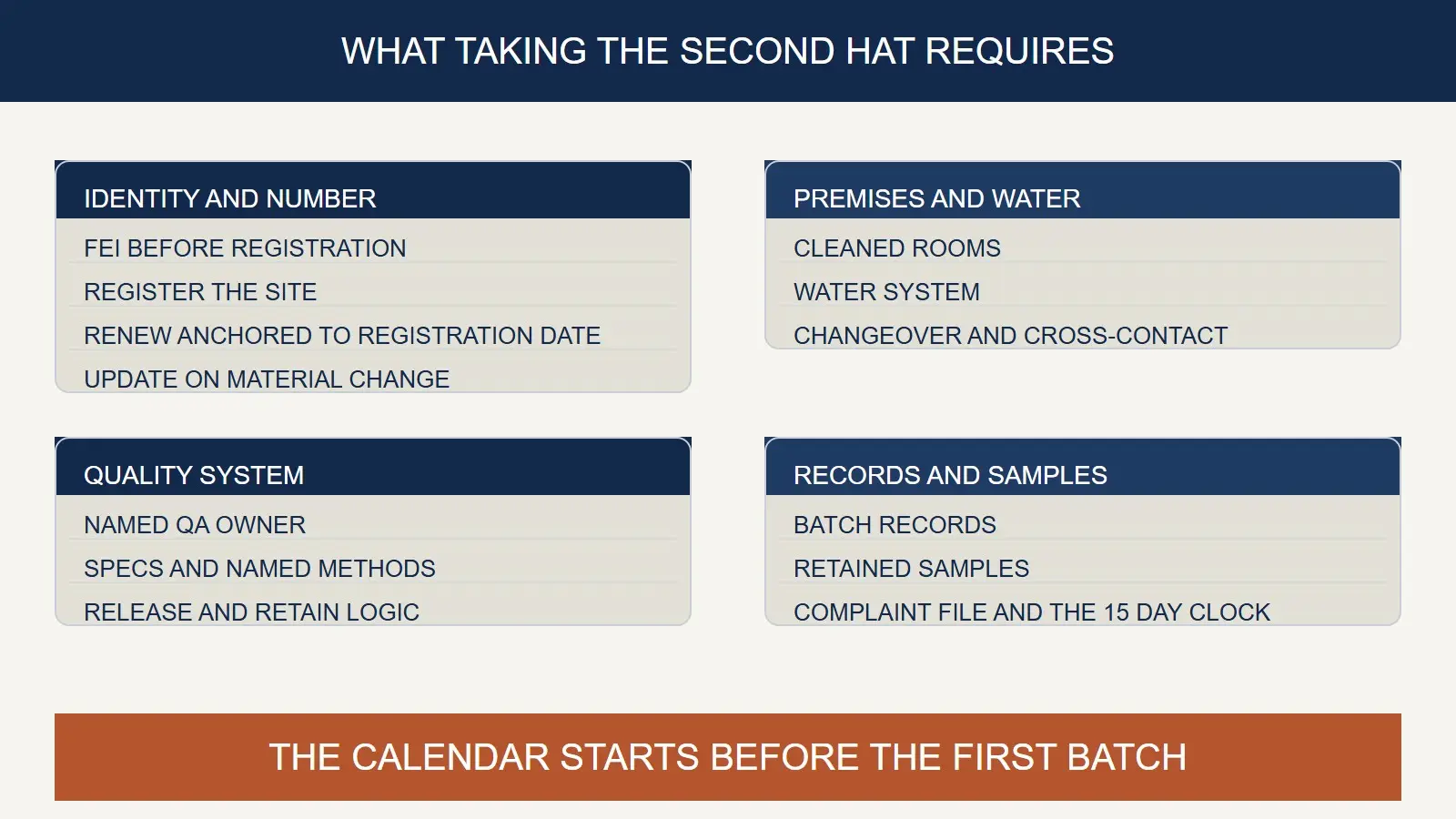
Building the line means a compliance calendar arrives before the first batch does - and the renewal date follows your registration, not somebody else's window.
Capital Shape: Fixed Cost With a Calendar Against Variable Cost With an Order
Strip the advertising out of both options and the financial difference is a difference in shape, not in size. A contract facility's charges are mostly variable with an order: you pay when you produce, and the idle hours on their line are their problem. Your own line is fixed with a calendar: depreciation, a quality team, utilities, validation, retained-sample storage and the renewal obligation all accrue whether orders arrive or not. That single sentence decides more make-or-buy arguments than any spreadsheet, because it tells you which of your two futures hurts: under-utilised capacity on one side, a queue you cannot jump on the other.
A house rule applies here, and it is why this section carries no figures: we do not publish absolute unit prices, capex bands or percentage savings that no reader can verify. What transfers between suppliers - and what belongs in a board conversation - is the structure of the question:
| Question, answered in writing | Why it decides the shape | What an honest answer looks like |
|---|---|---|
| What is our 12-month volume band, not our forecast? | Owned capacity costs money at the bottom of the band | A range with the low case costed against fixed cost |
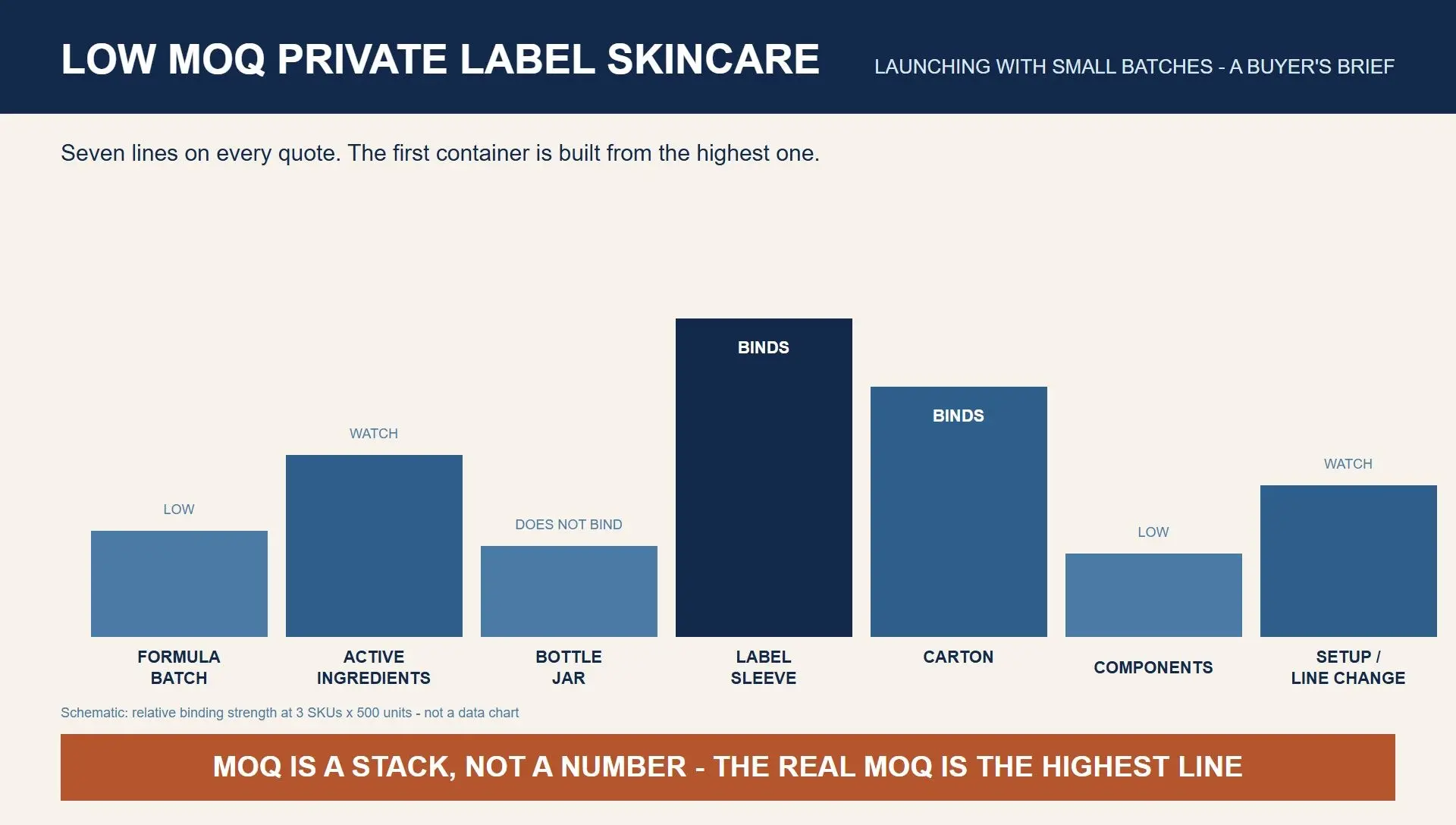
| Which lines bind us first - formula, components, or packaging? | The binding line is usually labels and cartons, not bulk | The stack read line by line, as in the low-MOQ guide |
| What does a changeover cost us on each side? | Outsourced changeovers price as a fee; owned changeovers cost a day of the calendar | An hour count, stated on both sides of the comparison |
| Who holds the forecast error? | Outsourcing hands it back to the facility in exchange for queue position; in-house keeps it | A sentence in the agreement or in the budget, explicitly |
| What is our working-capital cycle per SKU? | In-house ties cash in materials, work in progress and finished goods at once | Weeks of cover by line, not a number by brand |
| What does the compliance calendar cost in people? | A renewal date is somebody's hour, not a rounding error | A named owner mapped to each obligation in the build-out table above |
Two notes on reading this honestly, because the market data that arrives at your desk is usually designed to be misread. First, supplier-published "industry reports" claiming a fixed percentage saving for outsourcing are marketing documents, not evidence: they are authored by the party selling the service, frequently undated, and the method is never shown. This site handles that class of claim the way it handles undated low-MOQ promises - refused rather than quoted, and the same discipline governs which sources appear in the market section below. Second, the credible published numbers describe the size of the outsourcing economy, not your unit economics. Dated research houses put the personal-care contract-manufacturing market for 2026 between roughly US$18.7B and US$27.03B, and the broader cosmetic OEM/ODM boundary much higher again, depending on what each includes (MarkWide Research, 11 May 2026; Business Research Insights, 2026; Mordor Intelligence, 11 September 2026; Coherent Market Insights, 27 April 2026). The spread is a boundary artefact, not a forecast war: the range itself is the analysis object, and it tells you the direction is durable - buyers keep choosing to buy production - while telling you nothing about your own per-unit cost. Direction for strategy; your own numbers for budget.
What that family of reports genuinely does supply is the shape of the supply market. One dated analysis puts North America at roughly 31 percent of contract-manufacturing activity in 2026, with Asia-Pacific the fastest-growing region at a high-single-digit rate through the early 2030s, and attributes North America's weight partly to MoCRA-era compliance demand and a maturing full-service manufacturing ecosystem (Persistence Market Research, 24 July 2026). Read that as a supply-side fact a buyer can use: regulatory capability has become a purchasable service, and it is unevenly distributed by region. That is a reason to choose a particular facility for what it can file, not merely for what it can fill - and symmetrically, it is exactly the burden you take on yourself when you build. The market-entry side of the same statement is documented in the EU importer's guide and the four-desk filing map, where the holder of a notification number is frequently not the factory at all.
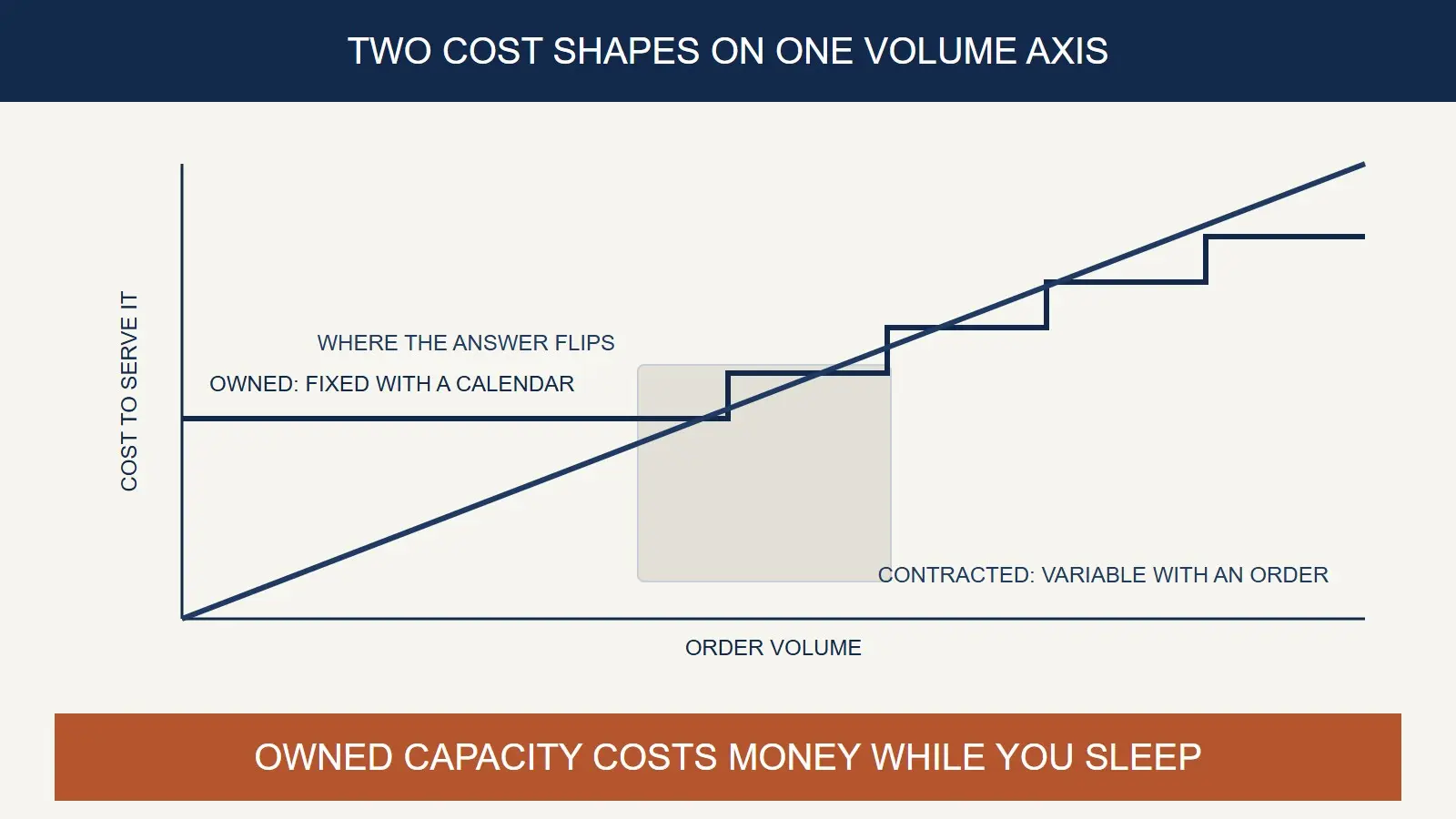
Outsourced capacity prices the idle hours to someone else; owned capacity prices the queue to you. Which of those two you can afford is the decision.
Iteration and Custody: What You Are Buying Is a Change Budget and a Filing Cabinet
The two arguments made most often for building a line are speed and control. Both are real - but they are real in narrower, more technical ways than the pitch suggests, and a buyer who prices them from the pitch overpays for the wrong version of each.
Speed is a change budget, not a launch date. Launching is a scheduling problem both models solve, and an established contract facility will usually get a first saleable batch into the world faster than a new site can be commissioned, validated and staffed; this site's launch sequence assumes outsourced sampling at standard terms (seven days for a sample pack at this desk), and the ordering logic is set out in how to start a skincare brand. What an owned line actually buys is the ability to change a product repeatedly without renegotiating: adjust a texture, shift a fragrance load, run a small pilot because a channel asked for something specific, retire a SKU without a minimum-order argument. If your roadmap contains four formula revisions a year, that is a real asset. If it contains zero, you are buying an empty gym.
There is a tax on that freedom that rarely appears in the brochure: every change reopens paperwork. A texture change can be a new exposure calculation. A preservative change is a challenge test. A new level of an active is a stability protocol and, in notification markets, an updated file. The market-entry version of this argument is documented for a whole range rather than a single tweak - per-variant filings and per-variant fees in the Southeast Asia guide and the four-desk filing map - and the ingredient version is the file chain in the risk-bearing-active guide. The arithmetic here is short: owning the line moves the execution constraint off your critical path and leaves the evidence constraint exactly where it was. Speed that re-triggers an evidence cycle is not free; it is merely yours to schedule.
Control is custody, and custody is measured in documents and drawers. Two kinds of knowledge sit behind any product: the formula, and the process. The formula is a document. The process - hold times, homogenisation sequence, cooling ramp, cleaning validation, the limits of the water system, which ingredient lot behaves differently - is knowledge stored in procedures and in people. That is the honest reason the "just take the recipe home" version of insourcing fails: a recipe without the process is a text file, and the receiving site will spend months rediscovering what the sending site never wrote down. Ask any brand that has moved a formula between factories how long re-validation actually took, and how much of the delay was documentation rather than equipment.
The same distinction cuts the other way when you outsource. The four ownership lines - formula, ingredient-level intellectual property, exclusivity, compliance file - are worked in detail in private label vs white label and are not re-derived here. What is specific to the make-or-buy question is the physical side of custody: who holds the retention samples, who holds the batch records, and who can answer a complaint on day twelve of a fifteen-business-day reporting clock. That is not a metaphor for diligence; it is a logistics fact. A facility keeps lot-level samples and process records by default. A brand that outsources and never contracted for copies has neither, and discovers this only in the week it needs them. Two written clauses fix it, and they are cheap enough that their absence is itself information: a retention-sample and records clause (who keeps what, for how long, and where it goes if the relationship ends), and a technology-transfer and formula-escrow clause (what must be handed over, in what form, on what trigger, and how quickly the same formula can be reproduced elsewhere). A supplier who negotiates those two easily is telling you they are confident in the value they add. A supplier who refuses is also telling you something.
An owned line buys revision cycles, not a faster first launch - and outsourced custody is only as real as the retention-sample and transfer clauses you actually signed.
The Six-Line Test: Contract Manufacturer vs In-House Production, Scored on Paper
Here is the instrument this piece exists to leave you with. It scores the decision, not the vendor - which is the deliberate difference between this table and the five-dimension factory scorecard elsewhere on this site for choosing between suppliers (the rights-ledger guide holds that one; it is not reprinted). Answer each line in writing before comparing options, and the comparison becomes arithmetic instead of temperament.
| Line | The question, in writing | Points toward owning a line | Points toward signing with a facility | The evidence you must hold |
|---|---|---|---|---|
| 1. Volume band | What is our low case for the next twelve months, not our plan? | A band whose low case still clears fixed cost | Any band whose low case leaves capacity idle | A two-case range, costed, signed |
| 2. Change frequency | How many formula revisions does the roadmap actually contain? | Four or more a year | Zero to two | The roadmap, not the ambition |
| 3. Format and category risk | Are we in aerosols, eye-area, long-wear or device-adjacent formats? | Formats where process control is the differentiator and validation is affordable | Formats where the binding constraint is testing capacity and certification cycles | The exemption carve-out list, checked against the SKU map |
| 4. Market set | Which markets do we file in, and who holds the number in each? | One dominant market where you can be the holder | A multi-market launch whose filings require local holders you do not control | A holder map per market (the filing guides hold the depth) |
| 5. Cash horizon | How many months of fixed cost can we carry before the SKU repays it? | Cash that survives commissioning and validation | Cash that belongs in inventory and channel | A working-capital cycle, in weeks, per SKU |
| 6. Exit cost | If we change direction in eighteen months, what is hard to unwind? | Assets liquid enough to matter | Depreciation and a compliance calendar that cannot be paused | A transfer clause that works in both directions |
Two notes on using it honestly. The lines are not weighted equally, and the weights are yours to set - a brand whose entire differentiation is a texture nobody else can hold will let line 3 outrank line 1; a brand whose constraint is cash will find that lines 5 and 6 decide everything. What cannot be negotiated is the method: score against the artifacts in the last column, not against a feeling. That is also why this site refuses to print absolute prices in any guide - a structure you can carry between suppliers is worth more than a number you cannot verify, and a decision scored on documents survives a change of factory.
And the middle is a legitimate answer. Line by line you will frequently land on split positions: bulk made by a facility and filled locally; one hero SKU in-house and the range outside; a pilot line that exists to test rather than to sell. Choosing a hybrid is not indecision - it is how most brands actually sequence this - but a hybrid has its own discipline, and it is the subject of the next section. Before that, one warning about the test itself: if your answers come from the marketing pages of the suppliers you are comparing, the test is measuring their copy rather than your business. Answer lines 1, 2 and 5 from your own order history first, then go looking for capacity.
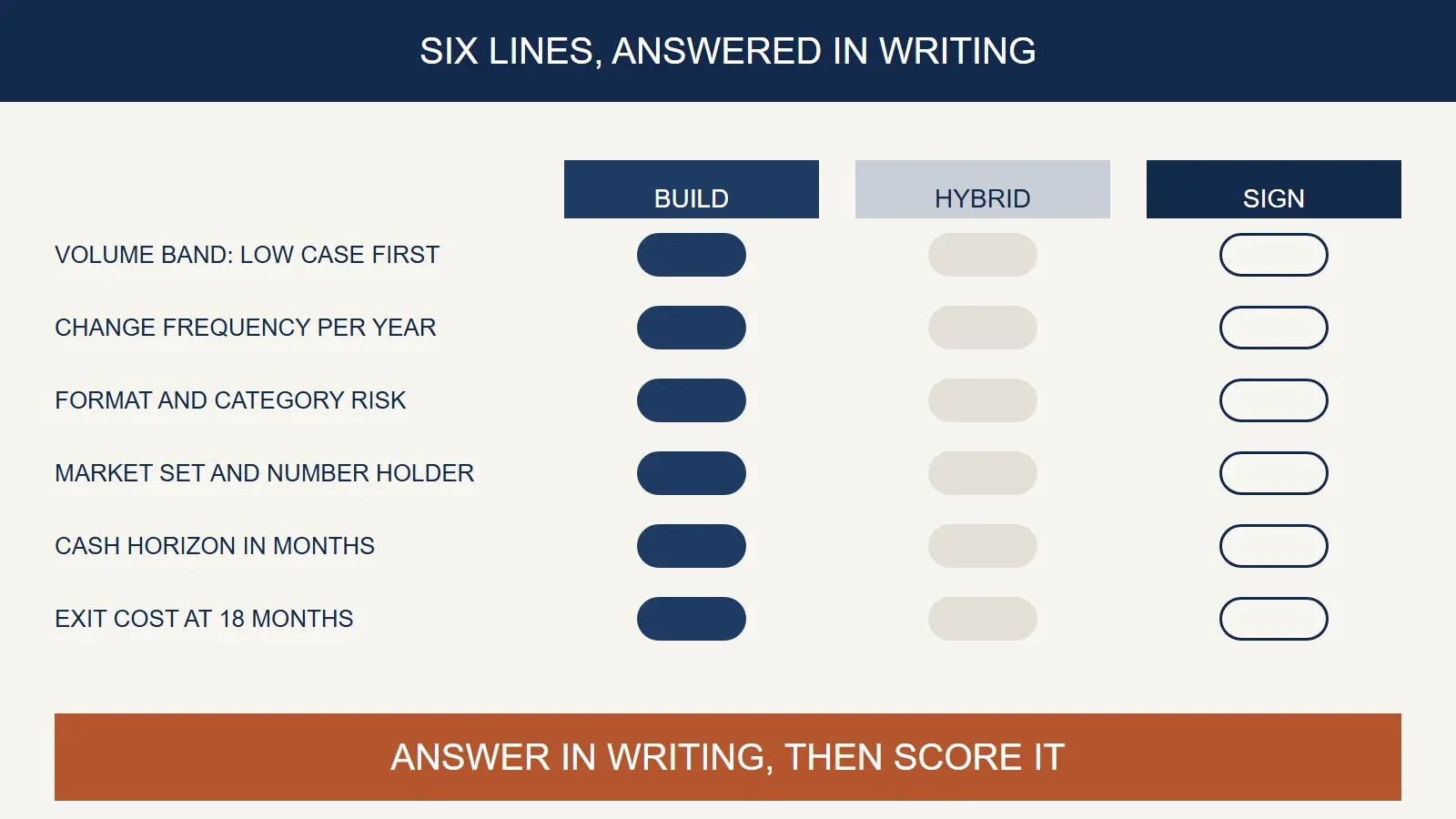
Answer the six lines in writing, then score the decision - not the supplier, and not the feeling.
The Staged Middle: What Most Brands Actually Do, in Sequence
The binary is a rhetorical device; the market works in stages. A credible sequence looks less like a decision and more like a set of gates, each passed on evidence rather than enthusiasm. The structure below is not a promise - durations depend on the format, the market set and the packaging line that binds first, and that arithmetic is worked out in the low-MOQ stack guide, not repeated here.
| Gate | What is actually being tested | What must be true to move on | The document that closes it |
|---|---|---|---|
| 1. Contracted range | Whether the range sells at all, on somebody else's capacity | Repeat orders on the same SKU, not first-order curiosity | Purchase history by SKU, plus the facility's file pack for each |
| 2. A process question | Whether a specific format or active needs tighter process control | A named failure mode that is about execution, not recipe - hold time, emulsion stability, fill-weight drift | Stability and in-process data with the assay method named |
| 3. A pilot, not a factory | Whether your people can run a process at all | A small line producing a saleable batch with the file set complete: batch records, cleaning validation, retained samples | A GMP-shaped procedure set, in the language your auditors use |
| 4. Registration identity | Whether the brand is ready to be a facility and not only a label | A named owner for the renewal calendar, the FEI and registration path, the complaint clock and the recall procedure | A compliance-owner matrix with names, not job titles |
| 5. Selective in-house | Which SKUs earn their own line | A volume band whose low case clears fixed cost, plus a change frequency that justifies the calendar | The six-line test, signed, with both cases costed |
Read what each gate buys: not independence, but information you could not obtain by asking. Gate 1 tells you whether you can sell. Gate 2 tells you whether your problem was ever a manufacturing problem - and at most brands it is not, which is the cheapest finding available in this entire exercise. Gate 3 is where the romance goes to die, because a pilot line that cannot generate a complete file set is not a manufacturing operation; it is an expensive mixer with a cleaning problem. Gate 4 is the one almost nobody plans for: the day your company becomes a registered facility, someone has to own a two-year renewal date anchored to your own initial registration, a fifteen-business-day complaint clock, and a recall procedure that has been rehearsed rather than merely written. Gate 5 is the only gate where the answer is a number, and it is a number about your low case, not your ambition.
Two honest cautions about the middle path. First, hybrids carry double overhead: a brand making bulk in-house and filling externally needs two quality systems that speak to each other, two retention-sample sets, and an interface document that nobody writes until the first deviation. If you choose a hybrid, choose it with a named interface owner on both sides and a written specification for the transfer - the handover, not only the process. Second, capability is not linear with equipment. Buying a homogeniser is not the same as knowing what it will and will not do to your emulsion at your hold time and your ingredient temperatures; the process knowledge that makes a line work is exactly the knowledge a machine catalogue cannot sell. That is the same lesson the format guides on this site teach from the substrate side - why a material choice is a manufacturing decision in hydrogel versus sheet mask, and how equipment and process decisions get made in the vacuum-emulsification and sustainable-sheet work on the site's Resource list.
So the real question for a buyer whose differentiation is the format itself - a particular sheet, a particular two-component system, a particular emulsion - is not "own or rent". It is which process step is the moat. If the moat is a recipe, it can be contracted, escrowed and moved. If the moat is a process window only your people have learned to hold, the machine is the smaller half of the investment, and the hiring and documentation plan is the larger one.
Reading the Numbers Without Romanticising Either Side
The market data around this decision is easy to misuse, so let us misuse it in the useful direction: by showing how differently the same sentence gets counted.
| Source (publication date) | Object actually counted | 2026-era figure | Forward figure | What the boundary leaves out |
|---|---|---|---|---|
| MarkWide Research (11 May 2026) | Personal-care contract manufacturing | US$18.7B (2026) | US$33.81B by 2035, 6.8% CAGR | Development-only and design-manufacturer revenue |
| Business Research Insights (2026) | Personal-care contract manufacturing | US$22.94B (2026) | US$50.81B by 2035, 9.24% CAGR | A different service basket, a faster assumed growth path |
| The Business Research Company (8 Jul 2026) | Personal-care contract manufacturing | US$24.72B (2025) | Growth projected to 2035 by product, service and formulation type | Its own regional and category definitions |
| Mordor Intelligence (11 Sep 2026) | Personal-care contract manufacturing | US$24.98B (2025) / US$27.03B (2026) | US$40.09B by 2031, 8.21% CAGR 2026-2031 | Brand-side marketing services |
| Global Growth Insights (7 May 2026) | Contract manufacturing plus private label | US$35.31B (2025) / US$37.15B (2026) | about +5.2% year on year | Nothing - it adds private-label volume into one basket |
| Coherent Market Insights (27 Apr 2026) | Cosmetic OEM and ODM | US$72.29B (2026) | US$113.07B by 2033, 6.6% CAGR | The broadest boundary: formulation, development, packaging services |
| Verified Market Research (21 Jan 2026) | Contract manufacturing plus private label | US$80B (2024) | US$135.41B by 2032, 6.8% CAGR | The widest basket in the set |
| Grand View Research (17 Jul 2026) | Private-label cosmetics only | US$10.6B (2024) / US$11.7B (2026 est.) | - | Counts retailer own-label product, not the service economy |
| Persistence Market Research (24 Jul 2026) | Regional structure of the same category | North America about 31% share (2026) | Asia-Pacific fastest, about 8.4% CAGR to 2033 | Names MoCRA compliance demand and full-service ecosystem maturity as drivers |
Four readings, in the order a buyer should use them. One: the range is the finding. For a single year, credible dated research houses size "the outsourcing business" between roughly US$18.7B and US$80B - about four times apart - because they are not counting the same object: the narrowest counts manufacturing services, the widest folds in private-label volume, development work and packaging. Quote the number whose boundary matches your question, or quote both and say why. The range itself is the analysis object, and a single figure offered without its boundary is marketing, not data. Two: growth direction is the only durable claim. Every house in the set forecasts mid-single-digit to high-single-digit growth to the early 2030s. Nobody credible is forecasting the outsourcing model disappearing. That is the sentence a board needs, and it is not a unit-price argument.
Three: the regional data is a supply-side fact, not a demand forecast. A dated analysis attributing North America's weight to MoCRA-era compliance demand and a maturing full-service ecosystem (Persistence, 24 July 2026) is telling you that regulatory capability is now a purchasable service - which raises what you should expect from a facility, and, symmetrically, is precisely what you assume when you build. Four: the phrase a buyer searches is not the market a buyer budgets. Someone typing contract cosmetic manufacturer is standing inside the OEM/ODM boundary - the broadest row above - while the number a procurement team actually works against is usually one of the narrow rows. The commercial consequence is that this category attracts a great deal of supplier self-promotion and very little comparable pricing: expect vendor-authored "industry reports" with undated percentage savings, and handle that class of material the way this site handles undated demand claims - as evidence about who is marketing, not about what anything costs or earns.
What is legitimately taken into the decision from all of this is narrow and checkable. The outsourcing economy is large, growing at mid-to-high single-digit rates in every dated estimate, and structurally concentrated: a long tail of listed brands riding a short list of registered sites. FDA's own counts - 16,398 active registered facilities against 1,298,361 active listed products as of 30 June 2026 - put that ratio near seventy-nine products per registered site, which is arithmetic on published government data rather than a market estimate, and it is the one number in this section you can safely repeat. Direction for strategy; your own channel, margin and forecast data for budget; and the six lines, in writing, for the decision.
Six Ways This Decision Fails - Three on Each Side
The failure modes are symmetrical, which is the honest way to write this section: the build path and the sign path each have characteristic ways of going wrong, and three of the six are the fault of the buyer's paperwork rather than anyone's factory.
| Failure mode | Which side it belongs to | Early signal | The one artifact that prevents it |
|---|---|---|---|
| The romantic line - equipment bought before anyone owns the compliance calendar | Build | A purchase order for mixers and no name next to "renewal date" | A compliance-owner matrix with people, not roles |
| The exemption surprise - a small brand discovers its eye-area or long-wear SKU is outside small-business relief | Build | "We are too small to register" said before the SKU map is read | The exemption carve-out list checked line by line against the range |
| Forecast absorbed by owned capacity - the low case arrives and the fixed cost stays | Build | A forecast presented as one number | Two cases costed, low case first |
| The single-site concentration - forty SKUs on one registration, and that registration can be suspended as a unit | Sign | Nobody asked how many of our SKUs live at one address | A site-concentration map of the range |
| The custody illusion - the brand believes it owns a formula it merely licenses | Sign | Development-fee terms that describe access, not ownership | An ownership clause naming the formula, the IP and the file |
| The interface gap - a hybrid model where two quality systems never met on paper | Both | A deviation that took three weeks to trace | A written transfer specification with two named owners |
Two of these deserve a sentence more, because they are the ones that cost the most per unit of warning. The single-site concentration failure is structural, not hypothetical: MoCRA gives FDA authority to suspend a facility's registration when a failure cannot be isolated to one product or is pervasive across the site, and once a registration is suspended it is a prohibited act to distribute that facility's cosmetics in the US (FDA registration and listing page, consulted 15 October 2026). A brand with one SKU at one site has a problem. A brand with forty has a forced re-launch, and it will discover at that moment exactly how much process knowledge it never documented. Concentration is a commercial decision with a regulatory tail; ask the question before the queue position makes it uncomfortable.
The custody illusion is the quietest and most expensive line in the table, and it is the reason the six-line test in the previous section asks for documents rather than intentions. Dev-fee structures, milestone payments and "we developed it for you" language routinely convert an ownership claim into a usage licence, and the difference only becomes visible when the brand tries to move the formula - at which point the receiving site needs a specification with an assay method, hold times and a validation plan, not a recipe card. The rights-ledger guide on this site works the four ownership lines in detail for the label-model decision (private label vs white label); the make-or-buy version of the same lesson is shorter: whatever you cannot describe in a document, you do not own - and that includes your own process.
Frequently Asked Questions
Q1: Is outsourcing production the same thing as private label? No. Private label is a branding and IP arrangement - you sell a formula somebody else owns under your name. Outsourcing is a production arrangement - somebody else's site makes the goods. You can outsource a formula you own (contract manufacture), or private label a formula you do not (their stock range). The two decisions are answered by different documents: the ownership clause in one case, the capacity and quality system in the other. The model comparison is worked out on this site in private label vs OEM vs ODM.
Q2: If I outsource, do I still have to register anything in the United States? Yes, and the two obligations are easy to confuse because they point at different objects. The facility that manufactures or processes registers with FDA and renews every two years. The responsible person - the entity whose name appears on the label - lists each marketed product, updates that listing annually, maintains the safety substantiation records and reports serious adverse events within 15 business days (FDA, Registration & Listing page, updated 9 September 2026; MoCRA overview page, consulted 15 October 2026). Outsourcing moves the first obligation to your supplier's address. It does not move the second one at all.
Q3: What volume makes in-house production worth it? Not a number you can take from anyone else's brochure. The test is whether your low case - the pessimistic twelve-month volume, not the plan - clears the fixed cost of the site, including the QA staffing, validation, retention storage and the compliance calendar, and whether your roadmap actually needs the revision cycles that owning the line buys. The same arithmetic that makes a packaging minimum bind before a bulk minimum makes idle capacity bind before a recipe question does; the stack method is documented in this site's low-MOQ guide.
Q4: Can I move a formula to a different factory later? You can move the document; the process has to be re-earned. A receiving site needs the specification with named assay methods, the raw-material approvals, the hold times, the cleaning and changeover plan, and then its own validation on its own equipment. This is the practical reason a technology-transfer and formula-escrow clause belongs in the original agreement: it decides whether "leaving" is a project or a filing cabinet.
Q5: Skincare contract manufacturer or own line - who actually signs the safety file? The responsible person, in both cases. A contract site can supply test results, in-process controls and certificates of analysis, but the person whose name is on the label is the one required to ensure and maintain records supporting adequate safety substantiation (FDA MoCRA page, consulted 15 October 2026). This is also why the safety conversation comes before the cost conversation for any active with a risk profile attached: as the ingredient-side guide on this site puts it, the allergen file gates the rest of the work (the five-file framework).
Q6: Do I need a GMP certificate before I build a line? Plan for two clocks. In the United States, MoCRA requires FDA to establish good manufacturing practice requirements for cosmetic facilities, and those rules are still in development, with a draft guidance published for industry comment (FDA MoCRA page, consulted 15 October 2026). In the meantime, the standards that retailers, marketplaces and customers actually audit against are the harmonised ones - ISO 22716 in the EU, ASEAN GMP in Southeast Asia, both already documented on this site in the EU importer's guide and the Southeast Asia access guide. Commercially, the buyer's question is never "will GMP be required eventually" - it is "who audits me first, and are the procedures written before they arrive."
Q7: What is the cheapest way to find out which side we belong on? Run the six lines as a document exercise with the data you already have: last twelve months of orders by SKU, the next four quarters of the roadmap, and the file list from your current supplier. Most brands discover something in the first hour - usually that the thing they wanted to control was never a manufacturing constraint at all, and the cost of testing that belief is one afternoon rather than a line.
Sources and Further Reading
Figures cited as of publication. Regulatory statements are taken from primary agency text and dated as consulted; market-size figures are research-house estimates with their boundaries stated in place, not measurements of your costs, and supplier-published "industry reports" (including percentage-saving claims for outsourcing) were excluded as promotional material rather than evidence.
- Facility registration by manufacturers and processors; renewal every two years anchored to the initial registration date; product listing by the responsible person with annual updates; FEI as the facility registration number; registration and listing are neither an approval programme nor a promotional tool; FDA does not issue certificates verifying compliance - U.S. Food and Drug Administration, Registration & Listing of Cosmetic Product Facilities and Products, page updated 9 September 2026; final industry guidance December 2024; Cosmetics Direct portal update announced 11 February 2026 - Counts of unique, active registered cosmetic product facilities (16,398) and listed cosmetic products (1,298,361) since 18 December 2023 - same FDA page, data stated as of 30 June 2026; the ratio used in this piece is arithmetic on those two published counts, not a third-party estimate - Definitions of "facility" and "responsible person" (section 609(a) of the FD&C Act / section 4(a) of the Fair Packaging and Labeling Act); safety substantiation record duty; serious adverse event reporting within 15 business days; mandatory recall authority; registration suspension; small-business exemptions and the four product carve-outs (eye-area mucous membrane, injected, internal use, appearance-altering beyond 24 hours); MoCRA's direction to FDA to establish GMP and fragrance-allergen labelling rules; PFAS report published 29 December 2025 - FDA, Modernization of Cosmetics Regulation Act of 2022 (MoCRA) overview page, consulted 15 October 2026 (What's New entries dated 4 May 2026 and 5 February 2026) - Voluntary Cosmetic Registration Program closed to new submissions on 27 March 2023; registration and listing deadline practice - FDA guidance document (Section 607(c) discussion) and FDA consumer-facing deadline explainer dated 13 June 2024 - First biennial renewal cycle under MoCRA described as an industry-wide compliance test for cosmetic facilities in 2026 - Wiley Rein client alert, 18 February 2026; independent compliance guides dated 1 June 2026 and 10 August 2026 (secondary, named as such) - Contract-manufacturing and OEM/ODM market estimates for 2024-2026 with forward figures, quoted here as a range because the boundaries differ - Mordor Intelligence (11 September 2026); The Business Research Company (8 July 2026); Coherent Market Insights (27 April 2026); Global Growth Insights (7 May 2026 and 18 February 2026); Verified Market Research (21 Jan 2026); Business Research Insights (2026); MarkWide Research (11 May 2026); Persistence Market Research (24 July 2026); Grand View Research (17 July 2026) - On-site layers this piece leans on and deliberately does not repeat: the four-market filing map and the EU importer's guide for who files what; the Southeast Asia access guide for notification holders and per-variant fees; the low-MOQ stack guide for which minimum binds first; the rights-ledger guide for the four ownership lines and the factory scorecard; the launch-sequence guide for stage order; the tariff guide for cross-border cost exposure; the format guide for substrate decisions; the professional-channel guide for protocol-bearing products; and the risk-bearing-ingredient guide for the five-file chain (all linked at the point of use above).
What to do next
If the six lines landed anywhere other than a single answer, that is the correct result - most brands sit on a hybrid and need the numbers to say so. Send us the three documents this decision runs on - your volume band by SKU, your next four quarters of roadmap changes, and the file list you already hold from your current supplier - and we will quote against them. Get your quote and MOQ table, with formula, component, packaging and documentation lines named separately rather than folded into one rounded number, and with the six service layers stated as deliverables instead of promises. A dedicated product manager on every RFQ - reply within 24 hours, sample packs in 7 days, MOQ from 1,000 pcs.