

Hydrogel Mask vs Sheet Mask: The Format Choice for Your Brand
Hydrogel mask vs sheet mask is the wrong question if you are answering it as a preference survey, and the right question if you are answering it as a supply-chain decision. Two substrates, two cost stacks, two stability envelopes, two retail price points — and one SKU slot on your 2026 plan. This guide is written for the brand owner or product developer who has to decide which format to commit to, and it treats the choice the way a P&L treats it: in terms of essence load, line speed, shelf life, order minimums, and the price point the finished product can defend at retail.
The honest starting point is that the two formats are not rivals for the same shelf. A nonwoven sheet mask is the category's volume engine — the substrate that keeps unit cost low, line speed high and order minimums modest. A hydrogel mask is a format that trades part of that cost advantage for a different consumer experience: a gel matrix that carries more essence, a cooling tactile feel, and a premium positioning a nonwoven sheet cannot replicate at the same price. Which one your SKU should be depends on where you want to sit on the price curve, what active you are loading, and how long you need the formula to stay stable.
By the end you will have a two-component model of what a mask actually is, a cost-stack comparison you can take against a supplier quotation, a read of the market data that does not overstate what the research houses agree about, a scoring matrix for the format decision, and the claim boundaries for the sentences you will print on the pack.
Hydrogel Mask vs Sheet Mask: A Format Decision, Not a Preference
The consumer-facing version of this comparison is about feel: the gel sheet is "sweeter, cooler, more premium", the nonwoven sheet is "thirstier, dries faster". None of that is wrong, and none of it is a business decision. For the brand owner, the comparison is a specification question with seven variables:
- Substrate. Cotton or synthetic nonwoven (meltblown, spunlaced or pulped) versus a hydrocolloid gel sheet. This is the variable that changes the manufacturing line, the sterilization step and the unit cost. - Essence load. The fibre substrate wicks and holds a limited volume; the gel matrix is itself a water-bearing carrier. Load determines what "rich in essence" may lawfully mean on your pack. - Stability envelope. A dry substrate plus a liquid essence is a two-part system with a wide shelf-stable window; a wet gel sheet is a single aqueous system where preservative efficacy and microbial control are the binding constraints. - Order minimums. The formats have different MOQ stacks, and the difference is not only in the substrate — it propagates into bulk, filling and printing. - Line speed. Die-cut and impregnate is a fast, mature line; gel casting with a sterilization step is slower and less commonly duplicated across suppliers. - Retail price point. The substrate difference is what lets a hydrogel mask sit at 1.5–2× the nonwoven price with the formula doing most of the work. - Claim space. Both formats share the same cosmetic claim boundary; the format may not be used to widen it. A gel sheet does not license the sentence "delivers deeper" any more than a nonwoven sheet licenses "gentler".
The framing this guide will use throughout: the substrate is not a packaging detail, it is the product. The essence is the ingredient story, but the substrate is the cost story, the stability story and the retail story — and it is the variable you cannot swap out after the artwork is signed.
Choose the format before you freeze the formula: the substrate decides the cost stack, the stability data you must evidence, and the price point you can defend — none of it can be swapped after artwork.
What Does Hydrogel Mask Do That a Sheet Mask Cannot?
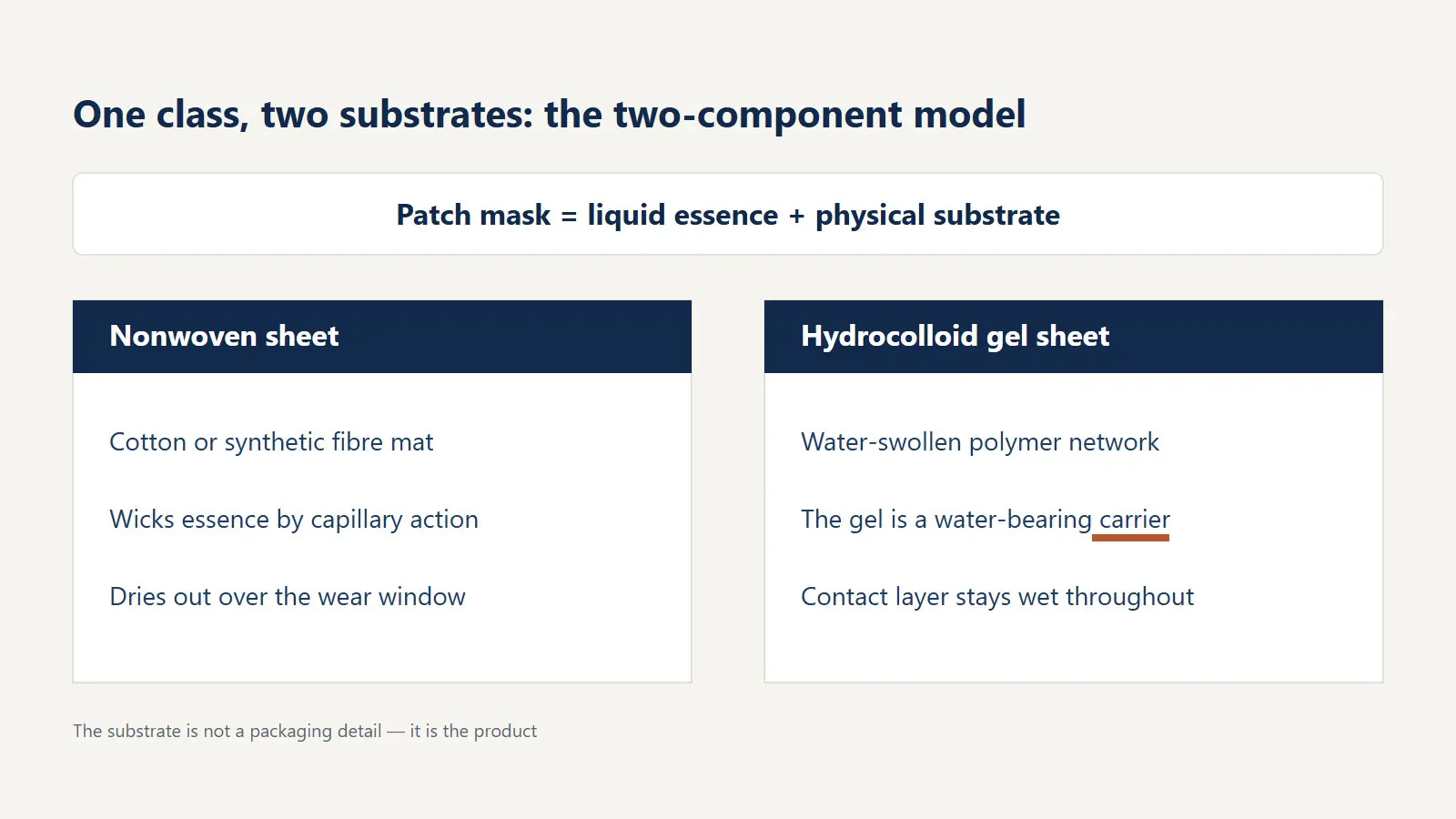
Every patch mask has two components: a saturated liquid (the serum or essence) and a physical substrate (the sheet) that carries it onto the skin and keeps it there (Voolga material guide, August 2026 — a brand-published explainer, useful for the framing, not a standard). The entire hydrogel-versus-sheet question is about what the second component is made of, and what it does to the first.
The nonwoven sheet is a mat of cotton or synthetic fibres. Its job is wicking: it holds the essence by capillary action and releases it as the skin absorbs or as it evaporates. The consequence is that the substrate dries. Fibre-based sheets are well understood to hold essence but dry out more quickly than gel systems, which is why most nonwoven masks are sold with a stated wear window and a "do not wear until dry" instruction (Biorepublic substrate comparison, June 2025 — brand-published).
The hydrogel sheet is different in kind, not in degree. A hydrocolloid gel sheet is a network of water-soluble polymers (commonly polyvinylpyrrolidone, polyvinyl alcohol, cellulose derivatives, chitosan or carrageenan-based systems) that swells into a continuous gel. The gel is not holding the essence the way a sponge holds water — the gel is a water-bearing carrier in its own right, so the sheet and the essence form one continuous phase. Two consequences follow. First, the contact layer stays wet for the full wear period, which extends contact time and the perceived "plump, cool" experience. Second, because the sheet itself is an aqueous phase, everything the substrate does to stability now has to be engineered into a single wet system rather than split across a dry substrate and a separate liquid.
How much more essence can the gel carry? The number that circulates in category marketing is that a hydrogel mask holds around 50% more essence than a standard paper mask (eBanel brand blog, April 2025). Treat that figure the way you should treat all supplier-side load claims: as a direction, not a specification. The actual load depends on the gel formulation, the die-cut weight and the impregnation method, and it is a number you can ask any supplier to state per finished unit. If your pack will carry an essence-load claim, the load has to be a measured, documented figure in your file, not a figure inherited from a category explainer.
What the gel sheet cannot do is make the format simpler or cheaper. The manufacturing path is longer: a substrate that must be cast, sterilized and cut rather than die-cut and impregnated, and industry guides describe a sterilization step in the range of 30–60 minutes as part of sheet preparation before impregnation (NutriaAdvisor format comparison, January 2025 — an industry guide, vendor-published). The slower line is why hydrogel capacity is more concentrated, and it is the reason the format carries a structural cost premium.
A hydrogel mask does not work differently on skin than a sheet mask — it works longer and heavier, and the price of that is a slower line and a tighter stability system.
Sheet Mask vs Face Mask: Why the Category Names Collide
Before comparing the two substrates, it is worth clearing up the naming collision, because the collision is what makes "sheet mask vs face mask" show up as a real search pattern in the first place.
"Face mask" is an umbrella category, not a format. Under it sit at least three product classes that are commercially different animals: wash-off masks (clay, cream, gel masks applied and removed), peel-off masks, and patch masks — a pre-dosed sheet saturated with essence, worn for a fixed window, and disposed of. A patch mask and a clay mask share a word and almost nothing else: different application, different removal, different active concentrations, different packaging, different shelf life, and different retail fixtures.
"Sheet mask" is the default name for the patch-mask class, and by extension for the nonwoven substrate within it. When a buyer or a retailer writes "sheet mask", the unspoken reference is almost always a die-cut nonwoven — cotton, cellulose, biocellulose or cellophane — carrying a liquid essence. Hydrogel is a substrate within the patch family, not a fourth class beside it. That is why the commercially useful comparison is "hydrogel mask vs sheet mask" (two substrates, one class) rather than "hydrogel vs face mask" (one substrate vs one whole category).
Why should a brand owner care about the taxonomy? Because the class determines the commercial frame:
- The claim frame — patch masks support leave-on, appearance-oriented claims; wash-off masks support different ones. Mixing the frames is how a compliant formula ends up with a non-compliant pack. - The packaging frame — single-dose sachets with a substrate versus jars or tubes; the packaging MOQ and the barrier requirements are different problems. - The retail frame — marketplace categories, fixture placement and comparison sets are organized by class, then by substrate. A hydrogel mask that is filed as a generic sheet mask competes in the wrong price band. - The procurement frame — "sheet mask" and "hydrogel mask" go to different production lines at different MOQs. An ambiguity in the brief is an ambiguity in the quotation.
If you are building out the patch-mask side of the range and want the substrate options laid out at a supplier level, the guide to sheet masks from China for global buyers is the practical companion to this decision — it covers substrate selection, essence load and the sourcing questions that follow directly from the format you choose here.
The Cost Stack of Each Format
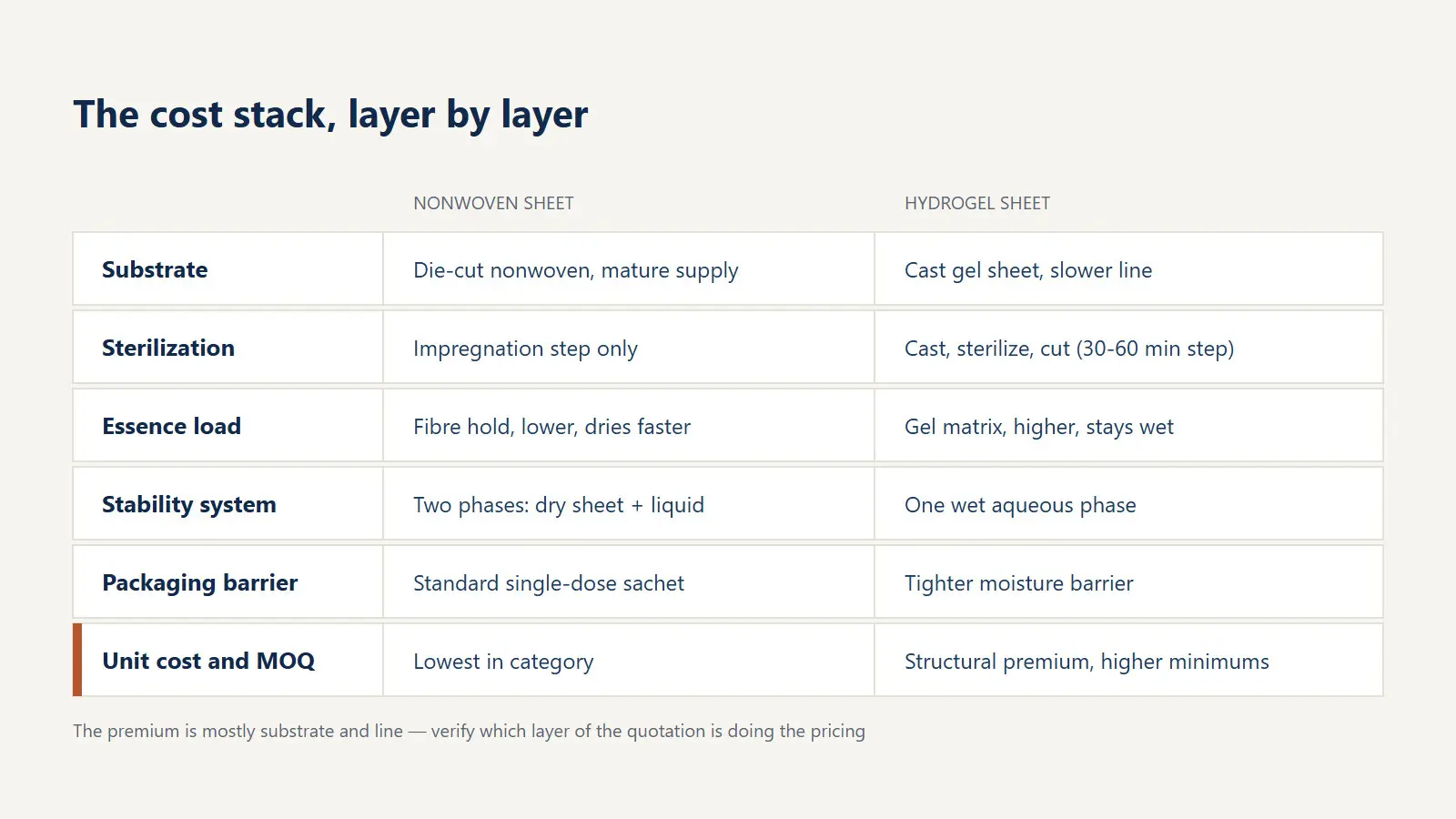
Put the two formats side by side on a cost basis and the premium a hydrogel mask charges is not one cost line — it is several, stacked:
| Cost layer | Nonwoven sheet mask | Hydrogel mask | What the buyer should verify |
|---|---|---|---|
| Substrate | Die-cut cotton/synthetic nonwoven; mature, high-volume supply | Hydrocolloid gel sheet: cast, sterilized, cut; slower line | Substrate spec sheet; sterilization method; supplier's own line or a subcontracted one |
| Essence load per unit | Fibre hold; lower, dries faster | Gel matrix; higher, stays wet | Measured load per finished unit, not the claimed one |
| Impregnation | Fast saturation step on a high-speed line | Impregnation into a wet matrix; industry guides cite a sterilization step of 30–60 minutes in sheet preparation | Line throughput and yield, in units per hour |
| Packaging barrier | Single-dose sachet; standard barrier | Aqueous gel demands a tighter moisture barrier | Barrier spec and the drop/leak test the supplier runs |
| Shelf stability | Dry substrate + liquid essence; wide window | Single aqueous system; preservative efficacy is the constraint | Accelerated stability data for the finished unit |
| Unit cost | Lowest in the category | Structural premium from substrate and line | Landed unit cost at your volume, in writing |
| Order minimums | Lowest stack in the category | Higher substrate and line minimums | The MOQ broken into the four layers, not one number |
Three reading rules for that table.
The premium is structural, not incidental. The substrate line, the slower casting-and-sterilization process and the tighter stability system each add a real cost layer. A supplier who quotes the hydrogel format only slightly above the nonwoven format is either under-scoping one of those layers or over-promising on the line — both are things you want to know before the first order, not after the first batch.
"Essence load" is where the quotation and the pack must agree. A hydrogel sheet that carries more essence means a heavier finished unit, a higher fill cost, and a shelf-life that must be re-proven for that load. If your marketing plan says "up to 50% more essence" in any market, the measured load per unit has to be in the file (see H2 二 for how to treat that figure).
The MOQ difference propagates. The substrate minimum, the bulk minimum, the filling minimum and the printing minimum are each different between the formats, and the smallest one gates the order. If you want the mechanics of that four-layer stack for small first runs, the low-MOQ skincare OEM guide for global buyers works through the same arithmetic for the category generally.
The premium a hydrogel mask charges at retail is mostly substrate and line, not essence — so verify which layer of the quotation is doing the pricing before you accept it.
Collagen Mask Benefits for Skin: The Anchor Active Behind the Category
The format decision is usually made in the shadow of one active: collagen. In marketplace search, collagen is the anchor of the patch-mask category — `collagen face mask` runs at a weekly volume of 19,066 in the United States over the 23 August to 5 September 2026 window, and 4,105 in the United Kingdom with a four-week change of +23.4% (marketplace figures from this site's keyword pack; they are marketplace volumes, not Google search volumes). That demand is what most buyers mean when they ask which mask format they should launch, and it shapes the format decision in three specific ways.
First, "collagen mask" is an essence definition, not a substrate definition. A collagen mask is a patch mask whose essence carries collagen — in practice hydrolysed collagen or collagen-derived peptides, which are the forms that survive a cosmetic formulation and can be dosed meaningfully. The substrate under that essence can be nonwoven, biocellulose or hydrogel. So when a buyer asks "which format for a collagen mask", the honest answer is that both formats are being sold under the same active — the decision is about the carrier, not the ingredient.
Second, the benefit claims that hold up are moisturising and appearance claims. The collagen mask benefits for skin that a brand can lawfully print are the ones that match the evidence: improved appearance of hydration, a smoother look, a more plump-looking surface after wear. The penetration logic for collagen is settled and this site has already written it up separately: hydrolysed collagen in the low-molecular-weight range (the 5–13 kDa band that the literature identifies as the range with measured skin penetration) is the form to specify, and the smaller the hydrolysate, the better the delivery case. What a format decision may not do is widen the claim: neither a nonwoven sheet nor a hydrogel sheet licenses "replenishes collagen" or "repairs collagen damage" — that sentence is outside the cosmetic claim boundary regardless of what the substrate is.
Third, collagen is where the two formats diverge commercially. A collagen mask on a nonwoven sheet is the volume play: the category's best-selling price band, the mass retail fixture, the refill-and-repeat purchase. A collagen mask on a hydrogel sheet is the premium play: the same anchor active, a higher carried essence, a cooling tactile experience, and a price point that sits above the category median. Two SKUs with near-identical essences can occupy two different price bands because the substrate is different — which is exactly why the format decision and the pricing decision are the same decision.
The practical implication: if collagen is your anchor active, the format choice is a price-curve choice, not a quality choice. Decide the price point first, then let it select the substrate.
Essence Load, Stability and Shelf Life: Where Formulas Break
The format decision is, in the end, a stability decision wearing a retail costume. Here is where formulas in each format actually break.
The nonwoven format is a two-phase system and its failure modes are mechanical. The substrate dries — that is the characteristic behaviour of fibre wicking — and the classic consumer complaint (mask drying back onto the face) is a formulation and dosing problem, not a substrate defect. The stability file for a nonwoven mask is the stability file of the essence: preservative efficacy, pH, and the compatibility of the actives in the liquid phase. The dry substrate is largely out of the picture, which is why the format tolerates a wider range of essences and a longer shelf window.
The hydrogel format is a single aqueous system, and its failure modes are microbial and rheological. The gel matrix is water with a polymer network, and that is the highest-water-activity environment in your product. Three things follow:
- Preservative efficacy is the binding constraint. The finished unit — gel, essence, everything in one phase — needs a documented challenge-test posture, not a preservative system that was validated for a different formulation. If the supplier validates the essence and then adds the gel, ask what was validated with the gel in the system. - Rheology drift is the shelf-life killer. Gel viscosity and the sheet's dimensional stability change with time and temperature; a sheet that holds its shape at the fill station can be a deformed, uneven sheet at month twelve. This is why the stability data you request must be for the finished unit, on the shelf, in its sachet. - Active compatibility has to be re-checked in the gel. Polyanionic actives (DNA fragments, certain polymers) and cationic components associate; heat-sensitive actives see the full process temperature of a casting line. The compatibility statement you need is for your actives in that gel system, not in the reference formula the supplier runs.
The buyer's move is identical in both formats and different in content: demand accelerated stability data for the finished unit at your specified essence load and actives, in writing, before the artwork is signed. A "12- or 24-month shelf life" without that file is a commercial sentence, not a stability claim. The difference between the formats is what the data has to prove: for a nonwoven mask, that the essence is stable; for a hydrogel mask, that the whole wet system — gel, essence, actives, preservative — is stable together, and that the sheet itself stays dimensionally sound.
Stability data is the format decision: the shelf life your supplier can evidence for the finished unit is the price point you can defend — and the gel system has to prove more, in one phase, than the sheet system does in two.
When the Format Is the Differentiator: PDRN, Gel Sheets and Premium Lines
In the premium tier of the category, the format stops being a delivery choice and becomes the differentiator itself.
The clearest current example is the polynucleotide/PDRN line. Marketplace data over the 23 August to 5 September 2026 window shows `pdrn mask` at a weekly volume of 2,006 in the United States (four-week change −18.9%, bouncing but softening), and `pdrn hydrogel mask` at 82 (−44.8%, estimated at the lower bound) — again, marketplace volumes, not Google figures. The honest read is that this is a small-volume, premium-price position: the category is not a volume play, it is a differentiation play, and the gel sheet is where the differentiation physically lives. Two PDRN essences can be near-identical, and the one on the hydrocolloid sheet is the one that sells at the higher price point with the stronger "treatment" story. The pdrn hydrogel mask benefits argument at retail is a substrate argument: cooling feel, sustained contact, premium tactile cue — and it has to be told inside the same cosmetic claim boundary that applies to every other format, because the active is the same.
The same logic is running through the collagen-gel segment. The "pink collagen gel mask" pattern — a visible gel-sheet collagen mask positioned as a treatment rather than a routine step — is one of the highest-volume mask patterns in the keyword pack (in the 1.9K / 880 weekly range across its variants). The sourcing read is that the format and the colour-and-glow cue are doing the differentiation work together, and the trend can be written and built without naming the products that started it. If you are evaluating the gel-mask side of this segment at supplier level, the gel face mask sourcing guide covers the substrate and essence questions that come up in that conversation.
Two cautions belong with this section. First, a premium format does not buy a premium claim: the claim boundary is set by the active and the evidence, not by the sheet. Second, premium formats carry a thinner demand base — the volume numbers above are small by category standards, and a plan built on them should be sized like a differentiation SKU, not a hero SKU. The format is the differentiator only when the price point, the active and the channel all agree; when they disagree, you are paying the hydrogel premium to hold a sheet-mask position.
In the premium tier the substrate is the SKU: near-identical essences on a gel sheet and a nonwoven sheet are two different price points — but the gel sheet's demand base is small, so size it like a differentiation SKU, not a hero SKU.
Market Data, Read Honestly: The Estimates Do Not Agree
The standard way to open this section is a single market-size figure. That is the wrong way, because the figures for these two formats do not agree with each other — and the disagreement is informative.
| Research house | Format | Base year | Size | Projection | Nature |
|---|---|---|---|---|---|
| Market Data Forecast | Sheet face mask | 2025 | USD 230.58M | CAGR 8.76% (2026–2034) | Commercial research |
| TechSci Research | Sheet face mask | 2025 | USD 372.12M | USD 540.23M by 2031, CAGR 6.41% | Commercial research |
| Dataintelo | Cosmetic sheet face masks | 2025 | USD 1.8B | USD 3.4B by 2033, CAGR 8.3% | Commercial research |
| Fortune Business Insights | Sheet face mask | 2025 | USD 2.57B | USD 2.67B in 2026 | Commercial research |
| GM Insights | Sheet face mask | 2025 | USD 2.8B | USD 5.3B by 2035 | Commercial research |
| Grand View Research | Hydrogel face mask | 2023 | USD 116.0M | USD 240.0M by 2030, CAGR 11.0% | Commercial research |
| Future Market Insights | Hydrogel face mask | 2025 | USD 142.07M | USD 417.67M by 2036 | Commercial research |
| GM Insights | Hydrogel face mask | 2024 | USD 212.8M | CAGR 10.1% (2025–2034) | Commercial research |
| Spherical Insights | Hydrogel face mask | 2025 | USD 468.64M | USD 1,325.08M by 2035 | Commercial research |
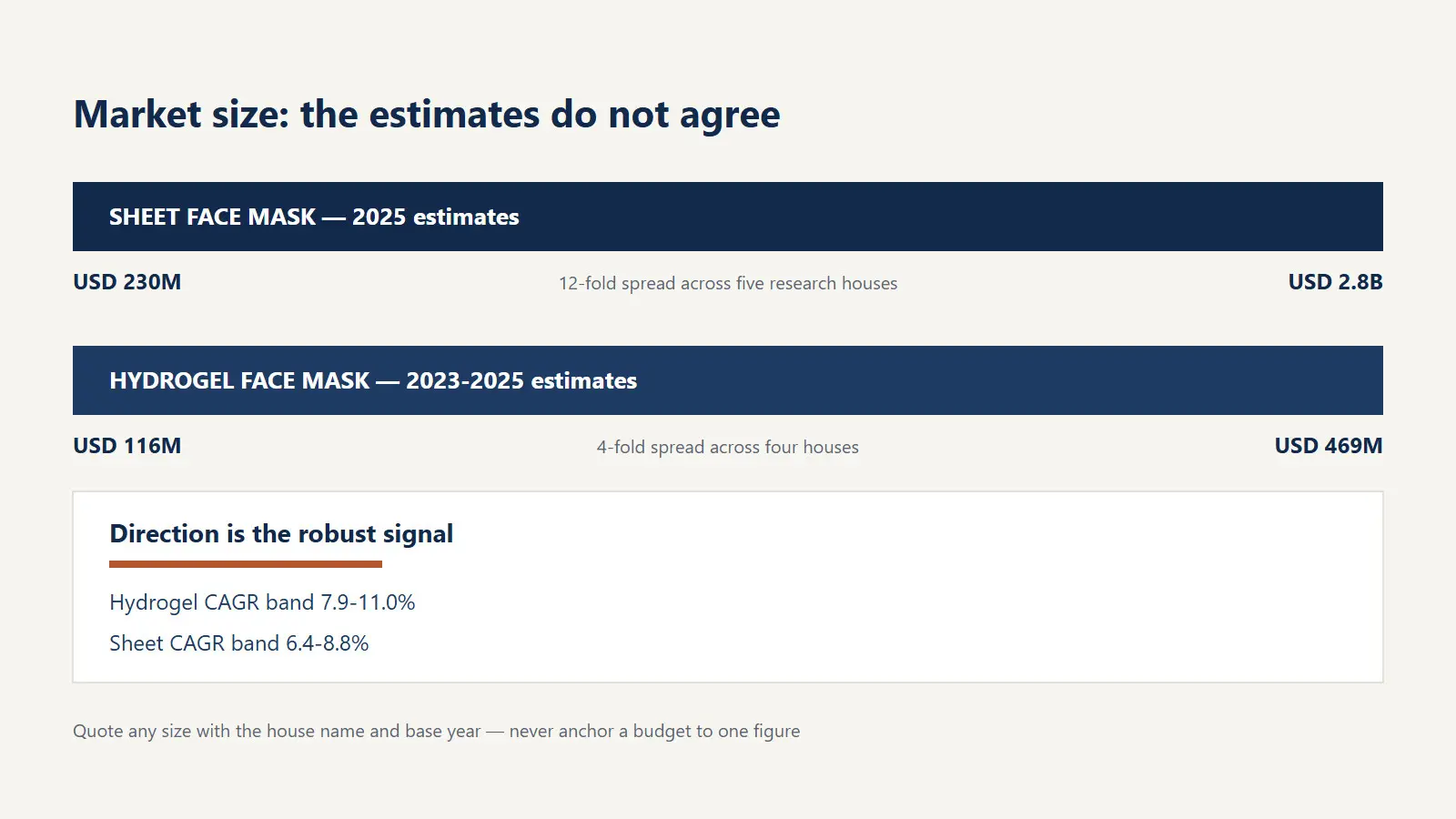
Read that table the way a buyer should. The 2025 estimate for the sheet face mask spans USD 230 million to USD 2.8 billion — a twelve-fold spread between houses. The hydrogel estimate spans USD 116 million to USD 469 million depending on base year and scope. The spread is not noise; it is the research houses defining the market differently: sheet-only versus all patch masks, cosmetic versus cosmetic-plus-dermal, global versus a subset of regions, and different treatment of the Korean and Chinese production bases. Every figure in the table is a house's estimate with a scope attached, and none of them is an agreed market size.
What the houses do agree on is direction. The hydrogel format's CAGR lands in an 8–11% band across the estimates above (7.87–11.0%), and the sheet format's lands in a 6.4–8.8% band. Both formats grow; the smaller one grows faster. That directional convergence — hydrogel outgrowing sheet from a smaller base — is the robust part of the data, and it is the part worth building a plan on. The absolute sizes are the part to quote only with the house name and the base year attached.
Against that, the demand-side read from marketplace data:
| Parent search term (marketplace) | Weekly volume | 4-week change | Read |
|---|---|---|---|
| collagen face mask (US) | 19,066 | +1.6% | Large base, softening |
| collagen face mask (UK) | 4,105 | +23.4% | High and firming |
| hand mask (US) | 6,192 | +16.9% | Flat to firm |
| pdrn mask (US) | 2,006 | −18.9% | Bounced, but weaker over four weeks |
| hydrogel face mask (US) | 210 | −19.7% | Low base, recovering |
| salmon dna mask (US) | 134 | −27.1% | Cooling |
| pdrn hydrogel mask (US) | 82 | −44.8% | Low, estimated at the lower bound |
| vitamin c serum (US) | 147,873 | +39.4% | Strengthening (adjacent category) |
The marketplace table says the same thing as the research table, in the buyer's own currency: the collagen sheet-mask base is large but softening in the US while firming in the UK; the hydrogel base is small and still finding its volume. Neither table is a reason to overbuild. The correct procurement conclusion: size the sheet-mask SKU to the large, softening base (cost efficiency is the margin), and size the hydrogel SKU to the small, premium base (differentiation is the margin). For the broader 2026 mask-category trend context, the 2026 face mask trends guide for global buyers is the companion piece.
The research houses disagree by an order of magnitude on size but converge on direction — use the direction for strategy, use your own channel data for the budget, and never anchor a plan to one house's number.
The Format Decision Matrix: Scoring Your SKU
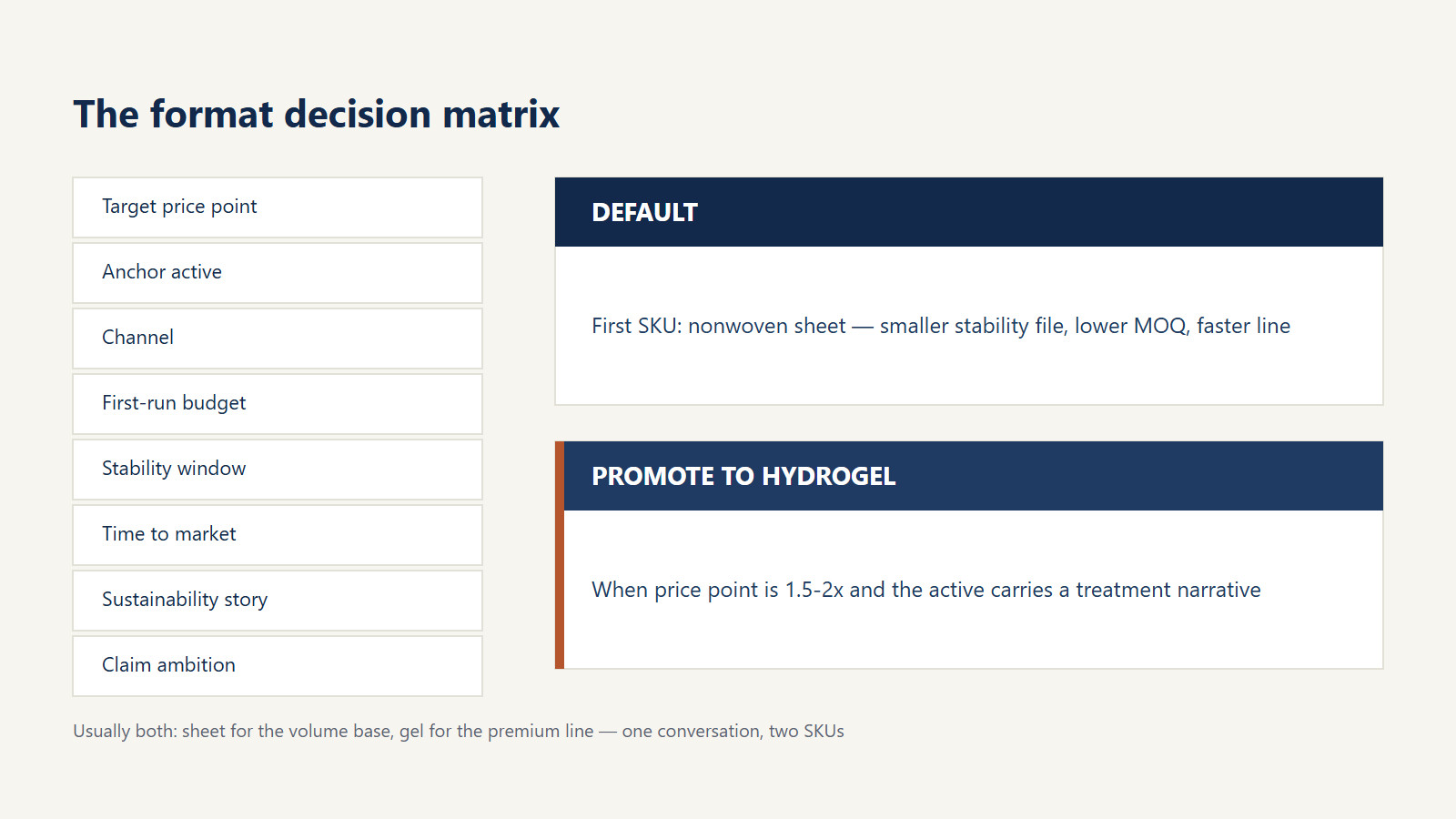
The decision, laid out as a matrix you can score against your own SKU:
| Decision dimension | Weight | Sheet mask wins when | Hydrogel mask wins when |
|---|---|---|---|
| Target price point | High | Mass to mid band; refill economics matter | Premium band at 1.5–2× the sheet price |
| Anchor active | High | Established hydrating/peptide actives | PDRN, collagen-gel, "treatment" actives |
| Channel | High | Mass retail, marketplace volume, e-com | Premium retail, DTC, specialty, gifting |
| First-run budget | Medium | Small budget; test-and-learn | Budget that absorbs the structural premium |
| Stability window needed | Medium | Long window, simple essence | Window matched to a wet-system stability file |
| Time to market | Medium | Fast; mature line | Slower; casting and sterilization steps |
| Sustainability story | Medium–low | Biocellulose/cellulose nonwoven available | Gel polymer choice constrains the story |
| Claim ambition | Medium | Moisturising, appearance claims (standard) | Same boundary plus tactile/experience language only |
Three rules of thumb come out of scoring it.
Rule one: the first SKU defaults to the sheet mask. For a brand entering the category, the nonwoven format is the lower-risk commitment: a shorter stability file, a lower MOQ stack, a faster line, and a price point the category's largest base actually transacts in. The format decision should not be the first big bet a new brand makes.
Rule two: promote to hydrogel when both the price point and the active justify it. The premium is only defensible when the product sits at 1.5–2× the sheet price and the active carries a treatment narrative (the PDRN and collagen-gel lines in H2 七 are the pattern). A hydrogel sheet on a mid-price, routine-hydration SKU is paying the premium without earning the position.
Rule three: the portfolio answer is usually both. The category's volume is in the sheet; its differentiation margin is in the gel. A two-SKU answer — sheet for the base, gel for the premium line — is the structure the demand data in H2 八 actually describes, and it is the structure to take to a supplier as a single conversation: one essence platform, two substrates, two price points, two stability files.
Default to the sheet mask for the first SKU; promote the hydrogel line only when the price point and the active both justify it — and take the two-SKU structure to the supplier as one conversation.
Packaging, Sustainability and the Compliance Footprint
The format decision has a compliance and sustainability footprint that buyers routinely underweight, because it is not on the quotation.
The substrate is a declared ingredient, not a packaging detail. The polymers that make the gel sheet — polyvinylpyrrolidone, polyvinyl alcohol, cellulose derivatives, chitosan, carrageenan-based systems — are part of the product's composition, and the INCI declaration has to reflect them. "Hydrogel" is a category name on the front of the pack; the polymer list is what the ingredient panel says. A buyer who has committed to a gel system without asking the supplier for the full polymer declaration has committed to an INCI list they have not seen.
The sustainability story runs differently by format. On the sheet side, the credible path is a cellulose or biocellulose nonwoven — a natural-fibre substrate with a documented end-of-life story, and a differentiator that mass retail and UK buyers in particular respond to. On the gel side, the polymer choice constrains the story: a PVP/PVA-based gel is a different waste proposition than a cellulose- or carrageenan-based one, and the claim you are allowed to make follows the polymer. The site has already worked the adjacent regulatory layers — the PPWR packaging compliance framework and the ECGT substantiation regime for green claims, which applies from 27 September 2026 — and this section deliberately does not restate them. The procurement move is narrow and concrete: before committing to a substrate, get the polymer declaration and the end-of-life documentation in writing, and route any "biodegradable" or "eco" wording through the same evidence file that ECGT will hold it to.
The single-dose packaging follows the format's moisture logic. A nonwoven sachet needs standard barrier protection for a liquid essence; a gel sachet is protecting an aqueous gel, which pushes the barrier spec tighter. The difference shows up in the packaging layer of the cost stack (H2 四) and in the leak-and-drop test the supplier should run. Neither format's packaging decision can be made on the substrate sample alone — the finished, filled unit is what has to pass.
The net effect is that the compliance footprint of the format choice is real but manageable: one INCI declaration, one polymer end-of-life file, one barrier spec, and one stability file per format. Four documents, in both directions, before the artwork.
Frequently Asked Questions (FAQ)
Q1: Hydrogel mask vs sheet mask — is this a consumer preference question or a supply-chain question?
Both, in sequence — and the supply-chain version comes first. The consumer preference (cooling gel feel versus a wicking sheet) is real, but it is a downstream effect of upstream decisions: the substrate determines the essence load you can defend, the stability file you must evidence, the line speed you pay for, and the price point the finished unit can hold. Answer the cost-stack and stability questions first, and the preference question mostly answers itself — the format the economics support is the format the customer can be shown.
Q2: Are collagen mask benefits for oily skin different from those for dry skin, and does the format change that?
The active's behaviour is the same in both formats; the format changes the dose and the contact window. For oily skin, the practical concerns are the essence's occlusivity and the wear window — a lighter, faster-absorbing essence on a wicking sheet, or a shorter wear window on a gel. For dry skin, the higher carried load and the sealed gel contact are the advantages. A brand should not write the skin-type benefit as a substrate claim ("the gel works better for dry skin"); it should write it as an essence-and-dose claim the substrate happens to carry well. The skin-type differentiation belongs in the essence specification, not in the substrate story.
Q3: What collagen mask benefits and side effects should a brand actually expect to manage?
Benefits that hold up: improved appearance of hydration and a smoother, plumper-looking surface after wear, with the moisturising claim as the floor of the file. Side effects and risk items to manage: the classic mask-drying-back complaint on nonwoven sheets (a dosing and wear-window issue), sensitisation or irritation from the essence's preservative and fragrance system (more visible on a sealed gel contact because the skin sits in the system longer), and the claim risk of "replenishes collagen", which is outside the cosmetic boundary regardless of format. A brand's job is to hold the wear window, the preservative file and the pack wording as one controlled set — the substrate changes the weight of each item, not whether each item exists.
Q4: Do collagen hydrogel mask benefits justify the premium over a nonwoven sheet?
For the premium price band, yes — on three defensible grounds: a higher and more sustained carried essence, the tactile cooling experience, and the "treatment" positioning that transacts at the top of the category's price curve. The korean hydrogel sheet mask is the pattern where this combination transacts best, and the collagen-gel segment is where the category's differentiation margin currently sits. The premium stops being justified when the price point is only modestly above the sheet band or when the essence is a routine-hydration formula — then the substrate cost is paid without the positioning to recover it.
Q5: Do pdrn hydrogel mask benefits depend on the gel sheet, or would the same essence work on a nonwoven sheet?
The essence would work on either sheet; what depends on the gel is the premium. The PDRN story at retail is a treatment story, and the treatment story transacts better in the format that feels like a treatment — sustained wet contact, cooling feel, visible gel. The same PDRN essence on a fast-drying nonwoven sheet at the same price is a product the market has already voted down in reviews. So the honest answer for a buyer: the active delivers the same cosmetic benefit in both formats, the gel sheet delivers the price point, and the demand base for the gel version is small enough that the SKU should be sized as a differentiation line, not a hero line.
Q6: Can we claim that the gel sheet "delivers deeper" or works better than a sheet mask, or is that a compliance risk?
"Delivers deeper" is the risk sentence. A format comparison that implies a mechanistic advantage ("penetrates deeper", "delivers the active into the skin") is structure/function territory the same way any efficacy claim is — the evidence bar does not drop because the word "deeper" is attached to a substrate rather than an ingredient. What stays inside the cosmetic boundary: statements about the wear experience (longer sustained contact, a cooling feel, a more plump-looking appearance after wear) and about the format's physical properties (higher carried essence at a stated load). Keep the comparison at the level of experience and load, and it is a defensible marketing sentence; push it to penetration, and it is a regulatory question.
What to do next
If you are deciding which format your next mask SKU should be, the fastest way to close the decision is to send us the three inputs the matrix in H2 九 actually needs: your target price point, your anchor active, and your primary channel. In return you get the part of the decision you cannot see from a spec sheet — a sample set on one shared essence platform, one nonwoven sheet and one hydrogel sheet, so you can weigh the load, the feel and the dry-out behaviour side by side, plus the cost stack for each format broken into substrate, bulk, filling and printing at your first-run volume.
You do not need a finished formula to start. A price point, an active and a channel are enough to size the decision — and enough for us to tell you plainly which format the economics support in your market.
Send us your format brief — target price point, anchor active, primary channel — and we will return the two-substrate sample set and the four-layer cost breakdown for your first run.
Sources and Further Reading
Format, substrate and process sources
1. Voolga, "Sheet Mask Materials: Cotton, Bio-Cellulose, and Hydrogel Compared", August 2026 — the two-component model of a patch mask (saturated liquid + physical substrate). Brand-published explainer: framing reference, not a standard. voolgausa.com
2. Biorepublic, "Biocellulose vs. Hydrogel vs. Sheet Masks: Which One Is Right for You?", June 2025 — nonwoven sheets made from cotton or synthetic fibres, holding essence but drying out more quickly. Brand-published explainer: framing reference, not a standard. biorepublic.com
3. eBanel, "Sheet Mask vs. Hydrogel Mask: What's the Difference and Which One's Right for You?", April 2025 — the "holds around 50% more essence than a standard paper face mask" figure cited in H2 二. Brand-published vendor claim: a direction to verify per finished unit, not an independent measurement. ebanel.com
4. NutriaAdvisor, "Hydrogel vs Sheet Mask: Complete Comparison Guide 2025", January 2025 — sheet preparation including die-cutting for face shape, a sterilization step described at 30–60 minutes, and the impregnation sequence. Industry guide, vendor-published: process description, not a universal constant. nutriadvisor.net
Market-size sources (each with its own scope; none is an agreed market size)
5. Market Data Forecast, "Sheet Face Mask Market Report", August 2026 — USD 230.58 million in 2025, CAGR 8.76% (2026–2034). Commercial market research: scope and methodology not published in full. marketdataforecast.com
6. TechSci Research, "Sheet Face Mask Market", August 2026 — USD 372.12 million in 2025 to USD 540.23 million by 2031, CAGR 6.41%. Commercial market research. techsciresearch.com
7. Dataintelo, "Cosmetic Sheet Face Masks Market", 2025 — USD 1.8 billion in 2025 to USD 3.4 billion by 2033, CAGR 8.3%. Commercial market research. dataintelo.com
8. Fortune Business Insights, "Sheet Face Mask Market", August 2026 — USD 2.57 billion in 2025, growing from USD 2.67 billion in 2026. Commercial market research. fortunebusinessinsights.com
9. GM Insights, "Sheet Face Mask Market", August 2026 — USD 2.8 billion in 2025, projected USD 5.3 billion by 2035. Commercial market research. gminsights.com
10. Grand View Research, "Hydrogel Face Mask Market", 2024–2030 — USD 116.0 million in 2023, projected from USD 156.9 million in 2026 to USD 240.0 million by 2030, CAGR 11.0%. Commercial market research. grandviewresearch.com
11. Future Market Insights, "Hydrogel Face Mask Market", April 2026 — USD 142.07 million in 2025, expected USD 417.67 million by 2036. Commercial market research. futuremarketinsights.com
12. GM Insights, "Hydrogel Face Mask Market", 2034 — USD 212.8 million in 2024, CAGR 10.1% (2025–2034). Commercial market research. gminsights.com
13. Spherical Insights, "Global Hydrogel Face Mask Market", January 2026 — USD 468.64 million in 2025, anticipated USD 1,325.08 million by 2035. Commercial market research. sphericalinsights.com
14. Mordor Intelligence, "United States Face Mask Market", August 2026 — USD 278.58 million in 2025 to USD 301.92 million in 2026, forecast to reach USD 451 million. Commercial market research, US scope. mordorintelligence.com
15. Market Research Future, "Hydrogel Face Mask Market", 2025 — projected CAGR 7.87% (2025–2035), cited in H2 八 as the lower end of the hydrogel growth band. Commercial market research. marketresearchfuture.com
Data and metric provenance
16. Demand figures in H2 八 are marketplace weekly search volumes for the window 23 August to 5 September 2026, taken from this site's skincare long-tail keyword pack. They are marketplace figures, not Google figures, and must not be quoted as Google search volumes.
17. The keyword metrics cited in the SEO configuration (Volume 20 for the primary term; Volume 20 for the collagen mask benefits for skin term; KD 15/16 for collagen face mask benefits and hydrogel sheet mask) are indicative results from the free tier of a commercial keyword tool, United States database, captured 17 September 2026, unaudited.
18. The hydrolysed collagen penetration logic referenced in H2 五 (the 5–13 kDa band with measured skin penetration) is consistent with the site's earlier published specification piece on hydrolysed collagen (March 2025) and the peer-reviewed literature reviewed there; it is cited here as settled site context, not re-derived.