
24K Gold Serum Benefits: Does Gold Actually Deliver?
24K Gold Serum Benefits: The Honest B-Side Read
The phrase you type into Google — 24k gold serum benefits for skin — is searched less by consumers and more by a brand's product committee that has already put "24K" on the moodboard. By the time a buyer asks us for a gold formula, the consumer-side decision is half made: the shelf moment is designed, the price band sits near the top of the range, and the word gold is already in the pitch deck. What is still missing is the part that separates a defensible SKU from an expensive decoration: what the metal actually does, what it cannot do, and what it costs to put in the bottle.
This piece answers the question in the title — does gold actually deliver? — by splitting it into two different questions. The efficacy question: does gold, as an active ingredient, deliver measurable skin results? The honest answer, stated first and never softened: the clinical evidence is thin. The premium question: does gold deliver the shelf moment, the trust cue and the price support that justify its cost? In specific markets the answer is a clear yes — and that is the question a brand owner should be optimizing.
Gold has three jobs in a formula, and none of them is "active":
- Perceptible luxury. The visible shimmer is the product's first sentence. A consumer tilts the bottle before they read the label — the flake does the talking, and the moment costs nothing to claim because it is literally visible. - Cultural trust. In the Gulf, gold is the region's established luxury code — in jewellery, fragrance, hospitality and gifting. A gold product arrives pre-trusted in a way that no new active ever is on day one. - Claim-safe inertness. Ninety-nine-point-nine-nine percent gold does almost nothing chemically. For a buyer, "inert" reads like a defect; in a regulatory sense it is the ingredient's best feature — the formula's risk profile is defined by everything else in the bottle, not by the metal.
So the buyer's frame for this SKU is not "can gold do more?" It is: which form of gold, which claims, which market, and which cost structure. This piece walks through those four decisions in order — the four sourceable forms, the ranked evidence, why the Gulf pays the premium, the claim map you may print, the safety read, the cost stack, the formulation pitfalls, the defensible-SKU checklist, and the private label path.
The Four Forms of Gold You Can Actually Buy
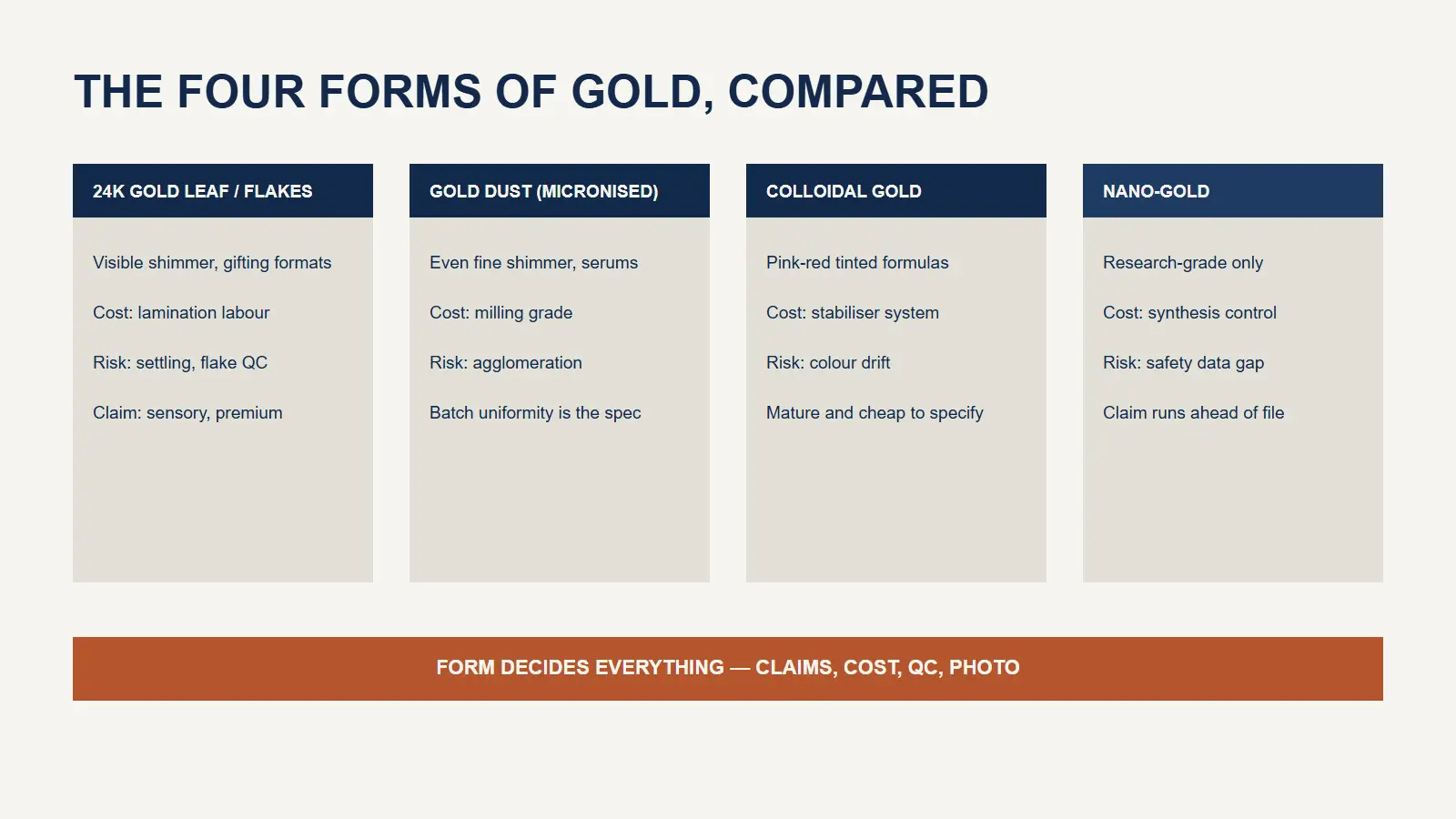
"24K gold" is a purity statement, not a product specification. Carat describes how much of the metal is gold; it says nothing about what actually arrives in the lab — a sheet of leaf, a jar of dust, a pink sol or a bottle of engineered particles. The form is the procurement decision, and it fixes the claim ceiling, the cost stack, the QC specification and the photograph the product will be known for.
| Form | What you receive | Typical use | Cost driver | Claim ceiling | Production risk |
|---|---|---|---|---|---|
| 24K gold leaf / flakes | Beaten metal sheets, cut or torn | Creams, masks, gifting formats; visible shimmer | Sheet size, purity certificate, lamination labour | Sensory, gifting, premium positioning; "contains 24K gold" | Distribution and settling; flake-size QC; handling |
| Gold dust (micronised) | Fine metal particles | Serums, creams; even, finer shimmer | Milling grade, particle-size specification | Same ceiling as leaf, finer finish | Agglomeration; batch-to-batch uniformity |
| Colloidal gold | Gold in a stable aqueous sol | Tints formulas pink-red; "colloidal gold" serums | Stabiliser system, sol stability | Colour plus sensory; traditional usage heritage | Sol stability, colour drift, pH interaction |
| Nano-gold | Engineered nanoparticles | Research-grade; some "nano gold" marketing claims | Synthesis control, characterisation data | Delivery-concept claims — not yet defensible in cosmetics | Safety and stability data gaps for cosmetic use |
The form decision is a four-way decision — claim ceiling, cost structure, QC spec and visual identity — and a quotation that names the metal without naming the form is naming a probability, not a product.
Two procurement notes follow from the table. First, purity documentation is per batch, not per brand: request an assay certificate stating 999 (99.9 percent) gold for every incoming lot of leaf or dust, and for gifting formats that market the leaf as edible, a separate food-grade file. Second, the colloidal and nano rows are where suppliers and buyers diverge most: colloidal gold is mature and cheap to specify, while nano-gold in a launched cosmetic is still a claim running ahead of its file — treat any supplier who pushes nano as a premium story before producing a complete characterisation dataset as a supplier selling the narrative, not the material.
Is 24K Gold Skincare Good? The Evidence, Ranked
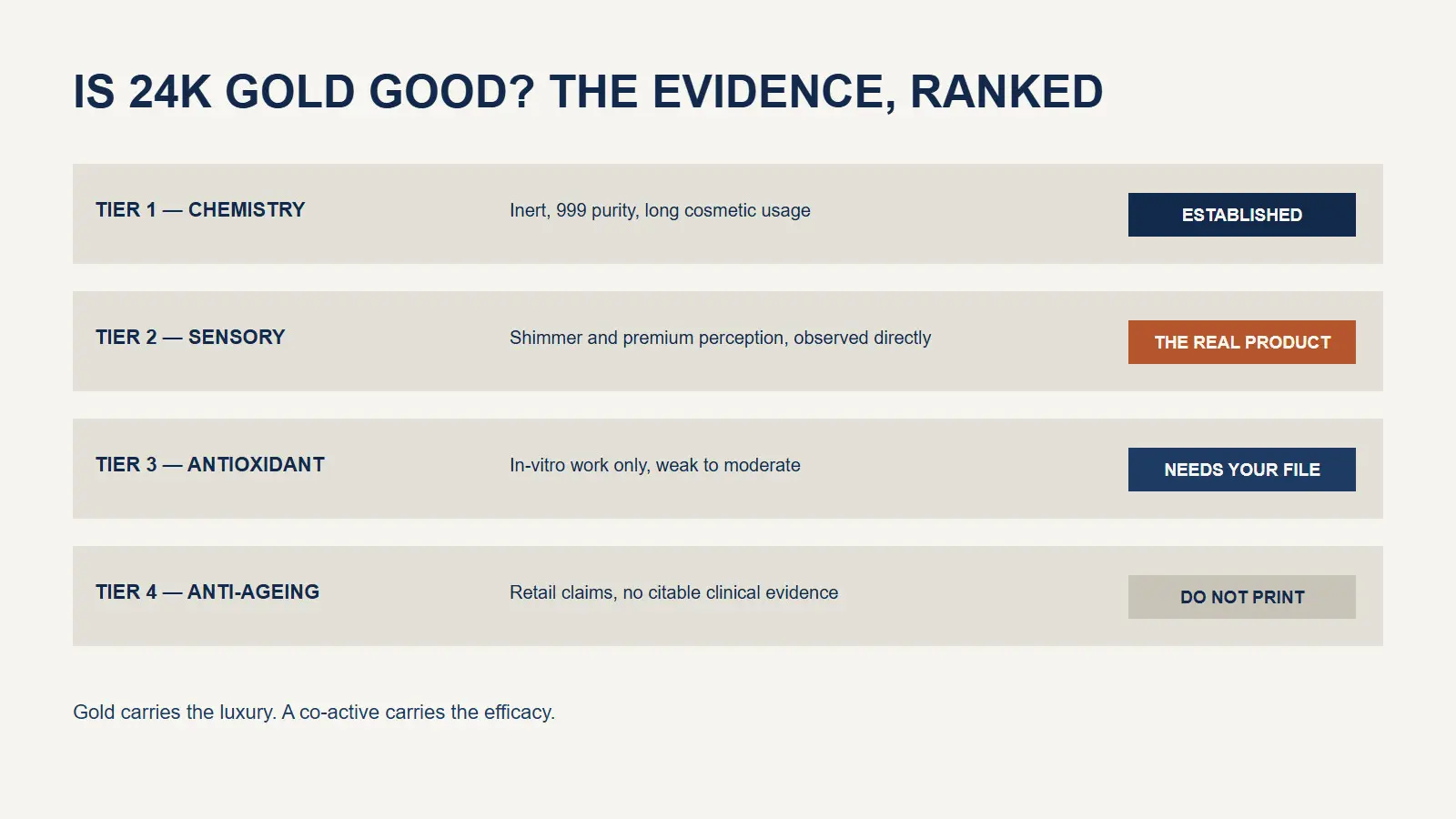
The question as it sits in the search bar deserves a ranked answer, not a yes or a no. Evidence for gold in cosmetics comes in four tiers, and the product strategy follows directly from where each claim lands:
| Evidence tier | What is supported | Strength | What a buyer may print |
|---|---|---|---|
| Tier 1 — chemistry | 24K gold is chemically inert; low reactivity; long cosmetic usage history | Established | "Contains 24K gold (999)" with the per-batch assay file |
| Tier 2 — sensory and perceptible | Visible shimmer, immediate premium perception, shelf presence | Direct observation — this is the real product | The experience itself; it needs no clinical backing |
| Tier 3 — antioxidant / anti-inflammatory | In-vitro and conceptual work around gold particles; widely used brand language | Weak to moderate; no robust clinical confirmation | Only with your own in-vitro substantiation on file |
| Tier 4 — anti-ageing / wrinkle claims | Retail listings claim "wrinkle reduction" and "firming" | Not supported by citable clinical evidence | Do not print without your own clinical data |
Good as premium. Unproven as active. That is the whole answer — and the product strategy follows from it: gold carries the luxury, a co-active carries the efficacy.
Two implications for the product committee. First, do not pay for gold as an active. The premium a gold formula costs over its non-gold twin is a perception and positioning charge; if the label needs a clinical story, that story belongs to the co-active in the matrix, selected with the same evidence discipline any hero ingredient gets. Second, tiers 3 and 4 are substantiation events, not marketing choices. "Antioxidant" on a gold label is a file you must be able to produce when a retailer, a regulator or a platform asks; "wrinkle reduction" without clinical data is a liability wearing a claim. In a market where efficacy claims are becoming legal exposure rather than copy, a gold SKU is a good place to practise the discipline — the metal is innocent, the printed word is not.
Why the Gulf Pays a Gold Premium
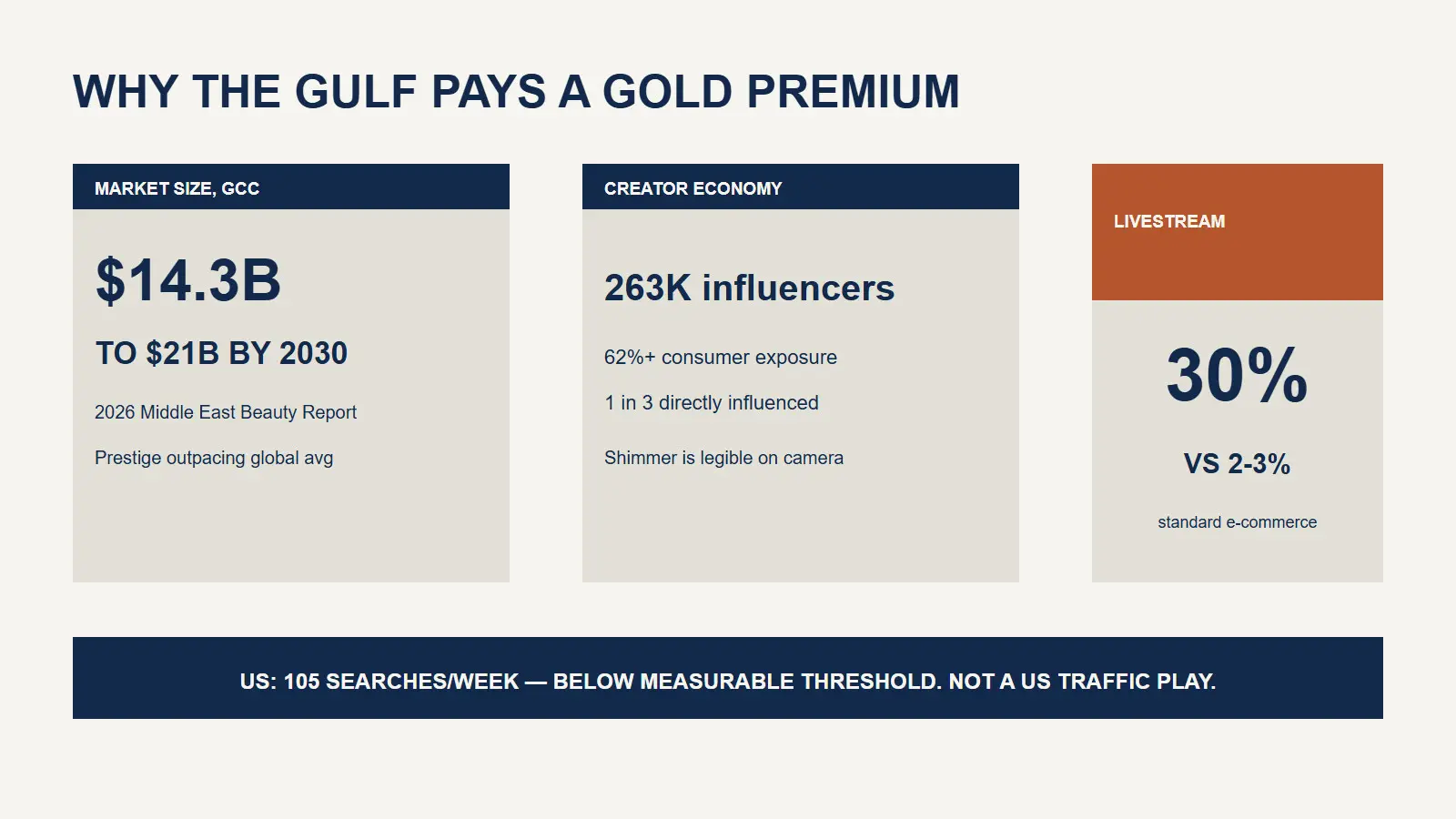
The number that frames this section: beauty sales in the Gulf Cooperation Council — Bahrain, Kuwait, Oman, Qatar, Saudi Arabia and the UAE — stand at US$14.3 billion and are forecast to reach roughly US$21 billion by 2030, according to the 2026 Middle East Beauty Market Report, commissioned by Messe Frankfurt Middle East and produced by the research arm of BeautyMatter, and summarised by CosmeticsBusiness in August 2026. The report is explicit that prestige and luxury sales in the region are outpacing global averages, driven by young, high-spending consumers, tourism and an increasingly omnichannel ecosystem. A gold SKU is not entering a market that tolerates the premium — it is entering a market that is structurally growing on it.
The engine underneath the number is the creator economy. The same report counts 263,000 social media influencers in the region, notes that more than 62 percent of GCC consumers are regularly exposed to creator-led content, and finds that more than a third say it directly influences what they buy. The sharpest figure in the document: influencer-led beauty livestreams in the UAE and Saudi Arabia report conversion rates of up to 30 percent, against 2 to 3 percent for standard e-commerce, with higher average order values. Gold is a format made for that channel — the shimmer is legible on camera at arm's length, and a price anchor the region's luxury culture already accepts makes the live moment closeable.
There is also the cultural layer that no market report can capture: gold is the region's established luxury code — in jewellery, fragrance, hospitality and gifting. In the Gulf you are not explaining gold; you are applying it. That is the opposite of the position a novel active starts from in any market, where the education cost is paid before the first sale.
And the honest counterweight, stated with its source: in our platform demand table (Amazon-internal search data, 23 August – 5 September 2026 — a marketplace signal, not a Google search metric), 24k gold serum sits at 105 searches per week in the United States, below the measurable threshold for our purposes. Do not build this SKU as a US traffic play — the 24k gold skincare benefits case does not rest on US search volume; it rests on the Gulf premium, the creator engine and the cultural code. The US is a secondary shelf where the premium formats already circulate, and the decision the numbers force is the opposite one.
The premium is real and it is regional: budget the gold SKU for the Gulf, not for US volume — the unit economics that carry the premium lines live on one side of that line, not the other.
The Claim Map: What You May and May Not Print
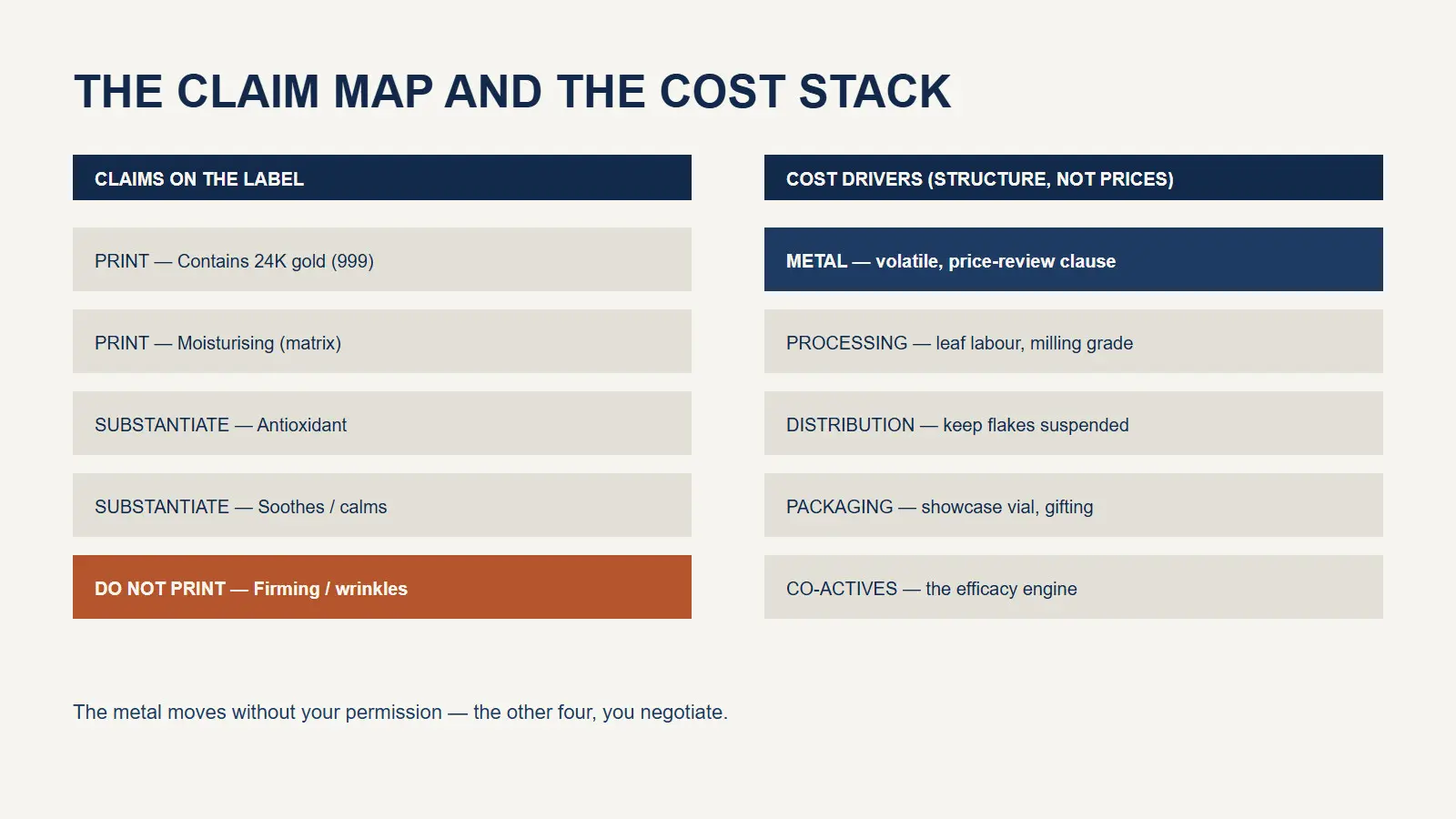
The claim map is the document a brand brings to the contract table: one row per claim, the evidence tier each claim sits at, and the file that backs it. For a gold SKU the map is short — because the metal is inert, most of the rows are really about the co-actives, which is itself the point: the label's clinical story must be carried by something other than the gold.
| Claim on the label | What actually carries it | Evidence tier | Verdict |
|---|---|---|---|
| "Contains 24K gold (999)" | The metal itself | Tier 1 — assay certificate | Print it, with the per-batch file |
| Moisturising / hydrating | The matrix's humectants | Tier 1–2 | Print — attribute to the formula, not the gold |
| Antioxidant | In-vitro file required | Tier 3 — weak | Print only with your own substantiation on file |
| Soothes / calms | Perception study plus in-vitro | Tier 3 — weak | Print only with the study file |
| Tone evenness / brightening | Co-actives in the matrix | Depends on the co-active | Print within compliant brightening language; attribute to the co-active |
| Firming / wrinkle reduction | Would require clinical data | Tier 4 — unsupported | Do not print without your own clinical study |
The tone-evenness row needs one sentence of boundary: gold SKUs habitually lean on glow and radiance language, and the claim rules around tone evenness and brightening have their own compliance edge — our buyer's guide to choosing the best skin brightening cream covers where that line sits, and the same discipline applies here. The co-active earns the claim; the gold earns the shelf.
The compliance tail is worth stating once, plainly: efficacy-claim enforcement is tightening across markets. The EU's ECGT regime has applied from 27 September 2026 to green and efficacy-adjacent claims, and the US direction of travel is the same — our coverage of efficacy claims becoming legal liability is the frame. A gold label that prints Tier-4 language is a gold label that starts with a finding, in whichever market finds it first.
The claim map is a contract, not marketing: every row either has a file behind it or it comes off the label — and on a gold SKU, the files belong to the co-actives, not the metal.
Gold Serum Benefits and Side Effects: The Safety Read
The defining safety property of gold is the one the efficacy marketing ignores: it does almost nothing. Ninety-nine-point-nine-nine percent gold is chemically inert, and the ingredient's risk profile is accordingly flat — flatter than almost any co-active that will share the bottle. For a buyer, the safety read on gold is therefore short, and the length of it is the point.
On the side-effects question specifically: gold contact sensitivity exists and is rare but documented in dermatology. That is why the artifact to test is the finished formula, not the metal — the safety file a buyer should hold for any gold SKU contains the finished-formula patch-test data, the complete INCI with process documentation, and, for leaf formats, the size and thickness specification plus an external-use-only statement. If a gifting format markets the leaf as edible, that is a food-grade documentation question and a different file entirely — do not let the two files blur.
The nano row deserves its own plain sentence: we cannot point a buyer to an established human cosmetic safety dataset for nano-gold that we would stake a launch on. Our position is therefore: launch on leaf, dust or colloidal; hold nano in the pipeline until the supplier produces the full characterisation and safety file. And read a supplier's answer to that request as information — the "not yet" is a data point about the supplier, not about gold.
The Cost Stack: What the Gold Actually Costs
The counterintuitive line first: the metal is often not the biggest cost line — it is the most volatile one. A gold SKU carries five cost drivers, and only one of them is gold:
1. Precious-metal content — purity (999) and weight per unit. Gold prices are at historic levels: Dubai trade posts had 24K crossing Dh550 per gram in January 2026 (an indicative, unaudited social source — treat it as direction, not a price). The operational consequence is simple: price the metal as a volatile input with a review clause, never as a fixed cost. 2. Form processing — leaf cutting and lamination labour, dust milling grade. This is the line where "24K" quietly becomes "hand-worked 24K"; the processing, not the gram, is what you are paying for. 3. Distribution engineering — the surfactant and viscosity system that keeps the shimmer suspended; this is formulation work with a QC tail (the H2 八 section). 4. Packaging — the showcase vial or the gifting format. On this SKU the package is part of the product, not around it. 5. Co-actives — the efficacy engine the printed claims actually rest on, priced like any other hero ingredient.
| Cost tier | Metal form | Relative position | Main driver | Typical buyer |
|---|---|---|---|---|
| Entry | Gold dust, light loading | Lowest | Milling grade, low loading | First gold test SKU; mass-premium launch |
| Standard | Gold flakes, visible loading | Mid | Leaf labour, distribution system | Core shelf SKU |
| Gift / luxury | Full leaf plus premium format | Highest | Gifting architecture, showcase packaging | Seasonal and gifting lines; GCC focus |
This piece does not publish unit prices — they move with the metal and with your volume, and a stale number in a procurement document is worse than no number. What the structure gives you instead is the negotiation map: which lines are fixed, which are volatile, and which scale with MOQ. The same architecture prices premium formats generally — our read on how premium facial oils structure their cost and shelf position applies to the gold line with the metal clause added.
The metal is not the main cost — the processing, the distribution system and the packaging are; and the metal is the one line that moves without your permission, so it is the only line that belongs in a price-review clause.
Formulation Engineering: Four Pitfalls That Kill Gold SKUs
Gold formulas fail in the same four places, in roughly the same order.
1. Settling and distribution. Flakes migrate. A beautiful sample and a lumpy bottle three months into stock are the same formula with a failed distribution system — the shimmer is the product's face, so it is also its QC gate. Specify the flake count per unit, the uniformity across the fill, and a 0 / 3 / 6-month physical stability check before the line is approved, not after the first customer photograph.
2. Interaction with co-actives. The metal does not care about pH; the actives do. Gold in a low-pH vitamin C matrix is fine for the gold and a stability problem for the C — the same logic we wrote for the vitamin C stability programme applies to everything in the bottle around the metal. Gold with retinol is fine for the metal and a protection problem for the retinol. The interaction test belongs in the spec, and the responsible party is the matrix, not the gold.
3. Visual QC is non-negotiable. Define the flake-size range, the count per millilitre and the batch-to-batch uniformity acceptance window in the specification. On a gold SKU, visible defects are the only defects the consumer will photograph — and the photograph is the complaint.
4. The matrix is not gold. Stability of a gold SKU is decided by the cream or serum around the metal. Demand the standard stability programme for the matrix and treat the gold as a passenger with a window seat: it will not cause the incident, but it will be in the photograph when something else does.
Building a Defensible Gold SKU: The Buyer's Checklist
The checklist that turns the piece into a procurement file. Eight items, in the order they should appear in your request to a supplier:
1. Form decision. Leaf, dust or colloidal for launch; nano only with the complete characterisation and safety file on the table. 2. Purity documentation. Per-batch assay certificate stating 999, metal origin stated; leaf size, thickness and cutting specification. 3. Claim map. One row per printed claim, tier assigned, file attached — the H2 五 table is the minimum version. 4. Safety file. Finished-formula patch test, complete INCI with process documentation, external-use statement for leaf formats. 5. Distribution specification. Flake count per unit, uniformity acceptance window, 0 / 3 / 6-month physical stability check. 6. Gulf fit. Halal-friendly matrix review on the finished formula (INCI plus process documentation, not the metal), gifting architecture, labelling for the region. 7. Price-band fit. Cost tier chosen from the H2 七 table; the volatile metal line carried with an explicit price-review clause. 8. The active engine. The co-active that carries the efficacy, selected on the same evidence logic any hero ingredient gets — our buyer's framework for choosing the manufacturer of an evidence-backed serum applies directly: gold is the luxury shell, and the engine is hired separately.
A defensible gold SKU is a document set before it is a formula: if the eight items above arrive with the quotation, the sample fee is an investment; if they arrive with the sample, it is a lesson.
Private Label Path: L1 Rebrand, L2 Custom, L3 Gold System
The private label decision on a gold SKU runs on the same three tiers we run on every format, with the documentation set as the differentiator:
| Tier | What changes | What the buyer gets | Typical use |
|---|---|---|---|
| L1 — Rebrand | Stock gold formula, your label and artwork | Fastest path to a gold SKU; fixed specification | First test SKU; measure shelf response |
| L2 — Custom | Form, loading and co-actives tuned to your claim map | The claim story and the formula become one document | Core SKU with a defensible, different label |
| L3 — Gold system | Multi-format line: serum, cream, gifting leaf format | Line-level story; gifting architecture; seasonal cadence | Premium line; GCC and seasonal focus |
The commercial frame we run on all three tiers: response within 24 hours, sample in 7 days, MOQ from 1,000 units per formula tier — the same standard as every other SKU in our book. What changes at the gold tiers is the documentation set behind the quotation (the H2 九 checklist), not the speed.
For timing, the context our buyers use when sequencing a premium line: the 2026 momentum in premium cream and serum formats — our read on what is moving in facial creams this year — is the shelf the gold system lands on, and the gifting architecture of L3 is built for the Gulf's seasonal cadence.
Frequently Asked Questions
Q1: Do 24k gold serum benefits for skin have real clinical proof? No robust clinical proof — that is the Tier-4 row, and we say so because the label you print is the question, not the moodboard. What is real is Tier 1 (the inertness you can verify per batch) and Tier 2 (the perceptible premium, which is the product). Sell the gold SKU on the premium and on the co-active's evidence, and print a claim only where the file exists.
Q2: Are 24k gold skincare benefits worth the cost premium for a brand? They are worth it when the target shelf is Gulf or premium-tier: a $14.3 billion market growing toward $21 billion, a creator engine with up-to-30 percent livestream conversion, and a cultural code that arrives pre-trusted. They are not worth it as a US volume play — 105 weekly platform searches is not a demand base. Compute it on the claim map: the premium buys perception and price support, not actives.
Q3: Can gold be combined with vitamin C or retinol in the same formula? Yes — the metal is inert and pH-independent; the matrix decides. The compatibility question belongs to the co-actives: the vitamin C stability logic and the retinol protection logic each apply to everything around the metal, and the interaction test goes into the specification.
Q4: What purity documentation should I request from a gold supplier? A per-batch assay certificate stating 999, the metal origin, and for leaf the size, thickness and cutting specification; for a gifting format that markets edible leaf, the separate food-grade file. A supplier who documents per batch, not per brand, is the one to shortlist.
Q5: Is a gold serum acceptable for the Gulf market? The metal is inert and unproblematic in itself; the review targets the matrix — gelling systems, alcohol, animal-derived components. Request the complete INCI with process documentation and run the review on the finished formula.
Q6: How do I test consumer perception of gold before paying for a full line? Run a consumer perception study on the sample — shimmer salience, price perception, purchase intent at two price points — launch an L1 rebrand at the low MOQ to measure shelf response, and let the measured response, not the moodboard, decide L2 and L3.
What to do next
Send us your gold brief. Tell us the form direction (leaf, dust or colloidal), the target market (Gulf, global, or both) and the retail price band you are holding. What comes back: a form recommendation with the claim ceiling attached, a draft claim map with tiers assigned, the cost-tier breakdown for your volume, a flake-distribution sample, and the evidence-pack template your compliance file should close against. Gold is a premium signal, and premium signals are built with documents, not adjectives — the brief is the first document.
Sources and Further Reading
1. BeautyMatter, 2026 Middle East Beauty Market Report (commissioned by Messe Frankfurt Middle East): GCC beauty sales US$14.3bn growing to approximately US$21bn by 2030; 263,000 regional social media influencers; more than 62 percent of GCC consumers regularly exposed to creator-led content; influencer-led beauty livestream conversion rates of up to 30 percent versus 2–3 percent for standard e-commerce; prestige and luxury sales outpacing global averages. 2. CosmeticsBusiness, "Middle East beauty market to hit $21 billion by 2030" (2026-08-25) — report summary: https://cosmeticsbusiness.com/middle-east-beauty-market-value-hit-21billion-2030 3. Beautyworld Dubai / BeautyMatter report landing page: https://beautyworld-dubai.ae.messefrankfurt.com/dubai/en/events/beautymatter.html 4. TechSci Research, Global Luxury Cosmetics Market: US$53.65 billion (2025) projected to US$70.11 billion (2031), 4.56 percent CAGR — https://www.techsciresearch.com/report/luxury-cosmetics-market/16393.html 5. Fashion Journal (Australia), "Does gold-infused skincare really work or is it an illusion" (2021-08-10) — observed market claim language (antioxidant, anti-inflammatory, calming); cited as a claims inventory, not as efficacy evidence: https://fashionjournal.com.au/beauty/gold-infused-beauty-really-work/ 6. Dubai gold trade post (goldtodaysl, January 2026) — 24K gold crossing Dh550 per gram at historic levels; indicative, unaudited social source, used for direction of metal-price volatility only: https://www.facebook.com/goldtodaysl/posts/122123350581286333 7. Alibaba.com B2B blog, "How Blue, Pink & Gold Shape Beauty Buyer Decisions" (2026) — gold as a premium colour signal across beauty markets: https://seller.alibaba.com/blogs/2026/southeast-asia/beauty/color-psychology-blue-pink-gold-strategy-alibaba-b2b 8. Khaleej Times, "Spreading fragrance of a golden scent" (2018-05-07) — historical MEA market context (Saudi Arabia and UAE growth rates); cited for context only: https://www.khaleejtimes.com/business/spreading-fragrance-of-a-golden-scent 9. FKY internal — word-pack platform demand table (Amazon-internal, 23 August – 5 September 2026, not a Google metric): 24k gold serum, US 105 searches per week, below measurable threshold. 10. Internal news — "Black gold to beauty gold: high-purity petroleum derivatives redefine skincare standards" (2026-03-11): https://www.fkybeauty.com/news/black-gold-to-beauty-gold-high-purity-petroleum-derivatives-redefine-skincare-standards/ 11. Internal news — "Efficacy claims become legal liability: SPF 50 tested at 4" (2026-09-14): https://www.fkybeauty.com/news/efficacy-claims-become-legal-liability-spf-50-tested-at-4/ 12. Internal news — "ECGT applies September 27, 2026: natural, eco and carbon-neutral skincare claims lose their free pass" (2026-09-02): https://www.fkybeauty.com/news/ecgt-applies-september-27-2026-natural-eco-and-carbon-neutral-skincare-claims-lose-their-free-pass/ 13. Internal news — "Dermocosmetics: clinical proof as valuation anchor" (2026-09-16): https://www.fkybeauty.com/news/dermocosmetics-clinical-proof-valuation-anchor/ 14. Internal blog — Choosing the best skin brightening cream: https://www.fkybeauty.com/blog/choosing-best-skin-brightening-cream/ 15. Internal blog — Choosing the best exosome serum manufacturer: https://www.fkybeauty.com/blog/choosing-the-best-exosome-serum-manufacturer/ 16. FKY contact — send us your gold brief: https://www.fkybeauty.com/contact-us/