
SPF 50+ Tested at 4: When Efficacy Claims Become Legal Liability
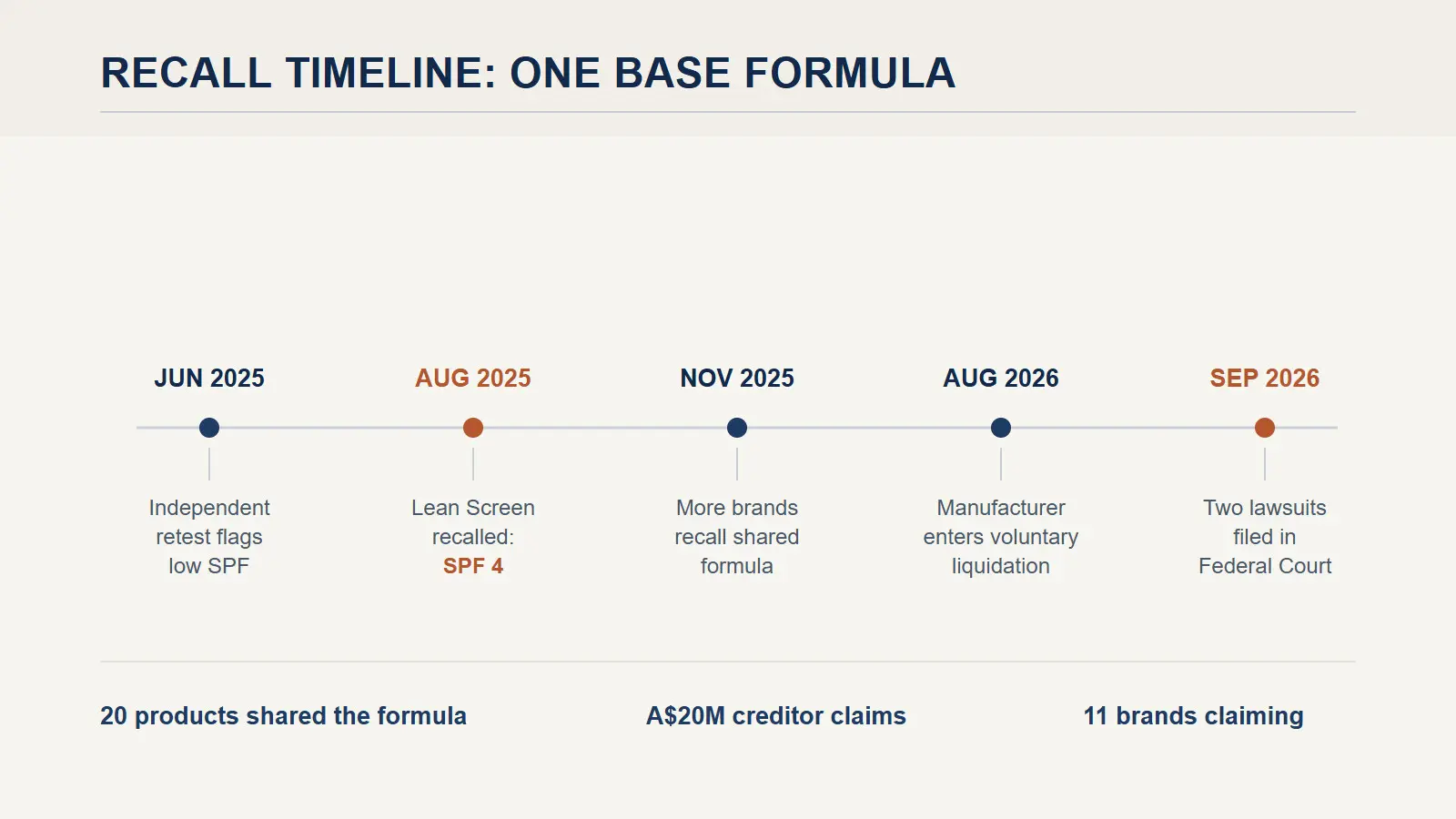
On 10 September 2026, ABC News reported that sunscreen brand Ultra Violette has sued base-formula manufacturer Wild Child Laboratories in the Federal Court, alleging "misleading" and "deceptive" conduct and seeking millions of dollars in damages. The trigger: Ultra Violette's Lean Screen SPF50+ was tested by consumer group Choice at an SPF of just 4, against an on-pack claim of SPF 50+. Critically, that same base formula was shared by 20 sunscreen products, all of which were recalled.
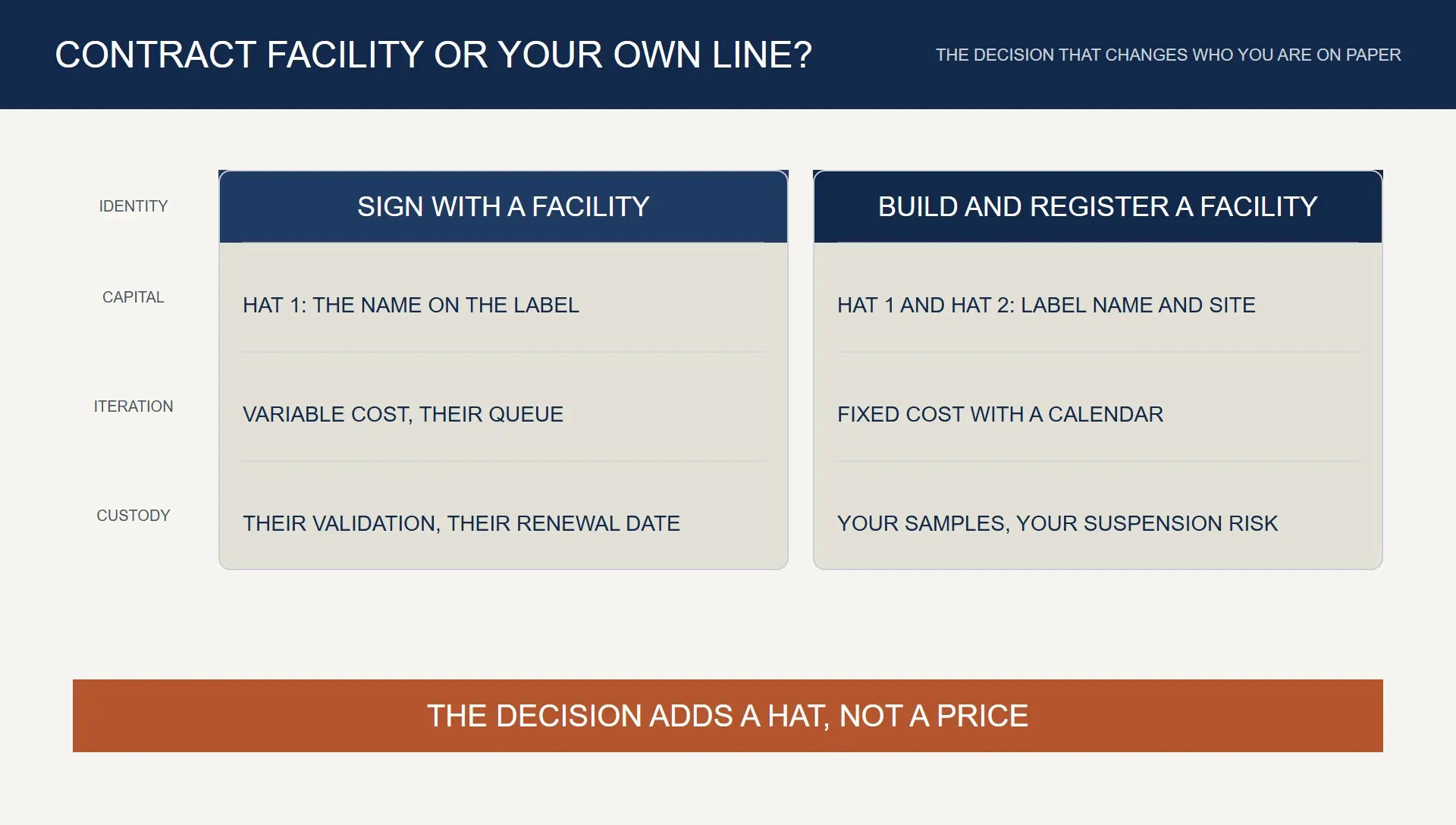
The question this raises for brand owners is one the industry has rarely taken seriously: when you hand your formula to a third-party factory, are you buying a product — or a claim whose legal consequences stay with you? Under Australia's framework the legal obligation sits with the brand (the sponsor), but the brand clearly believes it should not carry that alone. This litigation is drawing the line for the whole industry.
The facts: one base formula, 20 products, two lawsuits
| Date | Event | Source |
|---|---|---|
| Mid 2025 | An ABC investigation and retesting by consumer group Choice find multiple sunscreens labelled SPF 50+ measuring far below claim | ABC News, 2025-06-12 |
| Aug 2025 | Ultra Violette's Lean Screen SPF50+ is voluntarily recalled and its listing cancelled; Choice testing showed an SPF of 4 | ABC News, 2025-08-22; TGA, 2026-04-17 |
| Sep 2025 | Ultra Violette receives seven further results from four laboratories, with average SPF values of 2.9, 3.0, 3.6, 4.1, 10.5, 21.5 and 25.18 | ABC News, 2026-09-10 (statement of claim) |
| Oct 2025 | At least eight failing sunscreens had original certification testing performed by an overseas laboratory whose results are questioned by industry experts | ABC News, 2025-10-01 |
| Nov 2025 | Further brand recalls; the TGA notes some products failed after the formula "split into layers", leaving UV filters unevenly distributed | ABC News, 2025-11-14 |
| Mar 2026 | The TGA proposes regulatory changes, including removing SPF numbers from labels | ABC News, 2026-03-26 |
| Apr 2026 | The TGA confirms the base formulation is "unlikely to have an SPF of greater than 21", with some products possibly as low as 4 | TGA, 2026-04-17 |
| Aug 2026 | Wild Child Laboratories enters voluntary liquidation; a month earlier it sold its assets to a new company, Heliora, set up by the same director | ABC News, 2026-09-10 |
| 10 Sep 2026 | Ultra Violette and Advanced Skin Technology (owner of Aspect Skincare) each sue Wild Child in the Federal Court | ABC News, 2026-09-10 |
Three numbers define the scale: 20 products shared the same base formula (Source: ABC News, 2026-09-10); 11 sunscreen companies have filed claims totalling more than A$19 million, plus over A$400,000 owed to the tax office (Source: ABC News, 2026-09-10, citing the liquidator's report); and individually, Ultra Violette is listed at A$7 million, Naked Sundays at A$8.2 million, and the Aspect-related claim at close to A$2.5 million (Source: same).
How does SPF 50+ test at 4? Three defences failed at once
There is a counter-intuitive point here that buyers should notice. The TGA's GMP audit of Wild Child's facility concluded that it "did not identify any manufacturing issues that could have contributed to the low SPF results" (Source: ABC News, 2026-09-10). In other words: nothing was filled wrongly, no raw material was dosed incorrectly. So where did it fail?
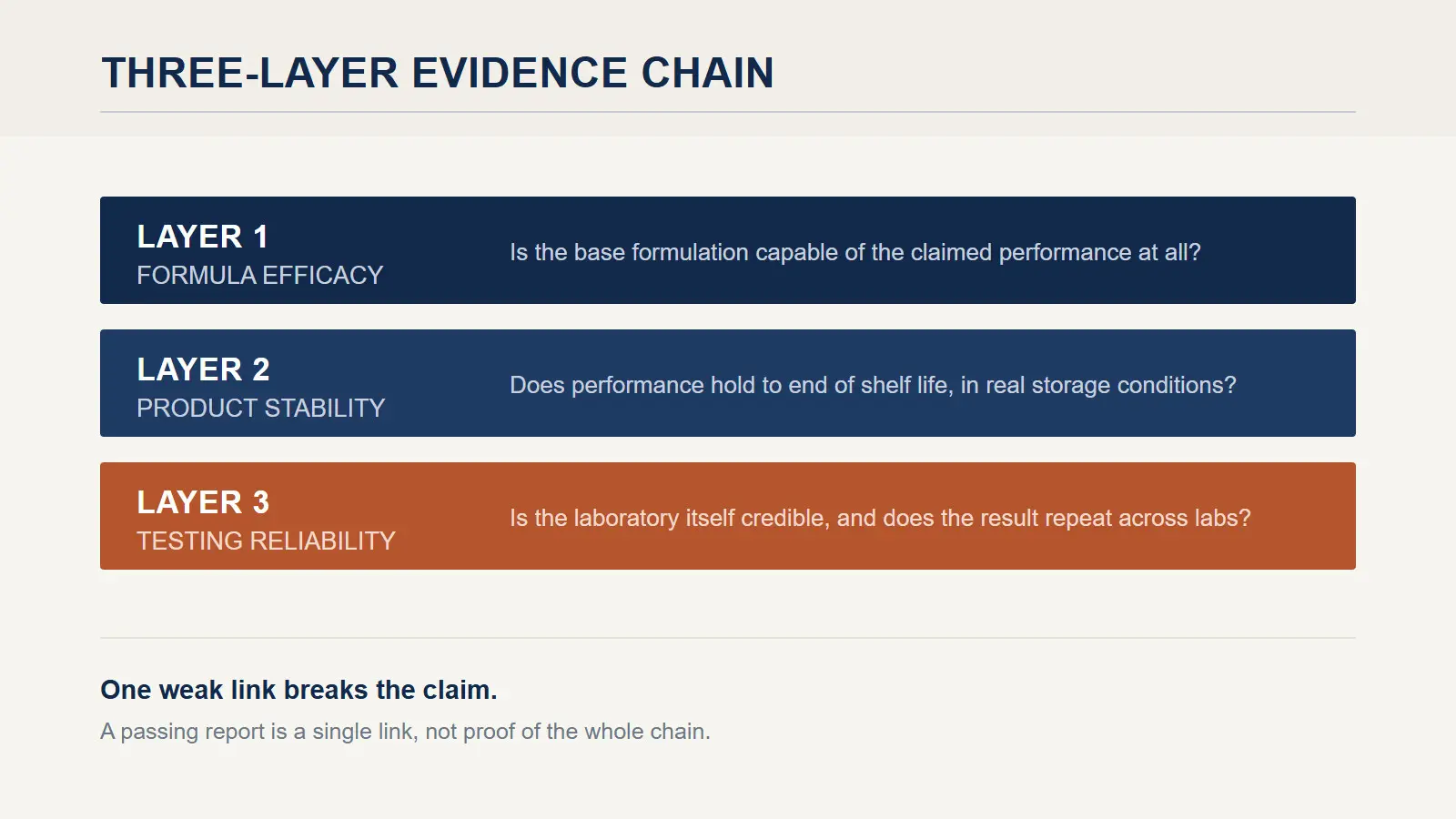
The answer sits in three separate links — which together form the complete evidence chain behind any efficacy claim:
| Link | What happened here | What it means for buyers |
|---|---|---|
| The formula itself | The TGA judged the base formulation "unlikely to have an SPF of greater than 21", with some products as low as 4 (Source: TGA, 2026-04-17) | Formula efficacy is the root cause, not a one-off fluctuation |
| Product stability | Some brands recalled after the liquid formula "split into layers", leaving UV filters unevenly distributed (Source: ABC News, 2025-11-14) | Passing at release does not mean passing at end of shelf life |
| Testing data | At least eight failing products had original certification testing done by a questioned overseas laboratory (Source: ABC News, 2025-10-01); Wild Child's defence names the testing companies as "concurrent wrongdoers" (Source: ABC News, 2026-09-10) | The report itself may be unreliable, and a report is not an indemnity |
Chain those three links together and you get a conclusion of real consequence for buyers: the SPF report in your folder is one link in the chain — it neither proves the formula works nor exonerates you when things go wrong. Worse, retest results scatter widely: for one single product, Ultra Violette obtained average SPF results of 2.9, 3.0, 3.6, 4.1, 10.5, 21.5 and 25.18 across four laboratories (Source: ABC News, 2026-09-10, citing the statement of claim), while Wild Child's own commissioned test returned 21.7 (Source: same).
This is the long-discussed weakness of ISO 24444, the in vivo SPF method widely treated as the gold standard: the method carries "appreciable uncertainty because of experimental variability" (Source: paper indexed on PubMed, 2026-04-26, proposing simplified sunscreen labelling).
The practical inference for buyers: do not judge a claim-bearing product on a single passing report — judge it on cross-laboratory consistency. A single data point can be cherry-picked; consistency cannot.
The liability contest: brand, factory, or lab?
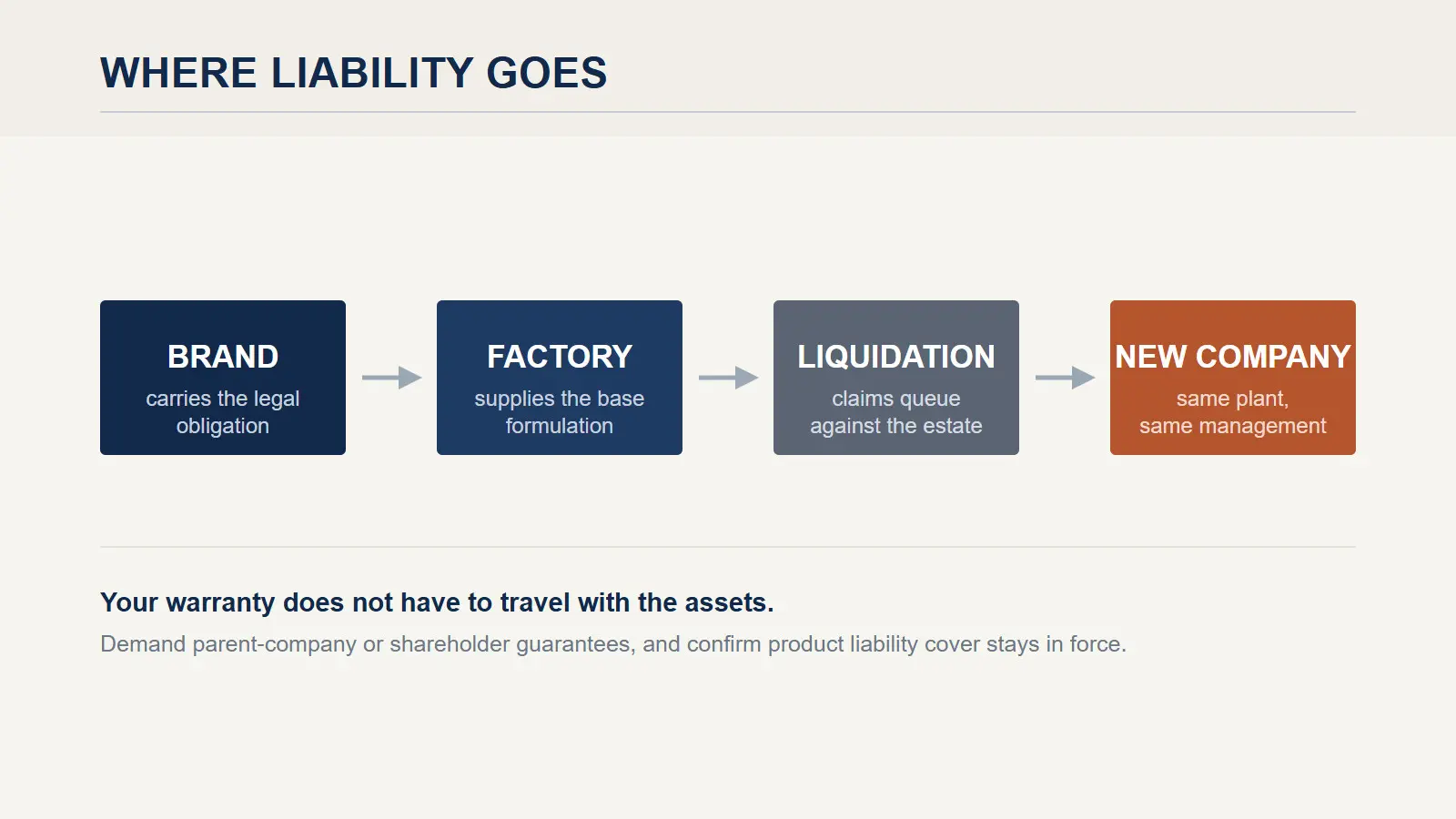
This is the most valuable part of the story, because it drags a liability chain normally buried in a contract annex straight into a Federal Court file. Wild Child's defence rests on two planks (Source: ABC News, 2026-09-10): first, that the brand (sponsor) itself assumed responsibility for meeting all legal obligations regarding the product's SPF label claim; second, that even if liability attaches, the companies it engaged to perform SPF testing are "concurrent wrongdoers", so liability should be apportioned.
| Party | Position exposed by this case | Buyer action |
|---|---|---|
| Brand (you) | Under Australian and EU frameworks the legal obligation for a performance claim normally sits with the brand or responsible person; buying a finished product does not transfer it (Source: ABC News, 2026-09-10; EU Regulation (EC) No 1223/2009 framework) | Claim responsibility cannot be outsourced to the factory — only recovered from it by contract |
| Manufacturer | Faces large claims, argues the brand is responsible, and has entered liquidation (Source: ABC News, 2026-09-10) | Lock in guarantees and insurance in advance; recovery after the fact is usually too late |
| Testing laboratory | Report reliability questioned; named as a concurrent wrongdoer (Source: ABC News, 2025-10-01 / 2026-09-10) | Know who tested it, their accreditation, and whether you can obtain the raw data |
One hard fact must be stated plainly: the manufacturer's defence is the worst-case scenario for a brand — it simultaneously means "the liability is yours" and "the money I can pay is limited." Stack those two together and the brand's real position is this: it absorbs the recall, the delisting, the refunds and the reputational damage alone, while the party it would recover from has already gone into liquidation.
The genuinely new risk: the counterparty changes company before you can claim
If the preceding sections describe an old industry problem, this one is the genuinely new risk — and the most important thing for export buyers to watch. The fact chain (Source: ABC News, 2026-09-10): Wild Child went into voluntary liquidation in August 2026; roughly a month earlier, a new company called Heliora was registered; Heliora shares a director with Wild Child (Paul Waldren, also a major Wild Child shareholder) and is headed by Wild Child's former CEO (Tom Curnow); Heliora took over Wild Child's clients and manufacturing business and continues under its TGA manufacturing licence; and Heliora says some investors were already Wild Child shareholders, that "no Wild Child shareholder received any payment or distribution from the transaction," and that it "firmly rejects any suggestion that it was established as a means of avoiding Wild Child's liabilities" (Source: same).
The implication for buyers is direct: the company you signed with can become a different legal entity — while the plant, the client list and the management stay exactly the same — and your quality warranty, indemnity and long-term supply agreement may not travel with it.
One reassuring detail is worth noting: Wild Child's insurer confirmed in writing that the liquidation had not altered or withdrawn indemnity previously confirmed for the relevant claims, and that cover continues to respond, subject to its terms (Source: ABC News, 2026-09-10). Which is precisely the point: before liquidation, insurance is the backstop that works — and whether it works in your case depends on whether you demanded to see that cover at signature.
Buyer checklist: 8 substantiation items to demand from your factory
Send this straight to your current or candidate factory and ask for written answers. Fix the answers as a contract annex. The underlying logic: do not ask "do you have efficacy data" — ask "will this data survive a second and third independent retest."
- Formulation-level efficacy data. Which study supports this product's performance claim (SPF/PA, anti-ageing percentage, hydration duration, barrier repair)? Provide the full report, not a summary of conclusions.
- Laboratory identity and accreditation. Which laboratory performed the testing? What is its accreditation and scope? Has it ever been questioned by a regulator or by industry experts? Here at least eight failing sunscreens had original certification testing performed by an overseas laboratory whose results are questioned by industry experts (Source: ABC News, 2025-10-01).
- Raw data and reproducibility. Can you provide raw data, including individual values, statistical method and sample size, so a third party can recompute the result?
- Cross-laboratory consistency. Has the same formula been tested by two or more independent laboratories with consistent results? What is the spread? For one product in this case, average SPF values across four laboratories ranged from 2.9 to 25.18 (Source: ABC News, 2026-09-10).
- Stability and end-of-shelf-life data. Was the claim measured at release or at end of shelf life? Do you hold accelerated and real-time ageing data? Some brands recalled after the formula "split into layers", leaving UV filters unevenly distributed (Source: ABC News, 2025-11-14).
- Batch-to-batch consistency. Are efficacy retest results consistent across three or more consecutive batches? What is the batch-to-batch variation?
- Change-notification obligation. How quickly will you notify us of changes to formula, raw material supplier, country of origin, process or manufacturing site? Is efficacy revalidated after such a change?
- Liability and insurance. Who underwrites your product liability cover, at what limit and scope? Can you provide the policy certificate and endorsements?
Six clauses that must go into the contract
This event shows that verbal assurances and "we've always done it this way" are worth nothing in front of a liquidation. Have legal confirm the following six clauses and write them into the supply contract or quality agreement.
| # | Clause | Why it is mandatory here |
|---|---|---|
| 1 | Efficacy warranty. The factory warrants the finished product meets the agreed claim through shelf life, and bears the cost of a failed retest | The factory argued that ensuring the SPF claim was the brand's legal obligation (Source: ABC News, 2026-09-10) — the contract must allocate it explicitly |
| 2 | Indemnity and joint liability. The factory indemnifies for recalls, delisting, refunds, channel penalties and reputational loss, and waives any apportionment defence | The factory named the testing labs as "concurrent wrongdoers" to apportion liability (Source: same) |
| 3 | Raw data access. Ownership of, and on-demand access to, efficacy raw data, test reports and batch records, agreed at signature | The recomputation here depended entirely on seven retests the brand commissioned itself (Source: same) |
| 4 | Independent retest right. The brand may commission third-party retesting, with cost and consequence allocation agreed in advance | The wide spread only emerged after the fact; without a prior clause, dispute costs are extreme |
| 5 | Entity change and asset transfer. Advance notice of any equity change, demerger, asset sale, deregistration or liquidation, plus a parent-company or shareholder guarantee that follows the assets | Heliora was registered a month before liquidation, sharing a director, and took over the business (Source: same) |
| 6 | Insurance and security first. Require proof of product liability cover and scope, and agree substitute security if cover lapses or is not renewed | In this case insurance was the only backstop still responding (Source: same) |
Clause 5 is the easiest to overlook yet the only one in this case that cannot be fixed after the fact. If the guarantee does not travel with the assets, then when the factory continues trading under a new legal entity, your right of recovery stays behind in the insolvency estate.
FAQ: six questions buyers ask most
Q1: This is an Australian sunscreen issue. Does it affect my sheet masks or serums?
Yes. The transferable part of this case is not "SPF" but the evidence chain and liability allocation behind any efficacy claim. Every category carrying a performance claim — hydration, barrier repair, anti-wrinkle, brightening, soothing — faces the same three layers of evidence (formula, stability, lab reliability) and the same three parties (brand, factory, lab). SPF simply quantifies most easily, so it broke first.
Q2: As a buyer, can I transfer claim liability to the factory?
Not completely, but you can preserve full recovery. Under Australian and EU frameworks the legal obligation usually sits with the brand or responsible person (Source: ABC News, 2026-09-10, citing the manufacturer's defence; EU Regulation (EC) No 1223/2009 framework). The right objective is therefore not exemption but an enforceable right of recovery while you carry the obligation — and that comes from contracts, guarantees and insurance, not trust.
Q3: The factory showed me a test report. Is that enough?
No. Here, at least eight failing products had original testing from a questioned laboratory (Source: ABC News, 2025-10-01), while the factory's own test returned SPF 21.7 and the brand's four laboratories returned 2.9 to 25.18 (Source: ABC News, 2026-09-10). A report existing is not the same as a report being reliable. Check accreditation, raw data and cross-laboratory consistency.
Q4: If my factory is large and well regarded, is the risk lower?
Scale reduces capability risk, not liability risk. The manufacturer here was a licensed manufacturer and the regulator's audit found no manufacturing issues (Source: ABC News, 2026-09-10). Systemic efficacy risk correlates with the completeness of the evidence chain, not the size of the factory.
Q5: Is retesting expensive, and is it worth it?
Relative to the exposure here it is close to negligible: Ultra Violette is listed as owed A$7 million, Naked Sundays A$8.2 million, and 11 companies filed claims totalling more than A$19 million (Source: ABC News, 2026-09-10). One independent retest costs far less than one recall. For high-risk claims, run cross-laboratory retesting on at least one batch per year.
Q6: If I find a problem with my factory's data, what is the first step?
Three steps: first, pause promotion and shipping of that product to stop widening the claim exposure; second, commission retesting at a different, independent laboratory and preserve full raw data; third, check whether the indemnity and guarantee clauses are enforceable and whether the factory's product liability cover is still in force. In this case insurance was the only backstop still responding (Source: ABC News, 2026-09-10).
12-month roadmap
| Phase | Action | Deliverable |
|---|---|---|
| Month 1 | Inventory every live performance claim; tier by retest risk (SPF, brightening, anti-wrinkle and percentage claims are high risk) | Claim risk register |
| Months 1–2 | Issue the 8-item substantiation request to all active factories; collect written answers and raw data | Supplier evidence file |
| Months 2–3 | Commission a second laboratory to retest high-risk products; compare spread | Retest consistency report |
| Months 3–6 | Revise supply contracts and quality agreements to add the six clauses; require policy certificates and shareholder guarantees | New contracts and guarantees |
| Months 6–9 | Build a change-notification process (formula, raw material, origin, site) and a retained-sample retest programme | Change control and sampling SOP |
| Months 9–12 | Fold "substantiation completeness" into the annual supplier scorecard as a condition for renewal and order allocation | Supplier scorecard |
What to do next
If you are sourcing a manufacturer for a claim-bearing product, settle the substantiation question before you settle price and MOQ — because it determines what you hold on the day things go wrong. If you are comparing low-MOQ skincare OEM options, start with this list: formulation-level efficacy data, lab identity and accreditation, raw data, cross-laboratory consistency, end-of-shelf-life stability data, batch-to-batch consistency, a change-notification commitment, and proof of product liability cover.
For background on how individual actives are compared and sourced, see our efficacy skincare ingredients guide. For how clinical evidence is read and evaluated, see reading clinical studies for acne treatment.
Sources
- ABC News — "Wild Child Laboratories sued for 'deceptive' conduct over recalled sunscreens" (2026-09-10): https://www.abc.net.au/news/2026-09-10/wild-child-laboratories-sued-over-pulled-sunscreens/107097510
- TGA — "Sunscreens using the same base formulation as Ultra Violette Lean Screen SPF 50+ sunscreen" (2026-04-17): https://www.tga.gov.au/resources/explore-topic/sunscreens/sunscreens-using-same-base-formulation-ultra-violette-lean-screen-spf-50-sunscreen
- ABC News — "Questions over lab that tested sunscreen SPF claims" (2025-10-01): https://www.abc.net.au/news/2025-10-01/australian-sunscreen-brands-dump-spf-testing-lab-pcr/105841262
- ABC News — "Bondi Sands the latest brand to recall sunscreens over potential SPF concerns" (2025-11-14): https://www.abc.net.au/news/2025-11-14/bondi-sands-latest-to-recall-sunscreens-potential-spf-concerns/106010758
- ABC News — "TGA proposes removing sunscreen SPF numbers in regulation changes" (2026-03-26): https://www.abc.net.au/news/2026-03-26/tga-sunscreens-regulation-spf-labelling/106496998
- Global Cosmetics News — "Wild Child Laboratories Sued Over Recalled Sunscreen SPF Claims" (2026-09-14): https://www.globalcosmeticsnews.com/wild-child-laboratories-sued-over-recalled-sunscreen-spf-claims/
- ISO — ISO 24444:2019 Cosmetics, Sun protection test methods, in vivo determination of the SPF: https://www.iso.org/standard/72250.html