


Delivery Beats Dosage: Why the Same Active Fails in Another Formula
For a decade, skincare's efficacy narrative has been built on "what you add": 10% niacinamide, 20% vitamin C, 0.1% retinol. Concentration became the shelf's common language. But in September 2026, several seemingly unrelated industry moves pointed at a different answer — the bottleneck is no longer the ingredient; it is the delivery.
First, French active-ingredient supplier Core Biogenesis pushed its growth-factor delivery platform from creams into colour cosmetics: its plant-derived biomimetic growth factor Peauvita™, built on the patented Oleosome-EGF platform, was used in an eye-shadow concept called Eye Longevity Shadow, combined with hyaluronic acid and mineral pigments (source: Premium Beauty News, September 2026). Then French manufacturer ALPOL Cosmétique disclosed its development principle for hybrid sun care: not every active can go into the same formula — retinol, for example, is ruled out of sunscreen bases for toxicological reasons; the company also invested in a Labsphere in-vitro SPF measurement system precisely so that doomed options are screened out before standardised in-vivo testing, "securing the development process, shortening timelines and reducing costs for our customers" (source: Premium Beauty News, September 2026). In the same week, Cosmetics & Toiletries published a cluster of longevity- and delivery-related launches on 10–11 September (Symrise Dragosine green, Ashland Collapeptyl biofunctional, Seppic Macro'Age, KLK OLEO DavosLife Rejuéclat, Biocogent DermalRx LuShield NAT, among others).
What these three share is not "another new ingredient" but an engineering problem: can the ingredient reach where it is supposed to go. For brands sourcing efficacy skincare, that means your factory-selection criteria, formulation brief and cost model all need updating.
The facts: three moves and a cluster of launches
| Date | Actor | Move | Relevance |
|---|---|---|---|
| Sep 2026 | Core Biogenesis (FR) | Extended its Oleosome-EGF delivery platform (carrying plant-derived biomimetic growth factor Peauvita™) from Skin Longevity Butter into Eye Longevity Shadow | A delivery platform becomes a reusable, cross-category asset |
| Sep 2026 | ALPOL Cosmétique (FR) | Uses a Labsphere in-vitro SPF system to screen formulas early; explicitly excludes photosensitising actives such as retinol from sunscreen bases | Delivery compatibility becomes a gate on formulation feasibility |
| 2026-09-10 | Symrise | Launched Dragosine green, positioned for skin longevity and prejuvenation | Continued longevity-actives flow |
| 2026-09-10 | Ashland | Launched Collapeptyl biofunctional | Biofunctional peptides |
| 2026-09-10 | Seppic | Launched Macro'Age | Longevity and anti-ageing actives |
| 2026-09-10 | KLK OLEO | Launched DavosLife Rejuéclat | Oil-soluble actives and delivery media |
| 2026-09-10 | Biocogent | Launched DermalRx LuShield NAT | Naturally derived protective efficacy |
| 2026-09-11 | CLR | Published three new in-vivo studies showing rinse-off formulas can actively support skin and scalp despite very short contact time | Contact time and residence become efficacy variables |
Source: Premium Beauty News (September 2026, Core Biogenesis and ALPOL articles); Cosmetics & Toiletries September 2026 ingredient roundup (published 2026-09-10 and 2026-09-11).
The most telling row is the last, because it inverts a long-standing assumption. The industry has treated rinse-off products as inherently incapable of meaningful efficacy given their short contact time; CLR's three in-vivo studies argue that this constraint can be engineered around. If contact time can be engineered, then concentration becomes an even weaker proxy for efficacy.
The mechanism: three delivery routes that decide efficacy
To see why delivery is the bottleneck, you need the three mainstream technical routes. The mechanisms and data below come from a signed technical article by Michelle Shieh, scientific valorization associate director / derma science director at Amorepacific's Americas R&I Center, published in Cosmetics & Toiletries (2026-07-28).
| Route | Nature | How it works | Limitation |
|---|---|---|---|
| Liposomes | Microscopic spherical vesicles made of lipids — the same building blocks as skin cell membranes | Act as protective micro-reservoirs encapsulating vitamin C, peptides and antioxidants; shield them from oxidation and degradation; improve penetration and enable controlled, gradual release | Structural stability of ultra-small carriers has historically been the constraint (now partly solved by new engineering) |
| Exosomes | Nano-sized extracellular vesicles naturally secreted by cells | Function more like messengers than carriers — transporting signalling mediators and biomolecules to coordinate cellular responses | Industry consensus: best understood as a complementary element, not a primary active |
| Spicules | Microscopic needle-like structures (traditionally from sponge skeletons, largely silica) | Create thousands of invisible micro-channels as "express pathways" for actives, while gentle mechanical action stimulates natural renewal | Traditional sponge-derived spicules bring irritation and size-control challenges (improved by synthetic spicules) |
Because exosomes behave as messengers rather than carriers, supplier capability varies widely — see our notes on choosing an exosome serum manufacturer.
These three routes expose a single criterion. The article states it plainly: efficacy "is defined by the synergy between the active itself and the system delivering it", because many actives are inherently unstable, poorly absorbed, or effective only at specific skin depths — "without the right system, even the most promising ingredient may never reach its intended target."
Just as important is its implicit rejection of the concentration race. On mature actives such as retinol, the current direction is not to keep stacking concentration but to improve tolerability and efficacy through pairing and system design — combining retinol with soothing actives such as cica to mitigate irritation, or with PDRN to support recovery — or to use multi-retinoid complexes that combine several retinoid forms with different absorption profiles for more balanced, sustained activity. That optimises efficacy, stability and tolerance simultaneously rather than gambling on a single high-dose retinol. For the mechanism, onset time and sourcing comparison of actives such as retinol, peptides, PDRN and hyaluronic acid, see our full guide to efficacy skincare ingredients.
The numbers: how much delivery actually moves efficacy
Mechanisms must land on numbers, or "delivery matters" stays a slogan. Everything below is publicly traceable, with the source marked per row.
| Metric | Figure | Test conditions | Source |
|---|---|---|---|
| Retinol absorption gain (spicule-encapsulated vs spicule-free formula) | +46% | Instrumental measurement, 30 participants | Amorepacific "Retijection" spicule technology; Cosmetics & Toiletries, 2026-07-28 |
| Irritation reduction (synthetic spicules vs traditional sponge-derived spicules) | −80% | Sensory evaluation, 31 participants, opposite-cheek comparison, stinging and burning assessed within 9 minutes of application | Same as above |
| Liposome structural scale | 20 nm stable nanocage | Plant-derived triterpenoids reinforce intermolecular bonds to prevent structural collapse; validated by cryo-electron microscopy and molecular simulations | Lipo3Ex technology, with KAIST; published in ACS Nano, May 2025 (Vol. 20, Issue 17), selected as cover article |
| Next-generation PDRN molecular size | About 1/20 that of salmon-derived PDRN | From microalga Chlorella protothecoides (BluePDRN); wound closure equivalent to salmon PDRN, promotes collagen accumulation and angiogenesis via an adenosine A2A receptor (A2AR)-dependent mechanism | Published in Archives of Dermatological Research, 2025-02-24 |
| Vitamin C oxidative stability | Significantly improved at concentrations above 20% | Patented phase-separated system reducing exposure to oxygen and external stressors | Korea Patent KR102008275B1 |
| Bioavailability of a hard-to-absorb active | Bio-converted Compound K shows significantly higher bioavailability | Inhibits IL-17A + UVB co-induced inflammaging and normalises impaired epidermal function | Published in Journal of Ginseng Research, 2025, 49(3): 326–330 |
| Receptor-selective retinoid | Selectively targets RAR-γ, the predominant epidermal receptor subtype | Molecular-modelling design; enhances keratinocyte proliferation, accelerates wound healing, restores UV-induced collagen loss | Seletinoid G; published in Int. J. Mol. Sci., 2020, 21(9): 3198 |
The value of this table is not any single row but the fact that it makes delivery efficiency measurable — figures such as "+46% absorption" and "−80% irritation" can be written into a formulation brief, committed to by a supplier, and re-verified when you change factories. Once delivery is quantifiable, it stops being a technical adjective and becomes a sourcing metric.
From nice-to-have to must-have: why market and regulation both push toward delivery
Delivery has been upgraded from "technical highlight" to "business necessity" by two forces stacking on each other.
Force one: market growth. According to Persistence Market Research, Delivery Systems in Personal Care Market Size, Share, and Growth Forecast, 2026-2033 (report ID PMRREP3373, January 2026, 191 pages):
| Metric | Figure |
|---|---|
| Market size, 2026 | US$3.4 billion |
| Forecast, 2033 | US$6.5 billion |
| CAGR 2026–2033 | 9.6% |
| Historical CAGR 2020–2025 | 8.5% |
| Application mix | Skincare 63% (largest); haircare the fastest-growing segment |
| Technology mix | Liposomes ~31.2% (largest); nanoparticles the fastest-growing technology segment (including 5–100 nm silica nanoparticles, lipid nanoparticles, solid lipid nanoparticles) |
| Regional mix | North America 30%, Europe 27%, East Asia 22% (fastest-growing) |
The report attributes growth to two drivers: consumer demand for measurable efficacy, and regulatory requirements for safety substantiation. The second is directly relevant to skincare buyers — the report states that MoCRA requires cosmetic manufacturers to register facilities, submit complete product listings and maintain documented safety substantiation, and that encapsulation systems reduce the potential for active-ingredient irritation by using controlled-release mechanisms that minimise peak-concentration exposure, and are therefore "explicitly recognise[d]" by regulatory frameworks as a mechanism that enhances product safety. In other words: delivery is not just a marketing story; it is becoming an engineering route to safety substantiation.
Force two: the physical limits of formulation. ALPOL's case above delivers the bluntest lesson — retinol simply cannot enter a sunscreen base for toxicological reasons. In real development, "I want these actives" and "these actives can live in this base" are two different questions. Delivery technology (encapsulation, carriers, phase separation) is what resolves that compatibility problem; without it, ingredients on a formula sheet stay on paper. To see how an independent factory lays out its anti-ageing, radiance and repair lines in practice, browse the FKY product range.
8 questions to ask your supplier about delivery
Turning the analysis into action yields a question list you can send to current or candidate factories today. Ask for written answers and put critical items into the contract annex.
- What is the delivery system? Which route does this product use for its efficacious actives (liposome / exosome / spicule / microcapsule / nanoemulsion / phase separation, or none)? Provide the technical name and mechanism.
- Carrier parameters: what are the particle size and structural parameters (e.g. liposome diameter, nanoparticle size range)? Is there stability data (e.g. size change over time or temperature)?
- Encapsulation efficiency and payload: what are the encapsulation efficiency and carrier payload, and by what method are they measured?
- Release behaviour: is release immediate or controlled? What does the release curve look like, and what fraction is released within which window?
- Compatibility limits: is this system compatible with the other ingredients I plan to add (especially UV filters, acids, high-concentration vitamin C)? Which ingredients must be excluded, and why (toxicology, photosensitivity, or system instability)?
- Absorption/penetration evidence: is there ex-vivo or in-vivo penetration/absorption data? What were the sample size, method and control design?
- Tolerability evidence: is there irritation or tolerance data (e.g. patch test, sensory evaluation)? How does it compare with a version without the delivery system?
- Site-change and change-control risk: if the manufacturing site or carrier supplier changes, how is delivery performance re-verified? Do you retain carrier specifications and equivalence validation records?
Questions 1–4 determine whether the supplier has delivery capability; 5 filters out formulation-compatibility traps; 6–7 determine whether efficacy and tolerability can be proven (and therefore whether your claim can ship); 8 protects your product consistency across site changes and scale-ups. Sending all 8 to three factories and comparing written answers is the cheapest delivery-capability due diligence available.
Contract points: writing delivery into the agreement
Data only becomes leverage when it lands in a contract. The five points below are ranked by importance and can serve as a legal brief (specific clauses depend on your market and commercial relationship):
- Delivery-system specification commitment: state the carrier type, particle-size/structural parameter range, minimum encapsulation efficiency and test method; require the COA or specification sheet to carry those items.
- Compatibility exclusion list: document in writing which ingredients must not be combined with this product (e.g. photosensitising actives must not enter a sunscreen base), so a later "formula upgrade" cannot silently break the system.
- Efficacy and penetration data per batch/version: require the most recent penetration or absorption test summary, plus a clause preserving your right to request it.
- Tolerability data and claim-substantiation support: require the supplier to provide test summaries and data usage rights needed for claim substantiation — directly relevant to evidentiary requirements in markets such as the EU (ECGT) and the US (MoCRA).
- Change-control clause: written advance notice plus equivalence data if the carrier source, delivery process or manufacturing site changes — the last gate protecting your product's consistency.
Six frequently asked questions
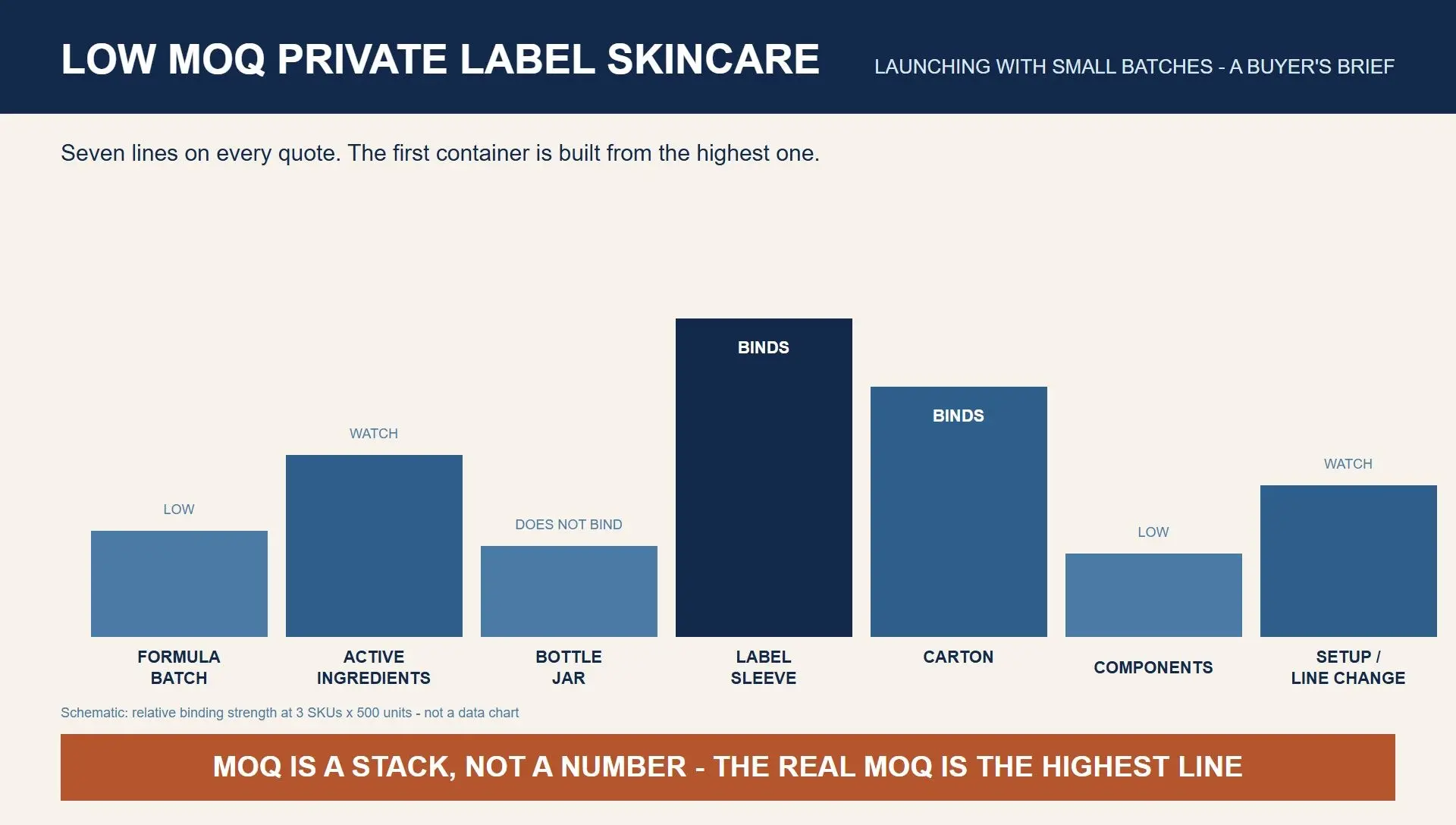
Q1: I'm a small-volume brand — is discussing delivery systems unrealistic? The opposite: small volumes need it more. Delivery is a formulation-layer decision and does not consume extra capacity — it determines whether, at the same cost, efficacy can actually be delivered. What really drives MOQ is packaging and filling, not the delivery system itself. If MOQ is your concern, see our note on low-MOQ cooperation routes.
Q2: Does a product without a delivery system necessarily lack efficacy? Not necessarily — it depends on the active. Ingredients that are inherently stable and readily absorbed, such as niacinamide or glycerin, can perform in a conventional formula; for actives that degrade easily or absorb poorly — retinol, vitamin C, peptides, exosomes — the presence or absence of delivery gets amplified. Start by classifying your active, then decide whether system engineering is required.
Q3: On a tight budget, how do I decide whether a delivery system is worth paying for? Use a three-step filter: (1) does the active have a clear stability or penetration weakness? (2) is a cheaper fix available (swap the active, adjust pH, restructure the formula)? (3) if neither works, then consider investing in a system. Delivery is not a default answer; it is the answer when an active's weakness cannot be solved more cheaply.
Q4: Can figures like "+46% absorption" be used in marketing directly? Use caution. Such data typically comes from instrumental measurement or specific ex-vivo conditions and is appropriate to support mechanism explanation; consumer-facing human efficacy claims generally need clinical or consumer-test data, and rules differ by market (the EU's ECGT and the US's MoCRA each set their own evidentiary expectations). Treating data as "evidence material" rather than "a quotable claim sentence" is the safer route.
Q5: Spicules sound clinical — are they safe for home use? The mechanisms differ. Clinical microneedling is a procedure with deeper penetration, potential micro-injury and downtime; spicules remain superficial and non-invasive, typically producing only mild tingling, with no downtime — hence their suitability for at-home use. If your product targets sensitive skin, scrutinise the tolerability data in question 7 and prefer synthetic spicules, which are markedly less irritating than traditional sponge-derived ones.
Q6: What can I legally put on the packaging? Stay within provable layers: (1) the system exists ("uses liposomal delivery"); (2) what the system does ("encapsulates and controls release"); (3) quantified results (only when a citable test report exists). Avoid dressing a system name up as an efficacy promise (e.g. "nano-scale = guaranteed results") — that reasoning chain is the most fragile under substantiation requirements.
A 12-month action roadmap
| Timing | Action | Output |
|---|---|---|
| Month 1 | Audit your main efficacious products with the 8-question list (one each for anti-ageing, radiance, repair); request written answers on delivery system and parameters | Delivery-capability baseline |
| Month 2 | Run an internal four-column filter — active / weakness / cheaper fix / system investment — to identify which actives genuinely need a system and which do not | Active-delivery decision matrix |
| Months 3–6 | Pilot a dual delivery requirement on 1–2 new products (carrier specs + penetration or tolerability data before project approval); assess how packaging and filling really affect MOQ | Pilot project charter and test plan |
| Months 6–9 | Write delivery specifications, the compatibility exclusion list, per-batch data and change control into the purchase agreement and specification sheet | Revised purchase agreement template |
| Months 9–12 | Review: rework and complaints avoided through delivery specification, trial-and-error cost saved by compatibility exclusions; decide whether to extend across the full efficacy range | Annual supply-chain review |
The core conclusion compresses into one line — efficacy = active × delivery × contact time, and the latter two are increasingly determined by engineering capability rather than unit price. Meanwhile, both the market data (US$3.4B → US$6.5B, 9.6% CAGR) and the regulatory logic (encapsulation explicitly recognised as a safety-enhancing mechanism) are pushing delivery into the "must-answer" category. For a brand, the highest-value move is not chasing the next new ingredient but asking about delivery capability at the factory-selection stage and writing it into the contract.
What this means for your next formulation decision
Take this list into your next supplier meeting: can your current factory articulate this product's delivery system, carrier particle size, encapsulation efficiency and release curve? Does your purchase agreement contain a single clause requiring equivalence data after a carrier or site change? If your next efficacy line needs a delivery system implemented across anti-ageing, radiance or repair — from carrier selection and compatibility screening to penetration and tolerability data — send us your formulation targets: FKY offers brand-side buyers a free delivery-system fit assessment, so you can see before project approval which actives can go in, which cannot, and at what cost.
Sources
- Amorepacific delivery-system technical article and quantified data: Michelle Shieh (scientific valorization associate director / derma science director, Amorepacific Americas R&I Center), "How K-Beauty Advances Skin Care Through Next-Generation Delivery Systems and the Continuous Reinvention of Proven Actives", Cosmetics & Toiletries, 2026-07-28.
https://www.cosmeticsandtoiletries.com/cosmetic-ingredients/specialized/article/22969422/how-kbeauty-advances-skin-care-through-nextgeneration-delivery-systems-and-the-continuous-reinvention-of-proven-actives
Peer-reviewed references cited therein: ACS Nano, May 2025, Vol. 20, Issue 17 (20 nm stable liposome nanocage; cover article); Archives of Dermatological Research, 2025-02-24 (BluePDRN); Int. J. Mol. Sci., 2020, 21(9): 3198 (Seletinoid G); Journal of Ginseng Research, 2025, 49(3): 326–330 (Compound K); Korea Patent KR102008275B1. - Delivery-systems market size and structure: Persistence Market Research, "Delivery Systems in Personal Care Market Size, Share, and Growth Forecast, 2026-2033", report ID PMRREP3373, January 2026, 191 pages.
https://www.persistencemarketresearch.com/market-research/delivery-systems-in-personal-care-market.asp - Core Biogenesis extends its delivery platform into eye makeup: Premium Beauty News, "Core Biogenesis expands growth factor-based longevity concept into eye makeup".
https://www.premiumbeautynews.com/en/core-biogenesis-expands-growth,28154 - ALPOL Cosmétique on formulation compatibility and in-vitro screening: Premium Beauty News, "ALPOL Cosmétique advances hybrid sunscreens without compromising protection".
https://www.premiumbeautynews.com/en/alpol-cosmetique-advances-hybrid,28163 - September 2026 ingredient launches: Cosmetics & Toiletries, September 2026 ingredient roundup (Symrise Dragosine green, Ashland Collapeptyl biofunctional, Seppic Macro'Age, KLK OLEO DavosLife Rejuéclat, Biocogent DermalRx LuShield NAT), 2026-09-10.
https://www.cosmeticsandtoiletries.com/roundups/2026/september - New evidence on rinse-off efficacy: Cosmetics & Toiletries, "Beyond Cleansing: Turning Rinse-off Products into Active Skin Care" (three new in-vivo studies with CLR SyriCalm™ CLR (PC)), 2026-09-11.
https://www.cosmeticsandtoiletries.com/cosmetic-ingredients/cleansing/article/22972998/clrchemisches-laboratorium-dr-kurt-richter-gmbh-beyond-cleansing-turning-rinseoff-products-into-active-skin-care
Note: every quantified figure in this article (+46%, −80%, 20 nm, 1/20, above 20% concentration, US$3.4B/US$6.5B, 9.6%) is attributed inline together with its test conditions, so brand buyers can cite and re-verify them directly in supplier conversations. The third-party market forecast (Persistence Market Research) is a projection and should be weighed alongside your own data in commercial decisions.