
Dermocosmetics Land Grab: Clinical Proof Is Now the Valuation Anchor
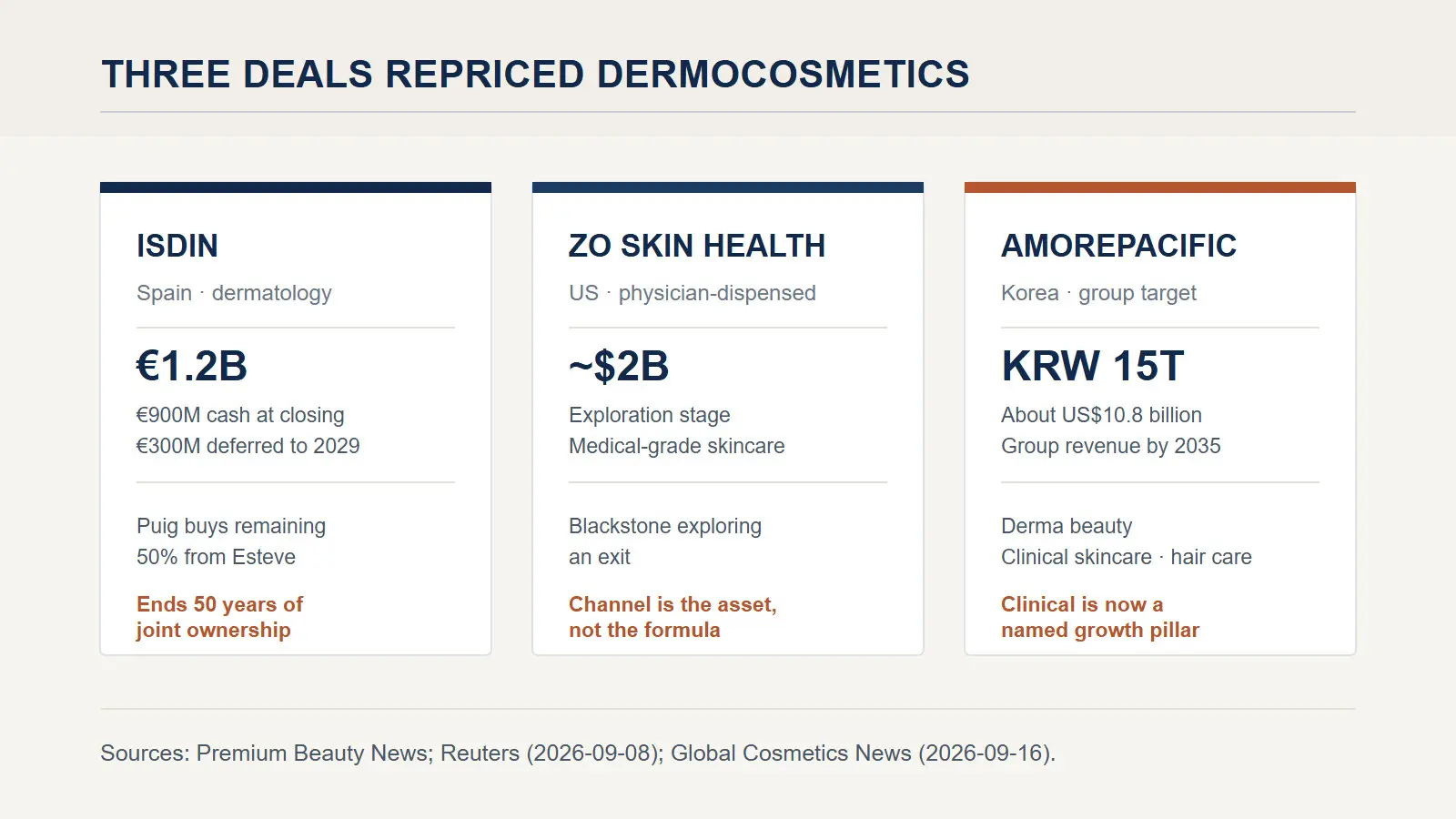
In September 2026 the global skincare asset market produced a cluster of deals pointing the same way. Spain's Puig agreed to acquire Esteve's remaining 50% stake in ISDIN, ending a 50-year joint ownership and taking full control of the Spanish dermatology and skincare specialist; total consideration is EUR 1.2 billion — EUR 900 million in cash at closing (expected Q1 2027), plus a fixed, non-interest-bearing deferred payment of EUR 300 million payable in Q1 2029 (Source: Premium Beauty News, "Puig takes full control of ISDIN", September 2026).
Over the same period, Reuters reported on 8 September 2026 that private equity firm Blackstone is exploring a sale of physician-dispensed skincare brand ZO Skin Health at a valuation of around US$2 billion, with the process still at an early stage (Source: Reuters, 2026-09-08). And Korea's Amorepacific has pinned its KRW 15 trillion (about US$10.8 billion) 2035 group revenue target explicitly on three new growth pillars: derma beauty, clinical skincare and hair care (Sources: Global Cosmetics News, 2026-09-16; en.sedaily.com, 2026-09-14).
Three deals spanning Spain, the United States and Korea, with very different asset shapes, point to one question: what is capital now using to price dermocosmetics?
The facts: three deals priced dermocosmetics in one week
| Date | Deal | Key figures | Source |
|---|---|---|---|
| 2026-09-08 | Blackstone explores a sale of ZO Skin Health | Valuation around US$2 billion; early stage | Reuters, 2026-09-08 |
| 2026-09-14 / 16 | Amorepacific names three pillars for its KRW 15 trillion 2035 target | About US$10.8 billion; pillars are derma beauty, clinical skincare, hair care | Global Cosmetics News, 2026-09-16; en.sedaily.com, 2026-09-14 |
| 2026-09 | Puig acquires the remaining 50% of ISDIN | EUR 1.2 billion total: EUR 900 million cash plus EUR 300 million deferred to Q1 2029; ends 50 years of joint ownership | Premium Beauty News, 2026-09 |
| 2026-09 | Caudalie acquires a majority stake in Talm | Terms undisclosed; Caudalie's first ever acquisition | Premium Beauty News, 2026-09 |
The deal structures themselves are worth reading closely. The ISDIN consideration is a signal: Puig was willing to defer nearly a quarter of the price (EUR 300 million) to 2029, interest-free, which suggests both sides share an understanding of how long-dated science assets monetise — dermocosmetic brands have longer growth curves and do not suit settlement against short-term financial metrics.
Puig CEO Jose Manuel Albesa said full ownership would give "the best platform to support its next phase of growth, deepen our presence in dermocosmetics and continue investing behind science, innovation and brand strength", while Executive Chairman Marc Puig emphasised a "long-term commitment to ISDIN, its people, its scientific culture" (Source: Premium Beauty News, September 2026). Note the language — it is about scientific culture, not channel or traffic.
The context matters too: Puig moved capital into dermocosmetics assets after shelving merger plans with The Estée Lauder Companies (Source: Premium Beauty News, September 2026). This is not an isolated purchase but a strategic redirection.
The valuation anchor has shifted from traffic to clinical credibility plus professional channel
Place the stated rationales side by side and they almost never mention marketing efficiency or user scale. They return repeatedly to two ideas: science, and the professionalism of the channel.
| Deal | Stated rationale | The anchor it points to |
|---|---|---|
| Puig × ISDIN | "Deepen our presence in dermocosmetics", "continue investing behind science", "scientific culture" | Long-dated monetisation of clinical and science assets |
| Blackstone × ZO Skin Health | Asset positioned as physician-dispensed medical-grade skincare | Access to and repeat structure of the professional channel |
| Amorepacific 2035 | Three pillars: derma beauty, clinical skincare, hair care | Pricing power created by clinical positioning |
| Caudalie × Talm | Explicitly to accelerate via the pharmacy network, sales force and global infrastructure | Distribution leverage in the professional channel |
Why does this matter materially for factories and brand buyers? Because it changes what spending is worth doing.
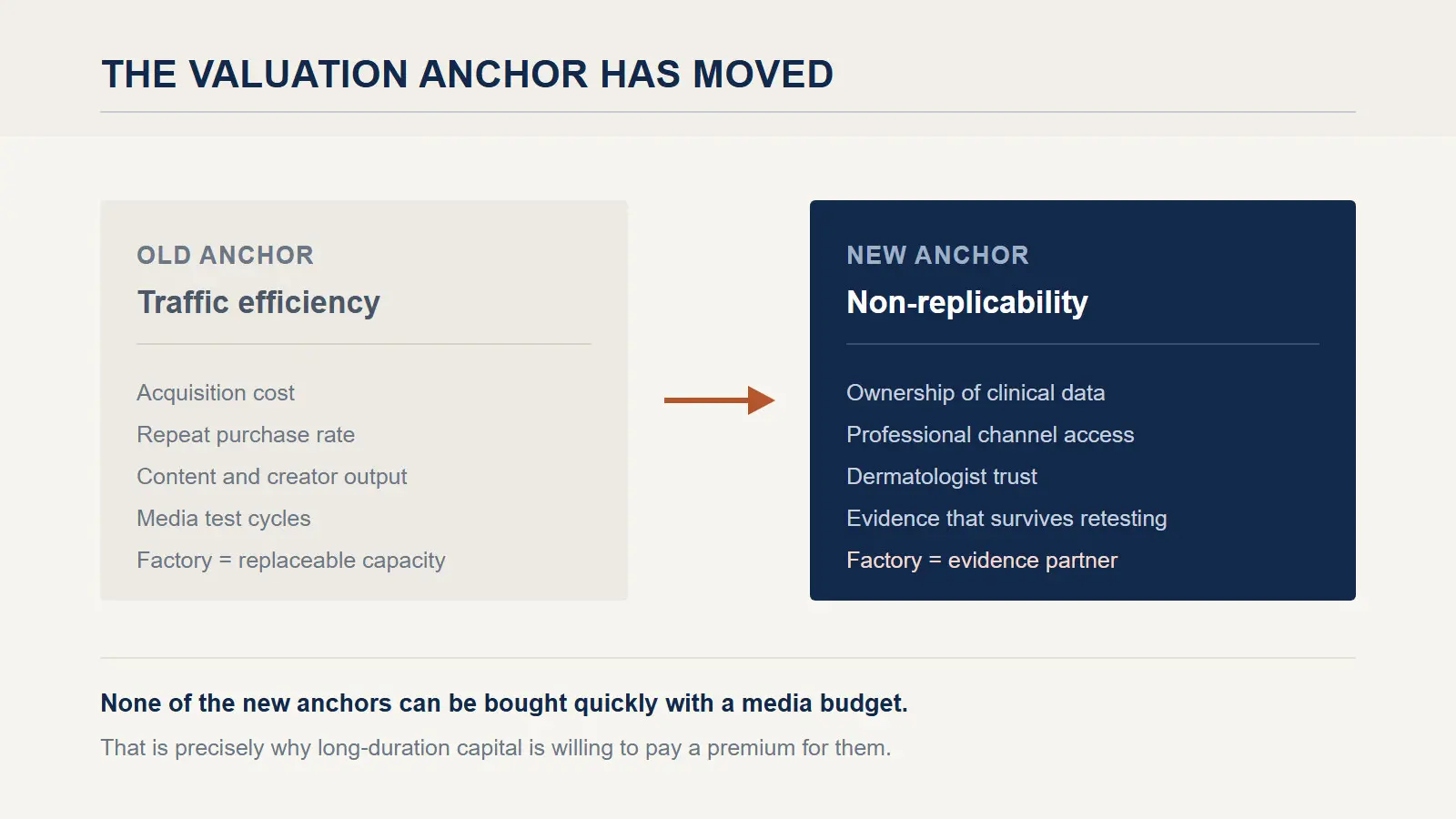
For the past decade, the valuation anchor in skincare capital markets was largely traffic efficiency: acquisition cost, repeat rate, content capability, creator networks. Under that logic the factory was replaceable capacity — whoever quoted lower and shipped faster won the order. Clinical evidence was a cost line, and money spent on a clinical study competed badly against money spent on media tests.
This week's deals move the anchor. When the buyer is long-duration capital such as Puig or Blackstone, it is not buying monthly traffic but non-replicability of the asset. In skincare, the hardest things to replicate are exactly three: ownership of clinical data, access relationships in professional channels, and the trust of dermatologists. None of the three can be bought quickly with a media budget.
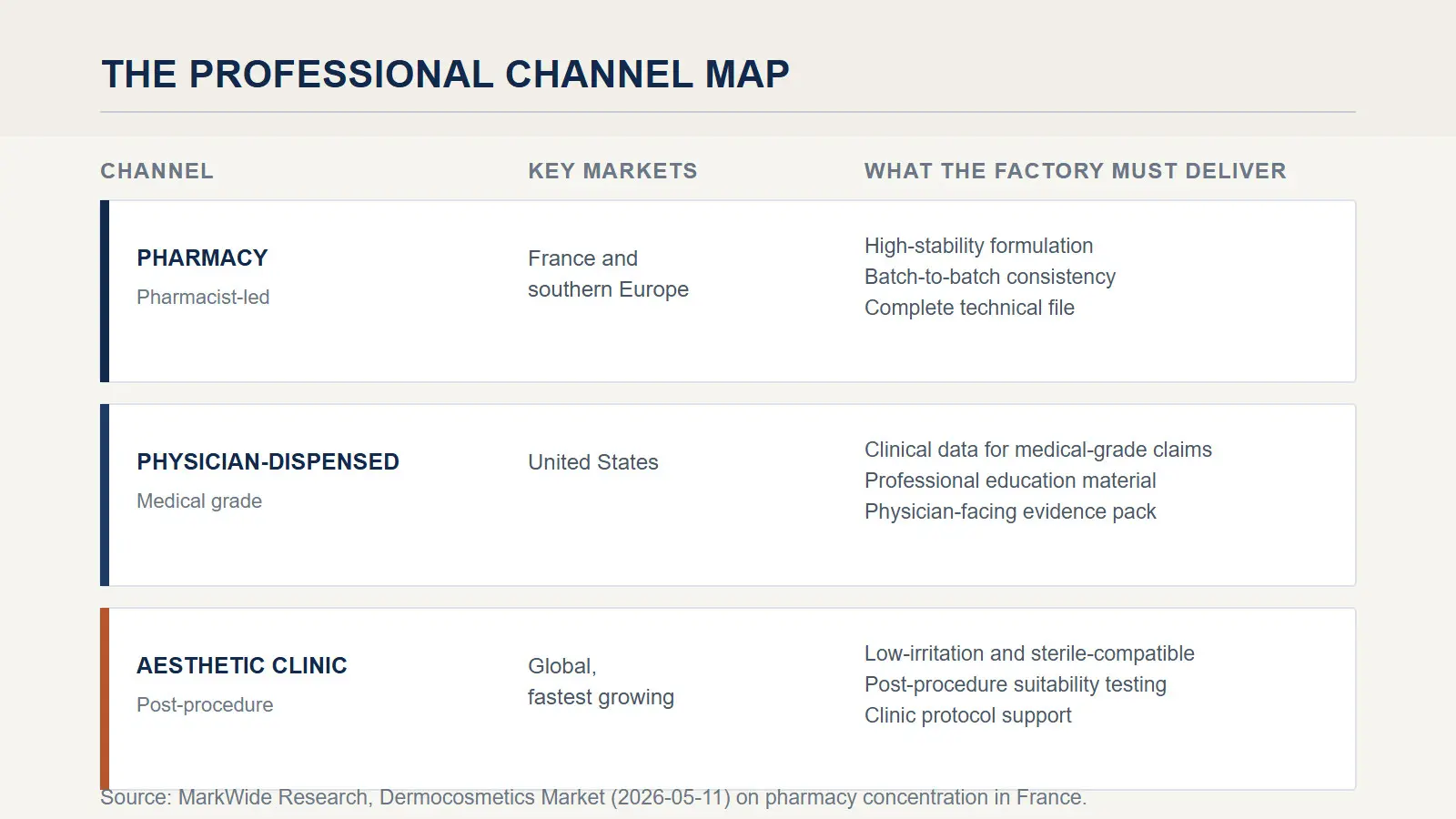
The professional channel map: pharmacy, dermatology office, aesthetic clinic
If the professional channel is now half the valuation anchor, it is worth breaking into three operable types, each of which demands different factory capabilities.
| Channel | Key markets | What the factory must deliver |
|---|---|---|
| Pharmacy | France and southern Europe (origin and structurally dominant) | High-stability formulation, replicable batch-to-batch consistency, a complete technical file |
| Physician-dispensed | United States | Clinical data capable of supporting a medical-grade narrative, physician education material |
| Aesthetic clinic / medical spa | Global, fastest growing | Sterile-compatible and low-irritation formulation, post-procedure suitability validation |
One easily missed reality: "pharmacy channel" is not rhetoric, it has structural barriers. Industry research notes that dermocosmetic demand is highly concentrated in France, where pharmacy-based distribution originated and remains structurally dominant (Source: MarkWide Research, "Dermocosmetics Market", 2026-05-11). A brand seeking to use pharmacy leverage therefore faces not a generic retail market but an access system built around professional pharmacist recommendation.
The direct implication for OEM buyers: if the product is moving towards a dermocosmetic position, formulation stability and the completeness of the technical file outrank price. Pharmacy and clinic channels tolerate batch-to-batch variation far less than e-commerce does — one fluctuation in sensorial feel or performance can end a pharmacist relationship.
Market size: eight reports disagree by 2x, but CAGR converges near 8.5%
To discuss dermocosmetic growth you must first raise a methodological point — otherwise the numbers will mislead a decision.
I collected eight published dermocosmetics market reports and placed their 2026 size estimates side by side:
| Publisher | 2026 size estimate | Terminal value | CAGR |
|---|---|---|---|
| Global Market Insights | US$41.5bn | US$85.7bn by 2035 | 8.4% |
| Persistence Market Research | US$54.0bn | US$89.0bn by 2033 | 7.0% |
| Coherent Market Insights | US$66.9bn | US$118.4bn by 2033 | 8.5% |
| MarkWide Research | US$52.7bn | US$110.7bn by 2035 | 8.60% |
| Research Nester | US$81.0bn | US$197.6bn by 2035 | 10.3% |
| SNS Insider | US$58.7bn (2025) | — | 8.77% |
| Straits Research | US$63.7bn | US$123.4bn by 2034 | 8.62% |
| Allied Market Research | US$51.1bn (2021) | US$130.5bn by 2030 | 11.1% |
2026 estimates range from US$41.5 billion to US$81.0 billion — nearly a 2x spread. That dispersion is not "the market is disputed"; it reflects inconsistent definitions. Some count only pharmacy-channel skin care; others include physician-dispensed, post-procedure and even part of the dermocosmetic hair and body segment. Citing any single absolute figure is unreliable.
One signal is stable, however: apart from two outliers, the CAGRs cluster between 7.0% and 8.8%, mostly 8.4% to 8.8%. Absolute size diverges sharply; growth direction is consistent.
The practical conclusion for buyers: plan on growth rate (8–9%), not on absolute size. If your business case rests on "the market is US$81 billion", an internal audit using the US$41.5 billion definition will undermine the whole model.
The most important question nobody asks: who owns the clinical data?
This section is the most actionable in the article.
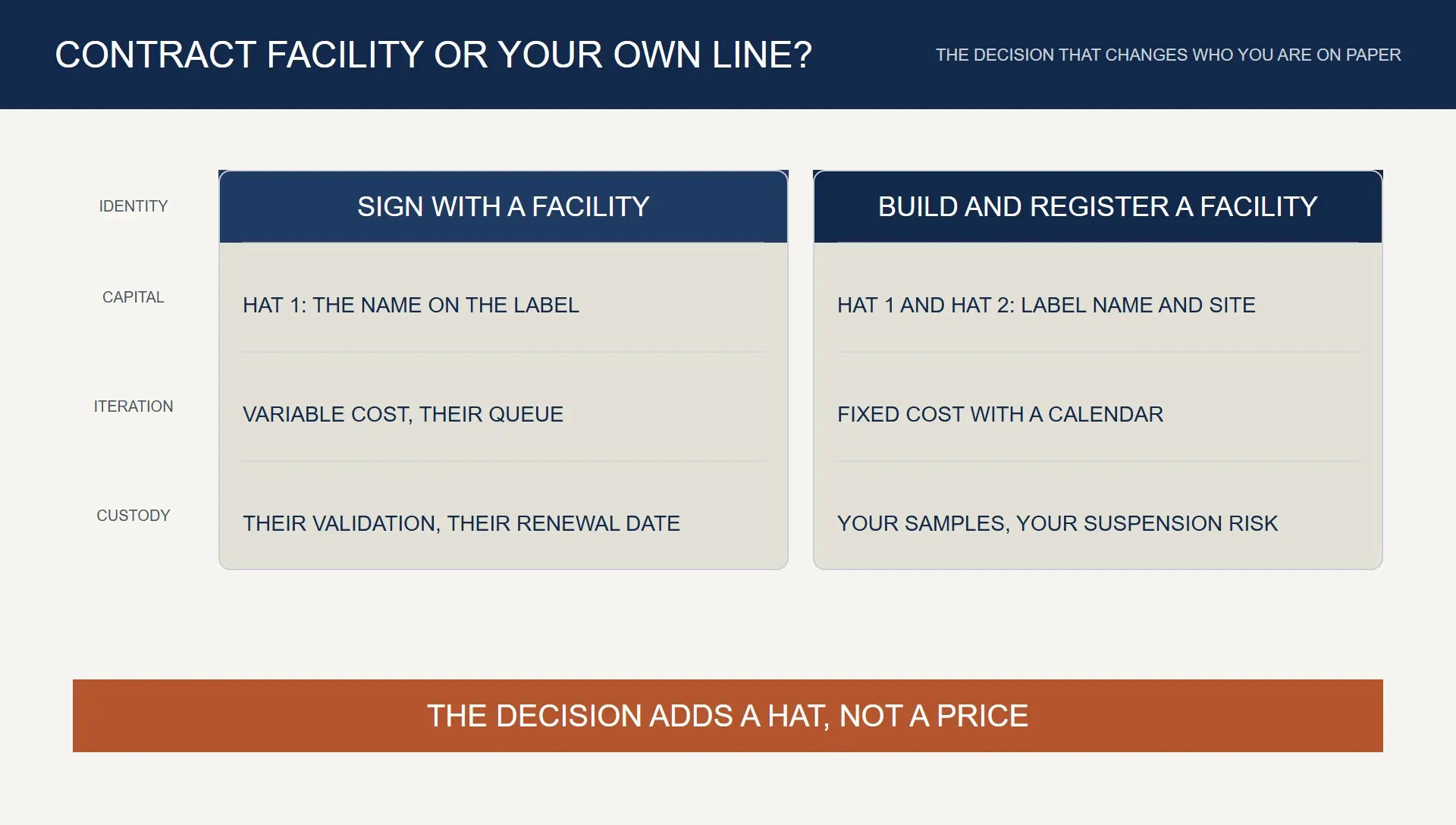
Once clinical evidence moves from cost line to asset line, its ownership becomes a financial question. Yet in most OEM arrangements this point is blurred — sometimes deliberately.
The typical pattern: a brand asks its factory whether it can provide efficacy data; the factory says it has lab data the brand may use; the brand cites it in listings and claims. Both sides appear to gain. The real question is who owns the intellectual property in that data. Three years later, when the brand raises capital or is acquired, diligence asks one thing: "Do you own the clinical data supporting your core claims?"
| Situation | Data ownership | Effect on brand valuation |
|---|---|---|
| Factory runs its own study; brand is licensed to cite it | The factory | Evidence cannot be counted as the brand's asset; diligence treats it as a third-party dependency discount |
| Brand commissions and funds an independent study | The brand | Can be carried as an intangible asset; the strongest evidence in diligence |
| Joint study with shared authorship | Must be specified in contract | Without an agreed clause the default may not favour the brand; usage, sublicensing and territory must be set out |
| Finished-ingredient data supplied by the raw material vendor | The ingredient supplier | Widely available and non-exclusive; competitors can cite the same data, so it creates no differentiation |
One direct link to this week's deals: ISDIN was valued at EUR 1.2 billion, and that value cannot come from the formula — formulas are replicable on today's contract-manufacturing market. It comes from accumulated science assets: clinical data, dermatologist and pharmacist networks, and the resulting status of being recommendable by professionals. Puig's Executive Chairman spoke of a "long-term commitment to ISDIN's scientific culture" (Source: Premium Beauty News, September 2026) — scientific culture is not an adjective; it is the line item that is priced but never appears on the balance sheet.
The most practical advice for brand owners: add a dedicated "research data ownership and usage rights" clause to your next manufacturing contract, specifying who funds, who authors, who owns, whether the brand may sublicense, and whether usage survives termination. It costs almost nothing to negotiate and can be worth six or seven figures at the next financing or exit.
Buyer checklist: 8 items to verify now
If a dermocosmetic position is already, or soon to be, part of your product strategy, hand this checklist to product, regulatory and your manufacturing partner in parallel.
- Grade your evidence. Behind each core claim, is the support consumer self-assessment, instrumental measurement, or an investigator-initiated or independent third-party clinical study? The three are valued very differently by upstream capital and by the professional channel.
- Confirm data ownership. Are ownership, authorship and sublicensing rights already documented in writing? If not, sign a supplementary agreement first.
- Check sample size and endpoints. Are your sample size, endpoints and statistical method strong enough to support the recommendation language used in pharmacy or clinic channels? Consumer research usually is not. For a concrete example of clinical-study requirements in the professional segment, see unlocking skin med clinical studies for acne treatment.
- Audit the technical file. Can your factory supply a complete technical file (formulation version control, batch consistency data, stability testing) rather than a single finished-product report?
- Request batch consistency records. Are the last 12 months of batch test records available for comparable products? Professional channels are sensitive to variation.
- Check channel access experience. Has the factory actually served pharmacy or physician channels (packaging rules, notifications, local regulations)?
- Professional education material. Can the factory help prepare the technical material professional channels require, rather than marketing material?
- Structural contract terms. Are ownership, post-termination usage, and whether the same formulation may be supplied to your direct competitors all explicitly agreed?
Item 8 is the most commonly ignored and the most damaging. If a formulation and its evidence, built jointly with your factory, can be supplied as-is to your competitor, the clinical asset you funded creates no differentiation — which is precisely the opposite of why ISDIN and ZO Skin Health command premium valuations.
Six clauses that protect the value of clinical evidence
Turning the analysis above into text yields these six clauses. They share one purpose: to ensure the money you spend on evidence ends up as your asset, not your supplier's.
| # | Clause | Consequence if omitted |
|---|---|---|
| 1 | Research data ownership: ownership, authorship, sublicensing and territory | Data may default to the factory and the brand holds only a licence, discounted in diligence |
| 2 | Exclusivity: the formulation and evidence may not be supplied to named competitors, in defined periods or territories | Clinical spending creates no differentiation and becomes generic industry background |
| 3 | Post-termination usage: whether the brand may keep using the data and claims | Changing factory means losing the basis for core claims; prior spending resets to zero |
| 4 | Technical file delivery: scope and format of formulation versions, batch data, stability reports | Equivalence validation cannot be completed when switching, forcing full re-testing |
| 5 | Consistency commitment: batch consistency metrics, testing frequency and deviation handling | Professional channels are variation-sensitive; one deviation can end a channel relationship |
| 6 | Professional material support: who prepares physician and pharmacist-facing technical material | Only marketing material exists, which cannot meet professional channel recommendation standards |
If you add only one, add clause 1; if you add two, clause 2 is equally critical. The reason was argued in Section 2: the premium on dermocosmetic assets comes from non-replicability. Ownership makes the data yours; exclusivity makes it scarce. Without either, clinical spending resembles cost rather than capital.
FAQ: six questions buyers ask most
Q1: I am not pursuing a dermocosmetic position. Do these deals concern me?
Yes, in two ways. First, valuation anchors transmit. When Puig prices "science assets" at EUR 1.2 billion (Source: Premium Beauty News, September 2026), growth-stage brands in the same space get measured on similar dimensions when they raise capital. Second, professional-channel talent and resources will be contested. When Amorepacific names clinical skincare a 2035 pillar (Source: Global Cosmetics News, 2026-09-16), it simultaneously competes for dermatology advisors, clinical research capacity and pharmacy relationships — all finite in the short term.
Q2: I am only an OEM buyer. How do I benefit from this wave?
The most direct move is to turn "evidence capability" into a new factory selection criterion rather than continuing to compare unit price alone. In practice: ask, at the quotation stage, what grade of evidence a factory can provide, who owns it, and whether it can be exclusive. Factories that answer all three clearly are materially more valuable as long-term partners.
Q3: Clinical studies are expensive. Can a small brand afford them?
Not all at once. A staged path is more realistic: (1) start with instrumental measurement (skin hydration, elasticity, transepidermal water loss) to establish baseline data; (2) run a small-sample human study to validate direction; (3) invest in an independent third-party clinical study only for core claims. The critical point at every stage is to settle data ownership — otherwise the more you spend, the more asset sits with someone else.
Q4: Can a brand serve physician-dispensed and pharmacy channels at the same time?
Yes, but the requirements differ and one set of material will not serve both. The physician channel needs a medical-grade narrative supported by clinical data (ZO Skin Health is explicitly described as a physician-dispensed medical-grade skincare brand — Source: Reuters, 2026-09-08); the pharmacy channel relies more on the pharmacist recommendation system and local cosmetics regulation. Caudalie's stated rationale for acquiring Talm was precisely its pharmacy network and sales force (Source: Premium Beauty News, September 2026).
Q5: Which market size figure should I use?
Do not use an absolute figure; use the growth rate. The eight reports I collected put the 2026 market anywhere between US$41.5 billion and US$81.0 billion — nearly a 2x spread reflecting definitional differences — but apart from two outliers every CAGR falls between 7.0% and 8.8%, mostly 8.4% to 8.8%. Plan on 8–9% growth, and when you cite size, always name the publisher and the year so an audit cannot dismantle the number.
Q6: Across these three deals, what is the most important signal for Chinese manufacturers and brand owners?
That professional-channel capability has been written into the stated rationale for deals. Caudalie bought Talm to use its pharmacy network; Blackstone's asset is defined by the physician channel; Amorepacific paired clinical skincare with hair care as growth pillars. Over the next few years, manufacturing and compliance capability to serve professional channels will be scarcer than production capacity. For manufacturers, that is the opening to move from price competition to capability competition.
12-month roadmap
| Phase | Action | Deliverable |
|---|---|---|
| Month 1 | Audit the evidence grade behind existing claims; identify the 2–3 claims with the largest gaps | Evidence grade register |
| Months 1–2 | Confirm ownership and licensing status of all existing efficacy data; sign supplementary ownership agreements | Data rights schedule |
| Months 2–3 | Design a staged evidence path with your factory or research partner (instrumental → small sample → independent clinical) | Evidence building roadmap |
| Months 3–6 | Complete the first round of instrumental measurement and stability data; set up batch consistency monitoring | Baseline data pack and consistency records |
| Months 6–9 | Run an independent third-party study for core claims; prepare professional-channel technical material in parallel | Clinical report and professional material |
| Months 9–12 | Map pharmacy or physician-channel access requirements; fold evidence and exclusivity into supplier scorecards | Channel access plan and revised contracts |
A final note: the common thread in these deals is duration. ISDIN's consideration extends to 2029; Amorepacific's pillars run to 2035 (Sources: Premium Beauty News, September 2026; Global Cosmetics News, 2026-09-16). Clinical trust is not an asset you build in a year — it requires consistent performance that professionals can repeatedly verify. Once that is clear, the investment cadence follows.
What to do next
If you are planning a dermocosmetic position, start with the two lowest-cost, highest-return actions: (1) open your existing manufacturing contract and confirm whether data ownership, usage rights and exclusivity clauses exist; (2) check the evidence grade behind each core claim — consumer self-assessment, instrumental measurement, or independent third-party clinical study.
For more granular guidance, see the efficacy skincare guide 2026: PDRN vs peptides vs retinol for evidence and sourcing comparisons by active; unlocking skin med clinical studies for acne treatment for the clinical study requirements typical of the professional channel; and China low MOQ skincare OEM solutions for global buyers if you want to validate a dermocosmetic position at a smaller minimum order. Put "who owns the data and is it exclusive" on the same negotiation table as unit price.
Sources
- Premium Beauty News — "Puig takes full control of ISDIN to strengthen dermocosmetics ambitions" (September 2026): https://www.premiumbeautynews.com/en/puig-takes-full-control-of-isdin,28196
- Premium Beauty News — "Caudalie makes its first acquisition with majority stake in Talm" (September 2026): https://www.premiumbeautynews.com/en/caudalie-makes-its-first,28181
- Reuters — "Blackstone explores sale of ZO Skin Health, sources say" (2026-09-08): https://www.reuters.com/legal/transactional/blackstone-explores-sale-zo-skin-health-sources-say-2026-09-08/
- Global Cosmetics News — "Blackstone Explores US$2 Billion Sale of ZO Skin Health" (2026-09-16): https://www.globalcosmeticsnews.com/blackstone-explores-us2-billion-sale-of-zo-skin-health/
- Global Cosmetics News — "Amorepacific Targets KRW 15 Trillion in Sales by 2035" (2026-09-16): https://www.globalcosmeticsnews.com/amorepacific-targets-krw-15-trillion-in-sales-by-2035/
- en.sedaily.com — "Amorepacific Targets 15 Trillion Won in Sales by 2035" (2026-09-14): https://en.sedaily.com/finance/2026/09/14/amorepacific-targets-15-trillion-won-in-sales-by-2035
- Blackstone — press release on majority investment in ZO Skin Health (October 2020): https://www.blackstone.com/news/press/zo-skin-health-leading-physician-dispensed-skincare-brand-bolsters-growth-with-majority-investment-by-blackstone/
- MarkWide Research — "Dermocosmetics Market Size, Share, and Industry Trends Forecast" (2026-05-11): https://markwideresearch.com/dermocosmetics-market
- Global Market Insights — "Dermocosmetics Market Size & Share 2026-2035" (2026-04-01): https://www.gminsights.com/industry-analysis/dermocosmetics-market
- Persistence Market Research — "Dermacosmetics Market Size, Share & Future Trends, 2033": https://www.persistencemarketresearch.com/market-research/dermacosmetics-market.asp
- Coherent Market Insights — "Dermocosmetics Skin Care Products Market Size & Trends, 2033": https://www.coherentmarketinsights.com/industry-reports/dermocosmetics-skin-care-products-market
- Straits Research — "Dermocosmetics Market Size, Share, Growth, Analysis, 2034" (2026-08-19): https://straitsresearch.com/report/dermocosmetics-market
- SNS Insider — "Dermocosmetics Market Size, Share & Growth Report, 2035" (2026-07-27): https://www.snsinsider.com/reports/dermocosmetics-market-7357
- Research Nester — "Dermocosmetics Market Size, Share, Growth & Forecast 2026-2035": https://www.researchnester.com/reports/dermocosmetics-market/6868
- Allied Market Research — "Dermocosmetics Market Size, Share | Forecast Report, 2030": https://www.alliedmarketresearch.com/dermocosmetics-market-A11130