
K-Beauty Sales Surge 53%: A Korean Wave Victory, or Are Global Beauty Rules Being Rewritten?
I. Data Decoded: What's Fueling K-Beauty's Global Takeover?
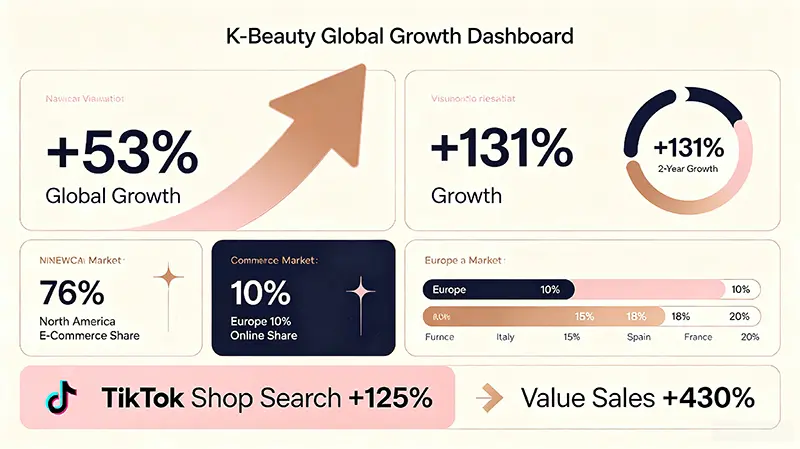
NIQ's report indicates that K-Beauty's growth is not an isolated boom in a single market but a multi-faceted "global penetration".
-
Deep Penetration in Western Markets: In Europe, K-Beauty value sales rose 58% year-over-year. Korean brands now account for approximately 10% of European online skincare sales, rising to 15–20% in leading markets including Italy, Spain, and France. In North America, e-commerce accounts for a staggering 76% of K-Beauty sales.
-
Explosive Growth in Emerging Markets: In Latin America, Brazil and Mexico delivered 135% value growth. In the Middle East, K-Beauty e-commerce grew 76%.
-
Social Commerce as the "X-Factor": If products are the bullet, social commerce is the gun. According to TikTok Shop data, searches for K-Beauty on the platform in the UK increased by 125% in 2025. Even more striking, across the UK, US, Spain, and Germany, value sales for K-Beauty brands on TikTok Shop rose by a massive 430% year-over-year.
What does this mean? In the past, the narrative of high-end beauty was controlled by headquarters in Paris or New York. Today, a new ingredient or formulation born in Seoul can go viral globally in just weeks, amplified by social media and closed-loop social commerce. Regional innovation is now scaling globally at unprecedented speed.
II. Ingredients & Experience: Beyond Speed, the Real Game-Changer
K-Beauty's victory is not solely about channels and marketing. In an era of increasingly savvy consumers, ingredient transparency and superior sensory experience are its true moats.
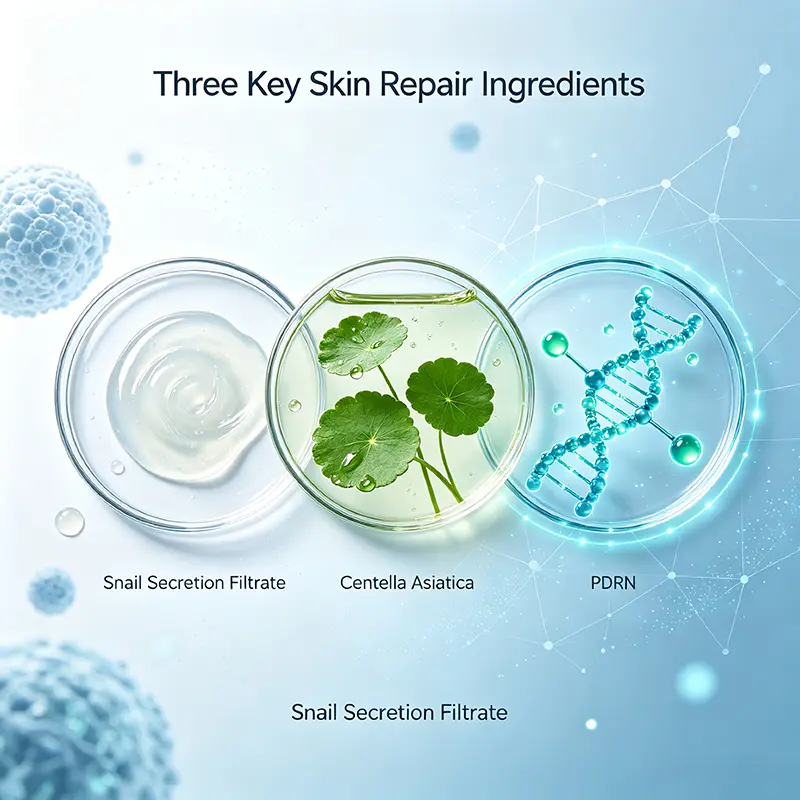
NIQ's analysis points out that product formats like sheet masks, acne patches, essences, and ampoules have transitioned from niche trends to daily essentials worldwide. Crucially, ingredient-led innovations such as snail mucin, centella asiatica (Cica), and PDRN have successfully crossed cultural and professional barriers, expanding from expert circles into mainstream demand.
Meanwhile, Mintel's "2026 Global Beauty & Personal Care Trends" highlights a deeper transformation. Consumers are moving beyond fear-driven "anti-aging" concepts toward "Metabolic Beauty" and "Skin Longevity". They expect products not only to deliver efficacy but also emotional value, and even to diagnose skin health through biomarker testing.
III. The Giants Awaken: When "Brand Stories" Meet "Value Channels"
Facing the onslaught of K-Beauty and new efficacy-driven players, global beauty giants are undergoing a painful transformation.
The beauty "layoff wave" affected over 14,000 people globally in the first half of 2026. Estée Lauder raised its net裁员 target from 7,000 to 10,000, accounting for approximately 17.5% of its global workforce. Behind these layoffs lies the failure of traditional "brand storytelling" and "duty-free channel dividends." In North America, beauty spending among consumers earning under $50,000 has stagnated, while value-focused retailers like Amazon and Walmart are gaining market share.
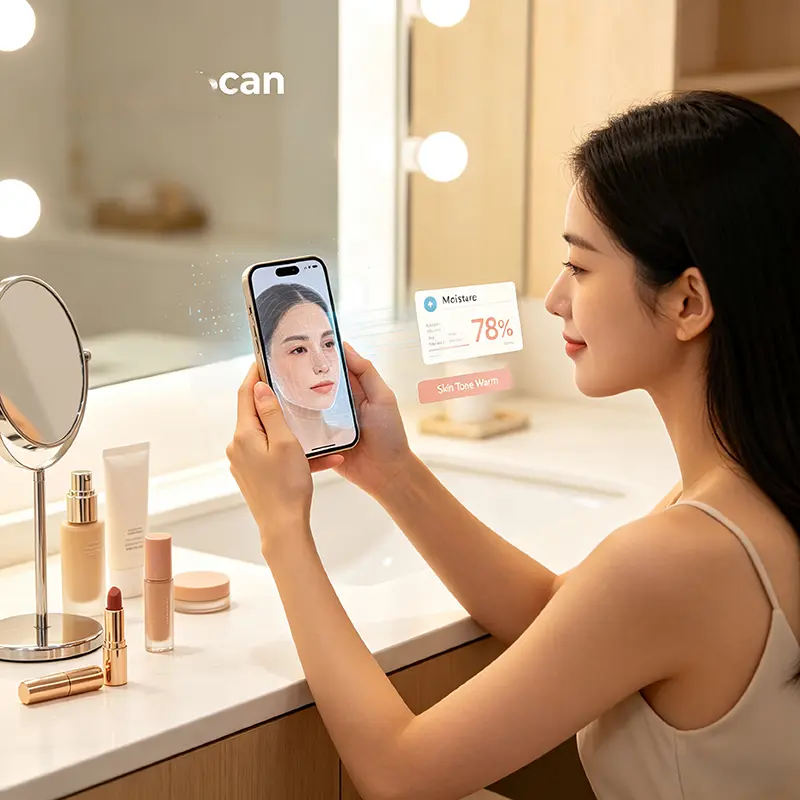
To counter sluggish growth, the giants are betting heavily on AI. L'Oréal is leveraging AI to analyze active molecules in skincare, boosting new product launch efficiency by four times, and successfully "cross-breeding" skincare molecules into haircare products. However, AI adoption comes with growing pains. Most current AI try-on models are trained primarily on Western datasets, failing to accurately match Asian skin tones, and also face data compliance challenges.
Returning to our opening question: This is both a victory for the Korean Wave and a prelude to the rewriting of global beauty rules. When consumers no longer blindly pay for brand光环, when AI compresses R&D cycles from "years" to "months," when a niche Korean ingredient can go viral globally on TikTok within days—the future of beauty undeniably belongs to those who are faster, more transparent, and better at delivering both scientific and emotional value.