
PPWR 2026 Full Enforcement: A Packaging Compliance Guide for Skincare Brands Selling to the EU
What PPWR Is: The Biggest Packaging Rule Rebuild in 30 Years
PPWR is a mandatory regulation driving the EU's circular economy: published in the Official Journal on January 22, 2025, in force since February 11, 2025, with Commission implementation guidelines issued on March 30, 2026, and core obligations fully applicable since August 12, 2026. Versus the old directive, it brings three structural changes: first, legal force — from "directive" to "regulation," uniformly enforced across all 27 member states with no room for divergent national interpretation; second, expanded responsibility — e-commerce platforms are pulled into the compliance network and must verify EPR registration numbers, with Amazon already enforcing this across nine marketplaces; third, quantified targets — packaging reduction, recyclability and recycled content all carry hard thresholds and deadlines. For skincare, everything from serum bottles, pumps and mask pouches to cartons and shipping boxes falls inside the regulatory scope — no exceptions.
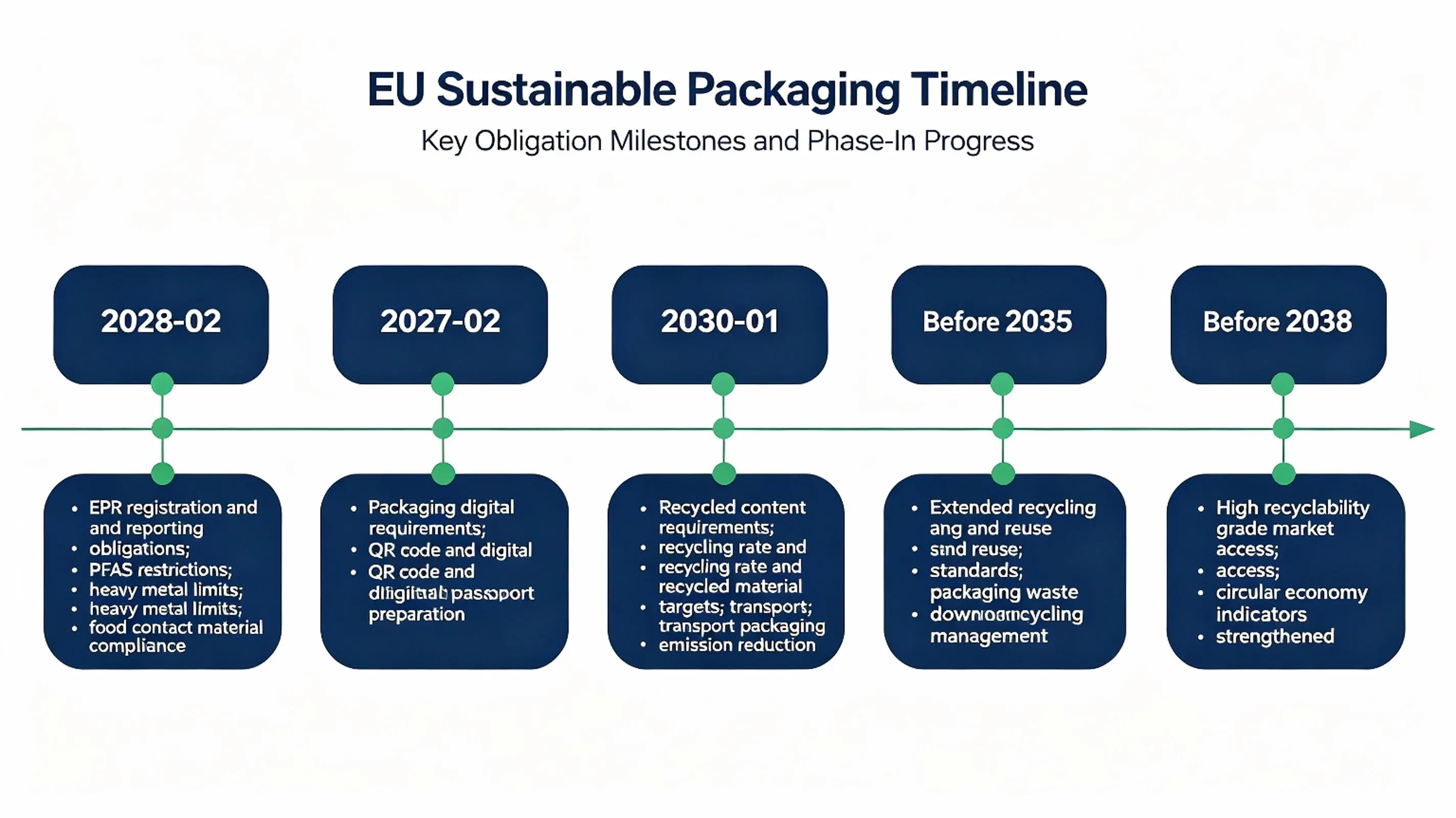
Timeline: Three Phases, None Missable
PPWR rolls out in phases; these dates directly define your sourcing and packaging decision windows:
| Time | Key Obligation |
|---|---|
| 2026-08-12 | EPR verification enforced; PFAS restrictions; total heavy metals ≤100 mg/kg (food-contact PFAS: single ≤25 ppb, total ≤250 ppb, total fluorine ≤50 ppm) |
| 2027-02 | Digital identifiers (QR codes) on packaging |
| 2028-01 | Unified material composition labels; mandatory digital marking for reusable packaging |
| 2030-01 | Recyclability ≥70%, recycled content thresholds, void space ≤50% for e-commerce/transport packaging |
| 2035 起 | 10% Full "large-scale recycling" standard; per-capita packaging waste down a further 10% |
| 2038 起 | Only A/B high-recyclability grades may enter the market |
Three reminders: EPR follows the "territorial principle" — one number per country, register wherever you sell, no "one certificate for all of Europe"; existing registrations such as Germany's LUCID remain valid but must stay active with timely declarations; registration lead times in some countries run 3–6 months — starting now is already a race against time.
Four Direct Impacts on Skincare Exporters
First, EPR registration costs: brands must complete "register—declare—pay" in every country of sale; with many SKUs and multi-marketplace operations, compliance costs rise materially. Second, packaging design must be rebuilt: composite formats such as pump bottles (plastic + metal spring + glass) are first in line under the 2030 ≥70% recyclability red line — mono-material design and easy-disassembly structures become the new standard for skincare packaging. Third, substance controls tighten: screening inks, adhesives and coatings for heavy metals and PFAS becomes mandatory, and suppliers must provide test reports and PFAS-free declarations. Fourth, e-commerce void space and labelling: skincare gift boxes and shipping cartons are typical "over-packaging" cases — from 2030 void space must not exceed 50%, and from 2028 unified material labels apply. None of this is "just a new box"; it is a full redesign of the packaging system.
Industry Pulse: China's Packaging Testing Capability Gains EU Backing
Two weeks into PPWR's full application, a supply-chain-defining signal arrived: on August 26, 2026, Henkel's Shanghai Packaging Recyclab gained accreditation from Germany's cyclos-HTP Institute (CHI), enabling it to issue EU-recognised paper packaging recyclability test reports for customers across Asia-Pacific. "EU-standard packaging testing completed in China" has moved from concept to reality — no more shipping samples to Europe, dramatically shorter supply-chain validation cycles. In parallel, French brand Firn chose a refillable solution for its SPF50+ sun stick, showing reusable design moving from concept to shelf. For buyers, both signals point one way: compliance capability and recyclable innovation are becoming the next core competitiveness of Chinese contract manufacturers.
Buyer Action List: Passing the Gate Together with Your Factory
PPWR cannot be handled by the brand alone — packaging compliance is decided at the design stage. From our sampling and delivery experience, buyers should complete five steps with their OEM factory immediately: ① compliance inventory — ask the factory for heavy-metal test reports, material composition sheets and recyclability assessments of current packaging; ② mono-material conversion — replace composite pumps and multi-layer pouches with recyclable solutions, evaluating cost and MOQ changes in parallel; ③ document package — declaration of conformity (DoC), technical files and PFAS-free declarations delivered with samples and bulk; ④ labelling and digital marking planning — reserve space for the 2028 unified labels and 2027 digital identifiers; ⑤ reconfirm trade terms — MOQ, FOB/CIF quotations, lead times (sampling and bulk) and sample policy, all re-baselined on the new packaging. All of these are defined and negotiable at FKY: packaging customization, structural optimization and compliance document support, backed by FDA registration, GMPC certification and ISO auditing. Bring your EU market plan and let's talk.
Conclusion
Like MoCRA two months ago, PPWR is the other half of 2026's "twin regulatory squeeze" — the US governs ingredients and safety, the EU governs packaging and circularity. For export-oriented skincare brands, these two lines are redrawing supply-chain selection criteria: factories that can rebuild packaging within the compliance framework and produce a complete evidence chain will become the preferred suppliers of the next decade.
Your EU market plan deserves to start with a packaging compliance assessment. FKY (Zhuhai Fukangyuan Biotechnology Co., Ltd.) provides end-to-end skincare OEM/ODM services under FDA, GMPC and ISO-certified systems: packaging customization with compliance documentation, MOQ policy, FOB quotations, sampling lead times and sample policy — all available on request. Leave us yourrequirements and we will reply within 24 hours with a tailored proposal.