
Salmon DNA Skincare Benefits: Sourcing and Claims Guide for Brands
Salmon DNA skincare benefits are usually argued in the wrong room. The consumer-facing version of that conversation is about regeneration, glow and K-beauty provenance. The version that decides whether your launch makes money is a sourcing file: which species the DNA was extracted from, which tissue, how it was purified and depolymerised, what molecular weight band you are actually buying, what documentation travels with the drum, and which sentence you are lawfully allowed to print on the pack.
That gap is the subject of this guide. It is written for the brand owner or product developer who has to approve the purchase order, and it deliberately skips the mechanism story — the biology of nucleotide signalling is well covered elsewhere and will not help you write a better brief. What will help is knowing that the raw material is a by-product of fish processing, that its supply rhythm is set by fillet demand rather than by your demand, that its price is driven by a specification most buyers never ask for, and that the regulatory question it raises most often has nothing to do with DNA at all.
By the end you will have a specification list to demand, a five-document pack to request before any sample is paid for, an honest read of what the demand data currently says about salmon-derived actives, and a claim list you can take to whoever signs off your packaging copy.
Salmon DNA Skincare Benefits: What a Brand Owner Is Actually Buying
The commercial object you are buying is not "salmon essence". It is a polydeoxyribonucleotide — a DNA fragment prepared from salmon tissue, purified, depolymerised to a target size, and supplied either as a liquid at a stated parts-per-million assay or as a powder. Three things define it commercially, and all three belong in your brief:
- A molecular weight band. In the pharmacological literature, PDRN is described as running roughly from 50 to 1,500 kDa, with a main distribution of 80–200 kDa and a peak near 132 kDa, purity above 95%, and around 50% double-stranded content (Squadrito et al., Frontiers in Pharmacology 2017;8:224). Reviews of the topical and aesthetic literature converge on a band rather than a maximum: mid-range molecular weight material outperformed both lower and higher molecular weight fractions in wound-healing models (narrative reviews in Journal of Cosmetic and Aesthetic Science and Cureus, 2026). That finding runs directly against the instinct to buy "the smallest fraction available". - A stated assay level. A liquid at 5,000 ppm and a liquid at 500 ppm are different products at different prices, and only one of them lets you hit a meaningful in-formula concentration at a workable use level. Without an assay figure you cannot compute unit cost at all. - A document pack. Certificates, specification sheets and declarations — covered in H2 四. In this category the paperwork is not administrative overhead; it is the thing that lets a distributor or a retail compliance team clear you.
Now the uncomfortable part. The strongest clinical evidence for PDRN is injectable: the pharmacological literature describes it as a registered injectable drug whose activity runs through adenosine receptor signalling. Topical delivery is a different proposition, and the evidence base for it is thinner. That does not make a topical product worthless — it makes the claim the risk. If your copy translates an injectable clinical result into a pack sentence, you have not made a stronger product; you have made a product that a regulator can describe differently.
Buy the specification, not the story: the only number in this category that changes what your formula can do is the molecular weight band.
Where Salmon DNA Comes From — Milt, Species and Supply Concentration
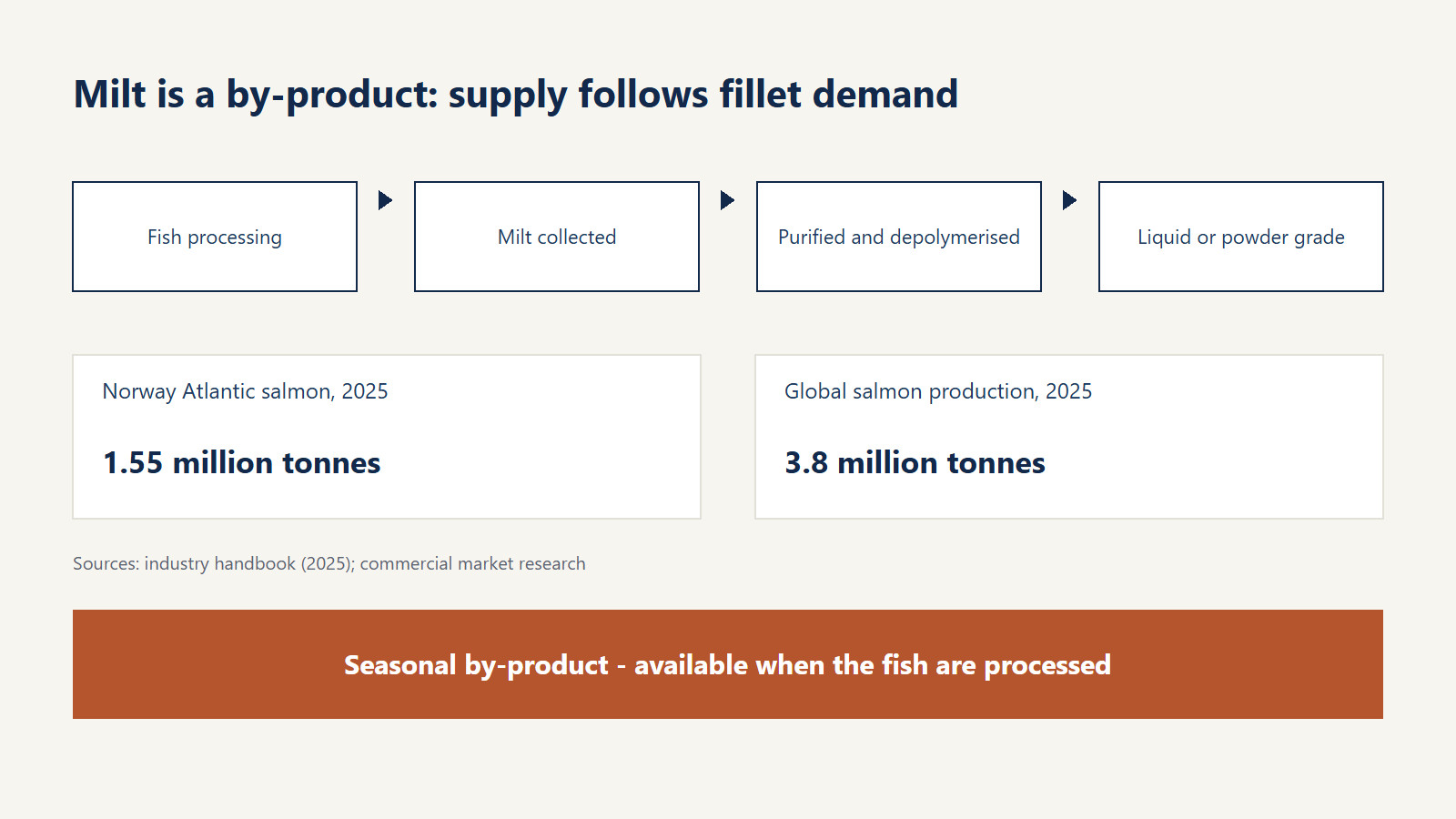
Most buyers assume salmon DNA is grown, harvested or commissioned for the cosmetics trade. It is not. The raw material is milt — the reproductive tissue of male salmon — which is a by-product of fish processing. Supplier documentation in ingredient databases describes the material plainly as a biologically active ingredient extracted from salmon milt, purified, depolymerised and neutralised, and commercial grades are routinely listed as a liquid at a stated ppm (ULProspector ingredient listing, PDRN 5000PPM Liquid).
Once you internalise that the raw material is a by-product, the supply structure stops being mysterious and starts being predictable:
- It follows fillet demand, not cosmetics demand. Milt volume scales with how many fish are processed for food, so a soft year for salmon fillets is a soft year for milt availability — regardless of how well your SKU is selling. - It is geographically concentrated. Industry figures put roughly 80% of the world's salmon harvest as farmed, with most farmed salmon coming from Norway, Chile, Scotland and Canada (Mowi, Salmon Farming Industry Handbook 2025 — an industry publication). Norway, the largest producer, harvested 1.55 million tonnes of Atlantic salmon in 2025 with an export value above NOK 130 billion (Hatch Blue trade analysis, August 2026). Chile is the second-largest producer of farmed salmon, though its volumes stagnated between 2019 and 2024 (FAIRR, May 2026). - The headline growth numbers are modest. One commercial research house puts global salmon production at 3.8 million tonnes in 2025, rising to a projected 4.9 million tonnes by 2034 (IMARC Group). That is a slow-moving supply base — treat any supplier claim of rapidly expanding milt capacity with the same scepticism you would apply to a rapidly expanding harvest. - Species is a specification, not a footnote. Atlantic salmon and Pacific species are different raw materials with different supply chains, and supplier literature distinguishes between them. If your pack or your customer's brief names a species or a provenance — "Pacific", "wild-caught", "Atlantic" — that naming has to be substantiated, not inherited from a supplier's marketing page.
The practical consequence is a procurement one. When a supplier tells you lead time and availability are stable, the useful follow-up question is not "how stable" but "which species, which processing region, and which months of the year". A supply chain anchored to one species and one processing region is a single point of failure dressed as a quotation.
Milt is a by-product: its availability tracks fillet demand, not your forecast — so pin the species, the processing region and the season window.
The Specification: What "Salmon DNA" Has to Mean in Writing
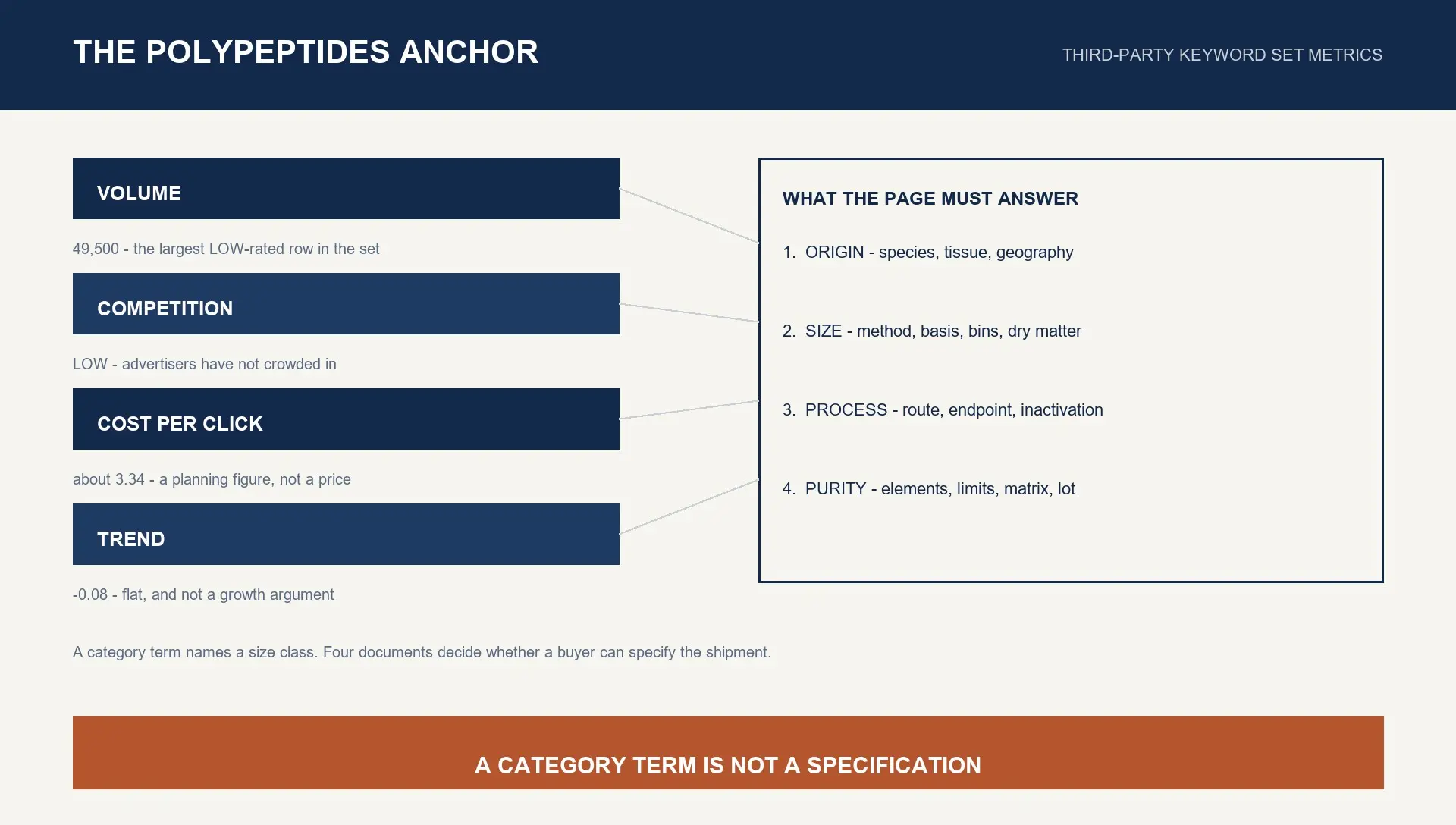
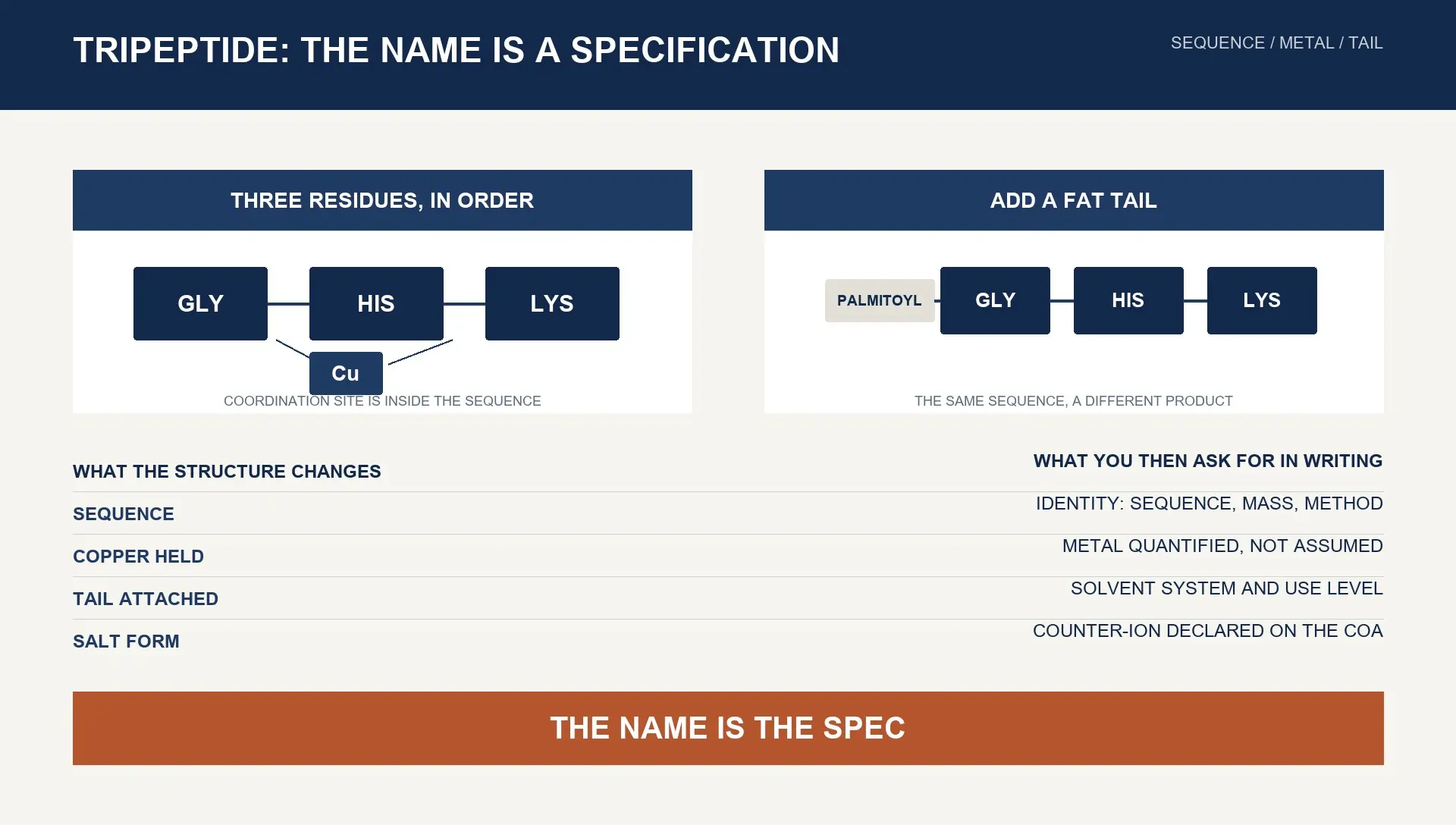
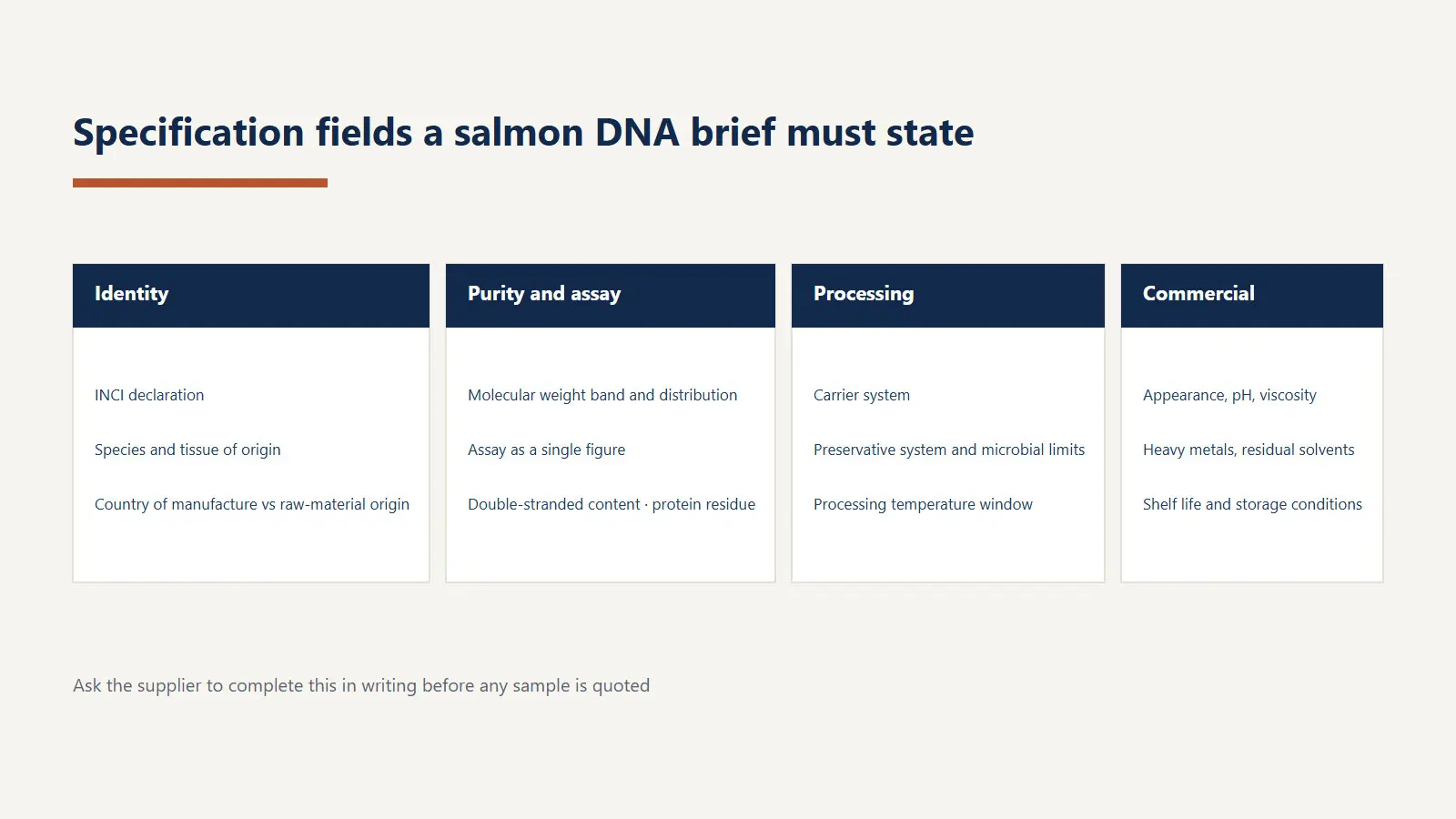
"Salmon DNA" is a category name, not a specification. Two drums carrying the same INCI name can differ by an order of magnitude in the qualities that matter, and unless the differences are written down, price comparison between suppliers is meaningless. Below is the field list worth demanding, and the reason each field exists.
| Specification field | What suppliers often write | Why it has to be written | Weak answer looks like |
|---|---|---|---|
| INCI declaration | A trade name only | Your ingredient list and your customer's compliance file are built from this | "Same as PDRN" |
| Species and tissue of origin | "Salmon" | Names on pack and in customer briefs need a factual basis | Silence |
| Molecular weight band and distribution | A single average figure | Distribution, not average, determines behaviour — the literature band is broad | "Low molecular weight" |
| Assay / concentration | A range across the range | You cannot compute unit cost or use level without a single figure | "Standard concentration" |
| Double-stranded content | Usually omitted | A purity indicator used to characterise the material | Not applicable |
| Protein residue | Usually omitted | Drives allergen diligence and the substantiation file | "Purified" |
| Carrier system | "Water" | Determines preservative strategy and compatibility | Unstated |
| Preservative system and microbial limits | Partial | A water-based biological raw material needs a documented challenge-test posture | CoA only |
| Processing temperature window | Rarely given | DNA fragments are heat-sensitive; the addition point matters | "Follow standard practice" |
| Appearance, pH, viscosity | Partial | Batch-to-batch consistency check at goods-in | Colour photo |
| Heavy metals and residual solvents | On request | Standard incoming-materials gate | "Meets regulation" |
| Shelf life and storage | Partial | Determines whether you can buy ahead of a seasonal window | 12 months, no conditions |
| Country of manufacture vs origin of raw material | Frequently conflated | These are two different claims and two different documents | One country named |
Two fields in that table do the heaviest lifting. The molecular weight band and its distribution is the variable that separates a functional ingredient from a marketing one: it is the difference between a material that has a literature-backed optimum and a material that is simply "DNA". And protein residue is the field nobody asks for until a distributor's compliance team asks them, at which point the answer has to come from the supplier rather than from your marketing agency.
A useful discipline is to send the table itself to the supplier and ask for it completed in writing before any sample is quoted. Suppliers who can complete it are usually selling a material they manufacture or control; suppliers who respond with a brochure are usually reselling.
"Contains salmon DNA" is a marketing line; a molecular weight band with a distribution is a specification — and only the second one is negotiable.
The Document Set That Gates a Purchase
Five documents decide whether a distributor, a retailer or a contract manufacturer can clear your ingredient. Treat them as a gate, not as paperwork that arrives with the drum.
1. Certificate of Analysis, per batch. Not per product line, not per year — per batch, tied to the drum you receive. It should carry the assay, the molecular weight band, microbial results and the batch number that matches the label. This is also the document you will lean on when a goods-in sample disagrees with what you were promised.
2. Safety Data Sheet. Standard hazard communication: handling, storage, transport classification. Nothing exotic, but its absence is a signal about how seriously the supplier documents its own operations.
3. Specification sheet (technical data sheet). The table in H2 三, completed. This is the document that makes price comparable between suppliers.
4. GMP certificate, plus United States registration status. For the cosmetic manufacturing step, ISO 22716 is the recognised GMP reference; for the United States, MoCRA made cosmetic facility registration and product listing mandatory (with certain small-business exemptions) and requires FDA to establish cosmetic GMP requirements, with a statutory deadline of 29 December 2025 (FDA). A supplier that has not resolved its own registration and GMP posture cannot carry yours.
5. Species, origin and allergen declaration. This is the document most buyers omit, and the one that causes the most trouble later.
Here is why. Europe's cosmetic allergen declaration regime under Regulation (EC) 1223/2009 covers fragrance allergens listed in Annex III: they must be individually declared when they exceed 0.001% in leave-on products and 0.01% in rinse-off products, and from July 2026 the list expands by 56 additional fragrance allergens (European Commission, fragrance allergens labelling; Obelis regulatory briefing, April 2026). Fish-derived protein is not a fragrance allergen and is not on that list. So a salmon-derived active will not trigger an automatic allergen declaration under the EU cosmetic regime — not because it is exempt from scrutiny, but because the label regime was not designed around it.
That has a concrete consequence for buyers. If your brand makes any consumer-facing promise about what is in or absent from the product — "fish-free", "vegan", "no animal-derived ingredients" — or if a distributor simply asks the question, there is no label disclosure to fall back on. The answer has to come from a written supplier statement on protein residue. Put it in the purchase order. And read your own label claims against it before the artwork is signed off, because a "vegan" or "plant-based" claim sits badly next to an ingredient list containing a fish-tissue derivative.
| Document | Issued by | What it proves | What it does not prove |
|---|---|---|---|
| Certificate of Analysis (per batch) | Ingredient supplier | That this batch meets the stated spec | That the spec is adequate for your format |
| Safety Data Sheet | Ingredient supplier | Handling and hazard information | Purity, performance or origin |
| Specification sheet / TDS | Ingredient supplier | The commercial specification | That production is repeatable |
| GMP certificate (ISO 22716) + MoCRA registration | Manufacturer | Manufacturing and registration posture | That your product is compliant |
| Species / origin / allergen declaration | Ingredient supplier | A factual basis for naming and for allergen answers | Anything about efficacy |
Europe's allergen regime declares fragrance, not fish — so allergen diligence on a salmon-derived active has to be written into the contract, not expected from the label.
Salmon DNA Skincare Products: Formats, Use Levels and Shelf Behaviour
Formats for salmon-derived actives are not a free choice — they follow the physical chemistry of a hydrophilic polyanion. DNA fragments dissolve readily in water, which is why the category clusters in water-phase formats: serums and ampoules, hydrogel masks, the essence of a sheet mask, mists, and the aqueous phase of a gel-cream. If you are looking for the format-level view of the mask category, sheet masks from China for global buyers sets out how essence load and substrate choice interact — the same logic applies here, because in a sheet mask the active is only as good as the essence it rides in.
Three engineering questions decide whether the material survives to the point of use, and all three belong in the sample brief rather than in the post-mortem.
Addition point and temperature. DNA fragments are heat-sensitive, and the hot process used to build an emulsion is the step most likely to degrade the active before the product has even been filled. The practical requirement is a documented processing temperature window and an addition point defined by the supplier — normally in the cool-down phase. If a supplier cannot state a temperature window, you are being asked to guess with a batch you have already paid for.
Compatibility with cationic systems. A DNA fragment is a polyanion. Formulators routinely flag interaction risk between polyanions and cationic materials — cationic actives, cationic conditioning agents and certain cationic preservatives — because opposite charges associate and can produce haze, viscosity drift or precipitation. The right move is not to assume it is fine or to assume it is fatal, but to ask for a compatibility statement covering your intended base. Compatibility is a documented answer, not a laboratory intuition.
Colour and odour contribution. A marine-derived raw material can contribute perceptible odour, and odour is one of the most common complaint drivers in consumer review sets (see H2 七). If your format is a leave-on serum with a light fragrance load, odour masking becomes a real formulation cost. If your format is a rinse-off mask, it matters much less. This is a format decision disguised as a fragrance decision.
A fourth question is commercial rather than technical: what level is meaningful? Use level depends on the assay of the grade you buy. Two suppliers can both quote a "PDRN serum concentrate" at the same price per kilogram while differing by an order of magnitude in deliverable active per unit — which is exactly why H2 三 insists on a single assay figure rather than a range.
Water phase first, cool-down addition always — the hot process is where a salmon-derived active degrades before it ever reaches the customer.
Salmon DNA Skincare Side Effects: The Risk Register a Buyer Carries
Consumers ask what the side effects are. A brand owner has to ask a different question: which risks am I carrying, and which of them can be transferred to a contract? The two questions have almost nothing in common.
| Risk | How it shows up commercially | Buyer-side action that actually transfers risk |
|---|---|---|
| Evidence risk | A pack claim that the topical evidence cannot support | Match claim language to topical evidence, not to injectable trials |
| Allergen and protein residue | Consumer complaint, distributor enquiry, or a contradiction with your own "free-from" claims | Written protein-residue statement in the purchase order |
| Microbial | Preservative failure in a water-based biological raw material | Preservative efficacy testing per batch; supplier microbial limits on the CoA |
| Specification substitution | Material arrives at a different molecular weight band or assay than contracted | Per-batch CoA tied to the drum label, plus a retained sample |
| Supply interruption | Seasonal or region-specific milt shortage mid-campaign | Named species and region in the contract; a qualified second source |
| Regulatory identity | The same material being a drug ingredient in injectable form and a cosmetic ingredient in topical form | Confirm the material's status for your route of administration and market |
| Claim substantiation | A claim you cannot evidence if challenged | An evidence file assembled before artwork, not after |
| Sourcing-ethics wording | "Wild-caught" or similar provenance language without documentation | Only use provenance language the supplier will sign |
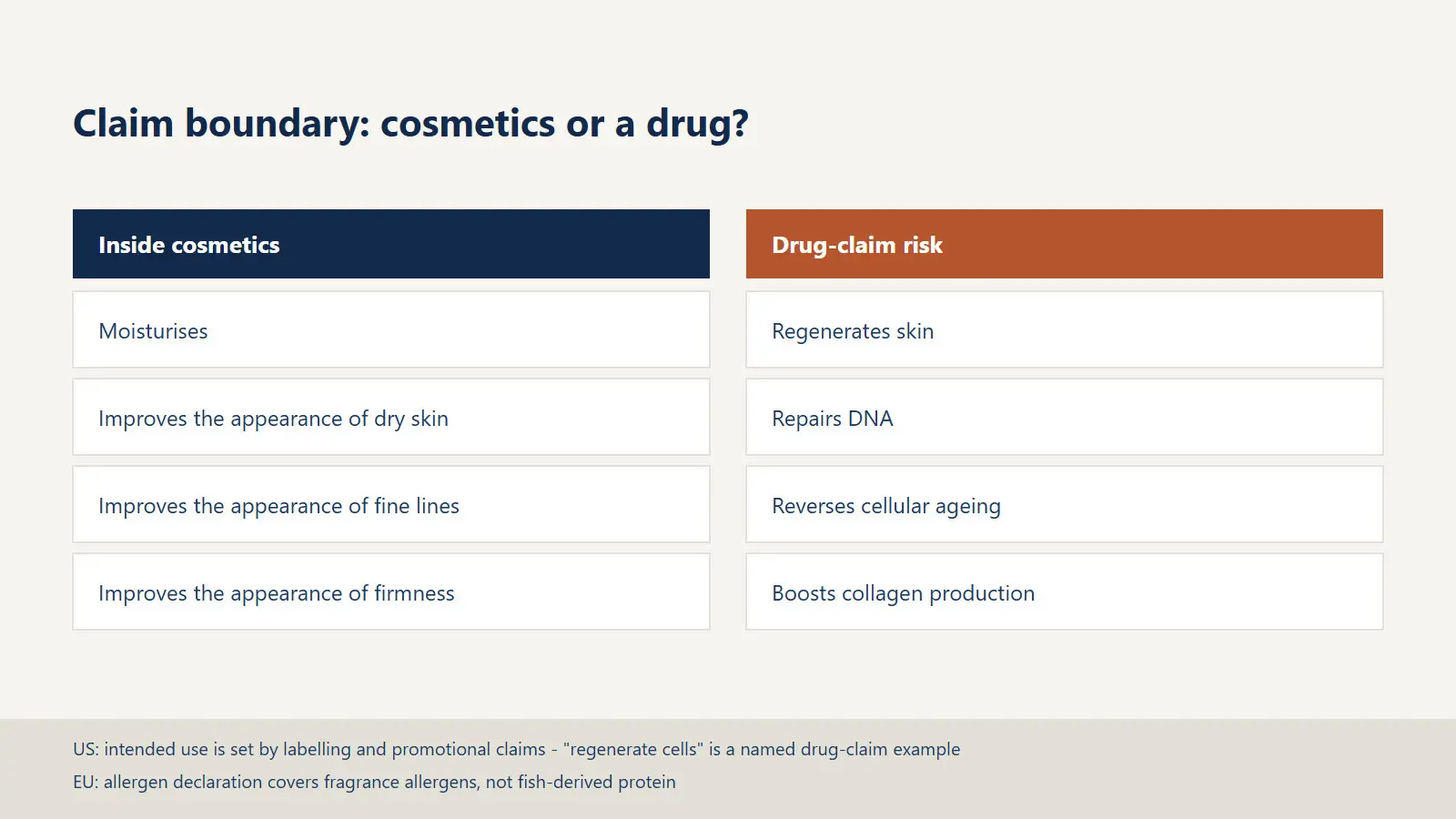
The evidence risk deserves emphasis because it is the one buyers systematically underprice. Under United States law, whether a product is a cosmetic or a drug is decided by its intended use, which FDA states may be established by claims on labelling, in advertising, online or in other promotional material — and FDA gives explicit examples of claims that push a cosmetic into drug territory, including claims to regenerate cells. FDA also states that the FD&C Act "does not recognize any such category as cosmeceuticals". A topical salmon-derived product can be sold lawfully and can be positioned well; it cannot be positioned as cell regeneration without changing what it legally is.
The microbial and specification substitution risks are the two that most often surprise buyers, precisely because neither is visible on a marketing page. A water-based biological raw material needs a preservative system you have tested, not one you inherited. And a material sold under a category name can arrive at a different molecular weight band without anyone intending fraud — which is why the CoA, the drum label and a retained sample are the cheapest risk controls in the entire file.
One risk that is overstated: topical sensitisation from a purified DNA fraction is not the headline risk in this category, and treating it as such distorts product decisions. The realistic product-defining risk is upstream of the consumer: a specification you did not write down, and a claim you cannot evidence.
The risk that ends a launch is not irritation — it is a claim your evidence cannot carry and a specification you never wrote down.
Reading Salmon DNA Skincare Reviews as Procurement Intelligence
Consumer reviews in this category are a defect log with a marketing veneer. Read as complaint clusters rather than star ratings, they tell you what the incumbent products got wrong — which is the same information a supplier's specification sheet will not give you.
- The "no effect" cluster. Nobody can see a DNA fragment work. But when a meaningful share of reviews says nothing happened, the likely causes are structural rather than perceptual: a molecular weight band too large to be relevant, or a use level that looks impressive on the front of the pack and is negligible in the fill. This cluster is a specification failure, and it is the one an incoming brand can most easily avoid by insisting on an assay figure. - The odour cluster. Marine-derived raw material can carry perceptible odour. When reviews complain about smell, the cause is usually the grade and the masking budget, not the base formula. It also tells you the price point the incumbent was building to. - The texture cluster. Pilling, stickiness and "feels heavy" complaints point at the carrier and thickener system, not at the active — but they are the reason a technically correct formula still fails at retail. - The price-anchoring cluster. Reviews reveal what your target market will pay for this category today. That number should constrain your cost stack more than the market-size figures do. - The comparison cluster. Where reviewers compare a salmon-derived product with the adjacent next-generation actives, you are looking at competitive territory, not a defect. If your sourcing brief is being shaped by that comparison, the exosome serum manufacturer selection guide is a useful parallel — the sourcing questions there are structurally the same ones you should be asking here.
The honest reading of demand, however, is not optional. Below is the platform data the sourcing decision should be checked against. Note the direction of the salmon-specific rows:
| Parent search term (Amazon marketplace) | Weekly volume, US | 4-week change | Read |
|---|---|---|---|
| salmon dna mask | 134 | −27.1% | Cooling |
| pdrn mask | 2,006 | −18.9% | Bounced, but weaker over four weeks |
| pdrn hydrogel mask | 82 | −44.8% | Low, and estimated at the lower bound |
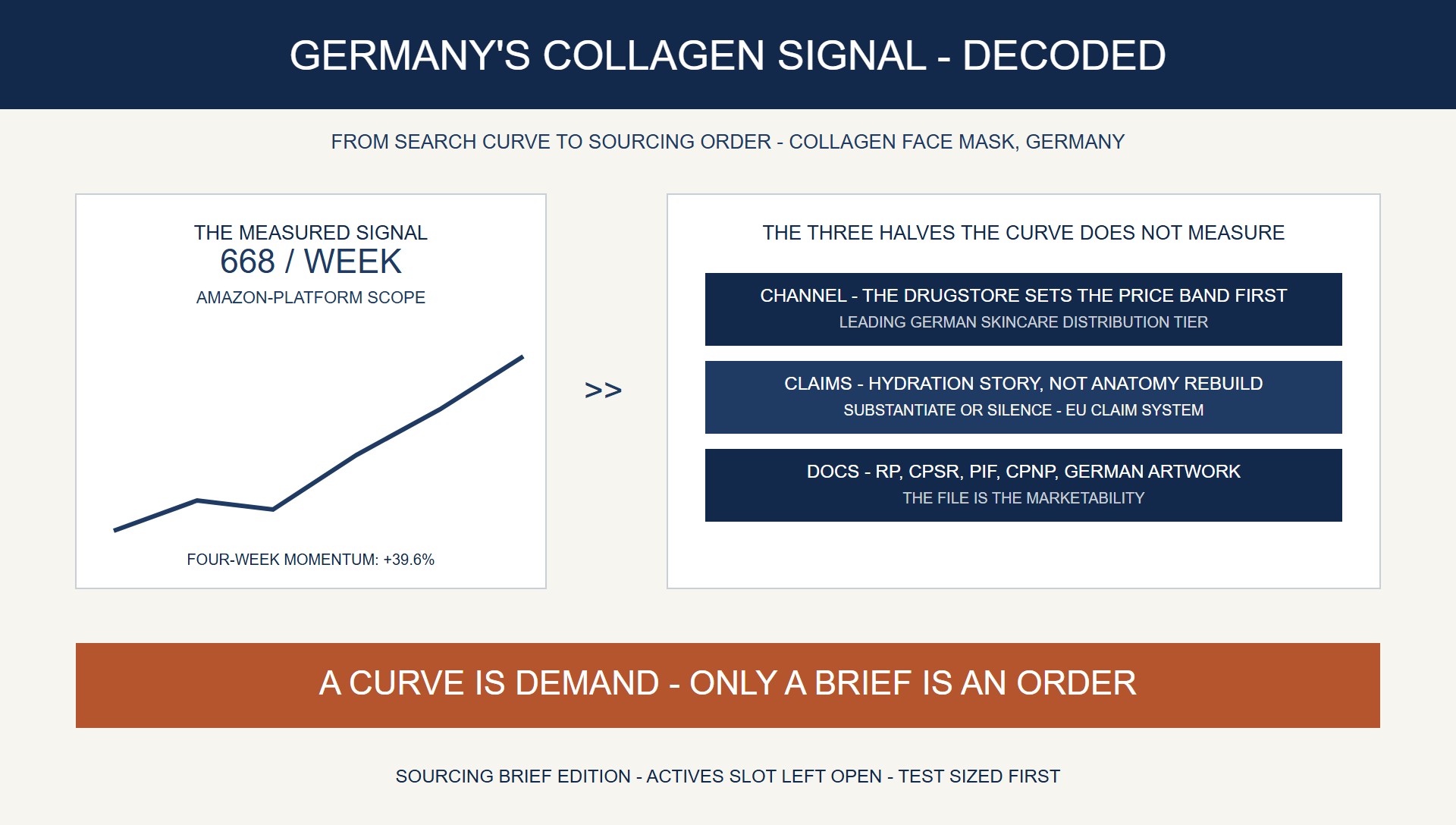
| collagen face mask | 19,066 | +1.6% | Large base, softening |
| hand mask | 6,192 | +16.9% | Flat to firm |
| vitamin c serum | 147,873 | +39.4% | Strengthening |
Two things must be said about that table, because both are easy to get wrong. First, these are marketplace search volumes, not Google search volumes — quoting them as Google data would be a straightforward error. Second, and more importantly for your decision: the salmon-specific terms are cooling, not growing. A brand plan that assumes rising organic demand for salmon-derived actives is running against the data. The correct conclusion is not "do not launch" — the category still has real search volume and a differentiated story — but do not build the plan on a growth assumption, and do not commit to a large first run or a long inventory position on the strength of a trend that is currently pointing the other way.
Read reviews as a defect log and read demand honestly: the salmon-specific search terms are cooling, so plan the first run accordingly.
Claims You Can Make — and the Sentence That Turns It Into a Drug
This is where a technically excellent product gets stopped, and the rule is counter-intuitive: the ingredient does not decide whether you are selling a cosmetic or a drug. The sentence does.
Under United States law, FDA determines intended use, and states that it may be established by claims on labelling, in advertising, online or in other promotional material. FDA's own examples of claims that push a cosmetic across the line into drug territory include claims that a product will restore hair growth, reduce cellulite, regenerate cells, or affect melanin production — and FDA states that the FD&C Act "does not recognize any such category as cosmeceuticals". There is no middle category to sit in.
Applied to salmon-derived DNA, that produces a clear map:
| What you want to say | Verdict | Safer wording that keeps you inside cosmetics |
|---|---|---|
| "Regenerates skin" | Drug-claim risk — "regenerate cells" is a named FDA example | "Helps improve the appearance of skin texture" |
| "Repairs DNA" | High risk — implies a physiological mechanism | "Helps skin feel moisturised and look more rested" |
| "Reverses cellular ageing" | High risk — structure/function territory | "Improves the appearance of fine lines" |
| "Boosts collagen production" | High risk — structure/function | "Improves the appearance of firmness" |
| "Contains salmon DNA at 5,000 ppm" | Acceptable if substantiated by your CoA | Keep the assay figure backed by the batch certificate |
| "Wild-caught / sustainable / eco" | Substantiation required under ECGT from 27 Sept 2026 | Omit unless you hold written supplier evidence |
| "Moisturises and helps skin feel smoother" | Within cosmetic territory | Use as written |
Two operational rules follow, and both save money when respected.
Write the claims before the formula. Claims are a specification item on the brief you send to your supplier, not a marketing task that happens after the formula is locked. Retrofitting claim language onto a finished formula means either reformulating or weakening the claim — both cost more than getting the wording approved first.
Assemble the evidence file before artwork. Under EU Regulation (EC) 1223/2009, cosmetic claims must be supported by adequate and verifiable evidence, and the green-claim framework under ECGT applies from 27 September 2026. A salmon-derived ingredient invites provenance language — species, origin, "wild-caught", "sustainable" — and every one of those words is a substantiation obligation. If the supplier will not put it in writing, it does not go on the pack.
For the wider evidence architecture around efficacy claims, including how dose and testing method interact, this 2026 efficacy skincare guide comparing PDRN, peptides, retinol and hyaluronic acid is a useful companion, because the claim you can make is limited by the test you can afford, not by the ingredient you chose.
Write the claim before the formula — the sentence on the pack, not the ingredient in the drum, decides whether you are selling a cosmetic or an unapproved drug.
Cost Structure, MOQ and Lead Time
Five things drive the price of a salmon-derived active, and only one of them is usually negotiable:
1. Narrowness of the molecular weight band and the purity level. A material specified to a tight band with documented purity costs more than a broad "PDRN" grade, and is worth more. 2. Assay level. Two liquids with the same trade name can differ by an order of magnitude in deliverable active. 3. Grade of raw material. "Purified, depolymerised and neutralised" is a process description; the certificate is what tells you how far it went. 4. Encapsulation or carrier technology, where offered — an additional cost line with its own evidence requirements. 5. Depth of documentation. A supplier who can complete the H2 三 table, issue per-batch certificates and sign an allergen statement is supplying more than a drum. That is a legitimate reason for a price difference.
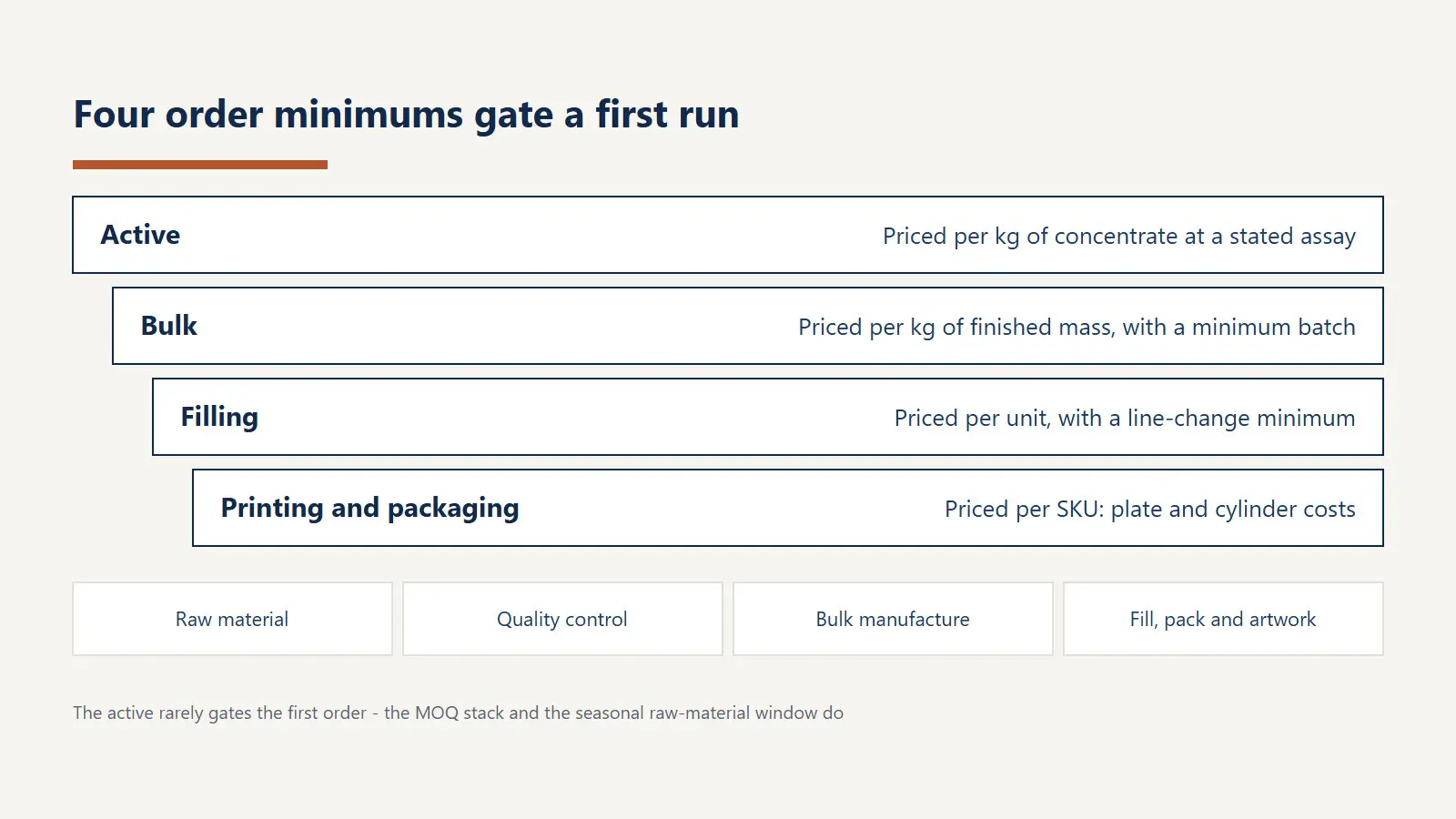
The cost that actually gates a first order, however, is rarely the active. It is the four-layer minimum order quantity stack — active, bulk, filling, and printing/packaging — and it is worth decomposing explicitly, as this low-MOQ skincare OEM guide for global buyers does for small runs generally.
| Cost layer | What it is priced on | Who controls it | Buyer's negotiating lever |
|---|---|---|---|
| Active | Per kg of concentrate at a stated assay | Ingredient supplier | Commit to an annual volume with call-off releases instead of one spot order |
| Bulk | Per kg of finished mass, at a minimum batch | Contract manufacturer | Match your fill weight to a standard batch divisor |
| Filling | Per unit, with a line-change minimum | Contract manufacturer | Accept a standard fill weight and a single pack format |
| Printing and packaging | Per SKU, driven by plate and cylinder costs | Packaging supplier | Share one print plate across shades or variants in the same range |
An illustrative arithmetic example — not a quotation. Suppose you buy a liquid grade at 5,000 ppm PDRN (that is, 0.5% active by weight, a commercial grade-level figure listed in ingredient databases) and you use that liquid at 2% in the finished formula. The finished concentration is 0.5% × 2% = 0.01%, or 100 ppm PDRN in the fill. If you then want 200 ppm in the fill, you either double the use level to 4% of the same liquid or buy a 10,000 ppm grade — two different commercial conversations with two different cost outcomes. The important point is that this arithmetic is only possible once the assay is a single number, which is why the specification table matters more than the price list.
Lead time has four components that are frequently conflated into one promise: raw material lead time (seasonal, because it derives from fish processing), quality control and certificate issuance, bulk manufacture, and fill-and-pack plus artwork. If a supplier quotes a single lead-time figure, ask which of the four it covers.
The active rarely gates your first order — the four-layer MOQ stack and the seasonal raw-material window do.
An Eleven-Point Procurement Checklist
Send this list to every supplier you are considering. The questions are deliberately written so that a brochure cannot answer them.
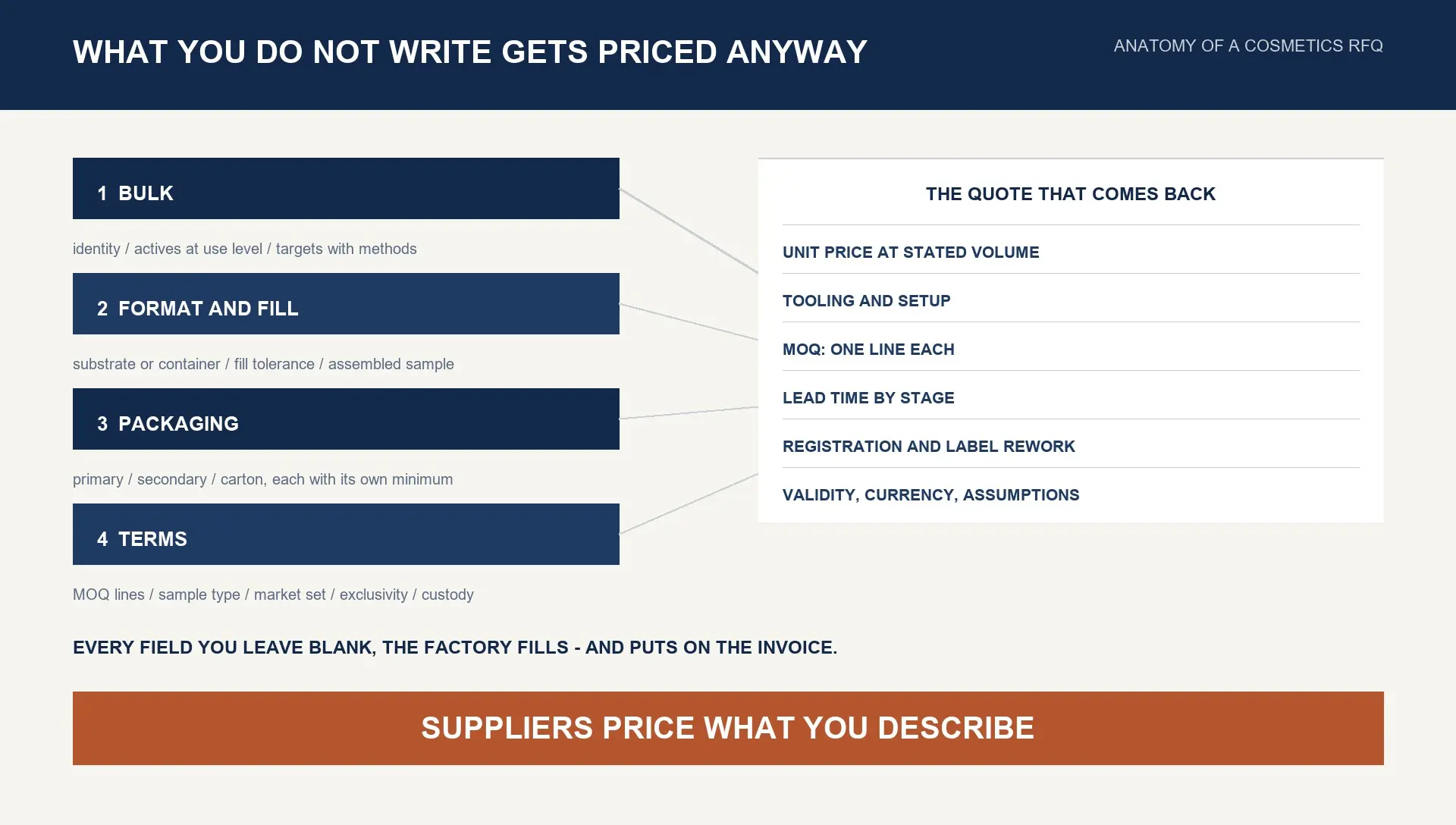
1. Molecular weight band and distribution, with the analytical method used to determine it. 2. Assay level as a single figure, plus how it is verified per batch. 3. Protein residue statement, written, signed, and specific to the batch. 4. Species and tissue of origin, and the processing region — stated as fact, not as marketing. 5. Per-batch Certificate of Analysis tied to the drum label, plus a retained sample of at least 200 g held for your reference. 6. Safety Data Sheet and specification sheet, in English and in your destination market's required format. 7. GMP certificate (ISO 22716) and current MoCRA registration status for the manufacturing site. 8. Processing temperature window and recommended addition point for your specific format, in writing. 9. Compatibility statement covering your intended base, including any cationic components. 10. Commercial terms: order minimums separated into active, bulk, filling and printing; sample cost and turnaround; lead time broken into its four components; Incoterms; payment terms. 11. Formula ownership and regulatory support scope — who owns the developed formula, what happens if you leave, and precisely which registrations and notifications the supplier will support in which markets.
Three of those eleven are routinely omitted, and each one has a known failure mode attached. Item 5, the retained sample, is the cheapest insurance in the file: it is the only object that can prove, months later, what actually arrived. Item 11 on formula ownership is the one that decides whether you have a supplier or a dependency. And item 8 is the one that separates a supplier who has run the material before from one who is quoting it for the first time.
Ask for the retain sample in writing, and put the answer to item 11 in the purchase order rather than in an email thread.
Frequently Asked Questions (FAQ)
Q1: Do salmon DNA skincare benefits survive a finished formulation, or is this an ingredient that only works as an injectable?
They survive, but in a narrower form than the marketing usually implies. The clinical evidence base for PDRN is strongest for injectable delivery, where the material is described as a registered injectable drug acting through adenosine receptor signalling. In a topical format the material's job is a formulation job — delivering a specified DNA fragment at a specified concentration in a format that does not degrade it before it reaches the customer. A well-built topical product can legitimately claim moisturisation, improved appearance of texture and improved appearance of fine lines. It cannot legitimately claim cell regeneration, and the gap between those two positions is a claims decision, not a chemistry decision.
Q2: Is salmon DNA the same thing as PDRN, or are they different materials?
They are the same ingredient family approached from two directions. PDRN — polydeoxyribonucleotide — is the technical and regulatory identity: a DNA fragment prepared from salmon tissue, purified, depolymerised to a target size band and supplied at a stated assay. "Salmon DNA" is the commercial and consumer-facing name for the same material. In practice the name you buy under matters less than the specification you buy to: species and tissue of origin, molecular weight band and distribution, assay level, and protein residue. Two suppliers can both sell you "salmon DNA" and mean two materially different things.
Q3: Can we claim that our product regenerates, repairs or renews skin?
Treat all three words as drug-claim risk unless a regulatory specialist has cleared the specific wording for your market. FDA states that intended use — and therefore cosmetic-versus-drug status — can be established by claims in labelling, advertising or promotional material, and gives "regenerate cells" as an explicit example of a claim that makes a product a drug. FDA also states there is no recognised "cosmeceutical" category. Wording that stays inside cosmetics includes moisturising, improving the appearance of dry skin, improving the appearance of fine lines and improving the appearance of firmness.
Q4: What use level should we specify for a salmon-derived active?
Specify the delivered concentration in the finished fill, not the percentage of concentrate you are adding. The reason is arithmetic: a liquid grade at 5,000 ppm used at 2% in the formula delivers 100 ppm in the fill, while the same use level of a 10,000 ppm grade delivers 200 ppm. Until the assay of the concentrate is a single documented figure, a use-level instruction is not a specification — it is a preference. Set the target concentration, then work backwards to the use level the supplier's grade requires.
Q5: How should we answer allergen or sensitivity questions from a distributor?
Answer with a written supplier statement, not with a label reference. The EU cosmetic allergen declaration regime under Regulation (EC) 1223/2009 covers fragrance allergens in Annex III, declared above 0.001% in leave-on and 0.01% in rinse-off products, with 56 additional substances added from July 2026. Fish-derived protein is not on that list, so a salmon-derived active does not trigger an automatic declaration — which means there is no label disclosure to point to. Obtain a protein-residue statement in writing, and check it against any "free-from" or vegan-style claim before your artwork is signed off.
Q6: What documentation do we need to sell in the United States and the European Union?
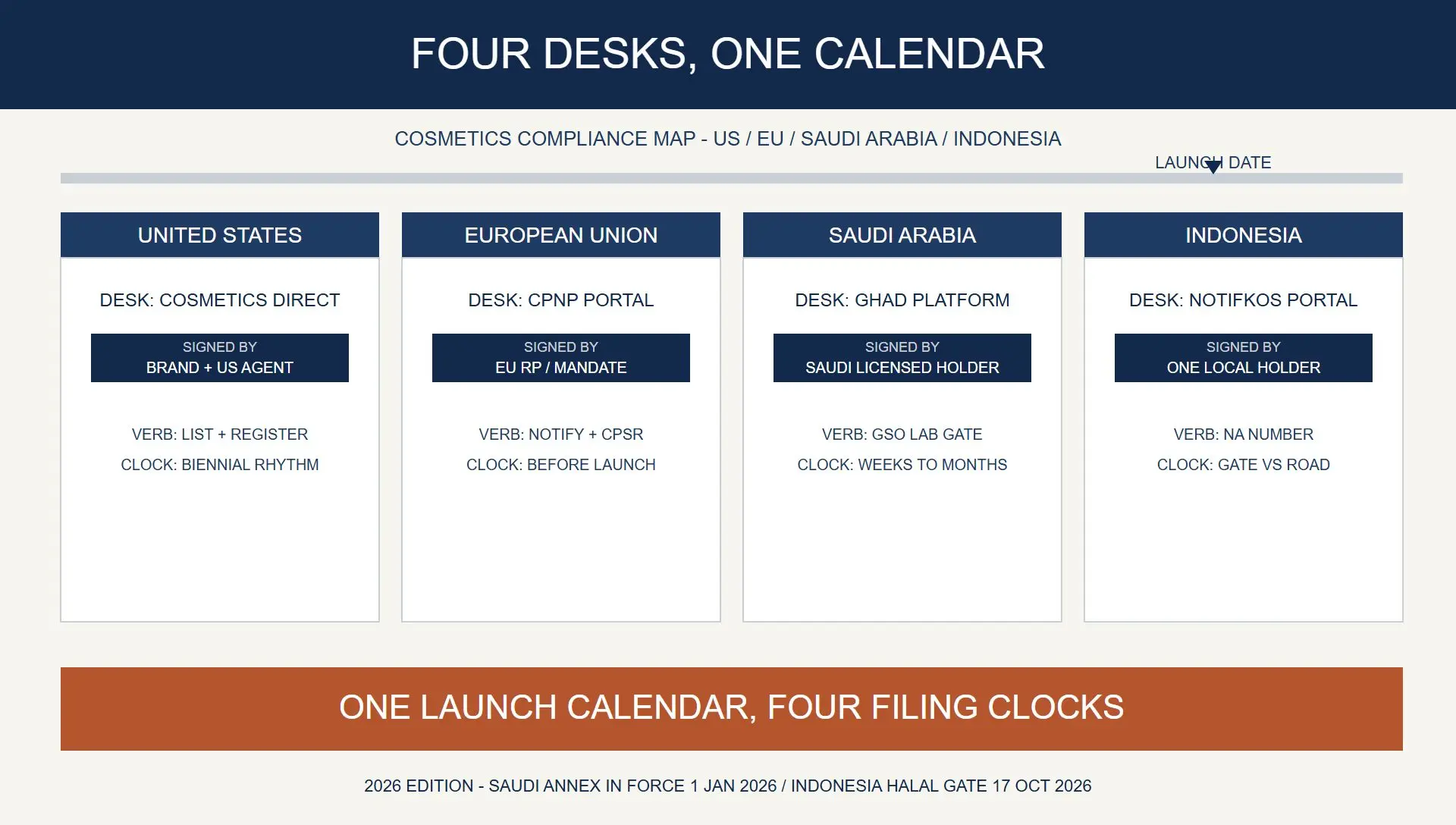
For the United States, confirm the manufacturing site's GMP posture and its MoCRA registration and listing status — MoCRA made facility registration and product listing mandatory, subject to certain small-business exemptions, with a statutory deadline of 29 December 2025 for FDA to establish cosmetic GMP requirements. For the European Union, you need the full ingredient documentation set and a claims file that satisfies the requirement for adequate and verifiable evidence, together with green-claim substantiation under ECGT from 27 September 2026. In both markets the practical bottleneck is not the ingredient certificate; it is whether your supplier can support your registration rather than only its own.
What to do next
If you are sourcing a salmon-derived active for a launch this year, the fastest way to avoid the expensive mistakes is to send us the parts of the brief you already have. Tell us your target format, your planned fill weight, the delivered concentration you want in the finished product, and the claims you intend to print, and we will come back with a bucketed cost stack, the order minimums separated into active, bulk, filling and printing, and the documented specification and certificate list we would hold for that material — so you can see which layer actually gates your first run.
You do not need a finished specification to start that conversation. A format, a fill weight and a claim list are enough. Write to us with those three items and we will tell you plainly what the material can and cannot carry in your market.
Send us your specification brief — format, fill weight, target concentration and intended claims — and we will return the cost stack and the document list for your project.
Sources and Further Reading
Primary and peer-reviewed sources
1. Squadrito F. et al., "Pharmacological Activity and Clinical Use of PDRN", Frontiers in Pharmacology 2017;8:224 — molecular weight range 50-1,500 kDa, main distribution 80-200 kDa, peak near 132 kDa, purity above 95%, approximately 50% double-stranded content, salmon-derived origin and injectable drug identity via adenosine receptor signalling. PMC5405115
2. "Polydeoxyribonucleotide in Skincare and Cosmetics", Journal of Skin and Stem Cell (Brieflands) — mid-range molecular weight PDRN as the optimal band, and the finding that lower and higher molecular weight fractions performed less well. brieflands.com
3. "Polydeoxyribonucleotide (PDRN) in Post-procedure Recovery in Aesthetic Medicine: A Narrative Review", Cureus, 15 May 2026 — convergent finding on the mid-range molecular weight optimum in wound-healing models. cureus.com
4. "Polynucleotides and polydeoxyribonucleotides in dermatology: a narrative review", Journal of Cosmetic and Aesthetic Science — same mid-range conclusion, used here as a secondary review rather than a primary study. jcasonline.com
Regulatory and institutional sources
5. U.S. Food and Drug Administration, "Is It a Cosmetic, a Drug, or Both? (Or Is It Soap?)" — intended use established by labelling and promotional claims, the "regenerate cells" drug-claim example, the absence of a legal cosmeceutical category, MoCRA facility registration and product listing, and the 29 December 2025 statutory deadline for cosmetic GMP requirements. fda.gov
6. European Commission, "Fragrance allergens labelling" — the requirement to declare Annex III fragrance allergens above 0.001% in leave-on and 0.01% in rinse-off products under Regulation (EC) 1223/2009. ec.europa.eu
7. Obelis regulatory briefing, "EU Cosmetic Regulation 2026: 56 New Fragrance Allergens", April 2026 — the July 2026 expansion of the fragrance allergen declaration list. obelis.net
Supply-side and market sources
8. Mowi, Salmon Farming Industry Handbook 2025, June 2025 — approximately 80% of the world's salmon harvest is farmed, with most farmed salmon from Norway, Chile, Scotland and Canada. Industry publication: Mowi is a salmon producer, so this figure reflects the farming industry's own accounting and should be treated as an industry estimate rather than an independent statistic. mowi.com (PDF)
9. Hatch Blue, "Where Is Capital Flowing in Norway's Salmon Farming Landscape", August 2026 — Norway harvested 1.55 million tonnes of Atlantic salmon in 2025 with an export value above NOK 130 billion. Trade analysis, not an official statistical release. hatch.blue
10. FAIRR, "Deregulating Chilean Salmon Farming: Where's the Catch?", May 2026 — Chile as the world's second-largest producer of farmed salmon, with production volumes stagnating between 2019 and 2024. fairr.org
11. IMARC Group, salmon market research — global salmon production volume of 3.8 million tonnes in 2025, projected to reach 4.9 million tonnes by 2034. Commercial market research: scope and methodology are not published in full, so the figure is cited as one house's estimate, not as an agreed market size. imarcgroup.com
12. ULProspector personal care ingredient listing, "PDRN (5000PPM Liquid)" — supplier-published description of the material as extracted from salmon milt, purified, depolymerised and neutralised, and the existence of a 5,000 ppm commercial liquid grade. Supplier-published listing: descriptive of one commercial grade, not an independent verification of the material's performance. ulprospector.com
Data and metric provenance
13. Demand figures in H2 七 are marketplace weekly search volumes for the window 23 August to 5 September 2026, taken from this site's skincare long-tail keyword pack. They are marketplace figures, not Google figures, and must not be quoted as Google search volumes.
14. The keyword metric cited in the SEO configuration (Volume 30 for the primary term) is an indicative result from the free tier of a commercial keyword tool, United States database, captured 17 September 2026, unaudited.
15. The cost and concentration arithmetic in H2 九 is an illustrative example using stated assumptions. It is not a supplier quotation, and the assumed grades are used to demonstrate the calculation rather than to price any specific project.