



Scalp Aging Is Skincare's Next Frontier — and Its Trickiest Claims
For a decade, the efficacy skincare battleground was the face: first ingredient concentration, then delivery engineering, then clinical evidence. In the third quarter of 2026 a clear signal appeared — the battleground is migrating to the scalp.
Three independent lines of evidence support that reading. First, science: researchers from LVMH Fragrances & Cosmetics and LVMH Recherche published a review in Cosmetics systematically examining the relationship between scalp health and hair aging, identifying reduced scalp skin thickness, altered microbiome diversity and lower sebum production as drivers of greying, thinning and fragility, and arguing that scalp care deserves the same attention as facial care (Source: Cosmetics & Toiletries reporting on the review, 2026-01-22; review published in MDPI Cosmetics 12(6):284). Second, ingredients: on 16 September 2026, Italian ingredient house Kalichem released a scalp and shaft care platform with quantified test results, including comparisons against minoxidil (Source: Cosmetics & Toiletries sponsored content, 2026-09-16). Third, capital and research: L'Oréal Groupe formed a multi-year research partnership with the NUS Academy for Healthy Longevity, explicitly combining skin and hair science with healthy longevity medicine (Source: Cosmetics & Toiletries, 2026-08-13).
All three converge on one commercial question: when efficacy skincare logic migrates to the scalp, how do the rules change for buyers?
The facts: the scalp becomes an efficacy battleground
| Date | Event | Layer | Source and strength |
|---|---|---|---|
| 2026-01-22 (report) | LVMH researchers publish a review on scalp health and hair aging: scalp thinning, microbiome change and falling sebum drive hair aging | Scientific literature | Peer-reviewed journal Cosmetics 12(6):284; trade media report |
| 2026-06-05 | PURA D'OR launches a peptide hair and scalp serum, entering the "scalp health" movement | Product | Trade media |
| 2026-06-23 | Silab releases new efficacy data for LIFTILIENCE on textured hair | Ingredient | Ingredient house release |
| 2026-07-14 | Kao verifies the mechanism of damage in coloured hair and develops hair link protection technology | Science + technology | Corporate research |
| 2026-07-21 | K18 launches FutureIQ Serum, using biomimetic peptides and antioxidants to activate root proteins | Product | Trade media |
| 2026-08-13 | L'Oréal Groupe and the NUS Academy for Healthy Longevity launch a multi-year research partnership combining skin and hair science | R&D partnership | Trade media |
| 2026-09-16 | Kalichem releases a scalp and shaft care platform with a PDRN complex, postbiotics and fibre-repair technologies, including 28/56/84-day follow-up data | Ingredient | Trade media sponsored content (note the disclosure) |
Note the last row: Kalichem's content ran on Cosmetics & Toiletries as sponsored content, with a closing disclaimer stating the content was produced by the sponsor and that Cosmetics & Toiletries did not participate in its creation. That does not make the data invalid, but it does mean the comparative conclusions — such as "superior to minoxidil" — have not been through independent editorial review. Buyers should request the underlying study report before citing any of it, rather than citing a media reprint.
This is a general principle: in scalp and hair, marketing intensity runs higher than in facial categories, because consumer anxiety about hair loss far exceeds anxiety about fine lines. The stronger the anxiety, the more aggressive the claims — and the more necessary the diligence.
Mechanism: why scalp aging becomes hair aging
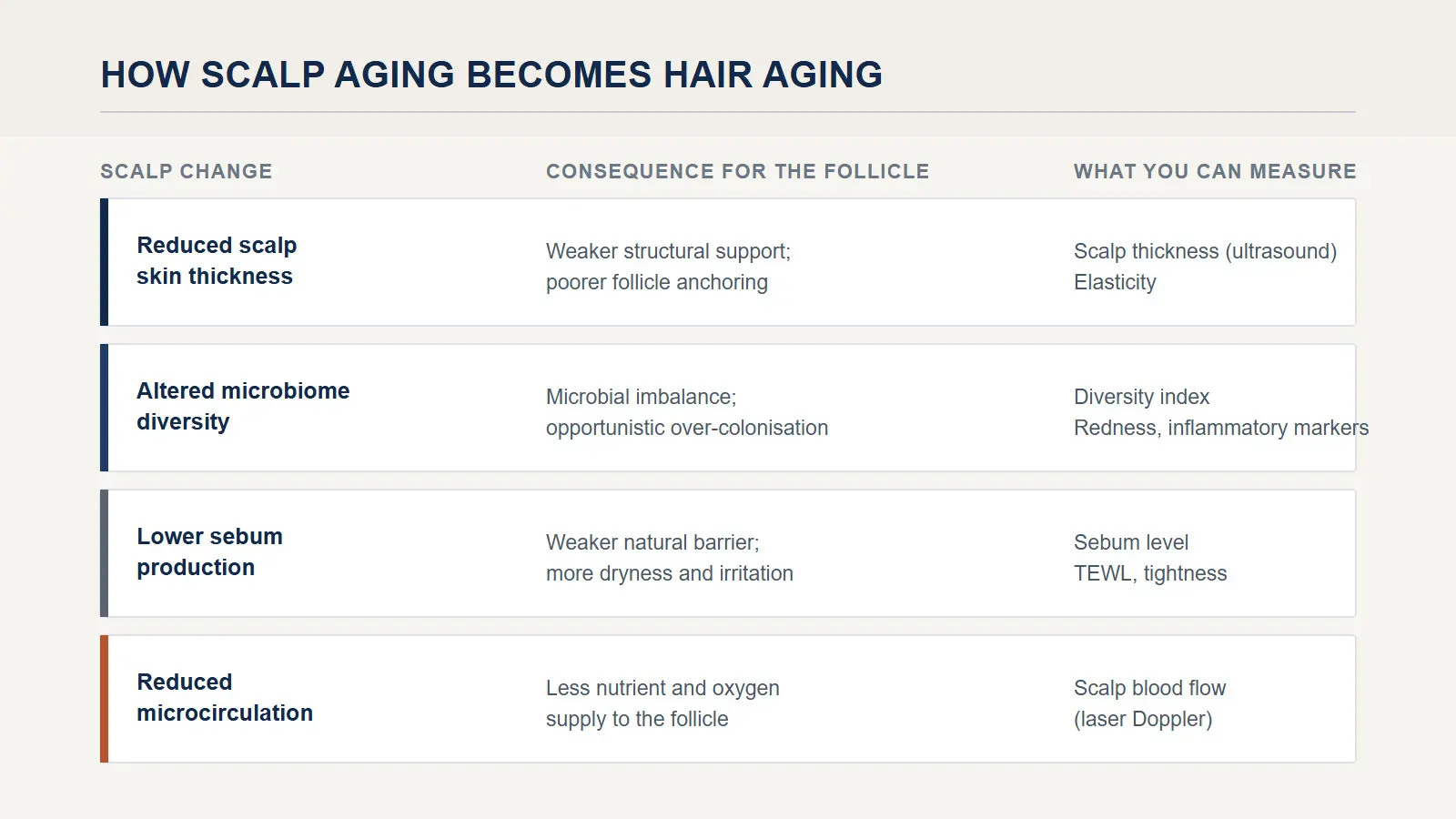
This section decides whether "scalp aging" is a real category or a marketing wrapper. The mechanism chain set out in the LVMH review is testable: the scalp is skin, and the follicle sits inside that skin. Mechanisms of facial skin aging — thinning, reduced microcirculation, microbiome imbalance, chronic low-grade inflammation — therefore act directly on the follicle's microenvironment and eventually show up in the fibre itself (thinning, fragility, loss of pigmentation).
| Scalp change | Consequence for the follicle | Measurable indicator | Formulation implication |
|---|---|---|---|
| Reduced scalp skin thickness | Weaker structural support; poorer follicle anchoring | Scalp thickness (ultrasound), elasticity | Needs matrix and structural support actives plus delivery |
| Altered microbiome diversity | Microbial imbalance; opportunistic over-colonisation | Diversity index, inflammatory markers, redness | Needs microbiome-modulating actives (postbiotics, antimicrobial peptides) rather than harsh antimicrobials |
| Lower sebum production | Weaker natural barrier; more dryness and irritation | Sebum level, TEWL, tightness | Needs gentle cleansing plus barrier repair; avoid strong degreasing systems |
| Reduced microcirculation | Less nutrient and oxygen supply to the follicle | Scalp blood flow (laser Doppler) | Needs local microcirculation support actives |
The practical value of this table for buyers is that it turns "scalp anti-aging" from a vague concept into a decomposable development checklist. It does not require an entirely new technology platform: the four core capabilities of facial efficacy skincare — barrier repair, microbiome modulation, microcirculation support and matrix support — migrate directly. What must be redesigned is delivery and tolerability: the scalp is hair-covered, washed frequently, and users are acutely sensitive to greasiness, so facial sensorial standards do not hold here.
This matters especially for manufacturers. The formulation difficulty of a scalp serum is not the active — it is the triple constraint of high active load, non-greasy feel, and no collapse of hair volume. Factories that satisfy all three are scarcer in scalp than in facial.
Technology already on the table: three routes and their test data
Three technology routes are already proven in the scalp category. To avoid a purely conceptual review, the measured results published by Kalichem are listed item by item below — while keeping the previous section's warning in mind: this is sponsored content, and the underlying reports must be requested from the supplier.
| Route | Representative active | Published key data | Formats |
|---|---|---|---|
| 1. Regenerative-medicine nucleic acids (PDRN) | PDRN with glutathione stabilised by conjugated linoleic acid (CLA) | Reported action on scalp homeostasis, prevention of follicle miniaturisation and local microcirculation; reported superior to minoxidil on several parameters; activity shown on hair density, baby new hair count and fibre thickness (Source: Kalichem sponsored content, 2026-09-16) | Leave-on and rinse-off |
| 2. Postbiotics (microbiome modulation) | Postbiotic complex (Kalibiome Sensitive D-V) | In vivo: a lotion containing 0.2% produced progressive improvement in hair-loss and density parameters at 28, 56 and 84 days; the same programme recorded reductions in redness, irritation and sebum, plus increased sTSLP (linked to the follicle microenvironment and the anagen phase) (Source: as above) | Sensitive scalp; leave-on and rinse-off |
| 3. Biomimetic peptides and fibre repair | Vegetable bioactive peptide complex (bioavailable sulfur-containing amino acids); postbiotic-plus-peptide natural conditioning system | Reported more effective than keratin and benchmark specialities at restructuring damaged keratin and improving hydrophobicity; the other reported superior to a synthetic quat benchmark on detangling, shine and long-lasting anti-frizz, tested on straight, curly and coily hair in vivo and ex vivo (Source: as above) | Wash-off and leave-on |
Three things in this data set deserve buyer attention.
First, the follow-up intervals are 28/56/84 days, not 7 or 14. This is the most fundamental difference between scalp and facial categories: the hair cycle runs in months. Facial efficacy can be measured instrumentally within two weeks, whereas hair-related parameters (density, new fine hair) need at least one full cycle to emerge. The evidence cost in scalp is therefore structurally higher than in facial — which is both a barrier and a moat: a brand willing to fund an 84-day follow-up acquires evidence depth competitors cannot replicate quickly.
Second, the 0.2% figure is worth noting on its own. A postbiotic reporting improvements at a 0.2% inclusion suggests the active may represent a much smaller share of cost than many brands assume. That has a direct negotiating implication: the cost bottleneck in scalp is not the active's unit price but the dosage form and tolerability (non-greasy, no volume collapse, no irritation). Shifting negotiation focus from "what discount on the raw material" to "how is the dosage form achieved" is more likely to yield real savings.
Third, PDRN is used differently on the scalp than on the face. In facial products PDRN mainly supports a repair and regeneration narrative; in scalp applications it is directed at preventing follicle miniaturization and improving local microcirculation. Same ingredient, different target — which means the evidence base does not transfer. Existing facial PDRN data cannot support a scalp claim; studies must be redesigned.
Market data: definitions differ, multiples differ, so use the growth rate
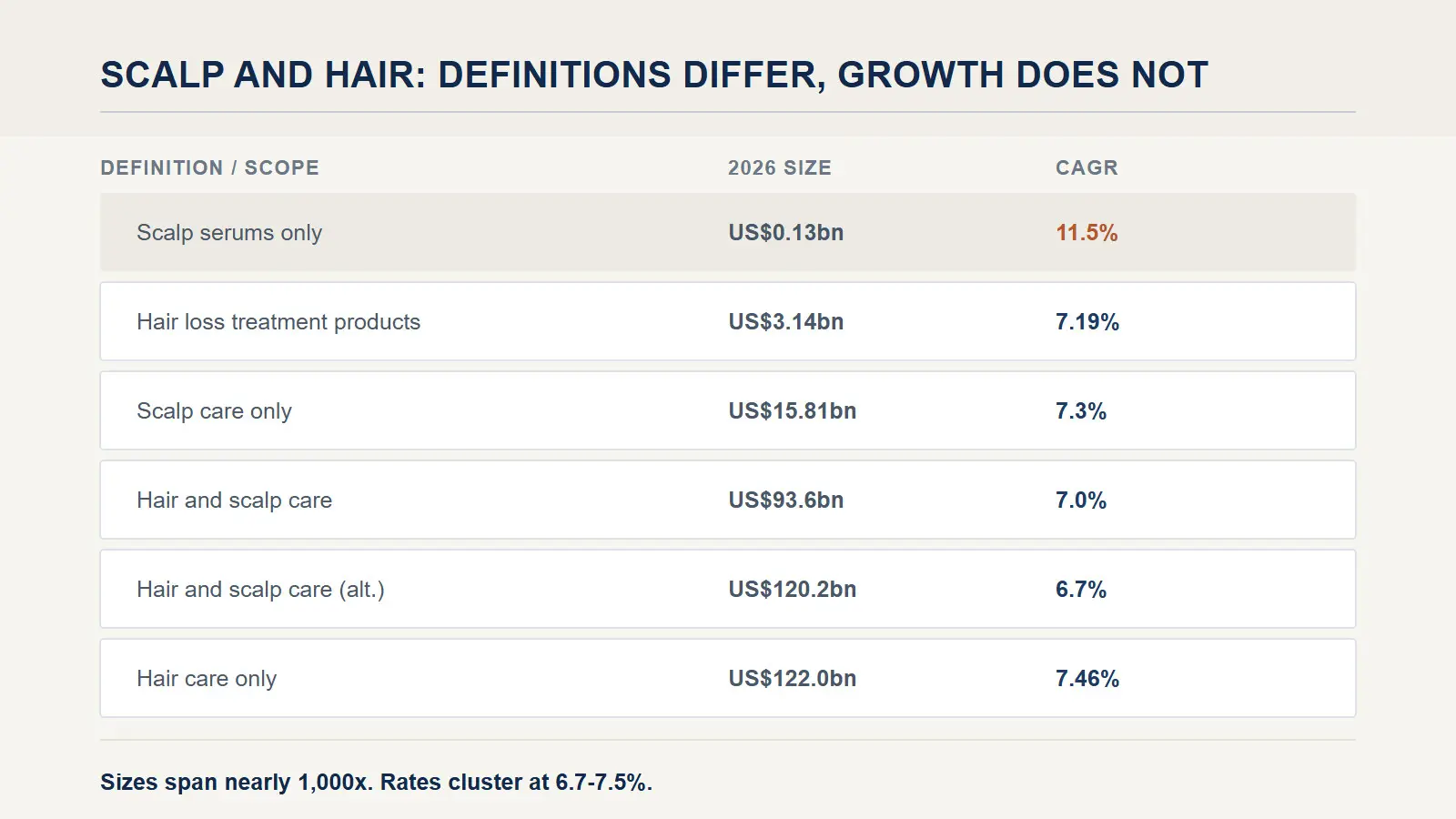
Market sizing in scalp and hair suffers from a serious definitional problem that must be stated before it misleads product planning.
| Publisher | Scope covered | Size and growth |
|---|---|---|
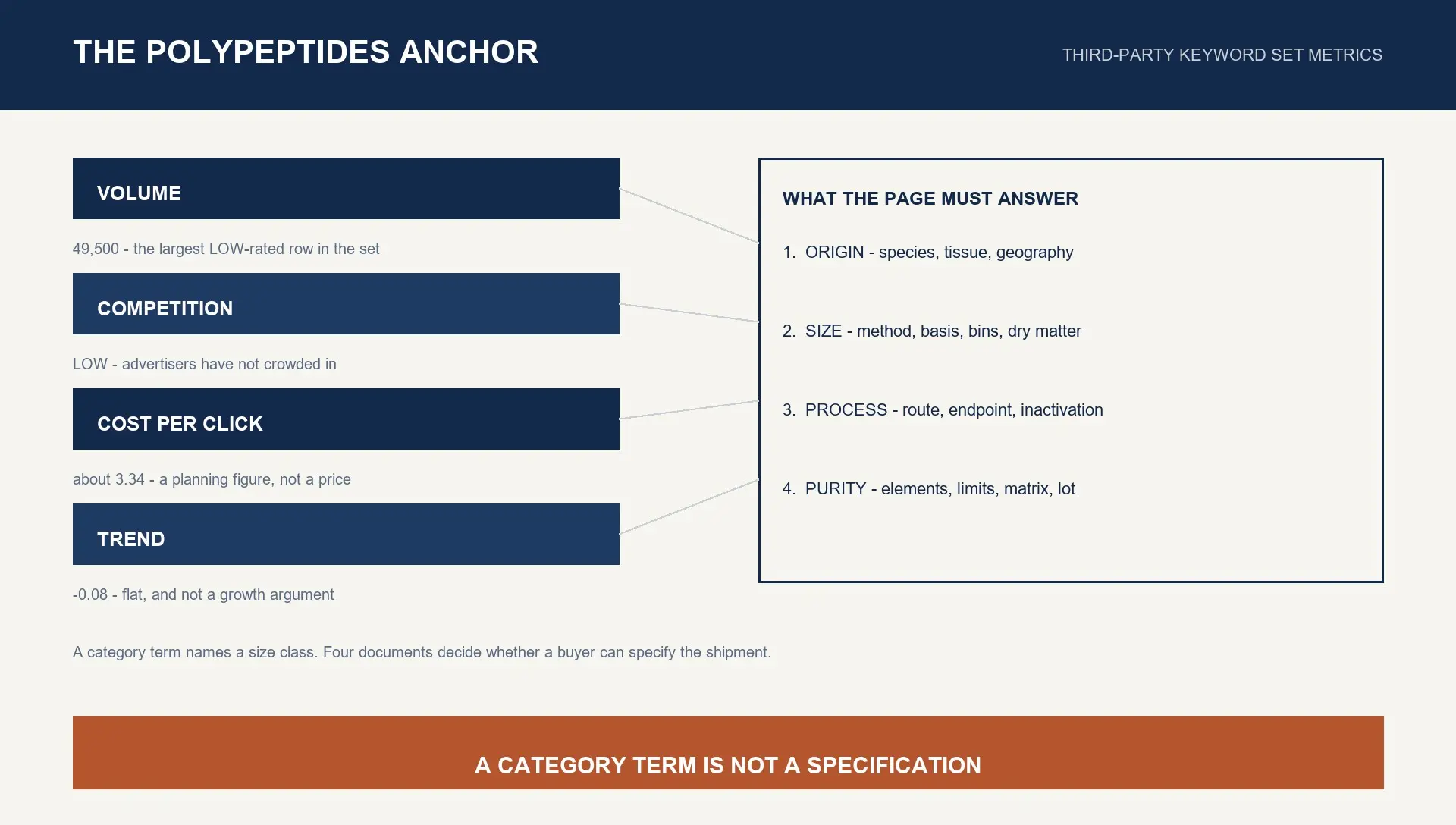
| Coherent Market Insights | Scalp care only | US$15.81bn in 2026 → US$25.88bn by 2033, CAGR 7.3% |
| Grand View Research | Hair and scalp care | US$88.2bn in 2025 → US$93.6bn in 2026 → US$150.5bn by 2033, CAGR 7.0% |
| Persistence Market Research | Hair and scalp care | US$120.2bn in 2026 → US$189.3bn by 2033, CAGR 6.7% |
| Fortune Business Insights | Hair care | US$122.04bn in 2026 → US$216.94bn by 2034, CAGR 7.46% |
| Mordor Intelligence | Hair loss treatment products | US$3.14bn in 2026 → US$4.45bn by 2031, CAGR 7.19% |
| Business Research Insights | Scalp serums only | US$0.13bn in 2026 → US$0.35bn by 2035, CAGR 11.5% |
Read this table vertically, never horizontally.
Definitions span an enormous range: from US$130 million for scalp serums alone, to US$15.8 billion for scalp care alone, to US$120.2 billion for shampoo, conditioner and scalp combined. Citing different figures in one analysis will convince internal reviewers the model is unreliable. But growth rates are remarkably consistent: apart from the narrowest sub-segment, every definition lands in a tight 6.7%–7.5% CAGR band. That is the only robust signal in this data set.
The most telling contrast: the narrowest segment (scalp serums) has the highest growth (11.5%) on the smallest base (US$130 million). This explains why ingredient houses all launched scalp actives in 2026 — it is a small, fast-forming market where the cost of defining the category rules as an early entrant is lowest.
Practical conclusion for buyers: plan on roughly 7% as a conservative baseline, use 10%+ as the aggressive scenario for the sub-segment, and always label "definition" and "source" together in internal documents.
The biggest trap: why comparing a cosmetic to minoxidil is dangerous
This is the section with the highest value for buyers, and it is where the scalp category most often goes wrong.
In the data set above sits one extremely tempting line: "superior performance against minoxidil on various parameters". For a marketing team that is a dream claim. For regulatory and procurement teams it is a mine.
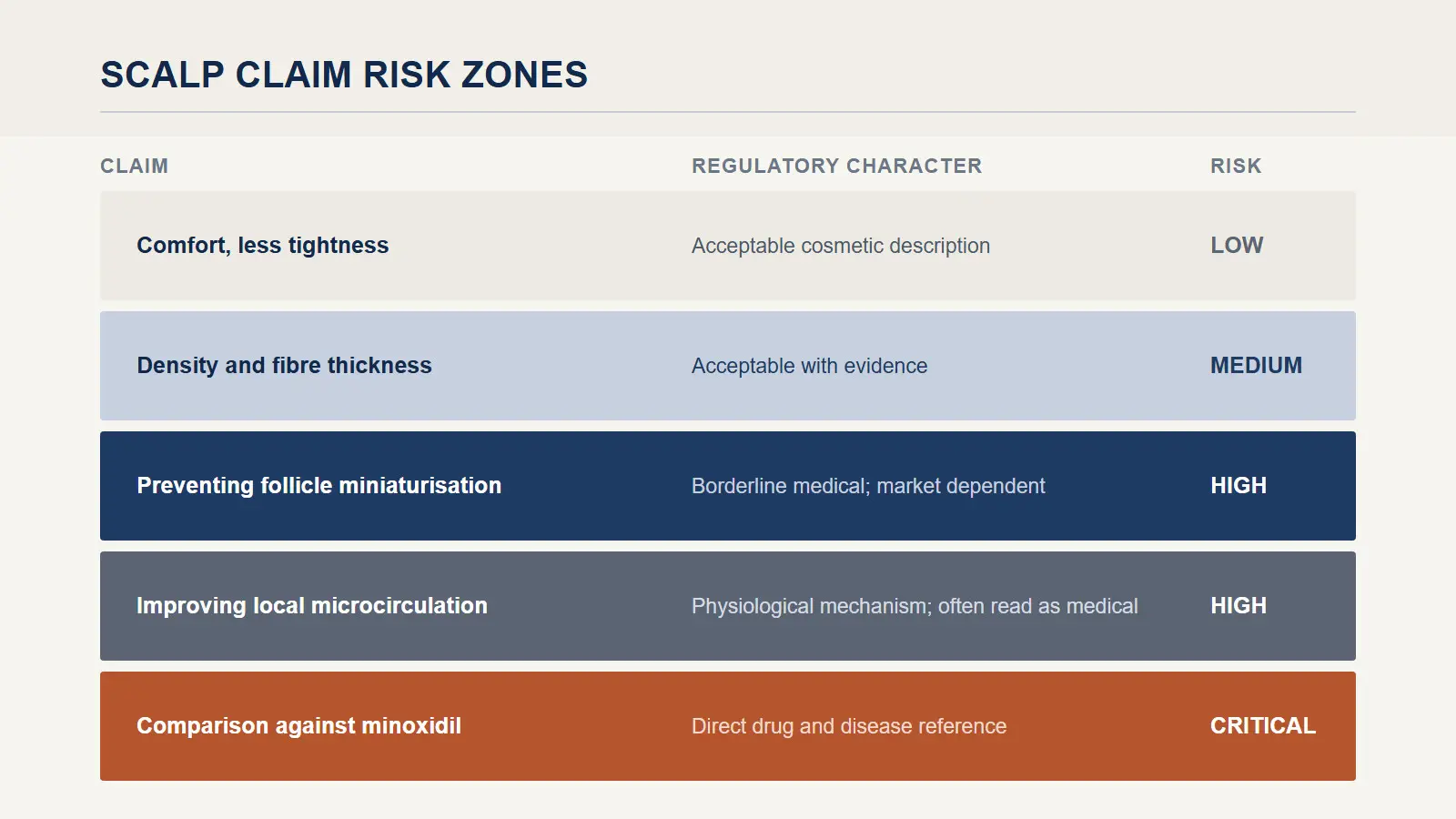
The reason is the legal status of a cosmetic. In major markets including the EU, the United States and China, the definition of a cosmetic is bounded by the inability to claim a therapeutic or disease-prevention function. Minoxidil is an approved pharmaceutical active indicated for androgenetic alopecia — a medically defined disease state. Therefore:
| Claim type | Regulatory character | Risk level |
|---|---|---|
| Improves scalp comfort, reduces tightness | Acceptable cosmetic description | Low |
| Increases hair density and fibre thickness (instrumental) | Acceptable cosmetic claim requiring evidence | Medium (data required) |
| Prevents follicle miniaturisation | Borderline medical; market dependent | High (may be read as a medical claim) |
| Improves local microcirculation | Physiological mechanism; often read as medical | High |
| Superior to minoxidil | Direct reference to a drug and a disease indication | Critical (may be treated as an unapproved drug claim) |
The irony is worth stating plainly: the strongest data you can buy from a supplier is precisely the data you can least afford to use. Ingredient houses have an incentive to publish drug-comparison results to demonstrate technological depth; but if a brand moves that language onto a consumer-facing page, the exposure is not merely an advertising-compliance issue but a re-characterisation of the product. Once treated as a drug, the required route is pharmaceutical registration, not cosmetic notification.
Three operational recommendations follow:
1. Manage "mechanism language" and "consumer claims" separately. Internal technical documents may retain mechanism statements (for supplier discussions and professional-channel material); consumer-facing pages should use only what a cosmetic can carry.
2. Define the "scope of use for evidence" in the contract. Require the ingredient supplier to attach a permitted-use statement to its data (which conclusions may go into consumer communication, which are for technical exchange only). This costs almost nothing and avoids costly remediation later.
3. Do not build communications on conclusions drawn from drug comparators. Even if the data holds, the risk-to-reward profile of publicising it is badly skewed.
The other overlooked risk: social-media DIY formulas at 3x the active load
The scalp category carries a risk source rarely seen in facial: consumers are formulating their own products.
According to research published in Frontiers in Medicine on 24 July 2026 (as reported by trade media), salon-grade hair serums contain roughly 5.0%–5.8% actives, while DIY recipes circulating on social media typically use at least 14%; the study concludes that viral social-media hair serums may deliver up to three times the active concentration with no additional benefit, while markedly increasing formulation complexity, cost and the risk of adverse reactions.
| Dimension | Salon / standardised formula | Social-media DIY formula | Risk direction |
|---|---|---|---|
| Active load | About 5.0%–5.8% | 14% or more (about 3x) | Irritation, barrier damage |
| Additional benefit | Baseline | Study reports no additional benefit | Risk not matched by reward |
| Formulation complexity | Controlled | Markedly increased | Stability and compatibility failures |
| Adverse-reaction risk | Manageable | Materially higher | Brand and channel liability |
This phenomenon carries three layers of meaning for B2B brands.
Layer one: it is a demand signal, not noise. Consumers formulating their own suggests existing products are not answering their need — most likely an intuition that concentrations are too low, or frustration at slow visible results. That is precisely the opening for product innovation: a product that appears higher-strength while carrying a tolerability-validated formula resolves the anxiety and the safety issue at once.
Layer two: it is brand risk. When consumers see "this is the ratio that actually works" on social media, responsibility tends to flow back to the category and the brand — even if the brand never suggested that usage. Adverse reactions in scalp (irritation, contact dermatitis, worsened shedding) are more serious and more visible than facial ones, and social amplification is stronger.
Layer three: it requires factories to supply tolerability-boundary data. Simply asserting "our formula is safe" is not persuasive. What is persuasive: the concentration range within which the formula passed tolerability testing, and the threshold beyond which risk rises. Such data serves three purposes for a brand: consumer education, customer-service scripts, and crisis response.
The direct opportunity for manufacturers: a factory able to supply concentration-versus-tolerability boundary data holds a differentiated capability in scalp. It requires genuine irritation and human tolerability testing rather than formulation experience.
Buyer checklist: 8 items to verify now
- Fix the claim boundary first. Sort every existing and planned scalp claim into three columns: cosmetic-acceptable, evidence-required, and potentially a medical claim. Draw the boundary before discussing the formula.
- Confirm the permitted scope of the evidence. Request the underlying study report from the ingredient supplier (not a media reprint or sponsored article), plus a written statement of which conclusions may be used in consumer communication.
- Check whether the follow-up period matches the hair cycle. If a supplier offers only 7–14 day data, its evidence cannot support hair-related claims; require at least 28 days, ideally 84.
- Request tolerability data. Including irritation testing, human tolerability, and the concentration-versus-risk boundary. This is the data that most clearly separates scalp from facial.
- Validate dosage-form feasibility. Under the triple constraint of high active load, non-greasy feel and no volume collapse, what is the factory's dosage-form approach? Ask for samples, not a description.
- Check microbiome claim compliance. If the claim involves microbiome balance (for example inhibiting over-colonisation), confirm the wording is acceptable in the target market — such claims are treated as medicalised in several jurisdictions.
- Adverse-reaction handling. Agree with the factory on the response process, liability allocation and data traceability for adverse reactions (irritation, contact dermatitis).
- Cross-category risk check. If your line-up includes both facial and scalp products, confirm that facial data has not been migrated into scalp claims without redesign (same active, different target — evidence does not transfer).
Items 3 and 4 are the most commonly skipped and the most consequential. The reason is simple: the barrier in scalp is not formulation creativity but evidence cost. A brand willing to fund an 84-day follow-up and tolerability testing does not purchase a marketing asset — it acquires an evidence asset competitors cannot replicate quickly.
Six clauses your scalp supply contract needs
Two requirements in scalp have no facial equivalent: defining the permitted scope of use for evidence, and handling drug-comparator conclusions. The six clauses below are ordered by priority.
| # | Clause | Consequence if omitted |
|---|---|---|
| 1 | Permitted scope of use for evidence: which data and conclusions may be used in consumer communication, which are for technical exchange only | Misuse of drug-comparator conclusions, risking re-characterisation of the product |
| 2 | Delivery of the underlying report: the full study report including methods and individual data, not a summary or media reprint | Conclusions cannot be verified and the evidence is unusable in diligence |
| 3 | Follow-up commitment: agreed duration and endpoints for hair-related research | Supplier provides only short-term data; claims cannot be supported |
| 4 | Tolerability data and concentration boundary: irritation and tolerability testing plus the concentration-versus-risk boundary | No basis for responding to adverse reactions from high-concentration social-media usage |
| 5 | Adverse-reaction response mechanism: response times, liability allocation and data traceability obligations | Unclear liability in a crisis; handling cost and brand damage multiply |
| 6 | Data ownership and exclusivity: ownership of scalp-specific evidence and whether it may be supplied to competing brands | The evidence you funded becomes generic industry background and creates no differentiation |
Clauses 1 and 3 should be prioritised. The first guards against a single catastrophic misstep capable of halting an entire product line; the second decides whether an evidence asset can exist at all. Neither requires large spending, but both must be negotiated early — a late add-on carries far weaker leverage.
FAQ: six questions buyers ask most
Q1: Is the manufacturing logic for scalp really different from facial?
Yes, and the differences concentrate in two places. First, stronger tolerability constraints: the scalp is hair-covered, washed frequently, and users are acutely sensitive to greasiness and loss of volume, so facial formulation standards do not apply. Second, higher evidence cost: the hair cycle runs in months, so shedding and density parameters need at least 28 days and ideally 84 days of follow-up (Source: the Kalichem data used 28/56/84-day follow-up, 2026-09-16). When selecting a scalp manufacturing partner, dosage-form capability and tolerability testing matter more than access to actives.
Q2: I want to develop a scalp serum. What should I look at first?
Look at the claim boundary first, not the formula. Sort every planned claim: which are cosmetic-acceptable (scalp comfort, smoothness, shine), which require instrumental or clinical data (hair density, fibre thickness), and which may constitute a medical claim (preventing follicle miniaturisation, improving local microcirculation). In the scalp category, the technical consequence of a claim crossing the line far exceeds that of a formulation failure.
Q3: My supplier gave me data showing "superior to minoxidil". Can I use it?
Not in any consumer-facing communication. Minoxidil is an approved pharmaceutical active indicated for a medically defined hair-loss condition. Using a cosmetic-versus-drug comparison in consumer communication can trigger re-characterisation of the product as a drug — at which point the required route is pharmaceutical registration rather than cosmetic notification. Technically, such data can inform internal understanding of mechanism, but the permitted scope of use must be set out in the contract.
Q4: Which market growth figure should I use for scalp?
Use roughly 7% as a conservative baseline and 10%+ as the aggressive scenario for the sub-segment. The definitions span an enormous range: scalp care alone is US$15.81 billion in 2026 (CAGR 7.3%, Coherent Market Insights); hair and scalp care combined is US$120.2 billion (CAGR 6.7%, Persistence Market Research); while scalp serums alone are only US$0.13 billion yet grow at 11.5% (Business Research Insights). Absolute values cannot be compared across definitions, but the growth band (6.7%–7.5%) is consistent. Always label both definition and source.
Q5: Many people on social media mix their own high-concentration serums. What does that mean for brands?
It means a demand signal and a risk at the same time. According to research published in Frontiers in Medicine on 24 July 2026 (as reported by trade media), salon-grade hair serums contain roughly 5.0%–5.8% actives while social-media DIY recipes typically use 14% or more (about 3x), with no additional benefit reported and a markedly higher risk of adverse reactions. Two responses: on the product side, launch a formula that appears higher-strength but is tolerability-validated; on the risk side, hold concentration-versus-tolerability boundary data ready for consumer education and crisis response.
Q6: If my supply chain is in China, what advantages are there in scalp?
Three. 1. Dosage-form engineering. The difficulty in a scalp serum is the triple constraint of high active load, non-greasy feel and no volume collapse — a formulation engineering problem rather than an active monopoly, where Chinese manufacturers iterate quickly and at low trial cost. 2. Transferability of sheet-mask technology. The high-concentration essences, leave-on gels and rinse-off formats appearing in scalp care overlap heavily with the sheet-mask technology stack, so processes and equipment can be reused. 3. Small-batch validation. Because scalp evidence is expensive and slow, validating dosage form and tolerability in a small batch before committing to a funded 84-day follow-up is the most capital-efficient path.
12-month roadmap
| Phase | Action | Deliverable |
|---|---|---|
| Month 1 | Classify every claim (acceptable / evidence-required / potentially medical); confirm target markets | Claim boundary register |
| Months 1–2 | Screen manufacturing partners with emphasis on dosage form and tolerability testing; request ingredient study reports and permitted-use statements | Supplier evaluation sheet |
| Months 2–3 | Complete dosage-form prototypes meeting the triple constraint; validate sensorial performance in a small batch | Prototype and user feedback |
| Months 3–4 | Run irritation and tolerability testing; establish the concentration-versus-risk boundary | Tolerability data pack |
| Months 4–8 | Launch hair-related parameter studies (at least 28 days, target 84-day follow-up) | Interim and final reports |
| Months 6–9 | Prepare consumer communication (using only cosmetic-acceptable wording) and professional-channel technical material | Dual-track material set |
| Months 9–12 | Establish adverse-reaction response; write evidence ownership and permitted use into contracts | Revised contracts and response process |
One deliberate trade-off runs through this roadmap: evidence building comes before launch, not in parallel. The reason is the risk structure of the scalp category — for a facial product, conservative claims merely mean a weaker selling point, whereas for a scalp product a claim that crosses the line can force remediation or withdrawal of an entire line. Build the evidence, then fix the claims, then scale: that is the safest sequence in this category.
What to do next
If you are evaluating a scalp line, start with the one action that costs almost nothing and avoids the largest risk: write out every planned scalp claim and sort them into three columns — "cosmetic-acceptable", "needs evidence", and "potentially a medical claim". You will find that what needs redesigning is not the formula but the boundary between evidence and language.
For more concrete guidance: see the efficacy skincare guide 2026: PDRN vs peptides vs retinol for evidence and sourcing comparisons on the core actives shared between scalp and face (PDRN, peptides); KFY GHK-Cu SNAP-8 peptide serum for how peptide engineering translates into a scalp format; and unlocking skin med clinical studies for acne treatment for a clinical study design framework that scalp categories also need. Put "permitted use of evidence" and "follow-up duration" on the same negotiating table as unit price.
Sources
- Cosmetics & Toiletries — "LVMH Review Underscores How Scalp Health is the Key to Fighting Hair Aging" (2026-01-22; review published in MDPI Cosmetics 12(6):284): https://www.cosmeticsandtoiletries.com/research/literature-data/news/22959052/lvmh-review-underscores-how-scalp-health-is-the-key-to-fighting-hair-aging
- MDPI Cosmetics — review on scalp health and hair aging: https://www.mdpi.com/2079-9284/12/6/284
- Cosmetics & Toiletries (sponsored content) — "Scalp and shaft care: PDRN, Postbiotics and conditioning solutions", Kalichem S.R.L. (2026-09-16): https://www.cosmeticsandtoiletries.com/formulas-products/hair-care/article/22974243/kalichem-italia-srl-scalp-and-shaft-care-pdrn-postbiotics-and-conditioning-solutions
- Cosmetics & Toiletries — "L'Oréal Groupe, NUS Academy for Healthy Longevity Announce Multi-Year Research Partnership" (2026-08-13): https://www.cosmeticsandtoiletries.com/news/companies/news/22972367/loral-groupe-nus-academy-for-healthy-longevity-announce-multiyear-research-partnership
- Cosmetics & Toiletries — "K18 Introduces FutureIQ Serum for Hair Longevity" (2026-07-21): https://www.cosmeticsandtoiletries.com/formulas-products/hair-care/news/22971022/k18-hair-k18-introduces-futureiq-serum-for-hair-longevity
- Cosmetics & Toiletries — "PURA D'OR Launches Advanced Peptide Hair and Scalp Serum" (2026-06-05): https://www.cosmeticsandtoiletries.com/formulas-products/hair-care/article/22968386/pura-dor-taps-into-the-growing-scalp-health-movement
- Cosmetics & Toiletries — "Silab Releases New Efficacy Data for LIFTILIENCE for Textured Hair" (2026-06-23): https://www.cosmeticsandtoiletries.com/cosmetic-ingredients/actives/news/22969400/silab-silab-releases-new-efficacy-data-for-liftilience-for-textured-hair
- Cosmetics & Toiletries — "Kao Corporation Verifies Mechanism for Damage in Colored Hair, Develops Hair Link Protection Technology" (2026-07-14): https://www.cosmeticsandtoiletries.com/research/methods-tools/news/22970517/kao-corporation-verifies-mechanism-for-damage-in-colored-hair-develops-hair-link-protection-technology
- Frontiers in Medicine — comparative study of active concentrations in salon-grade versus social-media DIY hair serums (2026-07-24, as reported by trade media)
- Coherent Market Insights — "Scalp Care Market Size, Trends & YoY Growth Rate, 2026-2033": https://www.coherentmarketinsights.com/market-insight/scalp-care-market-5132
- Grand View Research — "Hair And Scalp Care Market Size & Share Report, 2026-2033": https://www.grandviewresearch.com/industry-analysis/hair-care-market
- Persistence Market Research — "Hair and Scalp Care Market Size & Future Growth, 2033": https://www.persistencemarketresearch.com/market-research/hair-and-scalp-care-market.asp
- Fortune Business Insights — "Hair Care Market Size, Share | Global Industry Report [2034]": https://www.fortunebusinessinsights.com/hair-care-market-102555
- Mordor Intelligence — "Hair Loss Treatment Products Market Size & Share Analysis" (2026-07-30): https://www.mordorintelligence.com/industry-reports/hair-loss-treatment-products-market
- Business Research Insights — "Scalp Care Serum Market Size, Share | Industry Statistics": https://www.businessresearchinsights.com/market-reports/scalp-care-serum-market-114233