
Social Commerce Hits an Inflection Point: Sephora × TikTok Shop and YouTube × Amazon Are Rewriting How Beauty Launches
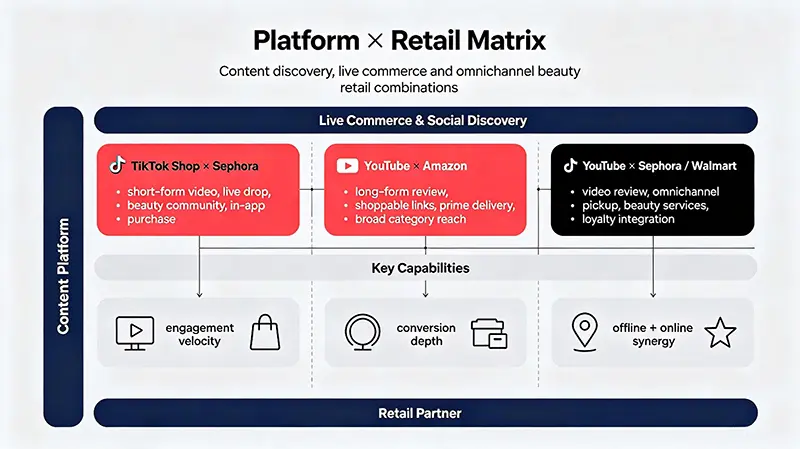
On September 4, 2026, two retail stories landed on the same day, pointing to the same signal — social commerce is entering a phase of "platform-level acceleration". First, Sephora announced it will launch on TikTok Shop on September 19 with a monthly-exclusive format called "Drop Shop": each drop is warmed up with teasers, creator content and interactive campaigns, then unveiled in a TikTok LIVE hosted by celebrities, founders and creators, with products initially exclusive to the TikTok Shop. Second, YouTube added Amazon to YouTube Shopping, letting creators tag Amazon products directly in videos and livestreams for commission. If you run your own skincare brand, or plan to launch new products through TikTok Shop or YouTube Shopping, these stories are not "retail industry news" — they are signals that directly affect your product and supply decisions: launches are shifting from annual planning and seasonal drops to monthly drops and sell-while-you-stream. Your yardsticks for choosing a factory — small-batch flexibility, fast reorders, multi-SKU parallelism — now matter as much as formulation and compliance.
What Happened: Two Platforms, One Day
First, the Drop Shop mechanics: the US pilot goes live on September 19 with one exclusive drop per month, curated from Sephora's brand partners; each drop is teased with trailers and creator content, then unveiled in a TikTok LIVE with celebrities, founders and creators. Products start exclusive to Sephora's TikTok Shop before flowing to Sephora.com, stores or other retail partners — Sephora calls it a "test-and-learn" pilot whose results will decide international expansion. Then YouTube: adding Amazon completes the creator monetisation loop — YouTube Shopping's global GMV grew 13-fold between Q1 2024 and Q1 2026, more than one million monetising creators participate, and viewers watch roughly 110 million hours of shopping content every day. In one line: within a year, TikTok and YouTube each tied up a retail giant — Sephora and Amazon — and the closed loop of "discover on social, buy in-platform" has moved from traffic experiment to retail main channel.
Three Tests for You: First-Batch Sizing, Testing Rhythm and Reorder Response
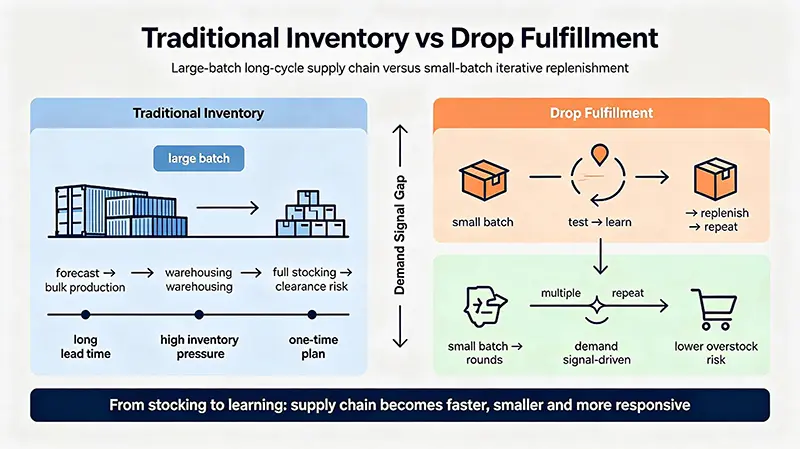
The drop model does not change the nature of skincare — it changes your operating parameters. The first test is first-batch sizing: with monthly drops, each SKU's fate is decided by a single live-event surge — order too much and you sit on dead stock after the exclusivity window; order too little and you miss the traffic window entirely. The second test is your testing rhythm: instead of launching ten SKUs at once and selling slowly, the model rewards "small first batch to validate, let the data speak, then scale" — your product selection and testing process must support that iteration. The third test is reorder response: how fast you can restock after a sold-out live event decides whether you capture the second wave of recommendation traffic — if restocking takes 60 days, the momentum is gone. Translated into supply-chain language: what you need is no longer "a factory that can mass-produce", but "a factory that can run small and fast beside you, and restock on call".
A Checklist for You: 8 Questions to Ask Your Factory
If you believe your brand suits the drop rhythm, send the eight questions below to your shortlisted factories in your next round of inquiry — a factory that gives clear written answers and is willing to put them in the contract deserves a place on your list:
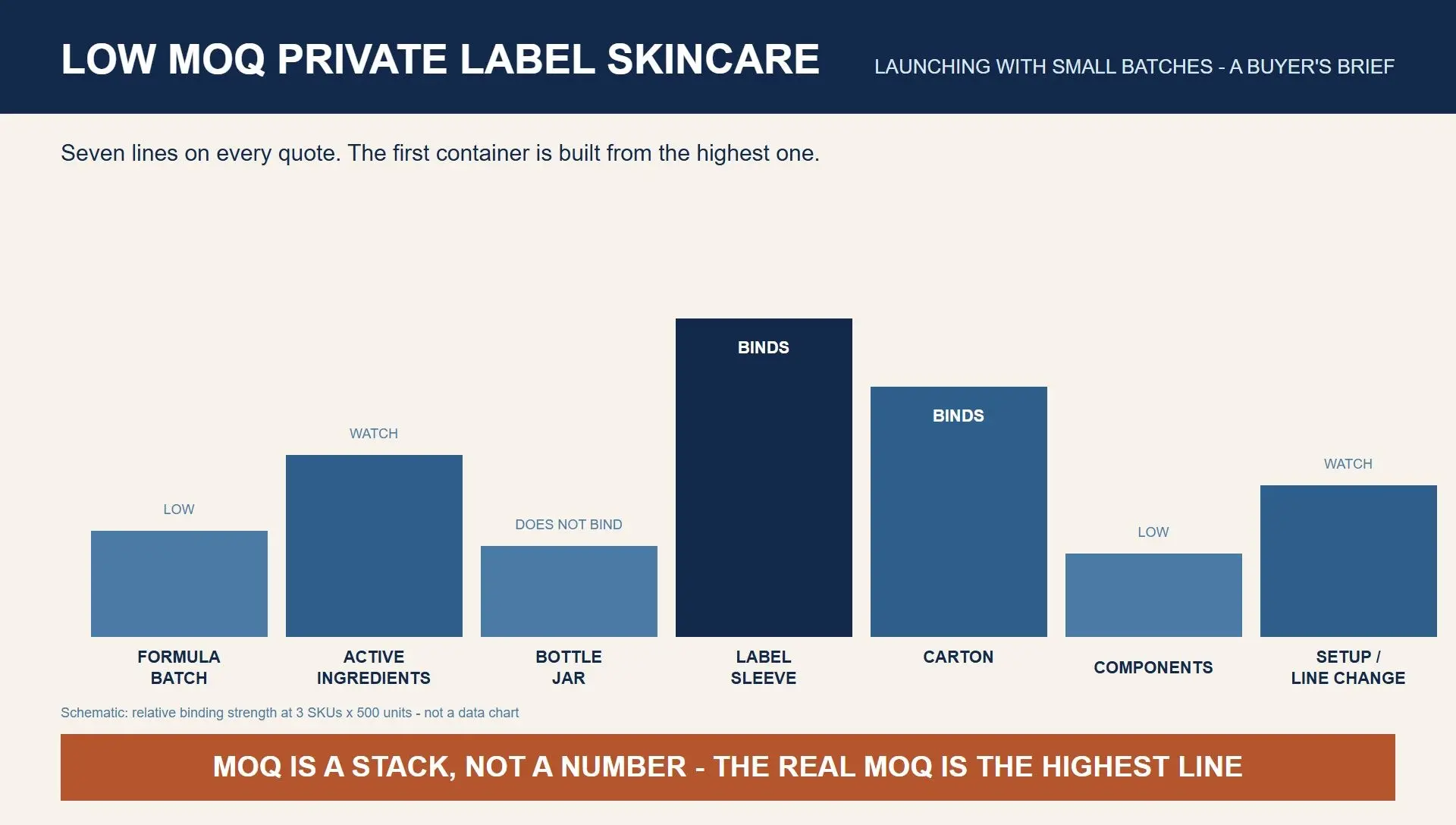
- Is the minimum order quantity (MOQ) calculated per formulation or per SKU? Can it support trial batches of 500–2,000 units?
- How many days from sample approval to first shipment? And what is the minimum interval between the first batch and a reorder?
- When several new SKUs move through the line in the same month, how is production scheduled? Is there a risk of uncontrollable lead times from "rush-order priority"?
- Has the factory proposed modular or universal packaging (same bottle, change the label = new SKU)? What is the minimum print run for a label change?You can refer to the existing general bottle type library of mature OEMs, such as the [FKY product series]
- Do samples come with social-ready assets (product photos, videos, unboxing material), or is that an extra paid service?
- Does the quotation support a two-stage "trial batch, then scale" structure, with separate trial and scale pricing?
- Will the factory reserve capacity for your reorders? What is the emergency channel for restocking after a sell-out?
- What happens to unsold trial-batch stock — can it be reformulated, relabelled or shipped in split consignments?
【Note】A written answer in the contract is worth far more than a verbal promise. If a factory is vague on questions 1, 2 or 7, its production line was not designed for fast-cycle launches.
Four Moves to Make Your Supply Chain Drop-Ready
Based on the many buyer projects we have worked on, four things are worth doing now regardless of which factory you finally choose. First, run a "supplier-fit test" using the eight questions above and compare the written answers from your current and candidate factories side by side — the result is often surprising: the cheapest factory is not necessarily the riskiest, but a factory that cannot clearly state its reorder lead time always is. Second, split your first order into two stages: use a ~1,000-unit trial batch to validate quality, logistics and market response before scaling — hedging stock risk with trial-batch cost is the cheapest insurance in the drop era. Third, ask for modular packaging design at the development stage so "new label, new launch" becomes routine and the marginal cost of monthly drops falls. Fourth, put reorder response time into the contract or SLA — an explicit commitment is worth far more than a vague "we will do our best". None of these need to wait for clearer platform policies; they can start today.
Take this eight-question checklist into your next round of sourcing — only factories that answer in writing deserve a place in your drop supply pool. If you would like to benchmark your current factory first, send the same eight questions to us: FKY will provide a free capacity-fit assessment from a buyer's perspective (with written details on MOQ structure, trial-batch lead time and reorder channels), so you can compare every option with the same ruler.