

Vitamin C Serum Benefits for Skin: Stability and Formulation Guide
"Vitamin C serum benefits for skin" is the question, and the marketplace answer to it is the largest in the category: the queue's word pack puts the US "vitamin c serum" signal at a weekly average of 147,873 on an Amazon-internal basis (window 23 August to 5 September 2026), running +39.4% over four weeks, with the German market at +94.6%. That is demand with a trend arrow pointing up — and it is the reason every quarter another brand owner asks the same manufacturer question: why did our vitamin C serum turn orange, and who is responsible?
Because the honest answer is that vitamin C is the one category where a perfectly specified formula can still fail on the shelf. L-ascorbic acid needs a low pH to perform, and that same acidity accelerates its own breakdown; it degrades in the presence of oxygen, light and trace metals, and every bottle ships with some headspace of all three. The benefits question — for skin, for acne, for oily skin — is therefore not a question about the ingredient. It is a question about the form, the concentration, the protection stack and the stability program behind the bottle. Four decisions, all made before your buyer ever sees the product, all priced into the quote in ways that are not always visible.
This guide is written for the buyer who signs the purchase order. You will get the three form families compared on the variables that actually decide cost and claims, the failure modes explained at a level where you can audit a supplier's answer, the formulation protection stack layer by layer with what each layer costs, the honest read of the market data across research houses, and the stability program — tests, curves, per-lot assays — that has to exist in writing before any sample is paid for.
Vitamin C Serum Benefits for Skin: What You Are Actually Buying
The consumer's question — "what does vitamin C do for my skin" — has a settled answer in the clinical literature, and it is not the part of the business that fails. What fails is the chain between that answer and the bottle on your shelf. The benefits a brand owner is actually buying decompose into a product of four terms:
- The form — L-ascorbic acid (L-AA) is the form with the deepest clinical evidence, and it is also the form that is easiest to destroy. Every alternative form is a trade of some evidence for some stability, and that trade is the first line of the quote. - The concentration — the evidence for L-AA clusters in a working band, and above it the irritation risk rises faster than the benefit. "20 percent" and "10 percent" are different products, and the per-lot assay is the only number that tells you which one is in the jar. - The pH — L-AA needs an acidic environment to do what the literature says it does; the same acidity is the condition that speeds its degradation. The pH specification is where efficacy and stability are negotiated against each other, in writing, before formulation starts. - The stability program — the accelerated curves, the forced-degradation work, the per-lot testing, the packaging that closes the system. This is the term that consumer content never writes about, which is exactly why it is where the category fails.
If any one of those terms is zero, the product on the shelf is zero, no matter what the ingredient list says. A brand that buys "vitamin C serum" as a single line item — one concentration, one assay, no stability file — is not buying a product; it is buying a probability. The buyer's frame for facial serum specifications generally is the natural starting point, but the vitamin C category demands one extra chapter that most specification guides skip: the chapter on the molecule that eats itself.
The commercial consequence is simple to state. Two manufacturers can quote the same "15% vitamin C serum" at different prices, and the price difference is not margin — it is which of the four terms each one has underwritten in writing. The rest of this guide is about learning to read those four terms in a quotation.
The Three Form Families: What the Form Decision Actually Is
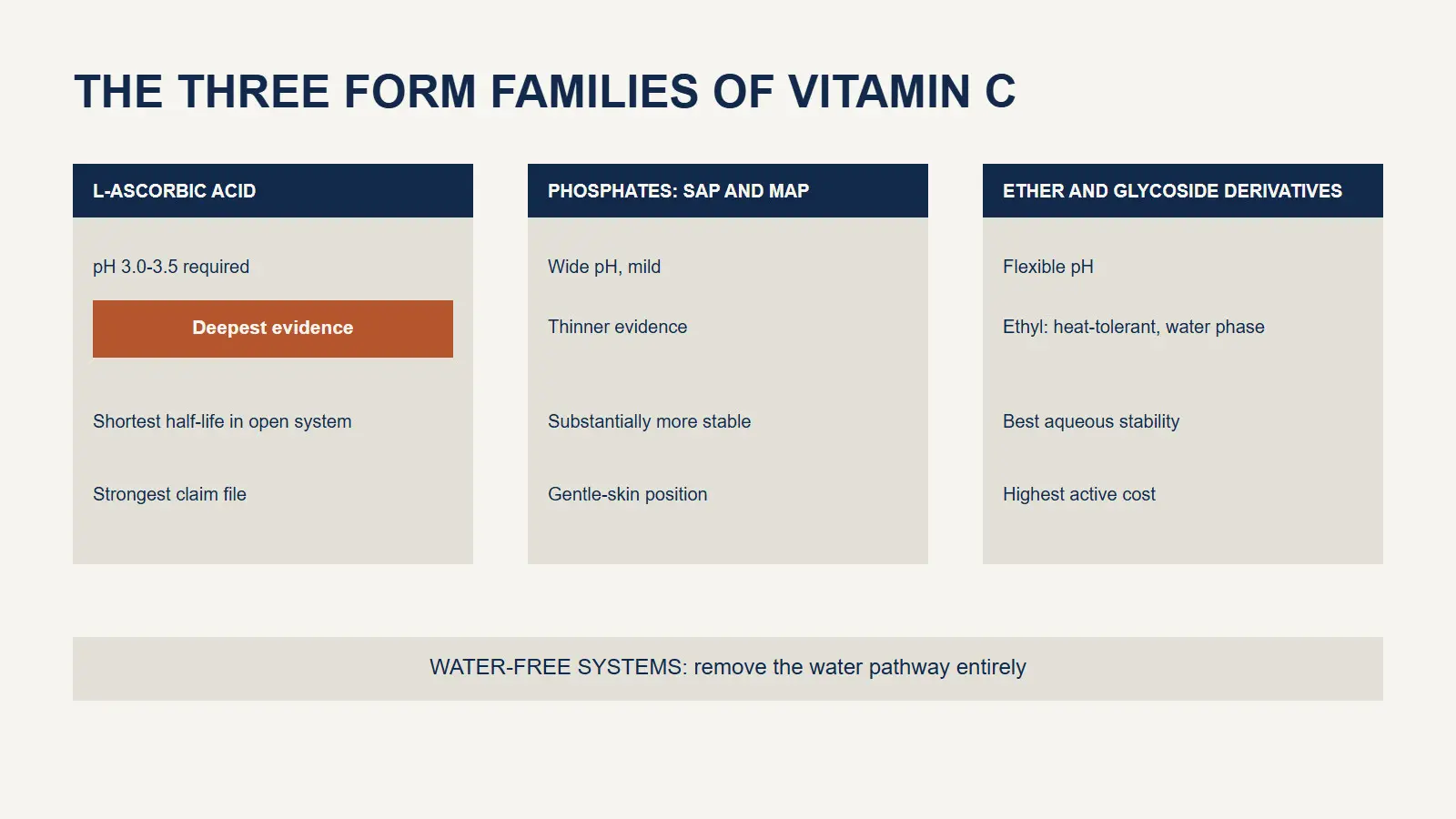
"Vitamin C" in a serum specification is a family decision, not an ingredient decision. Three families dominate commercial formulations, and they differ on the four variables that matter to a buyer: the evidence behind the claim, the stability envelope, the cost structure, and the pH the rest of the formula has to live with.
Family 1 — L-ascorbic acid (L-AA). The form with the deepest clinical literature, and the form whose performance is conditional on a low pH (the working range discussed in the formulation literature sits around pH 3.0–3.5) and a concentration band where evidence clusters, commonly cited in the 10–20% range. It is also the form with the shortest half-life in an open system. A manufacturer offering an L-AA serum is offering you the strongest claim file and the heaviest stability burden at the same time — the two travel together, and the quotation should show both.
Family 2 — Phosphate esters (SAP and MAP). Sodium ascorbyl phosphate and magnesium ascorbyl phosphate are water-soluble, substantially more stable, and workable across a wider pH range — which is what makes them the standard answer for sensitive-skin lines and warm-climate markets, where a poorly stored L-AA bottle loses to a stable derivative. The trade is evidence depth: the clinical file is thinner, and the claim language moves from the L-AA literature to "vitamin C derivative" territory.
Family 3 — Ether and glycoside derivatives (ethyl ascorbic acid, ascorbyl glucoside, ascorbyl tetraisopalmitate / VC-IP). Ethyl ascorbic acid is the heat-tolerant one — formulation literature notes it can be added in the water phase without the cold-inlet discipline L-AA demands. Ascorbyl glucoside is the formulation-friendly, premium-positioned one, widely used where texture and shelf life justify a higher retail price. VC-IP is the oil-soluble one, for anhydrous and oil-phase systems. These forms are where "stable vitamin C" stops being a slogan and becomes a supply chain.
One more system deserves its own line: water-free (anhydrous) formulations, which remove the water that oxidation kinetics run through — at the cost of a different texture, a different pump, and a different manufacturing step. How the serum manufacturers' form portfolios are typically structured is a useful frame for reading which of these families a candidate supplier actually runs in production rather than in samples.
| Form family | pH window | Evidence depth | Stability profile | Cost position | Claim strength |
|---|---|---|---|---|---|
| L-ascorbic acid | 3.0–3.5 (conditional) | Deepest in the category | Shortest half-life in open system | Moderate — active cost moderate, protection stack heavy | Strongest file, heaviest burden |
| SAP / MAP (phosphates) | Wide, mild | Thinner | Substantially more stable | Lower active cost, lighter stack | "Vitamin C derivative" language |
| Ethyl / glucoside / VC-IP | Flexible | Moderate, form-specific | Best in class among aqueous forms | Higher active cost | Form-specific, growing file |
| Water-free (anhydrous) | Not applicable | Form-specific | Removes the water pathway | Different manufacturing step | Texture-dependent retail story |
The form decision is a four-way decision — evidence, stability envelope, cost and claim boundary — and a quotation that names the form without the other three is naming a probability, not a product.
Why Serums Fail: The Oxidation Pathways, Stated at an Auditable Level
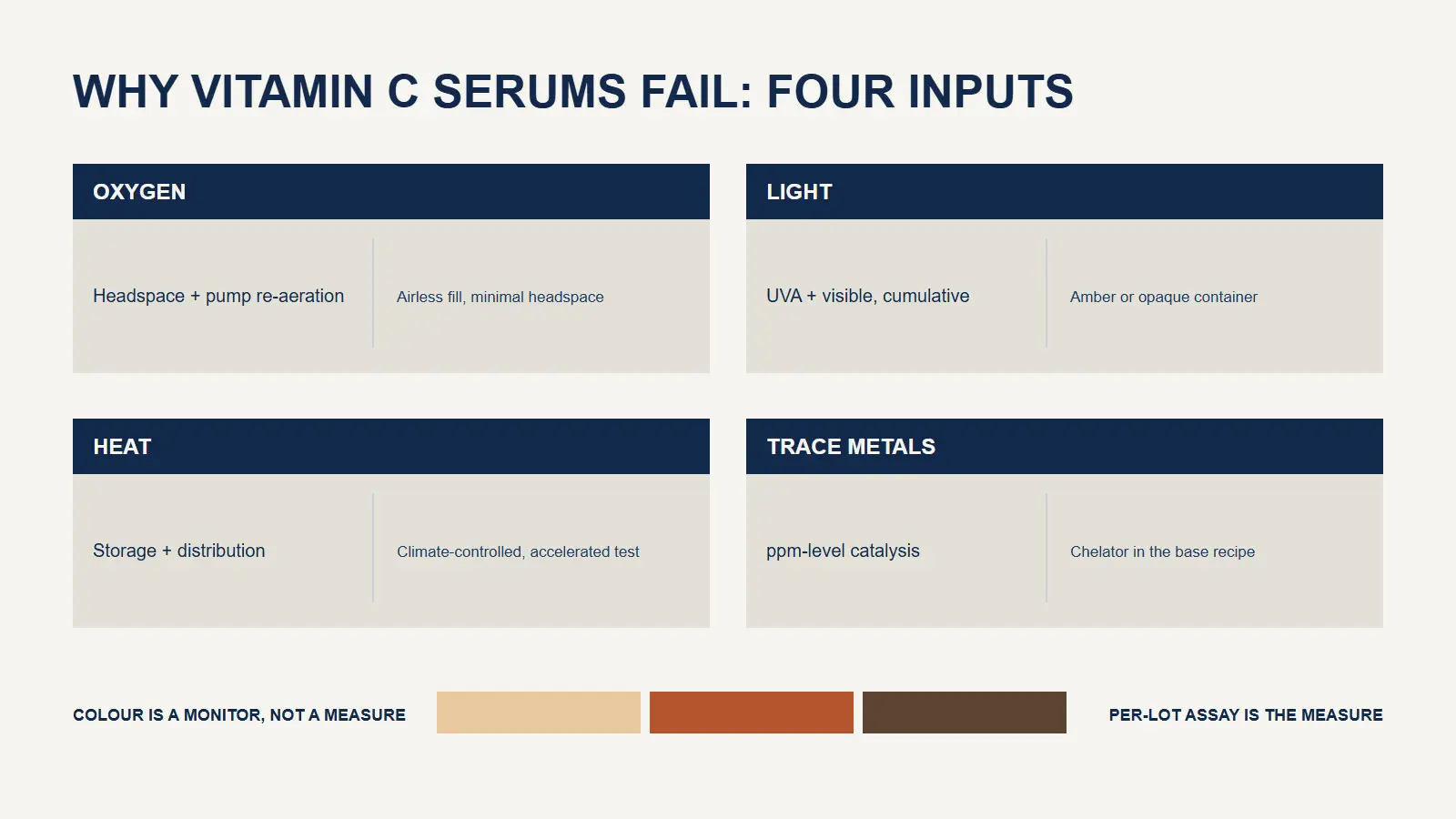
L-ascorbic acid does not "expire" the way a preservative system fails; it degrades continuously, at a rate set by four inputs. A buyer who can name those four inputs can audit any supplier's stability story, because each input has a named control, and each missing control has a named cost.
Oxygen. Every bottle carries a headspace of air, and the pump cycle re-introduces it. Oxygen is the primary oxidant, which is why the packaging conversation (airless versus conventional pump) is not a retail preference — it is a kinetics variable. A conventional pump bottle re-aerates the formula with every actuation; an airless system does not, and the difference shows up in the shelf-life curve, not in the ingredient list.
Light. UVA and visible light drive photodegradation, and the effect is cumulative from the moment the bottle leaves the line — through the warehouse, the retail shelf and the consumer's bathroom counter. Amber glass, opaque plastic and UV-filtered packaging are the standard controls; a clear glass bottle of L-AA is a formula being published under a skylight.
Heat. Every degree of storage temperature above the qualification condition accelerates the same chemistry. This is why the distribution route matters as much as the formula: a vitamin C line shipped through an unclimatised warehouse in summer is running its own forced-degradation test, with the consumer paying for the result.
Trace metals. Copper, iron and other transition metals at parts-per-million levels catalyse the degradation — which is why chelation sits in the base recipe of every serious L-AA formula, and why a "simpler, cleaner" ingredient list that drops the chelator is quietly buying back the failure mode.
| Failure input | What it does to the active | The named control | What missing it costs you |
|---|---|---|---|
| Oxygen (headspace, pump re-aeration) | Direct oxidation, continuous | Airless or sealed packaging, minimal headspace fill | Shorter shelf curve, re-aeration every actuation |
| Light (UVA + visible) | Photodegradation, cumulative | Amber / opaque / UV-filtered container | Shelf and bathroom counter as failure inputs |
| Heat (storage and distribution) | Accelerates the same kinetics | Climate-controlled warehousing, accelerated test envelope | Your logistics running the degradation test |
| Trace metals (ppm-level) | Catalysed degradation | Chelator in the base recipe | "Clean label" buying back the failure mode |
One distinction saves buyers from the category's most expensive misreading. Colour is a monitor, not a measure. An orange serum has degraded partway; a brown serum is mostly spent. But the orange bottle can still carry meaningful residual assay — and a pale bottle can be closer to failed than a yellow one, depending on the form. Colour tells you the degradation is happening; only the per-lot assay tells you how much active is left, and that number is the one that belongs in your quality agreement.
The Formulation Protection Stack: Layer by Layer, With What Each Layer Costs
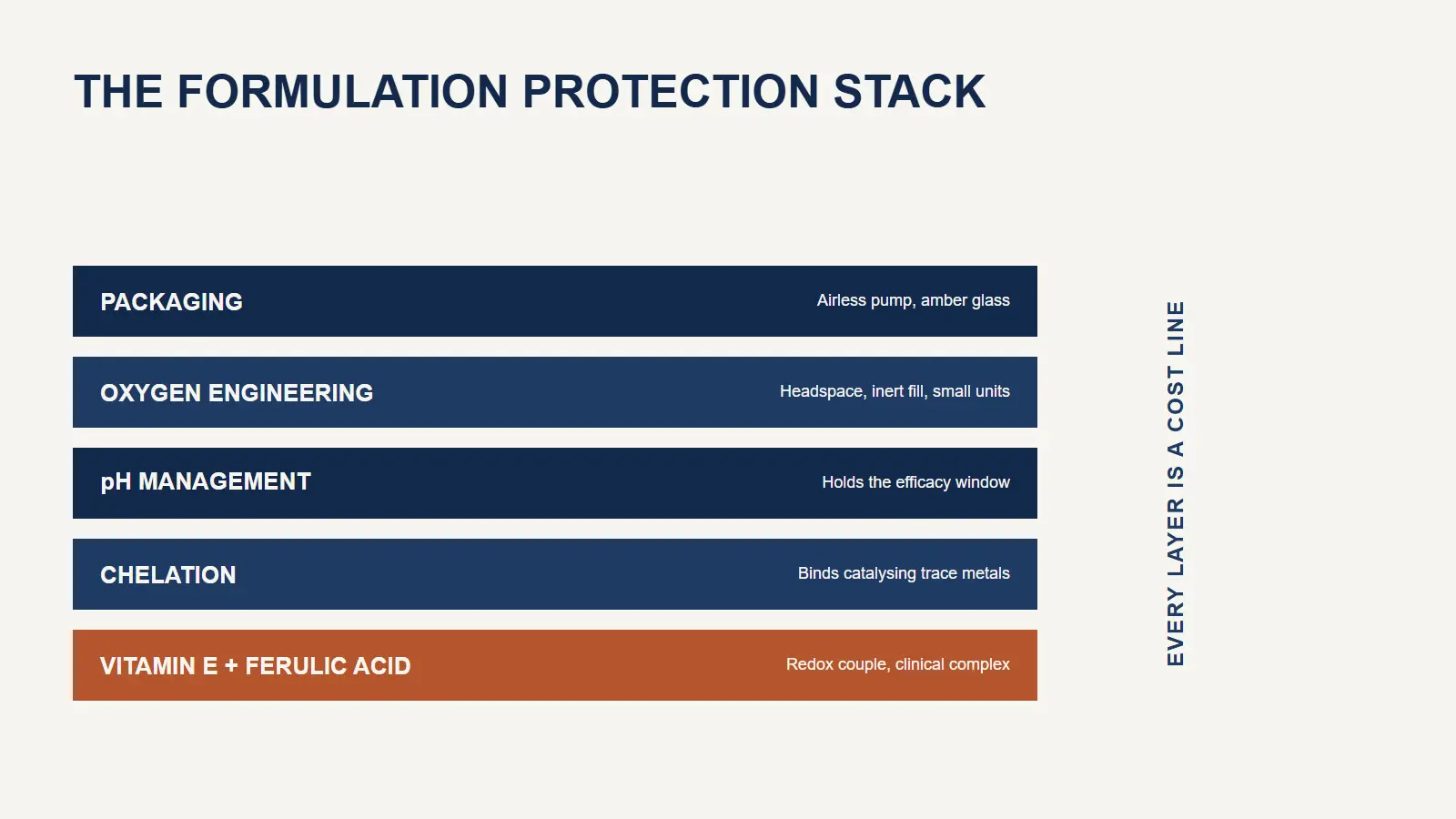
The protection stack is not one ingredient; it is five engineering layers, and a supplier who describes it as "added antioxidants" is describing a marketing decision. Each layer has a named function, a named mechanism and a named cost line — which is exactly what makes the stack auditable.
Layer 1 — The synergistic antioxidant pair: vitamin E and ferulic acid. The clinical literature on topical antioxidant complexes points to the pairing: vitamin C and vitamin E work as a redox couple (vitamin E is regenerated by vitamin C after quenching a radical), and ferulic acid stabilises the pair and adds its own photoprotective contribution. A peer-reviewed clinical study of a topical complex containing vitamins C and E with ferulic acid demonstrated protection against UV-irradiation-induced photodamage in human subjects — which is the closest the category comes to a claim with a trial behind it, and it is a claim about the complex, not about vitamin C alone. That distinction matters commercially: the stack is what the trial supports.
Layer 2 — Chelation. EDTA-class chelators bind the trace transition metals that catalyse degradation. The layer is cheap, invisible and routinely the first one dropped in a cost-down — which is how a formula that was stable in qualification quietly becomes unstable in the field.
Layer 3 — pH management. For L-AA the pH specification is the negotiation between efficacy (low pH) and degradation (low pH). Buffering capacity and the rest of the formula's acid tolerance decide how wide that window is. A supplier who states the working pH range and the reason for it is running a formulation; a supplier who states a single number is running a recipe.
Layer 4 — Oxygen engineering. Headspace minimisation at fill, inert-atmosphere handling where the line supports it, smaller unit sizes (a 30 ml bottle has a better surface-to-volume life than a 100 ml one), and the fill-line discipline that keeps air out during production. This layer lives in the manufacturing record, not the formula sheet — which is why it is the layer buyers forget to ask about.
Layer 5 — Packaging. Airless pump, amber or opaque glass, UV-filtered material, child-safety where the market demands it. The packaging is the last layer of the stack and the only one the consumer can see — which is also why it is the layer most often judged on cost alone, and then regretted in the review section.
| Stack layer | Function | Where the cost sits | How to verify it in a file |
|---|---|---|---|
| Vitamin E + ferulic acid | Redox couple; stabilises the pair | Active cost, small | INCI + per-lot assay of the complex |
| Chelator (EDTA-class) | Binds catalysing trace metals | Negligible in formula | Present in the base recipe, stated |
| pH management | Holds the efficacy/stability window | Buffering design | Working pH range stated with rationale |
| Oxygen engineering | Minimises headspace and re-aeration | Fill-line discipline, line capability | Fill record, headspace specification |
| Packaging | Closes the system on the shelf | Per-unit packaging cost | Container type, airless specification |
The protection stack is five cost lines, not one ingredient: a vitamin C serum that is cheap on the quote has a layer missing, and the layer is revealed in the stability curves, not in the ingredient list.
Vitamin C Serum Benefits for Acne: The Honest Read
The "vitamin c serum benefits for acne" search is a consumer looking for a vitamin C that will not aggravate an already-irritated face — and the honest read has two parts: what the chemistry supports, and what the compliance boundary allows.
On the chemistry: the antioxidant and anti-inflammatory properties of ascorbic acid are real, and they map onto the after of acne more than the during — tone evenness after inflammation has resolved, antioxidant defence in skin under daily oxidative stress. That is a legitimate product story, and it is a tone and comfort story, not a treatment story. The moment the copy crosses from "supports even tone and calms the look of redness" into "treats acne" or "clears breakouts," the product has crossed from a cosmetic into an unapproved drug claim — the same boundary the category's more aggressive retail copy keeps testing.
On the formulation: the low pH that makes L-AA work is, for active acne skin, an irritation input. This is precisely the commercial opening for the phosphate route: SAP and MAP deliver a vitamin C identity at a pH the compromised barrier can tolerate, with the gentler profile the acne-positioned product needs. A buyer positioning a line for acne-adjacent skin is therefore making a form decision first and a marketing decision second — and the form decision is the one that survives contact with a quality team.
The specification that follows: phosphate form or a low-pH-tolerant derivative, conservative concentration, no high alcohol load in the base, and copy written to the tone-and-comfort boundary. Everything else in the stack from H2 四 still applies — a gentle serum that oxidises in four weeks is still a failed serum, only more politely.
Vitamin C Serum Benefits and Side Effects: Tolerance as a Design Parameter
The "vitamin c serum benefits and side effects" query is the consumer version of the same question a quality team asks: where is the tolerance boundary, and who designed against it? In this category the side-effect profile is not a footnote — it is a design parameter, and the design happens in four places.
Concentration. The evidence for L-AA clusters in the working band, and above it the relationship inverts: irritation risk rises faster than benefit. The 10–20% discussion in the formulation literature is a discussion about the ceiling, not the floor — and the floor is set by the per-lot assay, because a "20%" formula that has oxidised to 8% is a different product from the one that was qualified.
pH. The acidic environment is the efficacy condition and the irritation input at once. Buffering design, application guidance (thin layer, dry skin) and the form choice all bear on it. A supplier who cannot state the working pH range and the tolerance testing done at that pH is describing a formula they have not finished.
Form. This is the lever buyers actually own. The same brand can run a strong L-AA serum for experienced users and a phosphate-form serum for the sensitive-skin entry point, and the pair is a range strategy, not a compromise — the derivative line is the answer to the "side effects" half of the query without weakening the "benefits" half of the brand.
The file. Patch and tolerance testing at the working concentration and pH belongs in the document pack for the same reason the stability curves do: it converts "some users experience stinging" from a review-section risk into a measured boundary with a number on it.
The side-effect profile is a design parameter set in four places — concentration, pH, form and the tolerance file — and a supplier who discusses it only as a consumer warning has not designed against it.
Vitamin C Serum Benefits for Oily Skin: Why the Category Fits
Of the three audience positions this category gets written into, oily skin is the one where the chemistry and the retail story agree. The "vitamin c serum benefits for oily skin" query is a buyer persona with a real formulation answer behind it, and the answer is in three parts.
Tolerance. Oily and combination skin generally tolerates the low pH that L-AA demands better than dry or compromised skin does — which is why the strong-form, high-band L-AA serum is historically an oily-skin product first and a "everyone" product second. The irritation boundary from H2 六 is furthest away for exactly the skin type the category's hero concentration targets.
Texture. The retail expectation for an oily-skin serum is matte, weightless, non-occlusive — which is a water-based, low-emollient system. That is also the system a vitamin C serum already is, so the texture requirement and the active's home agree instead of colliding. A cream-base vitamin C for oily skin is fighting both the persona and the molecule.
The sebum story. Oxidised sebum is a visible part of what oily skin looks like day to day, which gives the antioxidant narrative a concrete, honest use: defending the skin surface from the same oxidative chemistry that degrades the serum in the bottle. The claim stays in "antioxidant defence and comfort" language, and the story still lands.
The specification that follows: L-AA at the upper end of the working band, an oil-free base, a film-forming matte finish, and the full protection stack — because the faster-moving skin type is also the one that buys the fast-moving product, and the product that fails fastest on the shelf is the one that damages the line's review profile fastest.
Oily skin is where the low-pH chemistry, the matte texture and the antioxidant story all point the same way — the hero L-AA serum is an oily-skin product that got marketed to everyone.
The Hyaluronic Acid Pairing, Decided in the Formulation Lab
Hyaluronic acid is the pairing this category lives with — the morning vitamin C, the hyaluronic acid layer under it — and the "hyaluronic acid serum benefits for skin" query is where the buyer's range planning starts to touch the consumer's morning ritual. The decision a formulator actually faces has two answers, and they are different products.
Answer one: the single-bottle combination. Hyaluronic acid is chemically comfortable at the low pH an L-AA serum runs at — its hydration mechanism is not pH-fragile the way the ascorbate chemistry is — so a combined formula is feasible. The engineering is in the rheology: hyaluronate at working levels changes viscosity and drape, and the matte, fast-absorbing texture the vitamin C serum is supposed to have has to survive the thickening. A combined bottle is a single SKU with a combined stability programme — one bottle, one assay file, one stability curve — and a simpler routine is a real retention asset for a category where the consumer's morning stack is the purchase.
Answer two: the two-bottle routine. Two SKUs, two assays, two stability curves — and two price points, two shelf positions and a range architecture in which the vitamin C sells the morning and the hyaluronic acid serum sells the layer beneath it. This is the structure most mature brands actually run, and it is the structure where the vitamin C line's stability file and the hyaluronic acid line's specification file are separate contracts with the manufacturer, even though the marketing presents them as one system. The full B2B picture of hyaluronic acid as an ingredient line is the companion read for the second bottle.
The buyer's question is therefore not "should I combine them" but "which failure mode can I afford": the single bottle fails as one SKU with a harder rheology problem; the two bottles fail as a range with double the qualification cost. Both are defensible; neither is free.
The Stability Program You Must Demand Before Paying for a Sample
The stability programme is the document set that converts "12 months shelf life" from a statement into a fact. It has five components, and each one answers a different question the others cannot.
1. The per-lot assay. HPLC-based potency testing on the finished product, lot by lot. This is the only number that tells you how much active is actually in the jar you received — and the only number in the category that survives contact with a distributor's quality team. A supplier who assays the active ingredient on arrival but not the finished serum is measuring the wrong end of the line.
2. The accelerated stability curve. Colour and potency plotted over time at accelerated conditions (the standard 40 °C / 75% RH envelope and its relatives), at defined intervals. The curve — not the endpoint — is the deliverable: it shows the degradation rate, which is what lets you predict month six from month two.
3. The forced-degradation work. Single-variable stress: light, heat, oxygen exposure, each isolated. This is the experiment that proves the protection stack from H2 四 is doing its named jobs — remove the chelator and watch the rate change, and the chelator's line item becomes real.
4. The retention sample policy. What is held per lot, for how long, under what conditions — the audit trail that makes a complaint, a recall or a claim dispute resolvable instead of argumentative.
5. The fill and packaging record. Headspace specification, inert-atmosphere capability, the container type and the airless confirmation — the oxygen-engineering layer made documentary.
| Programme component | What it proves | What its absence means |
|---|---|---|
| Per-lot HPLC assay | Potency of the exact jar you receive | The concentration is a label, not a measurement |
| Accelerated curve (colour + potency vs time) | The degradation rate | Month six is a guess, extrapolated from nothing |
| Forced degradation (isolated variables) | Each protection layer does its named job | The stack is asserted, not demonstrated |
| Retention sample policy | The audit trail | Complaints become arguments |
| Fill / packaging record | The oxygen engineering | Headspace is whatever the line gave |
The reading discipline: colour data without potency data is a monitor passed off as a measure (H2 三); a four-week curve without a declared shelf-life qualification is extrapolation wearing a certificate. Ask for the five components as a set, in writing, before the sample fee moves — because the sample that arrives without them is the most expensive piece of packaging in the category.
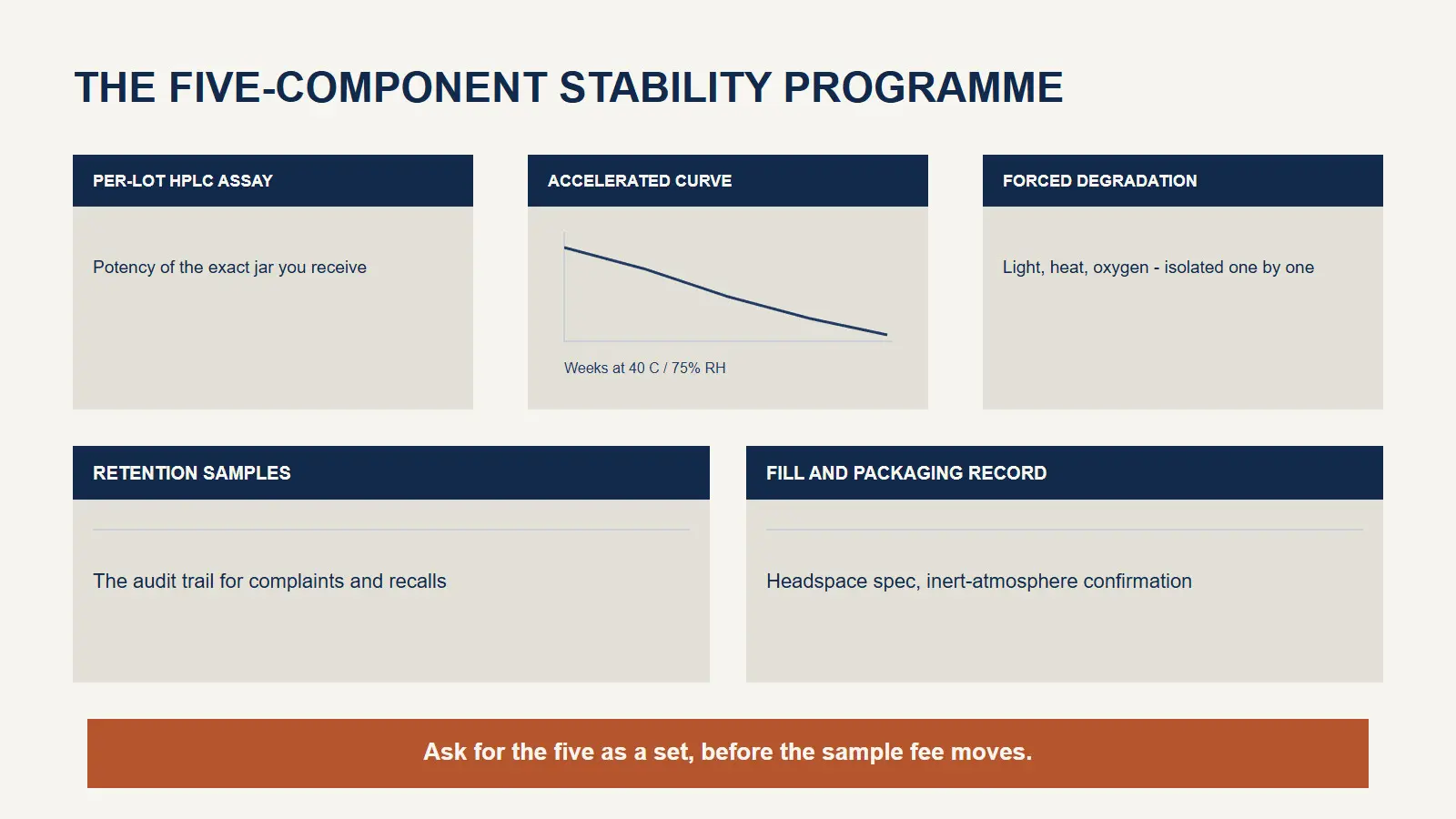
Ask for the five components as a set, in writing, before the sample fee moves — a sample that arrives without them is the most expensive piece of packaging in the category.
Cost, MOQ and the Private Label Decision
The quotation for a vitamin C serum is a quotation for four things at once, and reading them separately is what turns a price comparison into a decision.
The active. L-AA sits at a moderate position; the phosphates are cheaper per gram; the ether and glycoside derivatives carry the highest active cost in the family. A "15% vitamin C" quoted on a phosphate base is a different product from the same percentage on L-AA — same headline number, different evidence file, different stability burden, and the difference is visible only if you know to ask which form the percentage is in.
The protection stack. The vitamin E and ferulic acid layer is a small line; the chelator is negligible; the real stack cost is the oxygen engineering and the packaging that closes the system.
The stability programme. A one-time qualification cost (accelerated curve, forced degradation, tolerance file at your concentration and pH) plus a per-lot running cost (the HPLC assay on every finished lot). Suppliers who fold the qualification into the project fee and the assay into the per-unit price are pricing the programme honestly; suppliers who quote only the unit price are pricing it for someone else.
The packaging. Airless pump, amber or opaque glass, small-unit geometry — each is a per-unit premium over a conventional clear bottle, and each is a layer of the stack wearing a retail costume. How the serum manufacturers in China typically structure these cost and MOQ positions is the practical frame for the first conversation, because the MOQ in this category is driven less by the formula than by the packaging qualification and the stability project that precede the first production batch.
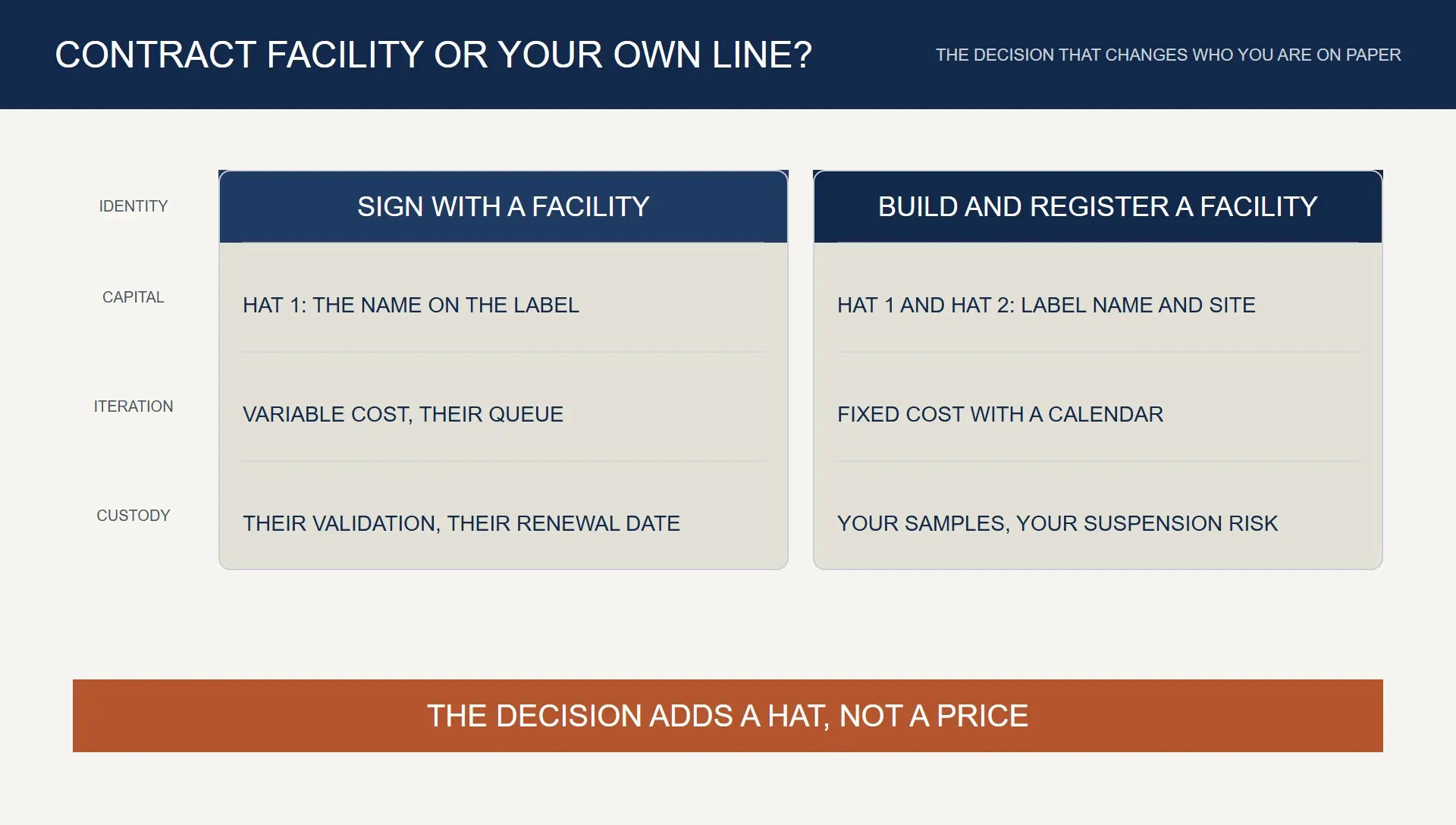
The private label decision then resolves into the same shape it has in every format category: an existing, qualified vitamin C line under your label (fast, cheap, and someone else's stability history), a re-positioned line at your concentration and your stack (the usual first custom step), or a fully owned formulation with the stability programme run under your specification (the only version where "our vitamin C" is a sentence your quality file can support).
| Cost line | L-AA line | Phosphate line | Derivative line |
|---|---|---|---|
| Active cost position | Moderate | Lower | Highest in family |
| Protection stack load | Heaviest (the whole stack earns its keep) | Lighter | Moderate, form-dependent |
| Stability programme | Full, at low pH | Full, at mild pH | Form-specific qualification |
| Packaging premium | Airless + dark, expected | Standard acceptable | Airless still preferred |
| MOQ driver | Packaging + qualification batch | Formula batch | Packaging + qualification batch |
The same "15 percent vitamin C serum" quoted on three form families is three different products — the price difference is the form decision wearing a cost column.
Frequently Asked Questions
Q1: Do vitamin c serum benefits for skin actually depend on the formulation?
Yes — and in this category more than in any other. The clinical evidence for the benefits is settled; what varies from bottle to bottle is whether the active survives to deliver them. The form (L-AA versus a derivative), the concentration and its per-lot assay, the pH window, and the protection stack together decide what the consumer actually receives in month six. The benefits are real, and they are conditional on four formulation decisions that the ingredient list does not show.
Q2: Why did my vitamin C serum turn orange?
Oxidation. The headspace oxygen, the light on the shelf, the summer warehouse, and any trace metal the chelator was not holding all contribute, and the colour change is the visible tail of the same chemistry that is consuming the active. Orange means partway degraded — the residual assay may still be meaningful; brown means mostly spent. Colour is the monitor, the per-lot assay is the measure, and only the second one belongs in a quality agreement.
Q3: Are vitamin C derivatives less effective?
Less evidenced, and more stable — the trade is real, and the honest framing is situational. A well-stored L-AA serum is the stronger claim file; a stable derivative in a warm climate, on a sensitive-skin line, or in a distribution chain you do not control can outperform an L-AA serum that has spent itself on the shelf. "Less effective" is only true for the bottle that made it to the consumer intact.
Q4: What concentration should I specify?
The evidence for L-AA clusters in the 10–20% working band, and above the band the irritation curve rises faster than the benefit curve. The specification is a pair of numbers — the target concentration and the per-lot assay tolerance around it — because a "20%" label and a 20% measured assay are different statements, and only the second one is enforceable.
Q5: Hyaluronic acid serum benefits and side effects — what should a range planner know?
The benefit profile is hydration and the look of plumper, better-drapped skin, delivered by a molecule whose mechanism is not pH-fragile — which is exactly why it pairs with vitamin C in both single-bottle combinations and two-bottle routines. The side-effect profile is mild and usually attributable to formulation quality (purity, co-solvents, the rheology agents) rather than to hyaluronic acid itself. For a range planner the practical point is that the hyaluronic acid bottle is the low-risk SKU that carries the routine, while the vitamin C bottle carries the claim — and the pair is a retention structure, not an ingredient coincidence.
Q6: How do I verify a manufacturer's stability claims before paying for a sample?
Ask for the five components as a set: the per-lot assay method and a result, the accelerated stability curve with colour and potency at defined intervals, the forced-degradation work, the retention sample policy, and the fill and packaging record. A supplier with the set has a programme; a supplier with a shelf-life number has a statement. The set costs you a request, and it is the cheapest quality audit in the category.
What to do next
If vitamin C is on your 2026–27 line plan — and the demand data says it should be, in the US, the UK and especially Germany — the next move is a stability conversation, not a price conversation. Send us the form direction you are weighing (an L-AA line at the strong end, a phosphate line for the gentle position, or a derivative line built for a warm-climate market), the price point you are defending, and the channel the bottle will land in. We will respond with a stability sample set — one fresh bottle and one six-month accelerated bottle from the same lot, so you can hold the degradation curve in your own hand — together with the per-lot assay template from this guide and the protection-stack configuration sheet for your chosen form.
The demand is rising in the largest markets in the category, and the molecule is unforgiving of the buyers who treat it as a commodity line. The four terms from the first section — form, concentration, pH, stability programme — are all still unpriced in your file.
Send us your vitamin C brief and put the stability conversation on the sample table.
Sources and Further Reading
1. Precedence Research — Vitamin C Market — https://www.precedenceresearch.com/press-release/vitamin-c-market (2025: USD 2.37B, projected USD 3.78B by 2033) — commercial research house 2. Emergen Research — Vitamin C Market 2025-2035 — https://www.emergenresearch.com/industry-report/vitamin-c-market (2025: USD 1.18B; 2026: USD 1.11B, growing toward USD 1.66B) — commercial research house, narrower scope than item 1 3. LinkedIn Pulse (secondary digest, not primary research) — Ascorbic Acid Market Size and Outlook 2031 — https://www.linkedin.com/pulse/ascorbic-acid-market-size-outlook-2031-mukul-tiwari-seo-expert-ncepc (2025: USD 2.15B to 2031: USD 2.96B, CAGR 5.45%) — secondary 4. Coherent Market Insights — Vitamin C Derivatives Market 2026-2033 — https://www.coherentmarketinsights.com/industry-reports/vitamin-c-derivatives-market (2026: USD 4.2B to 2033: USD 5.9B) — commercial research house 5. Verified Market Reports — Vitamin C Derivatives for Cosmetic Market — https://www.verifiedmarketreports.com/product/vitamin-c-derivatives-for-cosmetic-market/ (2024: USD 1.2B to 2033: USD 1.8B, CAGR 4.61%) — commercial research house, cosmetic-specific scope 6. Dataintelo — Ascorbyl Palmitate Market Research 2034 — https://dataintelo.com/report/global-ascorbyl-palmitate-market (2025: USD 182.4M to 2034: USD 308.6M, CAGR 6.0%) — commercial research house, single-derivative scope 7. Technavio — Ascorbic Acid Market Analysis — https://www.technavio.com/report/ascorbic-acid-market-industry-analysis (increment USD 379.16M over 2023-2028, CAGR 5.16%) — commercial research house 8. Peer-reviewed clinical study: "Protective Effects of a Topical Antioxidant Complex Containing Vitamins C and E and Ferulic Acid Against UV-Irradiation-Induced Photodamage in Chinese Women" — https://www.researchgate.net/publication/236654116 (the complex-level claim with a human trial behind it) 9. Peer-reviewed review: "Topical Vitamin C and Its Derivatives in Cosmetic Science: Stability, Formulation and Delivery" (Journal of Cosmetic Science, 2025-11) — https://brieflands.com/journals/jssc/articles/163798 (ethyl ascorbate water-phase addition; derivative stability profiles) 10. INCI API — Vitamin C in Skincare: Forms, Stability and What the Evidence Supports (2026-06, industry technical) — https://inciapi.com/blog/vitamin-c-in-skincare/ (L-AA working band 10-20%, low pH condition, vitamin E and ferulic acid pairing) 11. Grand Ingredients — Vitamin C in Cosmetics: Stability and Clean Innovation (industry technical) — https://grandingredients.com/vitamin-c-cosmetics-stability/ (low-pH systems 2.5-3.5; vitamin E plus ferulic acid as the daytime photoprotection standard) 12. Octagon Chem — The Cosmetic Formulator's Guide to Vitamin C Derivatives (2026-03, supplier technical) — https://octagonchem.com/blog/vitamin-c-derivatives/ (five derivative families: ascorbyl glucoside, MAP, SAP, ethyl ascorbic acid, VC-IP) 13. Hale Cosmeceuticals — Best Vitamin C Form for Professional Skincare (supplier technical) — https://www.halecosmeceuticals.com/blog/best-vitamin-c-form-professional-skincare-ascorbic-map-sap-ascorbyl-glucoside (water-free systems reduce oxidation exposure; pH and packaging checklist) 14. Retail and consumer format observation: mass-market vitamin C serum listings and consumer threads on oxidation and colour change — format and complaint-pattern observation only, not efficacy data 15. Demand data: Amazon-internal weekly search volume (window 2026-08-23 to 2026-09-05), from the queue word pack — US "vitamin c serum" 147,873 weekly average, +39.4% over four weeks; UK 13,147, +22.4%; Germany 7,709, +94.6% — not Google search volume 16. Keyword metrics: Semrush free online tool, United States database, 2026-09-17 — the main word carries Volume 720 / KD 28% / CPC USD 0.30; indicative, unaudited
Scope and interest disclosure: items 1-7 are commercial research-house estimates whose scopes differ materially (all applications versus cosmetic-specific, vitamin C as ingredient versus derivatives as market) — the article treats the spread as the analysis object and names each house and scope at the point of use; no single figure is presented as "the" market. Item 3 is a secondary digest used only to show the width of the estimates. Items 10-13 are industry and supplier technical documents; where they state formulation parameters they are corroborated across at least two independent sources and against the peer-reviewed items 8-9. Item 14 supports consumer complaint patterns only, never an efficacy claim. Item 15 is an e-commerce platform signal and is not interchangeable with Google search volume.