

When "Contains" Is No Longer Enough: Efficacy Skincare Moves Into the Dose-Response Era
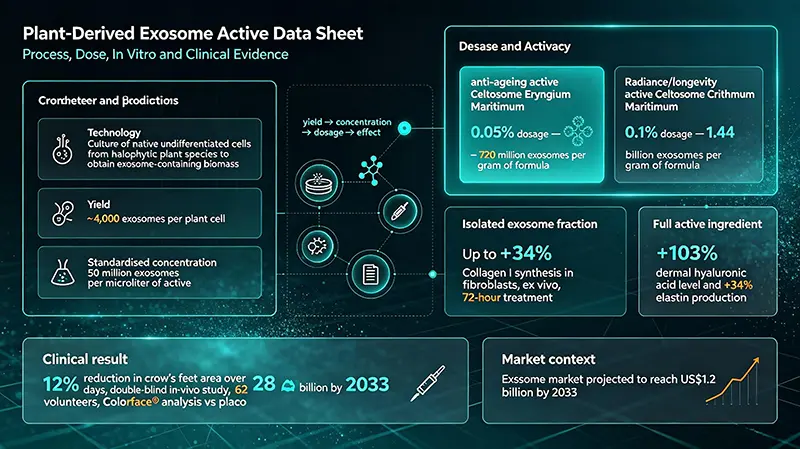
In September 2026, French cosmetic active-ingredient supplier Seppic published a set of figures every buyer should stop and read: its Celtosome technology platform cultivates native undifferentiated cells from halophytic species to yield biomass containing roughly 4,000 exosomes per plant cell, standardised to a concentration of 50 million exosomes per microliter of active. In product terms: Celtosome Eryngium Maritimum, aimed at anti-ageing, delivers 720 million exosomes per gram of formula at a 0.05% dosage; Celtosome Crithmum Maritimum, aimed at radiance and skin longevity, delivers 1.44 billion per gram of cream at 0.1%.
Why do these numbers matter? Because they do something the industry has long avoided — translating "contains ingredient X" into "delivers N active units per gram of formula". More importantly, Seppic tested the isolated exosome fraction separately, demonstrating that the fraction itself contributes directly to biological activity rather than merely being present. If you are sourcing efficacy skincare, or deciding formulas for your next anti-ageing or brightening line, the meaning of this news is not "another active launched" but this: your price comparison, your formulation brief and your claim evidence chain all need upgrading.
The Facts: Turning "Contains" Into "How Much"
Let us lay out the published raw data first, to avoid being led astray by "high-tech" language. All figures below come from Seppic's official release and trade-media technical reporting:
| Dimension | Figure |
|---|---|
| Technology | Culture of native undifferentiated cells from halophytic plant species to obtain exosome-containing biomass |
| Yield | ~4,000 exosomes per plant cell |
| Standardised concentration | 50 million exosomes per microliter of active |
| Anti-ageing active (Celtosome Eryngium Maritimum) | 0.05% dosage → 720 million exosomes per gram of formula |
| Radiance/longevity active (Celtosome Crithmum Maritimum) | 0.1% dosage → 1.44 billion exosomes per gram of formula |
| Isolated exosome fraction | Up to +34% collagen I synthesis in fibroblasts (ex vivo, 72-hour treatment) |
| Full active ingredient | +103% dermal hyaluronic acid (ex vivo skin explants vs placebo, 5 days); +34% elastin production |
| Clinical result | 12% reduction in crow's feet surface area over 28 days (double-blind in vivo study, 62 volunteers, Colorface® analysis vs placebo) |
| Market context | Exosome market projected to reach US$1.2 billion by 2033 (Grand View Research) |
Seppic stressed in its release that the real challenge for brands lies in "the ability to rely on a precise and reproducible concentration derived from an eco-responsible plant source in compliance with international regulations". That sentence exposes the commercial nature of dose data: it is not laboratory showmanship but a supply-chain consistency problem — if active-unit counts cannot be reproduced across batches, factories and formulas, then "efficacy" is a random variable.
The Third Upgrade in How Efficacy Is Expressed
The key to understanding this shift is seeing the three generations of efficacy expression the industry has already passed through:
English (cont.): What Seppic's figures do is push the industry from the second generation into the third: it does not merely claim "we contain exosomes", nor simply stack "10% concentration", but supplies a three-layer structure — standardised concentration (50 million per microliter), actual delivered quantity in formula (720 million / 1.44 billion per gram), and specific biological and clinical results measured at that dose. Remove any layer and the efficacy story is incomplete: concentration without counting is "contains"; counting without dose-response results is "a parameter"; results without standardisation is "one anecdote". All three together equal reproducible efficacy.
Why This Concerns You: Three Direct Impacts
Impact one: your price comparison table may need rebuilding. When two suppliers both write "contains exosomes", a price gap reads as "brand premium". But when one has a standardised concentration of 50 million per microliter delivering 720 million per gram in formula, while the other merely offers "exosome-containing culture filtrate" with no counting metric, the price gap becomes a cost-per-active-unit gap. That hands you a negotiating tool you did not have before: divide the quote by active units delivered per gram to get "cost per 100 million active units" — that is the only comparison that means anything. One caution: not every active uses the same unit definition, so meaningful comparison requires aligned counting conventions.(To compare the actual formula presentation methods of independent factories in anti-aging, brightening, and repairing lines, you can browse the FKY product series)
Impact two: your claim evidence chain needs an upgrade. If your product claims "contains exosomes, supports repair", and you are asked to substantiate it (under frameworks such as the EU's ECGT and the US MoCRA, claims must be evidenced), "what it contains" is not enough. You need the actual delivered quantity in formula, the test method used at that dose (ex vivo, clinical, consumer), sample size and duration, and control design. Seppic's "62 volunteers, 28 days, double-blind, Colorface® image analysis vs placebo" is a usable structural template — whether your supplier can provide data at that granularity directly determines whether your claim stands.
Impact three: your supplier screening gains a dimension. Screening used to mean capacity, certifications and price. Now add standardisation and reproducibility capability: a standardised active-counting convention, batch-to-batch concentration consistency data, and the ability to produce mechanism-level evidence such as testing an isolated fraction. For a brand, the value of that capability is simple — it determines whether your product is still the same thing after a batch change, a scale-up or a factory switch.
8 Questions to Ask Your Supplier
Turning the analysis into action yields a question list you can send to current or candidate suppliers today.(For the cooperation and verification path of small and medium-sized batches, please refer to the article "China Low MOQ Skincare OEM" on the website.) Ask for written answers and put critical items into the contract annex.
- Counting convention: how is an "active unit" defined and counted for this active — concentration (mg/mL), unit count (per gram), or something else?
- Standardised concentration: what standardised concentration can you commit to, and by what method is it measured (HPLC, NTA nanoparticle tracking, cell counting)?
- Batch consistency: what was the batch-to-batch concentration variance over the past 12 months? Is that figure stated on the COA?
- Delivered quantity in formula: at my target dosage (e.g. 0.05%, 0.1%), how many active units per gram of finished product? Is the conversion documented?
- Dose-response data: has dose-response testing been done? Which dose points were covered, and what were the conclusions?
- Mechanism-level evidence: has the isolated active fraction been tested separately to demonstrate its direct contribution? With what result?
- Clinical and consumer data: what were the sample size, duration, control design and statistical method? Can you share a test-report summary?
- Substitution and downgrade plan: if this active becomes expensive or unavailable, what is the equivalent alternative, and how will dose-response be re-validated?
How to use it: questions 1-3 filter out suppliers with concepts but no counting; 4-6 verify whether efficacy is genuinely reproducible; 7 determines whether your claim can ship; 8 protects your long-term cost. Sending all 8 to three suppliers and comparing written answers is itself an extremely low-cost supplier due diligence exercise.
Contract Points: Writing Dose-Response Into the Agreement
Data only becomes leverage when it lands in a contract. The five points below are ranked by importance and can serve as a legal brief (specific clauses depend on your market and commercial relationship):
- Active counting and concentration commitment: state the active-unit definition, the committed concentration range and the test method; require the COA to include that figure.
- Batch-consistency threshold: agree an allowable variance range and the remedy if exceeded (replacement, price adjustment or shared re-validation cost).
- Dose-response data with each batch: require per-batch concentration results for the active, plus a clause preserving your right to request the most recent dose-response report.
- Claim-substantiation support obligation: require the supplier to provide test summaries and data usage rights needed for claim substantiation — this ties directly to evidentiary requirements in markets such as the EU (ECGT) and the US (MoCRA).
- Change-control clause: written advance notice if the supplier changes raw-material source, process or manufacturing site, plus equivalence data after the change — the last gate protecting your product's consistency.
Six Frequently Asked Questions
Q1: Should a small brand really demand dose data? Won't it look unreasonable? On the contrary, it is the cheapest move available to a small brand. Large brands can validate internally; you cannot — so you need suppliers to provide reproducible counting and dose data. This is not being difficult; it is converting "I can't read your formula" into "I compare you and your competitors on one set of metrics".
Q2: Not every ingredient has a defined "active unit" — what then? Correct. Single-molecule actives such as peptides, niacinamide and hyaluronic acid are usually fine measured by concentration (%); composite systems such as exosomes, cell-culture filtrates and plant extracts need unit counting. Clarify which category your ingredient belongs to before choosing the metric — do not force one standard onto everything.
Q3: Can dose-response data be used directly as a marketing claim? Use caution. Lab data (ex vivo/in vitro) typically supports mechanism explanation, while human efficacy claims generally need clinical or consumer-test data — and rules differ by market (the EU's ECGT and the US's MoCRA each set their own evidentiary expectations). Treating data as "evidence material" rather than "a claim sentence you can quote" is the safer route.
Q4: Is 720 million exosomes per gram credible as an order of magnitude? As an order of magnitude, nanoscale vesicles (30-150 nm) reaching hundreds of millions per gram in a standardised culture system is not implausible; the key is whether the test method is disclosed and reproducible. You do not need to judge whether a number is "big" — you need to ask how it was measured, how much it varies between batches, and whether it can be re-verified.
Q5: If my current supplier cannot produce this data, should I switch? Handle it in tiers: if they cannot provide a counting convention (Q1), their efficacy narrative lacks a foundation — put them on a watch list. If they only lack clinical data (Q7), you can bridge with ex-vivo mechanism data plus consumer testing while writing the missing data into the next agreement.
Q6: Will this approach raise my sourcing costs? Possibly in the short term (testing and validation cost money), but usually lower in the medium term: once you negotiate on "cost per 100 million active units", overpriced quotes become visible, and rework or returns caused by underperforming efficacy decline. Front-loading validation cost is really back-loading risk cost.
A 12-Month Action Roadmap
Here is the analysis folded into an executable schedule:
English summary: The greatest value of Seppic's figures is not that they prove a particular exosome active works, but that they demonstrate a reusable structure for expressing efficacy: standardised concentration → delivered quantity in formula → mechanism and clinical results at that dose. That structure applies to any active you buy. Learning the structure matters more than memorising the numbers.
Take this list into your next supplier meeting: can your current active supplier answer "how many active units are delivered per gram"? Does your purchase agreement contain a single clause requiring per-batch concentration data? If you want to benchmark current or candidate factories on the same metrics — counting conventions, batch consistency, dose-response and substantiation support — send us the 8-question list: FKY offers brand-side buyers a free formulation and data-fit assessment, so you can see the differences before your next formulation decision.