

When Free Trade Stops Protecting Beauty: The 50% US-Canada Tariff
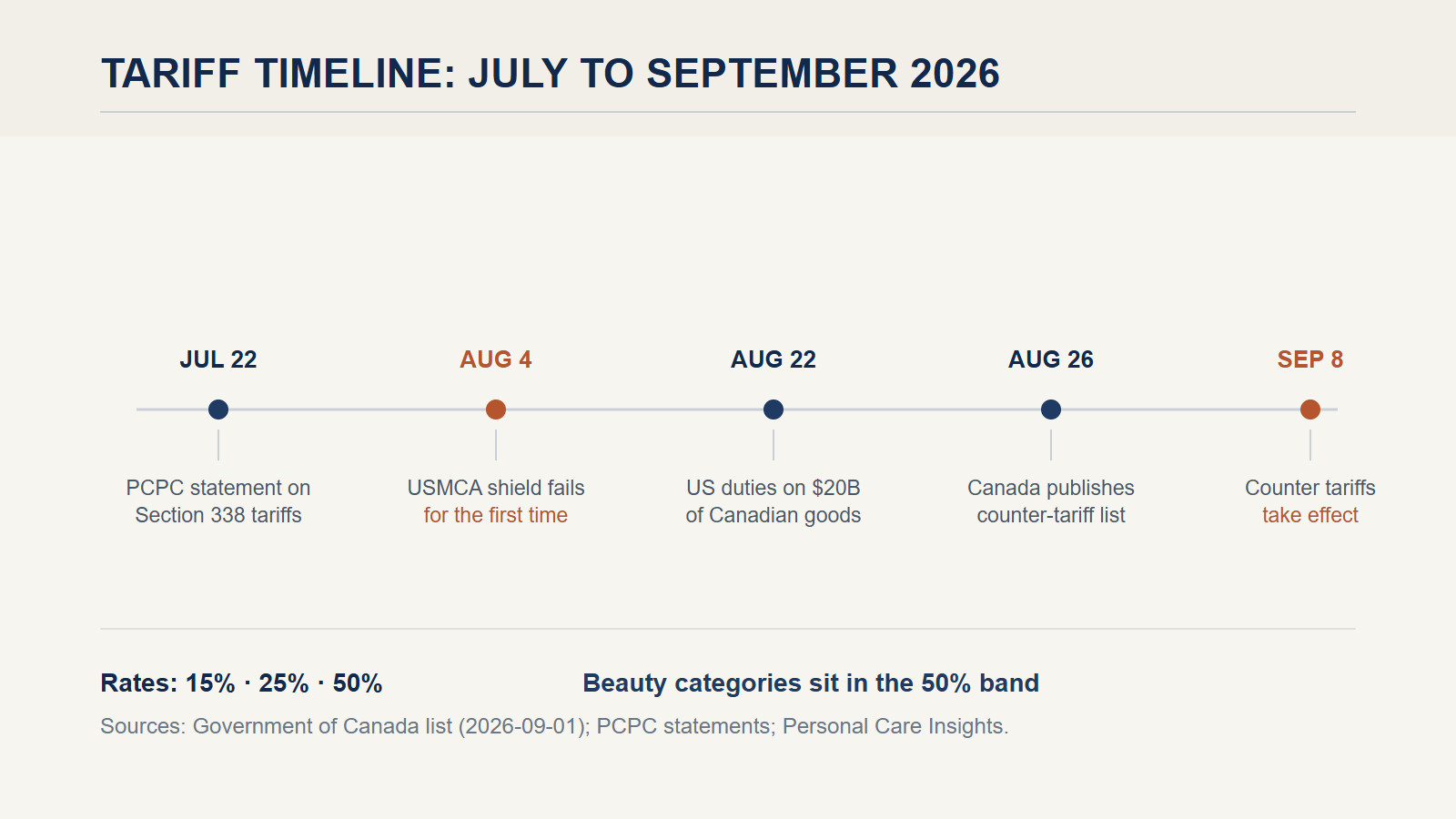
Since late August 2026, North America's personal care industry has taken a hit that differs in kind from earlier tariff rounds. The US imposed a 50% tariff on Canadian chemicals, cosmetics and toiletries, and Canada retaliated with duties at 15%, 25% and 50%, with perfumes and toilet waters, lip and eye makeup, hair care preparations and manicure/pedicure products placed in the 50% band, effective 8 September 2026 (Sources: Government of Canada, Department of Finance list, updated 2026-09-01; Premium Beauty News, 2026-08-26).
The bigger story is not the rate but a broken assumption. Personal Care Insights states plainly that this is the first time USMCA compliance has failed to shield Canadian personal care goods from US duties (Source: Personal Care Insights, 2026-08-04). In other words, the underlying logic of the North American supply chain — meet the origin rules and cross the border duty-free — has failed for personal care for the first time.
The facts: one tariff list, two effective dates
| Date | Event | Source |
|---|---|---|
| 2026-07-22 | PCPC issues a statement on Section 338 tariffs, noting the US maintains a $1.9 billion trade surplus in finished cosmetic and personal care products with Canada | PCPC statement, 2026-07-22 |
| 2026-08-04 | Trade media confirm a US 50% tariff on Canadian chemicals, cosmetics and toiletries; USMCA compliance fails to shield personal care for the first time | Personal Care Insights, 2026-08-04 |
| 2026-08-21 | Canada's Prime Minister Carney suspends trade negotiations with the US, calling the conditions "unfair" | Premium Beauty News, 2026-08-26 |
| 2026-08-22 (Sat) | The US imposes new duties on about $20 billion of Canadian goods, including construction materials, alcohol, honey, agricultural products and certain colour cosmetics and perfumes | Premium Beauty News, 2026-08-26 |
| 2026-08-25 | PCPC again urges both sides to return to the table; Canada announces 50% counter-tariffs on certain US makeup imports | PCPC, 2026-08-25; Bloomberg, 2026-08-25 |
| 2026-08-26 | PCPC responds to Canada's published counter-tariff list, noting the actions affect "cosmetics and personal care products used by consumers every day" | PCPC statement, 2026-08-26 |
| 2026-09-01 | Government of Canada updates the complete list of US products subject to counter tariffs | Government of Canada, 2026-09-01 |
| 2026-09-08 | Canada's counter-tariffs take effect (15% / 25% / 50%) | Government of Canada, 2026-09-01 |
The list of categories placed in Canada's 50% band is the most practical page of this story. Per the tariff table published by the Government of Canada, perfumes and toilet waters, lip makeup, eye makeup, hair care preparations, and manicure and pedicure products all attract 50% (Source: Government of Canada list, cited with table by Premium Beauty News, 2026-08-26). The implication: while skincare categories such as sheet masks, serums and cleansers were not individually named, the colour cosmetics, fragrance and hair care lines on the same purchase order will be hit by cost first — and on the retail side they typically share one replenishment and customs workflow with skincare.
Why this round is different: USMCA failed for the first time
The value of understanding this lies in what it changes about how buyers decide. North American sourcing logic used to rest on one premise: duties are predictable and agreements can be relied upon. That premise has now failed.
| Dimension | Before (USMCA in force) | Now (after this round) | What it means for buyers |
|---|---|---|---|
| Duty predictability | Origin compliance meant duty-free crossing; cost was precisely modelable | Agreement compliance is no longer sufficient for duty-free treatment (Source: Personal Care Insights, 2026-08-04) | Landed-cost models must include an "agreement fails" scenario |
| Origin selection logic | Choose between US, Canada and Mexico on capacity and cost | Origin itself can become a cost risk | Multi-origin moves from optimisation to risk control |
| Price pass-through | Duties mostly marginal, absorbable internally | 50% is a step change, hard to absorb | Renegotiate upstream or adjust specification and packaging |
| Compliance complexity | Customs mainly needed an origin certificate | Adds classification disputes, origin evidence, counter-tariff list checks | Assign dedicated ownership of classification and list matching |
PCPC's public data shows the scale of this supply chain. The US personal care industry manufactures in 49 states, supports more than 2.6 million American jobs, and exports a record $15.8 billion in cosmetics and personal care products each year. Canada is the largest export market for US cosmetics and personal care, accounting for $4.2 billion in annual exports and more than one quarter of all US industry exports (Sources: PCPC statements, 2026-08-25 and 2026-08-26). At the same time, the US maintains a $1.9 billion trade surplus in finished cosmetic and personal care products with Canada (Source: PCPC statement, 2026-07-22).
Put those three numbers together and the industry association's response makes sense: it is urging negotiations rather than endorsing tariffs because this is not a one-sided loss but a deeply interlocked bilateral chain. $4.2 billion in annual exports and a quarter of all industry exports mean a tariff at either end immediately rebounds onto capacity and jobs at the other.
Who actually absorbs the 50% tariff
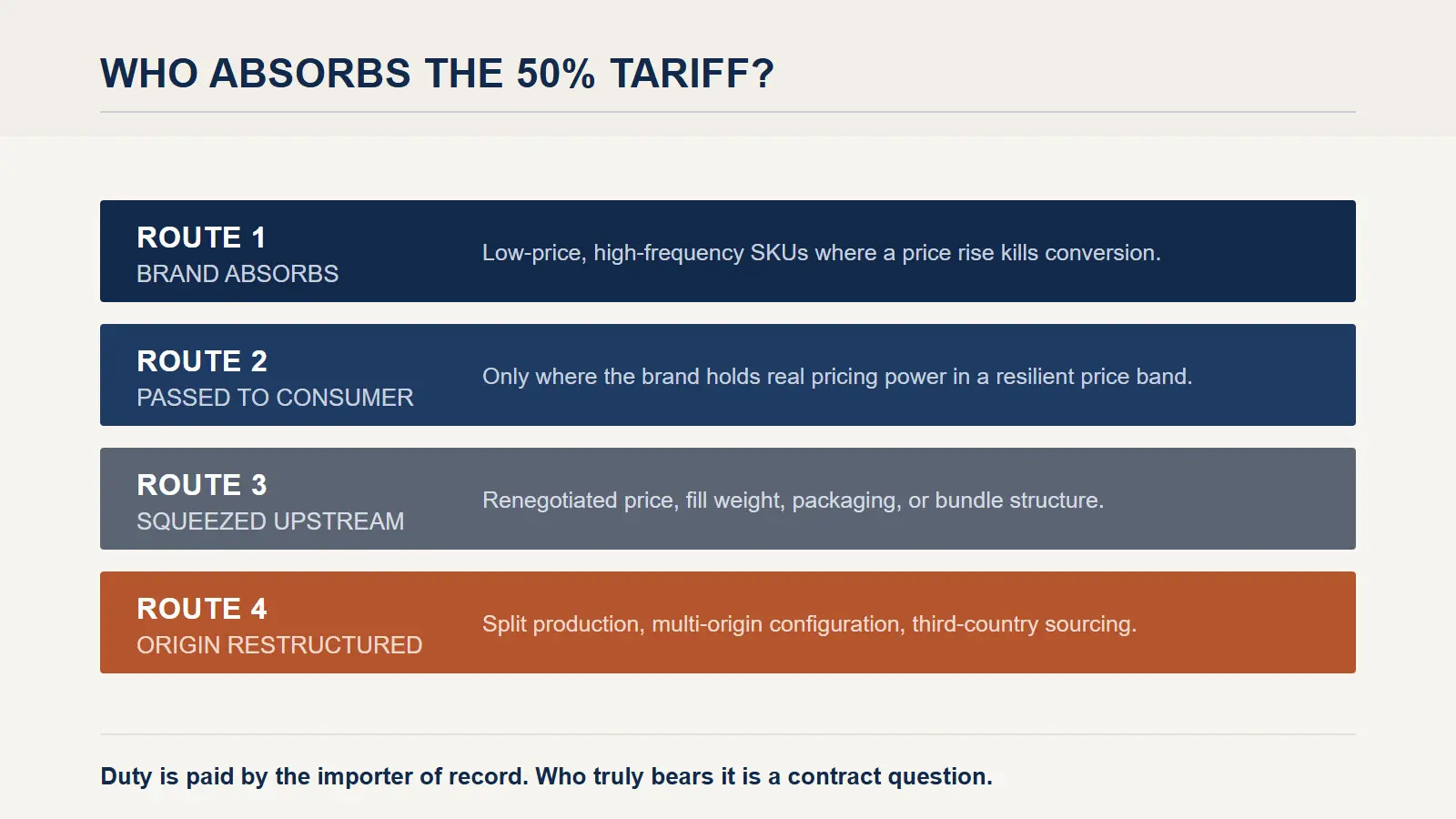
The duty is legally declared and paid by the importer of record, but who ultimately bears it depends on bargaining power and contract terms at each link — not on who is legally liable to pay. In North American personal care there are typically four absorption routes:
| Absorption route | When it triggers | What buyers should do |
|---|---|---|
| Brand absorbs | The brand fears that raising retail price will damage sell-through, especially on low-price, high-frequency items | Recompute unit margin and SKU mix; consider specification and packaging cost-down rather than a price rise |
| Passed to consumer | Category price elasticity is low and the brand holds pricing power | Test whether perceived premium can support it; watch the "impulse buy" price band |
| Squeezed upstream | The brand has strong bargaining power over its supply chain | Factories should prepare a cost-structure explanation rather than a bare discount, to avoid eroding quality headroom |
| Origin restructured | The tariff is long-term and large in magnitude | Evaluate multi-origin configuration, split production of semi-finished and finished goods, and compliant third-country routing |
One price band deserves particular attention: the "10 dollar impulse buy". In its 25 August 2026 coverage, Bloomberg framed the threat from US-Canada cosmetic tariffs directly as a hit to the "$10 beauty impulse buy" (Source: Bloomberg, 2026-08-25). That band cannot pass on cost through price: moving from 10 to 15 dollars shifts the consumer's decision from "pick one up" to "should I buy this at all", and the loss in conversion usually exceeds the gain in unit price.
So under a tariff of 50%, the most fragile lines are not premium ones but low-price, high-frequency ones. This matters especially for brands built on sheet masks and cleansers — precisely the categories with the least room to raise prices.
Another often-overlooked fact is how deeply manufacturing footprints are interwoven. Trade reporting notes that both L'Oréal and Estée Lauder manufacture in Canada (Source: BeautyMatter, 2026-09-01). The tariff is therefore not merely a matter of "the US buying Canadian goods" or vice versa — cross-border movement of semi-finished and finished goods within the same group also carries the cost. For mid-sized brands the same problem appears in the form "our fill plant is in Canada and our actives come from the US".
Run the numbers: landed-cost formula and a worked example
Base landed-cost formula:
Landed cost = FOB unit price + international freight and insurance + duty (dutiable value x applicable rate) + customs brokerage and compliance fees + destination warehousing and last-mile delivery
Two cautions. First, duty is assessed on the dutiable value, not on retail price. The duty amount therefore looks modest in absolute terms, but it stacks directly onto unit cost, eroding gross margin far more than its percentage of retail price suggests. Second, a tariff is a step-change cost, not a marginal one: 15% and 25% can usually be absorbed through negotiation and structural tweaks, while 50% typically cannot — it exceeds what any single link can concede and forces structural change.
Below is an illustrative calculation. It is simplified for clarity — in practice the dutiable value is as determined by customs.
| Assumption | Value | Note |
|---|---|---|
| FOB unit price | US$1.20 | Ex-works price |
| International freight and insurance | US$0.15 | Allocated per unit |
| Dutiable value (simplified) | US$1.35 | Treated here as FOB plus freight and insurance |
| Brokerage and compliance fees | US$0.30 | Allocated per unit |
| Duty band | Duty amount | Unit landed cost | Increase vs 0% |
|---|---|---|---|
| 0% (former USMCA duty-free scenario) | US$0.00 | US$1.65 | — |
| 15% | US$0.20 | US$1.85 | +12% |
| 25% | US$0.34 | US$1.99 | +21% |
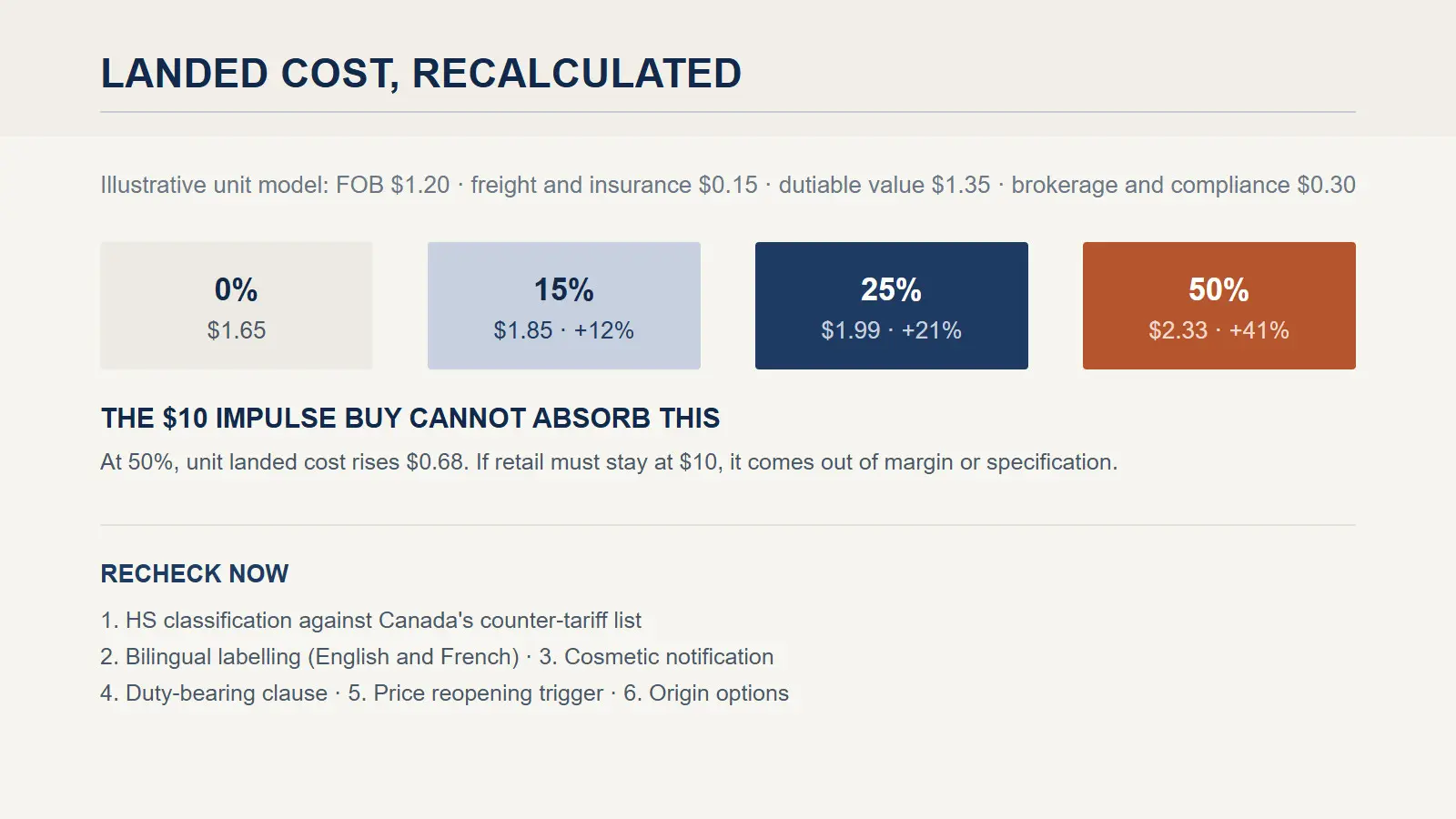
| 50% (colour cosmetics, fragrance, hair care, nail care) | US$0.68 | US$2.33 | +41% |
This table explains why the "$10 impulse buy" band is the most dangerous. At the 50% rate, landed cost per unit rises from $1.65 to $2.33 (+41%). If the channel structure requires retail to stay at $10, that $0.68 has nowhere to go through price — it can only come out of brand margin, channel margin, or product cost (specification, packaging, formulation redundancy).
Which is why the priority this round is not "communicating a price rise" but structural change: adjust fill weight, change packaging, restructure bundles, shift origin. None of those four depends on consumers accepting a higher price — they are unilateral moves a brand controls.
The overlooked second threshold: bilingual labelling and Canadian market access
While debating tariffs, buyers easily overlook a problem unrelated to duties but equally fatal: Canada maintains its own labelling and compliance requirements for cosmetics, and those do not relax because of a trade dispute.
| Requirement | What it covers | Common failure point |
|---|---|---|
| Bilingual labelling | English and French together, covering product name, net quantity and an INCI-compliant ingredient list | English only; French-speaking Quebec is strict; re-labelling is expensive |
| Ingredient compliance | Canada's own restrictions on cosmetic ingredients | Not identical to the US list; US formulations cannot simply be reused |
| Notification | Cosmetic notification required before placing on the market | Responsible party and notifier must be clearly established |
| Responsible person | A Canadian responsible party must carry compliance responsibility | Responsibility becomes blurred under cross-border direct-to-consumer models |
The strategic meaning deserves to be spelled out. When Canada suspended negotiations, it explicitly cited US conditions that would weaken protections for French-language online media and undermine Canada's requirement for bilingual labelling on products sold in the country (Source: Premium Beauty News, 2026-08-26). In other words, bilingual labelling is not merely a technical compliance item — it is also a sovereignty issue in the negotiation.
The practical inference for buyers: do not assume that "once the tariff deal is done, labelling can be simplified". The two are handled separately in Canada, and labelling requirements are more stable than tariff rates. Compliance investment in labelling and formulation should therefore be planned as a long-term fixed cost, not treated as a negotiable variable.
Buyer checklist: 8 items to verify now
Hand this to procurement, compliance and logistics in parallel. The underlying logic: tariffs change, but tariff classification, origin evidence and labelling compliance are certainties you can lock down today.
- Recheck HS classification. Verify each live SKU against Canada's Chapter 33 classifications (skincare, colour, hair, fragrance) and confirm which lines fall into the 15% / 25% / 50% bands. Canada has published the complete counter-tariff list and it must be matched line by line (Source: Government of Canada, updated 2026-09-01).
- Prepare origin evidence. Confirm that origin certificates, production records and material sourcing support the origin claim. Note that USMCA compliance is no longer sufficient for duty-free treatment (Source: Personal Care Insights, 2026-08-04), though it may still underpin appeals and refunds.
- Recompute landed cost. Model three scenarios (fully absorbed / partly passed on / fully passed on) and calculate margin sensitivity per SKU.
- Audit the price band. Identify SKUs sitting in the impulse-buy band (around US$10) and prepare cost-down options — size, packaging, bundling — rather than a straight price rise.
- Audit labelling. Check English and French are both present, the INCI list is complete, and the responsible party is clear. Review Quebec separately.
- Compare ingredient lists. Check the US formulation line by line against Canada's ingredient restrictions — do not assume US compliance equals Canadian compliance.
- Model supply-chain structure. Assess whether finished or semi-finished stages should exist in both Canada and the US, or whether third-country production removes a specific classification.
- Reopen contract terms. Confirm who bears duty cost, whether price can be reopened, and whether force majeure or change-of-circumstances clauses apply — this tariff is a textbook "event outside the contract".
Six clauses your supply contract is missing
The most underrated consequence of this round is that it exposed a long-standing structural gap in supply contracts: most contracts say nothing about who bears a tariff, because for decades the question simply did not arise in North America.
| # | Clause | Why it is now mandatory |
|---|---|---|
| 1 | Duty and tax allocation. State whether new duties and counter-tariffs fall on buyer or seller, or are shared | The importer of record is legally liable, but commercial allocation is separately negotiable — unwritten, it defaults entirely to the importer |
| 2 | Price reopening mechanism. Define triggers (e.g. duty change above X%) and a renegotiation cycle | Avoids being forced into "absorb everything or default" under a 50% shock |
| 3 | Origin and classification warranty. Seller warrants origin claims and classification, and bears back-duty and penalties | Consequences of classification disputes and false origin claims generally land on the importer |
| 4 | Labelling responsibility. Clarify who prepares and maintains bilingual labels, INCI lists and notifications | Canadian labelling and tariffs are two separate regimes and must be contracted separately |
| 5 | Change of circumstances. Expressly list "trade policy changes" as grounds for renegotiation | Tariffs are usually not treated as standard force majeure — this must be explicit |
| 6 | Alternative options reserved. Pre-agree alternative origins, pack sizes or bundle structures if the tariff becomes permanent | Gives the execution team a compliant cost-down path instead of improvised workarounds |
If you add only one, add clause 1 — because it determines whether the other five matter. Without a duty-bearing clause, the default is that the importer of record absorbs everything — and the importer is usually the link closest to the consumer and least able to pass the cost on.
FAQ: six questions buyers ask most
Q1: My products are sheet masks, serums and cleansers. They were not named — am I unaffected?
Not necessarily. Canada's 50% band explicitly names perfumes and toilet waters, lip makeup, eye makeup, hair care preparations, and manicure and pedicure products (Source: Government of Canada list, 2026-09-01). Skincare was not individually named, but three factors affect you indirectly: the US 50% tariff targets the broader category of "chemicals, cosmetics and toiletries" (Source: Personal Care Insights, 2026-08-04); rising colour and fragrance costs push up shared channel costs; and the list can be extended. Check by HS classification, not by product impression.
Q2: Is USMCA not still in force? Why did it not hold?
USMCA still exists, but this round is the first time it has failed to shield Canadian personal care goods from US duties (Source: Personal Care Insights, 2026-08-04). That breaks the assumption that origin compliance equals duty-free. Origin compliance still has value for appeals, refunds and certain exemptions, but it is no longer sufficient.
Q3: Under a 50% tariff, what is the most realistic response?
In priority order: first, recompute landed cost and SKU margin and identify the impulse-buy band that cannot take a price rise (Bloomberg has already flagged that band as the target of impact — Source: Bloomberg, 2026-08-25); second, renegotiate price or specification upstream (fill weight, packaging, bundling); third, evaluate origin diversification. A blanket price rise is usually the worst option.
Q4: I am an exporter based in China. Does this concern me?
Yes — and it may be an opportunity. As intra-North-American trade costs rise, third-country origins gain relative competitiveness. Do not read a 50% tariff as North American news only: it is simultaneously an opening for non-US, non-Canadian origins. Approach North American buyers with a total landed-cost comparison, not just a quote.
Q5: Are bilingual labels really that important?
Yes, and the requirement is a negotiating issue rather than a purely technical one. When Canada suspended talks it explicitly cited US conditions that would undermine Canada's bilingual labelling requirement (Source: Premium Beauty News, 2026-08-26). That means labelling requirements are more stable than tariff rates — plan them as a long-term fixed cost, and do not wait for a tariff deal. Requirements cover English and French, product name, net quantity and an INCI ingredient list.
Q6: As a brand owner, what is the single most useful thing to do right now?
Match this tariff list against your own SKUs, line by line. It is the one action you can complete immediately and that quantifies your exposure. The scale should not be underestimated: US annual exports to Canada reach $4.2 billion, more than a quarter of all US industry exports, with a $1.9 billion US surplus in finished personal care (Sources: PCPC statements, 2026-08-26 and 2026-07-22).
12-month roadmap
| Phase | Action | Deliverable |
|---|---|---|
| Weeks 1–2 | Match SKU x HS classification x duty band line by line; quantify exposure | Tariff exposure register |
| Month 1 | Recompute landed cost under three scenarios (absorbed / partly passed on / fully passed on) | Margin sensitivity model |
| Months 1–2 | Audit labelling and ingredient compliance (bilingual, INCI, notification, responsible party) | Canada market-access checklist |
| Months 2–3 | Renegotiate price, specification, packaging and bundling upstream; update the six contract clauses | Revised contracts and price lists |
| Months 3–6 | Assess origin diversification and split-production options; set up a tariff monitoring routine | Origin risk assessment |
| Months 6–12 | Fold "tariff and trade-policy exposure" into purchasing decisions and supplier scorecards | Updated sourcing decision criteria |
One thing must stay clear: where these tariffs go depends on bilateral negotiation, not on any single company. What a company controls is its exposure, its contract terms and its manufacturing footprint. Get those three right and, however policy swings, the damage stays within a budgeted range rather than arriving as a one-off surprise.
What to do next
If you are sourcing or manufacturing for the North American market, settle tariff classification and landed cost before you discuss unit price. Two materials you can use immediately: the Government of Canada's complete list of US products subject to counter tariffs (updated 2026-09-01) — check your SKUs against it line by line; and the 8-item checklist above — hand it to procurement, compliance and logistics in parallel.
Also worth running once: an origin comparison. As intra-North-American trade costs rise, non-North-American origins are repriced in relative terms. Start from our supply-chain options: china low MOQ skincare OEM solutions, browse high-frequency volume categories in best sheet masks from China for global buyers, or review top China skincare sets for global buyers. Comparing quotes on total post-tariff landed cost, rather than FOB unit price alone, gets you closer to the real decision.
Sources
- Government of Canada, Department of Finance — "Complete list of U.S. products subject to counter tariffs" (updated 2026-09-01): https://www.canada.ca/en/department-finance/programs/international-trade-finance-policy/canadas-response-us-tariffs/complete-list-us-products-subject-to-counter-tariffs.html
- Personal Care Products Council — Statement by Heather Helm, Executive Vice President for Global Strategies (2026-08-26): https://www.personalcarecouncil.org/newsroom/personal-care-products-council-statement-on-section-338-tariffs/
- Personal Care Products Council — Urges Continued Dialogue Between U.S. and Canadian Officials (2026-08-25)
- Personal Care Products Council — Statement on Section 338 Tariffs (2026-07-22)
- Personal Care Insights — "Canadian cosmetics face 50% US duty as USMCA protection fails" (2026-08-04): https://www.personalcareinsights.com/news/canada-us-cosmetics-tariff-usmca.html
- Personal Care Insights — "US–Canada tariff war escalates with reciprocal 50% cosmetics duties" (2026-08-27): https://www.personalcareinsights.com/news/canada-us-50-percent-cosmetics-tariffs.html
- Premium Beauty News — "Cosmetics caught in the crossfire of the US-Canada trade dispute" (2026-08-26): https://www.premiumbeautynews.com/en/cosmetics-caught-in-the-crossfire,28081
- Bloomberg — "US-Canada Cosmetic Tariffs Threaten the $10 Beauty Impulse Buy" (2026-08-25): https://www.bloomberg.com/news/articles/2026-08-25/us-canada-cosmetic-tariffs-threaten-the-10-beauty-impulse-buy
- BeautyMatter — "How US-Canada Tariffs Could Disrupt the Beauty Industry's Supply Chain" (2026-09-01): https://beautymatter.com/articles/trumps-tariff-war-with-canada-is-coming-for-beauty-again
- Clearit Canada — "Importing Cosmetics into Canada: 2026 Customs & Compliance Guide" (2026-08-04): https://clearit.com/canada/blog/importing-cosmetics-into-canada/
- BorderBuddy — "Importing Cosmetics to Canada: A Regulatory Guide" (2026-04-13): https://borderbuddy.com/canada-imports/cosmetics