
How to Start a Skincare Brand in 2026: A Factory Buyer's Playbook
How to Start a Skincare Brand in 2026: The Buyer's Sequence
"How to start a skincare brand" is among the most searched questions in this industry, and most of the published answers are written by marketers who will never have to manufacture what they describe. This one is written from the other side of the table. The honest answer is that starting a brand is a sequencing problem, not an inspiration problem: five procurement decisions — range, model, factory, sampling, compliance — made in the correct order, with a set of written terms locked at each step. Get the order wrong and every decision you lock in becomes a liability instead of an asset, because the later steps inherit the earlier ones.
The market keeps growing, and the institutions' estimates diverge — the divergence is itself useful information:
| Institution | Estimate | Reading |
|---|---|---|
| KBV Research | Skin care to US$244.8 billion by 2030, 6.2% CAGR | Mid-single-digit structural growth |
| Roots Analysis | To US$407 billion by 2035, 7.5% CAGR | Premiumization lifts the upper bound |
| Future Market Insights | Cosmetics at US$330.1 billion in 2026, 6.6% CAGR to 2036 | Skin care is the fastest core segment |
| Tricoci / industry overview | About US$162 billion (2025) to US$222 billion (2030) | Narrower skin-care-only scope |
| Maximize Market Research | US$247.9 billion by 2032, 5.81% CAGR | Conservative floor |
Scope, premium assumptions and end-year differ across the five houses, and no one of them sees a shrinking market. The workable reading for a founder: use the direction for strategy, use your own channel data for budgets — the range itself is the analysis object, not an average to be averaged.
Why this sequence matters right now, from the buyer's side. Capital is consolidating the mass shelf — our coverage of the US$40 billion tissue-giant deal covered where independent brands sit in that reshuffle: the slot opens at the specialist claim pillar, the defensible format and the channel fit. Meanwhile the regulatory floor has risen — MoCRA is in full enforcement in the US and CPNP is the baseline in the EU — which raises the value of a manufacturer that can document, not just produce. A brand that orders the five decisions correctly is, structurally, better equipped for both of those shifts than one that starts with a logo and a mood board.
The sequence is the product: order the five decisions correctly and each one funds the next; reverse any two and you pay for the rework in margin you will never get back.
Step One: Define the Range Before the Brand Name
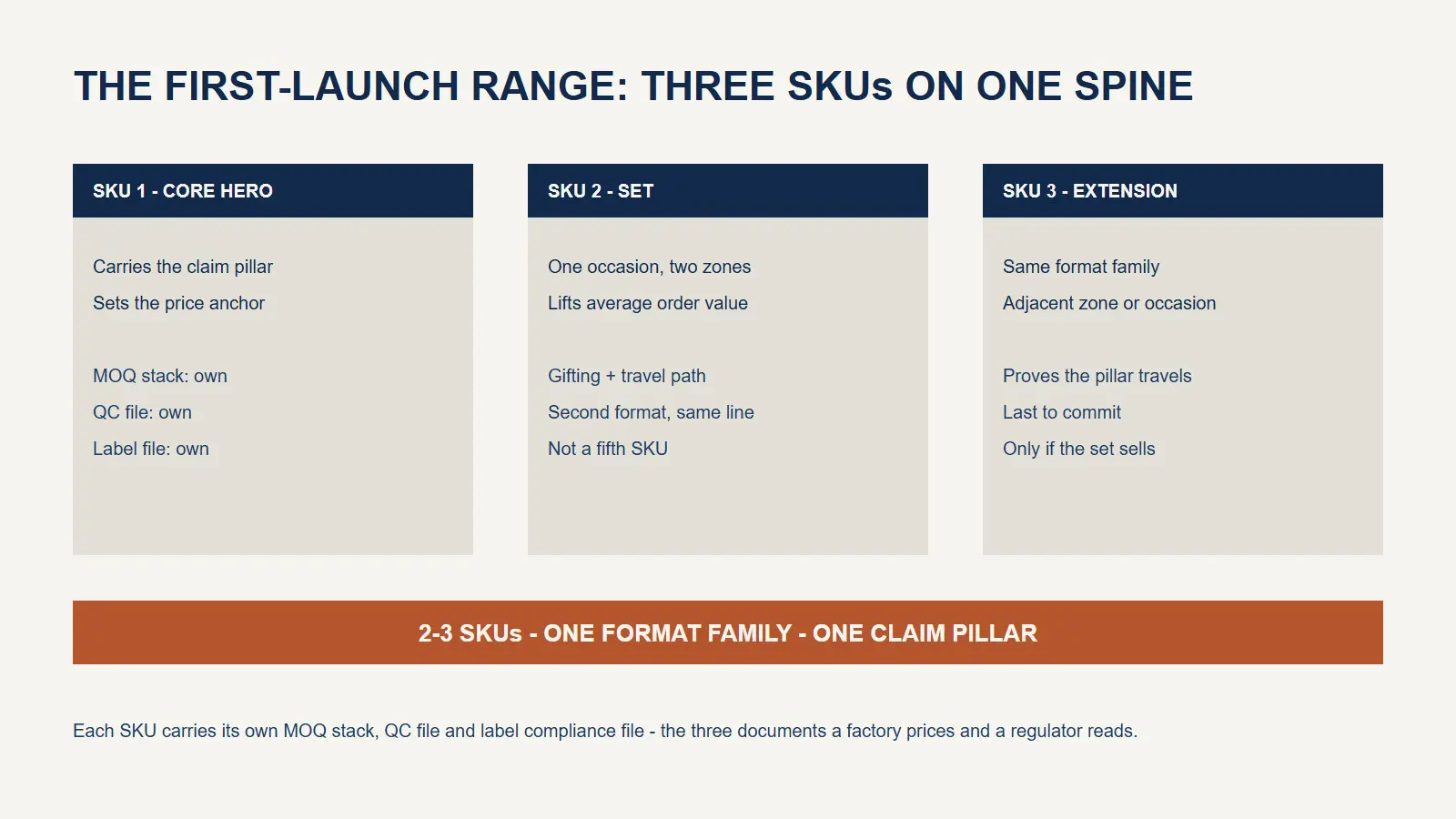
The most common first mistake of anyone starting a skincare brand from scratch is architectural, not aesthetic: a range designed as a wish list — ten SKUs, five formats, three claim pillars — that no factory can quote sensibly and no channel will stock. A workable first range has exactly three properties, and they are procurement properties: 2–3 SKUs, one format family, one claim pillar.
Two to three SKUs, because each SKU carries its own MOQ stack, its own QC file and its own label compliance file — the three documents that a factory prices and a regulator reads. The second SKU should not be another product; it should be the range's architecture piece. The set mechanics we broke down for global buyers in our skin care sets coverage apply at this stage too: a set is not two SKUs in one carton, it is one occasion with two zones — it lifts the average order value and gives the range a gifting and travel path without a fourth SKU. The third SKU, if you take one, is the extension test: same format family, adjacent zone or occasion, proving the claim pillar travels.
One format family, because shared substrates and shared lines are the single largest cost lever available to a first buyer — a mask-plus-serum range that runs on two lines costs more than a mask-and-mask-plus-cream range that shares the film line and the filling line. One claim pillar, because the claim file is what you defend at the listing level, in the retailer audit and in the marketplace policy review; three pillars at launch is three files, each half-built.
The output of this step is a one-page range brief: SKU list with role (core / set / extension), format per SKU, the claim pillar and the one sentence that defends it, and the target channel per SKU. Every later step quotes against this page.
Step Two: Pick the Manufacturing Model, Not the Supplier
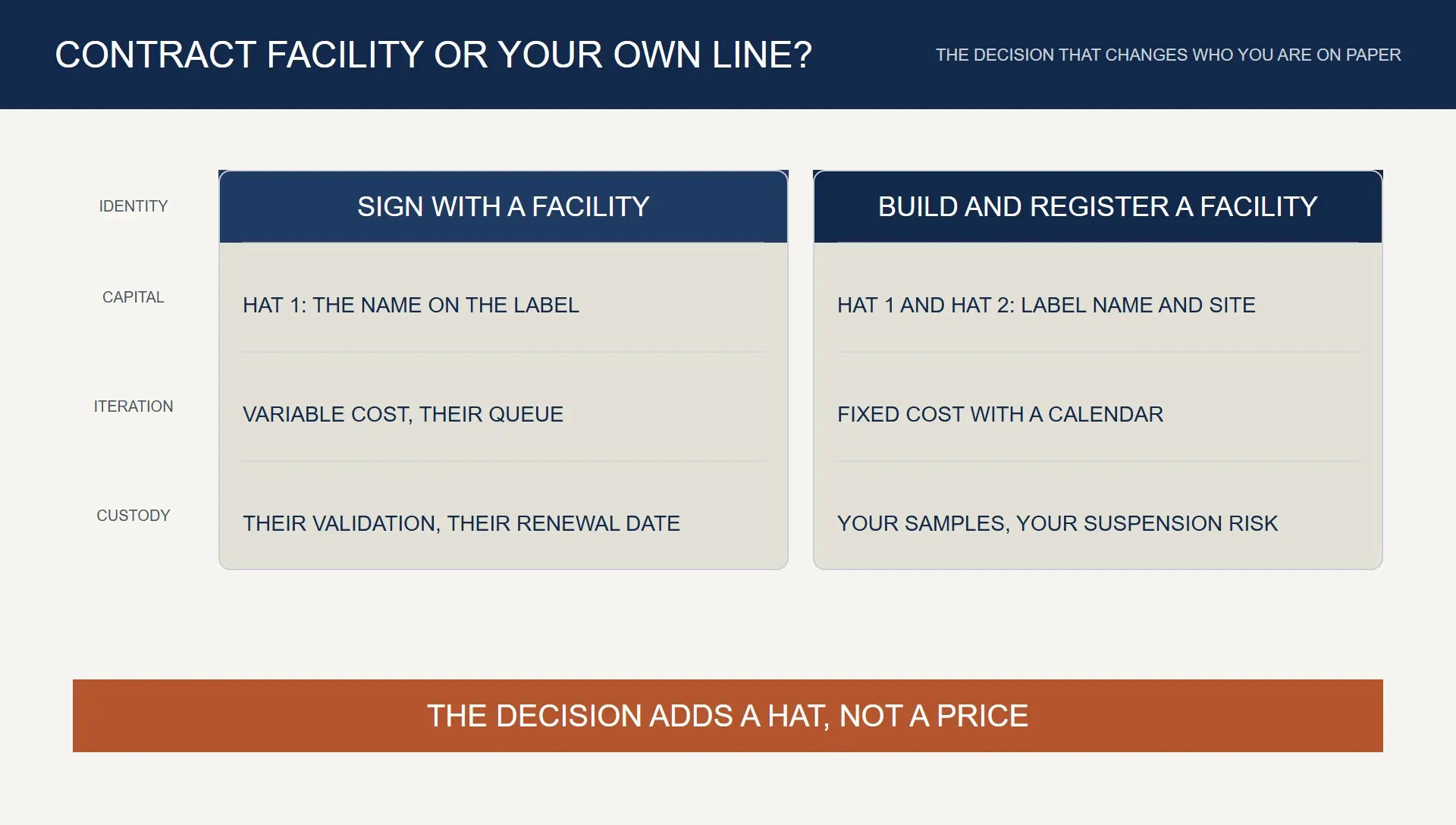
Shortlist the model before you shortlist the factory. The four models — white label, private label, OEM and ODM — are four different answers to a single question: who owns the formula? The question "how to start a skincare line" is almost always that question in disguise, because the model fixes what you can say, what you can defend, and what the first purchase order actually buys.
- White label — the factory's formula, your label. The fastest path to shelf; the formula is reusable by any other brand you have never met, so the differentiation you can defend is zero. The term to lock: exclusivity, or its absence, in writing. - Private label — an existing formula base, your packaging, usually your actives swapped in. The standard starting point for the first 2–3 SKUs: your brand, a proven base, the claim pillar carried by the active you chose. The term to lock: the formula-change boundary and the MOQ per variant. - OEM — your formula (yours, or one you licensed), manufactured to your specification. You own the IP and you carry the formulation risk; this is where the claim pillar becomes defensible. The term to lock: IP assignment and sample-to-batch parity. - ODM — the factory develops against your brief. The middle path, and the one where "who owns it" is genuinely negotiable. The term to lock: the co-development IP split and the milestone payment schedule.
Our model comparison covers the full decision matrix between the four — the point at this step is sequencing, not re-deriving it: the model is locked before the factory, because every factory conversation inherits it. A factory that cannot state, in one sentence, which of the four it is offering and what you own under it is a factory that has not decided either.
| Model | What you buy | Speed to shelf | What you own | The term to lock in writing |
|---|---|---|---|---|
| White label | Factory formula + your label | Fastest | The label | Exclusivity (or its absence) |
| Private label | Existing base + your packaging/actives | Fast | Brand + usually the actives | Formula-change boundary, MOQ per variant |
| OEM | Your formula, manufactured to spec | Slower | The formula + IP | IP assignment clause, sample-to-batch parity |
| ODM | Factory-developed against your brief | Slowest | Depends — it is the negotiation | Co-development IP split, milestone payments |
The model decision decides who owns the formula — and every downstream number, MOQ and lead time included, inherits that decision. Lock the model before the factory, not after.
Step Three: Shortlist Three to Five, Then Vet the File
Shortlisting is cheap; vetting is where the schedule is won or lost. A three-to-five factory shortlist against the one-page range brief gets quotes fast — but the quote is not the decision input, the file is. Before any sample fee leaves your account, request in writing: the GMPC / ISO 22716 certificate, the US FDA establishment registration (the MoCRA-era file, not the pre-2023 one — the difference is the product-listing and adverse-event machinery, and our MoCRA coverage explains what a stale file costs a buyer at the shelf), production line records for the exact formats in your range, the QC protocol with batch records and retention-sample policy, and the IP and sample terms.
Our 12-point audit checklist is the vetting instrument for this step — run it on paper first, then remotely, where a live video line walk beats a photo album in one exchange, and in person only when the volume justifies the flight. The remote round is not a compromise: it is the stage where the file either exists or does not.
Two questions sort a real factory from a trading layer faster than any certificate scan. First: "show me the batch record for a unit of your format produced last month." A factory that runs your format keeps this file current; a broker has no batch record at all, and the silence is the answer. Second: "what does your sample-to-batch parity look like in writing?" The factory that has made your format one hundred times can quote the tolerance; the one that has made it twice will improvise a sentence. The certification list you requested in step three is the same document a future retailer or marketplace compliance team will ask for — a factory's existing registrations are the cheapest proof of capability in the whole process, which is why they come before the sample, not after.
The output of this step is a vetting memo per factory: file status point by point, the two sorting questions answered or evaded, and the residual risks named. It is one page, and it is what you argue with when the schedule slips in step six.
Step Four: Sampling — the Sample Fee Buys Information
A sample is not a freebie to be negotiated away; it is a measurement device, and the sample fee is the price of the information. Three things must be answered in writing before the fee is paid: the lead time — the standard this factory works to is 7 days from a locked brief, and "about a week" is not a number; the cost and offset policy — whether the sample fee is credited against the first order, and under what condition; and the parity commitment — the sample is the same formula, the same batch of substrate and the same fill tolerance as production, or it is not your product at all.
The sequence inside the sampling round matters as much as the round itself. Lock the actives first: our ingredient comparison work is the selection instrument — mechanism, use level, molecular weight, claim boundary and cost structure per candidate. A sample of a formula you have not settled is a waste of the round-trip, because the iteration you then request is a second sample, with its own lead time and its own information cost.
Then run the sample inspection like the audit it is. Organoleptic and stability snapshot: does the unit sit, separate or darken at room temperature across two weeks — for actives with known instability, this is the check that predicts the shelf. Label mock-up reviewed against the target market's label rules, because a label correction in week six costs less than the same correction after packaging is committed. Format-specific checks: for mask formats, the substrate adhesion and fill-volume tolerances that our hand-mask coverage spec'd as the hidden QC line; for serums, the viscosity and the pump or dropper pairing. The output of the round is a one-page deviation list — item, observed, accepted or rejected — not a feeling, and not a "let's discuss it."
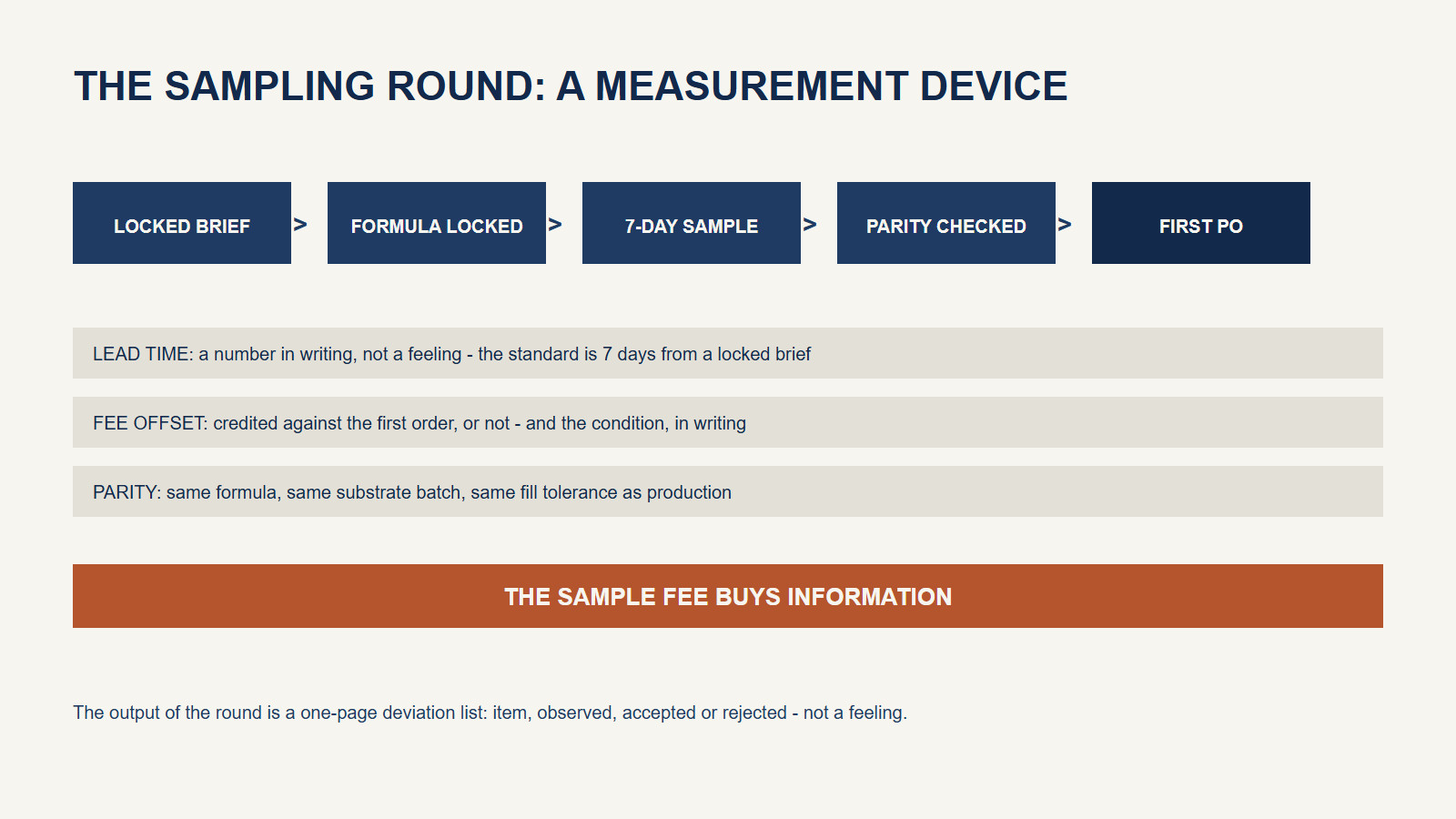
Buy the sample as information, not as a favour: lead time, offset and parity — all three in writing before the fee leaves your account.
Step Five: Compliance and Claims, Market by Market
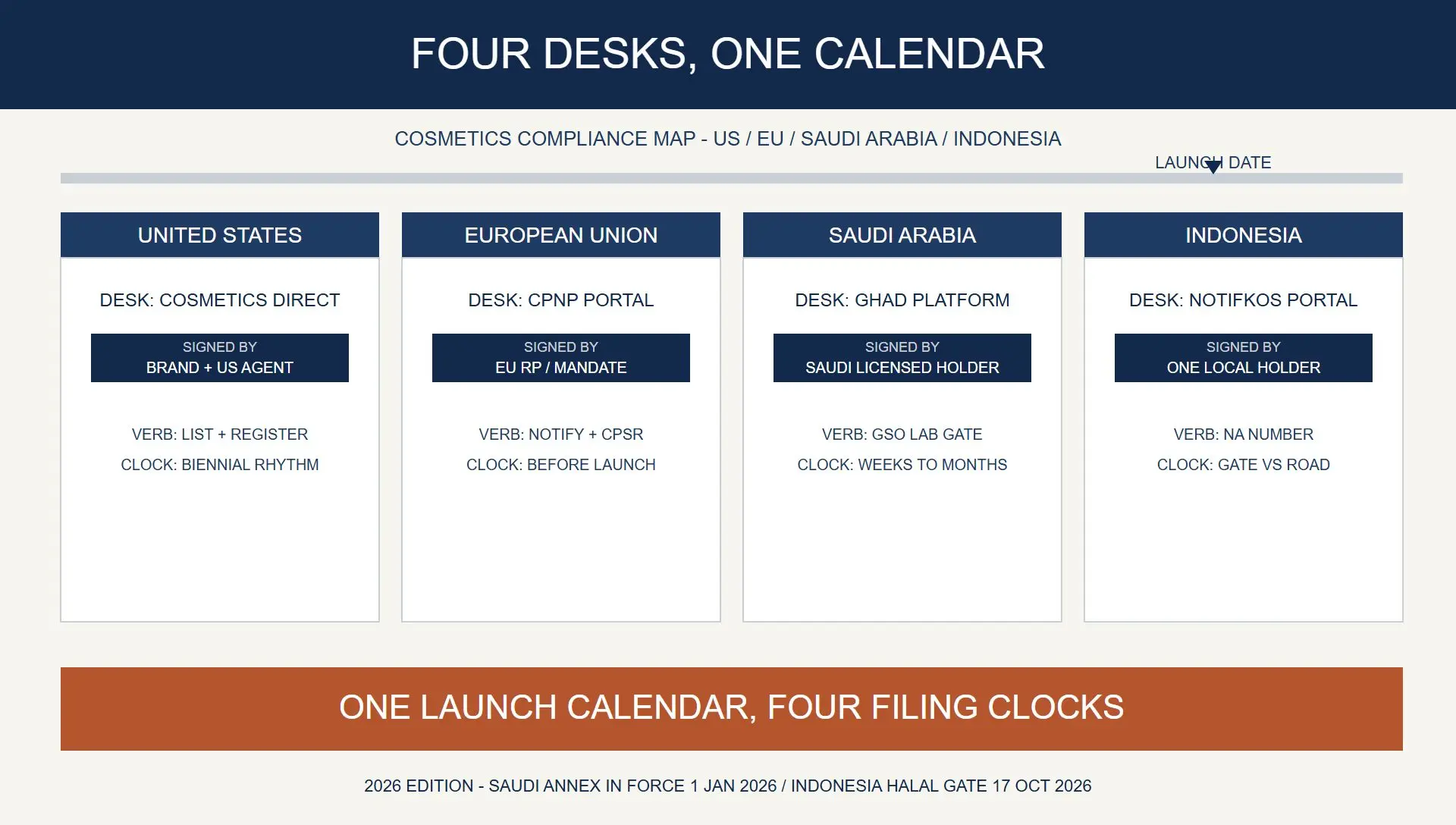
Each target market is a different document, and the documents are what a capable factory prepares for you — which makes this the step where the factory's existing registrations stop being background and start being the decision input. In the US, the MoCRA-era file is the baseline: establishment registration, product listing, the responsible-party machinery and adverse-event reporting — and our MoCRA enforcement read covers what it costs a buyer when the supplier's file is the pre-2023 version. In the EU, the CPNP notification with the full product information file, filed by a responsible person you appoint before the first EU SKU ships. In the Gulf, SFDA registration plus — where you want to sell into the Halal shelf — the certification path, which our Halal buyer's guide maps honestly: compliant formulation and file building, not a certificate the factory does not hold.
The natural route needs its own discipline at this step. How to start a natural skincare line credibly means the claim file travels with the formulation — the ECGT-era rules ended the free pass for "natural," "eco" and "carbon neutral" claims in the EU, and our ECGT coverage is the map of where the free pass stopped. A natural positioning without a documented claim trail is not a marketing asset; it is a compliance liability that the marketplace policy team will find before your customer does. The rule for this step is the same rule for every step: the claim you print is the file you can produce.
| Market | Regime | Core obligation | Who files | The buyer's action |
|---|---|---|---|---|
| United States | MoCRA | Establishment registration, product listing, adverse-event reporting | Manufacturer (your factory) + your responsible party | Demand the current file, not the pre-2023 one |
| European Union | CPNP + Reg 1223/2009 | Product notification, product information file, label per regulation | Responsible person — you, or your appointed agent | Appoint the RP before the first EU SKU |
| Gulf / Saudi | SFDA (+ Halal where the shelf requires it) | Product registration, Arabic labelling, Halal documentation | Manufacturer or authorized representative | Ask which formats the factory has already registered |
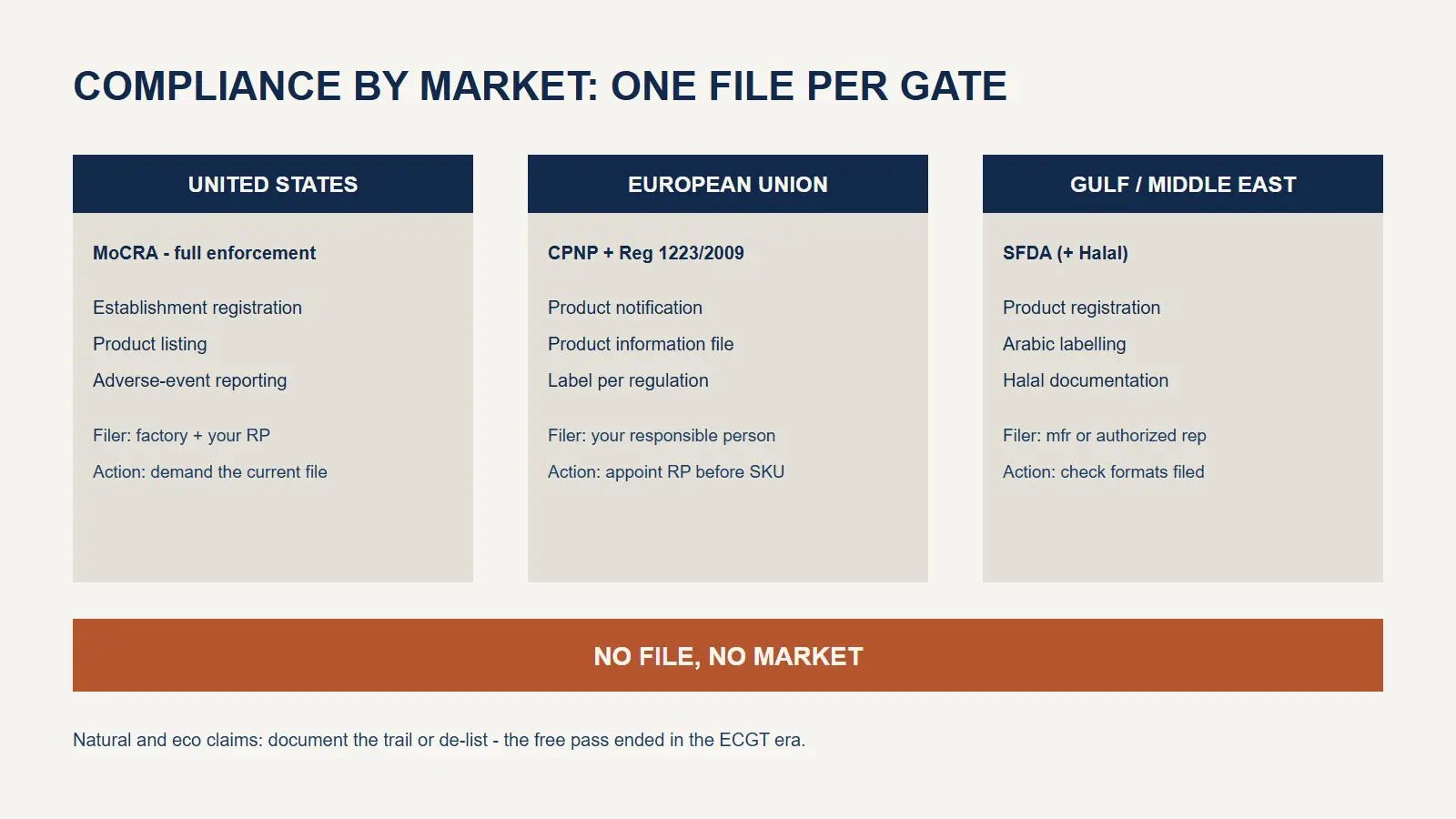
No single compliance file is optional: the market you cannot document is the market you cannot enter — and the factory's existing registrations are the cheapest proof of capability in the process.
The Unit Economics You Run Before the First PO
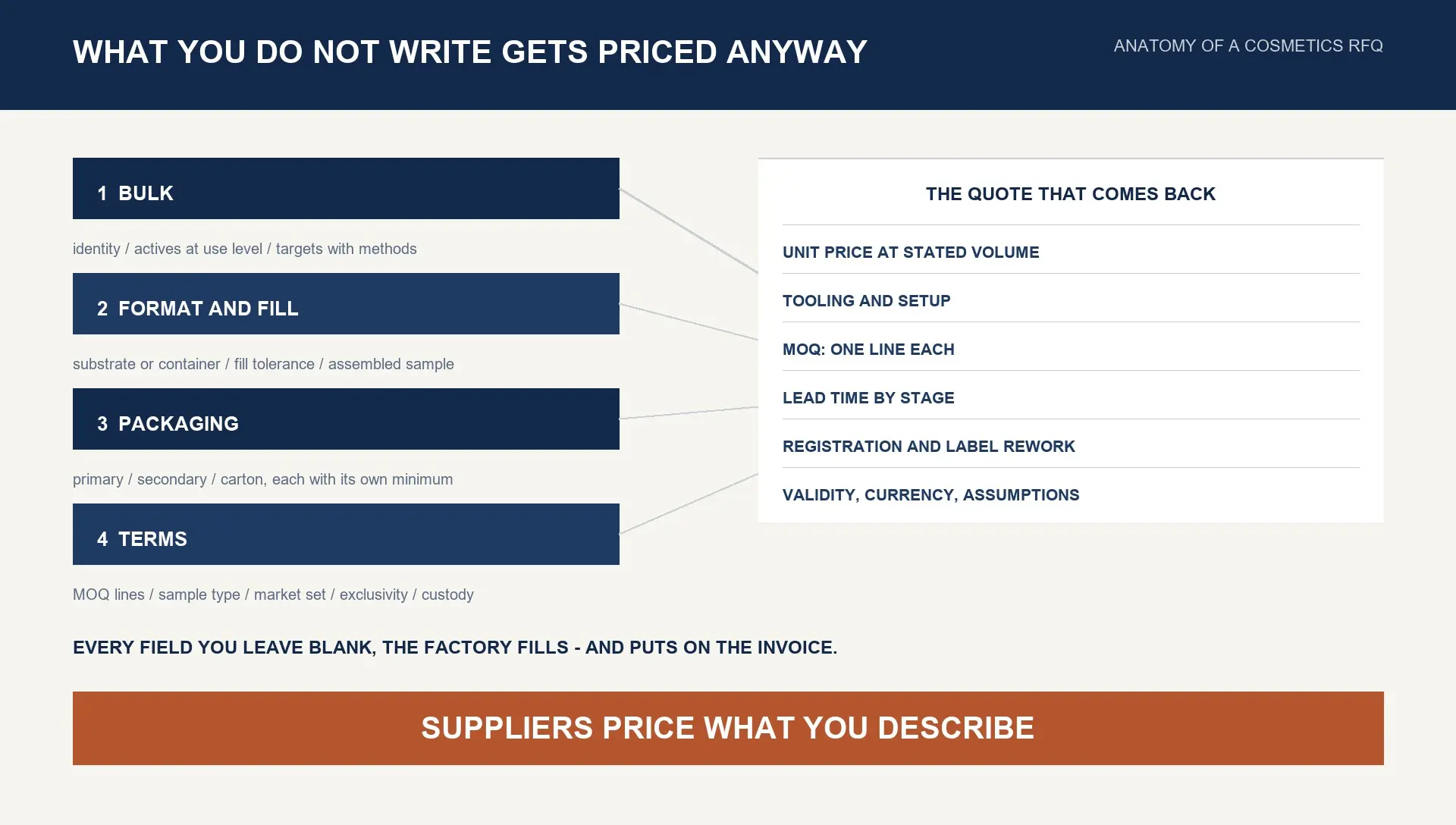
The first purchase order is not where your margin is decided; it is where the decisions made in steps one through five get priced. The cost levers, in the order they actually move the number: format (mask versus serum versus cream — different substrate, different line, different fill volume), active load (the use level is a cost line, not a marketing line — the active you chose in the sampling step is what the PO pays for), packaging (the second MOQ stack, and the one that is quoted separately), and volume tier (the MOQ schedule is where the first order and the reorder meet, and the gap between them is structural, not negotiable).
What you demand at this step is the written cost breakdown by component — formula, substrate, packaging, fill, QC and documentation, each line itemized — plus the written MOQ schedule per SKU and the reorder terms. We walked the low-MOQ starting path for global buyers in our low-MOQ OEM solutions piece; the point at this step is not the path but the instrument: a factory that will itemize the cost structure can price your reorders honestly, and a factory that will not itemize is telling you, in advance, who absorbs the variance when the volume moves.
Two honest readings to keep the arithmetic from flattering you. First, the first container costs more per unit than the reorder — that gap is the price of the MOQ floor, and it is normal; what is not normal is a factory that cannot state the gap in writing before the PO. Second, the landed number is not the FOB number: duties, the label-language obligations per market and the freight term (FOB versus CIF, and whose booking it is) are part of the unit economics of the launch, not a footnote to it — our US-Canada tariff coverage is the standing reminder that the duty line can move under a landed cost that looked settled.
The 0-to-First-Container Timeline
The schedule, phase by phase. The durations below are typical for a first launch on this sequence — they are planning numbers, and the exit criterion in the last column is the non-negotiable one, because every phase exits with a document, and the document is what the next phase quotes against:
| Phase | Typical duration | Exit criterion — the document that must exist |
|---|---|---|
| 1. Brief and range lock | Weeks 0–2 | Signed one-page brief: 2–3 SKUs, format family, claim pillar |
| 2. Model and factory selection | Weeks 2–5 | Model locked; file vetted point by point; IP terms in the contract |
| 3. Sampling and iteration | Weeks 4–8 | 7-day samples received; deviation list closed; parity committed in writing |
| 4. Compliance filing (runs in parallel) | Weeks 6–12 | Registration / notification filed per market; label approved against market rules |
| 5. Packaging and label production | Weeks 8–14 | Packaging MOQ confirmed separately from formula MOQ |
| 6. Production, QC, shipment | Weeks 12–18 | Batch records, COA, retention samples; booking confirmed |
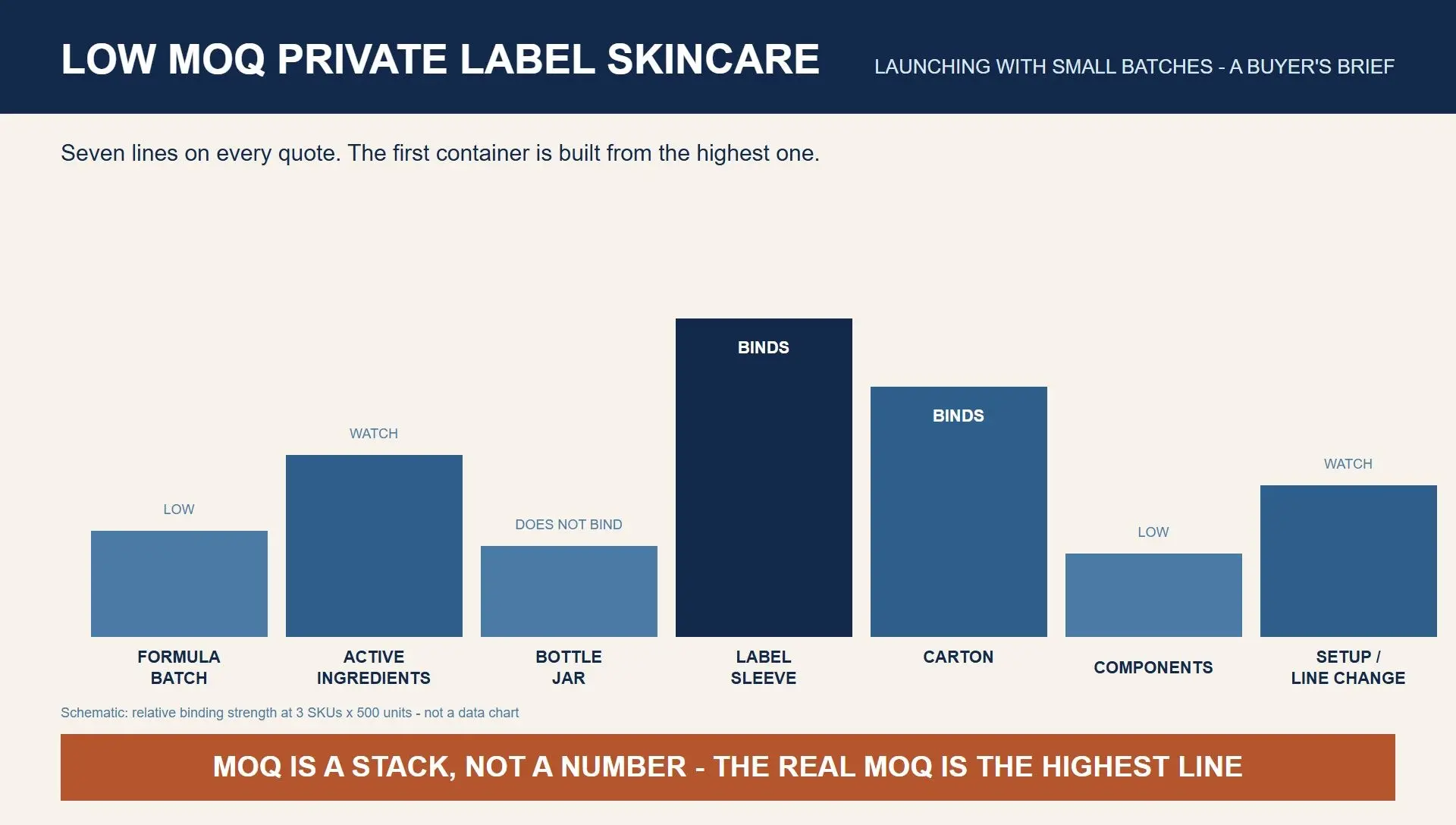
The line most first-time founders miss is row five, and it is the line that re-plans the whole launch: packaging MOQ and formula MOQ are two separate commitments, and the larger one sets your cash curve. The container is held by whichever stream finishes last — and for a first launch the stream that finishes last is usually the bottle, not the cream, because the cosmetic-grade packaging line quotes a different MOQ floor than the filling line and runs on a different lead time. Run the two MOQs as one number in your planning and the week the packaging lands, the whole schedule lands with it, one month late.
The parallelism is deliberate, not accidental: compliance filing (row 4) runs against sampling (row 3) because the label cannot be approved until the formula is locked, and the registration cannot be filed until the label exists. A factory that sequences those three in series is not slower — it is telling you how it sequences its own document work, which is a vetting data point in its own right.
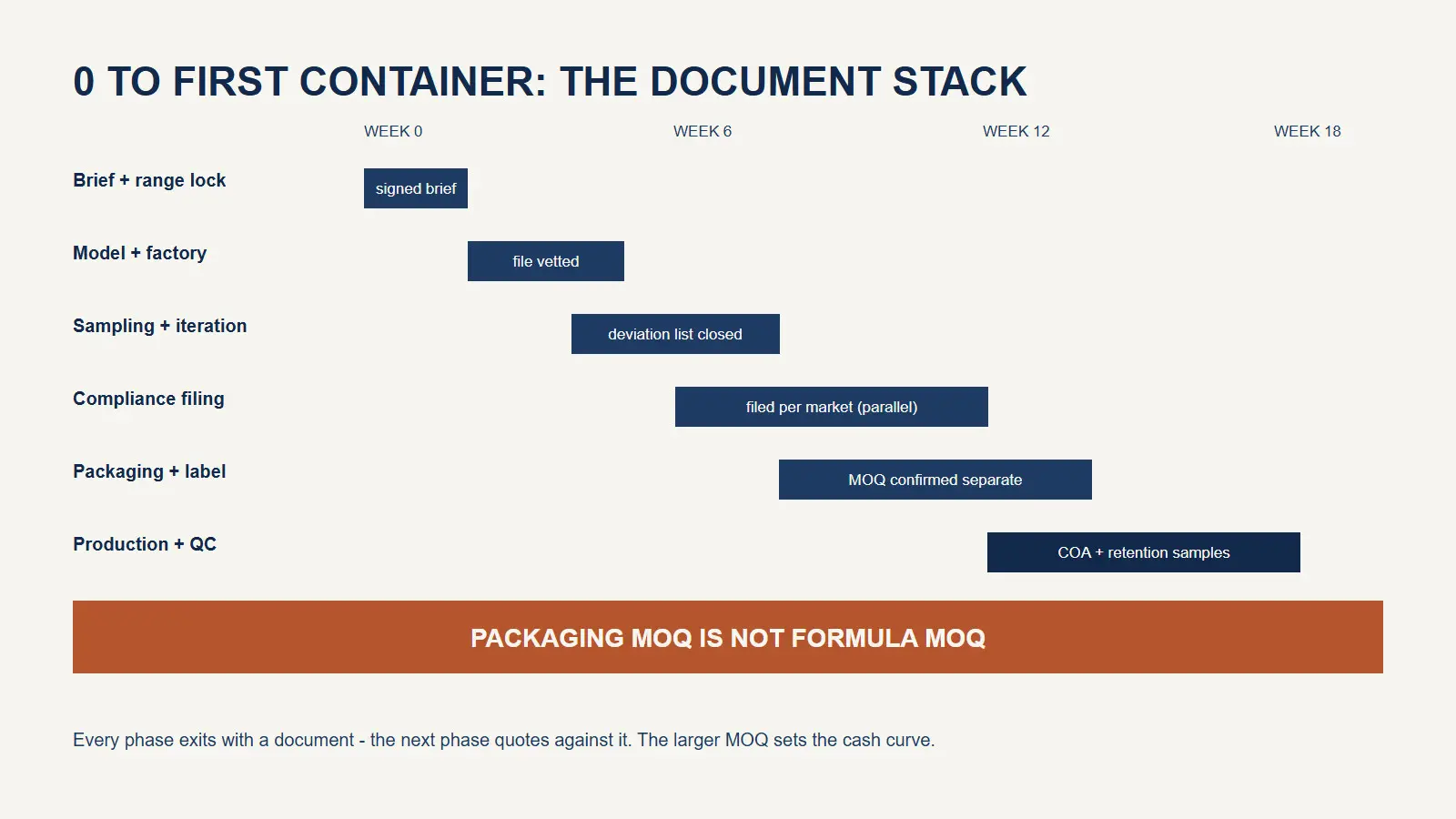
The timeline is a document stack, not a calendar: every phase exits with a paper trail, and the packaging-MOQ line is where first launches usually stall.
The Ten Questions to Ask Before You Pay
Every step above compresses into ten questions. Ask them of every factory in the shortlist — in writing, all ten, in one message — and compare the shape of the answers, not the content:
1. What is the MOQ per SKU, and is it formula-driven or packaging-driven? 2. What is the sample lead time — and is the sample fee offset against the first order, in writing? 3. Who owns the formula and the IP, and which contract clause says so? 4. Which certifications do you hold (GMPC / ISO 22716 / FDA registration) — and will you send the current documents? 5. What is the production lead time by volume tier, and what is the remedy when it slips? 6. How is QC documented — batch records, retention samples, a COA per batch? 7. What are the trade terms — FOB or CIF, which Incoterms version, what payment milestones? 8. What is the reorder MOQ, and may it differ from the launch MOQ? 9. Do you support label compliance per market — INCI, responsible party, net content, language obligations? 10. What is the complaint and recall path, in writing?
The test is not whether the factory answers. The test is whether it answers item by item, in writing, without a relationship manager having to chase it — because the factory that handles ten written questions well at the shortlist stage is the factory that will handle the deviation list, the label correction and the re-plan in month four. A brand is not the logo and the range; a brand is the quality of the document trail it leaves behind every time it asks a supplier something — and that is how to start a skincare brand the way the industry actually runs it, where the buyer's file is as real an asset as the formula.
If a factory resists putting any one of the ten in writing, that is your answer — and the schedule is the right place to learn it.
FAQ: The Six Questions First Founders Actually Ask
Q1: What is the minimum range to launch a first skincare line with? Two to three SKUs, one format family, one claim pillar — because each SKU carries its own MOQ stack, QC file and label file, and a ten-SKU wish list is unquoteable and unstockable. The set is the second SKU's job, not a fifth.
Q2: How long from brand brief to first container? Typically 14–18 weeks when the phases run as sequenced, with compliance filing in parallel against sampling. The variance is almost always the packaging MOQ line, not the formula — the two MOQs are separate commitments, and the larger one sets the schedule.
Q3: How to launch a skincare line with no industry experience? The sequence is the experience. Five decisions in order, each closed with a written term, each exited with a document — that is the institutional memory a first founder is missing, and it is exactly what a factory-side partner supplies. The experience you cannot outsource is the claim pillar: that has to be yours.
Q4: Who owns the formula — me or the factory? Only the model contract says. White label: the factory's. Private label: the base is the factory's, the brand and usually the actives are yours. OEM with your formula: yours, by IP assignment. ODM: negotiable — and the IP clause is the entire negotiation, so budget the legal time there, not in the logo.
Q5: Is private label the right model for a first launch? For the first 2–3 SKUs, usually yes: your brand, a proven formula base, the actives swapped where your claim pillar requires. Move up the model ladder — to OEM — when the claim pillar becomes defensible only as a formula you own, because that is the moment your claim file stops being the factory's to produce.
Q6: Can I position the range as natural from day one? Yes — if the claim file travels with the formulation. The ECGT-era rules ended the free pass for natural and eco claims in the EU, so "natural" without a documented claim trail is a compliance liability, not a positioning. Document the pillar, or de-list it.
What to do next
Send us your brand brief. Tell us the range direction (the 2–3 SKUs, the format family, the claim pillar), the target markets and the model you are leaning toward — or the model you are not sure about, which is the more useful conversation. What comes back: the factory-side read on model and MOQ, the sampling plan with lead time and offset, the compliance file map per market, and a sealed first sample of your format. The sequence is the product — the brief is where step one gets signed.
Sources and Further Reading
1. KBV Research, "Skin Care Market Size, Share & Forecast Report 2023–2030": global skin care to US$244.8 billion by 2030 at 6.2% CAGR. https://www.kbvresearch.com/skin-care-market/ 2. Roots Analysis, "Skincare Market Growth at CAGR of 7.5%" (press release): global skincare to over US$407 billion by 2035 at 7.5% CAGR (2024–2035). https://www.rootsanalysis.com/press-releases/skincare-market-growth.html 3. Future Market Insights, "Cosmetics Market Forecast and Outlook 2026 to 2036" (2026-01-22): cosmetics market US$330.1 billion in 2026 at 6.6% CAGR to US$625.5 billion by 2036. https://www.futuremarketinsights.com/reports/cosmetics-market 4. Tricoci University, "Skincare Industry Statistics 2026 — U.S. Market Overview" (2026-01-01): skincare industry from around US$162 billion in 2025 to over US$222 billion by 2030. https://www.tricociuniversity.edu/beauty-blog/student-life/skincare-industry-statistics-2025-u-s-market-overview/ 5. Maximize Market Research, "Global Cosmetic Skin Care Market Report": revenue to nearly US$247.89 billion by 2032 at 5.81% CAGR (2026–2032). https://www.maximizemarketresearch.com/market-report/global-cosmetic-skin-care-market/19691/ 6. U.S. FDA, "Modernization of Cosmetics Regulation Act of 2022 (MoCRA) — Cosmetics Regulations Facts": establishment registration, product listing and adverse-event reporting machinery. https://www.fda.gov/cosmetics/modernization-cosmetics-regulations-mocra/cosmetics-regulations-facts 7. Internal news — "A tissue giant takes over mass-market skincare: where do independent brands sit in a US$40 billion deal" (2026-09-09). https://www.fkybeauty.com/news/a-tissue-giant-takes-over-mass-market-skincare-where-do-independent-brands-sit-in-a-us-40-billion-deal/ 8. Internal news — "MoCRA 2026: full enforcement, compliance mandates and the supplier selection guide" (2026-08-20). https://www.fkybeauty.com/news/mocra-2026-full-enforcement-compliance-mandates-supplier-selection-guide-for-skincare-brands-exporting-to-the-u-s/ 9. Internal news — "ECGT applies September 27, 2026: natural, eco and carbon-neutral skincare claims lose their free pass" (2026-09-02). https://www.fkybeauty.com/news/ecgt-applies-september-27-2026-natural-eco-and-carbon-neutral-skincare-claims-lose-their-free-pass/ 10. Internal theme page — "Private Label vs OEM vs ODM: Which Model Fits Your Brand?". https://www.fkybeauty.com/private-label-vs-oem-vs-odm-which-model-fits-your-brand/ 11. Internal theme page — "How to Verify a Chinese Skincare OEM Factory: 12-Point Audit Checklist". https://www.fkybeauty.com/how-to-verify-a-chinese-skincare-oem-factory-12-point-audit-checklist/ 12. Internal theme page — "Halal Skincare OEM: Buyer's Guide for Middle East Markets". https://www.fkybeauty.com/halal-skincare-oem-buyers-guide-middle-east-markets/ 13. Internal blog — China low-MOQ skincare OEM solutions for global buyers. https://www.fkybeauty.com/blog/china-low-moq-skincare-oem-solutions-for-global-buyers/ 14. Internal blog — Efficacy skincare guide 2026: PDRN vs peptides vs retinol vs hyaluronic acid, with sourcing tips. https://www.fkybeauty.com/blog/efficacy-skincare-guide-2026-pdrn-vs-peptides-vs-retinol-vs-hyaluronic-acid-ingredient-comparison-sourcing-tips/ 15. Internal blog — Top China best skin care sets for global buyers. https://www.fkybeauty.com/blog/top-china-best-skin-care-sets-for-global-buyers/ 16. FKY contact — send us your brand brief. https://www.fkybeauty.com/contact-us/