
Private Label vs White Label Skincare: Which Model Fits
Private Label vs White Label Skincare: The Rights Question, Not the Logo Question
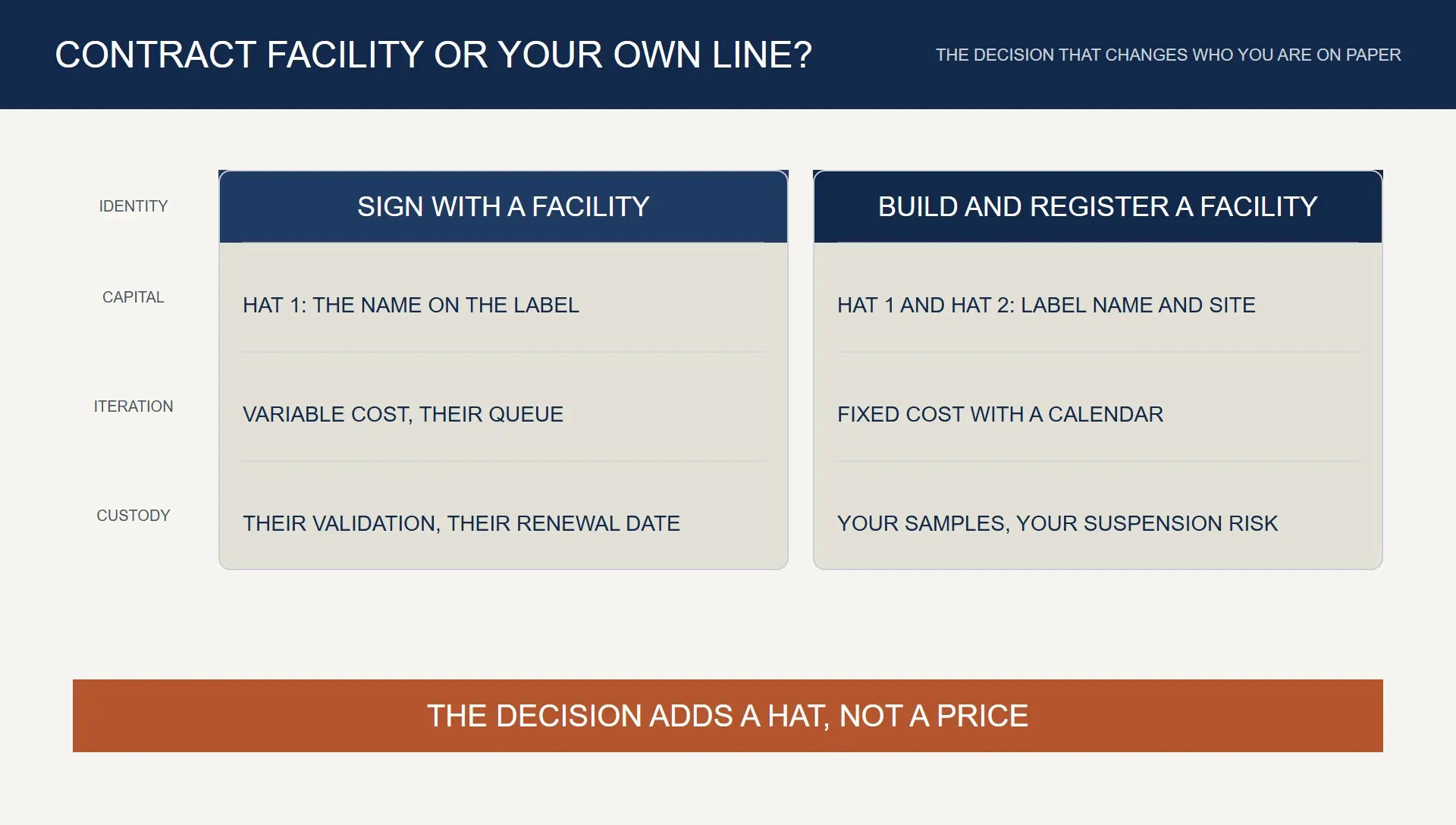
The question usually arrives through a search box — best skincare manufacturer usa, or through a founder who launched in eight weeks on a formula she never owned and can no longer modify. Either way, the private label vs white label skincare decision is not a branding question. It is a rights question. Four lines decide it: who owns the formula, who owns the intellectual property behind the actives, who else is allowed to sell it, and whose responsibility the compliance file sits with. Get those four lines wrong and the label on the carton is the only asset that is truly yours — and the label is the cheapest part of the product.
Why the rights framing, from the buyer's side. The model you choose determines which cost lines appear on your first purchase order, what documentation the factory owes you before a sample is paid for, and what your range is legally allowed to claim in year two. It does not determine how the product looks. Two factories can ship you the same serum in the same jar on the same lead time — and the two contracts behind it can be opposites on every ownership line. That is the part of the decision that survives contact with your second competitor.
The map itself is one level up and is not this piece: which structure to put in the contract — private label, OEM or ODM — is answered in our three-model comparison page. This piece answers what each line of that contract is actually worth, how the four ownership lines differ between white and private, and how to score the factory that signs it — without a name list, because a name list ages in a quarter and a scorecard is yours forever.
One scope note before the table: the spectrum is continuous. White label sits at one end — the factory's formula, sold to several brands. Full private sits at the other — your brief, your actives, your file. Between them is the semi-private middle (a factory base formula carrying your actives and packaging, the same L2 step of the ladder we walked through for encapsulated creams). Procurement-wise, the distinction that matters is simpler than the taxonomy: white label is buying a finished offer; private label is buying an asset and a service.
The logo is not the decision — the four ownership lines are.
The Market, the Range, and What Five Reports Actually Agree On
The buyer who asks "which model" is usually also asking "is this category worth a first container." Five research houses sized the private label cosmetics market this year, and the honest read is that they agree on the direction and disagree on the boundaries — so the table carries the boundaries, not just the numbers.
| Institution (report date) | Base year | Base value | Forecast | CAGR | Boundary that moves the number |
|---|---|---|---|---|---|
| Grand View Research (2026-07) | 2024 | US$10.6B | US$14.4B by 2030 | 5.2% (2025–2030) | All private label cosmetics; Asia-Pacific 48.6% share in 2024 |
| Research and Markets (2026) | 2024 | US$10.64B | US$14.39B by 2030 | 5.20% | Private label cosmetics, global |
| Business Research Insights (2026) | 2026 | US$10.57B | US$19.95B by 2035 | 7.2% (2026–2035) | Long-forecast boundary |
| Strategic Market Research (2026-08) | 2023 | US$12.8B | US$23.7B by 2030 | 9.1% | Widest base and forecast |
| Verified Market Reports (2026-05) | 2024 | US$12.5B (North America) | US$20.4B by 2033 | 6.4% | North America only, packaging bundled in |
| Future Market Insights (2026-09) | 2026 | US$341.4M | US$605.7M by 2036 | 5.9% | Skincare only — an order of magnitude smaller boundary |
Read it the way a range planner should. The 2024–2026 base values span US$10.6B to US$12.8B — a US$2.2B spread — and the 2030 values span US$14.4B to US$23.7B, a US$9.3B spread that grows with the horizon. The boundary column is why: skincare-only versus full cosmetics, packaging bundled versus not, North America versus global. The Future Market Insights row is not a contradiction of the others; it is the boundary closest to your actual product, and it is the one a first-container budget should be set against. Direction for strategy, your own channel data for budget — the range itself is the analysis object, and any single number cited without its boundary is marketing, not research.
Two structural signals in the same set of reports are worth more than the size numbers. First, manufacturing is moving toward the regulatory market: Cosmax acquired Italy's Keminova in February 2026 and established its first European cosmetics production base, per the Future Market Insights report (2026-09). Expect more "EU-base" offers on your shortlist within 12–18 months — and score them on the same checklist, not on the address. Second, the model is proven at the largest shelves in the world: the North American growth the reports attribute to retail is driven by the private label programs of Walmart, Target and Costco (Verified Market Reports, 2026-05) — the buyer question in 2026 is not "does private label work" but "which line of rights do I buy first."
Five reports, one direction, six boundaries — the range is the analysis object.
The Four Ownership Lines: What "Private" and "White" Actually Change
Definitions first, because the market has blurred them. White label is a formula the factory developed and owns, which it sells — in any quantity, to any number of brands — and the buyer's product is the label, the packaging and the distribution. Private label is a formula developed for one brand, where ownership or exclusivity is written to the buyer and the factory manufactures to spec. Between them sits the semi-private middle: a factory base formula carrying the buyer's actives, in the buyer's packaging — the L2 step of the ladder that our encapsulated-cream coverage walked through as a format decision. The shelf cannot tell these apart. The file is the only place the difference exists — so here is the file, line by line.
| Ownership line | White label | Semi-private (L2) | Full private (L3) |
|---|---|---|---|
| The formula | Factory owns it | Factory base formula; your actives added | Contractually yours (IP clause) |
| Active IP / moleculenames | Factory holds registrations | Split by contract | Registered to you |
| Who else can sell it | Yes — other brands, same formula | The base may be shared; your combination is exclusive | No — exclusivity clause, territory, term |
| Compliance file (stability, safety, CoA) | Factory's generic file | Shared file + your addendum | Your file, factory executes |
| What you can change in year two | The label, maybe the packaging | Actives, texture, packaging | Everything — including reformulation |
The procurement decision lives in the last row. White label caps you at the label: the moment your range needs a differentiation claim — a third-party actives story, a texture system you can defend — you are paying for development anyway, on a timeline that has already run. Semi-private is the standard second move, and full private is what the brand looks like when sell-through justifies carrying the file yourself. Buyers who treat the three as price points instead of ownership levels are the ones who discover, in month nine, that the "custom" formula was on the factory's website.
Note what the table does not contain: prices. Unit cost is discussed in the next section as quote structure, because absolute unit prices are the factory's number, not yours — and the model decision is made on lines that move before the price line does.
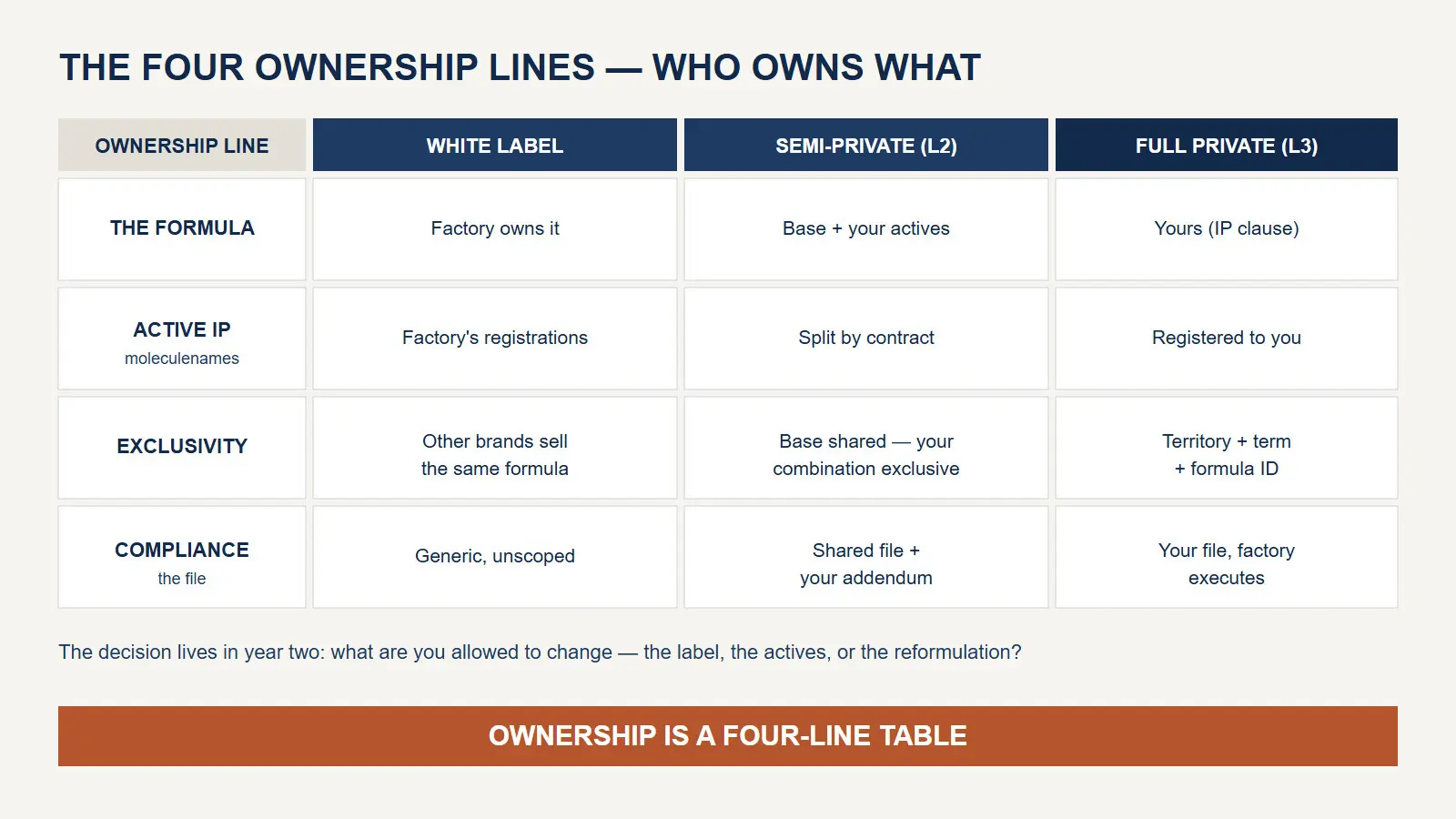
Ownership is a four-line table, not a vibes check.
The Quote Math: Which Lines Move When You Change Models
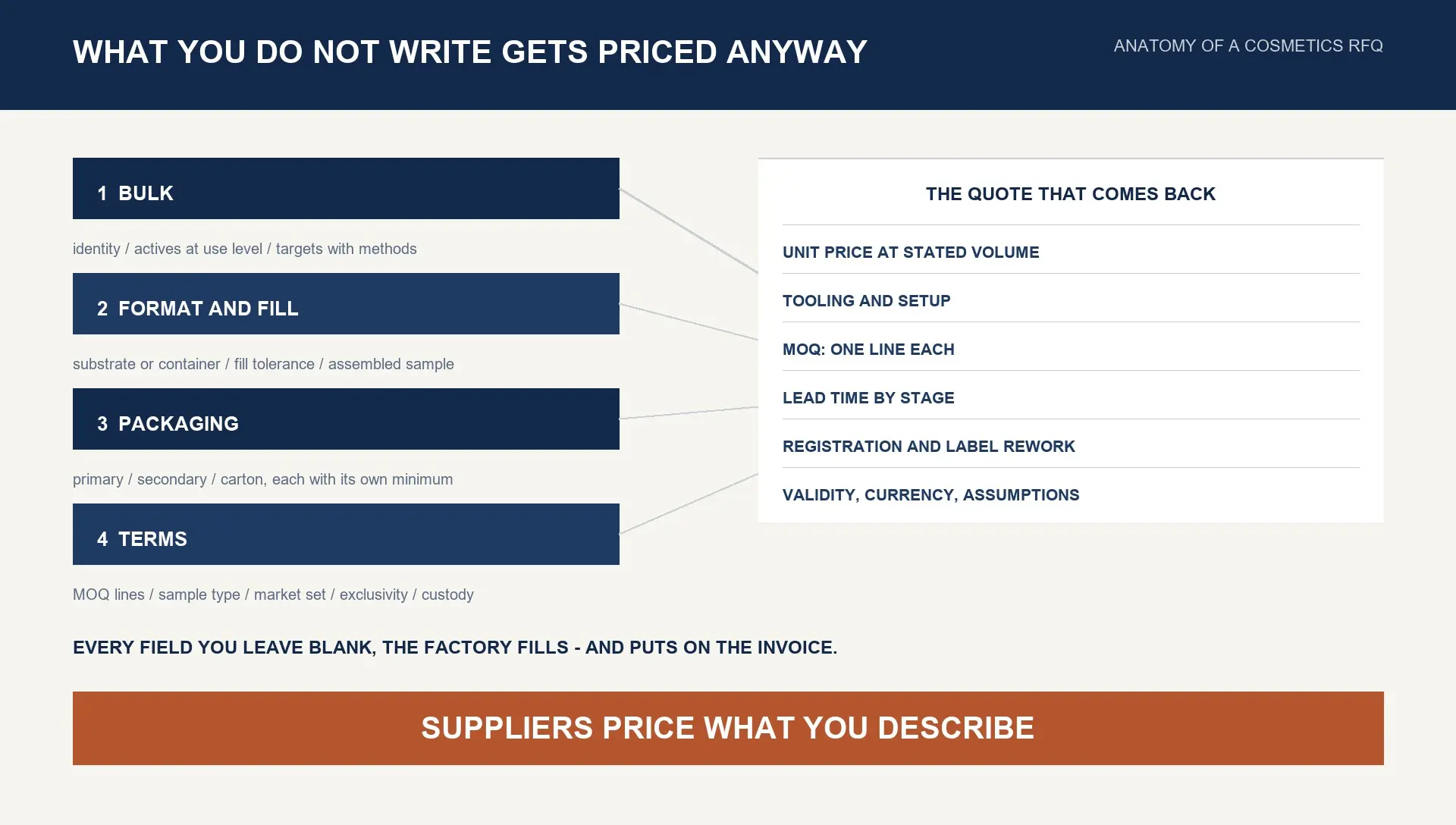
A useful quote comparison is structural, not numerical — no factory publishes list prices, and the number that matters on your first PO is not the unit price but which lines appear, and when they hit cash. The same serum, quoted three ways:
| Quote line | White label | Semi-private | Full private | When the cash moves |
|---|---|---|---|---|
| Formula development | None — included | Partial — actives addition | Full — brief through stability | Private: before any sample |
| Sample fee | Low / standard | Moderate | Moderate–high | Before the PO; the industry-standard ask is fee offset against the first order plus parity samples |
| Formula MOQ | Low — the factory's standing batch | Moderate | Moderate — your batch, not the shared one | Negotiated per formula ID |
| Packaging MOQ | Same as the other two models | Same | Same | The stall line in all three models — identical jar, identical carton math |
| Unit cost direction | Lowest per unit (shared batch amortization) | Middle | Highest early, converging at volume | Development cost amortizes across your first three POs |
| Lead time to first container | ~4–8 weeks | ~6–12 weeks | ~10–16 weeks | Sequenced in H2 九 with exit documents |
| Price review clause | Standard annual | Standard annual | Formula-IP review (protects the asset) | Write it at contract, not at renewal |
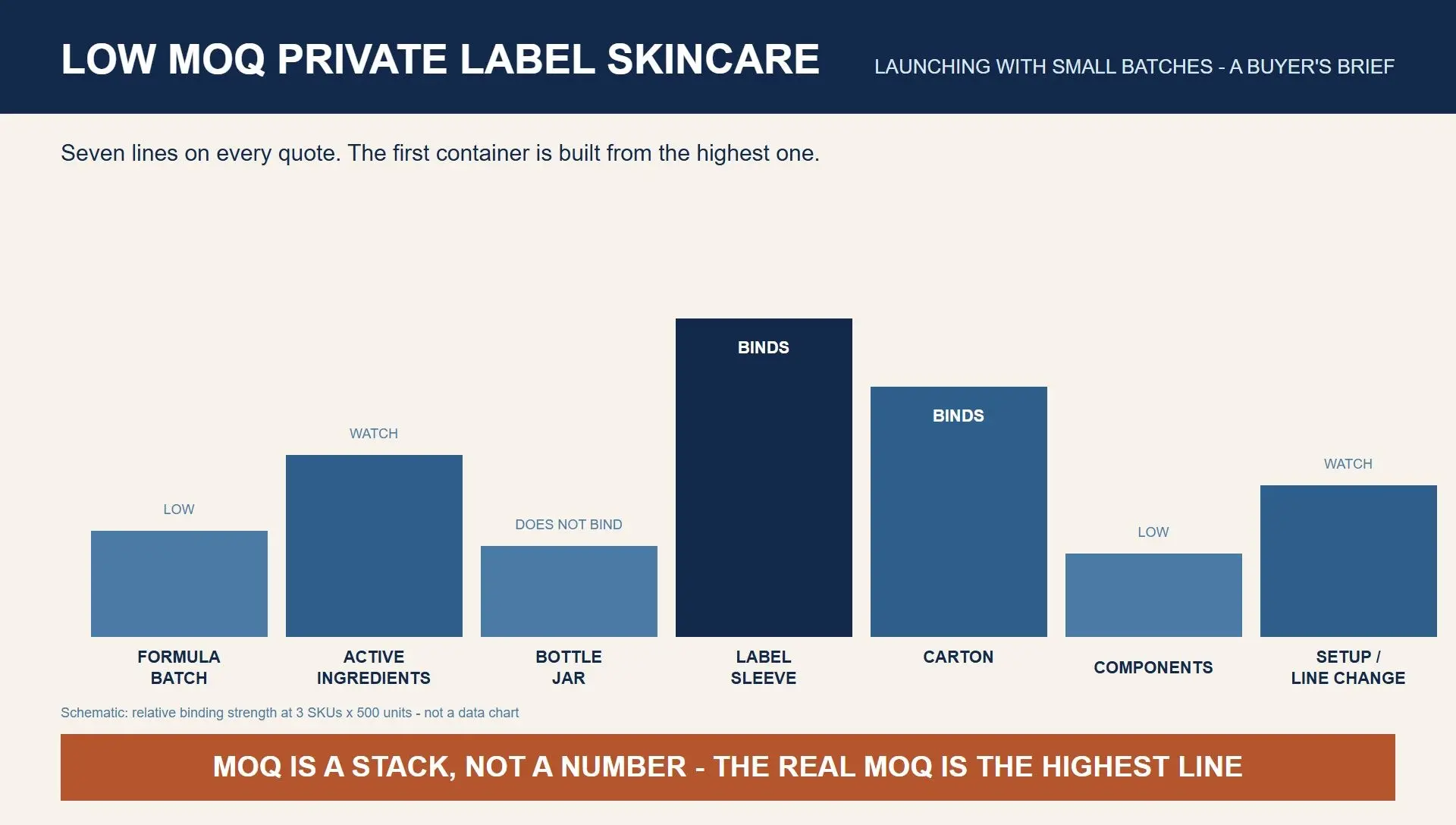
Two GSIM facts to put in writing at the quote stage. First, the sample fee: the standard, negotiable structure is a fee that is credited against the first order, plus parity samples — the exact batch composition that will ship, not a pilot. A sample that is not parity is a different product, and the gap shows up at the container, not at the sign-off. Second, MOQs are two numbers, not one: formula MOQ and packaging MOQ are independent lines. A factory can produce three hundred bottles of your formula while the jar MOQ is ten thousand units — the mechanism that makes low MOQ work, and where it doesn't, is walked through in our low-MOQ OEM coverage. A quote that shows only "MOQ" without splitting the two lines will surprise you on the first PO, and the surprise will be on the packaging line.
The white label trap is the mirror image: "low MOQ" advertised on the formula line often conceals "standard" on the packaging line. The model comparison is only honest when both MOQs are on the page — because the first container is built from the larger of the two.
Exclusivity: The Clause That Decides Whether Your Range Is a Me-too
The failure mode is common enough to have a name in the trade: the buyer launches a "private" range, and six months later a competitor in the same channel sells the same formula under a different sticker. The contract said custom. The contract did not say exclusive — and "custom" without exclusivity is white label with your sticker and a development invoice.
An exclusivity clause has three variables, and all three must be written: territory (which markets the exclusivity covers — a formula that is exclusive to you in the EU is still sellable in the US), term (how long, and what renews it — the clean structure is exclusivity tied to an MOQ commitment, reviewed annually), and scope (what exactly is exclusive — the clause must point at a formula ID or an INCI core set, because "the formula" is not a legally addressable object). The fourth question is price: exclusivity is a priced line on a quote. A factory that offers it free is usually reserving the right to revoke it — the fee is what makes the promise enforceable, and its absence is the risk priced in, not a discount.
Semi-private needs the sharpest reading. The base formula is the factory's commercial asset — it will be on other shelves. Your differentiation is the actives combination, and the clause has to protect the combination, not pretend to protect the base. Two asks that belong in the semi-private contract: confirmation that your exact combination is not already sold in your territory, and a non-circumvent — the factory does not approach your distributors with a near-identical combination during the term. Get both in writing before the actives are paid for; after that, the leverage has moved.
Geography Is Not Quality: USA, UK and China in One Table
A shortlist that opens in a search box — best skincare manufacturer uk this time, the United Kingdom — is using geography as a quality proxy. The proxy is sometimes right, because proximity genuinely shortens the audit path, the compliance path and the shelf path. It is sometimes wrong, in two documented ways: a UK address whose actual manufacturing is in the Far East, and a "US factory" that is a packaging house doing fill-and-label on imported bulk. Geography must be scored on what it changes in your file and your flight path — not on the flag.
| Dimension | USA base | UK base | China base |
|---|---|---|---|
| Regulatory proximity | MoCRA facility registration and the US-side file are closest to the factory | CPNP / Responsible Person duties sit with your appointed RP; the factory's GMP scope feeds the EU safety file | GMP manufacturing plus the export documentation pack; your destination-market duties (MoCRA / CPNP) are on your side of the border |
| Audit distance | Same-day to one-day flights for US buyers | Short-haul within Europe | Long-haul — third-party audit report plus video audit is the honest first layer, on-site audit the second |
| MOQ and lead-time typicality | Higher MOQs, longer first samples | Higher MOQs, longer first samples | Lower MOQ entry; the seven-day sample standard our factory runs |
| Where the cost sits | Labor, compliance, energy | Labor, compliance, energy | Lower labor; freight and destination duty land at your import step |
| What to verify in the file | Facility registration practice | Actual manufacturing site versus packaging site | GMP scope, export experience to your market, retained-sample policy |
The two compliance columns are where the buyer's own paperwork attaches — and the paperwork is per-market, not per-factory. Our MoCRA supplier-selection coverage explains the US side: the 2026 full-enforcement mandates and what they change in supplier selection. The EU/UK side — who must be your Responsible Person, what the CPNP notification requires of the importer — is the question our EU compliance guide for importers answers. Geography changes who is closest to the paperwork; it does not change that the paperwork exists.
The Cosmax–Keminova signal from the market section lands here too: with global OEMs building European production, "EU-base" offers will multiply on buyer shortlists. Score every one of them on the same five-dimension checklist — the address is not a dimension.
Shortlisting Without Names: The Scoreable Factory Checklist
Buyers usually ask for a list of private label skincare companies to shortlist — and the useful answer is a scorecard, not a name list, for the reason stated at the top: a name list ages in a quarter (acquisitions, line changes, cert lapses — the Keminova row in the market table is this week's example), while a scorecard is yours forever. The five dimensions below are weighted the way first-container risk is weighted: what you cannot un-buy later — intellectual property, the compliance file — carries more weight than what you can re-source next year, like capacity.
| # | Dimension | Weight | Evidence document (request in writing) | Pass line |
|---|---|---|---|---|
| 1 | Formula ownership & IP | 25% | IP clause draft; moleculename registration list; NDA practice | Ownership or irrevocable license to you; no shared actives combination in your territory |
| 2 | Qualifications & GMP | 20% | ISO 22716 / GMP certificate with scope and expiry; facility registration practice | Scope covers your formats; certificate current at signing |
| 3 | Capacity & line match | 20% | Line layout; shared-line policy; peak capacity; QC lab list | Your formats on dedicated or time-blocked lines; in-house stability and microbiology lab |
| 4 | Sample retention & batch traceability | 15% | Retained-sample policy (what, how long); CoA template | Per-batch retained sample; CoA requestable after a shelf failure |
| 5 | Auditability | 20% | Third-party audit report (body + date); response time to on-site or video audit request | Independent audit within 24 months; audit request answered within one week |
| Total | 100% | ≥75 = sample stage · 60–74 = one more document round · <60 = next candidate |
Two scoring disciplines make the card honest. Score against the document, not the description — a verbal "yes" is a zero until the named evidence document arrives, because the purpose of the row is to be re-run in month nine when something has changed. Weight is fixed before scoring, not after — the moment you let a weak dimension drag the total, the card has become a justification machine, which is what shortlists do when they are not scorecards. The deep version of dimension five already exists on this site: the 12-point factory audit checklist is what the "auditability" row expands into when a candidate reaches the sample stage.
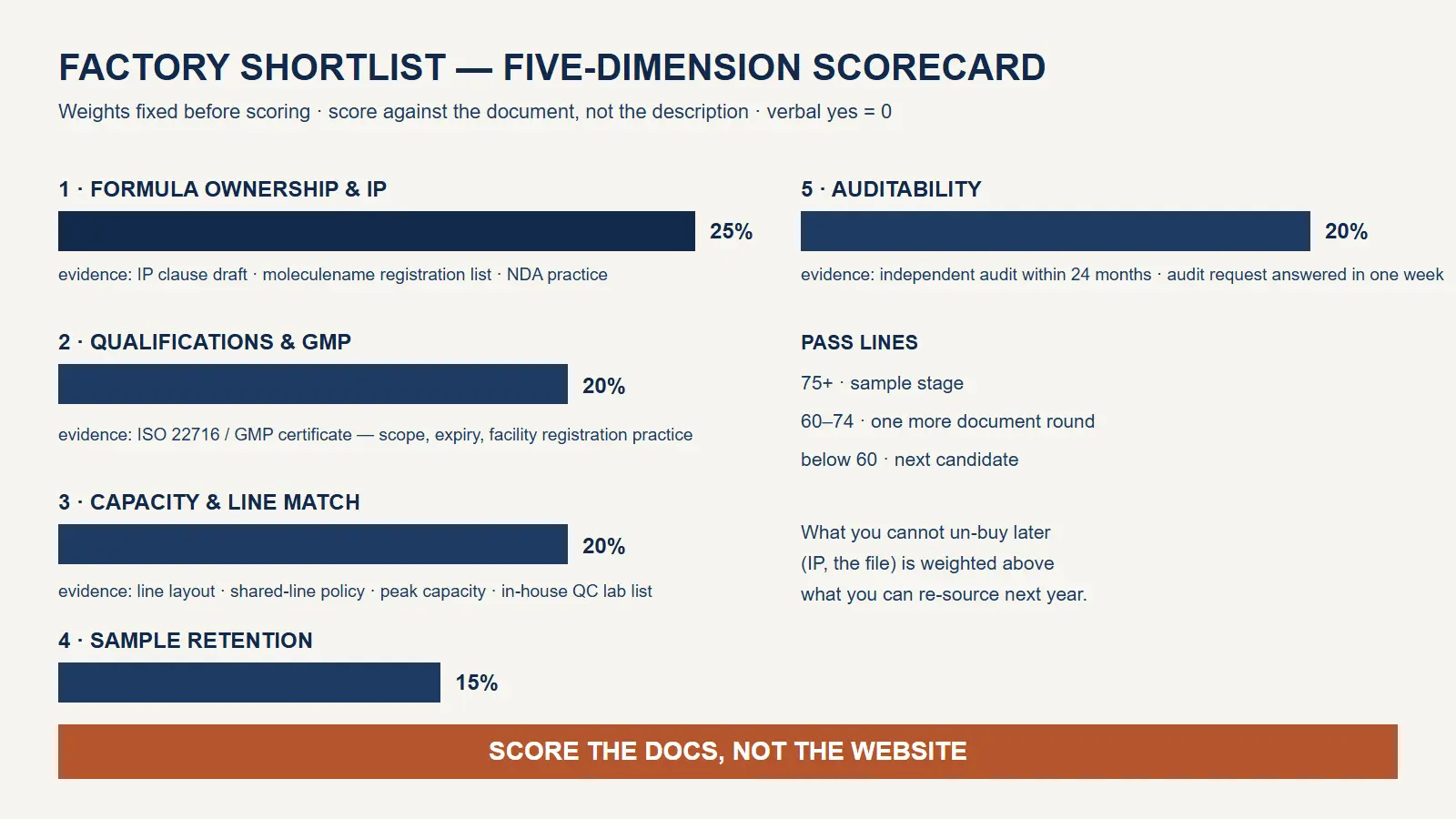
Score the docs, not the website.
The Documentation Pack: What to Request Before Paying for a Sample
The sample fee is not for the sample — it is for the file. In the five-decision sequence for starting a brand, sampling is the step where information is bought with money, and the six-file pack below is what the money buys. Request all six before the sample invoice is paid; the sequence is the whole point, because the file either exists or it does not, and its existence answers the model question faster than any swatch can.
| File | What it proves | Red flag if absent |
|---|---|---|
| Stability data (accelerated + real-time) | The shelf-life claim is testable, not promised | "Stable for years" with no protocol or curve |
| Certificate of analysis (CoA) | Per-batch assay and microbiological limits | CoA "to follow after shipment" |
| Safety assessment input (EU CPSR input / US risk assessment data per MoCRA) | Your compliance file can be built from the factory's data | "Your regulator, your problem" with no underlying data |
| INCI + allergen declaration | The label can be built for each market without rework | INCI that changes after your label is printed |
| Certification copies with validity dates | The GMP claim is current and scoped | A certificate image without expiry or scope |
| Batch traceability sample | The retained-sample promise is operational | A lab result that cannot be tied to a batch number |
Two market add-ons sit on top of the base pack. For Middle East markets, the Halal documentation build — compliant formulation plus the file that proves it — is the extra row: our Halal buyers guide covers what the file must contain. For EU/UK, the CPNP safety-assessment input is the extra row, and it comes from the factory's data set, not from your shelf. The base six are the same in every market; the add-on rows are per-market — which is another way of saying the model decision and the compliance decision share the same document pipeline.
The gate, stated as it is run: no file, no sample payment. A factory that sends the six files early is also telling you how the production file will arrive — on time, scoped, and tied to batch numbers. A factory that cannot send them has answered the model question for you, and the answer is in their silence.
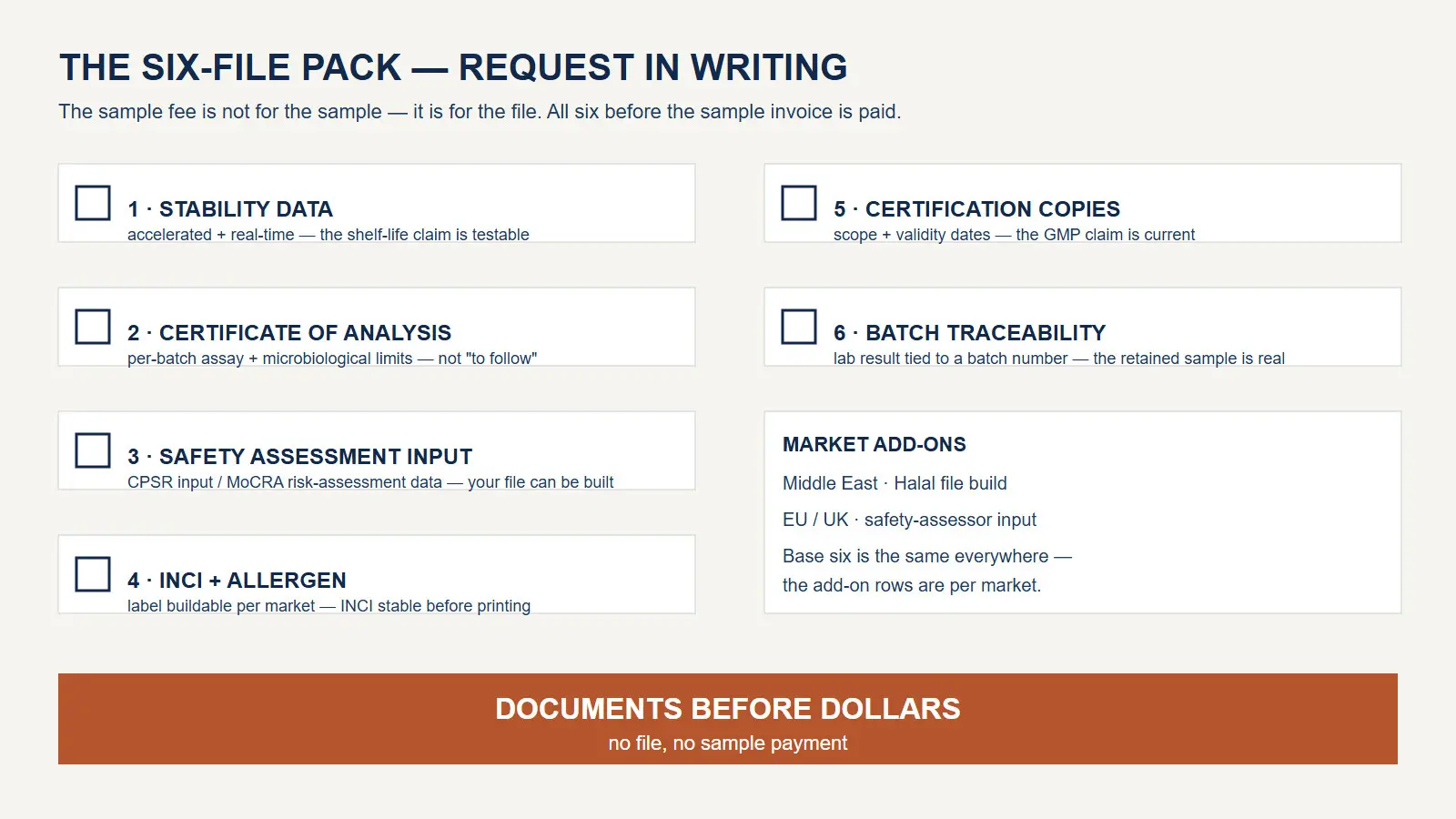
A factory that cannot send the file before you send the PO has already answered the question.
Two Timelines: 4–8 Weeks Versus 10–16 Weeks, With Exit Documents
The timelines below are standards for planning — the same way the seven-day sample is a standard, not a promise: they assume the documentation pack is requested at the brief stage, the exclusivity clause is negotiated at the quote stage, and no market add-on is discovered after production starts.
| Stage | White label | Semi-private | Full private | Exit document |
|---|---|---|---|---|
| Brief & specification | 0–1 wk | 1–2 wk | 2–4 wk | Signed specification sheet |
| Formula | — (the factory's) | 2–4 wk (actives addition) | 4–8 wk (development + stability start) | Formula ID + stability protocol |
| Sampling | 1–2 wk | 2–3 wk | 2–3 wk | Sample + CoA + retained sample |
| Compliance file | 1–2 wk (generic) | 2–3 wk | 2–4 wk | The six-file pack (H2 八) |
| Production | 2–4 wk | 3–4 wk | 4–6 wk | Batch release + CoA |
| First container | ~4–8 weeks | ~6–12 weeks | ~10–16 weeks | Shipping documents |
The stall line is the same in all three columns, and it is not the formula. Packaging MOQ is where first containers stall: the formula is ready at three hundred bottles, the jar at ten thousand units, and the gap between those two numbers is where launch dates die. The white label buyer's second stall is usually per-market claims on the label; the full private buyer's second stall is the stability duration, because the file must close before the claim prints. Both stalls are document stalls — which is why the timeline's exit-document column is the planning tool, not the week numbers.
The planning math, stated once: if the launch date is fixed, work backward from the production exit document (batch release), not from the PO date — the PO date is the number the factory controls, and the batch release is the number that controls your calendar.
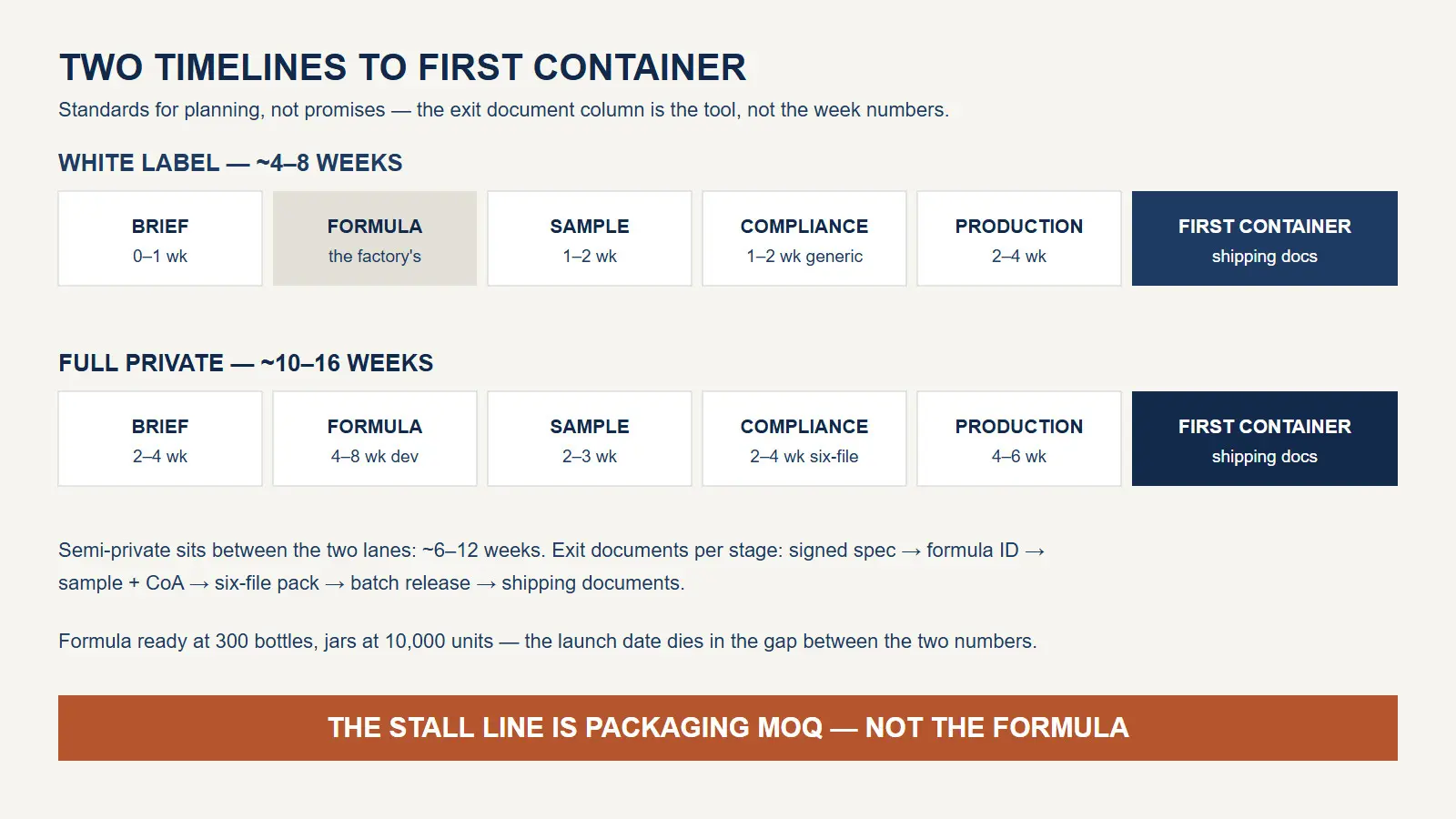
The stall line is the same in all three models — packaging MOQ.
Ten Questions to Ask Before You Choose a Model
The ten questions below are the model decision in interrogative form — each one has a document answer, and a factory that cannot answer in writing within a week has positioned itself on the scorecard.
1. Who owns the formula in writing, and for how long — and what happens to it if we stop ordering? 2. Which territories is the formula exclusive to me, at what fee, for how many years — tied to what MOQ? 3. What is the MOQ on the formula line versus the packaging line — the two numbers, separately, in writing? 4. What is the sample fee, the sample lead time, and is the fee offset against the first order with parity samples? 5. Will the six-file pack — stability, CoA, safety assessment, INCI plus allergen, certification validity, batch traceability — be sent before I pay for a sample? 6. Which moleculenames or actives are registered, and to whom — you, us, or neither? 7. Which production lines run my formats, and are they dedicated or time-blocked for my batch? 8. What does your QC lab test in-house, and which tests go to a third party — and when? 9. Retained samples: what exactly is kept, for how long, and can I request the retained sample after a shelf complaint? 10. What is the reorder lead time at my target volume, and on what cycle does the price review happen?
When the ten answers are in front of you, the question is no longer private label vs white label skincare — it is a quote against a known file, and a known file is something you can compare, audit and re-run in month nine. That is the difference between choosing a model and discovering one.
Frequently Asked Questions
Q1: What is private label vs white label — in one sentence? Private label: you own — or exclusively license — the formula and its file. White label: the factory owns the formula and sells the same one to other brands under your label. Everything else in this piece is the working detail of that one sentence.
Q2: Can I start white label and move to private later? Yes — and it is the standard path: white label to prove sell-through, semi-private (your actives on the factory base) to differentiate, full private when the volume justifies carrying the development cost. The one thing to keep open from day one is the exclusivity clause, so the move does not require renegotiating ownership.
Q3: Which model is cheaper for a first launch? White label on the first PO — no development fee, the factory's standing batch, the lowest formula MOQ. Private label is cheaper per unit at volume and cheaper per claim in year two. The crossover is usually the second or third reorder, which is why the decision should be made on the ownership lines, not on the first invoice.
Q4: Do I need a local entity in the USA or UK? Not necessarily, but the duties attach to US/EU-side roles: in the EU/UK the CPNP notification runs through a Responsible Person you appoint (an entity or a service provider), and in the US the MoCRA facility registration and the responsible-party file sit on the import side of the chain. Structure those roles before the first PO, not after the first container.
Q5: Who carries the compliance duties in each model? The regulatory duties follow the market — your RP in the EU/UK, your facility registration in the US, regardless of model. The manufacturing file follows the factory — stability, CoA, safety-assessment input. The model changes who writes the file, not who is regulated.
Q6: What MOQ difference should I expect between the models? The formula MOQ is lower in white label (the factory's standing batch) and rises through semi-private to full private (your own batch). The packaging MOQ is the same in all three — which is exactly why the stall line in H2 九 is packaging, not formula.
What to do next
Send us your model question: the formats you intend to run, the markets you intend to sell, and your first-container date. What comes back is a quote against named lines — development, sample, formula MOQ, packaging MOQ — plus the six-file pack list for your markets and the five-dimension scorecard with your formats marked against it. A dedicated product manager on every RFQ — reply within 24 hours.
Sources and Further Reading
Market sizing (second-party; institution + report date as cited in the table):
1. Grand View Research, Private Label Cosmetics Market Report (2026-07): US$10.6B (2024) → US$14.4B (2030), 5.2% CAGR; Asia-Pacific 48.6% share. 2. Research and Markets, Private Label Cosmetics Market (2026): US$10.64B (2024) → US$14.39B (2030), 5.20% CAGR. 3. Business Research Insights, Private Label Cosmetics Market (2026): US$10.57B (2026) → US$19.95B (2035), 7.2% CAGR. 4. Strategic Market Research, Private Label Cosmetics Market (2026-08): US$12.8B (2023) → US$23.7B (2030), 9.1% CAGR. 5. Verified Market Reports, Private Label Cosmetics and Packaging Market (2026-05): North America US$12.5B (2024) → US$20.4B (2033), 6.4% CAGR; retail private label programs as the growth driver. 6. Future Market Insights, Private Label Skincare Market (2026-09): US$341.4M (2026) → US$605.7M (2036), 5.9% CAGR (skincare-only boundary); Cosmax–Keminova acquisition (February 2026) as cited in the same report.
Site internal references:
7. Three-model comparison (private label / OEM / ODM): https://www.fkybeauty.com/private-label-vs-oem-vs-odm-which-model-fits-your-brand/ 8. Encapsulated cream private-label ladder (L1/L2/L3): https://www.fkybeauty.com/news/collagen-capsule-cream-benefits-private-label/ 9. Low-MOQ OEM mechanism: https://www.fkybeauty.com/blog/china-low-moq-skincare-oem-solutions-for-global-buyers/ 10. MoCRA supplier-selection guide: https://www.fkybeauty.com/news/mocra-2026-full-enforcement-compliance-mandates-supplier-selection-guide-for-skincare-brands-exporting-to-the-u-s/ 11. EU CPNP compliance guide for importers: https://www.fkybeauty.com/eu-skincare-oem-cosmetic-compliance-guide-for-importers/ 12. 12-point factory audit checklist: https://www.fkybeauty.com/how-to-verify-a-chinese-skincare-oem-factory-12-point-audit-checklist/ 13. Halal OEM buyers guide: https://www.fkybeauty.com/halal-skincare-oem-buyers-guide-middle-east-markets/ 14. Starting a skincare brand — the five-decision sequence: https://www.fkybeauty.com/news/how-to-start-a-skincare-brand-in-2026/