

Hand Mask Benefits: Use Frequency and Retail Angles for Brands
Hand Mask Benefits: The Body-Care Extension Play
The buyer's question is rarely "should hands get skincare?" — dermatology's standard answer has been yes for years. The question is what hand mask benefits mean for a range that is built around the face: hands are the first zone that shows age, the zone that is visible the most, and the zone that is still underserved by the formats your factory already runs. That is the whole opportunity in one sentence — and it is the same move your category already made with the scalp, which our coverage of scalp aging framed as efficacy migration: the active set travels, the format adapts, and the claim language has to be rebuilt for the new zone.
Why hands specifically, and why now, from the buyer's side. Three structural facts. First, the segment is growing faster than the face mask categories most of your competitors are crowded in: market projections cited in the 2026 Alibaba hand and foot care compliance guide put hand care at US$5.2 billion in 2025, expanding to US$7.8 billion by 2030 at an 8.5 percent CAGR, with anti-ageing formulations named as a primary growth driver. Second, the demand signal is flat-to-strong rather than explosive — our platform data table shows `hand mask` at 6,192 US searches per week, up 16.9 percent over four weeks (platform metric, not Google) — which is exactly the profile of a category ready for a line extension but not for a hero-SKU bet. Third, the retail format is already proven by others: US marketplace listings have settled on glove pairs, 15–20 minute treatment windows, 5-pack units and gifting/travel occasions long before most brand ranges caught up. The category's consumer education is done; the supply side is still thin.
What this piece does with those facts: it walks the four decisions a product committee actually makes — format (gloves vs single-hand vs sets), frequency (the repurchase engine), claims (what hands are allowed to say), and retail architecture (where the SKU sits in the range and who buys it).
Hand masks are an extension play, not a launch play: an existing line's actives, monetized on a new, visible, underserved zone.
Gloves, Single-Hand or Pair: The Format Decision
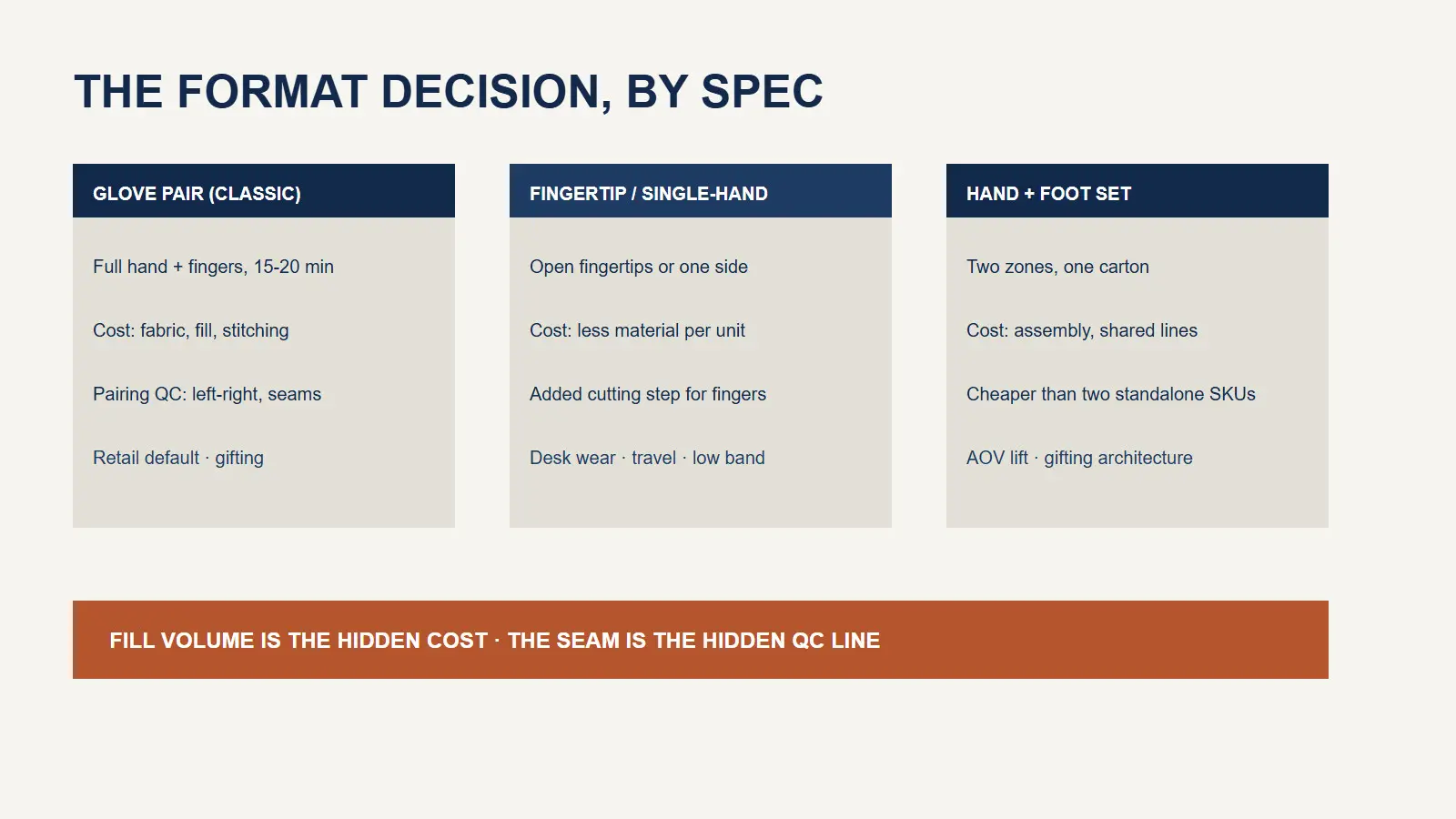
The hand mask gloves benefits question sounds consumer-facing, but it is really a spec question in disguise: the format fixes the wear time, the fill volume, the sewing cost and the shelf photograph before you choose a single active. The market has already sorted itself into three workable formats, and the differences are procurement differences, not style differences.
| Format | What the buyer ships | Wear time / coverage | Cost driver | Retail fit |
|---|---|---|---|---|
| Glove pair (classic) | Two fabric gloves, serum-filled, wrist seal | 15–20 min; full hand + fingers | Fabric, fill volume, stitching, left-right pairing | The retail default; gifting and 5-pack units |
| Fingertip-removable glove | Glove pair with cut-away or open fingertips | 15–20 min; hands while fingers stay free | Added cutting/sewing step | "Wear it at your desk" positioning; professional users |
| Single-hand / one-sided mask | One mask, one hand at a time | 10–15 min; one hand | Half the material per unit | Trial pricing, travel, lower price band |
| Hand + foot set | Glove pair + foot pair in one unit | 15–20 min; both zones | Two formats, one carton | Set pricing, AOV lift, gifting (see H2 六) |
Two notes that matter at the contract table. Fill volume is the hidden cost variable: a glove pair holds several times the serum of a single face mask, so the active load — and the active cost — scales with the format, not with the label. Stitching and pairing quality is the hidden QC variable: a glove that leaks, rides up or splits at the seam fails on the customer's hand in the middle of a 20-minute ritual, which is the worst possible place for a defect to surface. Specify seal integrity and fill-volume tolerance per unit in the quality protocol, the way we would specify sheet adhesion on a face mask.
The format is a spec decision wearing a style question — fill volume is the hidden cost line, and the seam is the hidden QC line.
The Collagen Question: What Hands Actually Need
If one claim travels with this category, it is collagen — and the collagen hand mask benefits argument is the strongest claim in the segment, because collagen loss is the single most visible ageing marker on the hand: thin skin, sun damage and low oil production make the dorsum of the hand read older than the face it belongs to. The buyer's job is to decide what that claim is allowed to mean, and the honest answer has two layers.
Layer one — what collagen does in a hand mask is mechanical and hydration work, not regeneration. Hydrolysed collagen and collagen-derived film-formers sit on and in the upper skin layers, deliver a visible smoothing effect while the mask is on, and support the hydration film for hours after. That is real, that is photographable, and that is what the consumer perceives as "firmer, softer hands." Layer two — the word "collagen" on a hand label should carry a carrier story, not a synthesis story. The claim to substantiate is "smooths and hydrates," not "regenerates hand collagen." Put the heavy lifting on a co-active that hands actually need — ceramides for the barrier, glycerin for humectancy, and in intensive formats urea at cosmetic-level concentrations for rough, cracked skin — and let collagen be the texture and the perception. Our ingredient comparison work for PDRN, peptides, retinol and hyaluronic acid applies directly: pick the engine, then spec the hand format around it.
The practical spec that follows: a collagen hand mask for a premium line is a ceramide-plus-collagen film system at 15–20 minutes, fragrance-light, with the label claims written against the barrier and the smoothing — not against the biology.
Usage Frequency: The Repurchase Engine
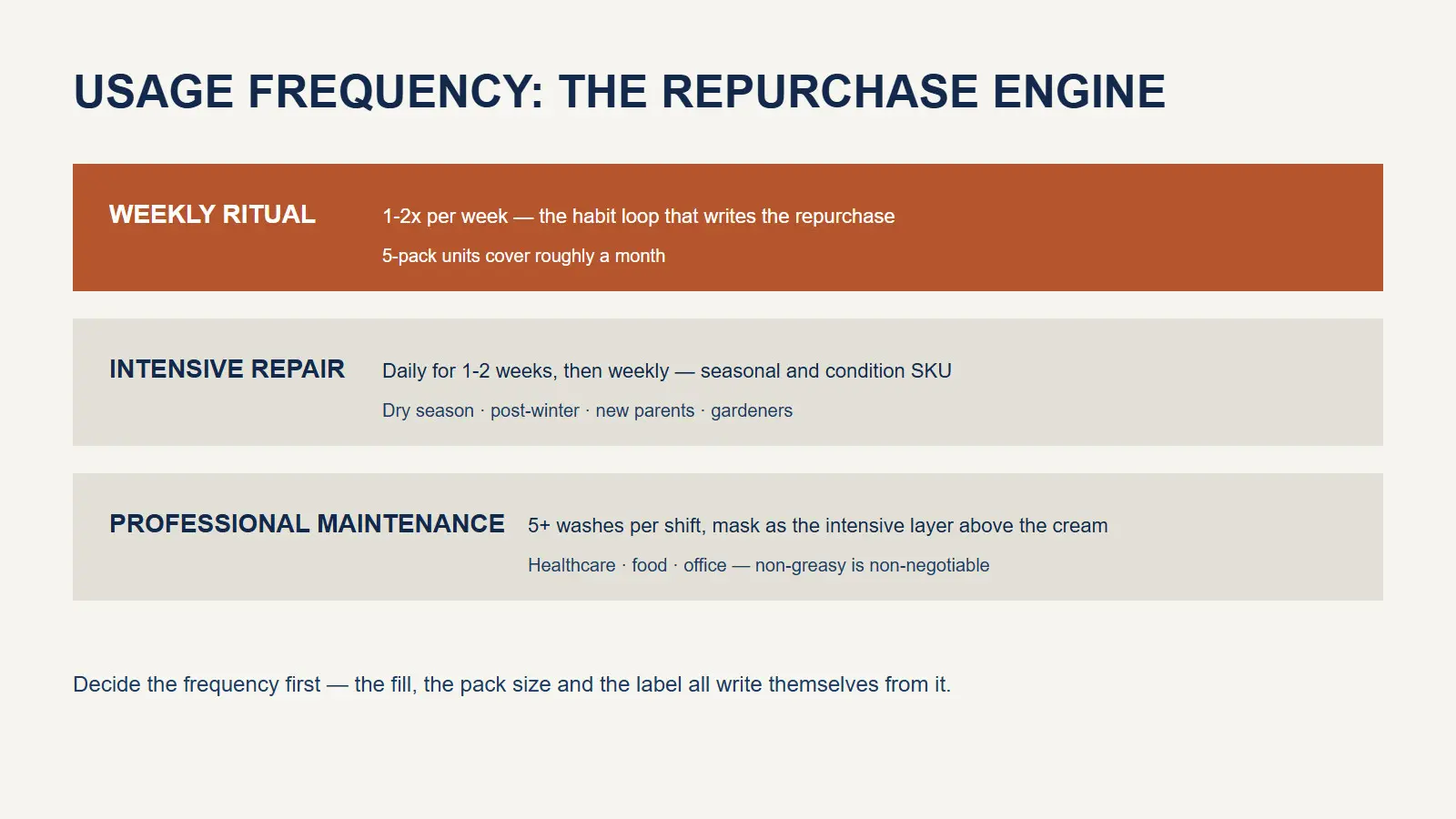
Here is where the consumer category and the B-side category meet, and it is the section a product committee most needs. A hand mask is not a once-and-done treatment — it is a frequency product, and frequency is what the repurchase revenue is built on. The observed usage structure in the market sorts into three patterns, and each one is a different SKU:
| Usage pattern | Who it is for | Frequency | SKU role | Repurchase logic |
|---|---|---|---|---|
| Weekly ritual | The retail mainstream | 1–2x per week | Core line extension | Habit loop; 5-pack units roughly cover a month |
| Intensive repair | Dry/cracked-season, post-winter, new parents, gardeners | Daily for 1–2 weeks, then weekly | Seasonal / condition SKU | Event-driven, then converts to weekly |
| Professional maintenance | Frequent hand-washers: nurses, baristas, pharmacy staff, food workers | Daily creaming 5+ times per shift, plus the mask as the intensive layer on top | Professional / B2B2C line | The mask is the "one good thing" above the daily cream; loyalty is high, price sensitivity is low |
The third row is the one most brands miss, and it is the most B2B-shaped of the three. The user-voice data in the 2026 hand and foot care guide is blunt about it: professionals who wash and sanitise their hands all shift report applying hand cream five or more times a shift, and they rank fast-absorbing, non-greasy, fragrance-free as non-negotiable — because greasy hands are a workflow problem. For that audience the hand mask is not the entry point, it is the intensive layer above the daily cream: the cream handles the shift, the mask handles the repair. That is a two-SKU story (daily cream + weekly mask) sold into one professional channel — and it is exactly the kind of architecture our esthetician and reseller channel work is built around.
The buyer's decision, stated plainly: spec the format for the frequency you intend to sell. A 15–20 minute glove pair sold as a weekly ritual is a different unit economics and a different photograph than the same gloves sold as a two-week intensive. The fill, the pack size and the label language all follow from the frequency claim.
Decide the frequency first — the fill, the pack size and the label all write themselves from it.
Are Hand Masks Worth It? The B-Side Math
The question in its search-bar form deserves the straight answer: yes — as an extension SKU; no — as a hero launch. Three numbers frame it.
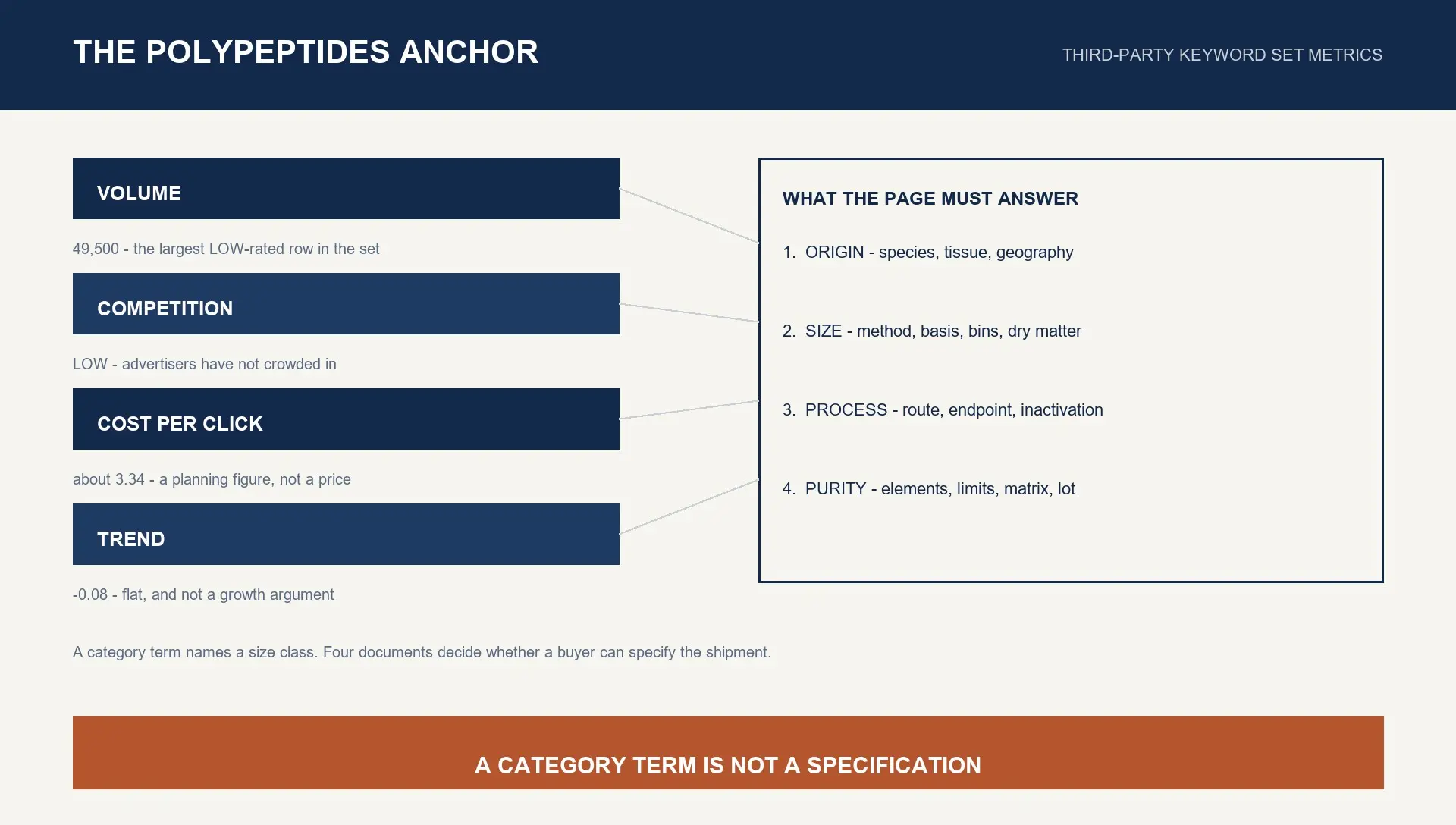
The demand number is real but modest. `hand mask` sits at 6,192 US searches per week on our platform table, up 16.9 percent over four weeks — the queue's own verdict is "flat to strong," not breakout. A hero SKU needs breakout demand to justify the marketing weight; a flat-to-strong signal is exactly what a well-placed line extension monetizes. The growth number is better. Hand care as a whole segment is projected to grow from US$5.2 billion to US$7.8 billion by 2030 at 8.5 percent, and the same guide names anti-ageing formulations as a leading driver — the hand mask is the format that most directly carries an anti-ageing hand claim. The cost number is structural, not scary. A glove pair costs more per unit than a face sheet — fabric, fill volume, stitching, left-right pairing — but it shares its entire base-material and filling infrastructure with the face mask line you already run. The incremental cost is the format, not the chemistry.
Run the math the way we would in a range review: a collagen-plus-ceramide glove pair built on your existing face-mask active system, launched as a weekly ritual in 5-pack units with a gifting variant, extends a proven line into a growing, visible, under-supplied zone at incremental format cost. The risks are equally concrete — the unit cost is higher than a face sheet, the category is young enough that your sell-through data will be the category's sell-through data, and a glove that fails at the seam fails publicly.
Worth it is a conditional: the fourth or fifth SKU of a mask line — never the first.
Hand and Foot Sets: The Retail Architecture
The hand and foot mask benefits overlap is precisely what makes the set work — and it is the retail angle the single-format buyers underprice. Hands and feet are the same story: exposed, hard-working, thin-skinned, high-visibility, and both are where consumers look first when they say "I look older." A set does three things a single SKU cannot.
It lifts average order value without lifting the story. One ritual, two zones, one carton: the set prices at a premium over the sum of parts because the occasion (the 20-minute weekly reset) is one occasion, and gifting — the format's strongest observed occasion in US listings — is structurally a set, not a single glove. It shares the supply line. Foot masks and hand gloves run on the same base fabric and filling system; the set is a packaging and assembly decision on top of infrastructure you already own — which is why the set cost is lower than two standalone SKUs and the set margin is higher. It covers the foot-care growth separately. Foot care is its own expanding segment — US$4.05 billion in 2025 heading to US$7.26 billion by 2034 at 6.84 percent, with Asia-Pacific holding 36.10 percent of it (Fortune Business Insights, via the same 2026 compliance guide) — and the set is the cheapest way to be in both zones with one brand story.
The architecture that follows is the same one our face mask set coverage walked through for the face: core hand glove (the line extension) → hand+foot set (the AOV and gifting play) → foot-only SKU (only when the set's sell-through proves the zone).
Do not launch the foot SKU first — the hands carry the story, and the feet ride the set.
The Claims You Can Make (and the Ones You Can't)
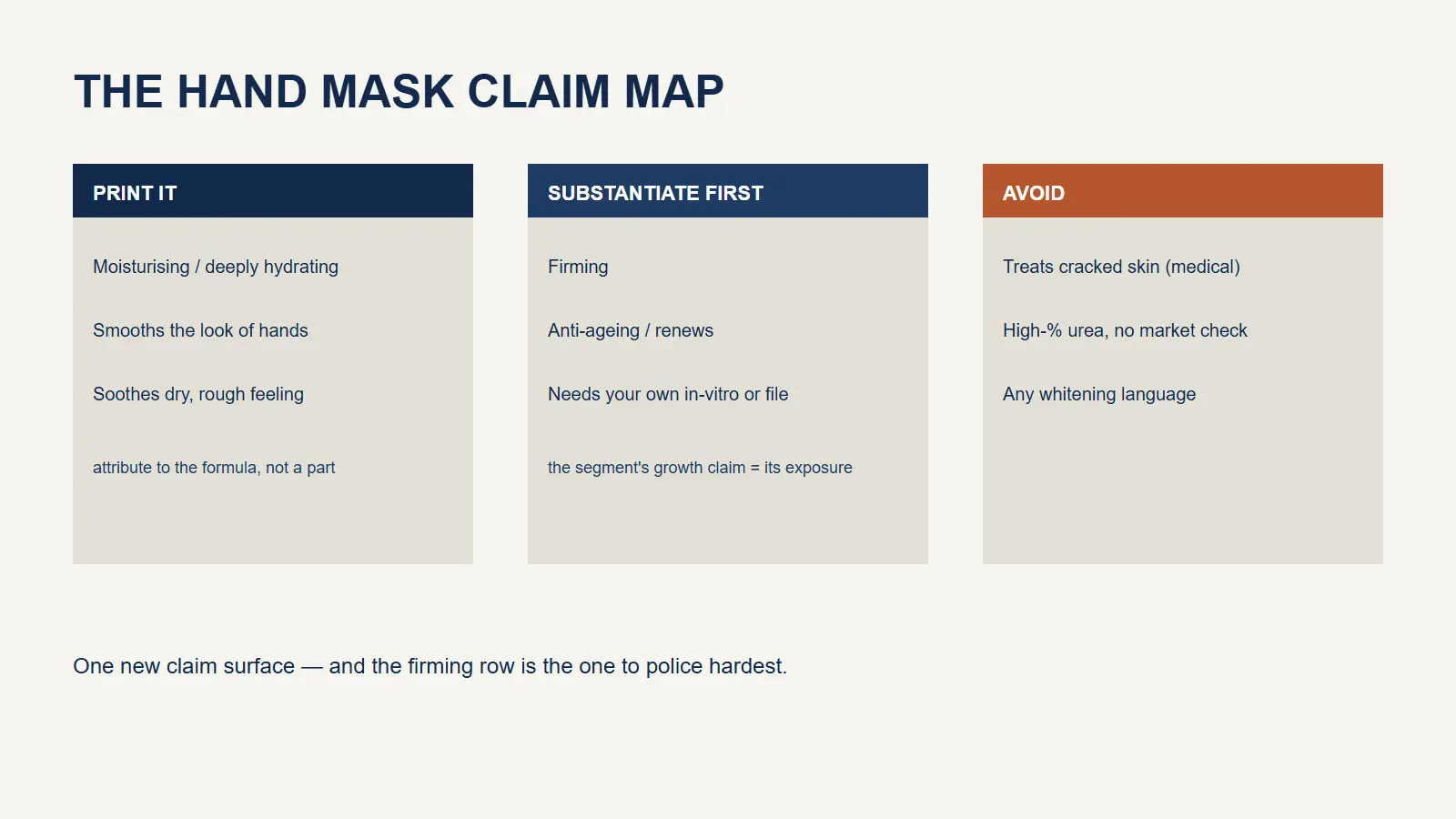
Hands are where anti-ageing language gets aggressive — the same guide that sizes the hand care segment names anti-ageing formulations as the growth driver — which means the claim risk in this category is higher than in face masks, because consumers are explicitly asking for the older-skin story. The map is short; keep it to the label.
| Claim on label | What carries it | Verdict |
|---|---|---|
| Moisturising / deeply hydrating | The fill system (glycerin, humectants) | Print it — attribute to the formula |
| Soothes dry, rough or cracked-feeling hands | Conditioning actives; cosmetic-level urea | Print it — "feeling" language, not clinical |
| Smooths the look of hands / visible softness | Collagen film-formers, the 15–20 min window | Print it — perception claims are safe |
| Firming / anti-ageing / "renews" | Would need clinical or in-vitro substantiation | Print only with your own file — this is where the segment's growth claim lives, and where the exposure lives |
| "Treats" cracked skin / medical language | Therapeutic claim territory | Do not print — cosmetic claims only |
| Urea at high concentrations | Drug-borderline depending on market and % | Engineer around it — cosmetic-level only, or check the target market's rule first |
Two structural notes. First, the compliance tail is the same tail as your face line — MoCRA in the US (facility registration, product listing, adverse-event reporting), the ASEAN Cosmetic Directive's per-country notifications with its December 2025 annex revision, EU rules elsewhere; our MoCRA and PPWR guides cover the machinery, and the hand mask adds no new regime — but it does add a new claim surface.
One new claim surface, and the "firming" row is the one to police hardest. Second, the professional channel raises the bar, not the rules: a nurse-facing SKU that prints fragrance-free and non-greasy is making a testable claim about the texture, so the spec must actually deliver it — the user voices are explicit that greasy is disqualifying.
Formulation and Manufacturing: What Hands Change Versus Face
The chemistry travels; the engineering does not. Four differences between a hand mask and the face masks your line already runs.
1. The skin is different. The dorsum of the hand has fewer oil glands than the face and takes more cumulative UV and wash wear — which is why the hand market's active set leans barrier-first: ceramides, glycerin, fatty alcohols, and in intensive formats cosmetic-level urea. Your face-mask active system is a head start, not a drop-in: spec the hand fill for barrier repair, not for the face's turnover story. 2. The format is wearable machinery. A glove pair is fabric + fill + seal + pairing: seal integrity (no leakage at the wrist), fill-volume tolerance (unit to unit), stitch durability over 20 minutes of movement, and left-right correctness. These are QC lines that do not exist on a flat sheet — put them in the quality protocol before sampling. 3. The fill volume changes the active economics. Several times the serum of a face mask per unit means the active cost per unit is structurally higher; that is the number to protect in the cost negotiation, and it is why "which active is the engine" (H2 三) is a cost decision as much as a claims decision. 4. The base material is shared — and that is the margin. Fabric, filling lines, even the hydrogel option if you run it: the format cost is real but the chemistry infrastructure is already paid for. Our format-decision work on hydrogel versus sheet masks transfers directly to gloves — the substrate choice sets the wear experience, the fill capacity and the shelf photograph.
Sourcing, MOQ and the Professional Channel
The procurement shape of a hand mask line is the same shape as the rest of the book, with two additions specific to this category.
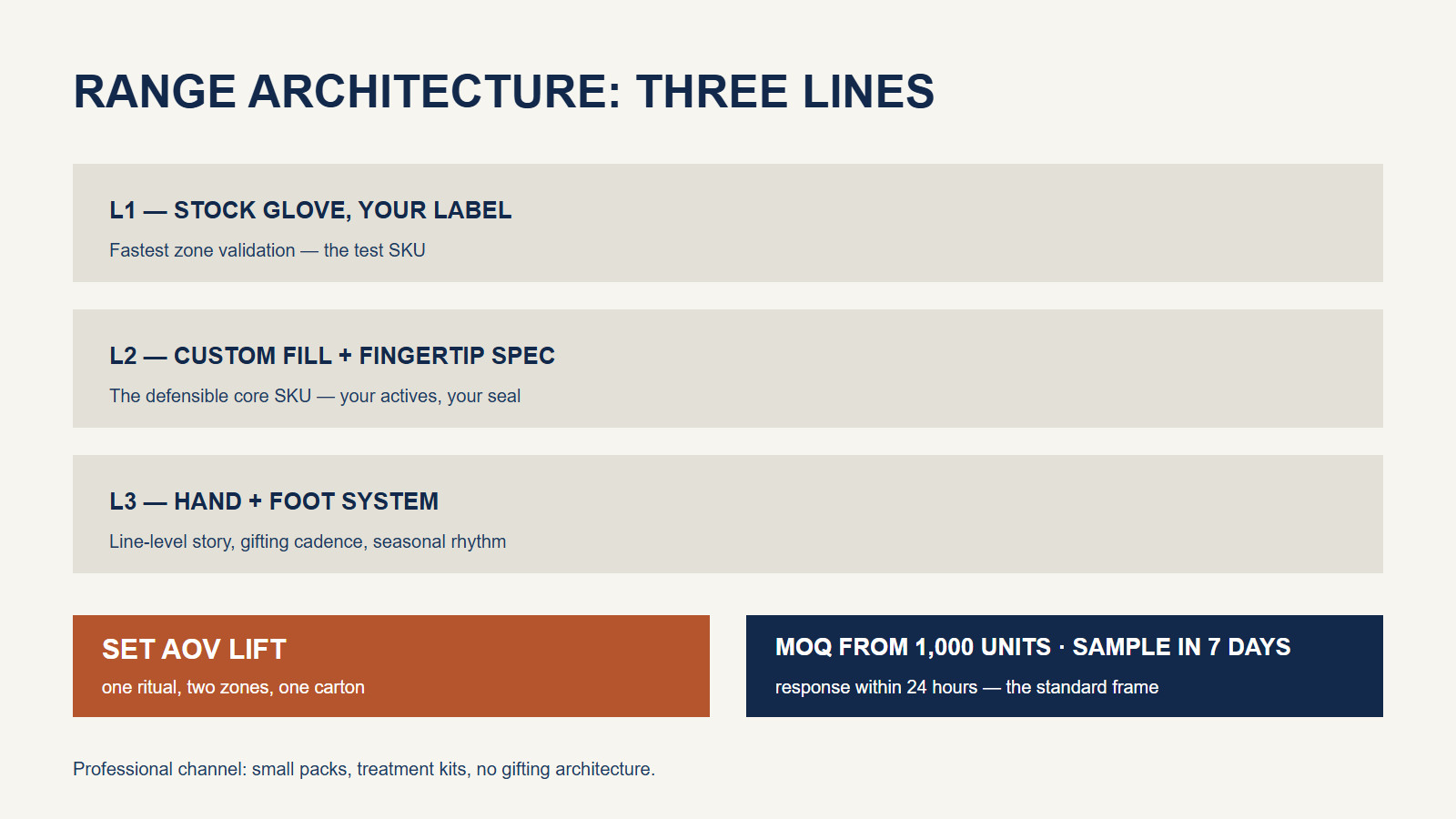
The standard frame. We run hand masks on the same commercial terms as every other mask format: response within 24 hours, sample in 7 days, MOQ from 1,000 units per formula tier. L1 is a stock glove formula with your label — the fastest way to validate the zone; L2 is a custom fill (your co-actives, your fragrance direction, your seal and fingertip architecture) — the defensible core SKU; L3 is a hand-plus-foot system across formats — the line, not the product. The sampling logic matters more here than in face masks because the format failure modes are physical: ask for the seal-integrity and fill-tolerance spec to be attached to the sample, and evaluate the glove on your own hands for the full 20 minutes.
The professional channel is a second door. The user-voice data (the 2026 hand and foot care guide's analysis of professional communities and marketplace reviews) shows the frequent-hand-washer segment — healthcare workers, baristas, pharmacy and food staff — buying hand care repeatedly, ranking non-greasy and fragrance-free as non-negotiable, and treating the intensive mask as the layer above the daily cream. That is a different ordering logic from retail: smaller packs, treatment kits, no gifting architecture, and the label written for the person who applies it five times a shift. Nail and beauty supply distribution is where this category already moves in the US market — our coverage of mask sourcing from China includes the channel mechanics, and the lip-mask adjacent line is the closest in-house analogue for a small-format, high-frequency body-skin SKU.
| Procurement question | What to ask the supplier |
|---|---|
| Format spec | Seal method, fill volume per glove, fingertip option, left-right QC |
| Fill system | Co-actives, active load per unit, fragrance direction, non-greasy finish proof |
| QC protocol | Seal integrity test, fill tolerance, 20-minute wear test, stitch durability |
| Pack architecture | 1-pair trial, 5-pack retail, professional small pack, set carton |
| Commercial terms | 24h response, 7-day sample, MOQ from 1,000 units, lead time at your volume |
Frequently Asked Questions
Q1: What should a brand look for in a hand mask before paying for a sample? The format spec (seal, fill volume, fingertip option), the fill system (co-actives and active load), and a QC protocol that tests the failure modes — seal integrity, fill tolerance, 20-minute wear, stitch durability. A sample without its spec attached is a photograph, not a proposal.
Q2: Do collagen hand masks actually work on ageing hands? As a smoothing and hydration treatment, yes — that is the film-forming and moisture work, and it is what the consumer perceives. As a collagen-regeneration claim, no — and the label should not say so. Write the claim against "smooths the look of hands" and put the barrier actives to work behind it.
Q3: What frequency should the packaging and label assume? The retail mainstream is a weekly ritual — spec the 5-pack around a month of weekly use, and offer the intensive-repair story (two weeks daily) as the condition variant, not the default. Professional users sit above both: daily creaming with the mask as the intensive layer.
Q4: Are hand mask gloves benefits different from single-hand masks? The experience is different; the chemistry is not. Gloves cover both hands and the full finger length in one 15–20 minute ritual and photograph as gifting; single-hand masks price lower and trial easier. The "benefits" gap is coverage and ritual, which is a format and price-band decision, not a formula decision.
Q5: Can a hand mask line be launched without a foot SKU? Yes — and for most ranges it should. The hands carry the story; the feet ride the set (H2 六). Add the foot-only SKU only when the set's sell-through proves the zone independently.
Q6: What does the professional channel change about the product? Pack size (small, repeatable), label language (non-greasy, fast-absorbing, fragrance-free as the headline), and ordering rhythm (treatment kits, not gifting). The formula logic inverts too: the daily cream is the volume SKU, the mask is the intensive layer above it.
What to do next
Send us your hand-care brief. Tell us the format direction (glove pair, fingertip option, or hand-plus-foot set), the channel you are building for (retail, professional, or gifting) and the co-actives you already run in your face line. What comes back: the format recommendation with its spec, the frequency architecture for your pack sizing, the claim map with tiers assigned, a sealed sample to wear for the full 20 minutes, and the cost-tier breakdown at your volume. Hands are the visible zone and the under-supplied one — the brief is the first document in the line.
Sources and Further Reading
1. Alibaba.com Seller Blog, "Hand & Foot Care Compliance Guide 2026" (2026): hand care segment US$5.2B (2025) to US$7.8B (2030) at 8.5% CAGR; anti-ageing formulations named as growth driver; foot care context and compliance machinery (MoCRA / ASEAN ACD with the December 2025 annex revision / ISO 22716 / COSMOS). https://seller.alibaba.com/blogs/2026/southeast-asia/personal-care/hand-foot-care-compliance-certifications-guide-alibaba-b2b 2. Fortune Business Insights, "Foot Care Products Market Size Report 2025–2034": US$4.05B (2025) to US$7.26B (2034) at 6.84% CAGR; Asia-Pacific share 36.10%; pharmacy channel 46.73%; diabetic foot care 8.2% CAGR (cited in the guide above). https://www.fortunebusinessinsights.com/foot-care-products-market-104272 3. FKY internal — word-pack platform demand table (Amazon-internal, 2026-08-23 to 09-05 window): `hand mask` US 6,192 searches/week, +16.9% over 4 weeks, verdict "flat to strong" (platform metric, not Google). 4. Observed US marketplace listings and professional-community analysis (multiple collagen glove hand-mask SKUs and hand-care reviews, accessed 2026-09-30; brand names omitted per site policy): glove pairs with and without removable fingertips, 15–20 minute treatment windows, 5-pack retail units, gifting/travel occasions, frequent-hand-washer segments (healthcare, food, office), non-greasy and fragrance-free as stated priorities. 5. Internal news — "Scalp aging: skincare's next frontier and its claim traps" (2026-09-17). https://www.fkybeauty.com/news/scalp-aging-skincare-next-frontier-claim-traps/ 6. Internal news — "Hydrogel mask vs sheet mask: choosing the right format" (2026-09-23). https://www.fkybeauty.com/news/hydrogel-mask-vs-sheet-mask-format-choice/ 7. Internal news — "MoCRA 2026: full enforcement, compliance mandates and the supplier selection guide" (2026-08-20). https://www.fkybeauty.com/news/mocra-2026-full-enforcement-compliance-mandates-supplier-selection-guide-for-skincare-brands-exporting-to-the-u-s/ 8. Internal news — "PPWR 2026: full enforcement, a packaging compliance guide for brands selling to the EU" (2026-08-26). https://www.fkybeauty.com/news/ppwr-2026-full-enforcement-a-packaging-compliance-guide-for-skincare-brands-selling-to-the-eu/ 9. Internal blog — Best sheet masks from China for global buyers. https://www.fkybeauty.com/blog/best-sheet-masks-from-china-for-global-buyers/ 10. Internal blog — Top 10 best lip masks for hydrated lips (the small-format, high-frequency body-skin analogue). https://www.fkybeauty.com/blog/top-10-best-lip-masks-for-hydrated-lips/ 11. Internal blog — Best face mask sets: transforming skin today (set architecture precedent). https://www.fkybeauty.com/blog/best-face-mask-sets-transform-your-skin-today/ 12. Internal blog — Efficacy skincare guide 2026: PDRN vs peptides vs retinol vs hyaluronic acid (co-active engine selection). https://www.fkybeauty.com/blog/efficacy-skincare-guide-2026-pdrn-vs-peptides-vs-retinol-vs-hyaluronic-acid-ingredient-comparison-sourcing-tips/ 13. Internal blog — Lip care cream trends 2026 (body-care trend context). https://www.fkybeauty.com/blog/lip-care-cream-trends-2026/ 14. Internal blog — Best face mask creams for every skin type (condition-format context). https://www.fkybeauty.com/blog/best-face-mask-creams-for-every-skin-type/ 15. FKY contact — send us your hand-care brief. https://www.fkybeauty.com/contact-us/ 16. Internal news — "When 'contains' is no longer enough: efficacy skincare moves into the dose-response era" (2026-09-12). https://www.fkybeauty.com/news/when-contains-is-no-longer-enough-efficacy-skincare-moves-into-the-dose-response-era/