
sh-Oligopeptide-1 vs rh-Oligopeptide-1: What the Prefix Decides
sh-Oligopeptide-1 and rh-Oligopeptide-1 Are Not Two Spellings of One Ingredient
A specification sheet usually arrives with the ingredient already decided. Someone has read a positioning deck, picked a name - sh-Oligopeptide-1 or rh-Oligopeptide-1 - and typed it into the brief as if it were a colour choice. For this class of material the typing is the decision, and it is worth watching closely, because two strings that look like variant spellings of one thing can describe different substances, sit on opposite sides of an ingredient catalogue, and, in more than one market, end a product launch on the strength of the words printed on the carton.
They are the two strings that turn up most often in enquiries of this kind, and they look like the same name wearing a different prefix. They are not two typographic habits; they are two claims about where the material came from. And for a class of ingredient whose entire regulatory difficulty is exactly that question - what is this thing, how was it made, is it in the list - the prefix is not decoration. It is the first sentence of the file.
Most skincare content about this class talks about what the ingredient is supposed to do. This piece does not do that, for three reasons and one commitment. The commitment is stated first: this is editorial guidance from a manufacturer for buyers, not legal advice, and positions in this area are jurisdiction-specific and change. The reasons are practical. Efficacy comparisons between this class and better-known actives are already covered on this site in the ingredient comparison and sourcing guide, and repeating them here would give a reader a second opinion instead of a document. The multi-market filing order - which desk, in what sequence, with what calendar - is worked through in the four-market registration map, and this piece deliberately does not restate it. And the question of what a registration number proves about a factory is settled elsewhere on this site too, in the origin-defaults piece.
What is left - and what nobody on the buyer's side of the table has written down yet - is the identity question, and it has five parts that arrive in a fixed order:
What exactly is the material, in parameters a third party could confirm rather than in a trade name? Which of the two strings does the formula actually declare, and did anyone write it down or only say it? Is that material listed - in the ingredient catalogue that governs the market you are selling into, or in the European Union's inventory of permitted cosmetic ingredients - or is it simply circulating? Where does the product sit on the line between a cosmetic and something a regulator would not call a cosmetic, and who gets to decide that? And finally: does the packaging, the product name and the advertising copy say anything the file cannot back up?
Those five questions are the article. They are also the reason a buyer should stop treating the ingredient line as the end of a conversation and start treating it as the beginning of one. A name that is wrong is not a typo; in this class, a name that is wrong is a status that is wrong, and the cost of discovering that after artwork approval is measured in reprints, in withdrawn listings and in a reformulation that starts from zero.
The cheapest thing in this entire process is the first ask, and it is not a question about performance. It is: send me the ingredient exactly as your formula declares it, in the string, not the synonym. Everything in the sections below follows from whether a supplier can answer that in writing, in one line, without being led.
What the Prefix Records: A Route, Not a Tone of Voice
Here is where honest writing has to slow down, because the easy version of this section is a nomenclature lecture, and the evidence for a nomenclature lecture is not something a manufacturer should assert from memory. What can be stated - and stated in a way a buyer can check - is narrower and more useful.
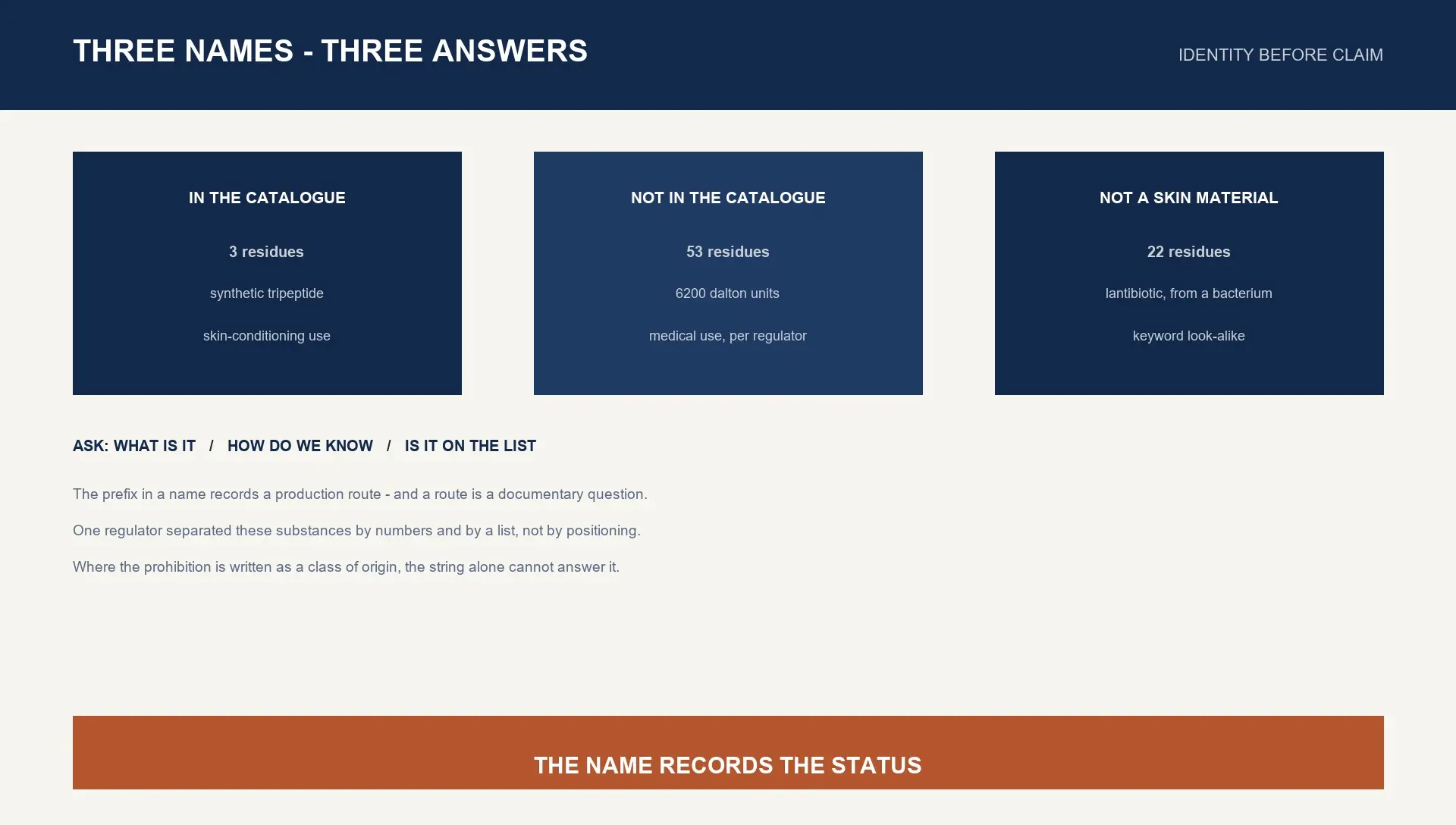
Start with what a regulator has said in public. When China's drug authority answered questions on this ingredient class in January 2019, it did not argue about marketing. It separated two materials by identity parameters: the entry that is in the existing-ingredient catalogue is a short synthetic peptide built from three amino acids - glycine, histidine and lysine, in the wording of the answer - while the substance the answer identifies as EGF is described in the same passage as a 53-amino-acid peptide with a molecular weight of 6200 dalton units, and it is not in that catalogue. Two names, two identities, two listings - drawn apart by numbers and by a list, not by positioning.
That is the whole logic of the prefix question, and you do not need to know what any abbreviation stands for to use it. The regulatory mind does not ask "is this a good ingredient". It asks three boring questions: what is it, how do we know, and is it on the list. The prefix in a name is a claim that answers the second question by pointing at the first - it says "this material's relationship to the human sequence, and the route by which it was produced, are such that the listed entry applies". Whether that claim is true is a documentary question, not a naming question, which is why the buyer's job is to demand the paper and not to memorise the abbreviation.
Two things follow that are worth saying plainly.
One: do not let a supplier answer this question for you by trading on the string. There are at least two prefixed strings in circulation for this class, and a keyword export - the kind of file a brand or an agency maintains for search planning - will happily contain rows for both, plus rows for longer relatives of the same family. Our own archive is a good example of how sloppy this gets: it holds a row typed as sh oligopeptide 78 and a separate row typed as rh oligopeptide 1, neither written in the hyphenated INCI form, and no row at all for either of the two strings this article is about. The typographic carelessness in a search file is small. The same carelessness carried into a declaration on a pack is not. [A supplier who cannot write the string correctly has probably not verified which string they are buying.]
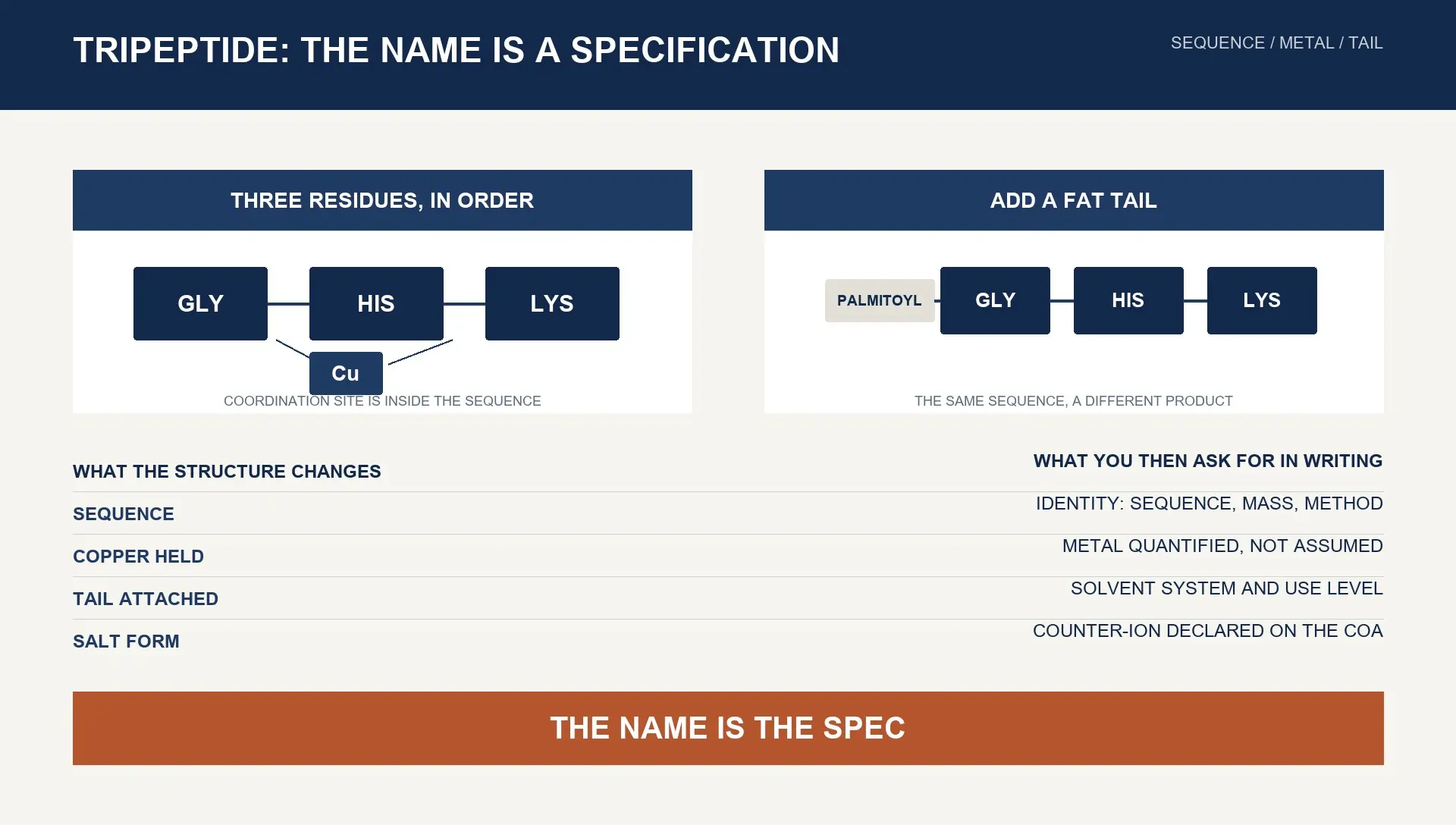
Two: the number in the name is not the identity either. A peptide called oligopeptide-1 and a protein called by a longer name that also ends in the same numeral are not close relatives; they are different materials that happen to share a counting convention. The 2019 answer exists precisely because someone, somewhere, had already conflated them. A buyer who reduces this to "the number matters" has understood half of one earlier piece on this site - the tripeptide specification sheet - whose point was that in a specification, the digits are an instruction, not a description. Here the point is adjacent and stricter: in this class, the digits and the prefix are both claims about identity, and both need a document behind them.
So the prefix is best treated as a hypothesis about provenance that the file must confirm. Ask it in three parts, in writing: state the string as declared in the formula; state the production route in one sentence and name the document that records it; state which catalogue or inventory entry the material is bought under, with the reference number or listing text. If those three answers arrive as three sentences, you are dealing with a supplier whose documentation exists. If they arrive as a marketing paragraph, you have learned the same thing in a different way, and more cheaply than a returned shipment would have taught it.
One Regulator Drew the Line in Public - and Drew It Twice
The clearest public statement available to a buyer on this class of ingredient came on 10 January 2019, when China's national drug authority published the first of its answers to frequently asked questions on cosmetics supervision. It is worth reading as a document rather than as a headline, because it does two separate things that suppliers routinely collapse into one.
The first thing it does is an identity split, in the plainest possible terms. Two names that circulate as near-synonyms are declared to be not the same substance. One is a synthetic peptide assembled from three amino acids - glycine, histidine and lysine are named - and it is listed in the catalogue of cosmetic ingredients already in use, in its 2015 edition, and used as a skin-conditioning agent. The other is the substance the answer names as EGF: a peptide of 53 amino acids, described with a molecular weight of 6200 dalton units, not contained in that catalogue. In the authority's own explanation, its clinical use sits in burn, trauma and surgical wound care and in the acceleration of epidermal growth after grafting - a medical context, listed there to explain why it is treated as a medicinal material, not to advertise a cream.
The second thing it does is set a consequence, and this is the sentence that a marketing department should be made to read before it writes anything: on the basis of efficacy and safety considerations, epidermal growth factor shall not be used as a cosmetic ingredient - and, in the authority's wording, a product that either contains it in the formula or claims on its packaging or advertising that it contains it is an unlawful product.
Read that twice. The violation is completed by the copy, not only by the batch. A brand can commit it with a blank formula sheet and a finished label.
For a buyer, the practical architecture of that statement is unusually clean, because it tells you exactly where your exposure sits. There is an ingredient status question - is this material admitted at all in the market you are shipping to. There is a presence question - is the declared thing physically in the product, deliberately, at a level you can evidence. And there is a statement question - does anything printed, posted or spoken say more than the file supports. Suppliers answer the first with a certificate of analysis and the second with an invoice, then create the third problem in the launch copy, which is the only one of the three that a regulator can detect without entering your factory.
A third sentence from the same answer is worth carrying into every market conversation, because it disposes of a category that brands keep trying to buy their way into. The authority notes that it is not only China that has no regulatory concept of a "cosmeceutical" - most jurisdictions do not recognise the category at law, and avoiding the confusion between cosmetics and medicines is described as a shared understanding among regulators, with some markets placing qualifying products in a separate drug or quasi-drug class that carries its own requirements. In other words: the borderline you are being sold a story about is not a shelf you can register onto. It is a line that a third party draws later, from your own words.
None of this means the class is unusable. It means the class is name-sensitive, and that the safest version of a brief for it does not start with a claim. It starts with a string, a route, a listing reference and a copy deck that has been read against the file. Buyers who sequence it that way tend to find the ingredient conversation gets shorter, not longer, because the supplier has to answer with documents rather than with enthusiasm.
The European Line Runs on Origin, Not on the Molecule
The ingredient catalogue listing question looks simple from the buyer's side - is it listed or not - and in the European Union it has an unusual shape, because the entry most likely to be raised about this class of material does not name a molecule at all.
Annex II of Regulation (EC) No 1223/2009 is the list of substances prohibited in cosmetic products. Its entry with reference number 416 reads, in full: "Cells, tissues or products of human origin." That is the entire entry. It is a class of origin, not an ingredient, and it is not framed as a question about what the molecule does or how large it is. It is a question about what the material is, in the sense of where it came from and how it was produced. Which is precisely the fact that the prefix in a name asserts - and precisely the fact a datasheet never states.
Set that beside two other sentences from the same instrument, because together they explain why this corner of the law resists summary. Recital (6) states that the Regulation "relates only to cosmetic products and not to medicinal products, medical devices or biocidal products", and that "the delimitation follows in particular from the detailed definition of cosmetic products, which refers both to their areas of application and to the purposes of their use." Recital (7) then adds that "the assessment of whether a product is a cosmetic product has to be made on the basis of a case-by-case assessment, taking into account all characteristics of the product."
So the European text does two things that a supplier conversation routinely collapses. It says the boundary is defined by use and application, i.e. by what you claim the product does on the body. And it says the classification of a given product is a case-by-case judgement, not a lookup. A document that asserts "this ingredient is permitted in the EU" without addressing either point has answered a question nobody asked. The honest version of the same statement is narrower: a given material sits under a given entry in a given inventory, produced by a given route, and characterised by given parameters - and all four of those have to be written down before the fifth question, "so may we sell it", can be answered.
This is the point at which it becomes useful to be blunt about what this article does not claim. It does not state the outcome for either prefixed string in the European Union. The reason is structural, not cautious: the entry quoted above keys on origin, and origin in a cosmetic material is a documentary determination - production host, characterisation, how the substance is described in the safety assessment - that no manufacturer should resolve on a buyer's behalf in a blog post. What a buyer can and should do is ask for the four documents and treat the absence of any of them as the answer. The dossier mechanics behind that - the safety assessment, the product information file, who is the responsible person, what a notification actually records - are set out on this site in the EU compliance guide for importers, and are not repeated here.
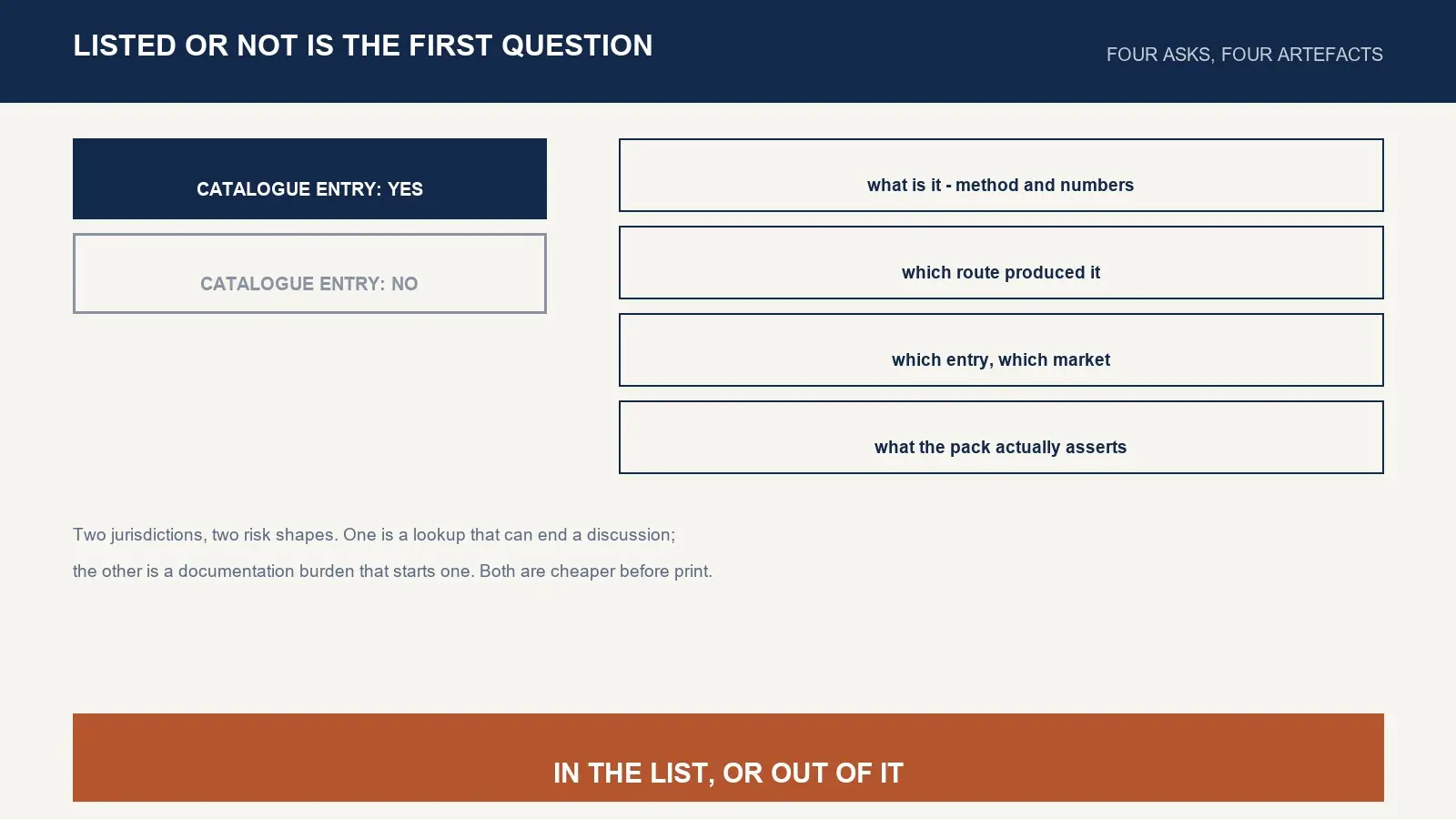
One asymmetry between the two jurisdictions met so far is worth naming, because it changes the shape of the risk rather than its size. In the Chinese answer, the material's status is settled at the ingredient level, publicly, once: a substance is in the catalogue or it is not, and the authority said so in a document anyone can read. In the European text, the ingredient-level prohibition is written as a class, and the product-level question is decided case by case against a file. The first is a lookup that can end a discussion. The second is a documentation burden that starts one - and a buyer who expects the European answer to arrive in the same shape as the Chinese one will keep asking a question that the law has deliberately left to the assessment.
Practically, that means the European enquiry is not "is this allowed" but four separable asks: which entry does the material sit under and where is it recorded; what is the production route and what document names it; who is the responsible person holding the file for the finished product; and what does the safety assessment say about the specific ingredient at the specific concentration you intend to use. Four questions, four artefacts. A supplier with four artefacts is a supplier who has sold into that market before.
The Copy Is the Classification: Four Provisions That Bind a Label to a File
If the identity question decides whether a material may be in the product, the claim rules decide whether the product may be sold as the product you described. On this side of the argument the European text is unusually concrete, and it is concrete in a way that catches ingredient-led launches specifically.
Commission Regulation (EU) No 655/2013 was adopted under the second subparagraph of Article 20(2) of the cosmetics regulation, and its first article defines what a claim is: "claims in the form of texts, names, trademarks, pictures and figurative or other signs that convey explicitly or implicitly product characteristics or functions in the labelling, the making available on the market and advertising of cosmetic products", applying "to any claim, irrespective of the medium or type of marketing tool used, the product functions claimed, and the target audience."
Read that definition as a buyer, because it does something most briefs do not expect: it makes the ingredient name itself a claim. The string printed on the front of a carton, the trade mark you registered for the hero active, the picture of a molecule on a shelf card, the phrase "with growth-factor technology" - all of it is inside scope, and all of it can convey a characteristic implicitly. A file that supports the ingredient's presence does not automatically support what the presence is said to imply.
Article 2 is where the paper becomes load-bearing. The responsible person must ensure that the wording of a claim complies with the common criteria and is consistent with the documentation proving the effect claimed for the cosmetic product in the product information file. That is a binding, not an aspiration: somewhere in the file attached to a named person and a single address, there is supposed to be a document that proves the sentence on the box. Ask for the sentence and the document in the same email, and watch how long the reply takes.
Four provisions out of the annex do the daily work in this ingredient class - and note that the six criteria are listed under their headings elsewhere on this site, in the ingredient comparison and sourcing guide, so this article is deliberately working one level down, at provision text.
Criterion 2(1) is the one that converts a name into an obligation: if a product claims to contain a specific ingredient, the ingredient shall be deliberately present. An ingredient that migrated into a formula from a supplier's positioning deck, and then into a label from the formula, is exactly the case this provision was written for. Ask the question in its plainest form: at what concentration, added at which step, recorded against which batch record.
Criterion 2(2) handles the other half of the same mistake - ingredient properties must not be smuggled onto the finished product. A substantial share of the material circulating about this class describes what a peptide does in a cell-culture or laboratory setting. That is a statement about the material. The finished product's properties are a different statement, requiring different evidence, and the regulation says so in one sentence.
Criterion 3(6) supplies the evidentiary form most of these conversations are missing: where a claim extrapolates ingredient properties to the finished product, it must be supported by adequate and verifiable evidence, "such as by demonstrating the presence of the ingredient at an effective concentration". Presence at a level chosen because it is what the datasheet's example formula used is not the same thing as presence at an effective concentration for the claim being made. And criterion 3(4) sharpens it for this class in particular: the level of substantiation must be consistent with the type of claim, "in particular for claims where lack of efficacy may cause a safety problem" - a category that describes any positioning built around a material whose own regulatory problem is what it might do to cells.
Two final provisions in the annex are worth carrying into a supplier meeting because they cut in both directions. Criterion 1(1) prohibits claims indicating that the product has been authorised or approved by a competent authority within the Union - the European counterpart to the point made about registration numbers on this site in the origin-defaults piece, which remains the right place to read that argument rather than re-deriving it here. And criterion 5(1) requires claims to be objective and prohibits denigrating competitors or denigrating ingredients legally used - which is why nothing in this article ranks markets, and why the ingredient-level conversation stays on documents rather than on whether a class of material is "safe" as a matter of opinion. Neutrality here is not a house style; it is the text.
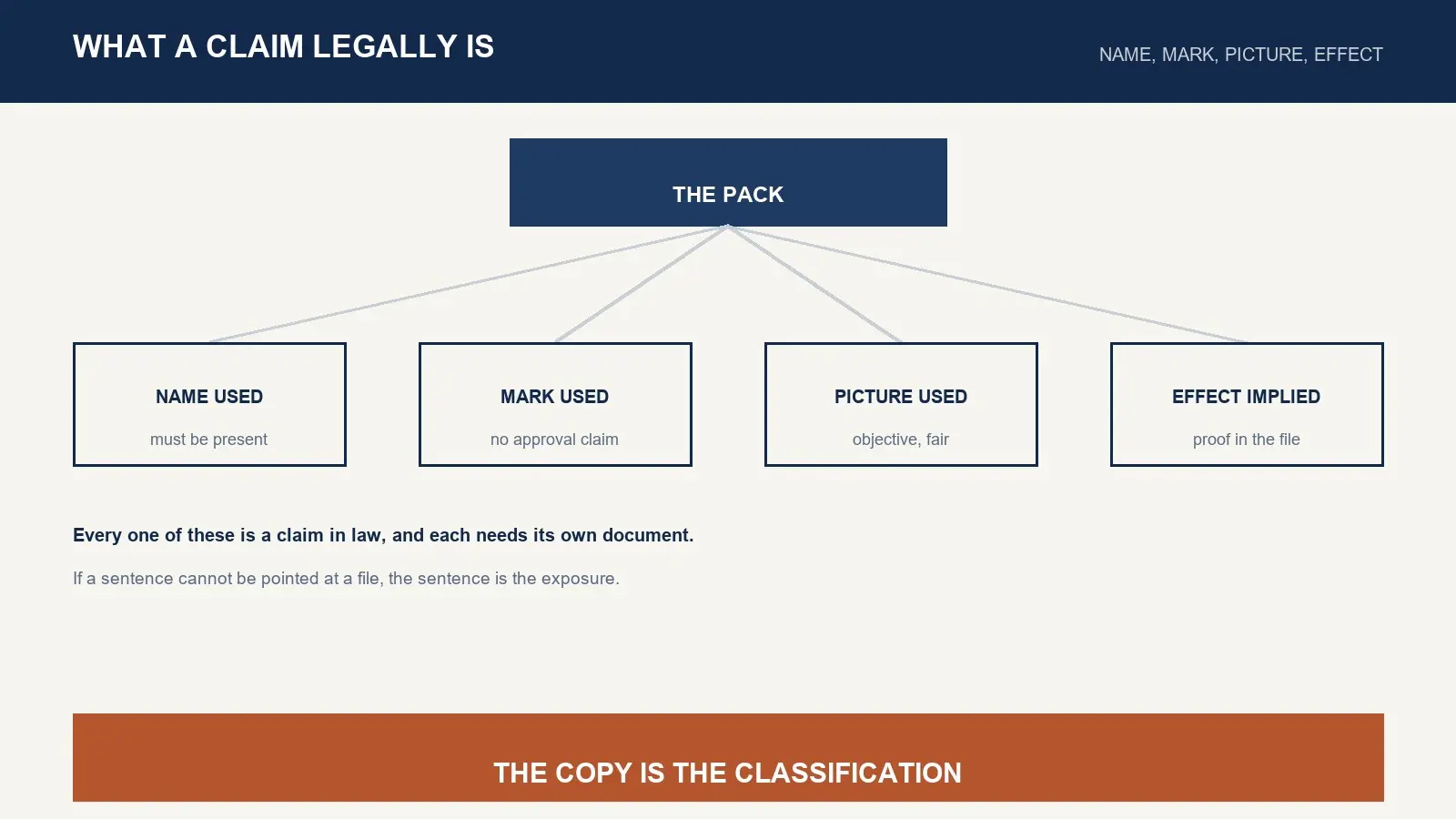
The four-line test that comes out of all this is short enough to paste into a brief. Does every ingredient named on the pack exist deliberately in the formula? Does every effect stated or implied have a document in the file that proves it? Has any laboratory property of a raw material been transferred to the finished product without its own evidence? And does anything on the artwork read like approval, authorisation or a comparison that takes the product outside the cosmetic definition? Four questions, and none of them requires a lawyer to ask.
Audit Your Own List Before You Audit Your Supplier's
A caution that applies to the buyer's side of this file, and one that this site can report honestly because it found the problem in its own paperwork.
While assembling the search vocabulary for this class of ingredient, the keyword archive maintained here contains a row for a term that is not a cosmetic ingredient. Not a marginal case, not a naming variant - a substance whose entire literature is microbiology. The term is epidermin, and in the extract it sits in the same list as the legitimate peptide terms, carrying its own traffic row, because a keyword list does not know what a molecule is.
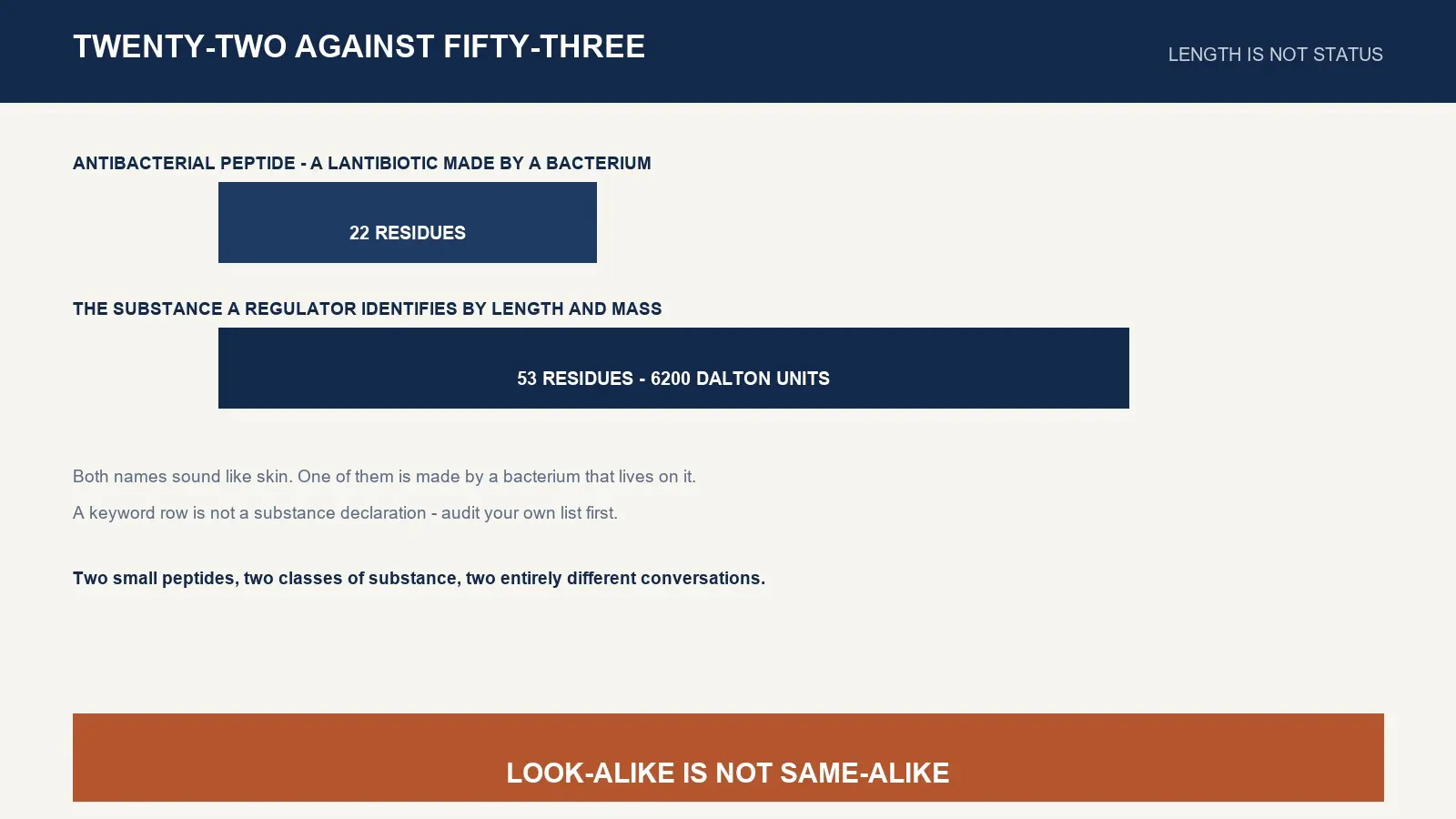
What epidermin actually is, in the published literature rather than in a positioning deck: it is a lantibiotic - a ribosomally synthesised, post-translationally modified antimicrobial peptide - produced by the bacterium Staphylococcus epidermidis, strain Tu3298, encoded on a 54-kilobase plasmid (PMID 1551392). It is synthesised as a 52-amino-acid precursor peptide, EpiA, which is processed by a dedicated serine protease into the mature 22-amino-acid peptide antibiotic (PMID 8550430). The 2014 review of staphylococcal lantibiotics records that this molecule, derived from S. epidermidis, "was the first lantibiotic that has been shown to be ribosomally synthesized and posttranslationally modified" (PMID 24119540), and the surrounding research asks how the producing organism protects itself from its own antibiotic and how quorum sensing regulates it (PMIDs 9770275, 12732329) - questions about bacteria, asked of bacteria.
The number that makes the confusion visible is the simplest one. Twenty-two amino acids for the mature antibacterial peptide, against the fifty-three that the Chinese regulator's answer used to identify the growth factor it removed from the cosmetic catalogue. Two peptides, both small, both named with a stem that sounds like skin. One of them is an antibiotic made by a bacterium that lives on skin. [Nothing in that sentence is an insult to either substance; it is a category correction, and category corrections are exactly what a fairness rule about not denigrating legally used materials permits.] The claim to remove here is about the keyword list, not about the molecule.
| Material as named | What the name is a claim about | Where the identity question is settled | Buyer's action |
|---|---|---|---|
| oligopeptide-1 | A short synthetic peptide of three named amino acids | Listed in the 2015 catalogue entry described in the regulator's answer | Use the listed name; do not let the label drift toward the other substance |
| sh-Oligopeptide-1 | A prefixed string asserting a relationship to the human sequence and a production route | Not in the local extract at all; status is a documentation question | Route statement plus listing evidence before any artwork |
| rh-Oligopeptide-1 | A prefixed string asserting recombinant origin | Same: no row here, and the origin class in Annex II keys on exactly this | Same asks; do not accept the string as the answer |
| epidermin | An antibacterial peptide made by a bacterium | Its own literature (PMIDs above) places it in microbiology, not in dermatology | Remove from skincare keyword lists and from all copy |
The audit that follows from that table is cheaper than any of the supplier work above, and it takes about an hour: read your own keyword list, your own formulation briefs and your own packaging copy as a list of substance claims, and check each one against a source that knows what the substance is. Three things are usually found. A look-alike term that was never an ingredient, like the one above. A prefixed string typed in the sloppy form a search tool produces - hyphens dropped, numbers separated - which in a keyword file is harmless and on a label is a different substance declaration. And a concentration copied out of a supplier's datasheet without anyone asking what claim it was written to support.
That third one is where a brand's own file quietly becomes the evidence for somebody else's claim. If a concentration reached your formula brief from a marketing sheet, and your pack then implies an effect that the sheet's own document does not cover, the inconsistency is not between you and the supplier. It is between you and your own file, and criterion 2(2) does not care which of you introduced the number.
What the Numbers Around This Class Can Say, and What They Cannot
An egf skincare enquiry aimed at a market that has drawn the line the Chinese authority drew is not a documentation problem. It is a substitution problem, and a substitution has to be decided before a sample is made, not after a label has been printed. That is the difference between an ingredient that is questioned and an ingredient that is not admitted, and it is worth stating first because the numbers below cannot tell you which of the two you are holding.
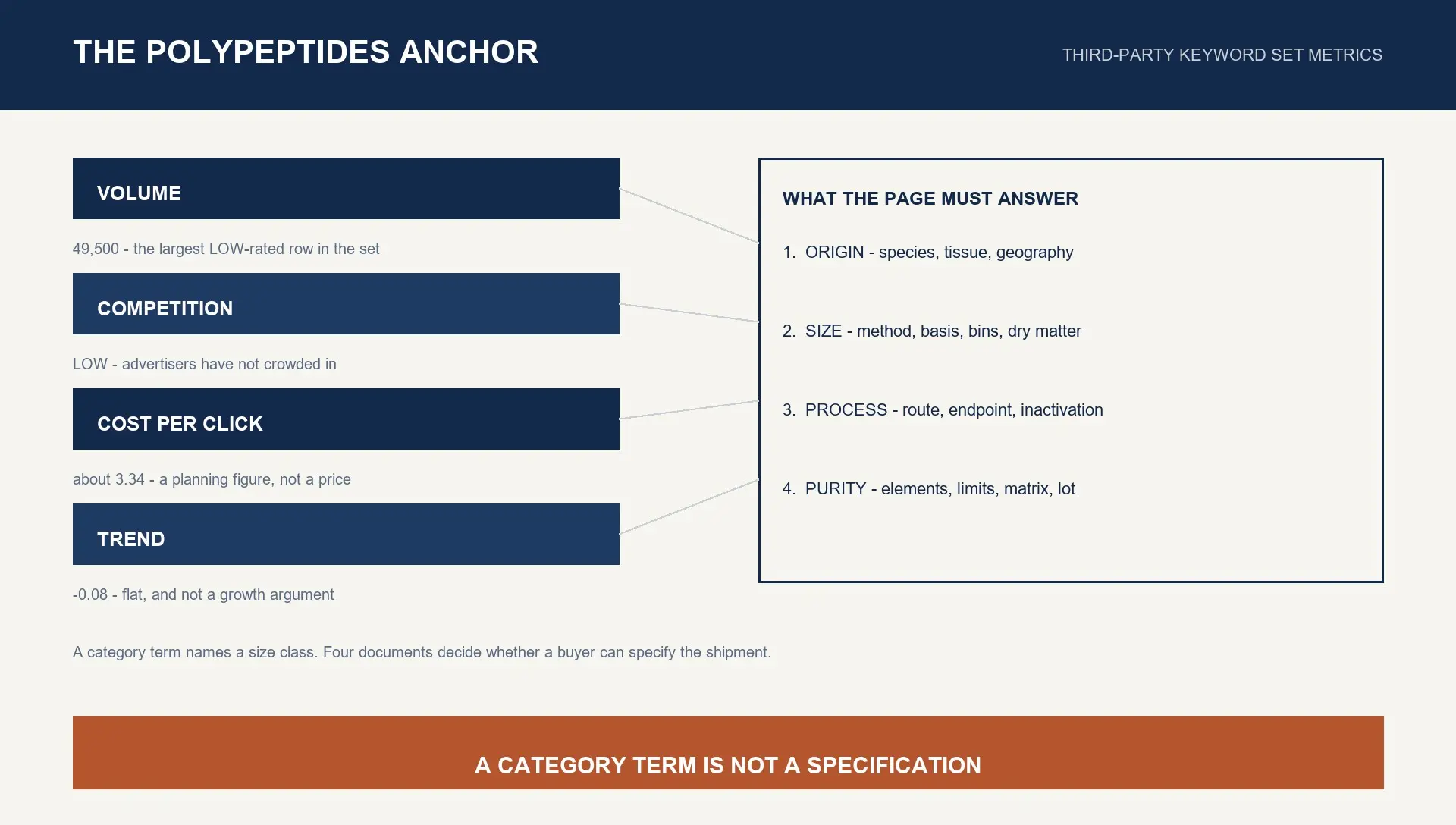
The only search-side figures in this article come from a third-party keyword-set export of 243 terms that this site commissioned; the local archive holds a fifty-row extract of that file, dated 2026-09-28, and the original workbook is not archived locally, so no collection date is claimed here. Those fields are platform-caliber. They are not Google search volume, and they should not be quoted as if they were.
| Row as filed in the extract | Level | Trend index | CPC field | Volume field | Competition | What it can and cannot support |
|---|---|---|---|---|---|---|
| oligopeptide | A | -0.95 | 2.36 | 8,100 | LOW | The only real volume in the family - and it is a category word, so it tells you people search the class, not which substance they want |
| sh oligopeptide 78 | B | -0.91 | 3.39 | 720 | MEDIUM | A different numbered relative; typed without hyphens, so the row is a search artefact, not a substance declaration |
| oligopeptide 10 | B | 1.17 | 1.54 | 480 | MEDIUM | Same caution; a number in a query is not a number on a specification |
| rh oligopeptide 1 | B | -5.33 | 0.0 | 210 | MEDIUM | A small absolute figure with a strongly negative index and a zero CPC field. Neither is a buying signal in either direction |
| epidermin | B | 1.22 | 1.18 | 210 | MEDIUM | A row for a substance that is not a cosmetic ingredient at all - the clearest argument in this file for reading a keyword list as a list of questions |
Notice what is not in that table. There is no row for either prefixed string this article takes as its subject, none for the two-word consumer term in the heading above, and none for the growth-factor term on its own. Under the discipline this site applies to every keyword-derived figure, that means those terms carry no numbers here - not zero, not "unknown", simply absent from the extract. A reader who needs a volume figure for them has to go to the source export, not to this page.
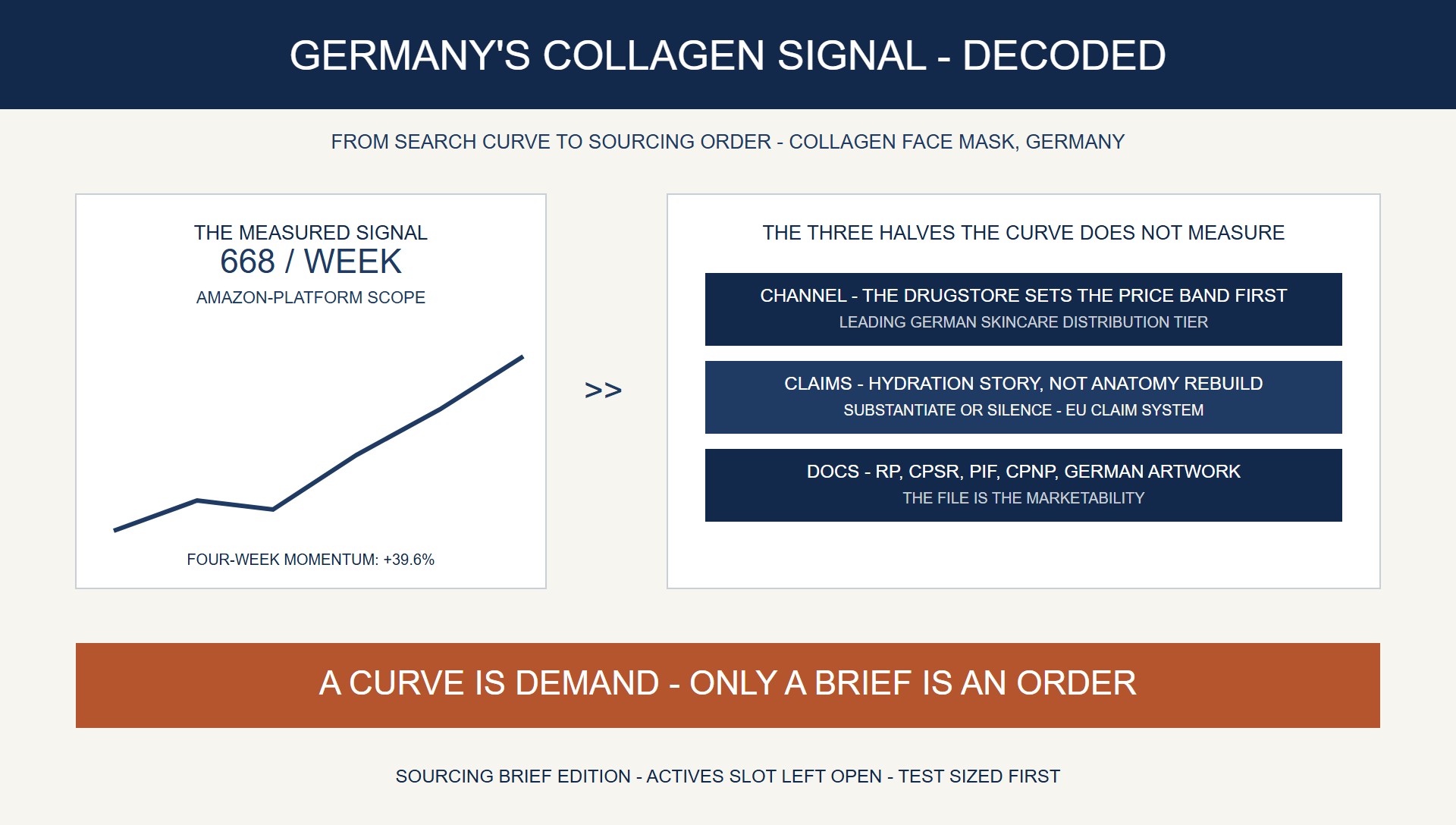
The reading rules matter more than the rows, because the temptation in this class is to let a search file answer a legal question. A negative trend index on a 210-row is not evidence that demand is falling; it is a small number moving. A CPC field reading 0.0 is not an invitation to free traffic; on a platform-caliber export it usually means no meaningful auction sat behind those terms. And a LOW competition flag on a category word is a statement about how many pages are written, not about how many orders are placed. The site's own rule on this, set out in the German market-signal piece, is that a curve is not an order - which applies with unusual force to a term family whose top row is a generic class word and whose lower rows are individually too small to fund a range decision.
What the table genuinely supports is narrower and, for a buyer, more useful. It shows that attention in this family clusters on the category word, not on the substance names - people are looking for a kind of ingredient, not for a specific declared material. That is exactly the profile of a class where positioning runs ahead of identity, and it is the same profile that produced the 2019 regulator's answer in the first place: when buyers cannot name what they want, someone else gets to name it for them, and the name that gets written into the brief is the one that later has to be defended with documents.
So the practical use of the search data ends here: it justifies writing technical content for free, and it justifies asking sharper identity questions. It does not justify a launch. If you need a demand figure to defend a range decision internally, the honest source is a repeat enquiry, a retailer's written requirement or a signed order - not a row in a keyword extract, and not this table.
Five Papers, Five Issuers: What to Hold Before a Name Goes on a Pack
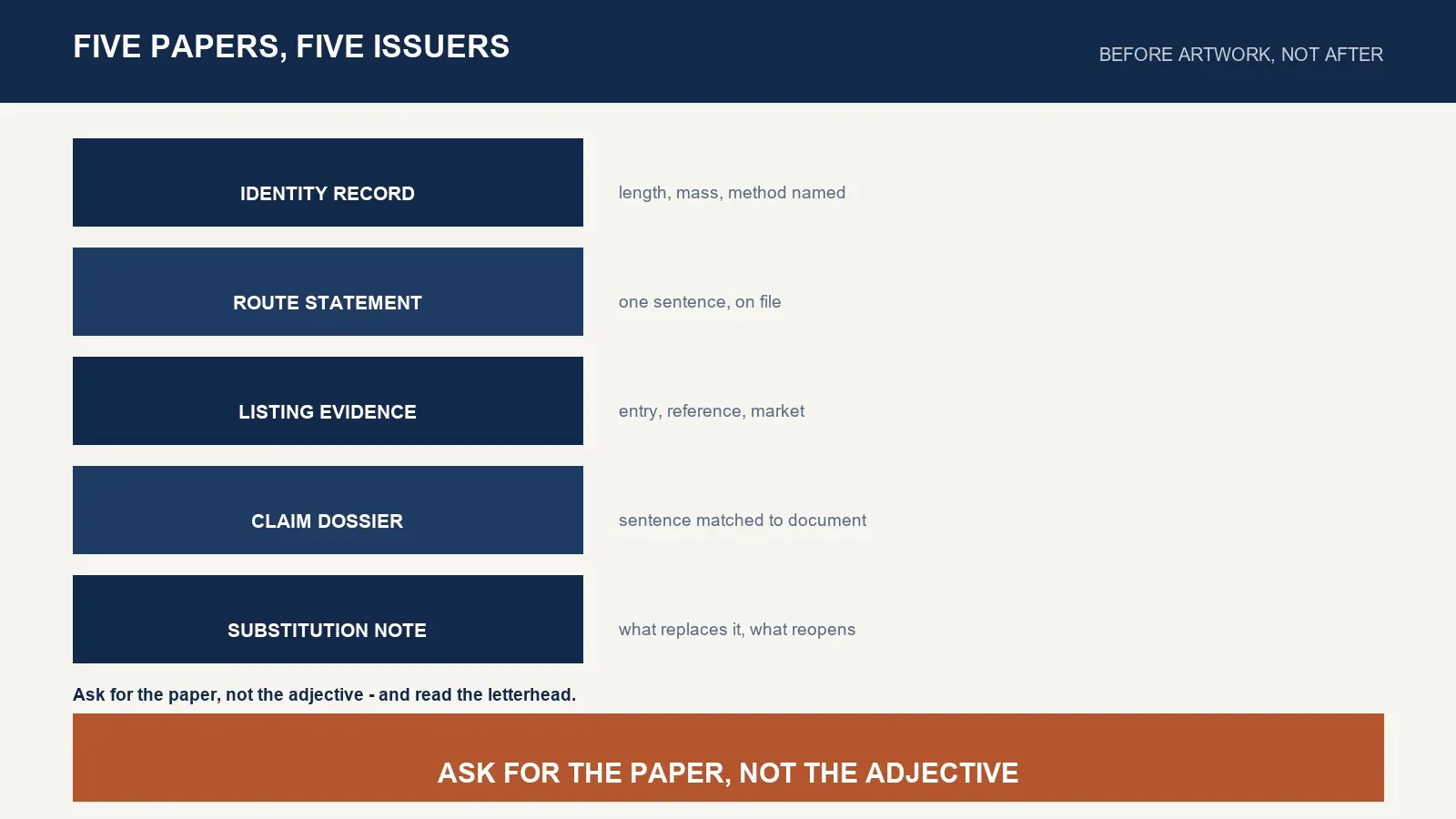
A claim substantiation dossier is not one document, and the reason launches fail in this class is usually that somebody treated it as one. What follows is the split that actually survives a question from a regulator or a retailer's compliance team, with the issuer named for each part - because the useful diagnostic in every line is not whether the paper exists but whose letterhead is on it.
| Paper | What it proves | Who can legitimately issue it | What its absence looks like |
|---|---|---|---|
| Identity and characterisation record | That the material is what the string says it is - peptide length, molecular weight, sequence or specification method | The raw-material supplier's certificate of analysis or specification, with a method named | A datasheet that gives a trade name and a function, no numbers, no method |
| Production route statement | In one sentence, where the material comes from and how it is made - the fact the prefix asserts | Supplier QA, in a document, not in an email sentence | "It's the recombinant one" said verbally at a call; nothing on file |
| Listing or inventory evidence | Which catalogue or inventory entry the material is bought under, for which market, and how it is cited | The supplier's regulatory file, or your responsible person's ingredient documentation | Confidence that it is "globally approved", which is a statement this class of material cannot honestly make |
| Claim dossier tied to the product information file | That every stated or implied effect has a document behind it, and that the pack wording matches that document | The responsible person for the finished product, holding the file at its single address | Copy written from the supplier's positioning deck, with no one owning the substantiation |
| Substitution note | If the declared material is not admitted in a market, what replaces it, what changed in the formula, and what has to be re-tested | Formulation record, signed by whoever approved the change | A reformulation discovered in the artwork process, three weeks before a launch date |
Two of those five are worth dwelling on, because they are where a manufacturing conversation normally breaks.
The listing evidence is the one suppliers are least willing to write down, because writing it down commits them to a market. It is also the cheapest thing in the world to ask for: not "is this allowed everywhere" - a question with no honest answer - but "give me the entry you bought it under, in the market on this purchase order, with the reference". A supplier who can produce a reference number and a citation has a regulatory function. A supplier who produces an adjective has a sales function, and the difference will surface later, in your file, not theirs.
The substitution note is the paper almost nobody asks for and the one that saves launches. It exists because of the asymmetry set out earlier in this article: where a material is questioned, the answer is documentation; where a material is not admitted, no document helps, and the only answer is a different formula. That decision has consequences - a different stability position, a different preservative interaction, sometimes a different texture that the marketing copy was written around - and those consequences are why a substitution made late is so much more expensive than a substitution made before the first sample. The stability programme that a substitution restarts is documented on this site in the vitamin C stability and formulation guide, which covers the testing a change reopens rather than pretending it can be waved through.
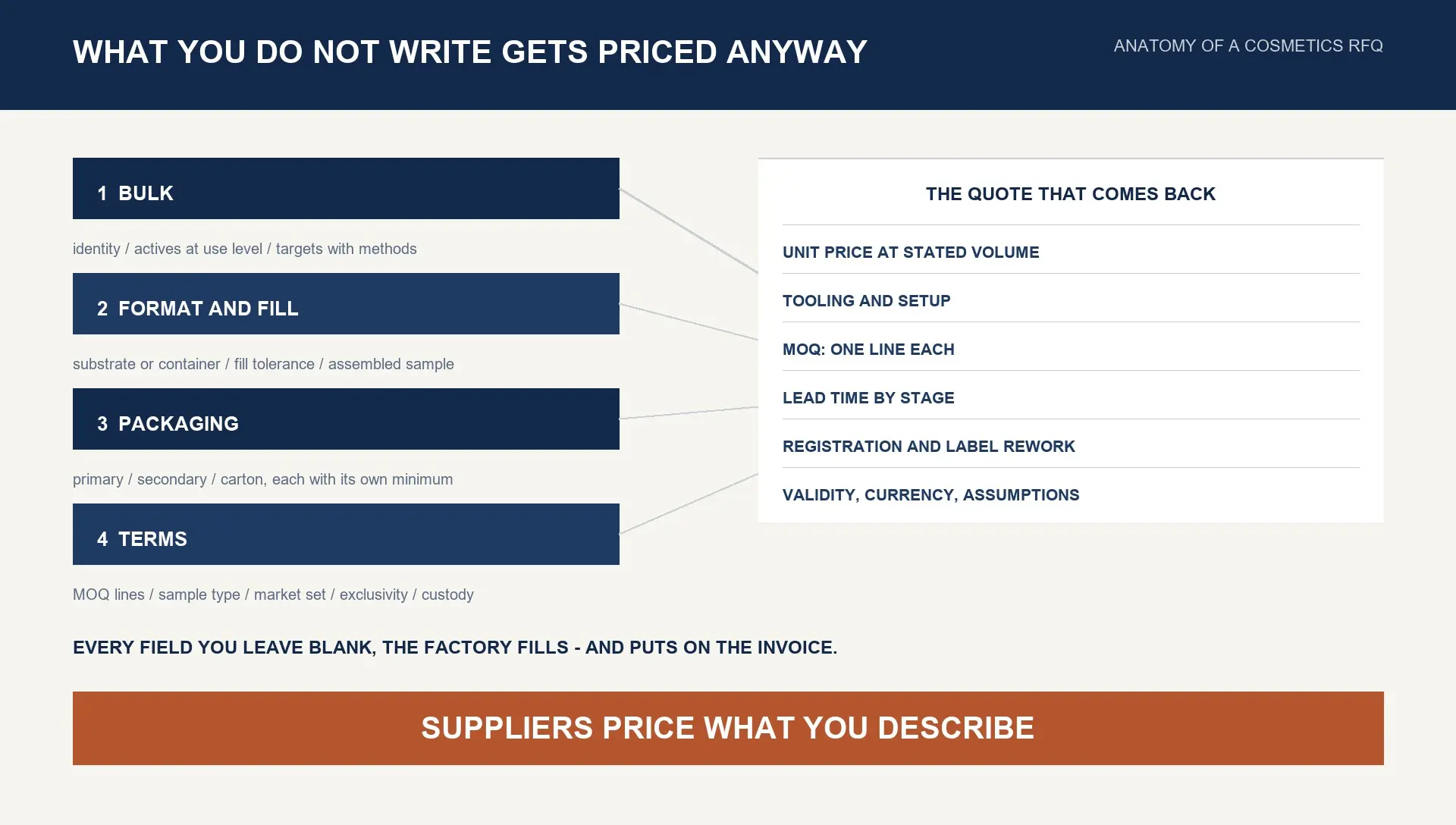
A buyer holding all five papers before artwork is not doing compliance as an afterthought; they are doing the only part of the launch that cannot be improvised. The document chain that surrounds a finished product - the twelve fields an RFQ should carry so that these papers arrive instead of being chased - is worked through in the RFQ field guide, and the identity of the ingredient that should appear in field one of that RFQ is what this article has been about.
And if the file says the material is not the one the string implies, that is not a paperwork failure. It is a label failure with a paperwork cause, and it is the cheapest kind: discovered before print, it costs a conversation.
Six Failure Modes, Each Visible in Your Own Paperwork First
The failure modes in this class are not exotic. They are ordinary document drift, and each one can be caught on the buyer's side of the table with a sentence.
| Failure | Where it starts, in your own paperwork | The one written ask that closes it |
|---|---|---|
| Name drift: the string changes between deck, brief and label | A marketing sheet supplies the name; nobody re-verifies it at brief stage | Restate the declared string on the purchase order and require the certificate to use the same one |
| A laboratory property printed as a product property | Copy lifted from ingredient literature rather than from the finished-product file | Name the document in the file that proves the sentence on the carton |
| A concentration adopted without its claim | A datasheet figure copied into a formula brief, then into artwork | State the claim the level supports, and where that evidence is held |
| One market's answer assumed to travel | A supplier's permission for one destination read as a global clearance | Ask per destination, in writing, for the entry and reference for that destination |
| Chasing a category that does not exist at law | Positioning written around a "cosmeceutical" framing nobody can register into | Write to the cosmetic definition of the market you are in, and let the actives carry the story |
| A look-alike term reaching copy | A keyword row read as an ingredient list | Run the audit in section six on your own list before approving artwork |
Three of these deserve a sentence each, because they are the ones that survive a careful buyer.
Name drift survives because the people who choose the name and the people who sign the file are never in the same room. The fix is procedural and costs nothing: the string on the purchase order and the string on the certificate must be the same characters, and someone must have checked that they are.
The concentration without its claim is the quietest of the six. A figure enters a brief from a datasheet, survives two reformulations, and ends up on a pack implying an effect nobody ever substantiated at that level. It fails the effective-concentration test not because the number is wrong but because no one recorded what it was supposed to prove.
The category that does not exist at law is the one with the longest tail, because it is usually the brand's own idea rather than the supplier's. A positioning deck promises something between a cosmetic and a medicine; the file, the definition and the enforcement all sit on one side or the other; and the middle ground has no form to submit. The honest move is to write the copy inside the cosmetic definition of the market you are actually entering, and to let the actives be interesting without being medicinal.
A Sequence Inside One Market: Identity First, Copy Last
There is a filing order across markets, and it is documented elsewhere on this site; the four-desk map exists precisely because a brand entering several markets at once has to sequence desks, and that question is not this article's. The sequence that belongs here is different and smaller: the order in which questions should be answered inside a single market, for a single ingredient decision. Getting that order wrong is why teams end up with beautiful artwork and no file.
The order is short, and it is worth writing as an instruction because intuition inverts almost all of it. Most teams start with the story, then choose the active, then find a supplier, then ask about status, and only then - at the moment of artwork approval - read the label. Each step of that sequence makes the next one cheaper to fake and more expensive to undo.
The reverse sequence begins with identity because identity is the only question in the list with an objective answer available before money moves. What is the material, in parameters a third party could confirm. Which string does the formula declare. Under which entry is it bought in the market you are entering. Only once those three hold does a claim become something you can build toward, because until then you are substantiating a substance nobody has identified.
Then comes the file, before the copy - which is the single inversion with the largest practical payoff. The reason is the consistency rule discussed above: the wording of a claim must match the documentation proving it. Written in that order, the claim becomes a promise you know you can hold. Written the other way round, it is a promise your competitor's packaging taught you to make, and the file becomes an exercise in catching up. A brand that has never done this tends to treat that sequencing as bureaucratic. What it actually is: the only place in a launch where the cheap version and the correct version are the same version.
The third step is the substitution decision, and it belongs before sampling for an obvious reason that gets discovered expensively: a substitution changes the formula, and a formula change restarts the work that was already paid for - the stability position, the compatibility of the preservation system, the sensory profile the copy was written around. If the identity step was answered honestly, this step is a decision. If it was skipped, this step is a crisis with a launch date attached.
Last is the copy, which in this class is not decoration but the document a regulator reads first. It is also the cheapest place to be wrong in private and the most expensive place to be wrong in public - and unlike the other four steps, it is the one a market can police without ever asking you for a formula.
FAQ - Six Questions Buyers Ask Before Naming an Active
Q1. Are the two prefixed strings in this article's title the same ingredient with two spellings? They are two names that both sit in the same family and both assert something about how the material was made. A spelling difference would be a formatting habit; a difference in the asserted route is a difference in identity, and identity is what the status questions in this class turn on. The safe buyer behaviour is the same whichever way the answer goes: ask for the string in writing, ask what the prefix claims, and ask for the document that records it. Treat the name as a hypothesis until a document makes it a fact.
Q2. If one authority has banned the material, does that decide it for everyone? No, and this is where the phrase "no global framework" is most often misread. A decision by one regulator is not a lookup table for the rest, and a supplier who claims their material is "banned" or "allowed" everywhere is usually compressing one document into a global verdict. What transfers is not the conclusion but the questions: identity, route, listing, the claim-to-file link. Take those four to each market, and read the answer in that market's own instruments or a named professional's opinion of them. This article is editorial guidance for buyers, not legal advice, and it deliberately does not resolve any of these questions for any destination.
Q3. Is the growth-factor problem a formulation problem or a paperwork problem? Both, and you need to know which one you are in, because the remedies are different and one of them is much cheaper than the other. If the material is admitted but its status is contested or under-documented, the remedy is documentation: characterisation, route, listing evidence, substantiation. If the material is not admitted in the market you are entering, no document fixes it - the remedy is a different formula, and that remedy gets cheaper the earlier you take it. The identity questions in this article exist to tell you which situation you are in before the sampling budget is spent.
Q4. Can we keep the positioning if we substitute the active? Sometimes, but not by default, and the honest answer depends on what the positioning was claiming. If the sentence was about the material by name, the sentence goes with it. If the sentence was about an outcome that a different active can support with its own evidence, the copy survives and the dossier changes. What rarely survives is the version where a brand keeps the story, swaps the ingredient for compliance reasons, and never re-opens the file - which is how a launch ends up making a claim that no document in the building supports.
Q5. Who should own this on our side of the table? Someone with access to both the formula record and the marketing copy, because the failures above all live in the gap between them. In a small team that usually means the person who signs the brief, and it is a poor fit for the person writing the launch post. If you have neither, the practical substitute is an external reviewer who can hold a document list, not a conversation - and the four asks in the documents section are written so that one person with a checklist can run them.
Q6. We already printed. What is the smallest useful thing to do now? Read your own packaging as a list of substance claims and effect claims, then check each one against what exists in the file - and if the file is not accessible to you, get the copy in front of someone who can read it against the rules for the market it will be sold in. Substantiation gaps discovered on stock in a warehouse are handled by relabeling, withdrawal or market-specific copy, and which of those three applies is a decision for a professional with the actual pack in front of them, not for a manufacturer's blog. The next launch, however, is entirely in your hands: put the string in the brief, the papers before the sample, and the file before the copy.
Sources and Further Reading
- China's national drug authority, answers to frequently asked questions on cosmetics supervision (no. 1), dated 10 January 2019. Retrieved 24 October 2026 as reproduced in full, with the regulator's wording quoted, by the official-party newspaper's edition of 14 January 2019, page 04 ("[title of the report]: cosmetics claiming 'cosmeceutical' is unlawful", People's Daily online edition). The authority's own page returned HTTP 412 to automated retrieval on the date of writing, so the dated full-text reproduction was used and the sentence quoted here can be checked against it: the identity split between the three-amino-acid synthetic peptide listed in the 2015 catalogue of already-used cosmetic ingredients and the 53-amino-acid, 6200-dalton substance that is not listed; the statement that, on efficacy and safety grounds, epidermal growth factor shall not be used as a cosmetic ingredient; the statement that a product containing it in the formula or claiming it on the pack or in advertising is an unlawful product; and the observation that most jurisdictions have no regulatory concept of a "cosmeceutical", with some markets placing such products in a separate drug or quasi-drug class. - Regulation (EC) No 1223/2009 of the European Parliament and of the Council of 30 November 2009 on cosmetic products, OJ L 342, 22.12.2009 (full text archived locally, retrieved 21 October 2026 and re-checked 24 October 2026). Provisions relied on: Annex II, reference number 416 ("Cells, tissues or products of human origin"); Recital (6) on the delimitation from medicinal products, medical devices and biocidal products following from the definition's areas of application and purposes of use; and Recital (7) on case-by-case assessment of whether a product is a cosmetic product, taking into account all its characteristics. Article 11 (single address for the product information file) and Article 8(2) (presumption of good manufacturing practice through harmonised standards) are used on this site elsewhere and are not re-derived here. - Commission Regulation (EU) No 655/2013 of 10 July 2013 laying down common criteria for the justification of claims used in relation to cosmetic products, OJ L 190, 11.7.2013, pp. 31-34 (EUR-Lex full text retrieved 24 October 2026). Provisions relied on: Article 1 (scope - texts, names, trademarks, pictures and figurative or other signs, explicit or implicit, irrespective of medium, function claimed or audience); Article 2 (claim wording must comply with the criteria and be consistent with the documentation proving the claimed effect in the product information file); Recital (4) (criteria apply only where the product has been assessed as a cosmetic product; the applicable framework is decided case by case by national authorities and courts); and Annex criteria 1(1) (no claims indicating authorisation or approval by a competent authority), 2(1) (a claimed ingredient must be deliberately present), 2(2) (ingredient properties must not imply product properties), 3(1), 3(4) (evidence level consistent with claim type, in particular where lack of efficacy may cause a safety problem), 3(6) (extrapolation supported, e.g. by demonstrating presence at an effective concentration), 5(1) (objective claims; no denigration of competitors or of legally used ingredients) and 6 (informed decision-making). - Epidermin literature, retrieved 24 October 2026 from the biomedical index (39 records for the term combination "epidermin lantibiotic Staphylococcus epidermidis"): Augustin et al., European Journal of Biochemistry 1992;204(3):1149-54 (PMID 1551392) - production by Staphylococcus epidermidis Tu3298 and the 54-kb plasmid pTu32 carrying the structural gene epiA; Geissler et al., Journal of Bacteriology 1996;178(1):284-8 (PMID 8550430) - a 52-amino-acid precursor EpiA processed to a mature 22-amino-acid peptide antibiotic; Otto et al., FEMS Microbiology Letters 1998;166(2):203-11 (PMID 9770275) - self-protection against the pore-forming lantibiotic; Kies et al., Peptides 2003;24(3):329-38 (PMID 12732329) - quorum-sensing control of precursor processing; Götz et al., International Journal of Medical Microbiology 2014;304(1):63-71 (PMID 24119540) - the first lantibiotic shown to be ribosomally synthesised and post-translationally modified. No therapeutic, dermatological or cosmetic property of epidermin is asserted or implied anywhere in this article; its literature is cited only to establish what class of substance it is. - Keyword metrics: third-party keyword-set export of 243 terms commissioned by this site; the local archive holds a fifty-row derived extract dated 2026-09-28, and the original workbook is not archived locally, so no collection date is claimed. Fields quoted are platform-caliber - not Google search volume - and rows exist only for the five terms printed in the table, which is why no figure appears for either prefixed string in the title, for the two-word consumer term, or for the growth-factor term alone. - Not used and deliberately excluded: no market size, growth rate, share or consumer-survey figure; no price, cost, tariff or percentage; no supplier, factory or retail brand name; no assertion about the regulatory position of the United States or of any market other than the two instruments quoted above; no claim that either prefixed string is permitted or prohibited in any jurisdiction; no therapeutic or protective property claim about any substance named in this article. This is supplier editorial guidance, not legal advice - regulatory positions in this class change, and each destination should be verified with counsel before publication or launch.
What to do next
Name it precisely, and the rest of the conversation gets shorter.
If you are building a range around a peptide active in this class, send the string exactly as your formula declares it, together with the market list in the order you intend to enter them, and we will answer in writing on the four questions this article keeps returning to: what the material is, in characterisation terms a third party could confirm; which production route the name asserts and which document records it; under which listing the material is bought for the destination on your order; and which concentration we are prepared to substantiate, with the claim attached to it. You will get the identity evidence, the route statement, the listing reference and a claim position you can actually write copy against - before a sample is made rather than after artwork.
A dedicated product manager handles every ingredient-status and formulation enquiry of this kind, with a reply within 24 hours, a standard sample route in 7 days, and MOQ from 1,000 pcs depending on format, closure and packaging. Request your quote and MOQ table here - and if the question behind yours is which peptide or active family to build on rather than how to document one, the comparison across the better-known families is on this site at the efficacy ingredient and sourcing guide.