

Custom Personal Care Manufacturer: Four Gates Beyond Face Masks
What a Custom Personal Care Manufacturer Is Actually Asked to Do
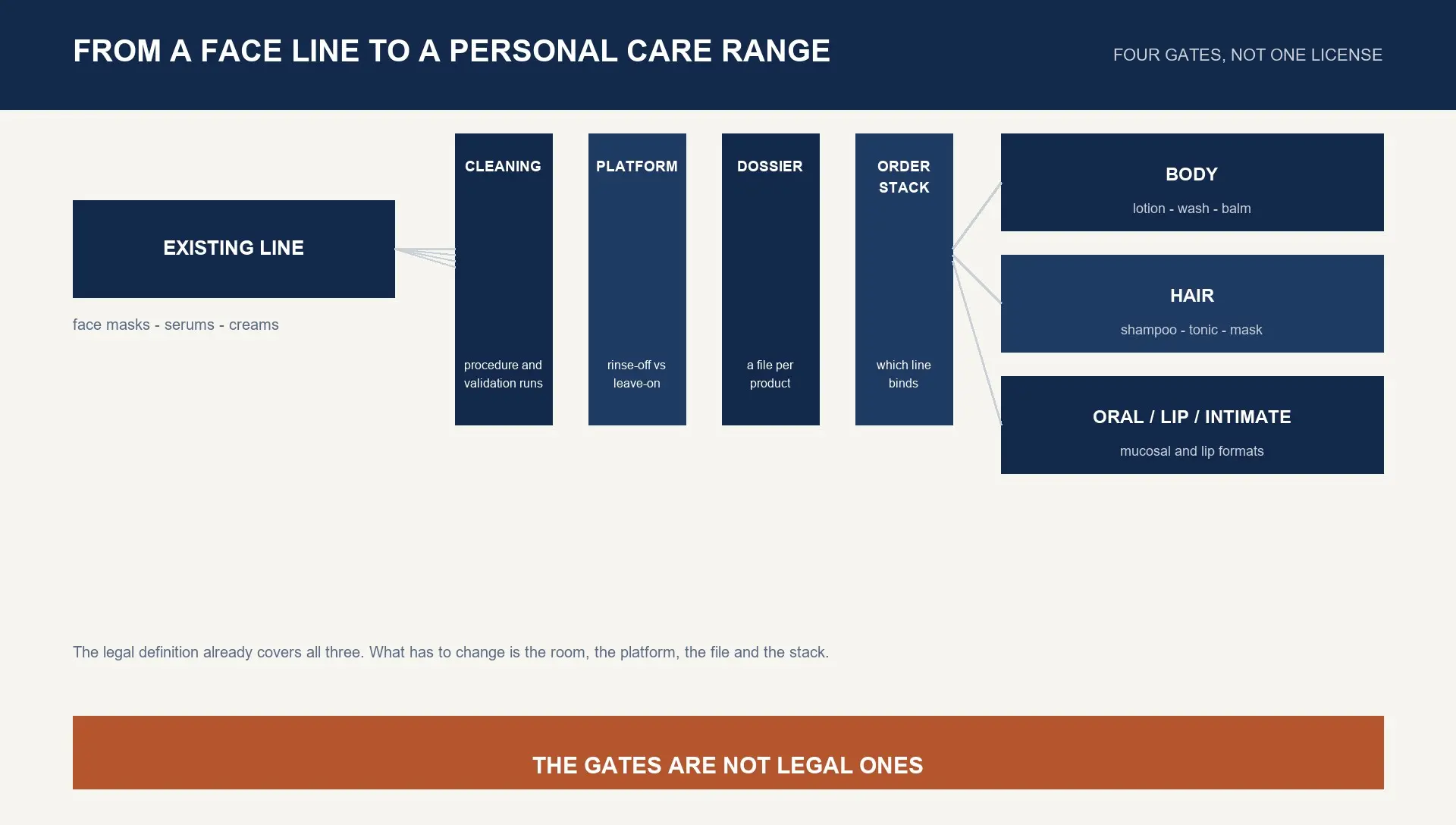
The enquiry usually arrives in one paragraph. A brand has two serums and a mask doing well, the founder has been reading the body-care charts, and the message asks whether we are a custom personal care manufacturer that can also run a shower oil, a scalp tonic and a hand balm. The question sounds like it is about capability - can you make it, will you take the order, what is the minimum. It is not. In the eleven years of enquiries this site answers, the projects that stall are almost never stalled by the factory's willingness. They stall at four gates that nobody named in the first email: cleaning validation, formula-platform transfer, a dossier per product, and an order stack that changes shape when the format changes.
Start with what is genuinely easy, because that is where the false confidence comes from. A body lotion and a face cream are emulsions. A shampoo and a shower gel are surfactant systems. A hand balm and a face balm are anhydrous sticks. The chemistry is not exotic and the machinery is not secret. A factory that runs facial skincare usually can, in the literal sense, make all three families today. That is the sentence a supplier will happily write back, and it is true, and it answers the wrong question.
The right question is not "can you make it" but "what has to change before the first saleable batch of it leaves your room." Those changes are not proportional to how different the product looks on a shelf. A body wash that shares a surfactant platform with an existing cleanser can require more line work than a serum that shares nothing, because the deciding variable is not the recipe - it is the cleaning validation between viscosities, the preservation performance in a new matrix, the safety assessment written for a new exposure pattern, and the component minimums of a pump instead of a dropper.
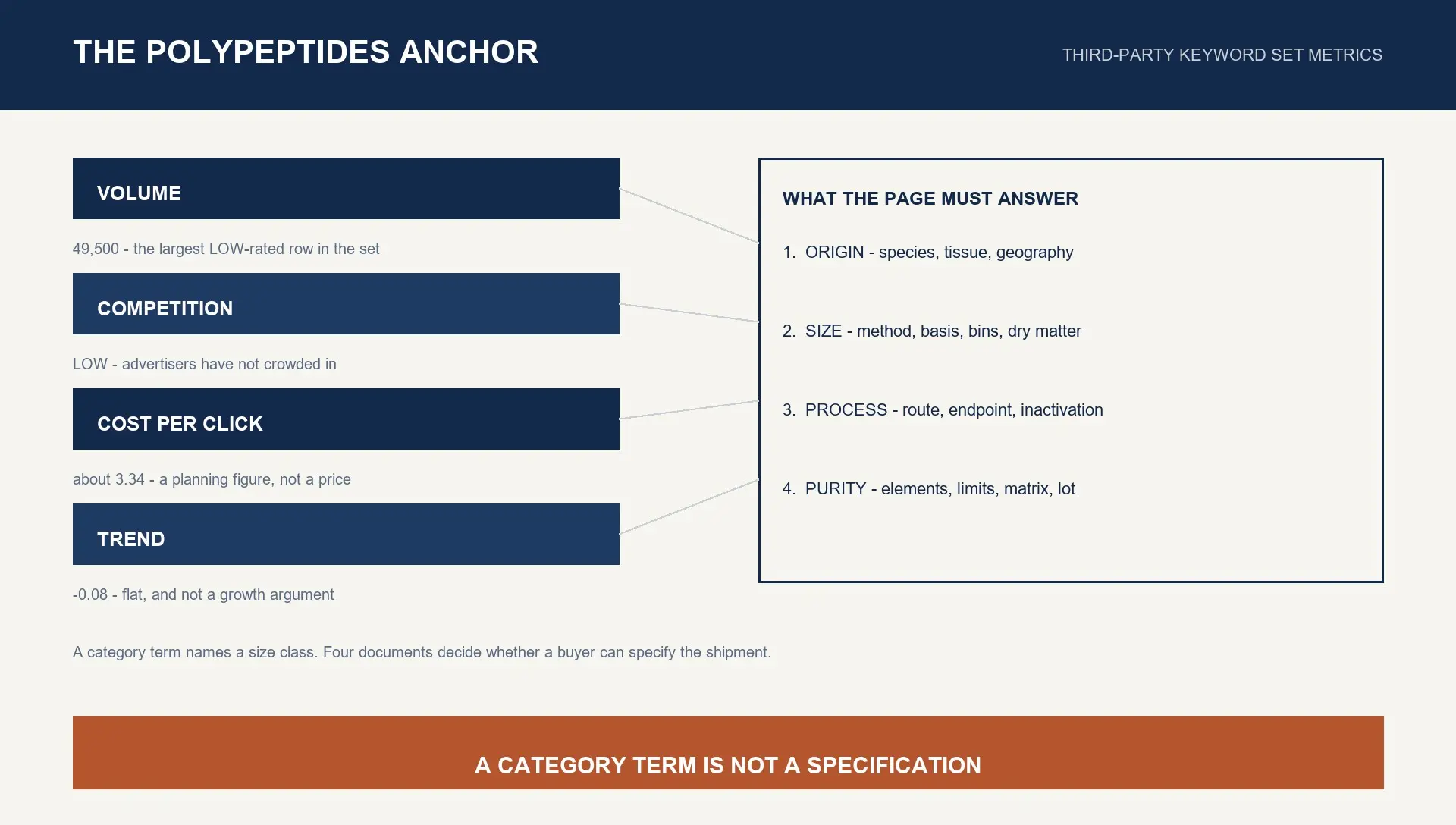
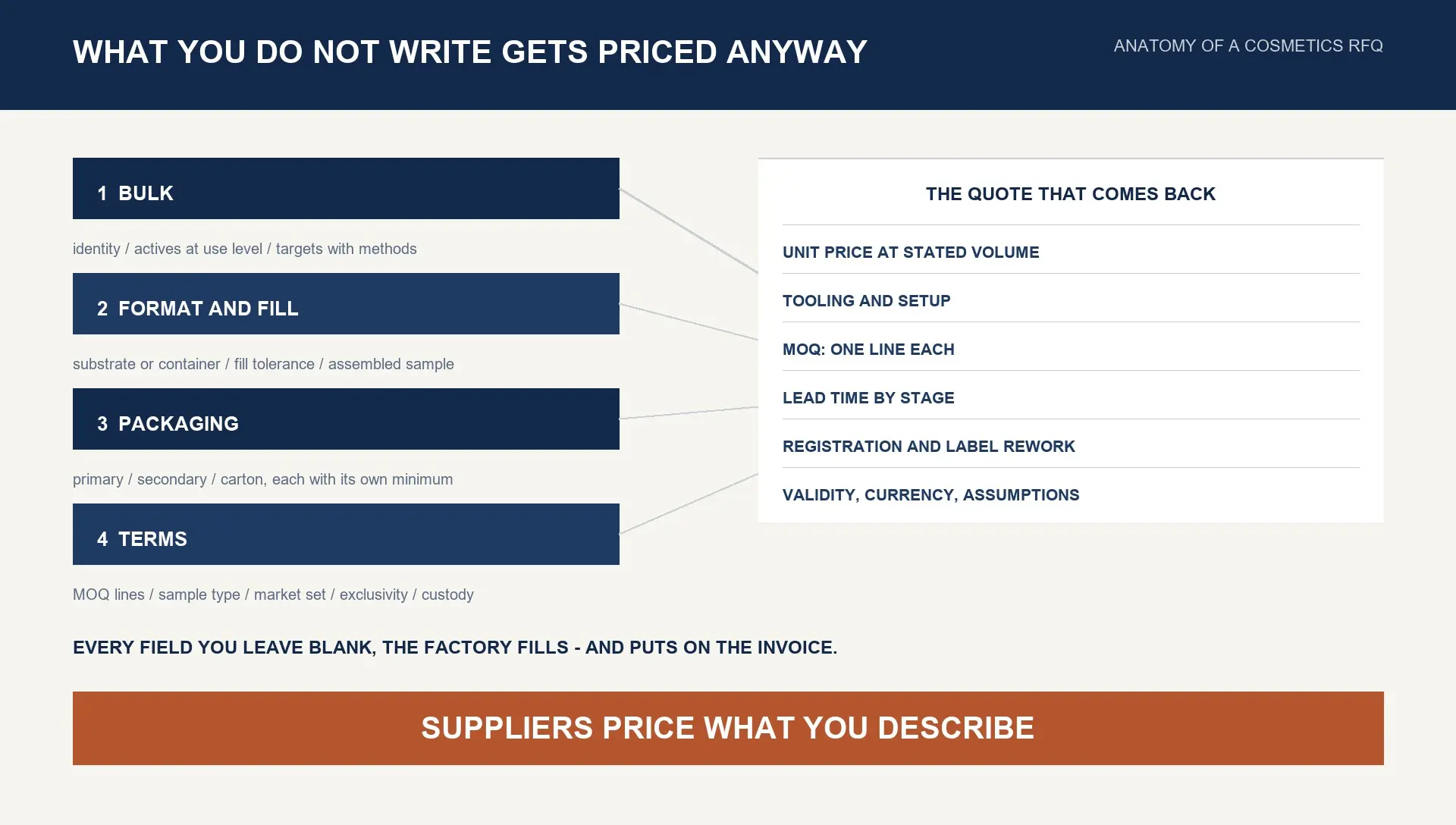
This piece is a map of those four gates, in the order a buyer meets them. It deliberately does not answer a different question that has already been answered elsewhere on this site: whether you should own the line or contract it is worked through in the make-or-buy decision framework; how to write the enquiry document that gets a comparable quote is in the RFQ field anatomy guide; which category-level words a specification page has to carry is in the category anchor piece. What is answered here is the extension question itself, and it is answered from the manufacturing and documentation side rather than from the demand side - because the demand side has been written about to death and the extension still fails.
The extension is not blocked by whether a factory can make the product; it is blocked by four changes nobody priced into the first quote.
One Legal Definition Already Covers the Whole Aisle
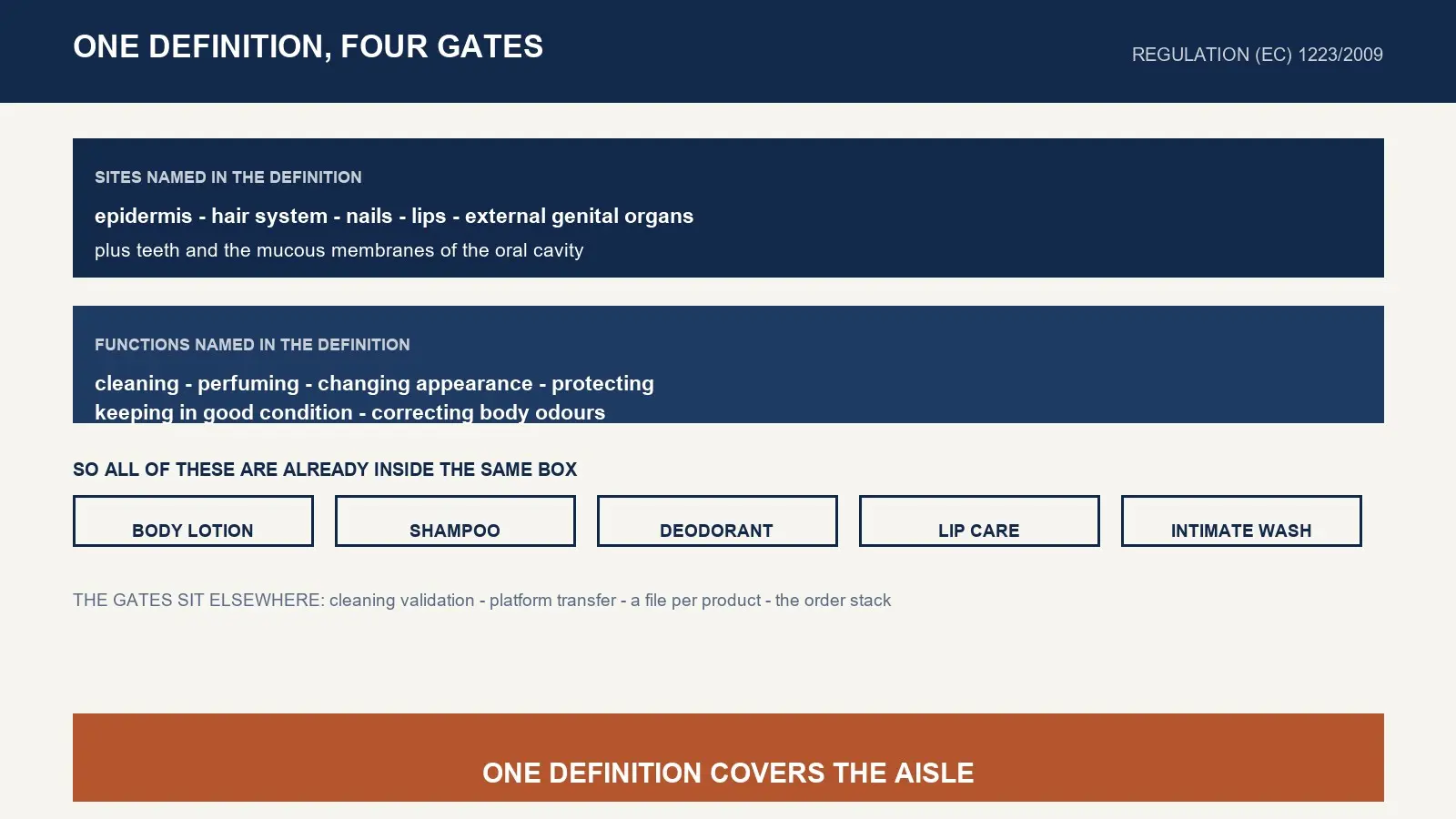
The most common reason given for treating personal care as a separate project is regulatory: "that is a different category." Read the actual text and the reason dissolves. Regulation (EC) No 1223/2009 defines a cosmetic product as any substance or mixture intended to be placed in contact with the external parts of the human body - epidermis, hair system, nails, lips and external genital organs - or with the teeth and the mucous membranes of the oral cavity, with a view exclusively or mainly to cleaning them, perfuming them, changing their appearance, protecting them, keeping them in good condition, or correcting body odours.
Run your intended extension through that sentence. A body lotion: epidermis, protecting, keeping in good condition. A shampoo: hair system, cleaning. A scalp tonic: hair system, keeping in good condition. A deodorant: epidermis, correcting body odours - the function is named in the definition. A toothpaste-adjacent oral product, a lip treatment: teeth, oral mucosa, lips. An intimate wash: external genital organs, cleaning. Every one of them is already inside the same legal box, in the same article, in the same regulation. A beauty and personal care manufacturer is therefore not crossing a legal boundary when it takes the extension; it is crossing a production and documentation boundary, which is a different and much more concrete thing.
That finding is worth holding precisely, because it cuts both ways. It removes the excuse a supplier uses to price an extension as if it were a new business ("different category, different terms"). It also removes the buyer's assumption that an existing compliance file will stretch. The definition does not grant a shared dossier; it sets a test that each product must pass on its own terms. Article 3 requires that a product be safe under normal or reasonably foreseeable conditions of use, and it names what those conditions are judged by: presentation, labelling, instructions for use and disposal, and any other indication the responsible person provides. Change the site of application, the contact time, the rinse-or-leave decision or the user population, and you have changed the conditions the safety judgement rests on - even when the formula looks adjacent.
Two consequences follow, and both belong in the buyer's checklist rather than in a footnote. First, the extension is a manufacturing problem wearing a category label - so the questions to ask are about rooms, rigs, and records, not about licences. Second, the boundary that does exist is not drawn by body part but by function: the definition's own qualifier is "exclusively or mainly," which is the hinge the next section turns on.
The Classification Moves on Claims, Not on Categories
If the European definition is a box with a wide mouth, the American regime is a different instrument entirely: it does not classify by where a product goes on the body but by what you say it does. The FDA's own framing is that whether a product is a cosmetic or a drug under the law is determined by its intended use, and that different laws and regulations apply to each - a page whose title concedes the existence of "both" cases, and of soap as a third question. Its guidance on cosmetic labelling states plainly that certain claims may cause a product to qualify as a drug, even if the product is marketed as if it were a cosmetic. The statutory definition of a cosmetic, in turn, is drawn partly by intended use rather than by ingredient or format.
For a buyer extending a personal care products manufacturer relationship across categories, this is the single most operationally useful fact in the whole file, and it is almost never treated as one. It means the classification of your new SKU is not decided when you choose the format. It is decided when the copy deck is approved - and the copy deck is usually owned by a different team, on a different calendar, than the one that qualified the factory.
The practical shape of the problem is a two-column exercise. On the left, the claims that keep a product inside the cosmetic frame for the aisle you are entering: cleanses, conditions, moisturises, freshens, improves the appearance of, helps protect. On the right, the claim families that move a product out of it: altering a physiological function, treating or preventing a condition, reducing a symptom, or reaching a structure - and note that the right column is reachable from any category, including the one you already sell. A body wash becomes a different regulatory object not by being a body wash but by a sentence on its back label.
Two buyer rules follow, and they are cheap to apply. Rule one: lock the claim set before you lock the supplier. A partner qualified against a cosmetic-frame claim set may be the wrong partner once the set moves - not because they are incapable, but because the obligations, the testing, the file and in some markets the facility requirements are different obligations. Rule two: build the claim inventory per SKU, per market, before the packaging artwork, not after. The site's own compliance-side treatment of what happens when a claim outruns its file is in the legal-liability piece on a tested claim that failed and in the claims-regulation coverage on natural and eco descriptors; the extension multiplies exactly that exposure, because it multiplies the number of claim sentences being written at once by teams that have never written for that aisle.
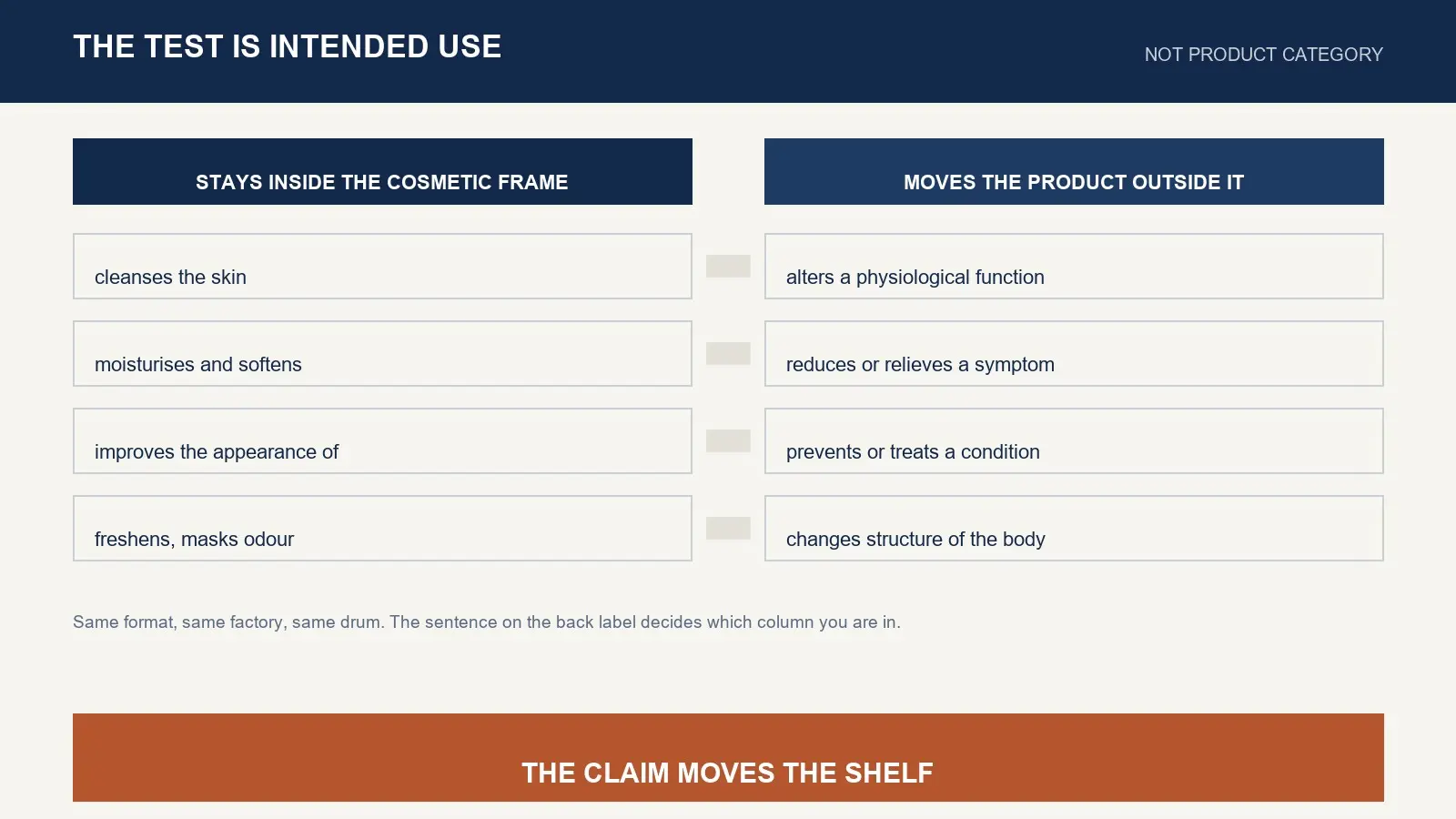
Classification is decided when the copy deck is approved - a different team, on a different calendar, than the one that qualified the factory.
The Four Extension Gates
Pull the two findings together and the extension decision has a shape. It is not a capability question and not a paperwork question; it is four gates, and each one is passed with a different kind of evidence. Below is the frame the rest of this piece walks through, with the written ask for each gate - the sentence a buyer can paste into an email and evaluate the answer against.
| Gate | What it actually decides | The written ask | What a good answer contains |
|---|---|---|---|
| 1. Cleaning validation and changeover | Whether the new format can be run on the existing rooms without carrying over the previous product | Provide the cleaning procedure and its validation for a change between these two product types | Named residue target, method, sampling points, number of validation runs, release criteria |
| 2. Formula-platform transfer | Whether your existing platform behaves in the new matrix and exposure pattern | Which of your platforms transfers to this format, and what has to be re-developed instead | Rinse-off versus leave-on behaviour, preservation performance data in that matrix, pH and electrolyte limits |
| 3. Dossier per product | What documentation the new SKU generates in each destination market | List the documents this SKU will generate per market, and who holds them | Safety assessment and report per product, the product file and its retention, the responsible-person entry, labelling review |
| 4. Order stack by format | Which component now binds the minimum order | Quote the material batch, the component lines and the setup lines separately | Batch quantity, pump or trigger or tube minimums, carton and print minimums, and which line is highest |
The category extension feasibility judgement collapses into one sentence once the table is filled: the gate you fail is usually not the one you asked about. Buyers ask about capability, which is gate zero and free. They rarely ask about changeover evidence, which is where a shared line becomes a scheduling constraint, or about the fact that a dossier is generated per product rather than per factory, which is where a five-SKU extension becomes five parallel documentation projects with five different bottlenecks.
A note on what this table deliberately is not. It is not a supplier scorecard - the site already publishes a twelve-point factory audit for that job in the verification checklist, and this piece does not re-open it. The audit asks whether a partner is sound. The four gates ask a narrower and more decision-relevant question: is this partner sound for the second thing you want them to make.
Gate One: Cleaning Validation and Changeover
Ask a factory whether it can make a body lotion and it will say yes. Ask it how long it takes to go from the shampoo before the lotion, and which rinse water is tested to prove the changeover was clean, and the answer becomes interesting. This is the gate that converts a shared line from a cost advantage into a scheduling constraint, and it is the one least often written into any document.
The physical reasons are unglamorous. Viscosity bands differ by an order of magnitude between the categories you are extending into: a toner, a serum, an emulsion, a balm, a shampoo, a conditioner with cationic deposition, a scrub. Each band leaves a different film in the same pipework, and the higher-viscosity materials hold onto surfaces and dead legs. Emulsions add an oil phase and an emulsifier film that a water rinse does not simply move. Conditioning formats add cationic materials, which are the classic cross-contamination problem because they bind to surfaces and survive rinses that clear anionic surfactants. Particulate formats - scrubs, clays, physical exfoliants - add abrasives and settle in low points. Fragrance load adds its own carryover, and fragrance allergen declarations are exactly the kind of thing a trace carryover can invalidate without anyone noticing until a labelling review.
The regulation does not ask a manufacturer to solve this in a particular way, but it does put the obligation beyond argument: cosmetic products placed on the market should, in the regulation's own words, be produced according to good manufacturing practice, and the safety test in Article 3 is judged under normal or reasonably foreseeable conditions of use, taking presentation and labelling into account. A carryover that puts an undeclared allergen on a label is not a hypothetical quality excursion; it is a compliance failure with a paper trail.
So the cleaning-validation-and-changeover question has a specific form, and a supplier who runs multiple categories will answer it in the same shape. Ask for: the cleaning procedure for the transition you actually need (from product A to product B, not "we clean between batches"); the residue target and how it is measured; the sampling points, including the least-drainable point and any gasket or hose; the number of consecutive validation runs and what made them acceptable; the rinse-water or swab result that released the next batch; and what happens to the schedule when the validated changeover takes longer than the planned slot, because that is where extension volume quietly eats your lead time.
A useful heuristic for reading the answer: a factory that has genuinely extended across categories will produce a document with numbers in it. A factory that has not will produce a policy sentence about hygiene. Neither answer is a disqualification - the second one just means the extension is a project, not a purchase, and the timeline should be built accordingly.
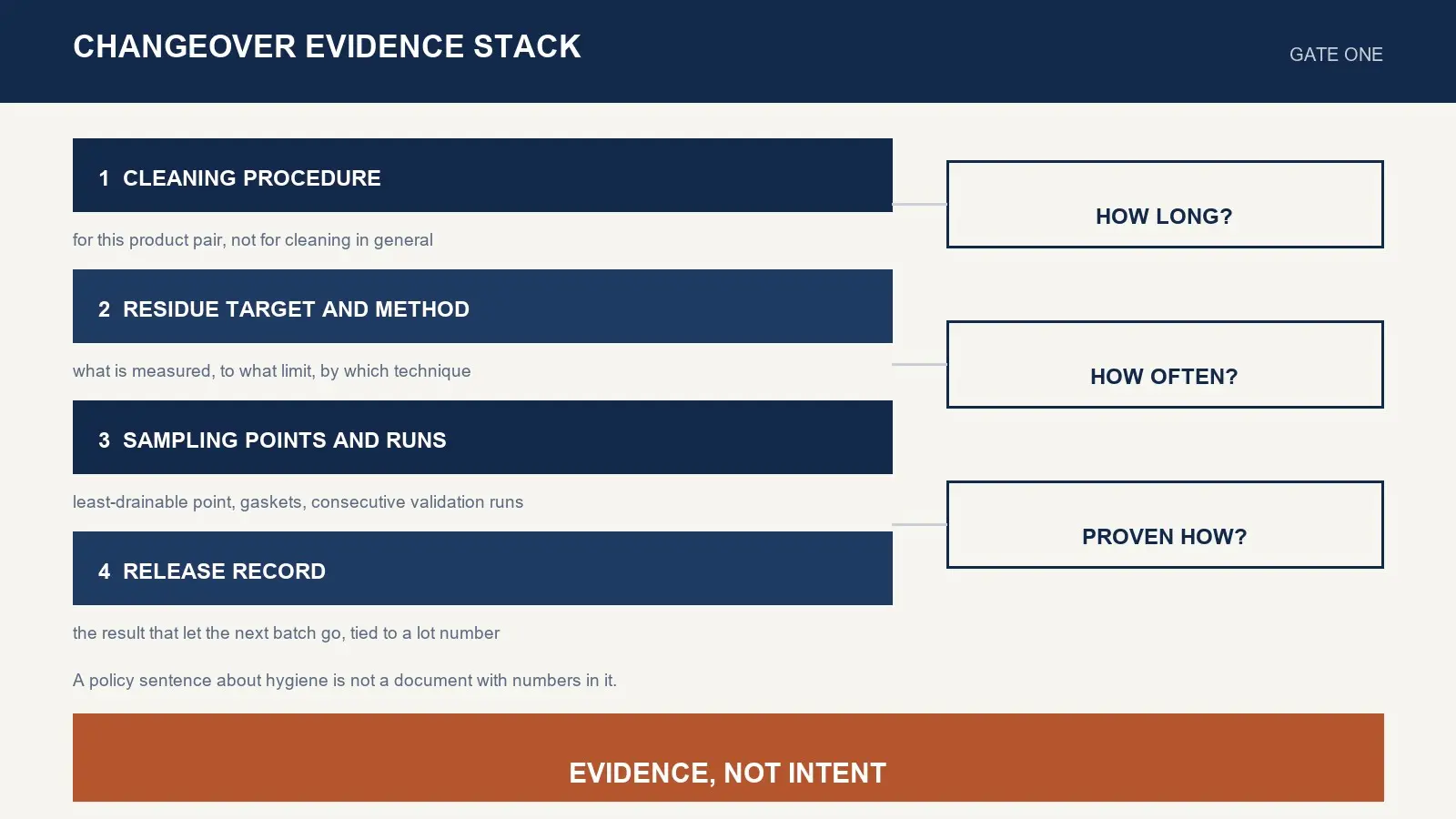
A factory that has extended before answers with a document containing numbers; a factory that has not answers with a sentence about hygiene.
Gate Two: The Formula Platform Does Not Transfer
A platform is not a recipe. It is a set of conditions under which a recipe behaves: a pH window, an ionic strength, a water activity, a viscosity range, a preservation system that still works at those settings, and a package that keeps it that way. When you extend across categories, almost every one of those conditions moves at once - which is why the sentence "we can use your existing serum platform" should be read as a starting hypothesis rather than an answer.
Rinse-off versus leave-on is the first break, and it is not a marketing distinction. A shampoo or a body wash spends seconds on skin and is removed with water; a serum or a cream stays. That changes what the formula has to do (deposit and feel in the wet state versus spread and absorb in the dry state), what it has to survive (a preservative in a rinse-off product is fighting a different organism load in a different exposure pattern than one in a jar that gets wet fingers daily), and what the consumer will tolerate (astringency, film, residue, odour on the hands after rinsing).
Surfactant systems are the second break, and they are the one facial skincare factories meet least often. An anionic-dominant cleansing base behaves nothing like a mild amphoteric or nonionic blend: foam volume and creaminess, mildness perception, salt tolerance for viscosity build, and compatibility with the deposition polymers and cationic conditioners that a hair format needs all sit in different places. A formula that was stable in a serum can destabilise the moment it meets a surfactant phase - which is why "add your active to our shampoo base" is a development project, not a configuration option.
The third break is the one the regulation itself flags. The minimum contents of the safety report include microbiological quality and the results of the preservation challenge test, and the same text directs particular attention to products used around the eyes, on mucous membranes in general, on damaged skin, on children under three, on elderly people and on people with compromised immune responses. Read that list against a typical personal-care extension and the overlap is not incidental: an intimate wash is a mucous-membrane product, a post-depilatory balm is a damaged-skin product, a baby or child body wash is an under-three product, a foot care format reaches an elderly population. The extension does not merely change the viscosity - it moves the product into the categories the safety assessor is explicitly told to scrutinise, and a preservation and irritation package built for a face mask is not the package that answers that scrutiny.
| Platform condition | Face / serum baseline | Body wash | Shampoo / conditioner | Balm / stick | Oral-adjacent or intimate |
|---|---|---|---|---|---|
| Continuous phase | Water or gel | Water plus surfactant micelles | Water plus surfactant plus deposition aids | Anhydrous or high-lipid | Water, mucosal exposure |
| pH window | Mildly acidic, tuned to actives | Often higher, salt-adjusted | Acidic for cuticle feel, cationic-compatible | Not applicable | Tight; mucosal tolerance |
| Preservation challenge | Standard matrix | Dilution and rinse dynamics | Surfactant partitioning of preservative | Low water activity | Highest scrutiny category |
| Irritation basis | Leave-on facial skin | Rinse-off body skin | Scalp and hair fibre | Lip or dry skin | Mucous membrane or damaged skin |
| What has to be re-developed | nothing by default | the whole surfactant system | surfactant plus deposition plus rheology | the lipid structure and melt point | the mildness and preservation package |
The honest commercial translation: a platform extension is usually one to three new platforms, not one new SKU. That is not a reason to abandon the extension. It is the reason the timeline and the sample budget for it look nothing like the timeline for a fifth serum - and the reason the buyer who prices an extension against serum economics always gets the wrong number.
Gate Three: A Dossier Per Product, Not Per Factory
The third gate is where an extension stops being a manufacturing conversation and becomes a project-management one, because the documentation obligation is written per product, not per site, not per platform and certainly not per brand.
The European text is unusually direct about it. Only cosmetic products for which a responsible person has been designated may be placed on the market, and for each cosmetic product placed on the market, the responsible person must ensure compliance with the Regulation's obligations. Before a product goes to market, that person must ensure the product has undergone a safety assessment and that a safety report is set up in accordance with Annex I. And when the product is placed on the market, a product information file must be kept for it - retained for ten years following the date the last batch of that product was placed on the market.
Three sentences, three consequences for an extension. A five-SKU body and hair launch is five safety assessments, five safety reports and five files - not one file with five annexes. The ten-year clock starts per product, on that product's last batch, so a short-lived extension SKU still generates a decade of custody obligations, and the question of who holds the file when a supplier relationship ends is a contract question long before it is a compliance question. And the responsible-person designation is a structural decision, not a formality: where a product is manufactured in the Community and not re-imported, the manufacturer established there is the responsible person by default, which is one of the reasons an extension into new markets can change who is legally exposed even when nothing about the formula does.
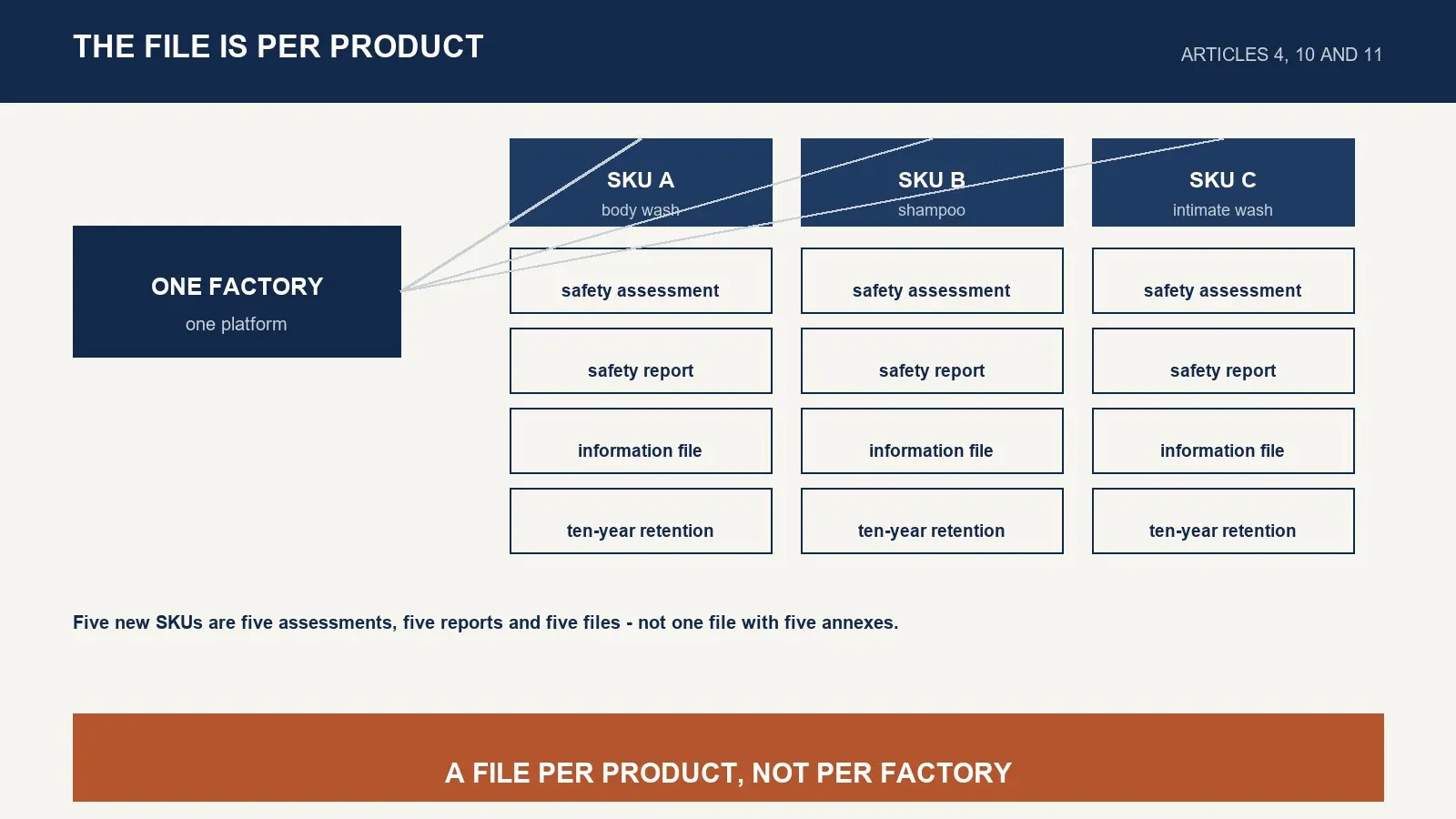
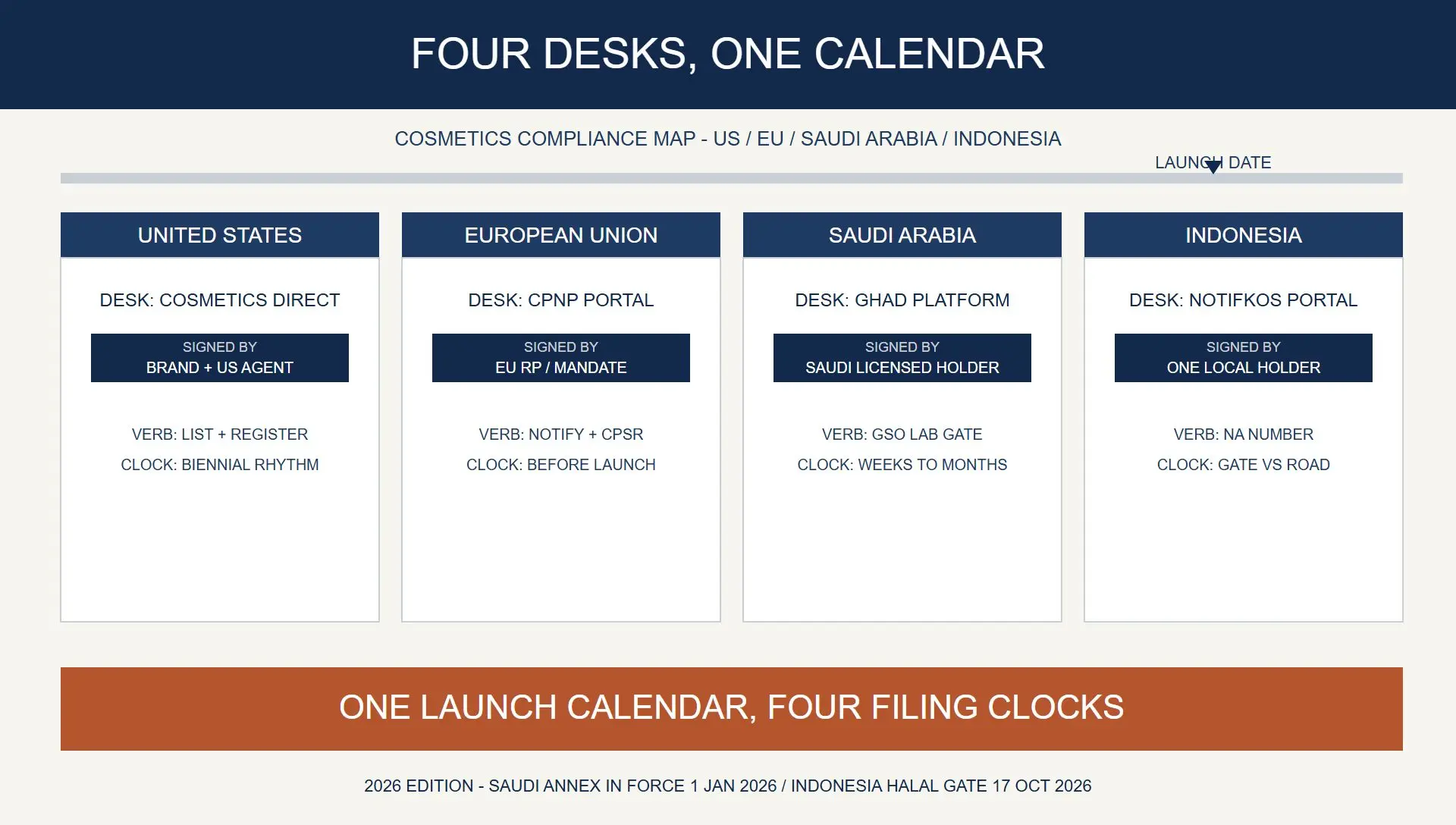
On the American side the same lesson arrives by a different route: the classification of each SKU depends on its intended use, and a claim can move a product from one statutory frame into another. Which means a mixed personal-care range can contain products sitting under different obligations in the same shipment, and a single compliance process designed for the cosmetic-frame products will silently under-serve the one that moved. The site's four-jurisdiction procedural comparison is in the registration requirements map and the US-side enforcement detail in the MoCRA supplier-selection guide; neither is re-opened here. What matters for the extension is the shape of the work, not the detail of each desk.
So the written ask at this gate is a list request, and it should be made before samples, not after a launch date is committed: for this specific SKU, in this specific destination market, name every document that will exist, who creates it, who holds it, what it costs in time, and what happens to it if we change factories. A supplier who can produce that list has run the extension before. A supplier who answers "we are fully compliant" has described a posture, not a workload - and workload is what an extension actually buys.
Every new SKU starts its own ten-year file clock - an extension is not a page added to a dossier, it is a dossier.
Gate Four: The Order Stack Changes Shape
The fourth gate is the one buyers think they understand, and it is where the arithmetic quietly changes. The mechanism itself is not re-argued here - the low-MOQ launching guide established that a minimum order is a stack rather than a number, with the effective minimum set by whichever line is highest. What changes on an extension is not that model but the shape of the stack, and the shape is what breaks budgets.
Formula batches usually get bigger, not smaller. A body wash or a shampoo runs at batch sizes a serum never sees; the per-unit material cost falls, and the naive reading is that the economics improve. They may. But the binding line moves. A dropper bottle and a 400 ml pump are different procurement objects: pumps have their own component minimums, their dosing mechanisms and their leak-test requirements; triggers and closures add another line; laminated tubes add a tooling-and-print conversation that a bottle does not. Carton and print minimums behave nothing like serum carton minimums once you are running five scents, because scent multiplies components without multiplying formulas - and every new scent is a new label, a new carton plate and a new print run.
For a private label personal care manufacturer relationship this produces a counter-intuitive planning rule: the cheapest extension SKU is rarely the one with the smallest batch. It is the one that reuses an existing component family and an existing scent. A brand that adds a body wash in a bottle shape already in the house, in a fragrance already qualified, has bought itself a materially smaller stack than one that adds a hand balm in a new tube with a new scent and a new carton.
| Stack line | Face-range typical | Body / hair extension | What to ask before committing |
|---|---|---|---|
| Material batch | Small batches, high flexibility | Larger batches, longer runs | Minimum batch for this format, and cost of a short run |
| Primary component | Dropper, airless, jar | Pump, trigger, tube, flip-top | Component minimum, colour and finish minimums |
| Closure and mechanism | Integrated | Separate line, separate supplier | Whether the mechanism is qualified with the bottle |
| Print and carton | One plate | One plate per scent per size | Plate cost, minimum run, changeover cost |
| Scent variants | Rare | Common | Cost of each additional fragrance, and its allergen file |
| Setup and changeover | Low | High, per the cleaning validation above | Whether changeover is charged per product pair |
The last row deserves emphasis because it is where gates one and four meet. If the validated changeover between two formats is long, the factory will want to run them in blocks, and blocks mean quantities. A cleaning-validation constraint converts directly into a minimum-order constraint - which is the single most common way an extension quote comes back higher than the buyer expected while every individual line item looks reasonable.
What the Retailer Asks That the Formula Does Not Answer, and Why There Are No Market Numbers Here
Two things belong in this section because they are the ones that surface last.
The first is the retail-facing file. Once a personal-care range leaves the direct channel, the questions change character. A buyer in a retail or distribution channel does not ask whether the lotion is nice; it asks for the documents, per SKU, in the format its own compliance portal accepts, plus the carton and pallet markings, the barcode allocation, the country-of-origin statement, and a claim set that survives review in every market the case pack is going to. The extension multiplies all of that at once, and it does so asymmetrically: a scent or a mucosal-adjacent format can raise a documentation question that the entire face range never triggered. The site's own treatments of the two hardest versions of this - religious and regional claim files in the Halal buyer's guide, and the EU-side responsible-person and documentation structure in the importer's compliance guide - are where that detail lives, and neither is repeated here.
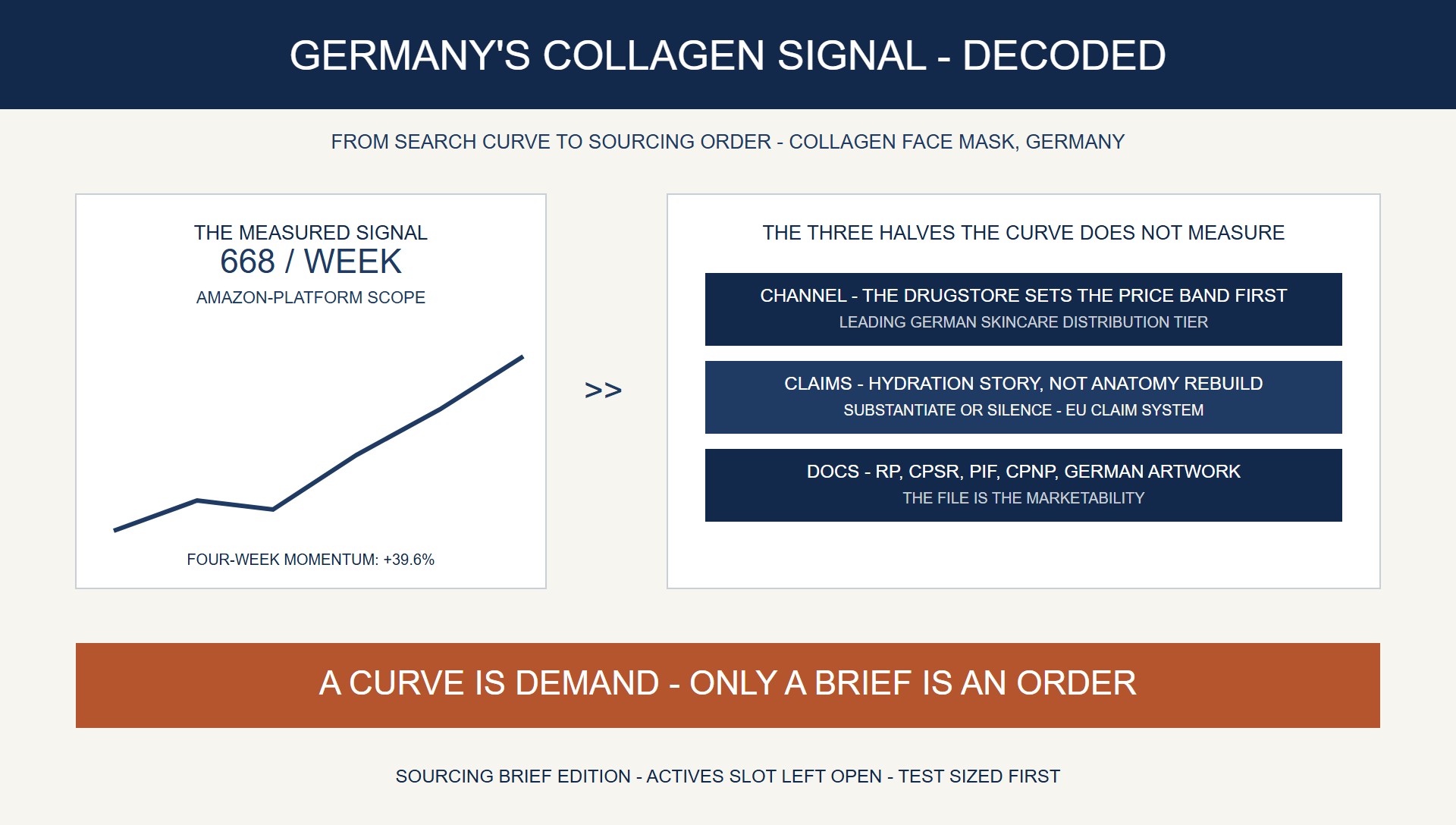
The second is an admission. This piece deliberately carries no market-size figure, no growth rate and no share number for body, hair or personal care. Not because the numbers do not exist - they exist in quantity, and they disagree with each other by wide margins depending on which product families an analyst chose to fold into the word "personal care." Within this run's evidence budget, no figure could be verified to the standard this site writes to, and an unverified headline number in a piece whose whole argument is "check the primary document" would undercut it. The honest version of the demand case is the one a buyer can check personally: the enquiry log. Count how many of the last hundred enquiries asked for a second category from the same partner, and count how many of those converted. That is a real number, it is yours, and it is worth more than any analyst's aisle definition. Where a dated market reading is genuinely needed, the site has published them with their sources and their caveats attached - the signal-versus-order analysis on German demand is an example of how a third-party figure should be presented: institution named, date given, and the measurement basis stated next to the number.
What replaces the missing chart is a decision rule, and it is cheap: do not fund a category extension on a market-size argument. Fund it on a component-reuse argument and a documentation-capacity argument. If the extension reuses an existing qualified component family, an existing fragrance, and an existing platform, and if the documentation workload is affordable at the SKU count you are planning, the extension is viable at market sizes far below the ones in the reports. If it fails those two tests, no market size saves it.
The Feasibility Test You Can Run in One Email
Everything above reduces to something a buyer can send before a single sample is requested. The point of the test is not to interrogate a supplier; it is to find out, cheaply and early, whether the four gates are already solved or are about to become your project. A partner that can operate as a custom personal care manufacturer across the formats you want will answer these in a call, because they have answered them before. One that cannot will route them to a meeting.
| # | The question | What a strong answer contains | The red flag |
|---|---|---|---|
| 1 | Which of our target formats do you already ship commercially, in this region, today? | Named formats with volumes described in batches per run, not adjectives | "We can make anything" |
| 2 | What is the validated changeover from your nearest existing product to mine? | Procedure, residue target, sampling points, number of runs, release record | A hygiene statement with no numbers |
| 3 | Which of your platforms transfers to my format, and what has to be developed new? | An explicit split between reuse and development, with timelines | Everything described as "standard" |
| 4 | Has the preservation and irritation package for that matrix been tested? | Test basis and date, and who performed it | "Our system is broad spectrum" |
| 5 | For this SKU in this market, which documents exist, who holds them, and what is the timeline? | A named list per market, including the file and its retention | "We are fully compliant" |
| 6 | What is the label review path for the claims we intend to print? | Who reviews, against which list, at which stage, before artwork | No owner named for claims review |
| 7 | Quote the material batch, the component lines, the print lines and the setup lines separately. | Four separate lines and the highest one identified | One blended unit price |
| 8 | If we add a second scent next quarter, what changes in all of the above? | The delta, itemised - especially changeover and print | Silence on the second scent |
Read the table as a diagnostic rather than a scorecard. Questions two, three and five are the ones that predict a schedule; questions seven and eight are the ones that predict a budget; question six is the one that predicts a recall. A supplier can be excellent on the first and still be the wrong partner for the extension, and the entire cost of discovering that is one email.
Two framing notes for the conversation that follows. First, ask for the delta, not the capability. Factories answer capability questions with confidence and delta questions with specifics, and only the second kind is usable. Second, put the changeover question in writing even if you already have a good relationship, because an extension is the moment when an undocumented habit becomes a scheduled activity, and the party that has to schedule it is you.
Frequently Asked Questions
Q1. Is a body and hair extension a different regulatory category from skincare? In the European Union, no. The definition of a cosmetic product already names the epidermis, the hair system, nails, lips, external genital organs, teeth and the mucous membranes of the oral cavity, and already includes cleaning, protecting, keeping in good condition and correcting body odours among its permitted purposes. The extension crosses a production and documentation boundary, not that definition. Elsewhere the answer differs, and the boundary is drawn by claims rather than by category.
Q2. What actually stops a facial-skincare factory from running a shampoo line? Usually three things in this order: the validated changeover between very different viscosity and surfactant systems, the preservation and irritation package for a matrix the house has never worked in, and the component supply for pumps and tubes rather than droppers. Equipment exists; evidence and supply chains usually do not.
Q3. Do we need a new safety assessment for every extension SKU? For the European market, yes - the obligation is written per product: an assessment before that product is placed on the market, a safety report for it, and a product information file kept for it for ten years after its last batch. A shared platform does not merge those obligations.
Q4. Our marketing team wants to add a treatment claim to the body wash. What breaks? Potentially everything upstream of the label. Classification on the American side turns on intended use, and a claim can move a product from one statutory frame into another even when it is sold as a cosmetic. The practical breakage is that the qualification you obtained, the testing scope, the file and sometimes the facility requirements were all built for the other frame. Fix the claim set before the supplier, not after.
Q5. Will our minimum order go down because body formats are cheaper per unit? The unit material cost may fall, but the binding line usually moves rather than disappears - to the pump, trigger, tube, carton plate or fragrance. The cheapest SKU to add is the one that reuses an existing component family and an existing qualified scent, not the one with the smallest batch.
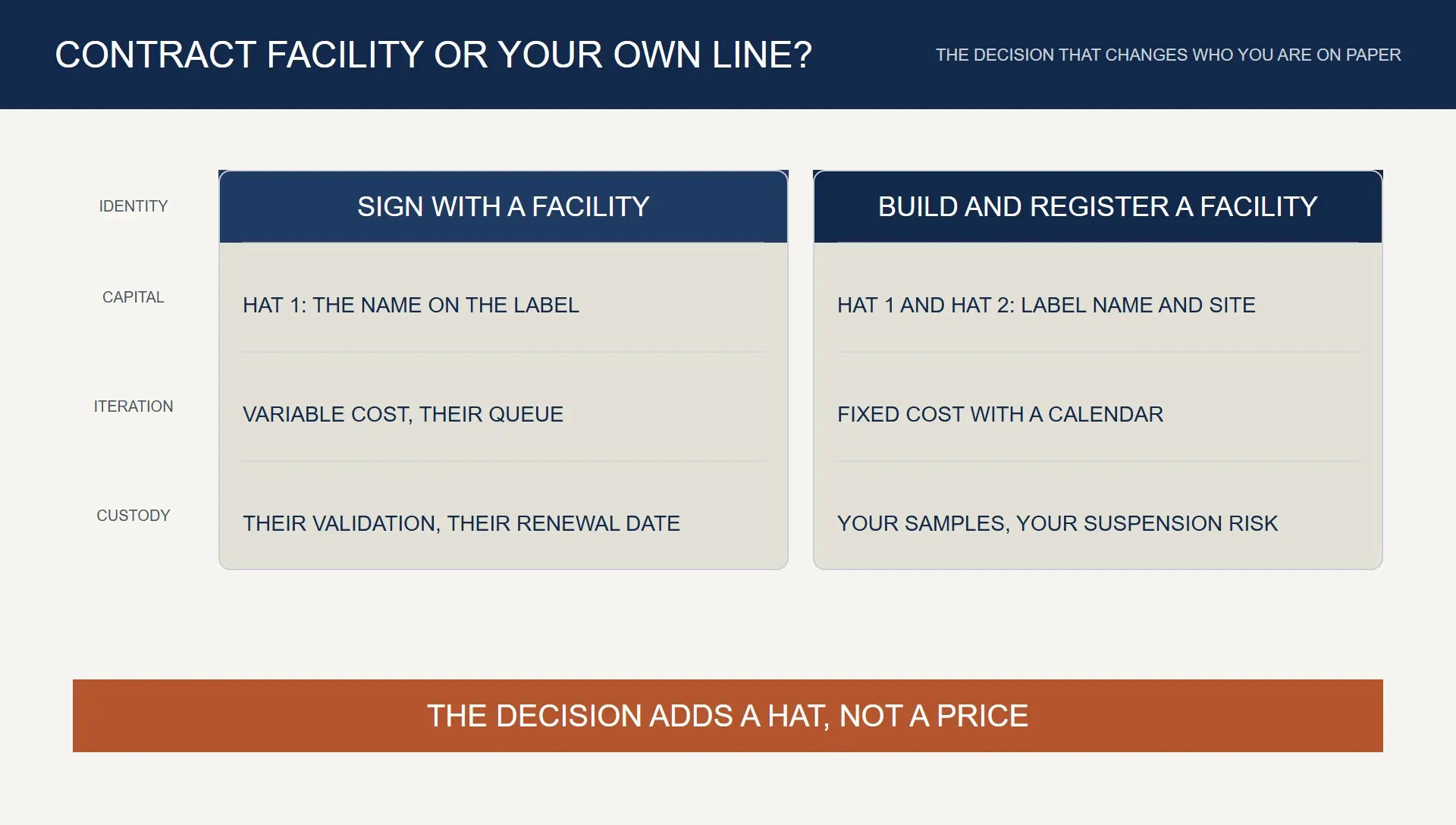
Q6. Should we bring the extension to our existing partner or quote it out? Test the existing partner first, on the specific gates rather than on general capability - the switching cost on gates one and three is paid twice if you move before you ask. If the changeover evidence, the platform boundary and the per-SKU document list all come back concrete, an incumbent is usually cheaper and faster. If they come back as assurances, quote it out. The make-or-buy framework for the deeper question is already covered in the contract-versus-in-house decision.
Q7. How does a small brand do this without funding five new platforms? Reduce the SKU count before reducing the ambition: one format, one scent, one component family already in the house, one destination market. Then extend the range by repeating the same four fields rather than by adding new ones. The sequencing logic for a small first run is in the low-MOQ launching guide, and the flexible-manufacturing side on this site's small-batch guide.
Sources and Further Reading
- Regulation (EC) No 1223/2009 on cosmetic products - Article 2(1)(a) (definition of a cosmetic product, including the enumerated sites of application and permitted functions), Article 3 (safety under normal or reasonably foreseeable conditions of use, and the factors assessed), Article 4(1)-(3) (responsible person; compliance obligations for each cosmetic product; manufacturer as responsible person for Community-made product), Article 10(1) (safety assessment before placing on the market, and the safety report per Annex I), Article 11(1) (product information file kept for the product; ten-year retention after the last batch), Recital 16 (production in accordance with good manufacturing practice), and Annex I Part A point 3 (microbiological quality, results of the preservation challenge test, and the categories requiring particular attention: eye area, mucous membranes generally, damaged skin, children under three, elderly persons, persons with compromised immune responses). Full text retrieved 19 October 2026 and re-read 21 October 2026. - FDA, "Is It a Cosmetic, a Drug, or Both? (Or Is It Soap?)", fda.gov, page dated 11 September 2024 - classification by intended use; different laws and regulations apply to each; the title itself recognises dual and borderline cases. - FDA, "Cosmetics & U.S. Law", fda.gov, page dated 17 August 2026 - certain claims may cause a product to qualify as a drug even where it is marketed as if it were a cosmetic. - FDA, "How can I tell if my product is a cosmetic, a drug, or both?", fda.gov, page dated 16 June 2022 - the statutory definition of cosmetics drawn in part by intended use. - On this site: the hair care OEM category page (the hair aisle in detail - formats by production-line distance and the claim matrix, which this piece deliberately does not repeat), the low-MOQ launching guide (the order-stack mechanism), the RFQ field anatomy guide (order-level fields), the contract-versus-in-house decision (who should own the capacity), the category anchor piece (what a category-level page must carry), the registration requirements map, the MoCRA supplier-selection guide, the EU importer compliance guide, the Halal buyer's guide, the twelve-point factory audit, the small-batch flexible manufacturing guide, the hand mask retail-angles piece, the scalp and hair ageing piece, the esthetician channel playbook, the claim-liability piece, the claims-regulation piece, the German signal analysis, the facial cleanser trends piece, the skin care lotion sourcing page, the lip care trend page, and the MOQ sourcing note. - Not used, deliberately: no market-size, growth-rate or share figure for body, hair or personal care (no figure met the verification standard available in this run - see section nine); no search-volume, cost-per-click or competition figure for any term in this piece (this batch of service terms has no locally verifiable metrics); no named factory, brand or retailer.
What to do next
If you are planning a body, hair or intimate-care extension onto an existing facial range, the useful first step is a feasibility read rather than a sample order. Send us the formats you want, the destination markets, the component families you already use, and the claim sentences you intend to print - and we will come back with the four gates scored for your specific range: which formats reuse a validated changeover, which require a new platform, what documents each SKU generates in each market, and where the order stack actually binds.
A dedicated product manager on every enquiry - reply within 24 hours, standard sampling in 7 days, and MOQ from 1,000 pieces on standard formats, with material batch, component, print and setup lines quoted separately so you can see which one binds. Request a category feasibility assessment and the quote with the MOQ table, and we will tell you plainly when an extension is better run as a second project than folded into the first.