

Cosmetic Manufacturer USA vs Europe or China: Six Defaults
Why a Cosmetic Manufacturer USA Shortlist Is a Defaults Question
Most buyers start this decision the wrong way round: they build a shortlist of countries, then ask what each one charges. The better sequence is the opposite - name the fields that a location fills in for you, then look for plants that give you the defaults you can actually live with. The reason is simple. A cosmetic manufacturer usa enquiry and a shortlist labelled with any other country are not two quality grades of the same thing; they are two different pre-filled forms, and part of what each one pre-fills cannot be negotiated away later.
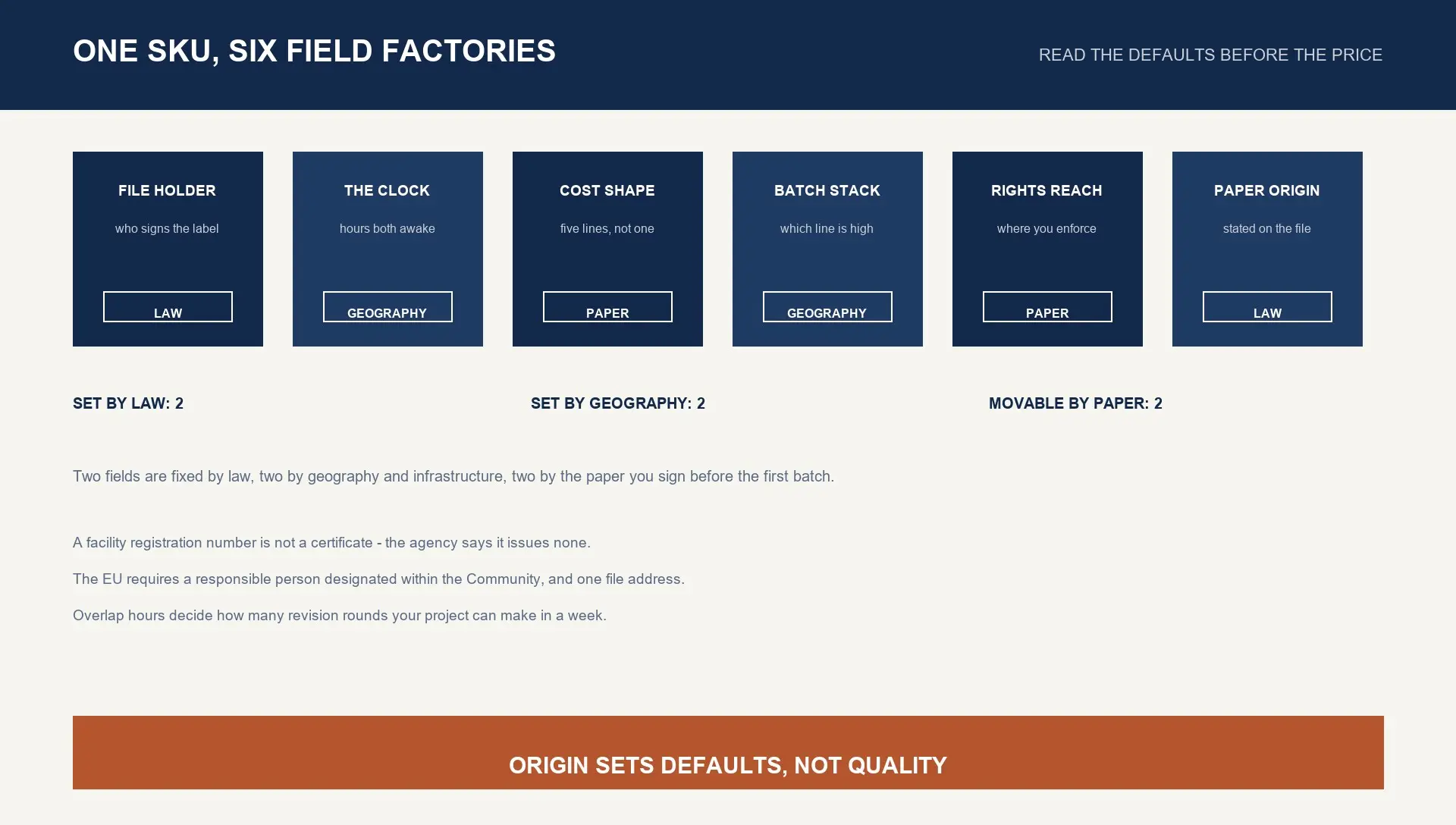
Call it the manufacturing origin decision: the choice of where a product is made, evaluated not as a ranking of nations but as a set of six defaults that arrive before your first email is answered.
The six are these. Who signs for the product file, and at what address that file can be reached. What clock your revision rounds can run on. What shape your cost lines take, as distinct from what level they sit at. Which line of the batch stack is highest in that place, given the suppliers around the plant. How far your rights are enforceable if the relationship ends badly. And what your paperwork and label have to state about where the thing came from, because for several markets that is a printed field, not an option.
Two of those are fixed by law and cannot be bought around. Two are set by geography and infrastructure, which means they change slowly and cost money to change. Two are matters of paper you can insist on before you sign. Most negotiations spend their energy on the price line, which is half paper and half geography, and skip past the legal pair entirely - which is how a buyer ends up with a well-haggled quotation and no access to the file it depends on.
This piece deliberately does not answer three questions that other pieces on this site already answer. It does not rank countries: the card that generated it required neutrality, and the honest version of this topic is that every default has a price on both sides, so a plant in New Jersey and a plant in Suzhou can each be the expensive choice for the same brand. It does not restate the four-desk filing sequence, the U.S. agent's role or the biennial renewal clock, all of which are worked through in the four-market registration map. And it does not touch landed-cost arithmetic under tariffs, which belongs to the tariff piece - here, duty appears only as one line in a cost shape, never as a number.
Choose the defaults first, and the conversation stops being about which country you trust and starts being about which fields you can live with.
The Address on Your File: Who Signs, and Where the Binder Sits
Start with the least glamorous default and the one with the longest tail: who is named on the product file, and at what address a regulator can reach it. For the European Union the answer is not a preference and not a service you can buy after the fact. Regulation (EC) No 1223/2009 is explicit in Article 4(1): "Only cosmetic products for which a legal or natural person is designated within the Community as 'responsible person' shall be placed on the market." The recitals then close the geography of the document itself. Recital (17) states that, for effective market surveillance, the product information file should be made "readily accessible, at one single address within the Community, to the competent authority of the Member State where the file is located."
Read those two sentences as a buyer, not as a lawyer. They say that in the EU regime, a product has one file at one address inside the Community, that a named person owns that address, and that the address persists: Article 11(1) requires the responsible person to keep the file for ten years after the last unit is placed on the market. The obligation is a list of articles attached to a person (Article 5(1) enumerates them - Articles 3, 8, 10, 11, 12, 13, 14, 15, 16, 17, 18, 19(1),(2) and (5), plus 20, 21, 23 and 24), and none of those obligations are attached to the address of the factory.
That produces the practical rule for a shortlist. If the plant is inside the Community, the file address and the plant can be the same organisation, and your access to it is a question of contract, not of distance. If the plant is outside it, the regulation's own definitions create an extra role: an "importer" means a person "established within the Community" who places a product from a third country on that market. A buyer searching for a skincare manufacturer uk is, from the EU side, not choosing a cheaper version of the same arrangement - they are choosing a different arrangement, in which somebody inside the Community holds a file you will want to read. Whether the United Kingdom is treated as inside or outside for a given product is a market-entry question, and the fifth-desk mechanics are already covered in the EU compliance guide for importers and in the four-market map above. What belongs here is only the default itself: the file always has one address, and the law cares who is standing at it.
Enforcement reaches further than people expect, which is why this default is not a formality. Article 17's provision is that the competent authority of any Member State where the product is made available may ask the competent authority of the Member State where the file is held to verify that the file satisfies Article 11. A question raised in one country travels to the file's country on its own. The distance it travels is a function of the structure you chose, not of anything you say later.
| Document or record | Whose address appears on it | Who can change it after launch |
|---|---|---|
| EU product information file | The responsible person, at one single Community address | Only by re-designating the person, then moving the file - a legal act, not a phone call |
| CPNP notification entry | Responsible person name and address, plus the country of origin for imports | Amended when the person or the supply arrangement changes |
| Consumer label | The responsible person's name and address; the highlighted one is where the file is reachable | Reprint. Stock already shipped cannot be relabelled |
| US facility registration record | The facility, its contacts and, for registrations submitted through the system, a U.S. agent among the contact roles | Updated by the facility owner; not transferable to you |
| Your own supplier agreement | Whoever your lawyer writes down | This one is yours - and it is the only document that can give you reach |
The last row is the whole point of this section. Four of those five records are written by other people's rules, and they will say what they say regardless of what your purchase order intended. One of them is yours. A buyer who negotiates price and lead time while leaving the file-address question to the supplier's letterhead has made a legal decision by default, in somebody else's building, in a country they did not choose.
The Clock You Are Buying: Overlap Hours and Revision Rounds
Every buyer says they want fast responses. Almost none of them convert that into the only unit that matters, which is how many hours per weekday the two teams are both awake and at work. This is not a soft consideration and it is not a stereotype about anybody's work ethic. It is arithmetic on published UTC offsets, and it is the second default a location chooses for you.
Take a brand whose team works a conventional 09:00 to 18:00 day. The table below is this article's own arithmetic, computed on standard-time offsets; daylight saving shifts the numbers by an hour on some sides and not on others, and the honest way to use it is to redo it for your actual dates rather than trust any table, including this one.
| Factory location (standard offset) | Factory workday in UTC | Overlap with a New York workday | Overlap with a London workday |
|---|---|---|---|
| US Eastern (UTC−5) | 14:00 - 23:00 | 9 hours | 4 hours |
| United Kingdom (UTC+0) | 09:00 - 18:00 | 4 hours | 9 hours |
| Central Europe (UTC+1) | 08:00 - 17:00 | 3 hours | 8 hours |
| East China (UTC+8) | 01:00 - 10:00 | 0 hours | 1 hour |
The 0-hour cell is the one that surprises people, and it does not mean what people think it means. It means that a request sent at the start of a New York day gets an answer at the start of the next New York day, because it arrives at the end of the working day on the other side. Two things follow. First, the calendar consequence is not a rate, it is a round count: a change that needs a synchronous conversation - a texture that is wrong in a way nobody can describe in writing, a shade, a fragrance hit, a viscosity that behaves differently on skin than in the beaker - consumes at least one full day of elapsed time per round in the 0-hour case, and roughly one round per day in the 9-hour case. That is an inference from the arithmetic, not a study of anyone's productivity; the mechanism is simply that each round needs one exchange and each exchange needs a window.
Second, and this is where neutrality matters: the overlap cost is real and it is also frequently the wrong thing to be optimising. A relabel of an existing, already-stable formula needs almost no synchronous rounds at all - written specifications, a sample, a check against the retained reference, and the clock stops mattering. A bespoke texture or a new active at a new concentration needs many, and the clock becomes a hard constraint. Many plants outside your overlap hours bridge the gap by scheduling a late window, and that bridge is not free - it is staffed, and staffed hours appear in a quotation somewhere, in every country. Choosing a location with a small overlap is therefore not automatically cheaper or slower; it is a different way of paying for the same development cycle, and which is better depends entirely on how many rounds your project actually needs.
The clock also has a second hand, which is the calendar line rather than the daily one. A development programme has a critical path, and the sequencing of it is worked through in the brand-launch start guide, whose 14-to-18-week shape already absorbs the round-count effect described above. What is added here is only the origin-specific version: ask every candidate plant, in writing, how many working days it takes to get from a change request to a posted sample, and get the number as a range with the reason for the range. A plant that answers "eleven to sixteen days, because the stability check needs the retained sample pulled from the archive" is telling you about its process. A plant that answers "fast" is telling you nothing, and you cannot plan a launch date on nothing.
There is one more calendar coupling that is easy to miss, and it is on the ingredient side rather than the factory side. If your formula depends on a botanical with a harvest window, the plant's location and your origin choice are entangled with a season you do not control. That question is answered in the coastal botanical specification piece - the two are the same axis read from opposite ends, and a buyer who plans a launch date without reading both is planning against one calendar instead of two.
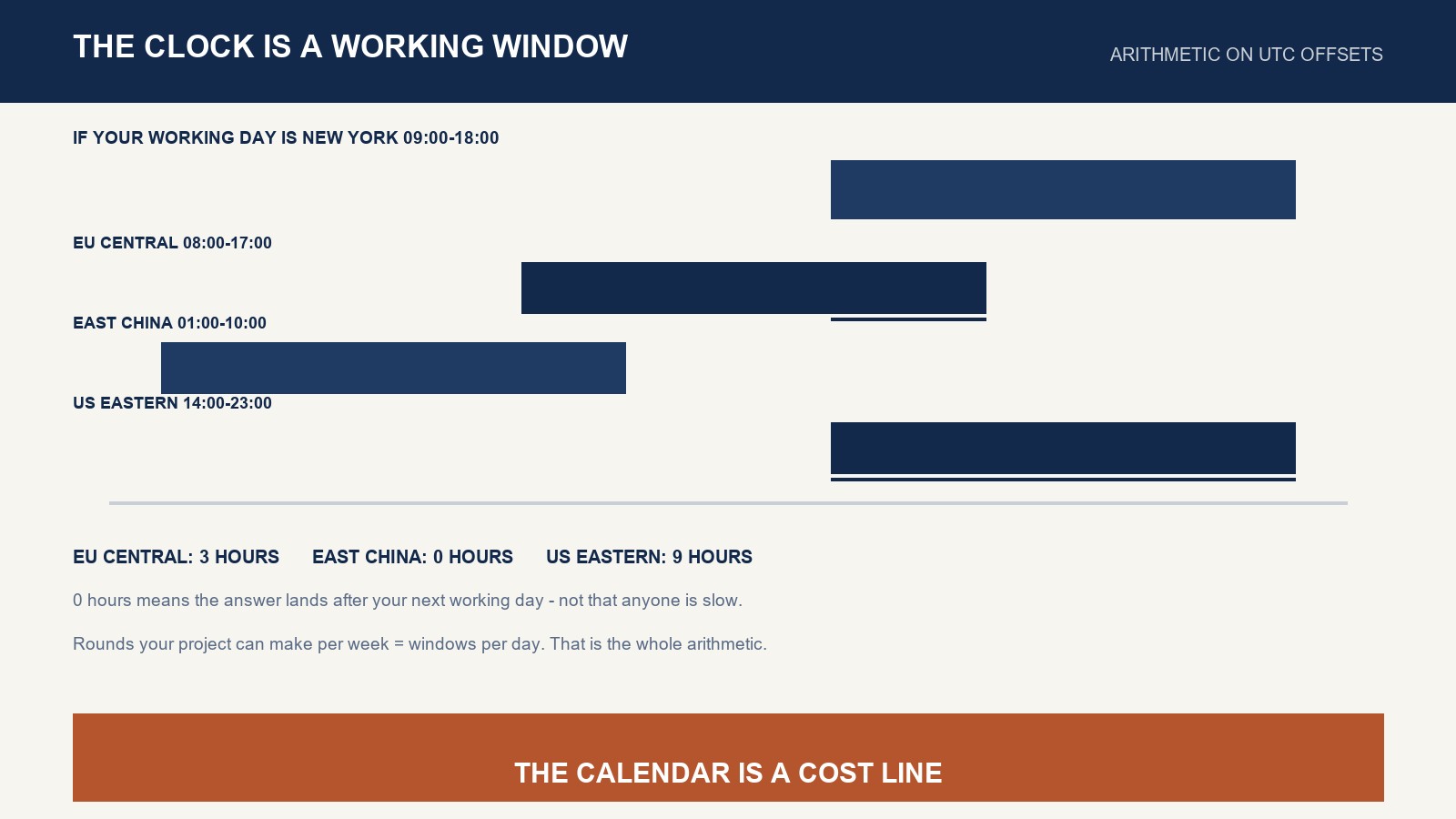
Overlap hours are not a comfort feature; they are the number of decisions your project can make per week.
Cost Has a Shape Before It Has a Level
Once you compare quotations as sets of lines instead of as single numbers, the country question changes character completely - and becomes answerable.
A manufacturing quotation is not a price. It is at least five lines, and their relative weights are set by different things: some by the factory's own efficiency, some by the buyer's distance, some by law, and some by what happens after the goods leave. Comparing only the second line is how experienced buyers get surprised.
| Cost line | What mostly sets it | What you can move | What it hides if you only look at unit price |
|---|---|---|---|
| Development, tooling and first batches | Existing formula availability, closure and component choices, trial-run losses | Formula reuse, component standardisation, staged tooling | A paid-for tooling line amortised into a batch you may never repeat |
| Batch manufacture | Local labour and energy structure, line utilisation, scale | Order size, format consolidation across SKUs | Whether the line includes fill validation or excludes it |
| Freight and lead-time reserve | Distance from your market, mode, incoterms | Consolidation, packaging density, planned buffer | The expedite you will buy back later at a worse rate |
| Duty, classification and representation | Destination-market rules and your declaration structure | Nothing at the quote stage; classification is a customs conversation | A tariff exposure handled by a specialist elsewhere on this site |
| Rework, retention and file keeping | Who holds the compliance file and how reachable it is | Contract terms on retention samples, audits, amendments | The cost of an argument six months after the batch was accepted |
Read the last line again, because it is the one origin decides most quietly. A product information file that sits with a responsible person ten time zones away is not free and not expensive; it is a cost you pay in an emergency instead of in advance, at a moment when you have the least ability to negotiate. The retention sample stored at the factory, the ability to reproduce a batch after a complaint, the speed of an amendment when a formulation changes: these are all file-and-address questions from section two wearing a cost coat.
The honest neutral statement of the whole trade-off is this. Locations with lower variable manufacturing cost generally present a flatter, larger development-and-first-batch structure and a longer freight-and-reserve line; locations with higher variable cost generally present a shorter supply chain to your own market, denser local component ecosystems and a compliance file that is closer to the shelf your product sits on. Those are descriptions of shapes, not scores. Which shape is cheaper for you depends on three facts only you know: how many SKUs share the platform, how many revision rounds the product needs, and how much regulatory distance you are willing to carry on your own balance sheet.
Two numbers deliberately absent from this article are prices and percentages. This piece will not quote a per-unit rate or a tariff figure, for two reasons. Rates move, and a number copied from a deck becomes a liability in someone else's procurement file the day it is re-read next year; and the tariff side is genuinely different arithmetic which belongs to the tariff and origin-strategy piece, while the structure of an actual OEM quotation - what belongs in a line item and what does not - is set out in the mask OEM cost breakdown. What is added here is only the frame: compare the shape, then and only then compare the level.
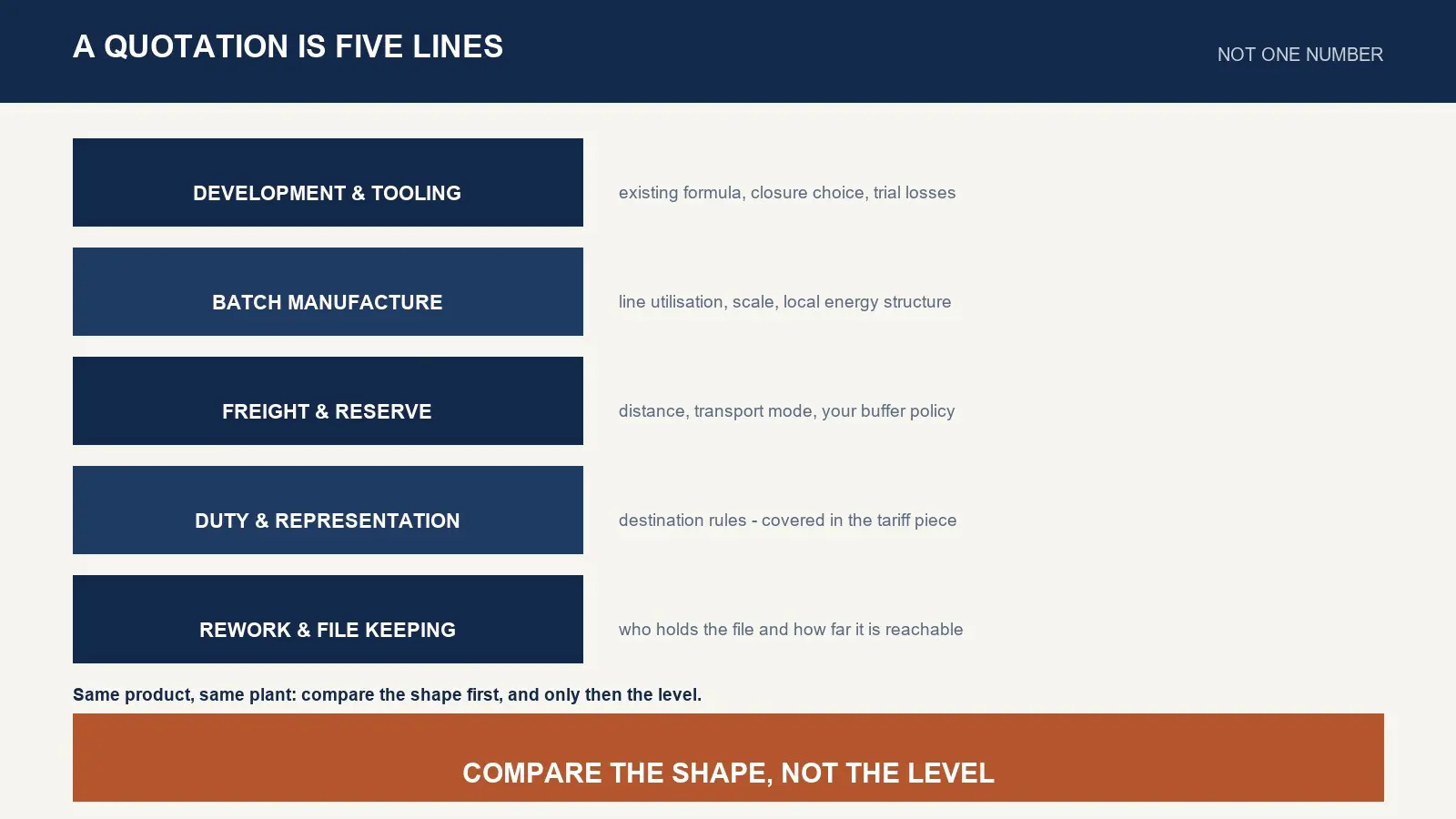
A low unit price with a high rework-and-file line is the same invoice seen twice.
The Registration Number Is Not a Credential, in Any Country
Supplier decks everywhere decorate themselves with regulatory badges, and a buyer who cannot read what a badge legally is will keep paying for the wrong reassurance. On the American side the source text is unusually blunt, and unusually recent. On 9 September 2026 the FDA stated on its registration and listing page that it "does not provide certificates or other documents to verify compliance for cosmetic product facility registration." The same page adds, in its important notes, that "Cosmetic product facility registration and cosmetic product listing is neither a cosmetic approval program nor a promotional tool," and that "the assignment of a facility registration number or product listing number does not indicate FDA approval of the facility or its cosmetic products."
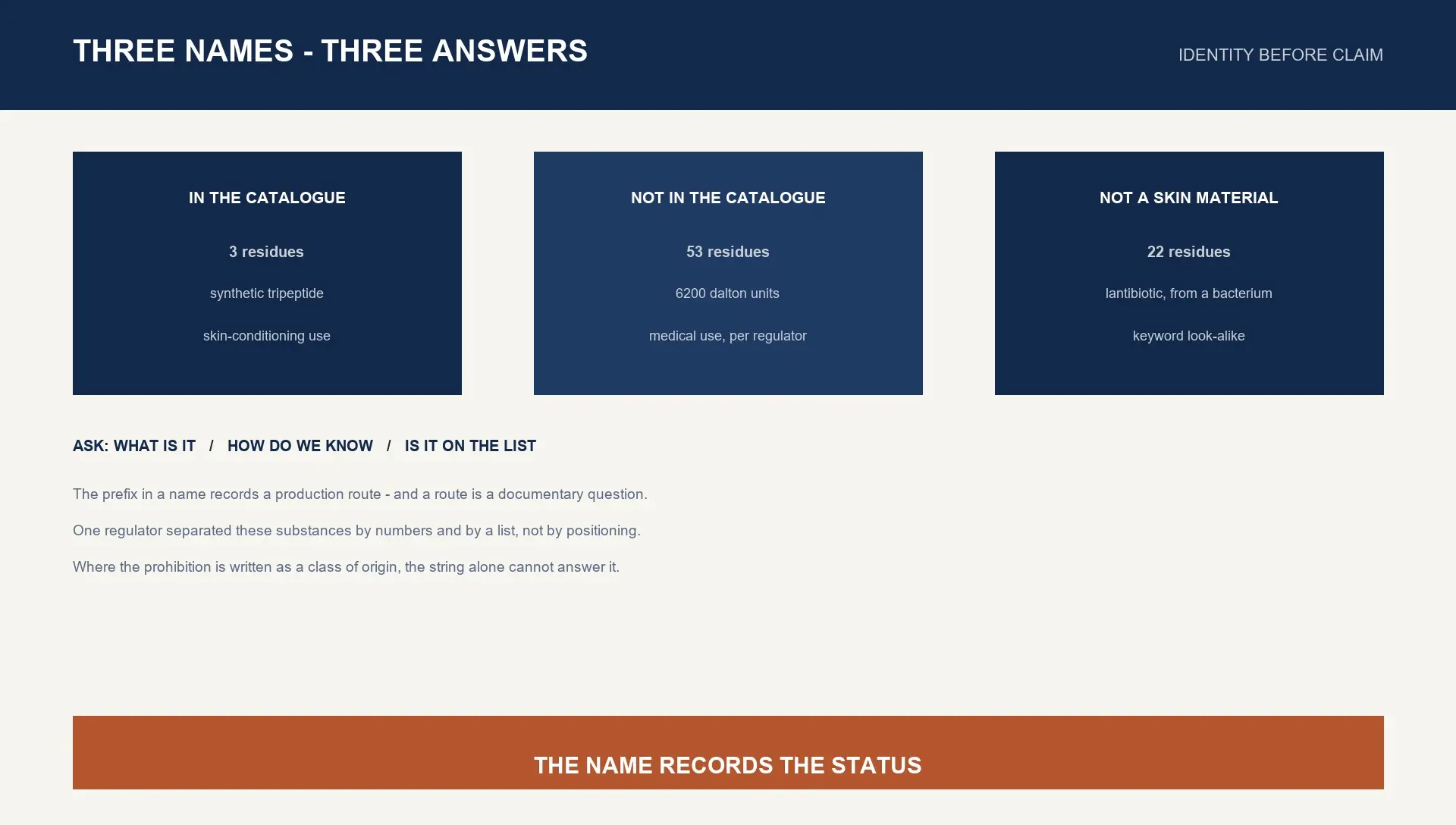
Those three sentences do more work in an origin conversation than any number of certificates in a PDF. They mean that a claim of being "FDA registered" is a statement about a filing having been made, not a statement about a government having examined and endorsed a factory - and that this is true whether the deck you are reading came from Ohio or from a supplier you found while evaluating a cosmetic manufacturer europe list for the American market. The badge is not a country advantage. It is a paperwork fact with a defined and limited meaning, and the honest version of it is available to any facility that registers, anywhere in the world, that manufactures for the US market.
What you can verify instead, and should ask for in the same first email as the price:
- The registration or listing number, and the exact facility name it belongs to. The FDA uses the FDA Establishment Identifier as the facility registration number and expects the owner or operator to obtain it before submitting - a specific, checkable identifier rather than a slogan. The renewal mechanics, the two-year cycle and the U.S. agent's role are treated in the four-market registration map and are not repeated here. - Since February 2026, two fields the agency added to its Cosmetics Direct portal: a registration status and a renewal date. You cannot read another company's portal, but you can ask a supplier to state both values for their own record and then ask why. A supplier who knows their own status and renewal date is managing a registration; a supplier who reaches for a screenshot of a certificate is selling one. - Whether the facility is even required to register. This is the piece that most buyers never hear. The MoCRA small-business exemption relieves certain facilities from registration and listing - but the exemption does not apply to products that regularly contact the mucus membrane of the eye under customary use, products that are injected, products intended for internal use, and products intended to alter appearance for more than twenty-four hours where removal by the consumer is not part of that use. A sheet mask and a leave-on cream sit inside those carve-outs differently, and a low-volume plant sitting on an exemption is not doing anything wrong; it simply means the paper trail you expected to receive does not exist and your own file has to be built to carry it.
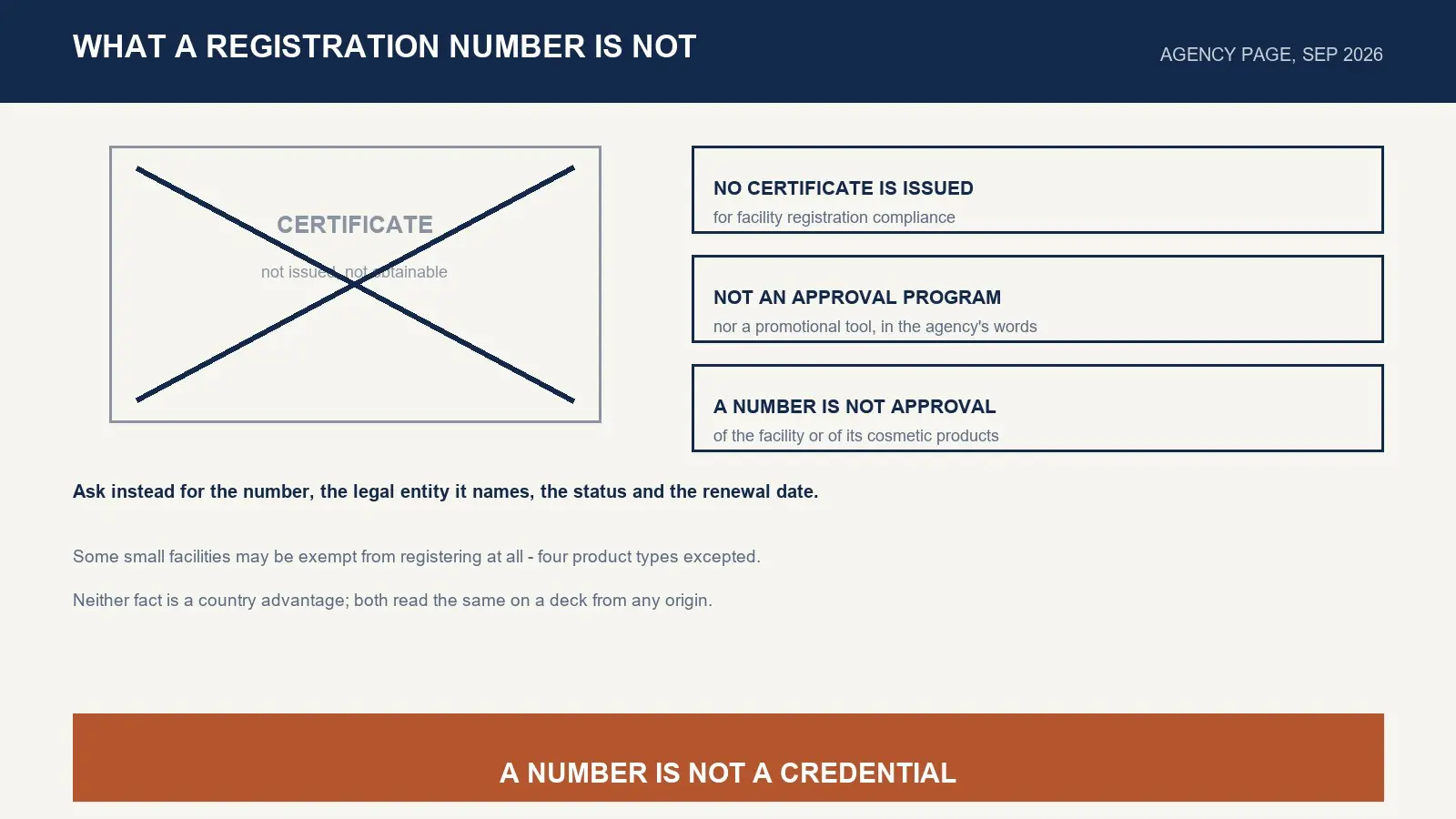
The generalisation for a buyer choosing an origin is therefore short and applies on both sides of every ocean: a regulation can be complied with in many ways and advertised in one. Ask for the artefact the law actually produces - a number, a status, a named responsible person, an address where a file sits - and not for the artefact marketing produces. Then check that those artefacts name the same legal entity as the one you are about to pay, because in a contract-manufacturing relationship the entity that filed is very often not the entity on the invoice, and that gap is a default you inherited from a location's business culture rather than anything you chose.
Which Line of the Batch Stack Is Highest Is a Local Fact
This site has already argued that a minimum order quantity is not a number but a stack - the batch the line can sensibly run, the components and closure somebody has to make, the carton and the label print, the ingredient lots a blender will open, and the highest of those lines being the effective minimum whoever quotes you is really talking about. That argument lives in the low-MOQ launch guide and it is not re-derived here. What origin adds is a single, testable observation: which line sits on top of that stack changes with where the plant is, because the stack is built from suppliers near the plant.
A contract factory does not make your jar, your pump, your carton, your shrink sleeve or your leaflet. It buys them. If those things are produced within a short haul of the building, the component line of the stack is short: the nearby supplier can print a small run, hold a small stock, and top up without a container. If the component has to be imported to reach the factory, that same line becomes a freight-and-lead-time line as well as a minimum-run line, and the plant's "flexible" batch size on the formula side stops being the binding constraint at all. Two plants with identical fill lines can therefore quote you genuinely different minimums, honestly, without either one bluffing.
A shortlist label that reads skincare manufacturer china usually arrives carrying a low component line precisely for that reason - major cosmetics manufacturing regions there are surrounded by glass, plastic, closure, decor and paper converters, and a dense supplier ring is a fact about geography and industrial clustering, not about the quality of the finished product or the character of the firm. The same effect exists in other clusters, including in Europe and North America, and a buyer should verify it plant by plant rather than assume it by country. The verification is cheap and specific: ask what proportion of your packaging and components is sourced within a day's drive, and ask what the minimum run is on the specific closure and decor you have chosen. The second question is the one that produces a real number, and it will not be the number in the brochure. For mask lines specifically, the low-MOQ OEM solutions guide already works through which of those minimums a small first run can actually absorb.
The mirror-image problem appears where the cluster is thin. If your chosen closure is not a local stock item, then the plant with the tempting batch minimum is about to place an order that becomes your problem: either it buys a full importer's quantity and shows it to you as a component surcharge, or it asks you to accept a different closure, or it waits. None of those is dishonest. All of them are the stack asserting itself, and they arrive as a longer quote validity period, a surcharge line, or a lead time that is suddenly "depending on material".
There is a third, less-discussed effect that belongs to origin: local regulatory expectations about how small a trial may be. Plants that have built their business on small-batch, high-variety work tend to have process documentation that survives short runs - cleaning validation notes, changeover records, first-off checks - because they have had to produce them thousands of times. Plants optimised for long runs sometimes do not, and a small trial order at that plant can carry more unresolved risk than a large one would. That is the same argument the small-batch flexible manufacturing guide makes about capability; here it simply notes that capability of that kind tends to cluster where the order profile clustered first.
The useful question is therefore never "what is your MOQ" and always "which of the five lines in my stack is highest, and is it yours to move or somebody else's." A plant that answers in that vocabulary is telling you where the real constraint sits - and a plant that cannot answer it has a minimum you will discover at production meeting number two.
Ownership Lines Only Reach as Far as the Venue
The rights side of an origin decision is usually discussed as a moral hazard - one country respects intellectual property, another does not - and that framing is both unhelpful and untrue in its confidence. The professional version is narrower and more actionable: you do not own a formula because you asked nicely; you own it to the distance that your contract can be enforced.
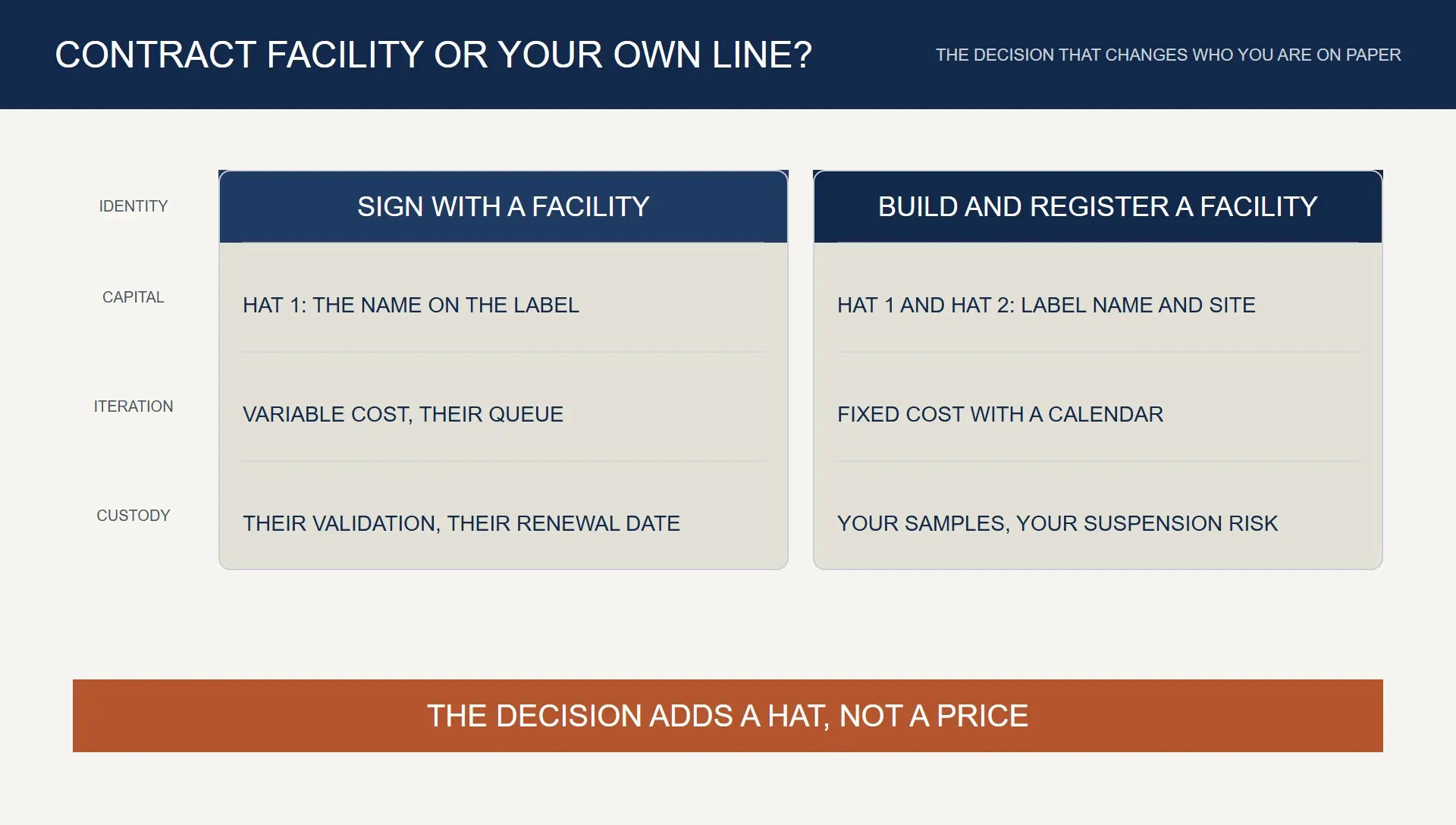
The four ownership lines that determine whether you actually hold an asset - the formula itself, the name it is registered under, the scope of any exclusivity, and custody of the compliance file - are set out in the private-label versus white-label guide, and the model choice behind them is on the site as a comparison page for private label versus OEM versus ODM. What is added here is the venue question, which those pieces do not ask, because it belongs to the location decision rather than to the mode decision.
Three things decide how far your ownership reaches, and a buyer can test all three before signing anything.
Which law the agreement is written under. A manufacturing agreement governed by a law you have no practical access to is, in the ordinary case, a document you hope never to use. This is not a statement about any country's legal system; it is a statement about your own cost of litigating in it, which is a number every small brand has and almost none writes down.
Where a dispute would be heard, and whether that seat can reach the thing you care about. For a cosmetics brand the thing you usually care about is not damages. It is stopping somebody from continuing to use your specification, or getting your retained samples and your file back so you can move production. Interim relief - the ability to stop something quickly - is what makes ownership real, and its availability is a function of the venue you chose, not of how clearly the contract says the formula is yours.
Who physically holds the evidence that the formula is yours. Retained samples, the master batch record, the stability files, the first-off photographs: custody of these is what turns a contract claim into a provable one, and in a cross-border arrangement custody often sits with the party you would be arguing against. Where the relationship has been a genuine co-development rather than a specification handover, the question gets harder and better documented practice exists - the site's look at co-development between brands and factories covers what that collaboration is changing about who owns what, and it is a more useful read than any generalisation about countries.
One further clarification belongs here because it is often used to imply a ranking that the text does not support. On the European side, the regulation's own route to presuming good-manufacturing-practice compliance runs through standards, not through national origin: Article 8(2) of Regulation 1223/2009 provides that compliance is presumed where manufacture accords with the relevant harmonised standards whose references have been published. A certification that follows a standard can be issued to a plant anywhere; a plant's passport is not the certificate. (What those certifications do and do not attest is a separate question, and a good one.)
The practical asks are short and belong in the same first email as the price request: state the governing law and the dispute seat in your agreement and confirm you have read them; specify who holds retained samples and for how long; specify that the compliance file and the master formula record are yours to receive or to copy on demand and within a stated number of days; and specify what happens to your specification if the relationship ends, including whether the plant may use it for anyone else. Four sentences. They are the cheapest asset protection available in any origin, and they cost nothing in every country.
What Each Shortlist Label Is Quietly Assuming
Four labels dominate this search, and each one smuggles in a set of assumptions that the label itself never states. Naming the assumptions is more useful than comparing the countries, because assumptions can be checked in an email while countries can only be visited.
| The label you type | What it quietly assumes | The first written question it should trigger |
|---|---|---|
| A plant in the United States | Your market, your file-holder and your goods are in one jurisdiction, so the accountable person and the factory can be the same entity | Who will be named as responsible person on my label - the plant, me, or a third party, and who holds the registration record? |
| A plant in the United Kingdom | One regime now covers the sale, which is rarely the whole truth once the same SKU also goes to the Continent | Which market does this batch satisfy, and what document accompanies the goods to prove it? |
| A plant in the European Union | Proximity to the shelf plus an in-Community file address equals compliance, without asking whose address is on it | Where does the product information file physically sit, who releases it, and within how many days of a regulator's request? |
| A plant in China | A dense local component ecosystem makes small runs easy, which is often true - and sometimes the reverse for a non-standard closure | Which line of my five-line stack is highest at your site, and how much of it is somebody else's minimum? |
Notice that every one of those questions is answerable without visiting, and that none of them is a question about a country. They are questions about a role (who signs), an address (where the file is), an ecosystem (what is nearby), and a calendar (how fast and how many rounds). This is the sense in which origin is a defaults package rather than a verdict: choosing the location accepts a starting configuration, and a competent buyer then negotiates the specific fields they can still move.
It is worth stating plainly what none of these labels implies, because supplier conversations do imply it in both directions. A US plant is not thereby more reliable; it is nearer your regulator and possibly nearer your own legal venue, which are different things with different prices. An EU plant is not thereby more compliant; it is inside the jurisdiction whose file rules are quoted above, which is an advantage only if the file address is yours to reach. A UK plant is not thereby bilingual in regulation; the desk count went up rather than down, and the sequence across desks is worked through in the four-market map referenced earlier. A Chinese plant is not thereby cheap and risky in the same breath; it is usually a shorter component supply ring and a longer calendar and freight line, and every one of those is measurable before you commit anything.
And if the market you are actually entering is not American or European at all, the origin question changes shape again, because in several Asian and Middle Eastern regimes the binding constraint is not the paperwork but who is legally permitted to hold the registration number - a local entity, in their own name, sometimes per product. That is a different conversation with its own evidence, and it is documented here in the Malaysia and South-East Asia access guide and in the Halal OEM buyer's guide.
Six Ways an Origin Decision Goes Wrong
None of the failures below is exotic, and all of them are visible before you pay, which is the only comfortable thing about them.
| Failure | What it looks like while you are still choosing | The written ask that prevents it |
|---|---|---|
| Treating a filing number as a credential | A deck built on a government seal, and no named person or address anywhere in it | Ask for the number, the legal entity it belongs to, the status and the renewal date - and note who hesitates |
| Assuming a nearby file equals a reachable file | "We handle all the EU paperwork" with no statement of whose address is on the notification | Ask where the file sits, in whose name, and how many days it takes them to hand you a copy |
| Comparing one number instead of five lines | The lowest unit price in the pile, with tooling, expedite and retention costs described as "standard, included" | Ask for the quotation split into development, batch, freight, duty-and-representation and rework/file lines |
| Carrying a file built for one market into another | A beautiful dossier assembled to one jurisdiction's shape, presented as universal | Ask which desk each document answers to, and who holds the number there |
| Believing a low minimum is generosity | A headline minimum with no component, decor or carton numbers alongside it | Ask which line of the stack sets it and what the chosen closure's own minimum run is |
| Signing ownership with no venue | Excellent clauses on formula ownership, and no governing law, seat, or sample-custody terms | Four sentences: law, seat, retained-sample custody, and what happens to your specification on exit |
The common structure is worth naming, because it is the actual lesson of this piece. In every row, the buyer's error was not ignorance of the country; it was accepting a default that nobody had told them had been set. Registration was defaulted to mean endorsement. Proximity was defaulted to mean access. A price was defaulted to mean cost. A dossier was defaulted to mean permission. A minimum was defaulted to mean a favour. A contract was defaulted to mean enforceability. Six defaults, six rows, and none of them required a factory visit or a translation to uncover - they required writing a question down.
That is also the argument for running the comparison as a procedure rather than a preference. The same three documents sent to three plants on three continents produce three answers that can be read side by side; a single plant visited with an open mind produces a good impression and an invoice. The procedure is next.
A Procedure, Not a Preference: Three Documents to Three Origins
The comparison that produces a real answer costs one afternoon and no travel. Send the same three documents to three candidate plants - ideally one near your own market, one in a dense component cluster, and one you were told to avoid for reasons nobody wrote down - and read the replies side by side.
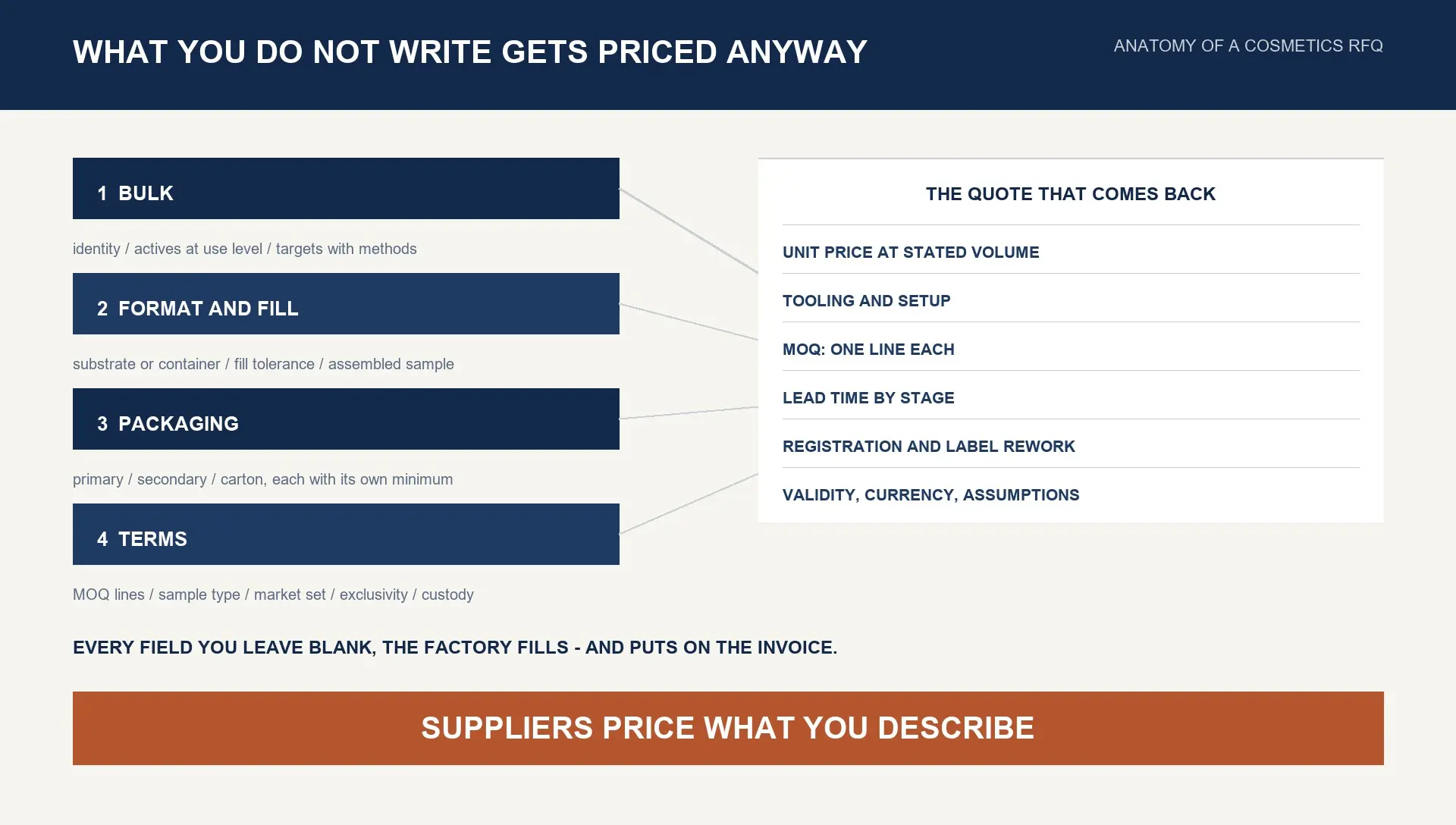
Document one: the specification sheet you fill in, not the one you describe. One page, with the fields already labelled so that answers arrive comparable: format and viscosity target; closure and component list, with alternatives ranked; active and concentration, or the statement that you are taking a standard formula; the claim pillar you intend to make, in plain words; the list of markets in the order you will enter them; the launch window as a date range; and the batch size you actually intend to order, not the one you hope is possible. A buyer who sends this gets comparable quotations. A buyer who sends a paragraph gets three different products priced against three different assumptions.
Document two: the role question, asked in writing. Who will be named as the responsible person on my label in each market; which legal entity holds the facility registration or notification; who will be the importer of record for the Community side if the goods are made outside it; and which of those roles, if any, is available to be taken by my company rather than by the plant. The first-hand reason these roles exist is in section two; the reason they must be answered in writing is that a verbal answer here is worth nothing in a filing six months later.
Document three: the evidence list you expect with the first commercial batch. Certificate of analysis for the batch, with the marker or assay values named rather than the word "conforms"; retained-sample policy stating who holds them and for how long; a commitment that a copy of the compliance file can be handed over within a stated number of days; component and decor minimum runs for the specific items you chose; and, for American sales, the registration status and renewal date the facility holds on its own record. Ask for these as deliverables attached to the order, not as assurances about the relationship. Two of the three documents can be scored without a factory trip if you know what to look at: the twelve-point factory verification checklist turns document three into a pass or a fail per item, and if the SKU in question is a mask format, the sheet-mask buying guide lists the fields that stop changing once the origin is settled - which is a fast way to see how much of your question was really about origin at all.
Score the replies on the six defaults from this article - file holder and address, clock, cost shape, stack line, enforcement reach, paperwork origin - and only then read the prices. Two things usually happen. The plant that was cheapest per unit moves up in effective cost once its freight reserve and its rework-and-file line are written down. And one of the three will answer document two in a way you did not expect, which is the cheapest structural information you will get from the entire exercise.
What can and cannot be moved afterwards is the summary of the whole topic, and it is worth putting as a short list rather than a diagram. Movable by paper, before signing: governing law and dispute seat, sample custody and file-release terms, exclusivity scope, component specification, batch size, who holds the registration. Movable by paper, but slowly and expensively, after launch: the responsible person named on a filed product, and with it the address where the file sits - a re-designation is a legal act, then a reprint, then a question about stock already shipped. Not movable by anything except time: the distance between the plant and your shelf, the density of the component ring around it, and the working hours you share with it. A buyer who reads an origin decision as one of those three lists, rather than as a nationality, is making the decision on facts.
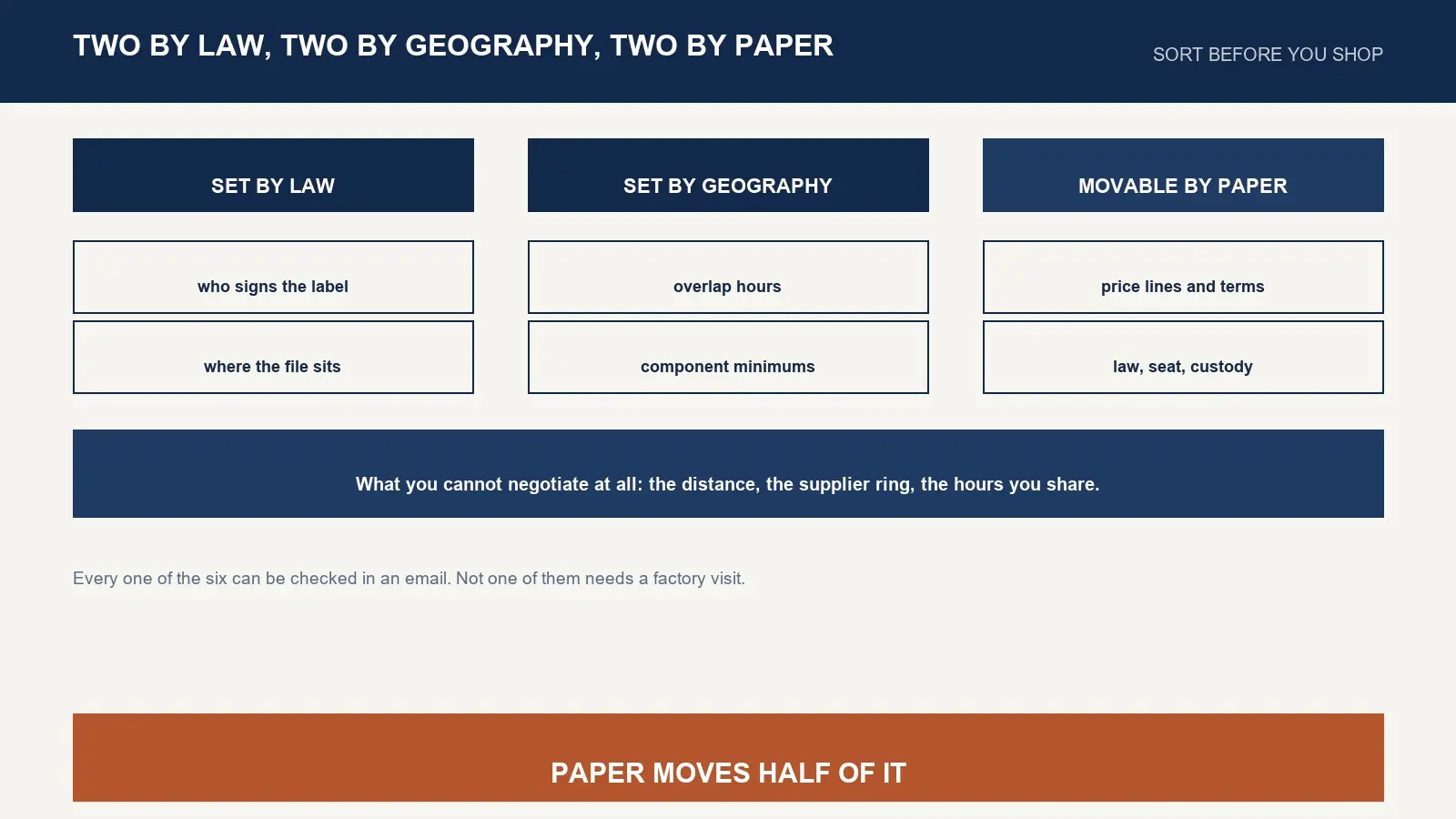
Before you compare prices, sort the six defaults into law, ecosystem and paper - the third list is the only one you can still change for free.
FAQ - Six Questions Buyers Ask Before Choosing an Origin
Q1. Is a cosmetic manufacturer usa shortlist inherently safer than an overseas one? No, and the word "safer" is hiding three different things. A domestic plant is nearer your regulator, which shortens an inspection conversation. It may be nearer your own legal venue, which changes what you can realistically enforce. And its address may coincide with the address on your filing, which changes who can reach the product file. Those are three separate advantages with three separate prices, and none of them is a statement about the quality of the goods made anywhere else. The site's own four-market map covers the filing side, and this piece deliberately does not restate it.
Q2. What is the one question I am probably not asking? Ask who will be named on the paperwork in each market, and at which address the file will sit. Not "are you compliant" - every supplier says yes and the term has no legal content. Ask for the entity name, the role, and the number of days it takes them to hand you a copy of what you are relying on. And if the question underneath your question is which manufacturer to shortlist for a specific active in the first place, the exosome serum manufacturer guide works that selection through on the product side.
Q3. Can a lower unit price from a distant plant genuinely cost more in the end? It routinely does, and the mechanism is a shape problem rather than a dishonesty problem. A distant plant usually transfers part of the cost into freight, into a lead-time reserve, and most of all into the rework-and-file line: the longer it takes to reproduce a batch, to get a retained sample measured, or to move a file to another responsible person, the more each disagreement costs you. Write those five lines down before comparing the second one.
Q4. If I choose wrong, what can I still change later? Split the defaults into three lists. Governing law, dispute seat, sample custody and file-release terms, exclusivity scope, batch size and component specification can all be fixed by paper now. The named responsible person and the file's address can be changed later, but as a legal act plus a label reprint plus a conversation about stock already shipped - slow and not cheap. Physical distance, the density of the component ring and the overlap of working hours cannot be negotiated at all; they are time and money or they are not.
Q5. We plan to sell in the European Union but the plant would be outside it. Does that create anything we have to buy? It creates roles, which someone has to occupy and which cost something to occupy properly. The EU regime requires a person designated within the Community to be responsible for the product before it is placed on the market, defines an importer as a person established within the Community bringing a product in from a third country, and expects the product information file to be readily accessible at one single address inside the Community. None of those can be satisfied by a promise from a factory outside them. The practical arrangements for doing this correctly are covered in the EU compliance guide for importers.
Q6. Does any of this change if the formula already exists and I am only relabelling? It changes the clock and the ownership questions a great deal, and the file questions not at all. A white-label relabel needs almost no synchronous revision rounds, so overlap hours stop being a cost driver and the shortest calendar usually wins. Ownership is also less exposed, because you are not buying an asset, you are buying access to somebody else's - which is exactly the distinction made in the private-label versus white-label guide. What does not soften is the address question: whoever is designated remains the person a regulator can reach, whoever printed the label.
Sources and Further Reading
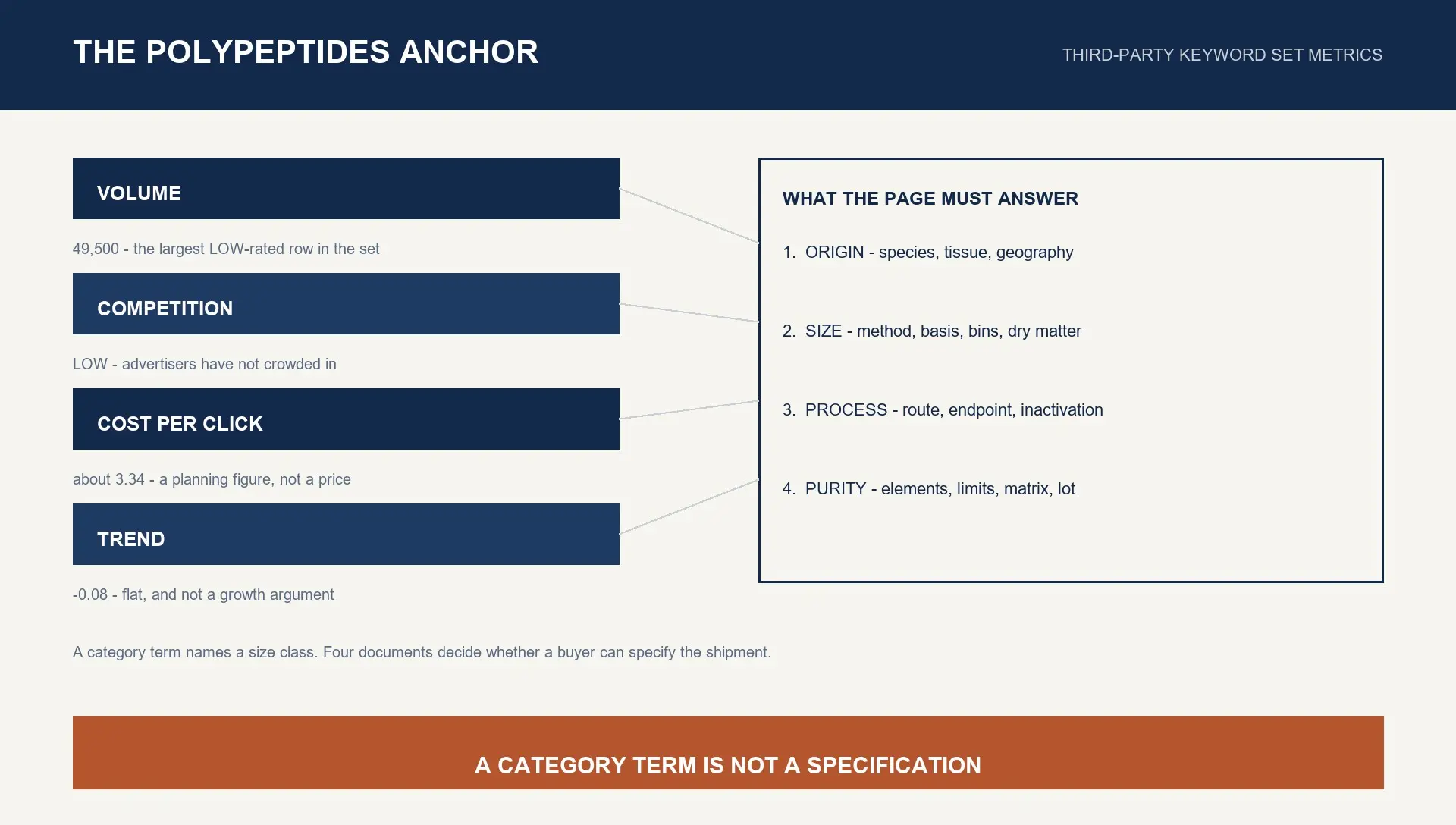
- U.S. Food and Drug Administration - Registration and Listing of Cosmetic Product Facilities and Products (agency page, "What's New" entry dated 9 September 2026, retrieved 23 October 2026). Source for: the agency not providing certificates or other documents to verify compliance for facility registration; the statement that registration and listing is neither an approval program nor a promotional tool; that a registration or listing number does not indicate FDA approval of the facility or its products; the two-year renewal obligation and the FEI as the required facility registration number; the small-business exemption and its four product carve-outs; and the two fields added to Cosmetics Direct in February 2026 (registration status and renewal date). The obligation of the responsible person to list products and update annually is also from this page, and its consequences for make-or-buy decisions are developed elsewhere on this site rather than here. - Regulation (EC) No 1223/2009 of the European Parliament and of the Council on cosmetic products, OJ L 342, 22.12.2009 (consolidated text retrieved 21 October 2026 and re-checked 23 October 2026; the local archive holds the full text). Quoted provisions: Article 4(1) on a person designated within the Community as responsible person; Article 2(1)(i) on the definition of importer; Recital (17) on the product information file being readily accessible at one single address within the Community; Article 5(1) on the enumerated obligations of the responsible person; Article 8(1) and 8(2) on good manufacturing practice and the presumption through harmonised standards; Article 11(1) on keeping the file for ten years after the last unit is placed on the market; Article 13(1)(b), (c) and (d) on the notification content including the country of origin in the case of import; Article 17 on one Member State's authority being able to ask the authority where the file is held; and Article 19(1)(a) on the label address to be highlighted and the country of origin to be specified for imported products. - Timezone overlap figures are this article's own arithmetic on published standard-time UTC offsets against a conventional 09:00-18:00 working day, and are labelled as such in the text. Daylight saving shifts them; no productivity, response-time or satisfaction survey was used, cited or implied. - Keyword metrics: deliberately none. The four terms framing this piece belong to a service-head-word family for which no verifiable local metric row exists in the archive, so no search volume, cost-per-click, competition or trend figure is quoted anywhere in this article. - Not used: no market size, growth rate or share figure; no per-unit price or percentage; no country-level wage, freight or tariff rate (the tariff arithmetic is left entirely to the dedicated piece linked above); no supplier, factory or retail brand name; no therapeutic or protective claim language.
What to do next
Send the three documents before you ask for a price, and we will answer them - in writing - for this facility.
If you are evaluating where your serum, cream, mask or eye-patch format should be made, put the specification sheet, the role question and the first-batch evidence list in one email and tell us which markets you are entering in what order. You will get back the six defaults for this site stated as facts: who is designated as responsible person and at what address the product information file is held, the working-hours window we can staff for your market, the quotation split into the five cost lines rather than presented as one number, which line of your batch stack is highest here and whose minimum it is, what the agreement says about retained samples and file release, and what your paperwork will state about country of origin.
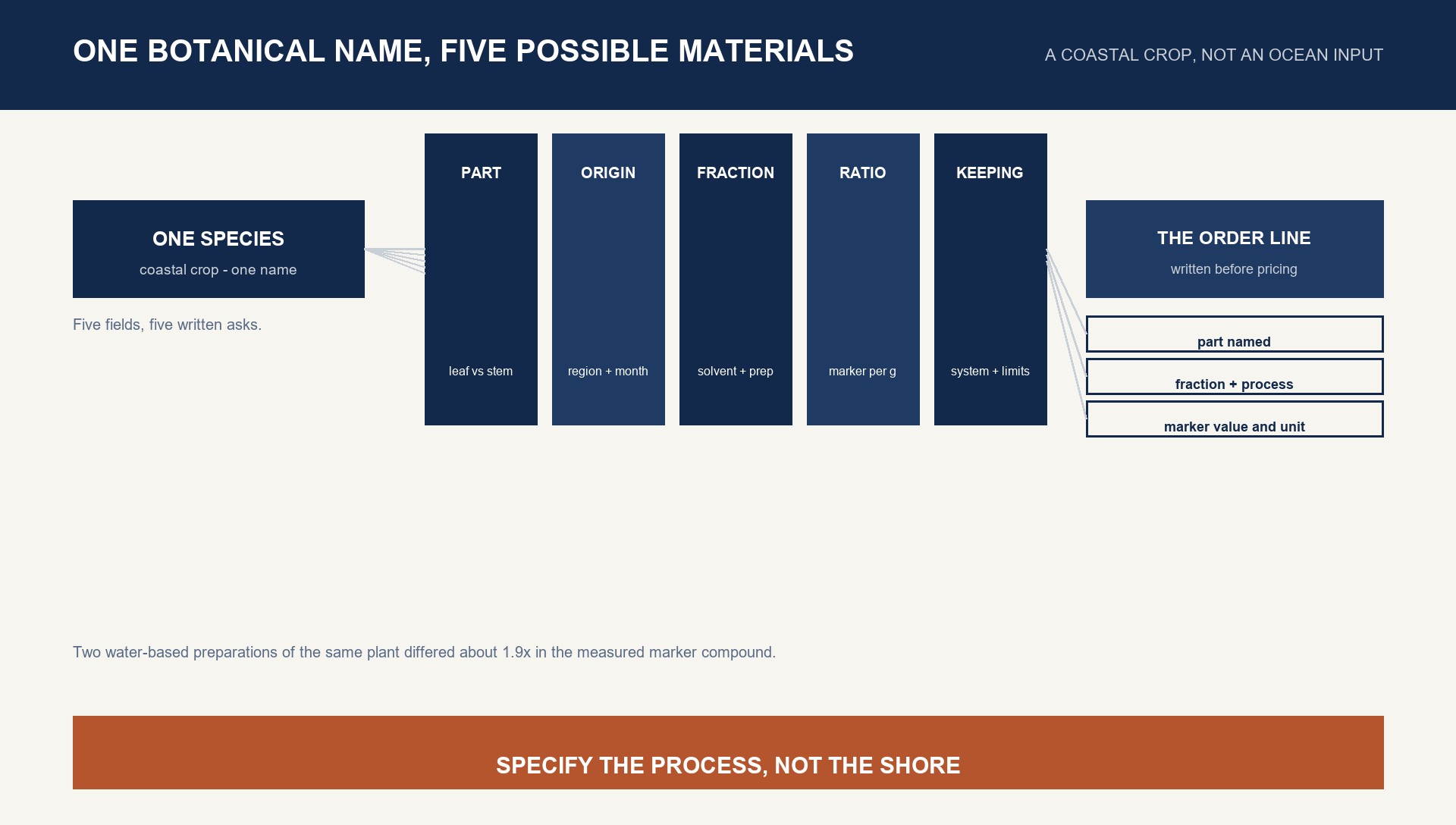
A dedicated product manager handles every origin and sourcing enquiry of this kind, with a reply within 24 hours, a standard sample route in 7 days, and MOQ from 1,000 pcs depending on format, closure and packaging. Request your quote and MOQ table here - and if you are also specifying the botanical side of the formula, the five fields that make an ingredient re-orderable are set out in the coastal botanical specification guide, so the two halves of your origin question can be answered in one conversation.