
Sea Fennel Extract: Five Specification Fields Before the First PO
What a Sea Fennel Enquiry Actually Buys
The enquiry usually fits in three lines. A brand has a serum doing well, the founder has been reading about coastal botanics, and the message asks whether we can supply sea fennel extract in a private-label formula, what the minimum is, and what it costs. Read literally, the question is about a price. It is not. What is actually being purchased is a specification that nobody has written down yet, and the price quoted to a blank specification is a guess.
Start with the part that makes buyers comfortable: the ingredient is real, it is a plant, and it is well studied. Crithmum maritimum is the species, and a 2023 study in the journal Antioxidants describes it in its own opening line as a facultative halophyte - a plant that tolerates salt - used as food in salads, soups and sauces and steeped into aqueous extracts (PMID 36829810). That sentence does more commercial work than any coastal photograph, because it fixes what category of raw material you are buying. It is an agricultural one.
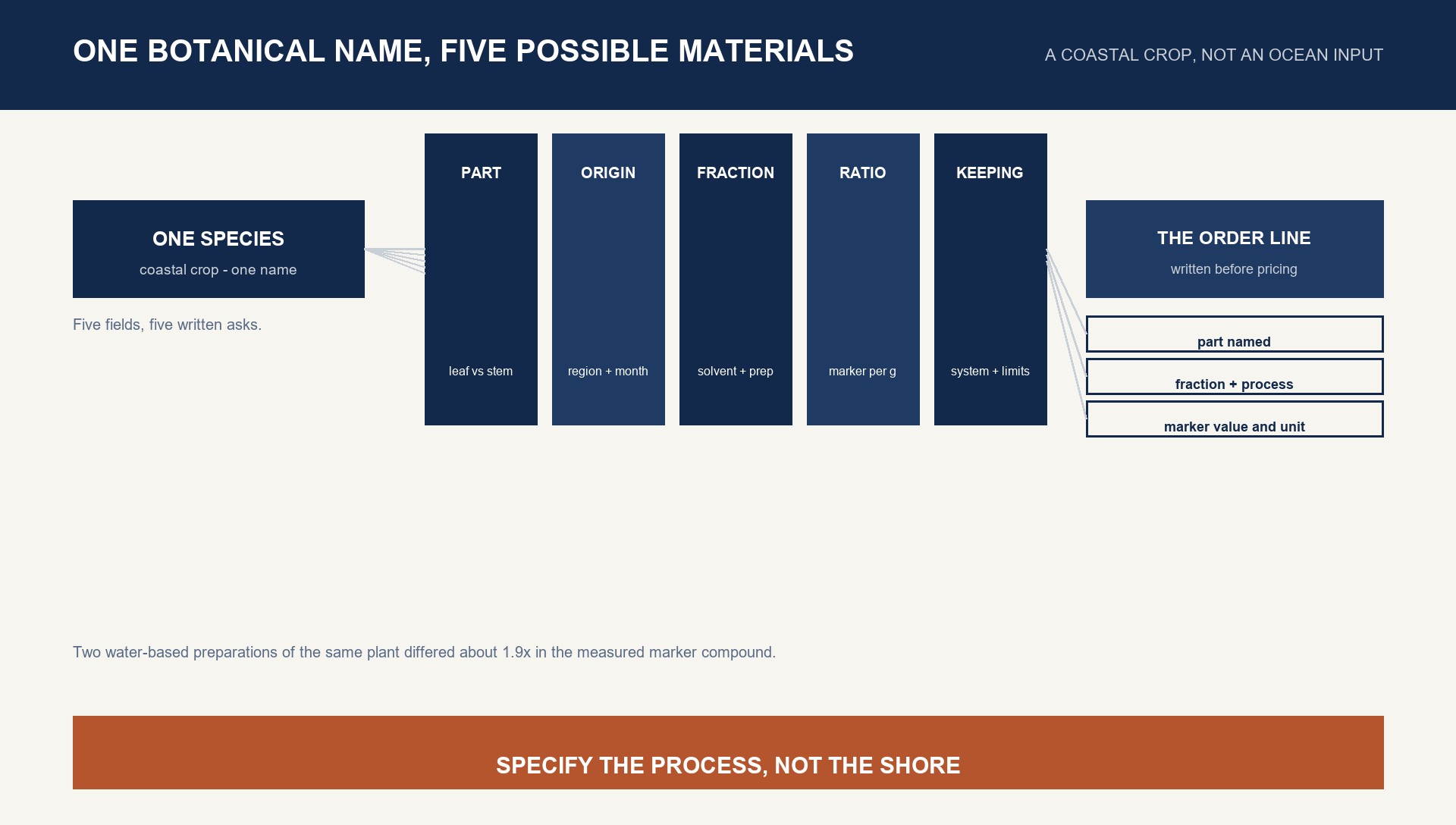
Which is precisely where most offers quietly fall apart. Two suppliers can both hand you a document that says the same Latin name and deliver materials that are not the same thing - different plant part, different coastline, different season, different extraction, different concentration, different preservation. This piece is the map of the five fields that decide which one you receive, in the order a buyer has to ask them.
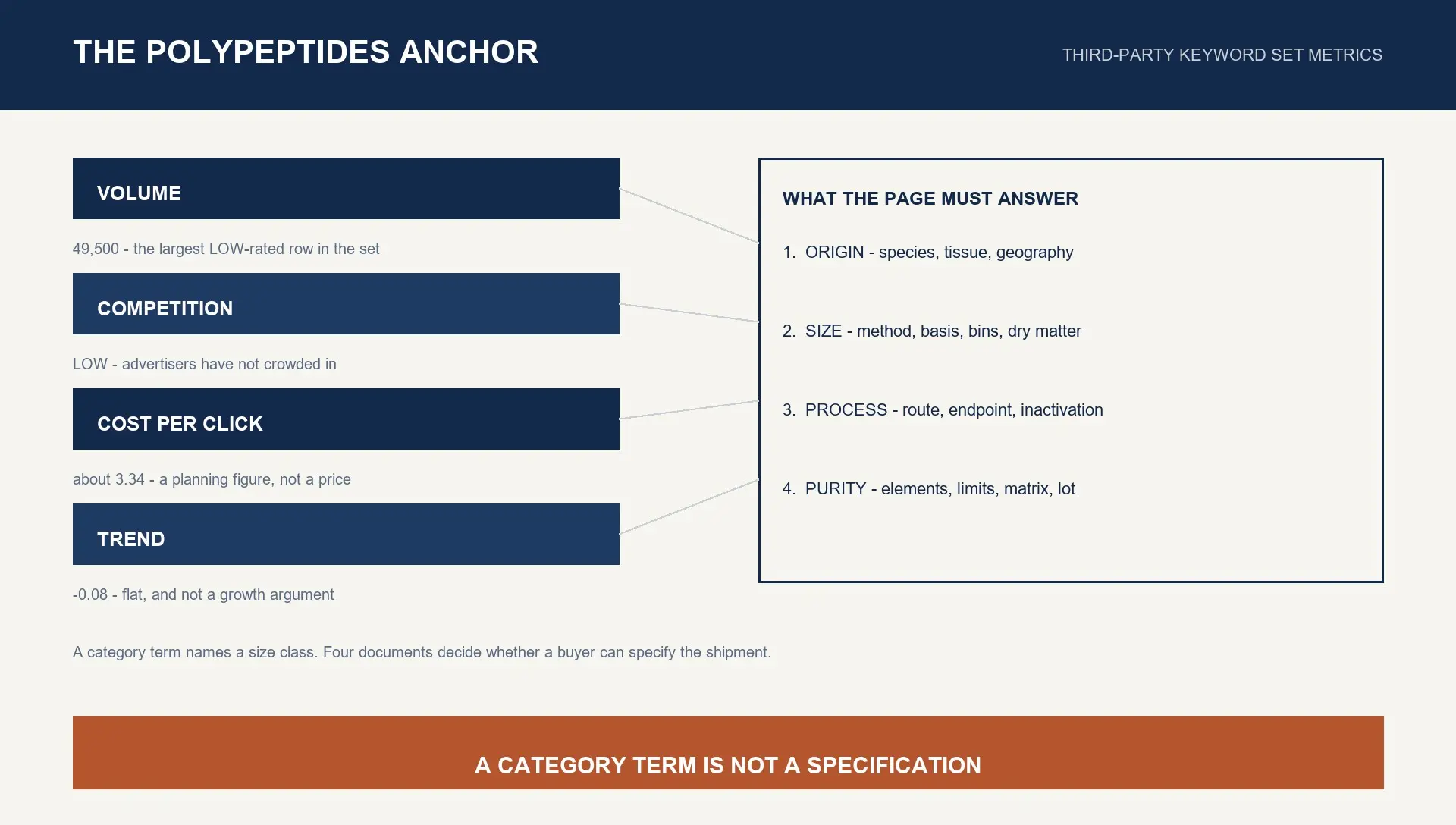
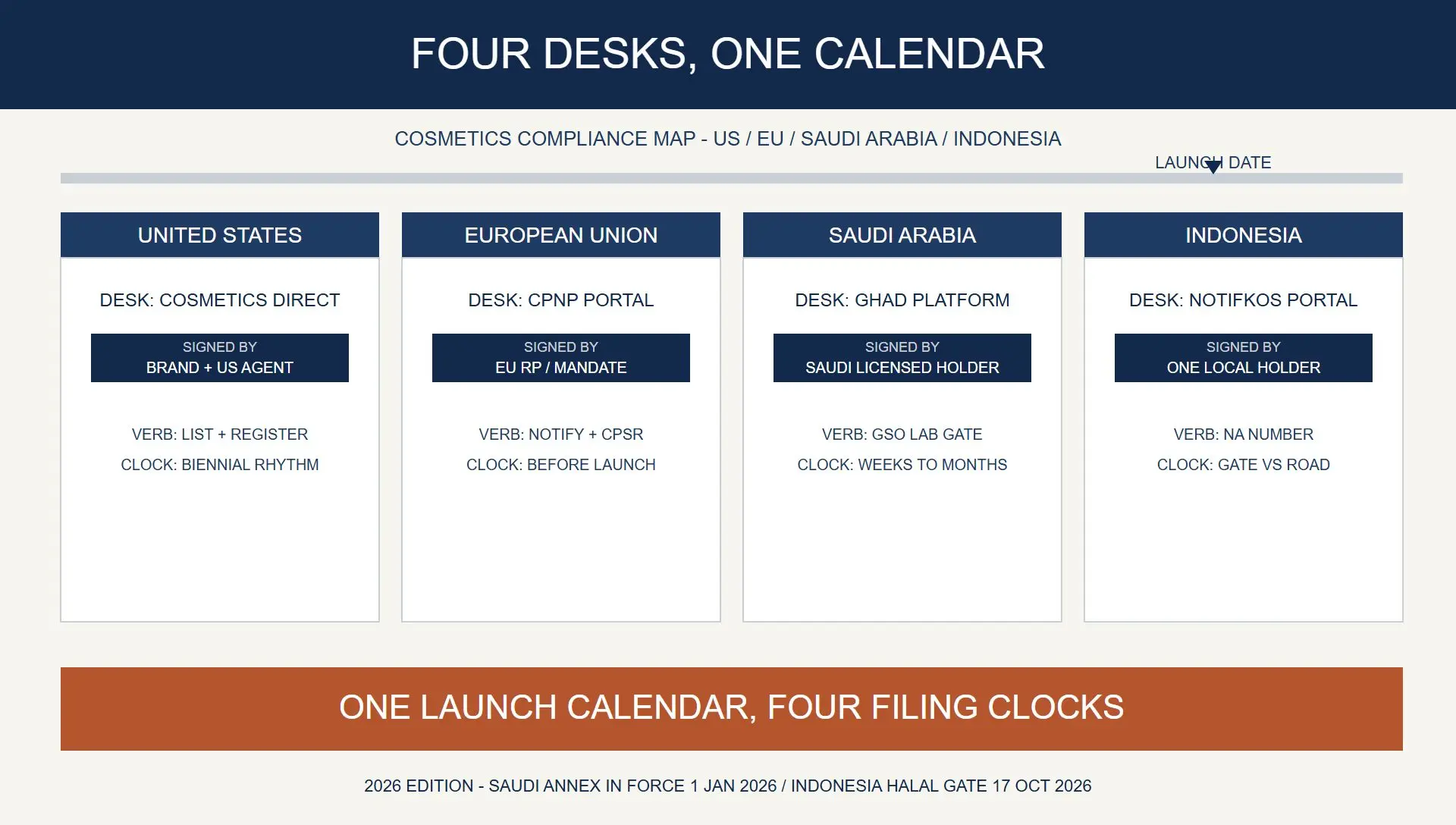
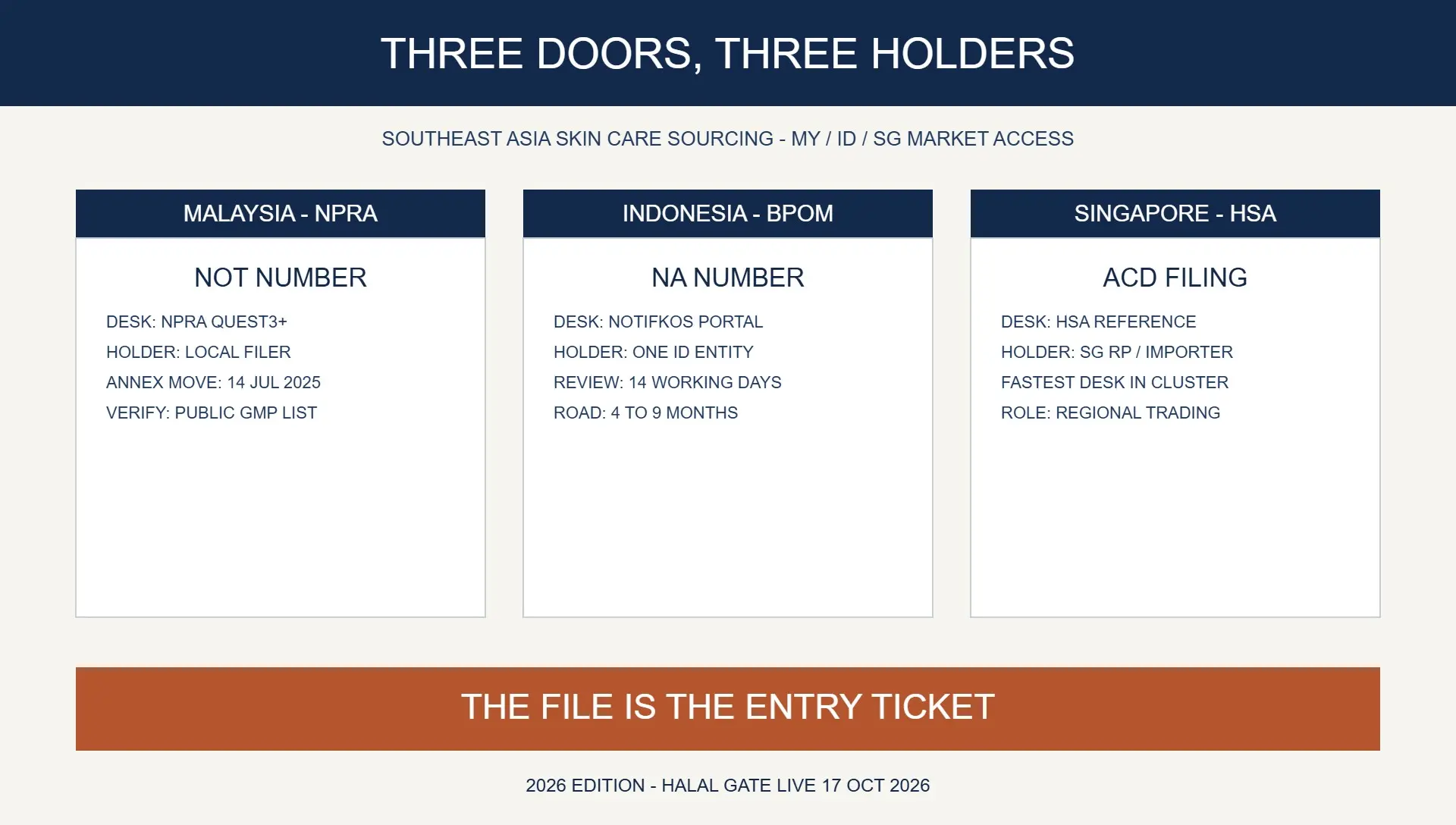
It deliberately does not answer four questions this site has already answered elsewhere. Whether the botanical sits in a marine story or a terrestrial one is not a supply-side premium argument - the ocean-origin framing has been written to death and it explains nothing about your batch. Whether a category-level word can carry a specification page is worked through in the category anchor piece; why the numbers inside an ingredient name are purchasing instructions is in the tripeptide specification sheet; which fields belong on the enquiry document for the finished product is in the RFQ field anatomy guide; and who signs for the file is in the EU compliance guide. What is answered here sits one layer below all four: the component itself, before it becomes anybody's formula.
A botanical is bought as a process, not as a place - and a supplier who can state the process unprompted is selling something you can actually re-order.
Crithmum Maritimum Is a Coastal Crop, Not a Marine Ingredient
Positioning language matters commercially because it silently decides which questions are legitimate. Call this material a marine ingredient and the conversation drifts toward origin mythology: pristine shores, rarity, the ocean's richness. Call it what the literature calls it and the conversation becomes a set of questions any crop buyer would recognise: which part of the plant, grown or gathered where, taken in which month, dried how, extracted with what, concentrated to what, and kept stable how.
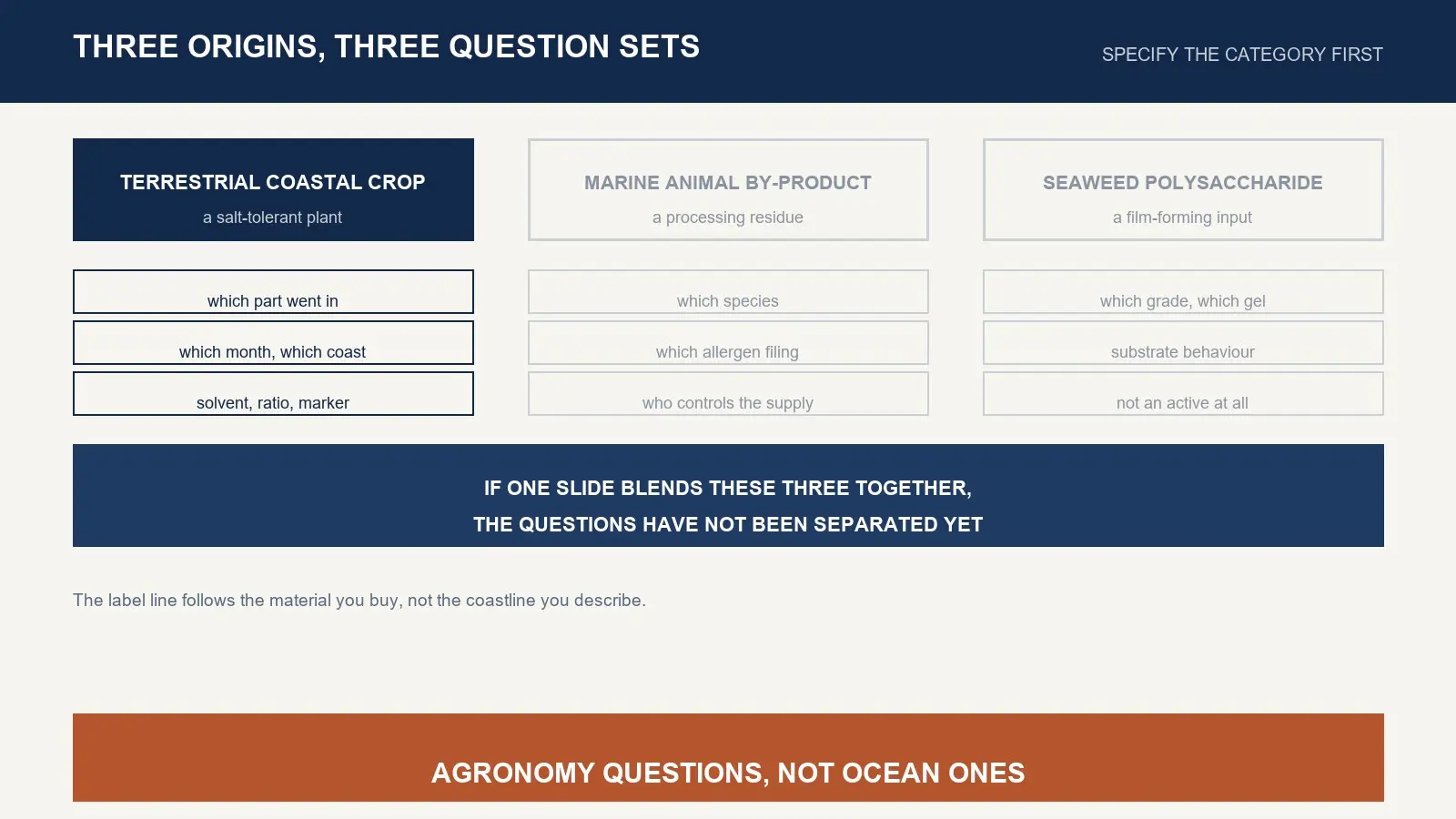
The species belongs to the carrot and celery family, Apiaceae, and it is a coastal plant rather than a sea organism - it grows on cliffs and salt-exposed ground, not in the water. Crithmum maritimum is the binomial you will see in the literature and, in some form, on a label; the practical consequence is that its chemistry is farming and processing, not harvesting the ocean. Two neighbouring pieces on this site answer the other two origins, and neither of them answers this one: the salmon-DNA sourcing guide works through a marine animal by-product - species declaration, the economics of a fish-processing residue, and an allergen-filing question that only protein sources raise; the chondrus crispus piece works through a seaweed polysaccharide used as a film-forming substrate, which is material science for a mask base. If your supplier's deck blends these three origins into one "ocean actives" slide, that is not a cosmetic insight. It is a signal that nobody has told them the questions are different.
One family-specific question belongs here, and it belongs in the form of an ask rather than an assertion. Botanicals in this plant family are the ones safety assessors most often probe on phototoxicity-relevant constituents. This piece makes no claim about what this particular species does or does not contain. What it does say is that if you are putting a coastal Apiaceae material into a leave-on product, the written question to your supplier and your safety assessor is simple: is there a documented constituent profile for the material you actually ship, and will you attach it. A supplier who has that profile answers in a day. A supplier who has never been asked answers with a brochure.
There is a second reason the crop framing pays. Because the plant is eaten and has been studied as a crop, there is an agricultural literature about growing it and about biomass production in Mediterranean conditions, which means supply can be cultivated rather than collected. That difference is not a sustainability talking point. It is a lead-time difference, and it is one of the five fields.
Why the Halophyte Frame Is a Chemistry Statement, Not a Brand Story
The commercial hook of a salt-tolerant plant is usually stated like this: plants under salt stress and strong light build defensive chemistry, and that chemistry is what formulators are buying. The mechanism-level version of that sentence is defensible, and the measurements exist. The 2023 study separated the aqueous extract's phenolic content by HPLC-PDA and found chlorogenic acid as the major phenolic compound, with the remaining identified peaks described as caffeic or ferulic acid derivatives and one p-coumaric acid derivative (PMID 36829810). Those are phenolic compounds of the class that plant stress physiology discusses. The story has a referent.
But the same sentence that gives the story its substance also destroys the story as a specification, and this is the pivot the whole piece turns on. Defensive chemistry is a response to conditions. Salt load, sunlight, substrate, population, harvest month, drying and extraction are inputs. Two fields of the same species, harvested a season apart on different coasts, are not one material - which is why researchers treat populations, ecotypes and plant parts as independent variables in the first place: a 2024 paper in Food Chemistry X characterised phytochemistry across multiple Croatian populations (PMID 38681233), a 2024 paper in Foods compared French and Croatian ecotypes and reported on both the oils and the hydrolates (PMID 38472808), and a 2024 paper in Plants measured essential-oil content, composition and radical-scavenging activity separately by plant part in wild material from Montenegro (PMID 39065529). The literature is not selling you a coastline. It is telling you that the variables are real and measurable.
Note also how a plant's own composition gets misread as a purity claim. The same study reports crude fibre at 34.3 ± 1.92% and mineral content at 23.6 ± 4.8% for the plant material. Those are whole-plant nutritional figures, not extract specifications, and a deck that puts them beside the word "purity" is mixing calibres on purpose. A mineral-ash number tells a formulator about the dried herb; it tells a purchaser nothing about a concentrated extract's marker load.
Then there is the claim side, which needs one honest sentence and no more here, because the site has already mapped claim boundaries in the gold evidence-tiering piece and in the bee-venom file-chain piece. Antioxidant wording is the widely studied and defensible side of this literature; the assay systems that produce those numbers are test-tube systems, and the sentence that reads as protection from something is a different regulatory conversation. On the "natural" and "coastal" positioning itself, the binding constraint is now the green-claims regulation rather than the ingredient story, and that is covered in the ECGT piece.
The stress-chemistry sentence is a reason to specify, not a reason to price.
Field One - Plant Part: Leaf, Stem and Flower Are Not One Material
Every botanical purchase starts from one physical question: which organ of the plant went into the drum. It is the cheapest field to specify and the easiest to leave blank, because the word "herb" is accepted as an answer and "aerial parts" is accepted as a specification. Neither is.
The reason this field is real is that the research studies it as an independent variable. A 2024 study in the journal Plants measured the essential-oil content, the composition and the free-radical-scavenging activity of wild material separated by plant part (PMID 39065529). Nobody designs an experiment like that unless the parts behave differently. The same logic applies to the phenolic fraction that formulators actually care about in an aqueous extract: the compounds identified in this species - chlorogenic acid as the major peak, with caffeic and ferulic acid derivatives around it (PMID 36829810) - are not distributed evenly through leaf, stem, flower and seed. Leaf tissue carries the metabolic load; stem is structural tissue that absorbs solvent and adds mass.
That is where the money hides. A quoted price is always per kilogram of material, and a buyer paying per kilogram of material containing forty percent stem is paying a lower price for a lower dose. The comparison that matters is cost per unit of the marker compound you intend to substantiate your claim with, and you cannot compute it without the part designation. This is the same arithmetic the site applies to fill volume in mask formats: the number on the invoice is never the number in the formula.
There is a second, subtler consequence for re-ordering. If your first trial batch was leaf and your second shipment is a whole-herb cut, your formula's colour, odour, viscosity and antioxidant assay can all shift while your INCI line stays identical. Retail buyers describe that as inconsistency; the supply chain describes it as an unspecified part.
Write it as two lines, not an adjective: part designation on the certificate of analysis, and the same designation reproduced in the botanical declaration attached to the safety file. Then set the acceptance rule you will actually enforce - if the material arrives as "aerial parts" against a purchase order that says leaf, that is a non-conformance, not a detail. Ask for the trial batch and its certificate to be from the same lot, which is a sample-policy question most suppliers find reasonable until they have to write it down.
What you refuse without it: a material whose marker load you cannot reproduce, priced in a unit that hides the difference.
Field Two - Harvest Geography, Season and the Wild-or-Cultivated Line
Harvest geography traceability is the second field, and it is really three questions stacked: which population or region, wild or cultivated, and which window inside the year. Each has a different commercial consequence, which is why they cannot collapse into one line reading "Mediterranean".
That the geography matters is again the literature's claim, not this piece's. A 2024 paper in Food Chemistry X set out to characterise phytochemistry across multiple Croatian populations of the species (PMID 38681233) - a study design whose entire point is that populations differ enough to be worth measuring. A second 2024 paper in Foods compared French and Croatian ecotypes, reporting on the volatile profiles and on the activity of both the oils and the hydrolates (PMID 38472808). If origin were cosmetic, those would be one paper with one sample pool.
The wild-versus-cultivated line is the one that surprises brand teams, because it is the least glamorous and the most load-bearing. This species has been studied as a crop: a 2018 review in Plants examined its prospects as an emerging vegetable crop (PMID 30373262), a 2023 review in Molecules positioned it as an emerging crop for innovative foods and nutraceuticals (PMID 37375298), and a 2022 study in Agronomy measured biomass production under Mediterranean conditions (DOI 10.3390/agronomy12040926). Cultivated supply exists. That is good news for a brand with a launch date and bad news for anybody who assumed the "hand-gathered cliff" line in the supplier deck described the actual procurement.
The reason to press it is delivery arithmetic, not ethics. A wild-collected material is constrained by season, weather and access, so its availability is a curve with a peak and a cliff. A cultivated material is constrained by a planting cycle and a harvest window, so its availability is a schedule you can plan against. Both can be honest. What breaks a launch is a supplier who has never distinguished them, because the failure arrives as a backorder in month nine.
Three written asks, and they should go in the same email as the price request: the region or population the material comes from; whether it is cultivated or collected, and if collected, on what authority; the harvest window, expressed as months, and the answer to one conditional question - what happens to this purchase order if the window closes while it is in production. Backorder, previous-year stock, a substitute region, or a different part? The fourth answer is the one that turns a specification into a rumour.
This piece makes no assertion about protected-geography regimes, certifications or quota systems for this crop, because those were not verified here and an unverified regulatory sentence is worse than no sentence. What it does assert is narrower and safer: the geographic statement must be one your safety assessor can read back off the paperwork you actually receive, and "coastal" is not a geography.
Field Three - Solvent and Preparation, Where the Literature Gets Concrete
Two words do most of the work in this field: extraction solvent and ratio. The reason to insist on them is that the strongest evidence in this whole literature is not about the plant at all - it is about what somebody did to the plant.
A 2023 study measured the phenolic composition and antioxidant activity of aqueous preparations of this species and reported the results separately for an infusion and a decoction (PMID 36829810). Same species. Same solvent, in the sense that both used water. Two preparation methods, differing in nothing more exotic than whether the plant material was steeped or boiled. The marker compound came back at 49.7 ± 0.8 mg per gram of infusion dry extract against 26.8 ± 0.9 mg per gram of decoction dry extract - roughly a factor of 1.9 apart, which is arithmetic on the published figures rather than a finding in itself.
It is worth reading the rest of that dataset before drawing the obvious conclusion, because the obvious conclusion is wrong in a way that would embarrass a brand. On the DPPH assay the two preparations returned IC50 values of 36.5 ± 1.4 and 44.7 ± 4.4 μg/mL; on ABTS, 37.3 ± 2.6 and 38.4 ± 1.8 μg/mL. The marker difference is large; the ABTS difference is almost nothing. So the study does not show that one preparation is uniformly stronger. It shows something more useful for a buyer: the preparations are not interchangeable, and a supplier who says "aqueous extract" has told you which solvent was involved and nothing about what you hold.
Widen the lens and the species resolves into at least five separable materials: an infusion-type aqueous extract, a decoction-type aqueous extract, an essential oil (the same 2023 study characterised it and reported monoterpene hydrocarbons, specifically gamma-terpinene and sabinene, as prominent), a hydrolate - the aqueous fraction left behind when oil is distilled, treated as its own material in a 2024 Foods paper (PMID 38472808) - and the non-volatile fraction, examined on its own in a 2024 Foods paper (PMID 38731664). There is also a 2023 Plants paper on the essential oils and the residual waste-waters of their isolation (PMID 36616340), which is the honest reminder that two of these five streams are industrial by-products rather than chosen ingredients. If what you actually want is the lipid route rather than the phenolic one, that is a different purchase entirely, worked through for emollient formats in the facial-oil sourcing guide.
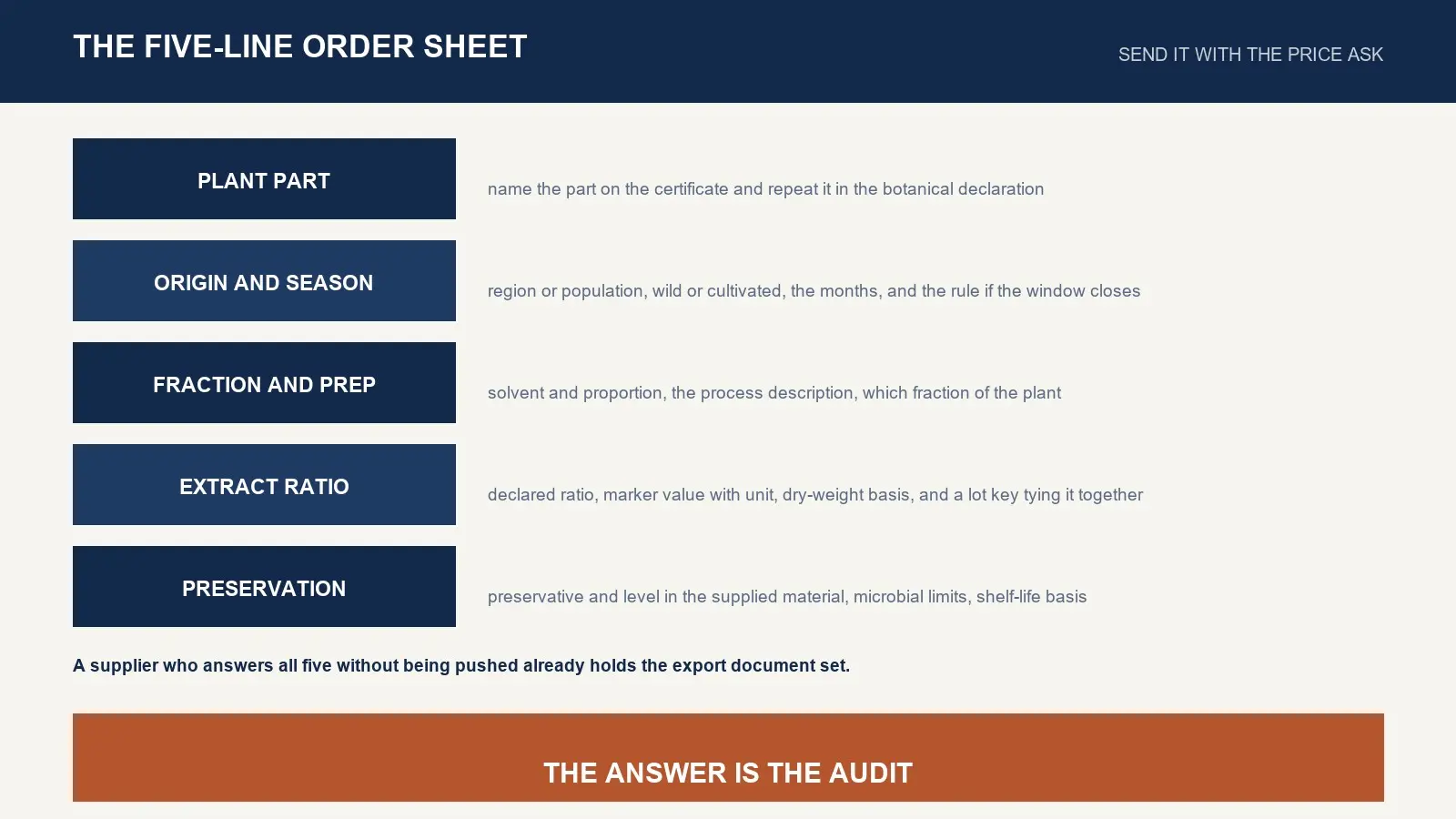
The ask therefore has four parts and none of them are technical to write down: which solvent and at what proportion; the preparation designation with its temperature and time, or the equivalent process description; which fraction of the plant you are buying; and one number for the marker compound on the certificate of analysis, with the HPLC profile attached rather than a photograph of green liquid. Nomenclature follows the material, not the other way round - settle whether you are buying an extract, an oil or an oil-and-water pair, and the label line and the safety-assessment line will sort themselves out. Do not let a supplier reverse that order, because a name chosen before the material is a marketing decision wearing a specification's clothes.
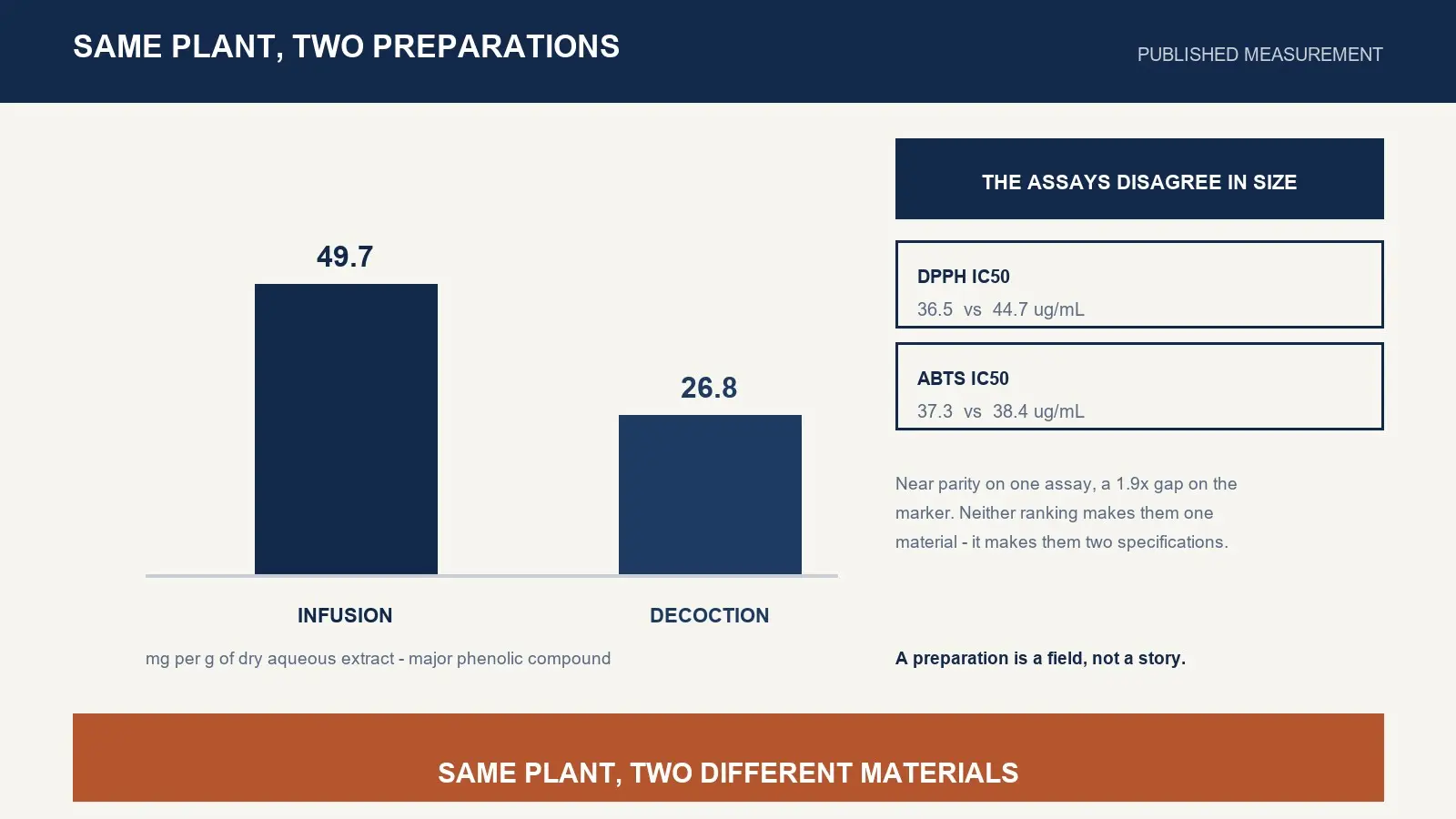
A preparation method is a specification; a coastline is not.
Field Four - Extract Ratio, and the Number That Makes It Honest
Ratio is the field that separates a specification from a description. The two-word ingredient name on the label tells a formulator what the raw material was called. The phrase "one to four" tells them how much plant went in and, by extension, how much of anything came out. Without it, two lots with identical paperwork can differ by an order of magnitude in strength, and the difference is invisible on the label line.
The mechanism is simple enough to state in one sentence and important enough to write into a purchase order. Extraction concentrates; the ratio states how much. A one-to-one extract and a ten-to-one extract made from the same dried material by the same solvent carry the same name, and the ten-to-one carries roughly ten times the soluble load, roughly ten times the colour, roughly ten times the odour, and roughly ten times the marker per gram. Formulated at the same percentage in the same base, those are not two versions of one ingredient; they are two formulations.
This is also where a supplier can dilute you politely. A ratio is a claim about input, and an unanchored claim about input degrades quietly: same price, same name, gradually less plant per kilogram of liquid, and nothing on the certificate of analysis to notice it against. The counter is not suspicion, it is a second number. If the only field is ratio, you are buying a process description. If the certificate also carries a marker compound with a figure and a unit, you are buying something you can reject.
The literature happens to supply the template for that second number, because it reports exactly this style of figure for the species: chlorogenic acid quantified per gram of dry extract, with the two aqueous preparations landing at 49.7 and 26.8 mg per gram respectively (PMID 36829810). That is a receiving specification in all but name - a compound, a unit, a value, and a method that produced it. Ask for the same shape of line on the certificate of your trial batch and on every lot after it, with an acceptance band you wrote rather than one inherited.
The arithmetic consequence is worth spelling out once, because it moves the conversation from quality to cost without anybody naming a price. Formulating a botanical at two percent of a batch means the same thing at 1:1 and at 1:10 only if you do not care what is in the jar. If you do, the equivalent plant load behind that two percent differs by the ratio, and so does the preservation burden, the colour drift, the odour profile and the cost per unit of actives. A buyer who compares two supplier offers without normalising for ratio has compared the packaging.
A species name identifies an organism; only a ratio and a marker identify a shipment.
That distinction is the same one this site drew two layers up, at the category level and the structural level: the polypeptide category piece showed that a category word names a size class rather than a delivery, and the tripeptide specification sheet showed that the modifiers inside an ingredient name are purchasing instructions. A botanical sits in the same family of problems, with the aggravating detail that its variability is biological rather than synthetic.
Four written asks: the declared ratio; the marker compound with value and unit; solids or dry-weight basis so the two are comparable across lots; and a lot key that ties the certificate to the drum you received. Then one clause in the agreement: certificates are issued per lot, and re-order is against the accepted lot's band, not against the trial sample you fell in love with.
Field Five - Preservation, and the Irony of a Botanical Sold as a Preservative
Botanical extract preservation is the field buyers leave blank most often, and it is the one where a good ingredient becomes a bad complaint. The irony is real and documented. The same 2023 study that quantified the phenolic marker concluded that the aqueous extract and the essential oil support use as potential alternative preservative ingredients for feed, food, pharmaceutical and cosmetic industries, and reported the oil as particularly active against two food-contaminating bacteria, Bacillus cereus and Lactobacillus plantarum (PMID 36829810). You will find that sentence in supplier decks within a year, converted into a claim about products that keep themselves fresh.
Both halves of that sentence need keeping apart. What was measured was activity in an assay, against organisms that spoil food, under laboratory conditions. It was not a preserved-efficacy challenge test in a cosmetic base, and it said nothing about your formula's water phase, your pH, your packaging or your warehouse in July. The gap between those two statements is exactly the gap where a recall starts.
The other half is what people skip: the material you are buying is a preservation liability before it is anything else. A concentrated aqueous preparation of a plant is water plus plant matter plus minerals - the study measured mineral content at 23.6 ± 4.8 percent of the dried plant - which is a growth medium with a good vocabulary. A vendor who describes this ingredient as clean-label-preserving while shipping it as a water-based liquid has told you two incompatible things, and the second one is the physical reality.
So the fifth field is three asks and a conditional. What preservative, if any, is in the material you ship, at what level, and is it compatible with the system in my base? Compatibility is not a detail: a cationic preservative in a formula using an anionic thickener is a settled argument that has to be re-settled per system. What are the microbial limits on the certificate, per lot, with the method named? What is the stated shelf life of the concentrate as supplied, and on what evidence - accelerated, real-time, or a supplier's own document? And the conditional: if the answer is that the material is supplied frozen, dried, or unpreserved and used immediately, that is a cold-chain or a production-scheduling fact that will show up in your minimum order quantity and your lead time long before it shows up in your quality file.
Two more lines belong in the file rather than the spreadsheet. The first is that the finished product's challenge test is a finished-product question, worked through on this site in the vitamin-C stability programme guide; the second is that the ingredient's own composition, microbiological quality and stability data are fields a regulator already listed for the product information file, which is what the RFQ field anatomy guide exists to make mechanical. Neither is re-derived here. What is new here is narrower: a botanical that gets marketed as a preservative still arrives needing its own preservation statement, and asking for it is the cheapest test of whether a supplier's document set is real.
The Five-Field Sheet, Line by Line
The five fields are worth putting in one table, because their value is not separate: an answer to all five, given without being pushed, is a different kind of supplier than an answer to any one of them.
| Field | What the evidence or the trade shows it changes | The line you write on the order | What you receive if you leave it blank |
|---|---|---|---|
| Plant part | Research measures organ as an independent variable for oil content, composition and radical scavenging; stem dilutes what leaf carries | Part named on the certificate and repeated in the botanical declaration | A cheaper price per kilogram that is really a lower dose per gram |
| Harvest geography and season | Populations and ecotypes are studied as separate samples; wild supply follows a season, cultivated supply follows a schedule | Region or population, wild or cultivated, harvest window in months, and the backorder rule | A backorder in month nine, or a new coastline mid-contract |
| Solvent and preparation | Two water-based preparations of the same species differed about 1.9x in the measured marker; five separable materials exist for one plant | Solvent and proportion, process description, which fraction, marker value and unit | Two "identical" ingredients that change your colour, odour and viscosity |
| Extract ratio | Ratio defines how much plant went in, therefore how much soluble load, marker and preservation burden comes out | Declared ratio, marker per unit, dry-weight or solids basis, lot key | A quiet dilution that no document can prove |
| Preservation system | The material is itself a growth medium; its own preservation is a compatibility and cold-chain fact | Preservative and level in the supplied material, microbial limits per lot, shelf-life basis | A stability argument you cannot locate, and a claim nobody can substantiate |
Read the last column as a list of complaints rather than a list of fields. Each one is a thing that has already happened to somebody's launch and was described afterwards as a supplier problem. The point of writing the fields down is not to distrust the supplier - it is to make the two of you able to have the same argument about the same object.
Two practical notes on using the table. First, it belongs in the first email, not the second. Every round spent negotiating after a price is agreed is a round you have less leverage in, and a specification attached to a price request costs nothing. Second, it doubles as the cheapest audit in the trade. A factory that answers all five lines in writing before you have paid for a sample has a document set that already exists; a factory that answers them in phone calls has a document set that will be constructed later, out of your file, on your deadline. The twelve-point factory verification audit asks whether a partner is reliable in general; these five lines ask whether they are reliable about this material, which is a smaller and much more answerable question.
What the Keyword Row Does and Does Not License You to Do
There is a number available for this ingredient, and it is the only search-side number this piece will quote, so it should be stated with its boundaries attached rather than presented as a market reading. It comes from a third-party keyword-set metrics export commissioned by this site - a 243-term file - of which the local archive holds a fifty-row derived extract dated 2026-09-28. The original workbook is not in the local archive, so no collection date is claimed here, and the fields are platform-caliber, not Google search volume.
| Term in the client file | Tier | Volume field | Trend index | CPC field | Competition | What this row legitimately supports |
|---|---|---|---|---|---|---|
| sea fennel | A | 3,600 | +2.86 | 0.96 | LOW | A content opening: a real query with little technical writing behind it |
| marine peptides | C | 260 | 1.20 | 1.90 | HIGH | A contrast only: the contested word in this neighbourhood is not the crop word |
| the two component-side terms used above | no row | - | - | - | - | Nothing numerical. They are vocabulary, not measured demand |
Three readings of that table, and the first two are the ones a buyer should refuse.
The first is to treat a positive trend index as a demand signal and build a range on it. The index is a momentum field on a modest absolute volume, on a platform caliber that counts interest rather than purchase intent, in a file whose own allocation column routes this term to an ingredient attribute or product detail page - meaning the client's own sheet already decided where this word belongs, and this editorial is the buyer-side companion to that page, not a substitute for it. The second refusal is the mirror error: treating a LOW competition rating as an easy win. Low competition on a small term means few people have written the technical content, which is an invitation to be useful, not a promise of traffic.
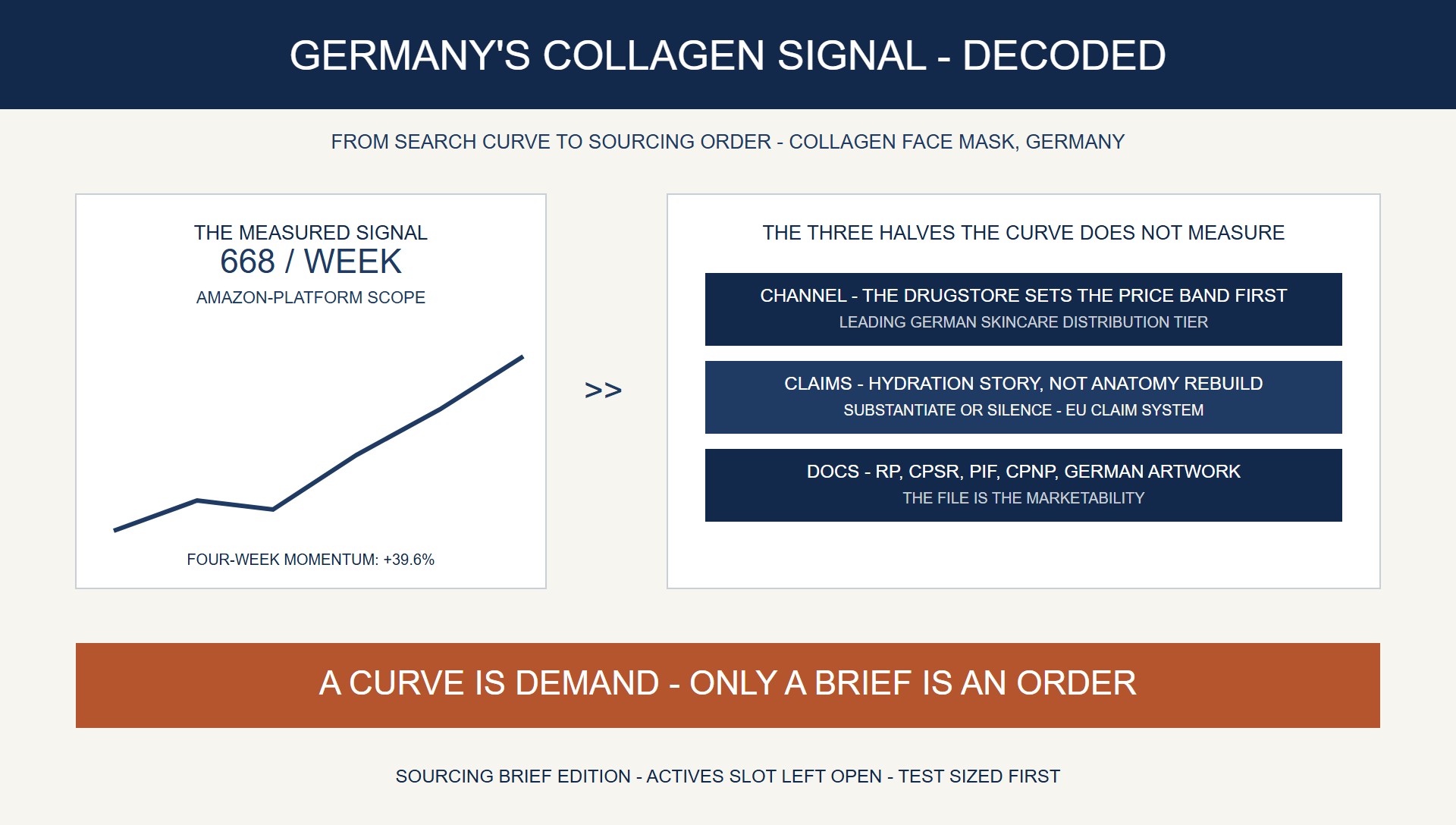
The third reading is the one that survives contact with a purchasing decision. What the row supports is a publishing judgement: there is an unanswered question set here, and a specification-grade answer costs one article. It supports no stocking judgement at all. The signal that should change how many units you commit to is order-level - a second enquiry from a different region, a retailer asking for the botanical on a line sheet, a buyer repeating a trial order - and none of those are visible in a keyword export. This is the same discipline applied to a single-market demand curve in the German collagen signal piece, where a small-base platform trend was treated as a trigger for test orders rather than a basis for a programme. A rising index on a low-competition term is exactly that shape of evidence: enough to write, not enough to warehouse.
A trend index licenses content. It never licenses inventory.
One further honesty note belongs in this section, because it is the reason it exists. Across the whole piece there are no market-size figures, no growth forecasts and no share numbers. That is not because the coastal botanical market has no such figures - published estimates of that kind are easy to find and routinely disagree with one another by a factor of several, since each firm defines the segment differently. It is because none cleared the standard applied here, which is that a number appears only with its publisher, its date and the boundary of what it measures, and a range that wide is a description of the analysts, not of the market. Where a decision needs a market figure, take one from your own channel: purchase orders, repeat rate and what retailers actually request.
Six Ways This Purchase Fails, and the Written Ask That Blocks Each
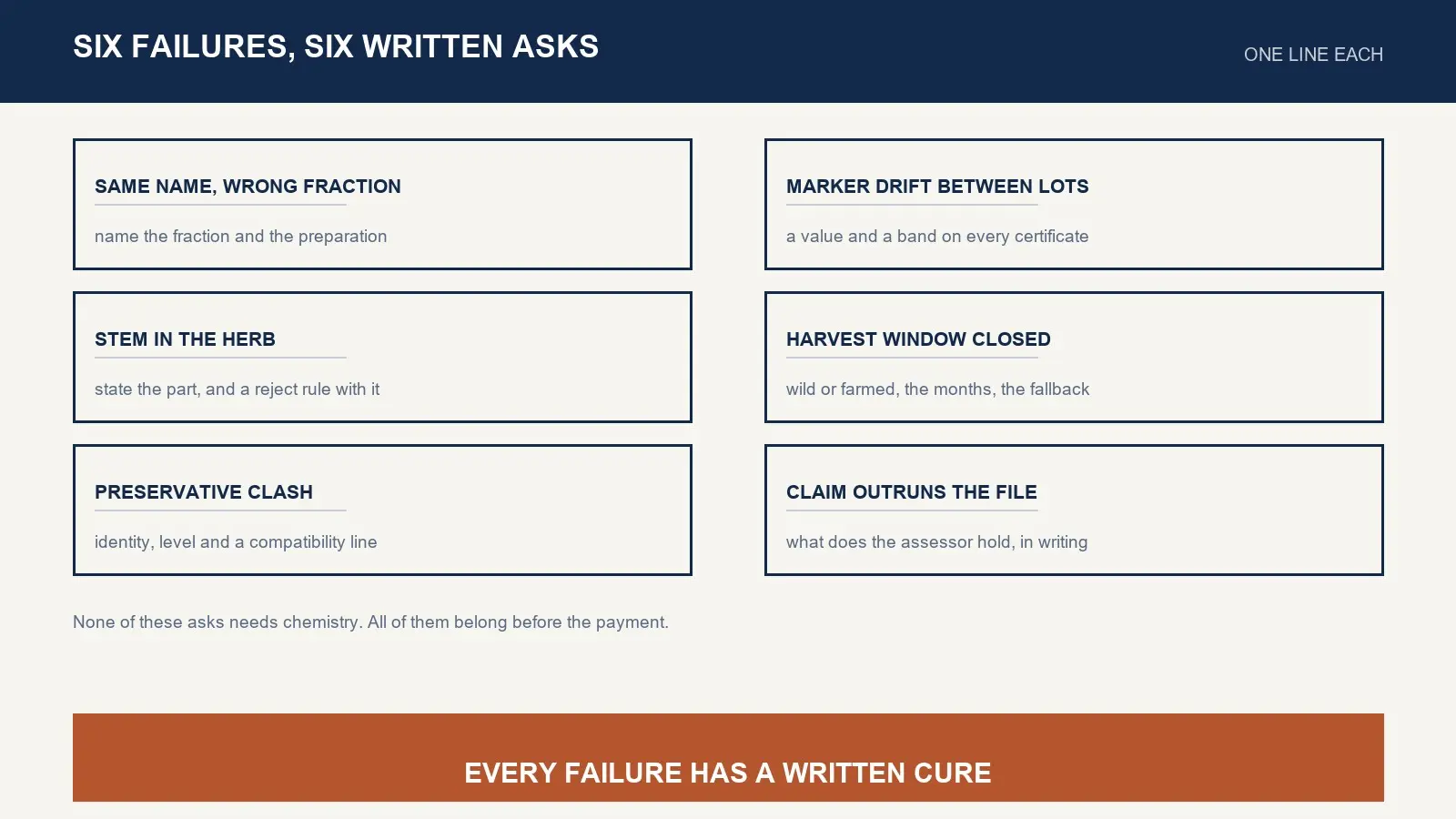
Every failure below is a document problem wearing a product problem's clothes. Each has a corresponding one-line requirement, and all six lines fit in the email you are already writing to ask for a price.
| How it fails | What it looks like before you notice | The written ask that blocks it |
|---|---|---|
| Same name, different fraction | The reformulated batch smells, colours and pours differently while the label line is unchanged | Name the fraction and the preparation on the certificate, not just the species |
| Marker drift between lots | Your substantiation quietly stops describing the material you are now using | A marker value with a unit on every lot, against an acceptance band you set |
| Stem in the herb | Cost per kilogram looks fine; dose per gram does not | Part designation on the certificate, with a stated non-conformance rule |
| Harvest window closes mid-order | A backorder arrives in month nine of a launch year | Cultivated or collected, the months, and the rule if the window closes |
| Preservative incompatibility | Precipitate in the base, or a challenge test that fails on a formula you did not change | The preservative in the supplied material: identity, level, and compatibility statement |
| Story outruns the file | A natural or coastal claim that nobody can point to paperwork for | Ask what the safety assessor holds on this material, in writing, before the claim is drafted |
The last row deserves a sentence more, because it is the one that converts a sourcing specification into a legal exposure. The green and environmental claim regime in the European Union moved from advice to obligation in late September 2026, and this site worked through what that means for a word like "natural" in the ECGT piece; what happens when a performance sentence exceeds its testing is a separate article on this site entirely, the liability case study. Neither argument is re-opened here. What is new in this piece is only this: for a botanical, the claim's weakest link is usually not the marketing department's verb but the raw-material file nobody asked about, because an origin story can be written from a photograph while a substantiated composition can only be copied from a certificate.
The six asks share one property worth noticing: none of them require a buyer to know chemistry. They require you to ask for a word, a number and a document, in writing, before money moves. A supplier with a real document set answers them in a day and is often relieved to be asked, because it means somebody will pay for what they already produce. A supplier without one will negotiate the vocabulary instead of the specification - and that negotiation is itself the answer.
FAQ - Six Questions Buyers Ask Before Committing to a Coastal Botanical
Q1. Is this a marine ingredient or a plant ingredient, and does the distinction change anything on my label? It is a plant - a salt-tolerant coastal crop in the Apiaceae family, studied as a food plant and, in recent literature, as a crop. The distinction changes your question set rather than your label wording: marine animal inputs raise species and by-product questions, seaweed substrates raise material questions, and a coastal crop raises agronomy and processing questions. Your label line is decided by which material you bought, so settle the material first. And if the real question is whether this belongs in your range at all next to better-known actives, the buying-side comparison of ingredient families is on this site at the efficacy ingredient sourcing guide.
Q2. If I can only enforce one of the five fields, which one should it be? The preparation and fraction, with a marker value attached. It is the field with the clearest measured consequence in this literature - two water-based preparations of the same plant differed about 1.9 times in the marker compound - and it is the one that determines what else you can even measure. Part and geography explain why a marker drifts; ratio scales it; preservation keeps it safe. Fraction and marker are what you reject a lot against.
Q3. What can we legitimately say about antioxidant activity? Print what you can substantiate for your formula, not what a study did to an extract in a cuvette. The published work here is laboratory assay work, and the cosmetic-adjacent phrasing convention this site uses throughout is appearance and condition language rather than protection language. Note also that the surrounding sentence matters as much as the activity claim: environmental and natural positioning now carries its own substantiation duty in the EU, which is a separate file from the ingredient's efficacy data.
Q4. Wild-harvested supply sounds better in our marketing. Is it a problem for a launch schedule? It is a problem for any schedule, and a manageable one if you name it early. Wild collection is constrained by season, weather and access, so supply arrives as a curve with a peak; cultivated supply - which exists for this species and is studied as such - arrives as a calendar. Neither is unethical and neither is inherently superior. What kills launches is a deck describing hand-gathered cliffs while the actual procurement is agricultural, or the reverse, because the two fail at different times of year.
Q5. Which documents should we require before paying for a trial batch? A certificate of analysis for the specific lot carrying the part, the fraction and preparation, the declared ratio, the marker value with units, and microbial limits with the method named; a botanical declaration repeating the part and the region; a preservative statement for the supplied material; and the shelf-life basis. Ask that the trial sample and its certificate come from the same lot. That last request is the quickest way to learn whether certificates are real or reconstructed.
Q6. How do we make shipment two behave like shipment one? By re-ordering against a number rather than a name. Set an acceptance band on the marker, retain a sample from the accepted lot, and write the clause so that re-orders are verified against that band and the retained reference instead of the original sample you approved months earlier. Suppliers who already issue per-lot certificates usually accept this without argument, because it protects them too when a customer complains about a batch they did not make.
Sources and Further Reading
Primary literature, cited by journal, year and record number. Article titles are deliberately shortened here because several of them repeat the ingredient's common and Latin names, and a copied title would double-count phrases this piece budgets for; every record remains identifiable by its PMID or DOI.
- Antioxidants (Basel), 2023, PMID 36829810 - the study behind most of this piece: aqueous extract preparation by infusion and by decoction, HPLC-PDA phenolic profile with chlorogenic acid as the major compound, fibre and mineral content of the plant, antioxidant assay values (DPPH and ABTS), essential-oil composition, antibacterial activity against two food-contaminating bacteria, and the authors' conclusion supporting use as a potential alternative preservative ingredient including for cosmetic industries. Every numeric figure quoted in this article comes from this single record, and the ratio between the two marker values is this article's arithmetic on them. - Plants (Basel), 2024, 13(14):2003, PMID 39065529 - essential-oil content, composition and free-radical-scavenging activity measured separately by plant part in wild material from Montenegro. - Food Chem X, 2024, 22:101386, PMID 38681233 - comprehensive phytochemical characterisation across multiple Croatian populations. - Foods, 2024, 13(5):695, PMID 38472808 - volatile profiles of French and Croatian ecotypes, and the activity of both the essential oils and the hydrolates. - Foods, 2024, 13(9):1294, PMID 38731664 - biological activities and bioactive phenolics from the non-volatile fraction. - Plants (Basel), 2023, 12(1):214, PMID 36616340 - essential-oil profiling together with the residual waste-waters of isolation, the record that keeps the by-product question visible. - Plants (Basel), 2018, 7(4):92, PMID 30373262 - review of the species' prospects as an emerging vegetable crop. - Molecules, 2023, 28(12):4741, PMID 37375298 - review positioning it as an emerging crop for innovative foods and nutraceuticals. - Agronomy, 2022, 12:926, DOI 10.3390/agronomy12040926 - biomass production under Mediterranean conditions; the evidence that cultivated supply is a real option. - Keyword metrics - a third-party keyword-set export of 243 terms commissioned by this site. The local archive holds a fifty-row derived extract dated 2026-09-28; the original workbook is not archived locally, so no collection date is claimed, and the fields are platform-caliber rather than Google search volume. - On this site - the component-architecture and category-anchor precedents, the marine and seaweed sourcing pieces this article deliberately does not repeat, the request-for-quotation field guide, the stability-programme guide, the EU compliance and four-market registration maps, the green-claims and claim-liability pieces, and the small-batch and factory-audit guides, each linked at the point where it carries the argument.
What was not used: any market size, growth rate or share figure; any therapeutic or protective language; any supplier, factory or retail brand name; any price. The 2023 study's own description of traditional medicinal use is deliberately not quoted, because a sentence about ailments cannot be carried into a cosmetic claim without becoming somebody's regulatory problem.
What to do next
Send the five fields with your target use level and ask for the price against them, not beside them.
If you are specifying this botanical into a serum, essence, cream or mask programme, put the part, the region and season, the fraction and preparation, the declared ratio with a marker value, and the preservation statement in writing, then request the quotation and the MOQ table on that basis. Where the answer is a stock standard, you will get a specification sheet back rather than a name; where the answer is a schedule problem, you will get the harvest window and the minimum with it, which is a usable answer even when it is not the one you wanted.
A dedicated product manager handles every component-level enquiry of this kind, with a reply within 24 hours, a standard sample route in 7 days, and MOQ from 1,000 pcs depending on format and packaging. Request your quote and MOQ table here - and attach the five lines, because the difference between the two quotes you get back will be written in them.