

News
Salmon DNA Skincare Benefits: Sourcing and Claims Guide for Brands
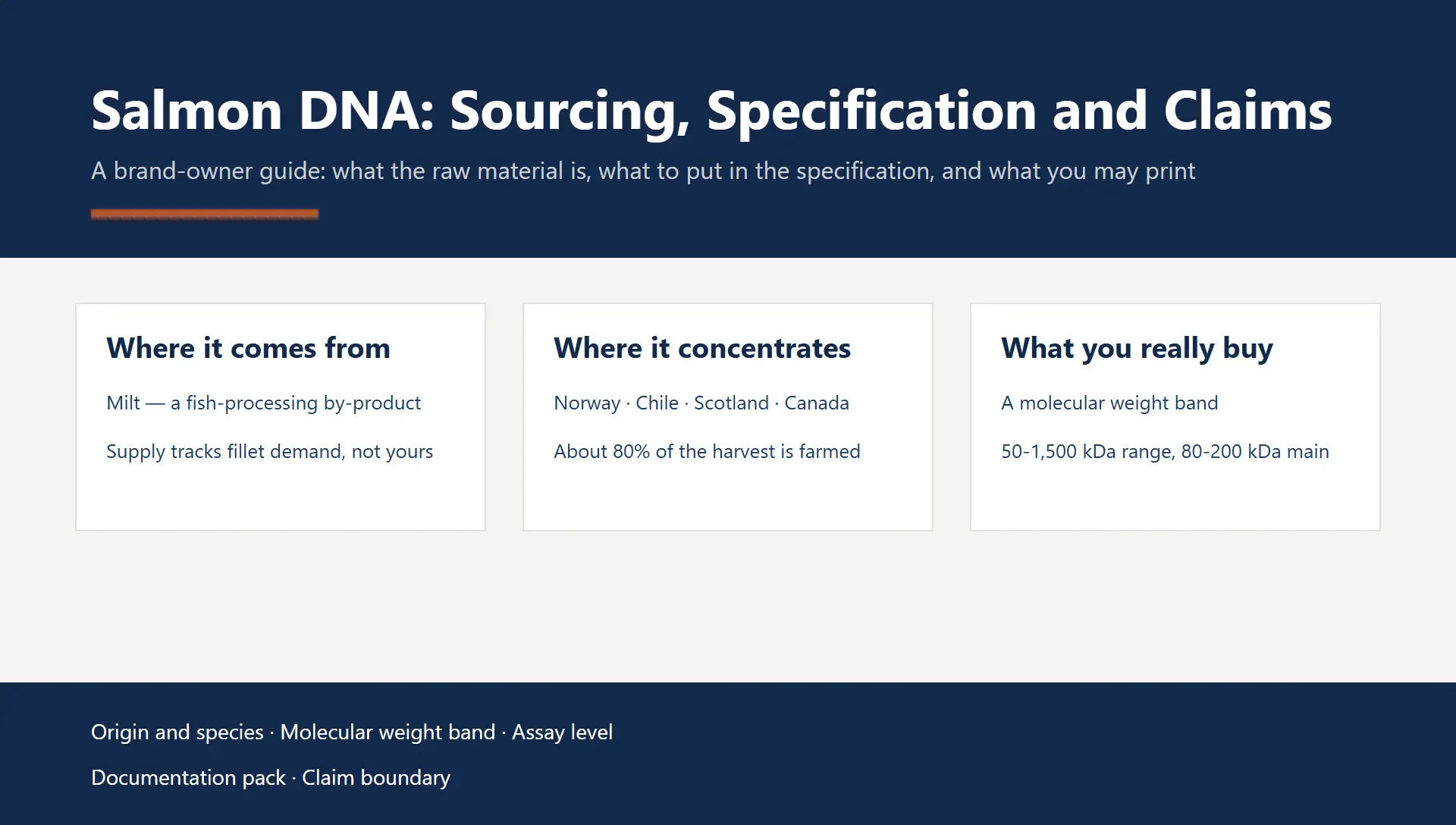
This is not a beauty contest, it is a sourcing file. Salmon DNA arrives as a milt-derived DNA fragment sold under a stated molecular weight band and assay level, and everything that decides your margin sits in the specification sheet and the document pack rather than on the front of the box. Here is what to demand, what each layer of cost actually attaches to, and the sentences you can lawfully print on the pack.
PDRN vs Collagen vs Hyaluronic Acid: Ingredient Comparison for Brands
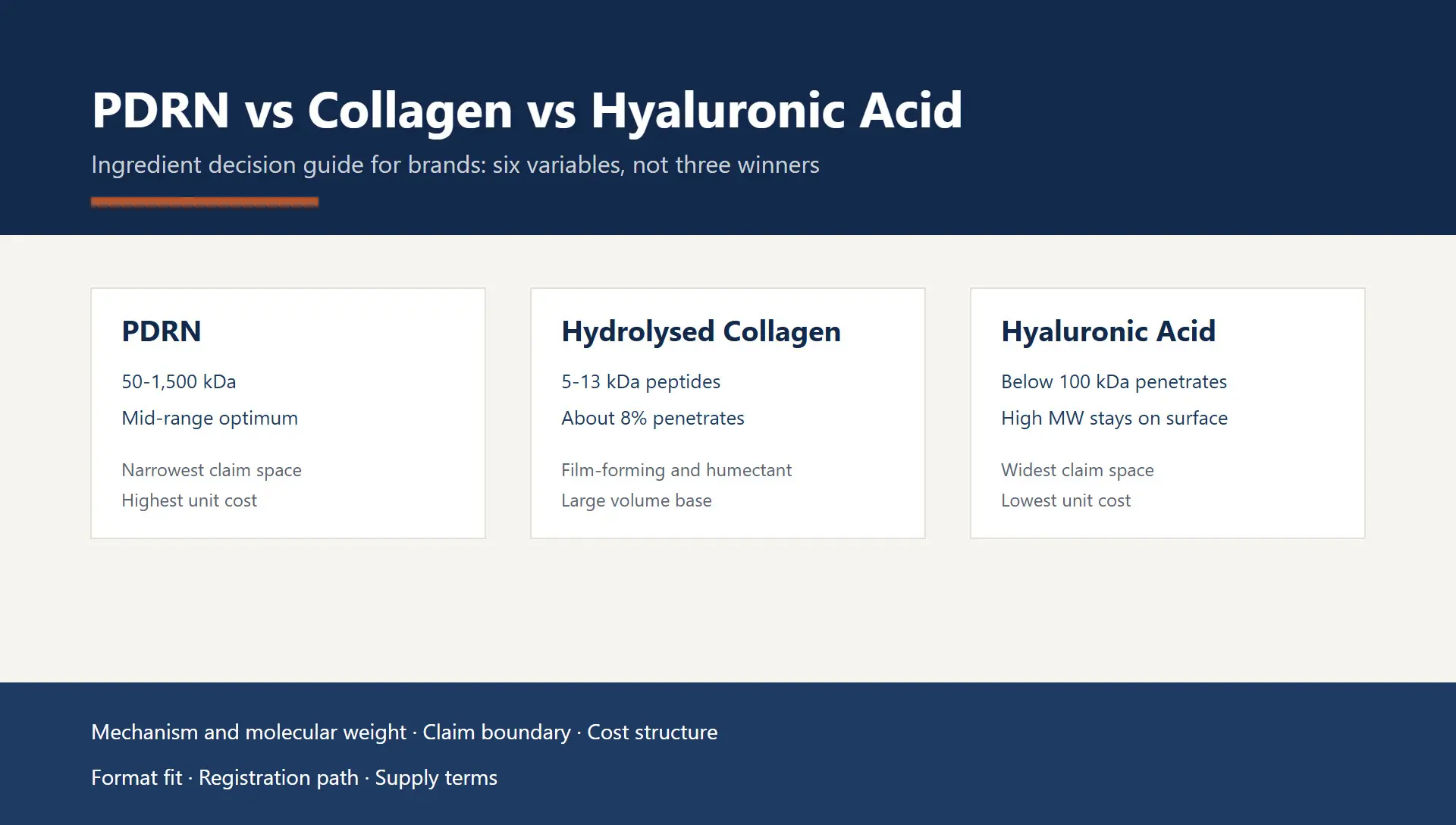
Three actives sit on most new SKU briefs this season, and the brief is usually written as a beauty contest. It should be a sourcing decision. This guide compares PDRN, collagen and hyaluronic acid on the six variables that actually decide a launch — mechanism and molecular weight, claim boundary, cost structure, format fit, registration path and supply terms — and hands you a scoring matrix you can run before you pay for a sample.
What Is PDRN Skincare? A Brand Owner's Guide
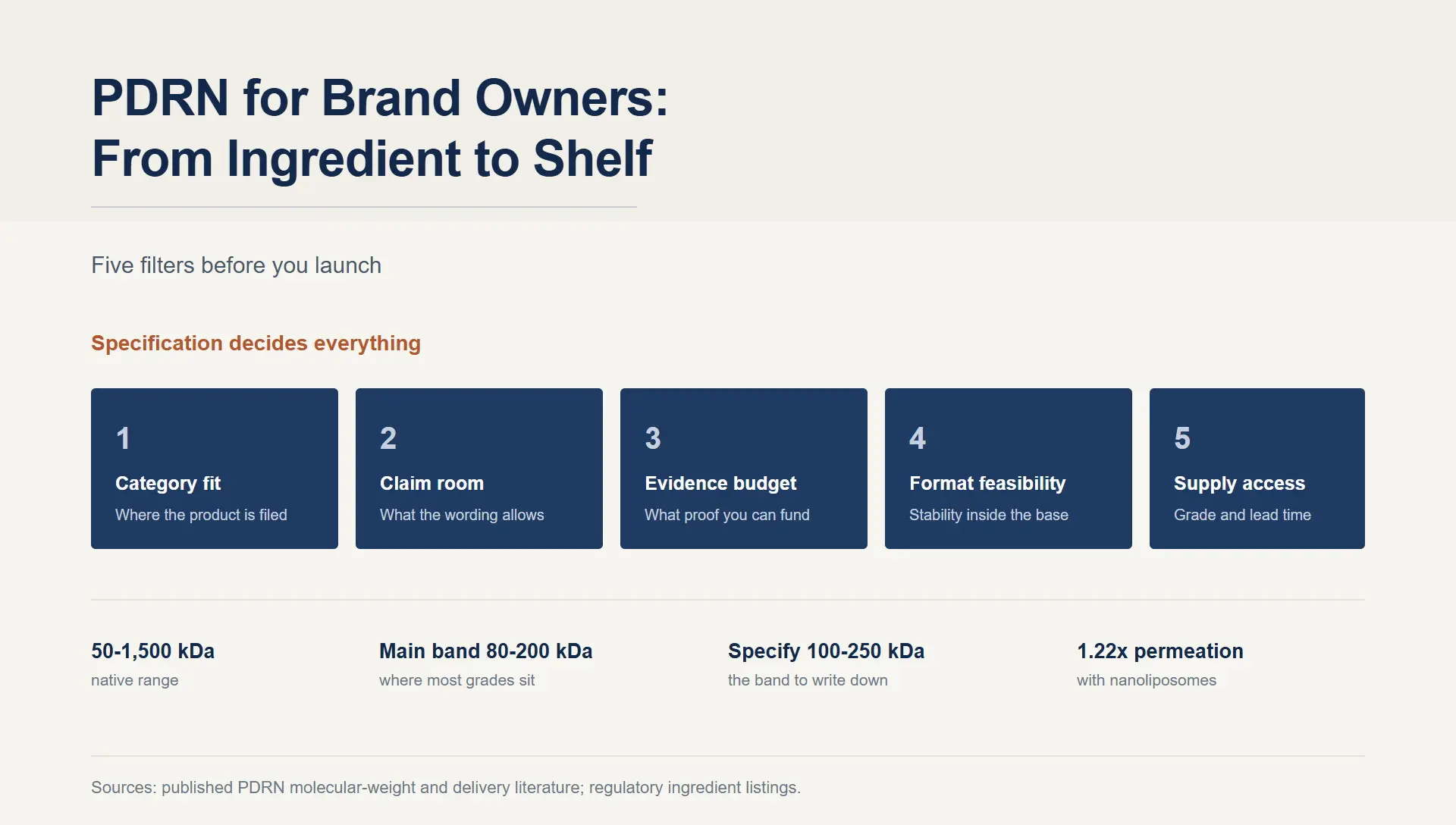
PDRN has moved from a clinic injectable to a shelf keyword. But for a brand owner the real question is not whether it works — it is which molecular weight you are buying, at what use level, in which format, and which sentence you can legally print. This guide breaks the PDRN sourcing decision into specs you can check, a cost structure you can negotiate, and claim boundaries you can defend.
Scalp Aging Is Skincare's Next Frontier — and Its Trickiest Claims
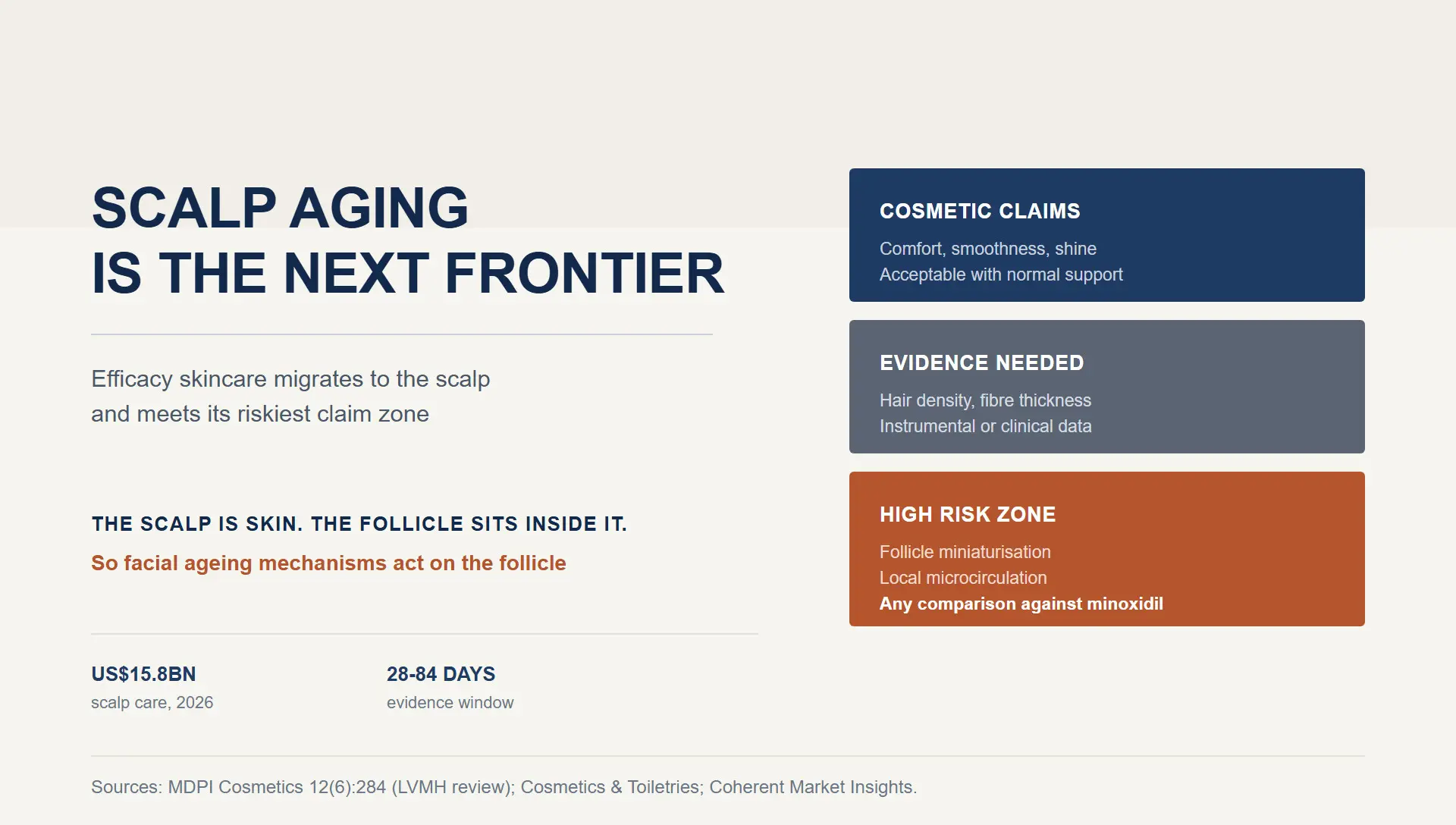
The scalp is becoming skincare's new battleground. A review published in Cosmetics by LVMH researchers found that reduced scalp skin thickness, altered microbiome diversity and lower sebum production together drive greying, thinning and fragility - scalp health is not a supporting factor but the foundation. On the ingredient side, quantified results already exist (a postbiotic at 0.2% improved hair-loss and density measures at 28, 56 and 84 days), and the scalp care market is roughly US$15.8 billion in 2026 growing at 7.3%. But for buyers this is also the most dangerous claim space: any language comparing a cosmetic to a drug such as minoxidil risks turning the product into an unapproved medicine.
Dermocosmetics Land Grab: Clinical Proof Is Now the Valuation Anchor
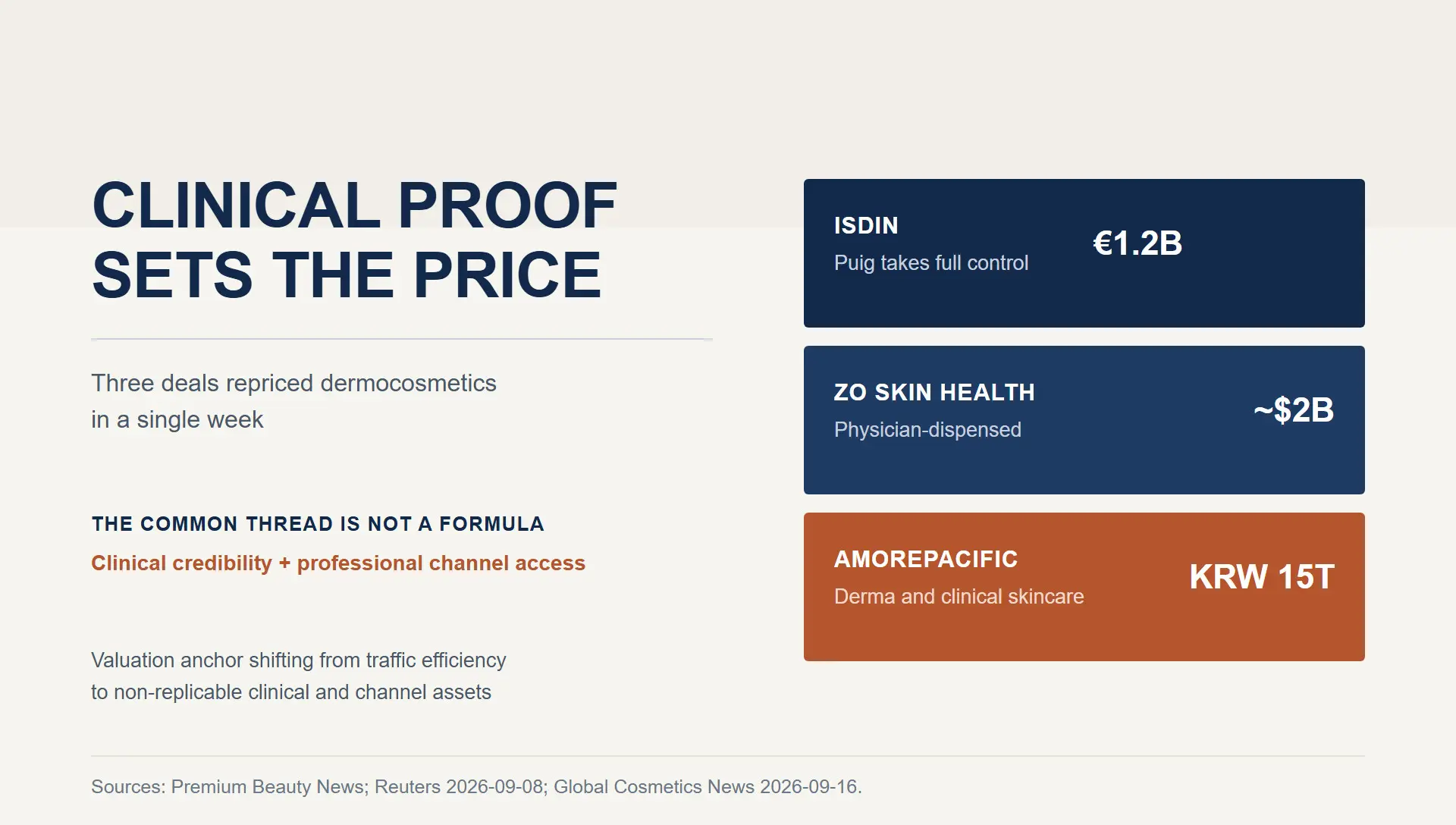
Within one week, three deals repriced dermocosmetics: Puig paid EUR 1.2 billion for full control of ISDIN, Blackstone is exploring an approximately US$2 billion sale of physician-dispensed ZO Skin Health, and Amorepacific named derma beauty and clinical skincare as a 2035 growth pillar; Caudalie's stated rationale for buying Talm was to leverage its pharmacy network. What these deals share is not a formula but clinical credibility and professional channel access. For brand owners and OEM buyers, that shifts clinical evidence from a cost line to an asset line - and who owns the evidence decides whether your brand can be valued at all.
When Free Trade Stops Protecting Beauty: The 50% US-Canada Tariff
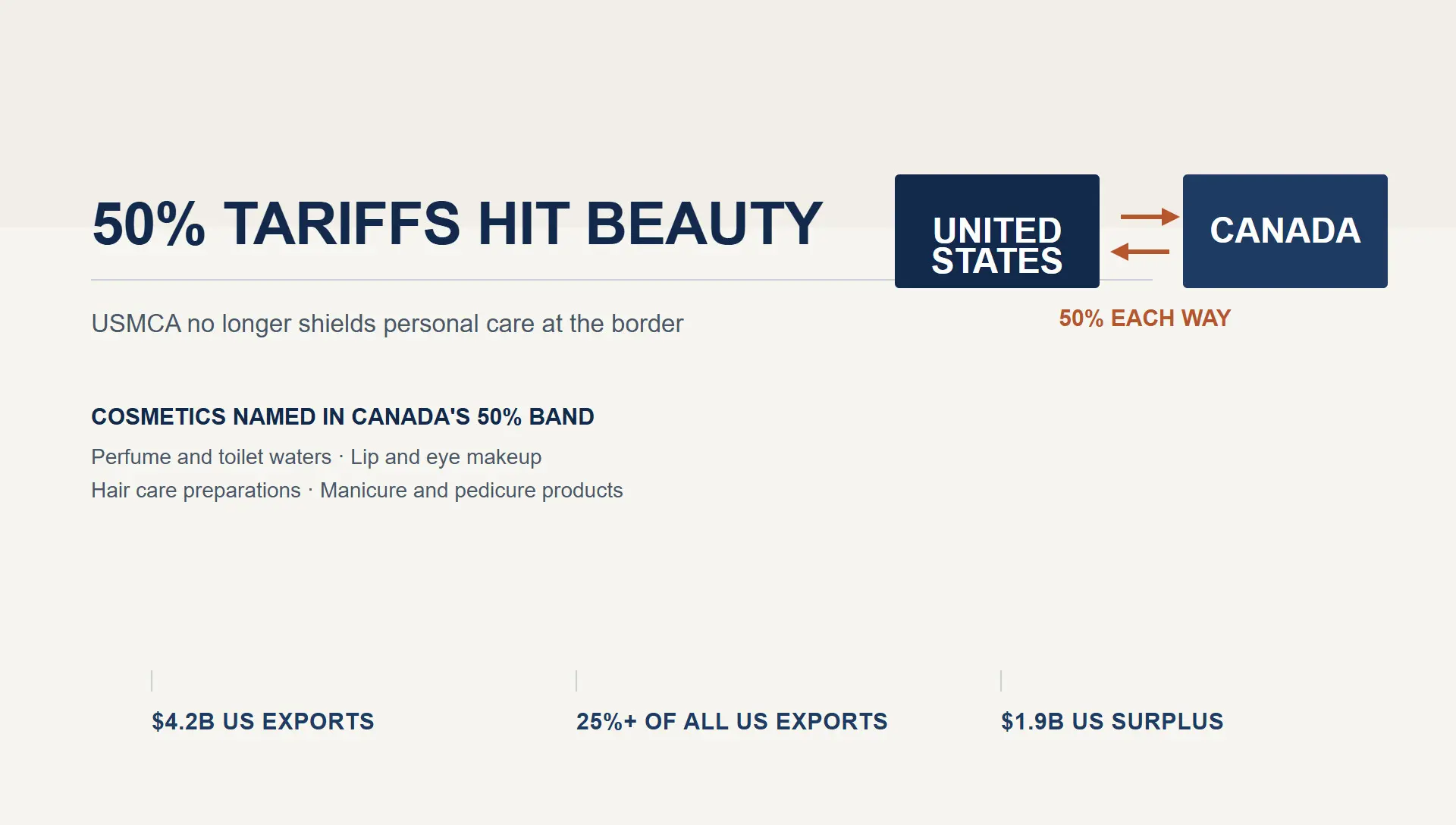
The US and Canada have hit each other with tariffs of up to 50%, directly naming perfumes and toilet waters, lip and eye makeup, hair care preparations and nail products. The change is not just the rate - this is the first time USMCA has failed to shield personal care goods from duties, which breaks the long-held assumption that origin compliance equals duty-free. This article unpacks the tariff list and effective dates, who actually absorbs the cost, the overlooked bilingual-labelling threshold, and gives buyers an actionable landed-cost reset checklist.
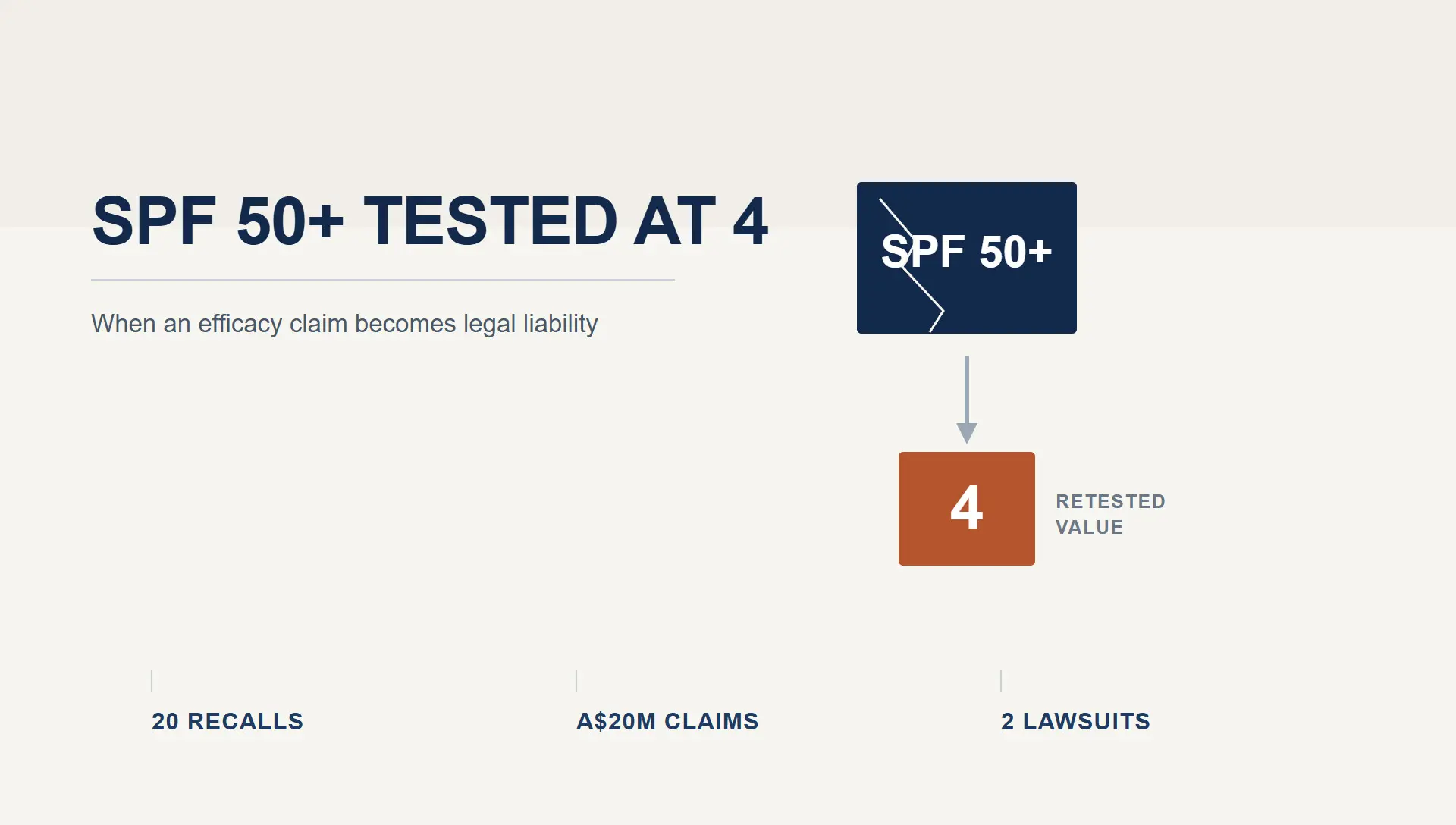
SPF 50+ Tested at 4: When Efficacy Claims Become Legal Liability
One base formula, shared by 20 sunscreen products labelled SPF 50+, was retested as low as SPF 4. What followed: 20 recalls, the manufacturer's liquidation, and multi-million-dollar lawsuits filed by the brands. Efficacy claims have just been exposed as a legal-liability problem - and where that liability sits, between brand, manufacturer and testing lab, is now being contested in court. Here is the chain of liability, with an executable substantiation checklist and contract clauses for buyers.
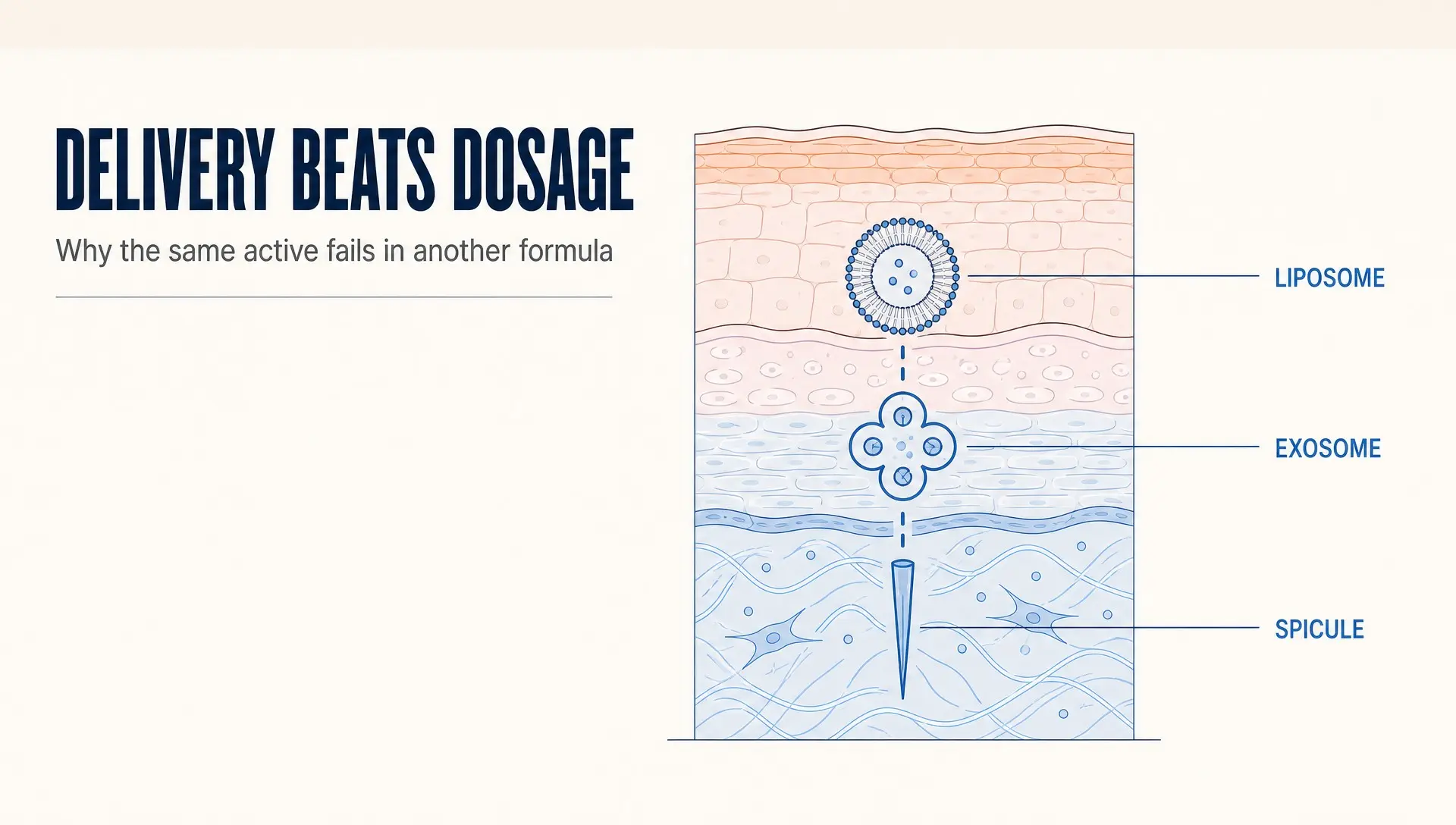
Delivery Beats Dosage: Why the Same Active Fails in Another Formula
In September 2026 three moves pointed at the same thing: Core Biogenesis extended its growth-factor delivery platform (Oleosome-EGF) from cream into eye shadow, ALPOL Cosmétique invested in an in-vitro SPF screening system to de-risk formulation validation, and Cosmetics & Toiletries published a cluster of delivery-related launches on 10-11 September. More telling is the quantified evidence: Amorepacific reports retinol embedded in spicules lifts absorption 46% while cutting irritation 80%. The delivery-systems market stands at US$3.4B in 2026 and reaches US$6.5B by 2033 (9.6% CAGR). Efficacy's bottleneck has shifted from "what you add" to "does it arrive".
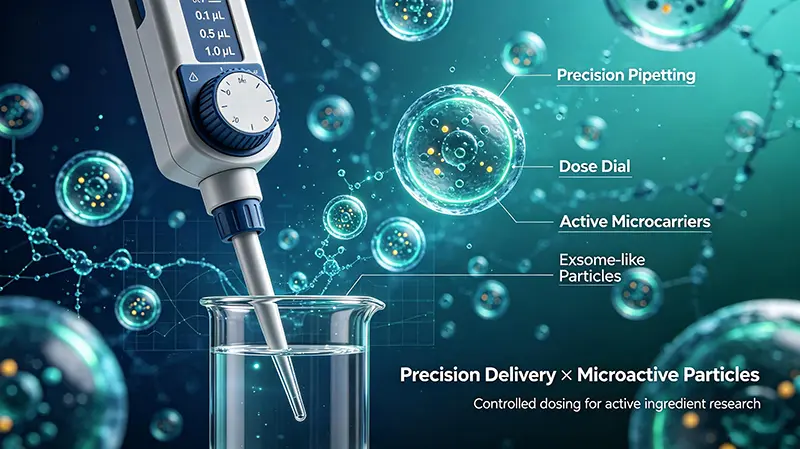
When "Contains" Is No Longer Enough: Efficacy Skincare Moves Into the Dose-Response Era
In September 2026, French active-ingredient supplier Seppic published standardised quantification for its Celtosome platform: at 0.05% dosage its anti-ageing active delivers 720 million exosomes per gram of formula, with up to +34% collagen I synthesis, +103% dermal hyaluronic acid and a 12% reduction in crow's feet area over 28 days; its radiance active delivers 1.44 billion per gram at 0.1%. Efficacy is shifting from "which ingredient" to "how many active units, at what dose" — your price comparisons, formulation briefs and claim evidence all need upgrading.
When Giants Start Co-Developing with Factories: Efficacy Skincare Is Changing Lanes
On September 10, 2026, L'Oréal and Korean cosmetics ODM giant Cosmax signed an MOU to co-develop next-generation beauty products, ingredients and sensory innovations across three areas: K-beauty-inspired products for international markets, new cosmetic raw materials and active ingredients, and new sensory signatures and formats influenced by Korean beauty. Meanwhile Yatsen's Q2 skincare revenue grew 40.4% while colour cosmetics fell 35.8% — efficacy-led skincare is absorbing other categories. When giants plug R&D capability directly into factories, the entry ticket to efficacy competition shifts from "can you source good ingredients" to "can you co-develop with your factory".